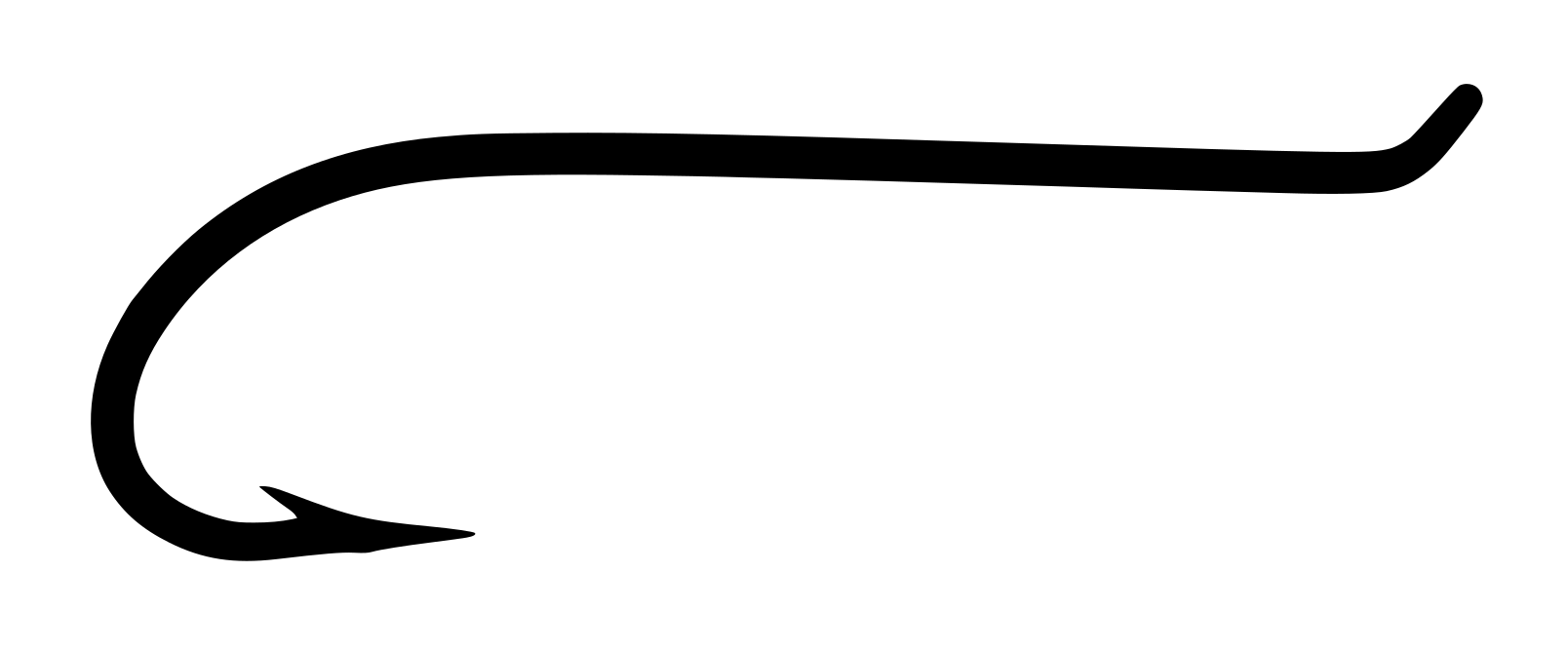
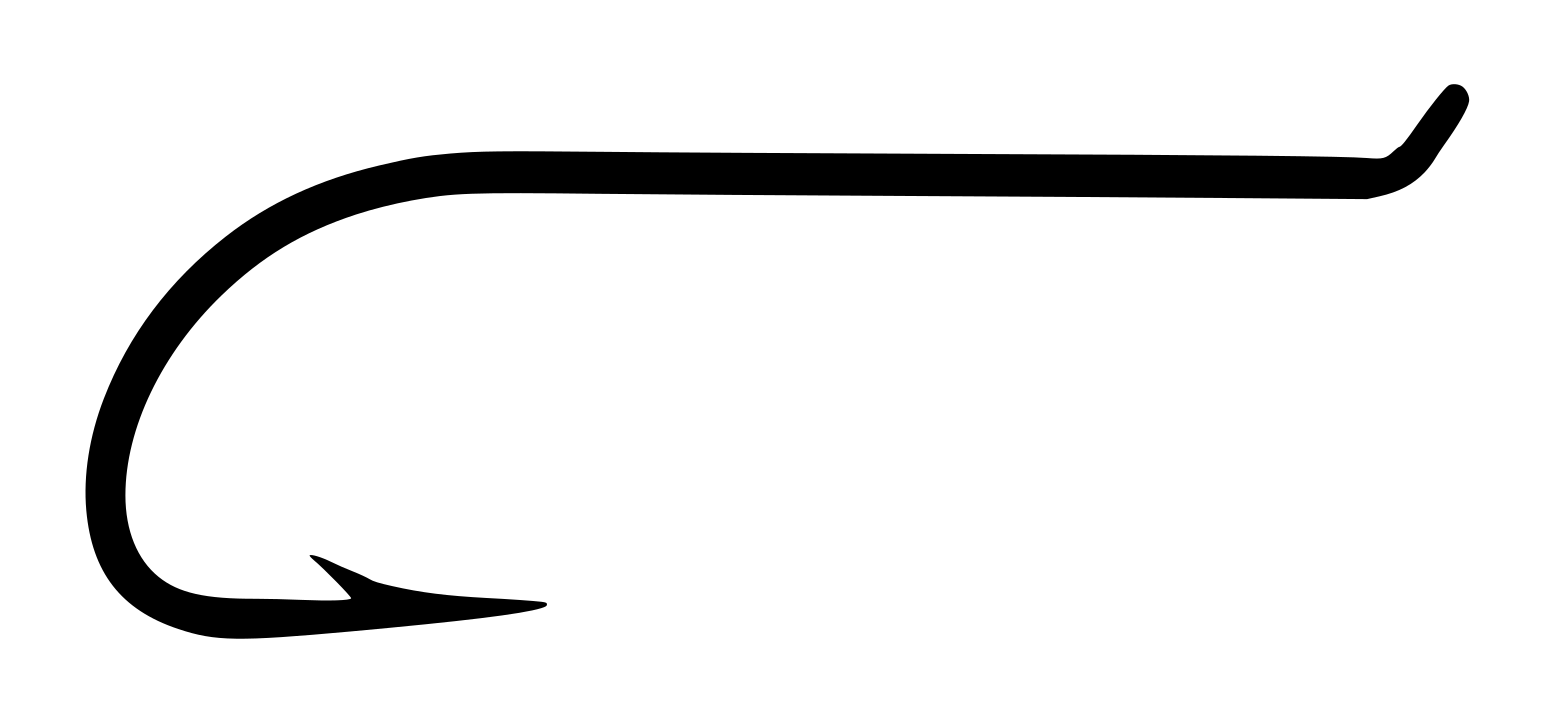
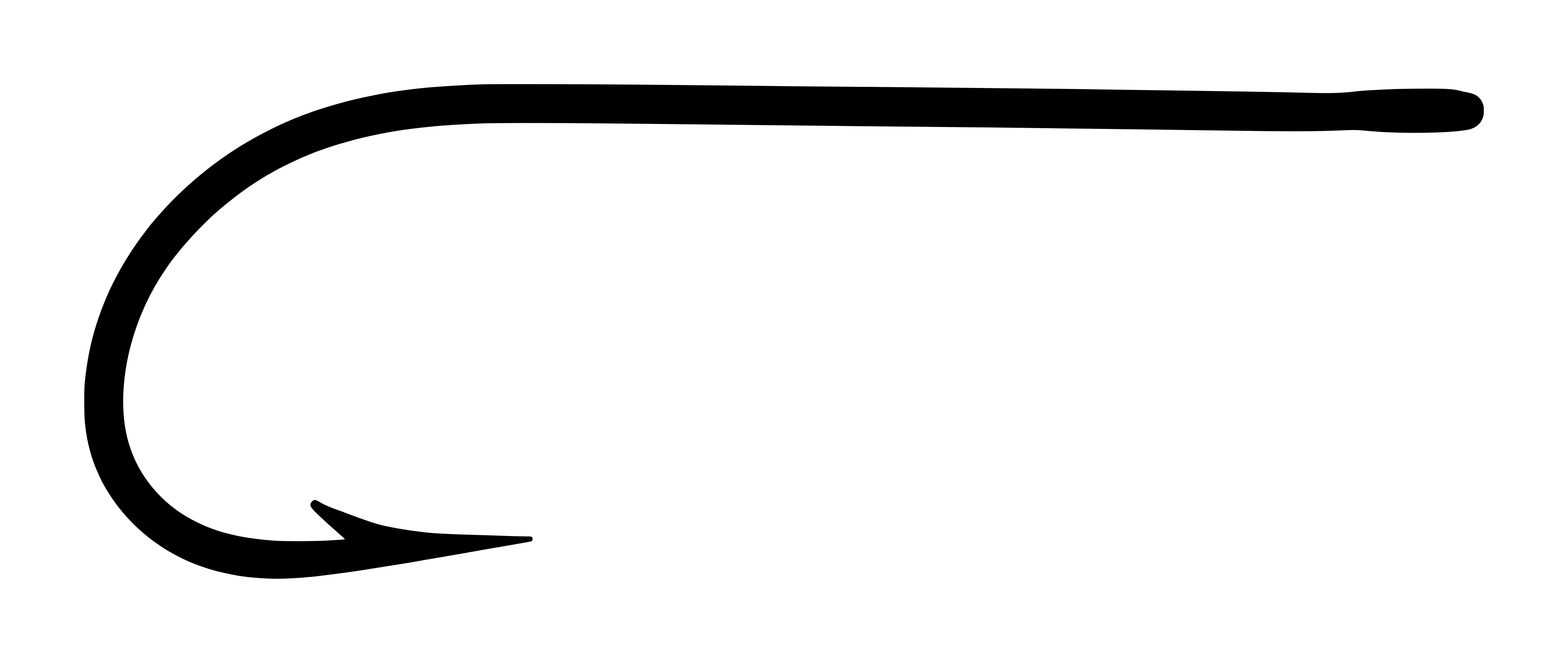
The Mustad 9049 is a premium Atlantic Salmon and Steelhead fly hook manufactured by O. Mustad & Søn in Gjøvik, Norway, during the mid-20th century (c. 1950s–1960s). This is a heavy-gauge, forged-wire Limerick bend with a distinctive turned-up looped eye, black japanned finish, and extra-long shank ideal for classic hairwing salmon flies and streamer patterns.
The 9049 exemplifies a high point in vintage fly hook engineering, combining traditional Limerick geometry—with its characteristic angular shoulder that locks the jaw securely—with mechanized manufacturing precision. The turned-up looped eye, a luxury carryover from gut-eyed era, distributes stress evenly and prevents eye opening under the violent runs of large migratory fish. Black japanning provides exceptional corrosion resistance in freshwater, making this hook the choice of serious Atlantic Salmon and Steelhead anglers worldwide.
Packaging evidence (Oslo–Norway mark, slide-box cardboard format, Key Brand logo typography) places this hook in the firm’s mid-20th century commercial export peak, when Mustad controlled approximately 50% of global hook production. The presence of the traditional arbitrary quality code (9049) on the classic eight-line label confirms this as genuine vintage stock, predating Mustad’s transition to the modern Signature Series numbering system in the early 2000s.
Collectors value the 9049 for its functional elegance, robust construction, and role in establishing the classical Atlantic Salmon fly tradition. Size 6 examples remain moderately available; smaller and larger sizes are more challenging to locate. Complete original packaging significantly enhances collectibility.
Close-up detail of the Mustad 9049 hollow point and barb, showing the concave inner face geometry and swept barb characteristic of this salmon fly hook design. Jet-black japanned finish visible with minor age patina.
Photographic record
10 cataloged imagesSelect any record to load it above.
8 images shown
Mustad 9049 Size 6 Point Detail JapannedClose-up detail of the Mustad 9049 hollow point and barb, showing the concave inner face geometry and swept barb characteristic of this salmon fly hook design. Jet-black japanned finish visible with minor age patina.Open originalMustad 9049 Size 6 Full Hook Profile Looped EyeFull side profile of the Mustad 9049 size 6 salmon hook, clearly showing the distinctive turned-up looped eye, extra-long shank, and sharp angular Limerick bend base. Jet-black japanned finish throughout.Open originalMustad 9049 Size 6 Specimen Label HandwrittenTwo Mustad 9049 size 6 salmon hooks displayed alongside handwritten specimen identification label. Label shows model code (9049) and size annotation (No. 2) in period-correct pencil handwriting. This represents typical retail stock marking from the 1950s–1960s distribution period.Open originalMustad 9049 Size 6 Original Box and LabelOriginal Mustad 9049 cardboard slide-box with cream-colored printed label. Shows Key Brand logo (downward-pointing skeleton key), eight-line typographic label format, green-tone printed text, decorative snowflake border pattern, and 'Made in Norway' notation. Light browning and age-patina consistent with 60+ year vintage storage.Open originalMustad 9049 Size 6 Point Geometry DetailExtreme close-up detail photograph of the Mustad 9049 hollow point, showing the characteristic dished-out concave inner face profile, fine sharp tip, and swept backward barb. Jet-black japanned finish exhibits uniform color with minimal wear.Open originalMustad 9049 Size 6 Looped Eye ProfileFull side profile of the Mustad 9049 size 6 hook emphasizing the premium turned-up looped eye construction, the classical sharp-angled Limerick bend at the base, and the proportionally extra-long shank. Jet-black japanned finish is uniform throughout the specimen.Open originalMustad 9049 Size 6 Pair Profile ComparisonTwo Mustad 9049 size 6 salmon hooks photographed together in profile, demonstrating consistent manufacturing and the proportional relationship between shank length, gap width, and bend depth. Both hooks exhibit identical jet-black japanned finish and geometry.Open originalMustad 9049 — Limerick hooks sales card detailSix japanned Mustad 9049 limerick hooks mounted on original sales card with sequential numbering. Hooks display extra-heavy wire gauge and straight eye configuration typical of mid-century salmon and streamer patterns.Open originalMustad 9049 — Original sales card size rangeComplete Mustad 9049 sales card displaying size range from 1/0 through 12 in japanned finish. Card identifies hooks as Mustad-Dublin Limerick Hooks, forged, with tunisian-up looped eye and extra-long shank in fine wire. Manufactured in Norway, 100-hook package.Open originalMustad 9049 — Product label specificationsProduct label for Mustad 9049 Limerick Hooks detailing specifications in gold type: Qual. 9049, hollow point, Mustad-Dublin Limerick Hooks, forged, tunisian-up looped eye, black finish, extra-long shank, fine wire, made in Norway. Decorative border pattern visible.Open original
Technical profile
Eye
Looped Eye, Turned UpTurned-up looped eye (T. up. looped eye) is a premium feature characteristic of classical Atlantic Salmon fly hook design. Wire is looped back along the shank rather than forming a simple ring, creating a smooth, snag-free connection point. This design distributes stress evenly across both sides of the loop, preventing eye opening under heavy pressure. P
Wire
Fine (1X Fine), Forged
Shank
2X Long — Plain
Bend
Limerick, Narrow gapClassic Limerick bend characterized by a distinct angular shoulder at the base of the curve, rather than a smooth continuous arc. This sharp angle serves a critical biomechanical function: it locks the fish's jaw into the deepest, strongest point of the hook, preventing sliding or tearing during violent head-shakes. Typical of Irish-origin salmon fly patterns. P
Point
Hollow Point (concave inner face)Barb is moderately sized, swept backward at approximately 45° angle from the point taper. Placement is clean and well-centered. Barb cut is consistent and uniform, indicative of precision mechanized manufacture. P
Finish
Black Japanned — Confirmed (stated on packaging)Black japanned finish — a baked-on alkyd resin lacquer typical of premium salmon hooks. Color is deep jet-black with minimal wear patterns on this specimen. Finish exhibits excellent adhesion with no flaking or crazing visible. This finish was the industry standard for Atlantic Salmon irons for over a century due to superior corrosion resistance in freshwater environments and an aesthetic that photographers and collectors value. P
Specimen hooks show jet-black japanned finish with minor surface wear and patina consistent with 60+ year age. No corrosion or flaking evident. Original cardboard box shows light browning, minor creasing, and adhesive yellowing on label verso. Label remains fully legible with original colors intact.
The Hollow Point geometry on the 9049 reflects a sophisticated understanding of tissue penetration mechanics developed through decades of salmon angling field experience. The concave, dish-ed-out inner face creates an incredibly fine, razor-sharp tip that flares rapidly toward the barb, achieving initial penetration with minimal applied pressure—critical for soft-mouthed Atlantic Salmon and the friable tissue of sea-trout and anadromous species. Once the sharp tip penetrates past the barb, the point holds securely without creating an overly large entry wound that could tear open during sustained head-shakes and powerful runs.
Forging the wire dramatically increases structural rigidity and tensile strength without adding weight or bulk. The mechanical drop-press process work-hardens the steel, effectively preventing the hook from bending open or straightening under the extreme stresses of fighting heavy migratory fish. Extra-heavy wire gauge (approximately 0.03″ diameter) provides absolute confidence in rocky rivers and high-flow conditions typical of Atlantic Salmon and Steelhead habitat.
The turned-up looped eye distributes stress evenly across both sides of the loop, eliminating the risk of eye opening under the concentrated pressure of a fighting fish. This design addresses a critical failure mode of simpler ringed-eye constructions, where unidirectional stress could cause the eye to gradually open, reducing holding power.
We have measurements for sizes 2, 4, 8. Know any others? Submit calipered measurements and we'll review and add them. Thank you!
Historical context
mustad
O. Mustad & Søn was founded in 1832 in the remote village of Gjøvik, Norway, initially as ‘Brusveen Spiger- og Staltradfabrikk,’ specializing in nails, steel wire, and cast-iron goods. The company was rebranded by founder Hans Schikkelstad’s son-in-law, Ole Hovelsen Mustad, and his son, Hans Mustad, as O. Mustad & Søn. The defining industrial pivot occurred in 1877, when visionary Mathias Topp invented the first fully automated hook-making machine—raw steel wire continuously fed, autonomously cut, bent, barbed, and pointed at unprecedented speed and consistency.
Recognizing the immense competitive advantage, the Mustad family deliberately avoided patenting this revolutionary technology, instead relying on strict corporate secrecy, non-disclosure agreements, and restricted factory access to protect proprietary methods. This strategy proved devastatingly effective against rival hook-making centers in Redditch, England, and manufacturing hubs across Japan and the United States. By the 1950s, when the 9049 was in peak production, Mustad had secured approximately 50% of global hook production market share, establishing sales offices and manufacturing facilities across multiple continents.
Mustad’s industrial ascendancy fundamentally altered the trajectory of fishing tackle development, democratizing access to precision hooks and enabling the globalization of regional angling traditions. The Key Brand trademark—a downward-pointing skeleton key symbolizing the ‘key to angling success’—became virtually synonymous with the fishing hook itself across four continents.
Series History
The Mustad 9049 belongs to the classic Mustad-Limerick series, which traces its origins to the late 19th century when Mustad began systematically reverse-engineering regional European hook patterns for global export. The Limerick bend, originating in Ireland and perfected by regional blacksmiths, was identified as a premium salmon hook geometry and incorporated into Mustad’s catalog during their aggressive industrial cloning phase (1880s–1920s).
The 9049 specifically represents Mustad’s premium salmon fly variant, combining the traditional Limerick bend with the looped-up eye construction—a feature that originated in the gut-eyed era and was maintained as a premium feature for classical Atlantic Salmon tyers. The extra-long shank designation (3X length) and heavy forged wire emerged during the mid-20th century as Mustad expanded their salmon fly offerings to accommodate increasingly complex and innovative fly patterns developed by Scottish and Irish fly tyers.
The 9049 remained in continuous production from at least the 1950s through the early 2000s, when Mustad transitioned to the modern Signature Series numbering system. The black japanned finish was the standard throughout this period, reflecting the finish’s established superiority for freshwater salmon applications. Variants existed in different sizes (from 1/0 to 12) and occasionally in alternative finishes (though japanned black was the commercial standard).
The presence of the traditional arbitrary quality code (9049) on the classic eight-line paper label serves as the definitive hallmark of genuine vintage production, predating the corporate transition that rendered these historical codes obsolete. Modern Mustad Heritage Series reissues (such as the DL71U) explicitly honor the 9049’s design legacy.
Era and Packaging Dating
Packaging shows Oslo–Norway designation (established January 1, 1925, confirming post-1925 production). Cardboard slide-box format with decorative snowflake border pattern typical of mid-20th century. Key Brand logo typography with crown-topped key is characteristic of late post-war Mustad export packaging through mid-1960s. Handwritten size annotation (No. 6 in pencil) and printed specifications on label are consistent with 1950s–early 1960s vintage retail stock. No barcode visible, confirming pre-1974 manufacture.
The Legacy of the Looped Eye
The looped eye was originally a 'luxury' carryover from the days when silk-gut snoods were hand-lashed directly to hook shanks. Early fly tyers discovered that the looped-eye design—with its gentle curve and smooth terminus—prevented sharp wire ends from snagging delicate feather materials during tie-in. This premium feature became the hallmark of classical Atlantic Salmon fly hooks and remained standard on Mustad's premium models well into the second half of the 20th century. Traditionalists still prefer looped-eye designs today for the correct 'profile' and balance of classic hairwing patterns in the water.
Design lineage and influence
The Mustad 9049 is a direct descendant of Irish and Scottish regional salmon hook designs perfected during the 19th century by Redditch craftsmen and perfected through the early 20th century by Irish and Scottish regional anglers. The Limerick bend, originating in Ireland, was reverse-engineered and standardized by Mustad as part of their aggressive industrial cloning strategy beginning in the late 1800s. The 9049 represents Mustad’s premium interpretation of the classical looped-eye Limerick salmon hook, maintaining fidelity to the original regional design while leveraging industrial manufacturing efficiency.
The Mustad 9049 competed directly with Partridge of Redditch looped-eye Limerick hooks (Partridge CS10/1 Bartleet) and Allcock premium salmon irons throughout the mid-20th century. While Partridge maintained craft-tradition hand-finishing and Allcock offered regional variants, Mustad’s 9049 achieved global dominance through consistent quality, reliable availability, and aggressively competitive wholesale pricing to tackle dealers worldwide.
The 9049’s design remains influential in modern salmon and spey hook development. Contemporary looped-eye Limerick hooks—such as the Mustad Heritage Series DL71U (introduced to honor the historical design)—trace their lineage directly back to the 9049’s geometry and turned-up looped-eye construction.
Best matchRelated by Attribute
Computed automatically from catalog data — updated as new hooks are added.
Matches: Bend, Shank, Wire, Gap, Point +2 moreDiffers: Eye: Looped Eye vs Tapered Eye; Eye Orient.: Turned Up vs Turned Down; Finish: Black Japanned vs Bronzed +2 more
Matches: Bend, Shank, Wire, Eye, Forging +3 moreDiffers: Gap: Narrow vs Standard; Eye Orient.: Turned Up vs Turned Down; Point: Hollow Point vs Standard / Spear +2 more
Matches: Bend, Shank, Wire, Gap, Shank Feat. +2 moreDiffers: Eye: Looped Eye vs Tapered Eye; Eye Orient.: Turned Up vs Turned Down; Point: Hollow Point vs Superior +3 more
Matches: Bend, Wire, Eye Orient., Point, Shank Feat. +1 moreDiffers: Shank: 2X Long vs 1X Long; Gap: Narrow vs Standard; Eye: Looped Eye vs Tapered Eye +3 more
The Mustad 9049 was engineered specifically for classical Atlantic Salmon and Steelhead fly patterns, particularly long-bodied hairwing designs such as the Blue Charm, Silver Doctor, and Hairy Mary. The extra-long shank (approximately 3X standard length) provides ample real estate for tying complex wing structures and tinsel bodies characteristic of traditional Scottish and Irish salmon fly discipline. The Limerick bend’s sharp angular base and heavy forged wire deliver the structural strength necessary to handle multi-year-old Atlantic Salmon and Pacific Steelhead in high-flow rivers.
In bait and streamer applications, the 9049 excels at imitating large baitfish profiles—particularly in deep-water jigging and offshore streamer presentations. The extra-long shank accommodates extended synthetic fiber bodies and buck-tail wings that mimic the elongated silhouettes of sandeel, anchovy, and herring forage. The turned-up looped eye reduces line-to-hook connection stress during violent head-shakes from aggressive saltwater and anadromous species.
Direct modern reissue of 9049 design philosophy; looped eye, Limerick bend, heavy wire, salmon fly application. Maintains design fidelity while incorporating modern materials.
Green entries are full records; amber entries are spec records.
Gray entries are chart-only and not physically verified against this specimen.
Collector notes
Rated 4.5/10 — moderately uncommon in the broader Mustad catalog, with size 6 being reasonably available but smaller and larger sizes more challenging to locate. Collector demand is moderate, concentrated among Atlantic Salmon fly tyers, spey casters, and vintage tackle specialists. Complete original packaging and intact condition significantly enhance value.
Reference value
$20 – $39 USD estimate
Packaging condition
Good — moderate wear, legibleRecorded specimen
Packaging format
GW-MUS-01Catalog code
What makes this hook collectible: The 9049 represents a high point in mid-20th century salmon hook engineering, combining premium looped-eye construction with heavy forged wire and classical Limerick geometry. The turned-up looped eye is a premium feature increasingly rare in modern hook production, making functioning vintage examples valuable to traditionalists. The presence of the original quality code (9049) on the classic eight-line label represents pre-2000s Mustad production, a threshold that demarcates genuine vintage stock from modern Heritage Series reissues. For serious Atlantic Salmon and spey fishing communities, the 9049 holds functional, not merely historical, significance.
What limits the rating: Mustad’s industrial dominance in the mid-20th century meant the 9049 was produced in very large quantities. Unlike Redditch craft makers or limited regional patterns, Mustad hooks remain abundant in the marketplace. Complete boxes of 100 hooks occasionally appear, and individual 9049s are regularly listed on eBay at modest prices. This volume availability prevents the collectability rating from reaching the scarce (5.5+) or rare (7.0+) threshold. Condition issues (corrosion, missing hooks, damaged packaging) are relatively common, moderating the premium for average examples.
Most desirable variants: Size 6 (as documented) is moderately available; sizes 2/0 and larger are scarcer. Size 12 and smaller are increasingly difficult to locate. Original boxed stock in mint condition commands the highest premiums. Black japanned finish examples are standard; tinned or bronzed variants (if they exist) would be notably more desirable. Packaging condition is critical—complete original box and label with intact label printing is worth 2–3X the equivalent loose-hooks price.
Condition factors affecting value: Hooks with bright, unoxidized japanned finish command premiums. Flaking, crazing, or active corrosion substantially deduct value. Original cardboard box, even with age-related browning, adds 50–100% to value over loose hooks. Handwritten size annotations (like the No. 6 pencil mark visible on this specimen’s label) are period-correct and add authenticity; they do not diminish value. Pricing reflects: (1) hook condition (rustless japanning), (2) packaging completeness (card vs box vs loose), (3) hook count (full 100-hook card vs partial), (4) label legibility and printing quality.
Packaging
Cardboard slide-box with cream-colored stock. Front label printed with green and gold-tone inks. Key Brand logo (downward-pointing skeleton key) in upper left. Decorative repeating snowflake border pattern around label perimeter. Eight-line typographic format: O. MUSTAD & SÖN / Manufacturers / Oslo – Norway / Qual. 9049 / Hollow Point / Mustad-Limerick Hooks / Forged T. up. looped eye / Black Ex. long shank. Size designation (No. 6) handwritten in pencil on label. Made in Norway notation at bottom. Label shows light toning and minor adhesive residue consistent with long-term storage.
Market Value Notes
Low ($20): Good condition — opened packaging, most or all hooks present, minor wear on card/box, japanned finish intact with minor patina. High ($39): Excellent/Mint condition — sealed or near-sealed original packaging, complete hook count, minimal card/label wear, japanned finish bright. Premium factors: Complete original box (vs card) commands 2–3X card value; sealed packaging adds 25–50%; smaller sizes (12–14) or larger sizes (1/0+) command premiums. Platforms: Based on 3 eBay sold listing(s), $19.99–$39.00, avg $29.50. eBay market history (Apr 13, 2023–Apr 12, 2026) shows avg $18.34, range $5.99–$24.99 for comparable Mustad 9049 lots. Confidence: V verified — derived from eBay sold data (3 specific listings + market history block). Flag: Higher-end estimates ($35–$39) apply only to sealed original box stock with complete hook count; card-only lots typically $18–$28; loose hooks typically $5–$12 per 50-hook bulk.
Where to Find
eBay UK and US (search 'Mustad 9049 Salmon Hook'); eBay market frequency: irregular, average 2–4 active listings monthly. Specialty fly tackle dealers (Northeast US, UK, Scandinavia) occasionally stock vintage Mustad lots. Tackle fairs and regional angling clubs (Atlantic Salmon Anglers Association, Scottish Casting Association events) feature vintage hooks. Online dedicated vintage tackle forums (Classic Fly Forum, Fly Tying magazine archives). Price variability is substantial depending on packaging completeness and condition.
Collector's Identification Tips
Identify by: (1) Model code Qual. 9049 printed on label; (2) Looped-up eye construction (not ringed or ball eye); (3) Heavy forged wire gauge; (4) Extra-long shank (approximately 3X length); (5) Limerick bend with sharp angular base; (6) Black japanned finish; (7) Hollow Point designation on label; (8) Oslo–Norway post-1925 origin mark; (9) Decorative snowflake border on label and Key Brand logo typography (1950s–1960s style).
eBay market reference. Researcher-curated. Prices in USD. Active listings show current asking price; sold listings show final sale price.
Preservation
Storage and Preservation
Store in a cool, dry environment away from excess humidity. The black japanned finish, while durable, is susceptible to patina development and slight color shift with prolonged moisture exposure—many collectors actually consider this patina desirable and authentic to the specimen’s age. Original packaging (cardboard box and paper label) should be preserved intact; storing hooks on the original card rather than loose significantly extends both functional and aesthetic life. Avoid contact with dissimilar metals to prevent galvanic corrosion. If stored in a tackle box, ensure separation from tinned or stainless steel hooks with acid-free tissue paper to prevent bimetallic corrosion. Periodically inspect for any signs of moisture intrusion or corrosion. A light silica gel packet placed in long-term storage containers helps maintain low humidity. Do not attempt to restore or polish the japanned finish—aging and patina are valued by collectors and restoring may significantly diminish value.
Marking Analysis
Handwritten Label Annotations
The specimen displays a handwritten size annotation—’No. 6′ in pencil—written directly on the printed label. This handwriting is consistent with period retail stock marking practices, where shop assistants or wholesalers would annotate package size for inventory or sorting purposes. The pencil medium and casual script (slightly irregular baseline, moderate pressure) are characteristic of mid-20th century retail practice, suggesting this label mark was added during the original distribution and sales period (c. 1950s–1960s), not later collector annotation. The presence of such handwritten marks is period-correct and actually adds authenticity and provenance documentation to the specimen; it does not diminish value and may enhance interest among collectors seeking evidence of period use and distribution history.
Primary Source
Eight-Line Label Decryption
The label on this 9049 specimen exemplifies Mustad’s standardized eight-line typographic format used for global export from the late 19th century through the early 2000s. The label reads as follows:
Line 1: ‘O. MUSTAD & SÖN’ — Corporate identity and manufacturer name (Note: Scandinavian umlaut ‘Ö’ confirms Norwegian production.)
Line 2: ‘Manufacturers’ — Establishes Mustad as primary manufacturer, not a distributor or jobber (critical distinction in early 20th century tackle market saturated with repackagers).
Line 3: ‘Oslo – Norway’ — Geographic origin mark. The ‘Oslo’ designation indicates post-January 1, 1925 manufacture, when the Norwegian capital was officially renamed from Christiania.
Line 4: ‘Qual. 9049’ — Arbitrary quality code indicating premium salmon fly hook (model numbers 4000+ denoted premium, specialized designs). This code was rendered obsolete when Mustad transitioned to the modern Signature Series (c. 2001–2009).
Line 5: ‘Hollow Point’ — Specifies the concave, dished-out point geometry; exclusive domain of Line 5 per Mustad’s rigid labeling protocol.
Line 6: ‘Mustad-Limerick Hooks’ — Identifies the bend family and regional pattern origin (Limerick, Ireland). The word ‘Hooks’ is standard Mustad nomenclature for this position.
Line 7–8: ‘Forged T. up. looped eye / Black Ex. long shank’ — Anatomical modifications and finish: ‘Forged’ indicates drop-press work-hardening; ‘T. up.’ = turned-up; ‘looped eye’ describes the premium eye construction; ‘Black’ denotes japanned finish; ‘Ex. long’ indicates extra-long shank (approximately 3X standard).
Source: O. Mustad & Søn Eight-Line Label Typographic System (reference document: ‘A Comprehensive Typology and Decryption of Vintage O. Mustad & Søn Hook Labels’).
Additional
The Salmon Fly Tradition and the Looped Eye
The looped eye on the Mustad 9049 represents a direct continuity with the craft traditions of 19th-century Redditch fly hook makers and 20th-century Atlantic Salmon anglers. Unlike a simple ringed eye (formed by bending the terminal wire back onto the shank), the looped eye is formed by bending the wire into an elegant oval and running a ‘return wire’ seamlessly parallel down the main shank for a short distance before terminating it smoothly. This design creates an incredibly strong, snag-free connection point where the extreme pressure of a fighting fish is distributed evenly across both sides of the wire loop.
For salmon fly tyers, the looped eye provided a superior platform for traditional double-hook configurations and complex wing structures. The smooth, rounded entry point prevented sharp wire ends from snagging delicate feather materials (such as golden pheasant tippet, mallard flank, or black bear hair) during tie-in operations. More importantly, the looped eye eliminated a critical failure mode: in simple ringed-eye designs, unidirectional stress from a fighting fish could gradually pry open the ring, reducing holding power catastrophically at the moment of maximum tension.
By the mid-20th century, when the 9049 was in peak production, simpler (and cheaper) ringed-eye designs had become dominant in commercial hook manufacturing. The 9049’s retention of the looped eye marked it explicitly as a premium product for serious salmon anglers willing to pay a premium for proven technology. This design choice influenced fly hook development for decades; modern premium salmon hooks (such as Partridge and Tiemco designs) retain looped-eye or similar premium eye constructions in homage to this tradition.
Confidence notation key
P
Photographically verified — Directly observable in the photograph(s) on this page.
V
Verified by documentation — Confirmed by manufacturer catalog, spec sheet, or published reference.
I
Inferred — A logical deduction from observable or documented evidence, not directly stated.
E
Estimated — An approximation based on visual comparison, proportional analysis, or limited data.
S
Speculative — A reasoned hypothesis that cannot be confirmed from available evidence.
Claims with no notation are confirmed by multiple independent sources. All photographs on garrenwood.com are taken on a measurement grid where each square equals 1/10 inch (0.1″ / 2.54 mm).