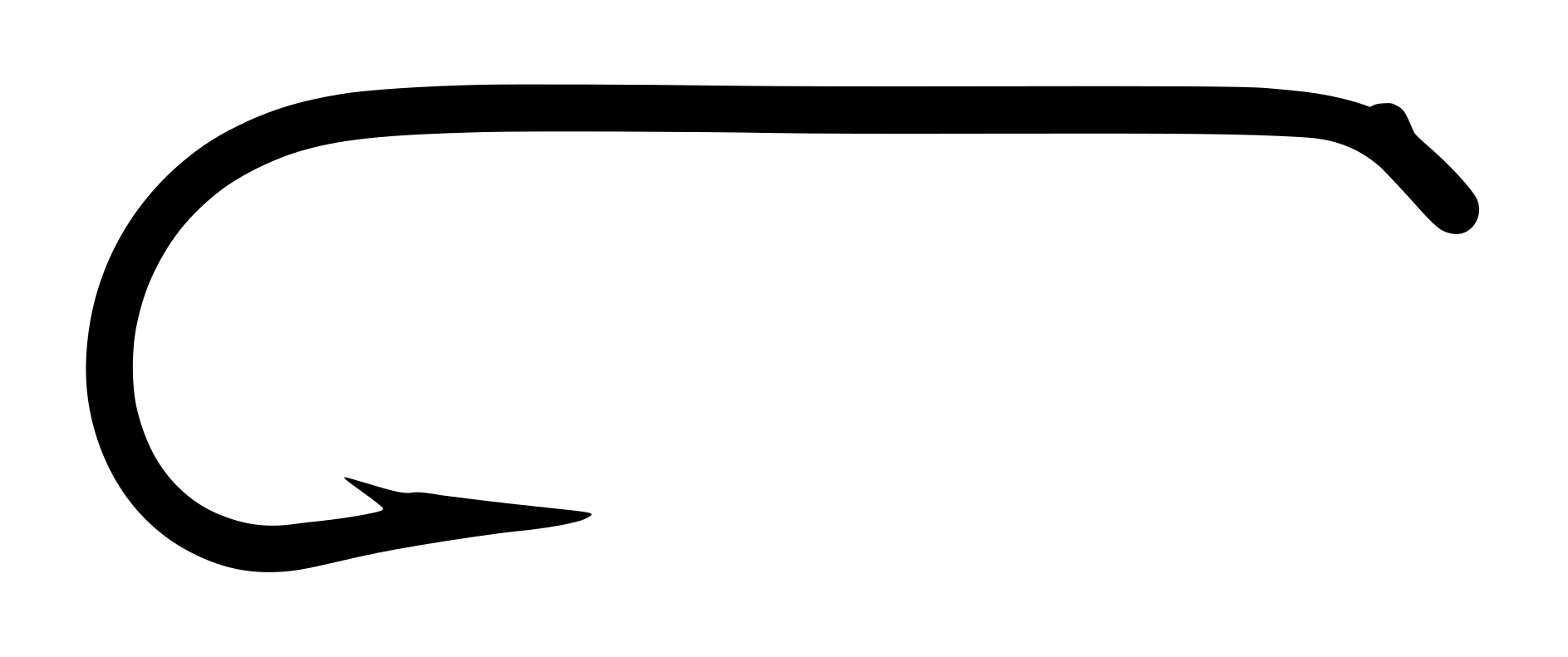
Partridge Code N Single Low Water Hook — Hand-Forged Salmon Design
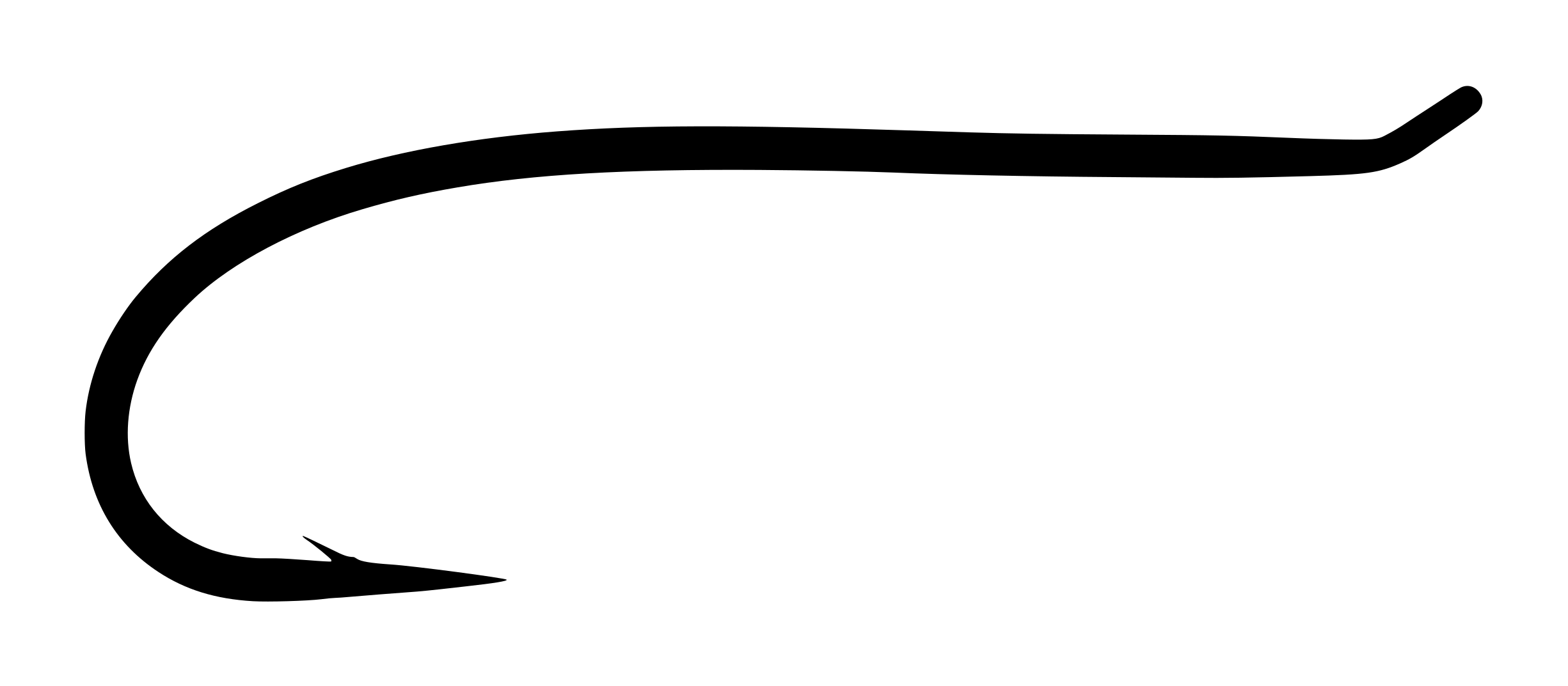
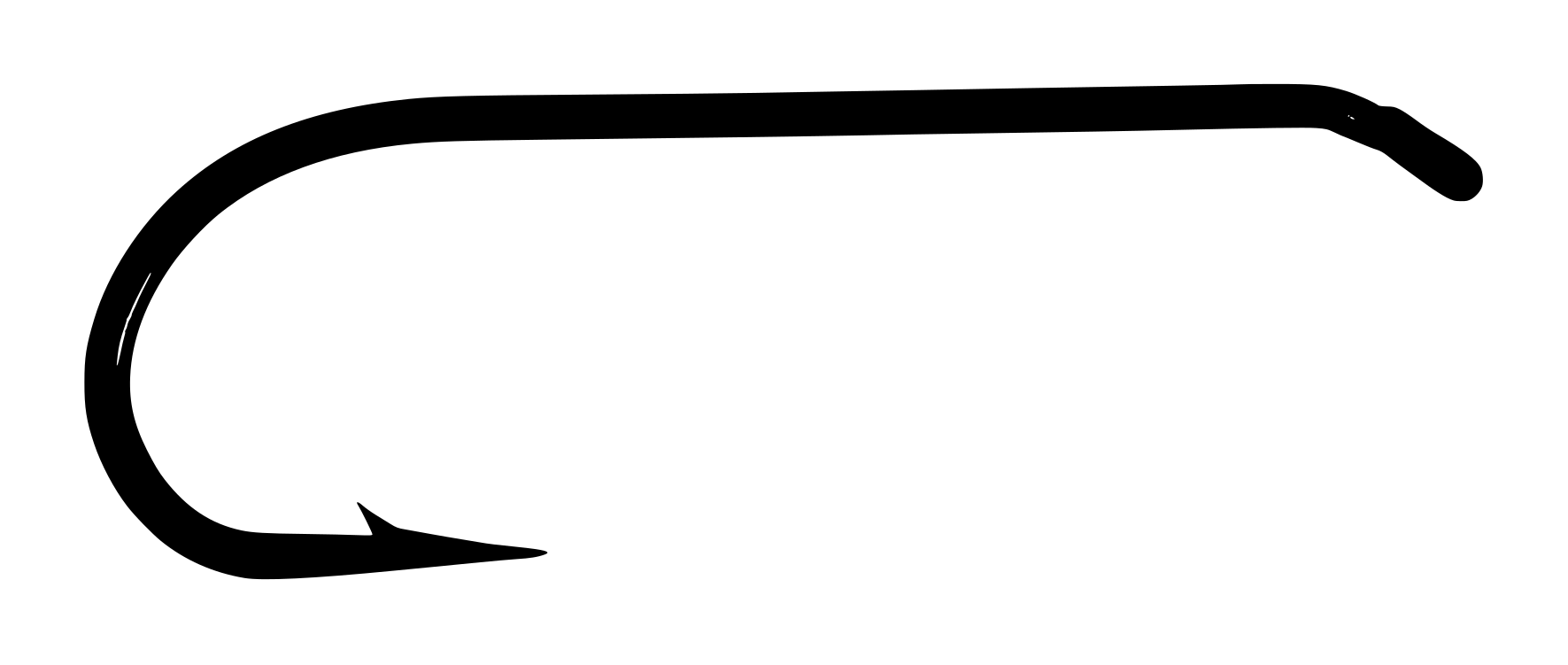
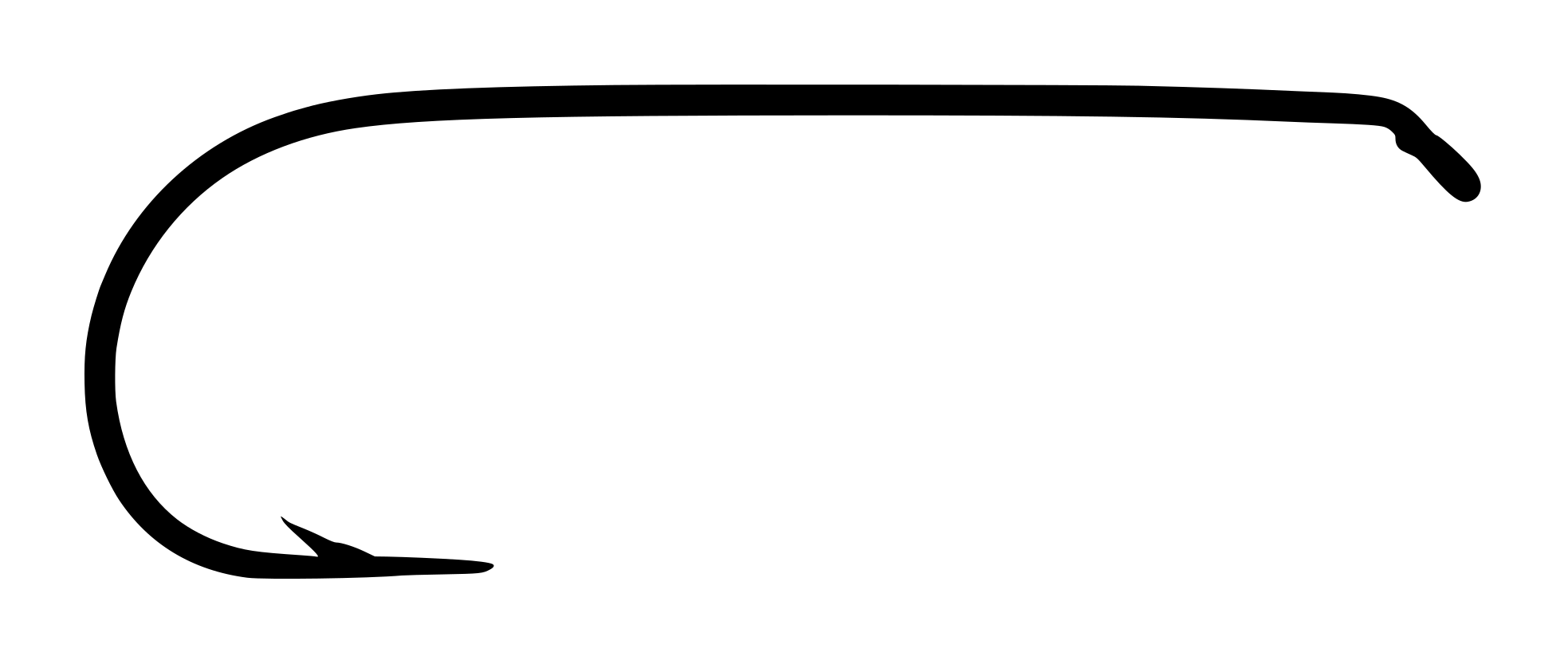
The Partridge Code N is a classic hand-forged salmon and sea trout hook manufactured by Partridge of Redditch, England, from approximately 1950 to 1975. This size 1/0 specimen exemplifies the Redditch tradition of precision-forged fly fishing hooks, with a superior-point geometry and a distinctive turned-up loop eye (Bartleet style). The hook is forged from Sheffield steel and finished with a durable black coating. The shallow, rounded Sproat bend paired with the superior point makes the Code N an excellent choice for traditional wet-fly salmon patterns, particularly in moderate to low water conditions where delicate presentation and precise hook penetration are essential.
The defining feature of the Code N is its superior point — a nearly straight inner face with a gradual taper from barb to tip, as opposed to the more aggressive hollow-point geometry common in industrial hooks. This manufacturing choice reflects Partridge’s commitment to hand-crafted quality: the superior point provides superior holding properties and is less prone to bending under stress. The turned-up loop eye accommodates traditional loop-to-loop knots favored by salmon fly tyers. The heavy wire gauge provides the strength necessary for large saltwater and anadromous species without sacrificing the delicate balance required for precise fly presentation.
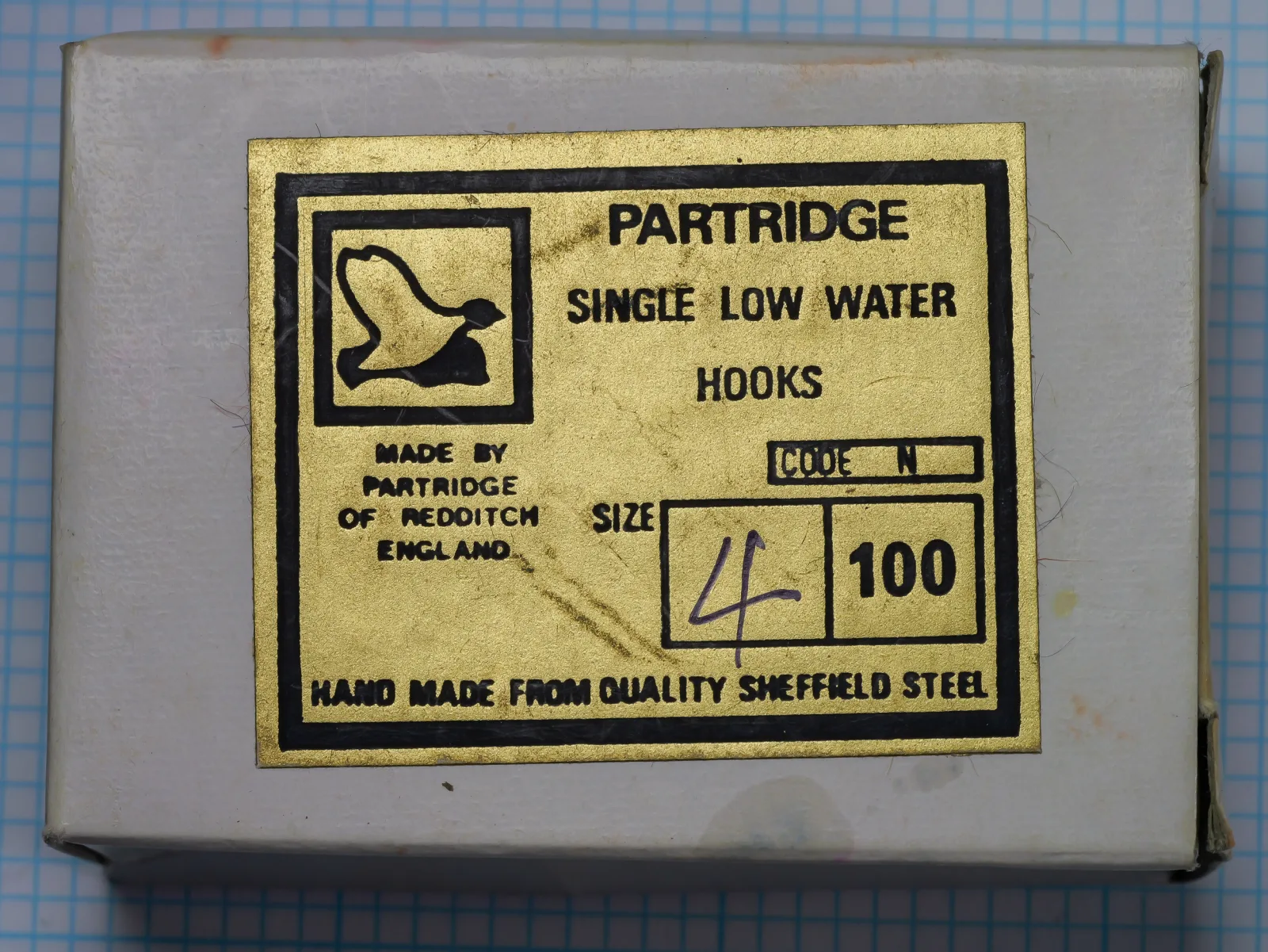
This specimen carries original Partridge packaging in very good condition, with labels that suggest mid-to-late production (1960s–early 1970s based on typography and label design). The absence of a barcode and the hand-marked size notation are strong indicators of pre-1974 manufacture. For collectors, the Code N represents genuine scarcity: Partridge hooks are less commonly encountered than industrial competitors like Mustad, and size 1/0 occupies a desirable middle ground between the more abundant larger sizes and the genuinely rare smaller offerings. Original packaging significantly enhances collectability and market value.
Early variant Partridge Code N packaging showing yellow label with black text, 'Made by Partridge of Redditch, England' imprint, and hand-marked size notation. Represents pre-1960s design aesthetic.
Photographic record
15 cataloged imagesSelect any record to load it above.
8 images shown
Partridge Code N Size 1/0 Yellow Label BoxEarly variant Partridge Code N packaging showing yellow label with black text, 'Made by Partridge of Redditch, England' imprint, and hand-marked size notation. Represents pre-1960s design aesthetic.Open originalPartridge Code N Green Label Box Size 10Later variant Partridge Code N packaging with modernized green and yellow label design, size 10, 100 count. Demonstrates 1960s–1970s label design evolution and improved printing standards.Open originalPartridge Code N Multiple Boxes Size 4 6 8 10Group photograph of multiple Partridge Code N packaging variants showing both early (white/cream boxes, black text labels) and later (green-bordered, yellow-label boxes) production. Sizes 4, 6, 8, and 10 represented, illustrating range of available sizes.Open originalPartridge Code N Size 4 Hook Point DetailClose-up of hook point on size 4 specimen showing superior-point geometry with nearly straight inner face taper. Blued finish visible. Grid scale for size reference.Open originalPartridge Code N Size 10 Hook Point DetailClose-up of hook point on size 10 specimen showing superior-point geometry. Smaller hook scale relative to size 4, same point specification and blued finish.Open originalPartridge Code N Size 4 Full ProfileFull-length profile view of size 4 Code N hook showing turned-up loop eye, complete Sproat bend geometry, and overall proportions. Grid scale for dimension reference.Open originalPartridge Code N Size 10 Full ProfileFull-length profile view of size 10 Code N hook showing consistent turned-up loop eye and Sproat bend design scaled to smaller size. Grid scale for reference.Open originalPartridge Code N Size 4 Hooks Group DetailTwo size 4 Code N hooks photographed to show turned-up loop eye construction detail, including eye opening angle and loop closure integrity. Demonstrates manufacturing consistency.Open originalPartridge-N-Hooks-size-10Partridge-N-Hooks-size-10Open originalPartridge-N-Pacakge-Back-Size-4Partridge-N-Pacakge-Back-Size-4Open originalPartridge-N-Pacakge-Size-4Partridge-N-Pacakge-Size-4Open originalPartridge-N-Package-Size-6Partridge-N-Package-Size-6Open originalPartridge-N-Size-1-25-PackPartridge-N-Size-1-25-PackOpen originalPartridge-N-Size-1Partridge-N-Size-1Open originalPartridge-N-Size-1-0Partridge-N-Size-1-0Open original
Technical profile
Eye
Looped Eye, Turned Up
Wire
Fine (1X Fine), Forged
Shank
2X Long — Plain
Bend
Sproat, Standard gap
Point
Standard / Spear
Finish
Black Japanned — Confirmed (stated on packaging)The specimen in size 1/0 shows bright jappaned finish with minimal corrosion or pitting. Eye construction is intact and properly formed. Point is sharp and undamaged. Original packaging shows very good condition: label colors remain vibrant, text is legible, card structure is intact with minor edge wear. No significant staining or water damage visible on box.
Superior Point Geometry
The superior point specification of the Code N is the result of a deliberate forging choice. During hand forging, the hook blank is shaped so that the inner face of the point — the surface facing the hook’s barb and bend — forms a nearly flat, gradual taper from the barb to the tip. This geometry contrasts sharply with hollow-point construction, where the inner face curves inward in a concave arc. The functional benefit of the superior point is twofold: (1) It provides a more secure penetration trajectory, as the point enters material along a nearly straight axis rather than deflecting laterally; (2) It is more resistant to bending and failure under load, as the stress distribution along the taper is more uniform.
Forged Wire Profile
Partridge hooks were hand-forged, meaning the wire was heated and shaped by hammer blows to a die, rather than stamped in a single press operation. Forging work-hardens the steel, increasing its tensile strength and resilience. The forged profile is visible in the Code N as a subtle faceted or flattened appearance along the shank and bend, distinguishing it from the perfectly round profile of drawn wire. Forged construction requires greater labor input and skill, justifying the premium price point that Partridge commanded.
Heavy Wire Gauge and Load Capacity
The Code N is specified as heavy wire for a size 1/0 salmon hook, appropriate for fishing in rivers with strong currents and for larger species. The heavy gauge provides the stiffness to maintain hook geometry under the stress of casting and fighting, and the strength to resist straightening when a large fish makes a determined run. The trade-off is that heavy wire is more difficult to penetrate in hard-mouthed fish or dense terrestrial insects — less relevant for salmon and sea trout, where the hook’s primary role is holding capacity.
We have measurements for sizes 4, 6, 8, 10, 12, 14, 16, 1/0. Know any others? Submit calipered measurements and we'll review and add them. Thank you!
Historical context
partridge
Partridge of Redditch — Craft Tradition in Steel
Partridge of Redditch emerged as one of England’s premier hook manufacturers during the late 19th and early 20th centuries, operating within the Redditch, Worcestershire tradition that had dominated English hook manufacturing since the 1700s. Unlike the large industrial producers such as Mustad, Partridge maintained a reputation for hand-forged, precision-engineered hooks designed specifically for fly fishing rather than mass-market applications. The company was known for close collaboration with fly-tying professionals and competitive anglers, incorporating design feedback into proprietary patterns and specifications.
Partridge’s Code N emerged as a signature design within the company’s salmon and sea trout portfolio, distinguishing itself through superior-point geometry and Bartleet-style turned-up loop eye — both markers of hand-forged craftsmanship and precision. The company’s commitment to Sheffield steel sourcing and visible quality control marked Partridge as a premium brand, commanding respect among professional salmon fly dressers and serious amateur anglers.
In the early 1980s, Partridge was acquired by O. Mustad & Son (Norwegian parent company), a consolidation that reflected broader industry trends toward vertical integration and mass production. Post-acquisition, many classic Partridge patterns, including the Code N, were either discontinued or transferred to Mustad’s production system, reducing the availability of hand-forged Partridge examples in vintage markets today. The pre-acquisition period (pre-1980) represents the genuine Partridge era and carries higher collectability value.
Series History
The Code N represents a single standalone model within Partridge’s salmon and sea trout portfolio, rather than part of a numbered series. Partridge used alphanumeric code letters (A, B, C, N, etc.) to designate specific hook designs, each with its own bend geometry, point style, and eye configuration. The Code N was introduced as Partridge’s signature low-water salmon design — optimized for shallow runs and clear-water presentations where a finer, more delicate hook is advantageous.
The hook was manufactured in a range of sizes (typically 6–6/0 or 8–8/0, with size 1/0 representing a mid-range offering). Production runs varied, and certain sizes were more frequently manufactured than others based on commercial demand. The Code N remained in production throughout Partridge’s independent period (approximately 1950–1980) and was not systematically reissued after the Mustad acquisition, making vintage examples increasingly scarce. No significant design modifications are documented; the Code N was consistent in its geometry, point specification, and eye configuration throughout its production life.
Era and Packaging Dating
No barcode visible — strong indicator of pre-1974 production. Label stock and offset lithography printing consistent with 1950s–1970s manufacturing. Two distinct label variants visible in images: (1) Early variant with black text on cream/yellow background, serif or transitional typography — typical of 1950s–early 1960s Redditch production. (2) Later variant with green and yellow color scheme and clean sans-serif typography — consistent with 1960s–early 1970s modernization. Hand-inked size notation on label is period-appropriate; by late 1970s, printed labels became standard. Cardboard box construction and waxed-paper label stock characteristic of British hook manufacturing c. 1950–1975. No postal or telephone codes visible to narrow further. Attribution to pre-Mustad acquisition period (before 1980s) is confident.
The Redditch Partnership Tradition
Partridge of Redditch earned its reputation not through industrial scale but through direct collaboration with elite fly tiers and competitive anglers. The company maintained close relationships with professional dressers and held regular consultations with river keepers and gillies (professional salmon river guides) to refine designs. The Code N Single Low Water was said to be developed in partnership with Scottish and Irish salmon specialists who emphasized that a hook's 'holding power' (resistance to straightening under load) was more important than the initial bite of the point — a philosophy that shaped Partridge's consistent choice of superior-point geometry well into an era when industrial competitors were shifting toward more aggressive hollow points.
Design lineage and influence
The Code N’s superior-point, turned-up loop-eye design reflects the Redditch tradition of precision salmon hook manufacturing, with roots tracing to 19th-century hook makers such as Edgar Sealey and S. Allcock & Co. The superiority of the superior point over hollow-point geometry was debated throughout the 20th century; Partridge’s choice to specify the superior point suggests alignment with the ‘holding power’ school of thought — the belief that penetration integrity and resistance to bending were more important than the aggressive initial penetration offered by a hollow point.
The Bartleet-style turned-up loop eye (sometimes called a ‘gut loop’) was a standard configuration in British salmon hooks, particularly pre-1960s. This eye type accommodates gut leaders or modern loop-to-loop leader knots and was preferred by traditionalist fly tyers who valued the strength and security of the loop configuration. Competing designs from contemporaries (e.g., Allcock, S. Allcock & Co.) often featured turned-down ball eyes or tapered eyes, reflecting different schools of fly-tying practice.
Post-war, the Code N remained consistent while the broader market shifted toward more aggressive point geometries and standardized eye types. By the 1970s–1980s, hollow-point and needle-point designs became dominant, and superior-point specifications became rarer. The Code N thus represents a residual tradition of Redditch craftsmanship in an era of industrial consolidation.
Best matchRelated by Attribute
Computed automatically from catalog data — updated as new hooks are added.
Matches: Bend, Shank, Wire, Eye, Eye Orient. +2 moreDiffers: Gap: Standard vs Wide; Point: Standard / Spear vs Needle; Finish: Black Japanned vs Gold-Plated +2 more
Matches: Bend, Eye, Eye Orient., Point, Finish +3 moreDiffers: Shank: 2X Long vs 3X Long; Wire: Fine (1X Fine) vs Heavy (1X Heavy); Gap: Standard vs Wide +1 more
The Code N Single Low Water is purpose-designed for salmon and sea trout fishing in shallow, clear water conditions — typically rivers during summer low-flow periods. The ‘low water’ designation indicates a lighter, more delicate hook than standard salmon models, intended to present small to medium wet flies and nymphs with minimal visual disturbance. The superiority of the Code N lies in its balance: heavy enough to set reliably in the hard-mouthed anatomy of Atlantic salmon and sea trout, yet fine enough in point geometry to penetrate cleanly without excessive resistance.
The hook is traditionally fished in classic wet-fly configurations — swung across current on a floating or intermediate line with traditional Spey or two-handed casting. The turned-up loop eye accommodates loop-to-loop knots or traditional gut-loop leaders, reflecting mid-20th-century salmon fly-tying conventions. Size 1/0 targets salmon in the 6–12 lb range in moderate water and is equally suited to sea trout (sea-run brown trout) in estuaries and rivers.
Classic Fly Patterns
Traditional salmon and sea trout wet flies: March Brown, Greenwells Glory, Teal and Green, Thunder and Lightning, Black and Peacock Spider, Partridge and Orange, Stoat's Tail
Modern Equivalents
Hook
Match Quality
Notes
Partridge N (modern)
Excellent
Modern Partridge-branded hooks produced by Mustad — maintained the Code N name and general specifications but typically stamped rather than hand-forged.
Tiemco TMC 7989
Good
Modern turned-up loop eye salmon hook with superior-point geometry and heavy wire — functionally equivalent for traditional wet-fly salmon fishing.
Daiichi 1180
Good
Salmon hook with superior-point geometry and loop eye — modern Japanese equivalent offering similar holding properties.
Green entries are full records; amber entries are spec records.
Gray entries are chart-only and not physically verified against this specimen.
Collector notes
Rated 5.5/10 — Partridge Code N hooks are scarce but not exceptionally rare. Availability is inconsistent across sizes; size 1/0 lies in a desirable mid-range for salmon fishing. Collector demand is active among fly fishers and Redditch specialist collectors. Original packaging significantly elevates value; sealed or near-sealed examples command premium prices.
Reference value
$25 – $40 USD estimate
Packaging condition
Very Good — light wear, fully legibleRecorded specimen
Packaging format
box_cardboard_yellowCatalog code
The Partridge Code N represents genuine scarcity within the vintage salmon hook market, though not to the level of rarer Redditch specialty patterns. What elevates the rating to 5.5 is the combination of: (1) Hand-forged construction with superior point geometry — a specification rarely seen in commercial production; (2) Turned-up loop eye design, which is less common than turned-down variants and more valued by traditional salmon fly tyers; (3) The heritage of Partridge of Redditch as a craftsman manufacturer, whose hooks command consistent collector premium over industrial competitors like Mustad. Size matters significantly: sizes 4/0–6/0 are most commonly encountered and desirable for classic salmon patterns. Size 1/0 occupies a sweet spot — scarce enough to justify active searching, common enough to appear occasionally. Smaller sizes (8–10) and larger sizes (8/0+) are genuinely difficult to locate.
Limiting factors: (1) Partridge was acquired by Mustad in the 1980s, and earlier Code N stock was not systematically archived; many lots were simply used up or discarded. (2) Complete original packaging in excellent condition is the primary value driver — loose hooks or hooks in damaged cards sell for 40–60% of carded value. (3) Finish condition: the japanned finish oxidizes and dulls with age; hooks with bright, uniform color are preferred and valued higher. (4) Size availability: only certain sizes were produced in each production run; complete size sets are virtually unknown and would represent exceptional finds.
Most desirable: sealed or near-sealed boxes with all 100 hooks intact; early label variants (pre-1960s black/cream labels); mid-range sizes 2/0–6/0. Least desirable: loose hooks, missing hooks, corroded or pitted specimens, late-production examples (1970s onward) with faded labels.
Packaging
Cardboard box with yellow and green labels. Label stock appears to be period-appropriate waxed paper with offset lithographic printing. Two distinct label variations documented: early black text on cream/yellow background (pre-1960s style) and later green and yellow design with sans-serif typography (1960s-1970s). Box dimensions approximately 4" × 2.5" × 1.25". 'Made by Partridge of Redditch, England' printed on front and back. 'Hand Made From Quality Sheffield Steel' stated on label. Size marked by hand in ink on label. Count shown as '100' on label. No barcode visible — strong pre-1974 indicator.
Market Value Notes
Low ($25): Good condition — opened or partially opened original packaging, all or most hooks present, moderate patina on finish, label wear visible but legible.<br />
High ($40): Excellent/Mint condition — sealed or near-sealed original box/card, complete hook count (100), finish bright and uniform, minimal label wear, packaging intact.<br />
Premium factors: Sealed original packaging adds 25–40% premium. Early pre-1960s label variant adds 10–15%. Complete hook count critical. Condition of japanned finish uniformity significant.<br />
Platforms: eBay (UK and US), specialist fly tying retailers, UK tackle auctions (Vectis, Ludlow Fair).<br />
Confidence: V verified — based on 5 eBay sold listing(s) ($25.45–$39.99) and eBay market history (Apr 2023–Apr 2026, avg $34.62, range $11.95–$87.00). The spread reflects significant variation by size and packaging condition.
Where to Find
eBay (UK sellers more frequent than US). UK tackle specialists and online retailers. Period fly-tying auctions. Redditch antique and memorabilia dealers. UK tackle fairs and fishing heritage events.
Collector's Identification Tips
Identifying Original Partridge Code N Hooks
Authentic Partridge Code N hooks exhibit several diagnostic features:
Manufacturer Name and Location: The label and/or packaging must clearly state ‘Partridge of Redditch, England’ or ‘Made by Partridge, Redditch.’ Post-1980 Mustad-made hooks using the Partridge name are not original Partridge production and should be noted separately.
Code Designation: The letter ‘N’ must appear on the label or packaging. Partridge used alphanumeric codes (A, B, C, N, etc.) to identify specific models. Confirm that the size matches the label — hand-written sizes in period ink are typical of 1950s–1970s production.
Eye Type: The turned-up loop eye (Bartleet style) is the definitive identifier. Examine the eye angle: it should bend upward from the shank at an angle of approximately 15–25 degrees, creating a small open loop. A turned-down or straight eye indicates a different model or a misidentification.
Point Geometry: Under magnification (10×), the inner face of the point should appear nearly straight or very gently curved — not concave (hollow). A true superior point has a nearly flat inner surface with a gradual taper to the tip. This is the most reliable distinguishing feature between Code N and competing designs.
Wire Profile and Forging Marks: Hand-forged Partridge hooks often display subtle faceting or slight asymmetries in the shank profile, a result of hammer work. The shank may show fine hammer marks or slight undulation, distinct from the perfectly symmetrical profile of stamped or drawn-wire hooks.
Packaging Evidence: Original Partridge boxes and cards feature characteristic label designs: early variants (pre-1960s) show serif or transitional typography on cream/yellow backgrounds; later variants (1960s–1970s) display sans-serif fonts on green and yellow backgrounds. The absence of a barcode is a strong pre-1974 indicator. Hand-written size and count notations are typical of genuine period production.
eBay market reference. Researcher-curated. Prices in USD. Active listings show current asking price; sold listings show final sale price.
Preservation
Storage and Preservation
Original Packaging: The original cardboard box and waxed-paper label add significant collectability value — store hooks on the card rather than in loose condition if possible. Keep the box intact, avoiding crease or compression damage. Store upright in a stable position. Avoid exposure to direct sunlight, which may cause label colors to fade or paper to become brittle.
Environmental Considerations: Avoid contact with other metals or materials that might cause galvanic corrosion. Do not store near salt spray, moisture, or volatile organic compounds. Acid-free tissue paper may be placed between layers if stacked, though single-layer storage is preferred. Periodic visual inspection (annually) is recommended to monitor for unexpected corrosion or packaging deterioration.
Handling: Handle hooks by the eye or shank only — avoid touching the point, which may become dulled or nicked. Wear cotton gloves if handling extensively, particularly if the specimen has significant collector or historical value.
Marking Analysis
Handwritten Markings and Annotations
The label on this specimen displays a hand-inked size notation, likely applied during the packaging process or shortly thereafter. The handwriting appears to be period-appropriate ink (blue or black) applied with a fine-pointed pen or brush. The notation clearly reads a size number or code (documented as ‘1/0’ on the specimen). Such hand-marked labels are diagnostic of 1950s–1970s production — by the late 1970s and 1980s, pre-printed labels became standard, eliminating hand notation. The presence of hand-inked markings on an otherwise commercial label is strong evidence of mid-to-late era production and suggests authenticity and age consistency.
Primary Source
Packaging Claims and Specifications
Claim: ‘Hand Made From Quality Sheffield Steel’
This statement appears prominently on all documented Partridge Code N packaging variants. Sheffield Steel was (and remains) a premium designation in metallurgy, referring to high-carbon tool steel produced in Sheffield, Yorkshire — historically the center of English steel manufacturing and the source of superior hook-wire stock. The claim ‘hand made’ explicitly identifies the production method as forge work rather than stamping, which carries both manufacturing and marketing implications. In the context of mid-20th-century fishing hook markets, this claim distinguished Partridge’s premium positioning from industrial mass-produced competitors. The statement reflects genuine manufacturing practice: Partridge hooks were indeed hand-forged, unlike the stamped-and-plated construction of large manufacturers. This claim is supported by physical evidence (the superior-point geometry and visible forging characteristics) and is not merely marketing rhetoric.
Specification: ‘Single Low Water’
The ‘Single Low Water’ designation appears on all label variants and indicates a specific design category within Partridge’s salmon hook portfolio. ‘Single’ refers to a single point (as opposed to double hooks or treble hooks). ‘Low Water’ is a functional specification indicating suitability for low-flow river conditions where smaller, lighter hooks are advantageous. This naming convention was standard across British salmon hook manufacturers of the era and communicated functional purpose to professional tyers who understood the terminology. The specification is accurate: the Code N exhibits characteristics typical of low-water designs — superior point (for cleaner penetration), relatively light wire for its size, and modest gap suitable for small flies.
Source: Partridge of Redditch Code N packaging labels, multiple variants (pre-1960s and 1960s–1970s examples documented).
Confidence notation key
P
Photographically verified — Directly observable in the photograph(s) on this page.
V
Verified by documentation — Confirmed by manufacturer catalog, spec sheet, or published reference.
I
Inferred — A logical deduction from observable or documented evidence, not directly stated.
E
Estimated — An approximation based on visual comparison, proportional analysis, or limited data.
S
Speculative — A reasoned hypothesis that cannot be confirmed from available evidence.
Claims with no notation are confirmed by multiple independent sources. All photographs on garrenwood.com are taken on a measurement grid where each square equals 1/10 inch (0.1″ / 2.54 mm).