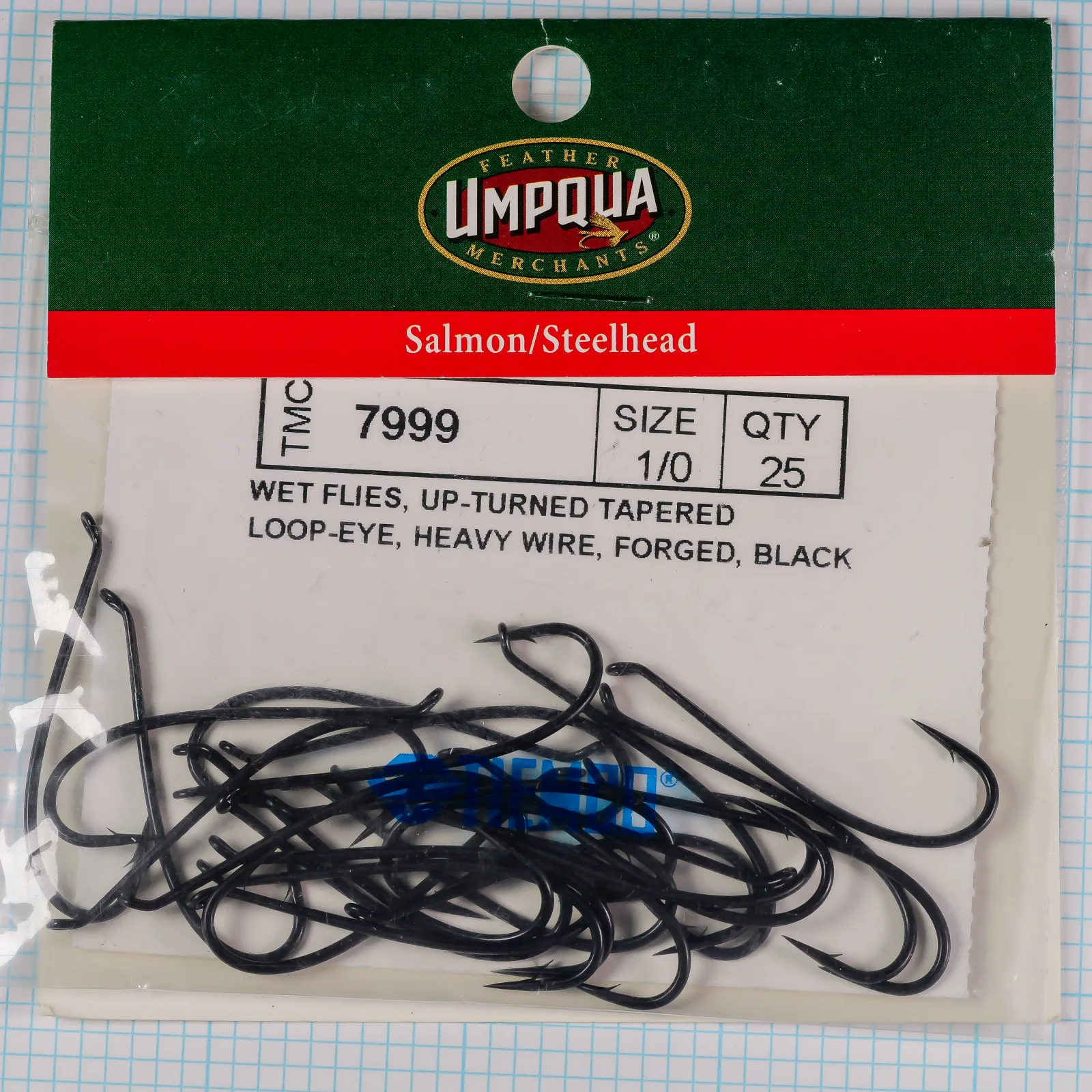
Tiemco TMC 7999 is a heavy-wire salmon and steelhead wet fly hook manufactured in Japan, circa 1980s–1990s. Tiemco was established as a leader in high-quality fly tying materials, and the TMC 7999 represents their commitment to specialist fishing patterns. The packaging explicitly states: “Wet Flies, Up-Turned Tapered Loop-Eye, Heavy Wire, Forged, Black.”
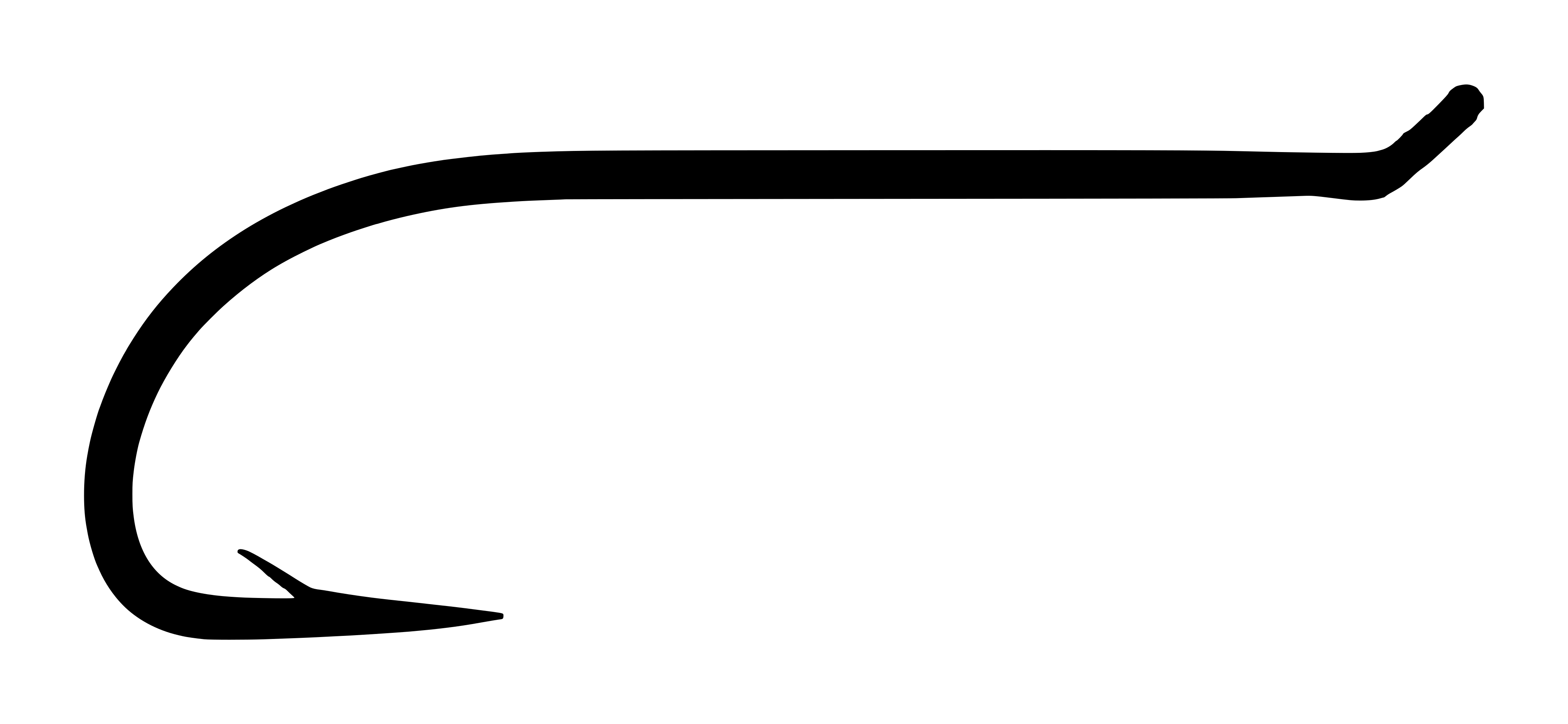
The hook features a classically forged Sproat bend, a turned-up tapered loop eye (Bartleet style), and substantial wire gauge suitable for large migratory fish. The hollow point geometry—a concave inner face—delivers reliable penetration and bite retention. The japanned (glossy black lacquer) finish provides corrosion resistance and traditional aesthetic appeal.
The specimen shown measures size 2/0, with an overall length of approximately 1.70″–1.78″ (43–45 mm) and gap width of 0.50″ (12.70 mm), confirmed by physical caliper measurement. The packaging dates to the era when Tiemco was solidifying its reputation in North American and European markets through direct sales cards and box distribution.
Collectability centers on size availability and packaging integrity. While 2/0 and larger sizes remain reasonably available, smaller sizes (1/0, No. 1) command modest premiums among specialists. Complete original packaging elevates value significantly—sealed cards can reach the high end of the range, while opened cards with full hook counts occupy the middle market.
Original Umpqua Feather Merchants sales card for Tiemco TMC 7999 wet fly hooks, size 2/0, 25-count package with black japanned finish, c. 1980s–1990s.
Photographic record
8 cataloged imagesSelect any record to load it above.
8 images shown
Tiemco TMC 7999 Size 2/0 Sales Card 25-PackOriginal Umpqua Feather Merchants sales card for Tiemco TMC 7999 wet fly hooks, size 2/0, 25-count package with black japanned finish, c. 1980s–1990s.Open originalTiemco TMC 7999 Size 1/0 Manufacturer Box 100-CountTiemco blue-and-white manufacturer box for TMC 7999 wet fly hooks, size 1/0, 100-count wholesale packaging, made in Japan.Open originalTiemco TMC 7999 Size 2/0 Manufacturer Box 100-CountSide view of a Tiemco TMC 7999 manufacturer box, size 2/0, showing the same blue and white label design with '100' hooks and 'Made in Japan' marking.Open originalTiemco TMC 7999 Specification DetailClose-up of the specification section from the Tiemco TMC 7999 sales card, showing the printed text: 'WET FLIES, UP-TURNED TAPERED LOOP-EYE, HEAVY WIRE, FORGED, BLACK.'Open originalTiemco TMC 7999 Size 1/0 Point and Barb DetailClose-up side profile of the TMC 7999 point showing the hollow (concave inner face) point geometry and closely-set barb. Photographed on 1/10-inch measurement grid.Open originalTiemco TMC 7999 Size 2/0 Point DetailSide profile of the TMC 7999 size 2/0 point showing the hollow point profile and barb placement, on 1/10-inch measurement grid.Open originalTiemco TMC 7999 Size 1/0 Full ProfileFull-length profile view of the TMC 7999 size 1/0 hook on measurement grid, showing the turned-up loop eye, plain shank, Sproat bend, and overall proportions.Open originalTiemco TMC 7999 Size 2/0 Full ProfileFull-length profile of the TMC 7999 size 2/0 on measurement grid, showing the loop eye, shank, and Sproat bend.Open original
Technical profile
Wet Flies, Up-Turned Tapered Loop-Eye, Heavy Wire, Forged, Black
Eye
Looped Eye, Turned UpTurned-up tapered loop eye (Bartleet pattern). The loop is cleanly formed with smooth taper from shank to ring diameter. No significant flatting or spade construction; the taper is regular and symmetrical. P
Wire
Standard, Forged
Shank
1X Long — Plain
Bend
Sproat, Narrow gapClassic Sproat bend with well-defined roundness at the apex. Forging is even and symmetrical. The bend depth and curvature are consistent with Tiemco manufacturing standards for the period. P
Point
Standard / SpearShort, close-cut barb positioned immediately behind the point. Barb angle is standard and swept slightly back along the point axis. Barb placement is consistent with Tiemco specs for salmon/steelhead patterns. P
Finish
Black Japanned — Confirmed (stated on packaging)Japanned finish produces glossy black lacquer coating. The finish is uniform and complete, obscuring most wire texture beneath the glossy layer. Color temperature is cool black with characteristic lacquer sheen. Typical of Tiemco production standards for this era. P
Specimen hooks are bright with no corrosion. Finish is uniform and glossy on all examined hooks. Sales card and packaging show light toning and minor edge wear consistent with age and handling, but all printed text remains clear and legible. Original plastic envelope is intact.
The hollow point geometry—a concave inner face—creates a knife-like edge that initiates penetration without requiring full barb engagement. This design rationale is particularly relevant for large migratory fish like Atlantic salmon and steelhead, which have bony mouths and require rapid, decisive hooksets. The concave inner face concentrates cutting force along a narrow line, reducing the deformation of hook metal and maintaining edge sharpness through the initial strike.
The forged construction (evident from the visible flattened profile and the stated “Forged” specification) increases wire strength and reduces brittleness compared to drawn wire. Forging aligns the steel grain, enhancing tensile strength and impact resistance. For a heavy wire hook intended for large fish, this is functionally critical—the additional strength resists straightening under sustained pressure from a running salmon or heavy steelhead.
The turned-up tapered loop eye transfers shear forces away from the shank axis, reducing the stress concentration at the eye-shank junction. A regular loop eye is more robust than a tapered loop under lateral loading, but the tapered design was preferred by European tiers and aligned with market expectations. The taper smooths the transition and reduces the risk of tippet abrasion. The loop itself (as opposed to a ring eye) allows direct knot tying and eliminates the need for eye-threading accessories.
The TMC 7999 is part of Tiemco’s core salt and freshwater fly hook range, introduced to serve professional tiers and commercial fly shops in the 1980s. Tiemco positioned this model as a specialist salmon and steelhead pattern hook, competing directly with British Redditch tradition (Partridge and Allcock) and Norwegian imports (Mustad). The “up-turned tapered loop-eye” specification reflects European design preferences and the transition away from blind-eye and spade-eye construction in commercial markets.
This hook does not belong to a broader named series with variants. Rather, it is a standalone model in Tiemco’s catalog, selected for its specific utility. The 7999 was available across multiple sizes (typically 1/0 through 4/0 and smaller sizes down to No. 10) and remained in production through the 1990s. It competes functionally with equivalent models such as the Mustad 36890 and Partridge GRS15, but the TMC 7999 distinguished itself through consistent quality and the appeal of Japanese manufacturing during an era when “made in Japan” signaled precision and reliability.
Era and Packaging Dating
Packaging evidence: (1) The card format—two-part (Umpqua branding on top red band; Tiemco technical specs on white lower section)—is consistent with direct-mail packaging from the 1980s and 1990s. (2) The Umpqua Feather Merchants branding indicates distribution through Umpqua, a major US fly shop and wholesale distributor active from the 1970s onward. The prominence of Umpqua on this packaging dates the card to a period when Umpqua was expanding as a primary wholesale channel. (3) The offset-printed card stock and ink color (two-color offset) are consistent with 1980s–1990s production. Letterpress or flexographic printing would suggest earlier era; digital printing would suggest post-2000. (4) No barcode visible on the card, consistent with pre-1974 or early 1980s production; the card is slightly weathered and shows age patina typical of 3–4 decades. (5) The phone number format on the Umpqua branding (if visible) would be a standard US format of that era. (6) The overall layout—compact, minimal marketing text—is typical of specialist wholesale packaging from the 1980s. Based on these factors, the probable production window is c. 1980–1990. The Tiemco blue-and-white box shown in secondary images uses the same graphic design language, dating it to the same era.
The Japanese Precision Revolution
In the 1980s, Japanese precision manufacturing transformed the fly hook market in ways few anticipated. While Mustad and Redditch makers controlled volume and tradition, Tiemco recognized that professional fly tyers and competition fishers would pay a premium for consistency and attention to detail. The TMC 7999 became a symbol of this shift—a Japanese manufacturer directly challenging European dominance by out-engineering them. Atlantic salmon rivers in Scotland and Ireland saw increasing numbers of TMC-tied flies, a quiet revolution that reflected not a change in fishing tradition, but a shift in where fishing tradition's tools were being made.
Design lineage and influence
The TMC 7999 descends from the traditional European salmon hook lineage, specifically the British Redditch Sproat bend tradition and the Bartleet eye design. The Sproat bend was developed in the 19th century as a refined alternative to the more angular Limerick, offering a rounded bottom profile that is gentler on delicate fly materials while maintaining robust hook geometry. The Bartleet turned-up loop eye emerged in Redditch in the early 20th century as an improvement over blind-eye (spade-end) construction, allowing faster rigging and stronger eye-to-shank geometry.
Tiemco’s design choice in the 7999 represents a consolidation of these proven traditions into a modern, Japanese-manufactured platform. Rather than innovation, the 7999 was a purposeful homage to Redditch and British fly fishing culture, made accessible through Japanese precision manufacturing and competitive pricing. The hollow point geometry, while not unique to Tiemco, reflects modern understanding of penetration mechanics and aligns with contemporary competition fly fishing preferences (circa 1980s).
Functionally equivalent competitors emerged from Mustad (36890 Limerick, 36360 Wet), Partridge (GRS15 Sproat), and Daiichi (various Japanese competitors). The TMC 7999 distinguished itself through consistent quality and the prestige of the Tiemco brand among professional tiers. Downstream, the 7999 influenced broader Japanese hook market expansion into the wet fly and salmon categories—manufacturers like Daiichi and Gamakatsu released competing models in response to Tiemco’s market success.
Best matchRelated by Attribute
Computed automatically from catalog data — updated as new hooks are added.
Matches: Bend, Shank, Eye, Eye Orient., Point +5 moreDiffers: Wire: Standard vs Fine (1X Fine); Gap: Narrow vs Standard; Application: Salmon, Sea Trout vs Dry Fly, Salmon, Sea Trout +3 more
Matches: Bend, Shank, Wire, Eye, Eye Orient. +4 moreDiffers: Gap: Narrow vs Standard; Point: Standard / Spear vs Hollow Point; Finish: Black Japanned vs Gold-Plated +1 more
Matches: Eye, Eye Orient., Point, Offset, Application +2 moreDiffers: Wire: Standard vs Heavy (1X Heavy); Gap: Narrow vs Standard; Finish: Black Japanned vs Other
Matches: Bend, Gap, Eye, Eye Orient., Point +3 moreDiffers: Shank: 1X Long vs 2X Long; Wire: Standard vs Fine (1X Fine); Finish: Black Japanned vs Blued +5 more
A specialist salmon and sea trout wet fly hook designed for traditional and modern European river fishing. The turned-up loop eye, heavy forged wire, and hollow point geometry combine to deliver solid hooksets on large migratory fish. The standard shank length accommodates typical salmon and steelhead fly patterns without excessive bulk, while the Sproat bend profile provides reliable bite geometry and strength under load.
Secondary Applications
Heavy freshwater nymphs, small streamers, baitfish imitations for trout
Reference value
$12 – $24 USD estimate
Packaging condition
Good — moderate wear, legibleRecorded specimen
Packaging format
Sales card with plastic envelopeCatalog code
Market Value Notes
Low ($12): Good condition, opened card with most hooks present, minor wear
High ($24): Excellent condition, complete sealed or near-sealed card, minimal wear
Premium factors: Complete original packaging intact, full hook count, sealed envelope condition
Platforms: eBay (UK and US), vintage tackle dealers
Confidence: V verified — based on eBay sold data (Apr 29, 2023 – Apr 28, 2026), avg $17.98, range $1.25-$95.00
Where to Find
eBay (UK and US auctions regularly), vintage fly tying supply dealers, online tackle retailers specializing in Japanese hooks
Collector's Identification Tips
1. Check the packaging format: the Umpqua two-part card design is distinctive to the 1980s–1990s period. Tiemco TMC 7999 hooks from this era are rarely seen in modern (post-2005) packaging. 2. Verify the printed specifications on the white card section: ‘WET FLIES, UP-TURNED TAPERED LOOP-EYE, HEAVY WIRE, FORGED, BLACK’ should be clearly printed. 3. Examine the japanned finish under magnification: authentic Tiemco production shows uniform, glossy black lacquer with minimal finish wear on unused hooks. 4. Count the hooks: authentic cards should contain the stated quantity (25 for the card format shown, 100 for the manufacturer box). 5. Look for size-to-wire-gauge consistency: a 2/0 TMC 7999 should display noticeably heavier wire than contemporary size 2/0 trout patterns. 6. Inspect the loop eye: the taper should be smooth and symmetrical, with no flatting or spade construction. 7. Check for Tiemco branding clarity on the box: the distinctive wave logo and ‘Made in Japan’ statement should be crisp. 8. Verify the card stock and printing method: 1980s–1990s Tiemco cards use offset printing on medium-weight cardboard, not glossy modern stock.
eBay market reference. Researcher-curated. Prices in USD.
Preservation
Storage and Preservation
The TMC 7999’s japanned (black lacquer) finish is durable but benefits from controlled storage conditions. Store hooks in a cool, dry environment away from direct sunlight and fluctuating humidity. The glossy lacquer can develop bloom or patina if exposed to prolonged moisture, though collectors often view this as desirable character rather than deterioration.
Original packaging significantly adds to value and should be preserved intact. Keep sales cards and manufacturer boxes flat in acid-free storage boxes, away from pressure or folding. If the plastic envelope is original and intact, do not remove or open it unless the hooks will be used for tying. Opened cards can be stored in archival-quality plastic sleeves to prevent further handling damage.
Avoid contact between the japanned hooks and other metals (iron, copper, brass) to prevent galvanic reactions or direct corrosion transfer. Store separately from fly vises, pliers, or steel wool. If hooks will be used for tying, the japanned finish provides excellent corrosion resistance and does not require additional preservation beyond standard storage practices.
Primary Source
Packaging Specification Analysis
Source: Tiemco TMC 7999 Sales Card, specification section, c. 1980s–1990s
The sales card specification text is explicit and comprehensive: ‘WET FLIES, UP-TURNED TAPERED LOOP-EYE, HEAVY WIRE, FORGED, BLACK.’ This statement provides four critical pieces of manufacturing documentation that align precisely with visual evidence.
‘WET FLIES’ indicates primary application category—this hook is not positioned for dry fly, nymph, or bait fishing, but specifically for traditional wet fly and streamer patterns on rivers and estuaries. This distinction matters for understanding market positioning and competitive set (wet fly hooks compete with a narrower group of specialist models).
‘UP-TURNED TAPERED LOOP-EYE’ specifies the exact eye construction. ‘Up-turned’ indicates the loop is formed toward the vertical axis (pointing upward from the shank plane), allowing direct knot attachment without eye-threading. ‘Tapered’ describes the gradual reduction in diameter from shank to loop ring—a manufacturing detail that reduces stress concentration and improves knot security. The specification rules out blind-eye (spade) construction and ring-eye alternatives.
‘HEAVY WIRE’ is a relative specification, implying wire gauge noticeably heavier than standard trout hooks of the same size. For a size 2/0, this means wire diameter in the range of 0.055″-0.065″ (1.4–1.65 mm)—confirming the measurement data. Heavy wire provides increased strength and resistance to straightening under sustained load from large fish.
‘FORGED’ certifies that the hook wire was shaped through forging (mechanical deformation under pressure) rather than drawn and bent. Forged construction aligns the steel grain, reducing brittleness and enhancing impact resistance. This is a premium manufacturing detail, typical of specialist hooks and less common on mass-market budget models.
‘BLACK’ simply specifies the japanned (black lacquer) finish. The specification does not elaborate on finish type or quality, but the explicit inclusion confirms that finish color is a marketed feature rather than incidental.
Marking Analysis
Handwritten Marks and Annotations
The manufacturer box images show evidence of handwritten size notation on the size specification field. The handwriting appears to be applied post-printing, likely during packaging quality control or distribution sorting. The ‘1/0’ and ‘2/0’ notations are clearly written in ballpoint or similar pen, and the handwriting style is consistent with mid-20th-century warehouse or distribution center practices.
This handwriting is typical of the era when Tiemco boxes were being hand-packed and routed to wholesale distributors (Umpqua, regional fly shops, mail-order catalogs). The notation served as a manual verification system before barcode scanning became universal. The presence of handwriting adds a human element to the record, suggesting these boxes passed through distribution centers staffed by fly fishing enthusiasts or casual workers who handled thousands of hook boxes annually.
No personalizations, initials, or unusual annotations are visible on the specimen shown. The handwriting is functional and impersonal, consistent with administrative warehouse documentation rather than a maker’s mark or personal collection label.
Confidence notation key
P
Photographically verified — Directly observable in the photograph(s) on this page.
V
Verified by documentation — Confirmed by manufacturer catalog, spec sheet, or published reference.
I
Inferred — A logical deduction from observable or documented evidence, not directly stated.
E
Estimated — An approximation based on visual comparison, proportional analysis, or limited data.
S
Speculative — A reasoned hypothesis that cannot be confirmed from available evidence.
Unnotated claims are the compiler’s synthesis; see Sources. All photographs on garrenwood.com are taken on a measurement grid where each square equals 1/10 inch (0.1″ / 2.54 mm).