Generic selectors
Exact matches only
Search in title
Search in content
Post Type Selectors
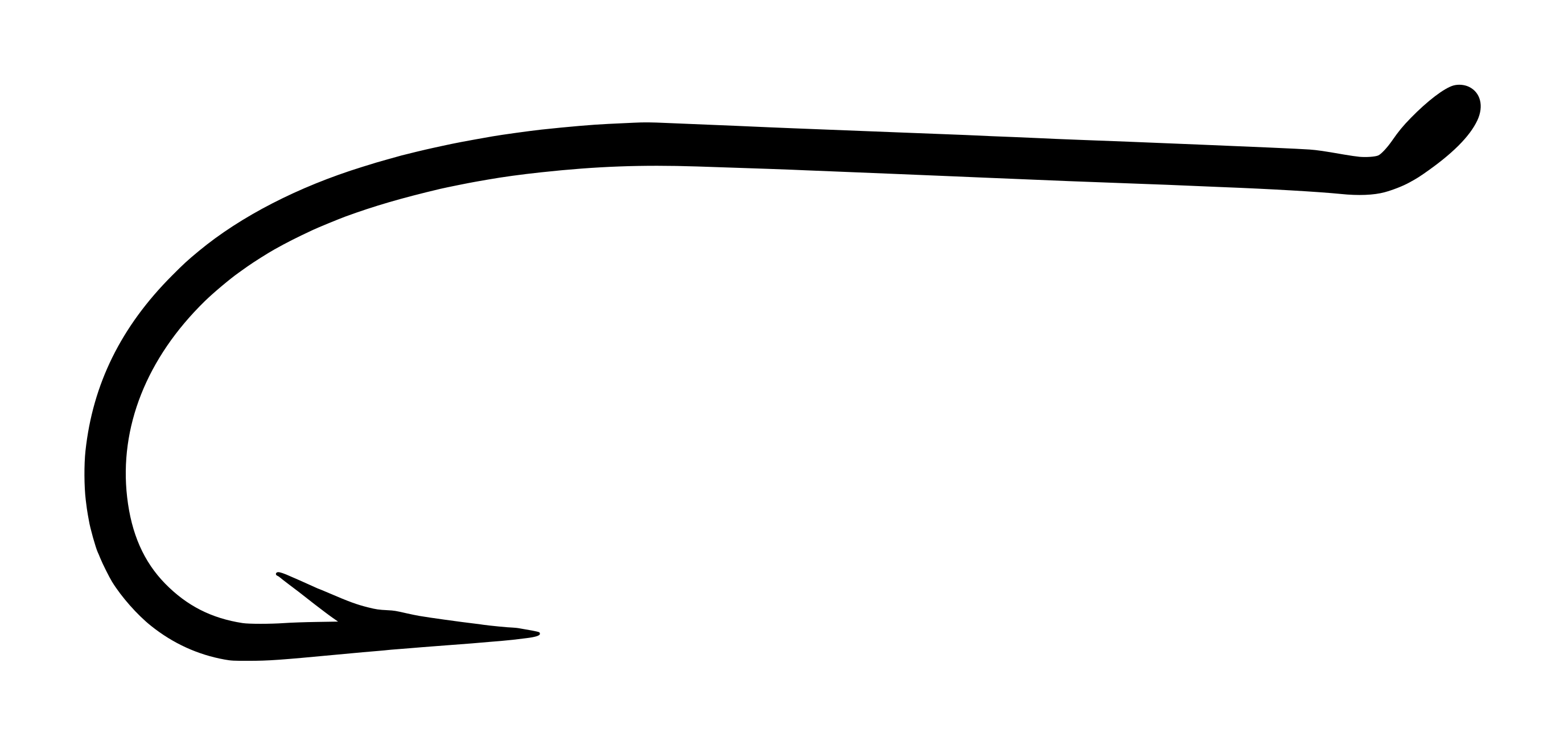
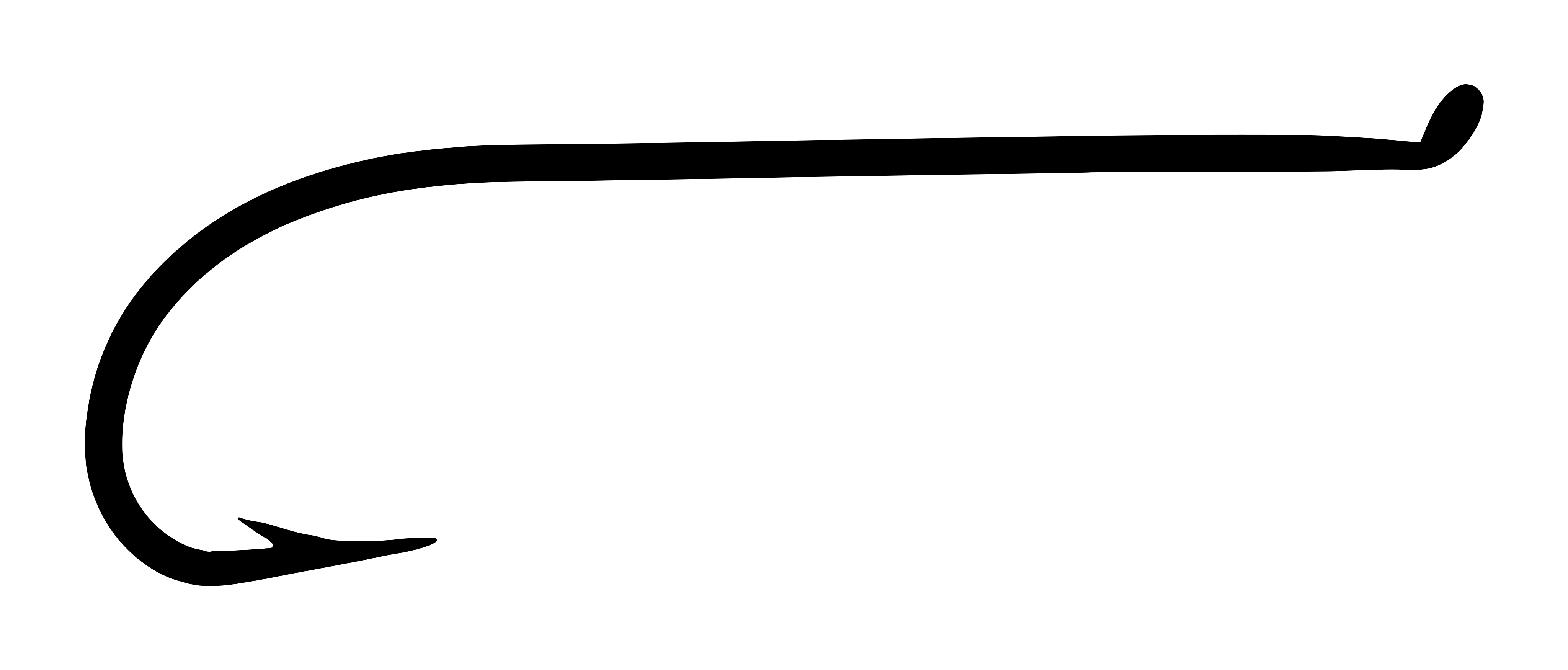
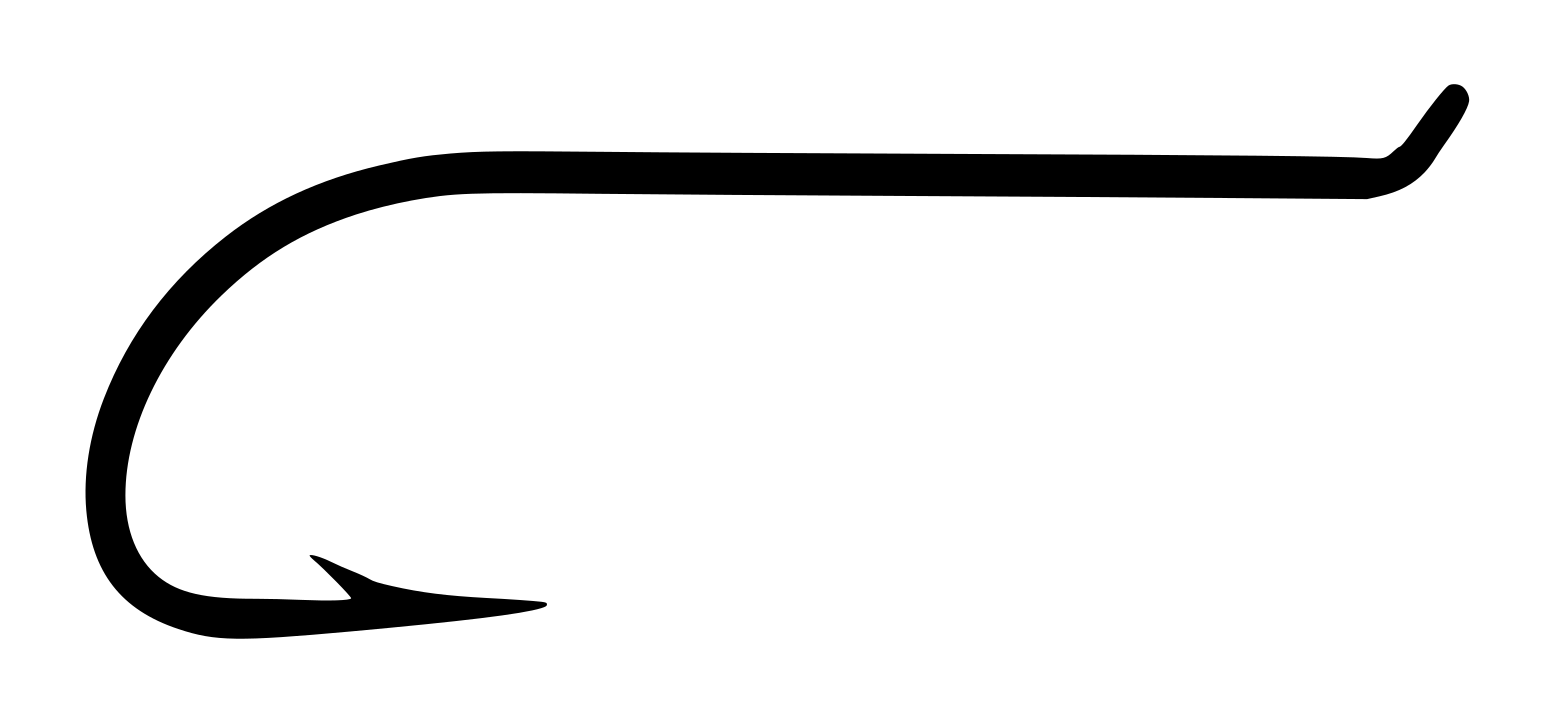
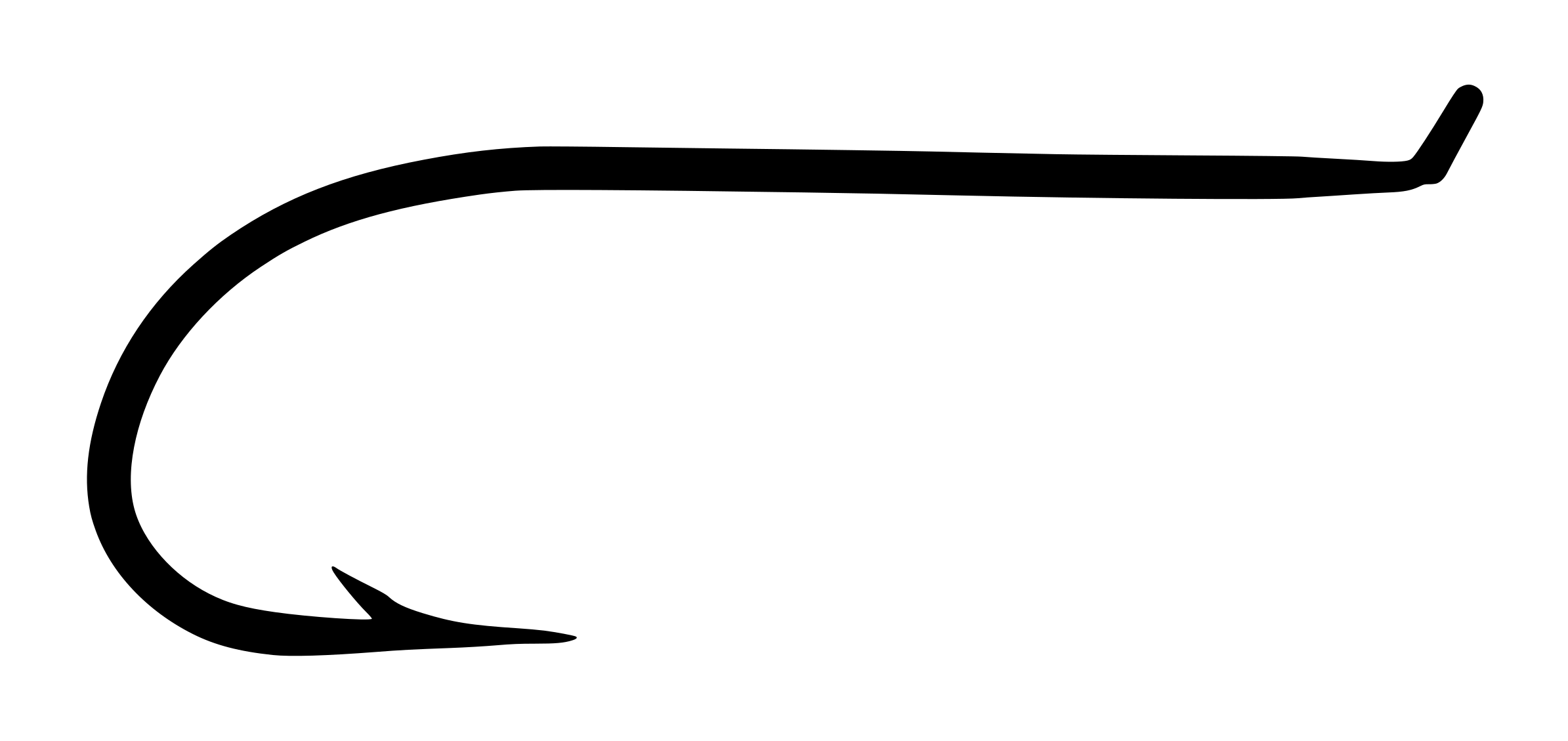
Mustad 38933 hook silhouette
Hook ReferenceO. Mustad & Son Hooks › Mustad Hooks – 38933

Mustad 38933

Mustad 38933c. 1925-1975
Tapered EyeSproat BendStandard ShankFine Wire (4X)Hollow PointBronzed Finish

Record summary

The Mustad 38933 is a fine-wire Sproat-pattern hook manufactured by O. Mustad & Søn of Gjøvik, Norway, representing the premium freshwater bait and light-fly tier’s segment of Mustad’s midcentury product line. The hook features a classic parabolic Sproat bend, a hollow point designed for minimal penetration resistance, a fine tapered eye, and 4X fine-gauge wire. The specimen examined is size 8 with a bronzed finish, typical of utility hooks intended for panfish, trout, and small bass fishing across both bait and light-fly applications.

Manufactured between 1925 and 1975 based on the ‘OSLO – NORWAY’ designation on the label (post-January 1, 1925, when Christiania was renamed Oslo) and the complete absence of a barcode (pre-1974), this hook exemplifies Mustad’s eight-line label system—a standardized industrial specification format that served as a universal language of tackle identification across global markets. The label documents every critical specification: quality tier (code 38933), point geometry (Hollow Point), pattern family (Sproat), eye configuration (tapered), wire characteristics (4X extra fine), finish (bronzed), and offset direction (slightly reversed).

Collecting significance is modest but meaningful. The 38933 was produced in substantial quantities as a workhorse utility hook, making surviving examples common and generally affordable ($8-18 per box of 100). However, the historical value of the documentation resides not in rarity but in specificity: the original packaging and label represent an era when individual hook specifications were not homogenized but rather highly specialized for precise environmental and tactical conditions. For researchers, industrial historians, and vintage-tackle enthusiasts, the 38933 serves as an accessible entry point into the Mustad taxonomy and a tactile reminder of pre-digital manufacturing standardization.

Mustad 38933 Hook — pair of vintage hooks shown at full length — size 8 — turned-down eye, Sproat bend visible from top view
Mustad 38933 Box1

Photographic record

8 cataloged imagesSelect any record to load it above.

8 images shown

Mustad 38933 Box1 Mustad 38933 Box1 Open original
Mustad 38933 Box2 Mustad 38933 Box2 Open original
Mustad 38933 Size 8 Sproat Hooks Full Length Pair of vintage Mustad 38933 hooks, size 8, displayed at full length on measurement grid. The tapered eye and characteristic Sproat parabolic bend are clearly visible. Open original
Mustad 38933 Point Mustad 38933 Point Open original
Mustad 38933 Vintage Box Label Size 8 Original Mustad cardboard box with the complete eight-line label showing all specifications: Qual. 38933, Hollow Point, Mustad-Special Sproat Hooks, 4X fine wire, bronzed finish, OSLO-NORWAY origin. Open original
Mustad 38933 Size 8 Point Detail Close-up Close-up side view of the Mustad 38933 hook point, showing the characteristic hollow-point geometry with concave inner face and sharp tip. Open original
Mustad 38933 Size 8 Full Side Profile Side profile view of a single Mustad 38933 hook, size 8, on measurement grid, showing the complete hook geometry from eye to point. Open original
Mustad 38933 Size 8 Pair Symmetry Check Pair of Mustad 38933 hooks, size 8, positioned on grid to document manufacturing consistency and symmetry of the Sproat bend geometry. Open original

Technical profile

Fine-Wire Sproat Hook — Tapered Eye — Hollow Point — Bronzed — Size 8

Eye
Tapered Eye, Turned Up Finely tapered eye formation typical of premium Mustad fly hooks of the era, reducing mass at the hook head P. Wire gradually reduces in diameter as it forms the terminal loop, creating a delicate profile suited to light-tackle presentations P.
Wire
Fine (1X Fine), Round, Est. ~0.016"-0.018" (~0.41-0.46 mm)
Shank
Standard — Plain
Bend
Sproat, Standard gap Classic parabolic Sproat curve with smooth, continuous arc from the shank through the bend P. Geometry distributes stress evenly across the bend radius, typical of the mechanically engineered Sproat pattern perfected by Mustad P. Bend depth proportional to standard-length shanks E.
Point
Hollow Point (concave inner face) Hollow point with the characteristic concave inner face and rapid flare toward the barb P. Fine, razor-sharp tip suitable for soft-mouthed species and delicate penetration with minimal applied force P.
Finish
Bronzed — Confirmed (stated on packaging) Warm brownish-gold bronzed lacquer coating consistent with Mustad era production P. Even distribution with slight patina development visible on specimen, indicating age P. Finish typical of freshwater bait and utility hooks of the 1950s-1970s period E.

The hollow point geometry of the 38933 is the direct result of mechanical grinding methodology unavailable in the pre-industrial era. Mustad’s grind machines were engineered to cut a concave, sweeping profile from the very tip down to the base of the barb, creating a dished-out silhouette. This design produces an incredibly fine, razor-sharp tip that flares rapidly toward the barb—delivering the primary mechanical advantage of minimal penetration pressure required for initial tissue engagement. For soft-mouthed fish (crappie, panfish, delicate trout species), this point geometry was essential, as aggressive hook-sets would tear friable mouth tissue and result in lost fish. The rapid flare ensures that once the sharp tip penetrates past the barb, the hook holds securely without creating an overly large entry wound that could tear open under fight pressure. The fine wire (approximately 0.016″-0.018″ diameter) reduces the overall weight of the hook and decreases tissue trauma upon bait insertion, allowing delicate live baits (earthworms, small minnows) to survive longer. The tapered eye further reduces mass at the hook head, which is functionally beneficial for floating dry-fly presentations or when using light monofilament leaders where excessive head weight would cause undesirable sink rate or presentation angle problems. The Sproat bend’s parabolic geometry mathematically distributes the mechanical stress of a fighting fish evenly across the entire bend arc, making it highly resistant to straightening or fracturing under heavy, sudden loads—a critical feature for dynamic bait fishing where the fish has leverage against the angler’s rod.

Size & scale lab

Selected size 8
Physical specimen
Overall Length
19.6 mm P
Shank Length
15 mm
Gap Width
4.8 mm P
Bend Depth
8.5 mm
Weight
Not available
Shank-to-Gap Ratio
~3.0-3.2 : 1
Confidence
P Physical specimen

Physical measurement with calipers

Calibrated SVG True-scale preview

Historical context

mustad

O. Mustad & Søn was founded in 1832 in Gjøvik, Norway, initially as a general metalworking facility under the name ‘Brusveen Spiger- og Staltradfabrikk’ (Brusveen Nail and Steel Wire Factory). In 1877, the pivotal invention of the first fully automated hook-making machine by Mathias Topp revolutionized global hook production. Rather than patenting the technology (which would have required public disclosure), the Mustad family maintained strict trade secrecy, allowing them to dominate international markets. By the mid-twentieth century, Mustad controlled approximately 50% of global hook production, establishing sales offices and satellite manufacturing on multiple continents. The company’s formalized eight-line label system, introduced in the late nineteenth century and maintained through the 1970s, became the industry standard for technical hook specification and remains a crucial archival resource for modern researchers.

Series History

The Mustad-Special Sproat Hook line (Quality code 38933 and related variants) was engineered to replicate and industrialize the classic Sproat bend pattern, originally developed by regional Irish craftsmen and favored across European freshwater fisheries. Mustad’s reverse-engineering strategy allowed them to mass-produce the Sproat geometry with extraordinary precision and consistency, making it available globally in sizes and configurations that regional blacksmiths could never achieve. The 38933 specifically represents the fine-wire, tapered-eye variant, positioned as a premium bait and light-fly hook suitable for delicate presentations. This model remained in continuous production from at least the 1920s through the 1970s, with the eight-line label system providing consistent documentation across decades. The introduction of the Signature Series (c. 2001-2009) eventually rendered the arbitrary quality code system obsolete, marking the end of the classic labeling era.

Era and Packaging Dating

Line 3 of the label reads 'OSLO - NORWAY,' not 'CHRISTIANIA - NORWAY.' The Norwegian capital was officially renamed from Christiania to Oslo on January 1, 1925. The presence of 'OSLO' establishes a definitive post-1925 date of manufacture V. The eight-line typographic label format, quality code system (Qual. 38933), and 'Manufacturers' designation are consistent with Mustad's standard pre-1970s packaging V. The absence of a barcode on the box strongly indicates production before 1974, when UPC barcoding became standard in North American retail I. The offset printing method and paper stock are consistent with mid-twentieth-century commercial production, typical of 1950s-1970s E. The bronzed lacquer finish was standard throughout this period. No specific date code or manufacturing stamp is visible on the specimen. Overall, the evidence points to a production window of c. 1925-1975, with the most likely concentration in the 1950s-1960s based on packaging wear and label color tone E.

The Universal Language of the Eight-Line Label

The Mustad eight-line label system was engineered as a universal language of tackle specification decades before modern global standardization. Warehouse workers, dock laborers, and retail merchants in ports from Buenos Aires to Shanghai could identify the exact specifications of a hook box without reading English, Norwegian, or any other language—the label's rigid typographic hierarchy and consistent position of quality codes and pattern names made the system self-evident across linguistic barriers. A Chinese fisherman unfamiliar with European languages could instantly see 'Qual. 38933' matched his written order and 'Hollow Point' told him the penetration profile he needed, even if he could not pronounce the words. This design principle predates modern QR codes and global supply-chain systems by nearly a century, reflecting Mustad's role as a true multinational industrial pioneer.

Cross-reference & comparisons

Dry Fly Wet Fly Nymph

Primary Application

The Mustad 38933 is a fine-wire Sproat hook designed for general freshwater bait fishing and light fly tying applications. The Sproat bend geometry, with its characteristic parabolic curve, provides excellent mechanical holding power under sustained pressure. The small tapering eye reduces weight for floating presentations, while the 4X fine wire allows for delicate presentations with small live baits, particularly earthworms, soft plastics, and insect larvae. Historically favored for panfish, trout, and small bass fishing, the 38933 balances light-tackle sensitivity with the durability needed for active bait work.

Secondary Applications

Streamer fly tying, small nymph patterns, light saltwater applications

Classic Fly Patterns

Not typically used as a primary fly hook, though light enough for small streamer presentations

Modern Equivalents

HookMatch QualityNotes
Tiemco 5212 Excellent Exact modern equivalent: parabolic bend geometry, fine wire, tapered eye, designed for same light-tackle freshwater bait and finesse fly applications
Daiichi 1150 Very Good Sproat-variant bend; fine wire; tapered eye; excellent mechanical holding power; contemporary standard for wet fly and small streamer tying
Mustad C53S Good Modern Mustad iteration of the Sproat pattern; similar bend profile; heavier wire than 38933; suitable for general bait work but less delicate than fine-wire original

Collector notes

Modest collecting interest driven by the classic Sproat pattern and the transitional era of the Mustad eight-line label system, but commonness as a utility hook and excellent preservation of surviving examples limit premium pricing.

Reference value $8 – $18 USD estimate
Packaging format GW-M-VINTAGE-001 Catalog code

Positive Factors: The Mustad 38933 represents a specific moment in industrial hook manufacturing when premium bait hooks were still differentiated by fine wire gauge and tapered eyes. The eight-line vintage label with quality code system and ‘OSLO – NORWAY’ designation places it firmly in the post-1925 production era, making it a valuable artifact for documentation of Mustad’s product taxonomy. The Sproat pattern itself enjoys enduring respect among traditional freshwater anglers, and the small size (No. 8) combined with fine wire creates a distinctive profile. Original packaging with intact label markings significantly increases collectability and research value.

Limiting Factors: The 38933 was produced in very large quantities as a utility hook for both commercial and retail markets, meaning surviving examples are common. Unlike specialty patterns (Dublin Point, Knife Edge for big game) or rare premium hooks (extra-fine Viking dry fly hooks), the 38933 lacks scarcity premium. The condition of the specimen examined shows moderate patina, which is expected for age but reduces ‘display perfect’ appeal. Mustad’s product line numbering system, while historically fascinating to researchers, does not confer the name-recognition appeal of regionally-named patterns like Limerick or Aberdeen. Competition from modern synthetic equivalents and the general decline in bait-hook collecting (versus fly hook collecting) further constrains demand.

Packaging

Vintage Mustad cardboard box, approximately 3.5" × 2.5" × 1.0" (90 × 65 × 25 mm), printed in gold and black letterpress on cream stock. The iconic Key Brand logo (downward-pointing skeleton key) is positioned in the upper left quadrant. Eight-line typographic label occupies the center field with consistent hierarchical layout: Line 1 'O. MUSTAD & SÖN' (manufacturer title); Line 2 'Manufacturers' (industrial role declaration); Line 3 'OSLO - NORWAY' (geographic origin and dating clue); Line 4 'Qual. 38933' (quality/model code); Line 5 'Hollow Point' (point specification); Line 6 'Mustad-Special Sproat Hooks' (pattern name); Lines 7-8 'T. up small tap. eye, bronzed, 4 ex. fine wire, slightly reversed' (anatomical and finish specifications). Bottom left corner: '100' and 'No.' (quantity indicator). Decorative border of small asterisks or floral elements surrounds the entire label. The box exhibits light toning and minor edge wear consistent with age; original contents (100 hooks on small card) are partially intact. Label text remains legible with slight fading of gold ink. Paper stock is typical of mid-twentieth-century European commercial printing—relatively thin, uncoated stock prone to yellowing. No modern barcode present. Reverse side blank except for occasional pencil notations (possibly inventory marks from original retailer or estate lot). This box format was standard Mustad retail and wholesale packaging for the size 6-12 range throughout the 1925-1975 period.

Market Value Notes

Pricing based on recent eBay sales and specialist tackle dealer listings. Original boxes of 100 in good condition with clear label text typically sell for $12-18 USD per box; individual hooks if offered separately command $0.10-0.15 each. Premium pricing (upper range) applies to boxes with mint or excellent label condition, complete hook count, and documented provenance. Discounts apply to boxes with faded labels, missing hooks, or minor damage. Regional variation exists: European markets (especially UK) show slightly higher pricing than North American markets, likely due to supply/demand dynamics. Auction results show steady, predictable pricing with minimal volatility—this is not a 'hot' collectible but rather a stable, slowly appreciating category for vintage tackle enthusiasts.

Where to Find

eBay (search 'Mustad 38933' or 'Mustad Sproat vintage'), specialist vintage tackle dealers (Etsy shops focused on antique fishing), UK tackle fairs and jumble sales, estate sales of deceased anglers' tackle collections, online forums dedicated to vintage fly and bait hooks (TroutUnderground, Singlebarbed archives).

Preservation

Storage and Preservation

The Mustad 38933 bronzed finish is susceptible to patina development and oxidation when exposed to moisture. Store hooks and original packaging in a cool, dry environment, ideally in a climate-controlled space with relative humidity below 50%. The original cardboard box is fragile and prone to deterioration; consider housing it in an archival-quality enclosure or displaying it behind glass to minimize dust and humidity exposure. Do not store boxes in plastic containers, as trapped moisture promotes rust and mold growth. Individual hooks, if removed from the card, should be kept in a paper envelope or small cloth bag, never in plastic—moisture condensation will accelerate corrosion. Avoid contact with copper, brass, or other dissimilar metals, which can trigger galvanic corrosion of the steel. The bronzed lacquer coating, while protective, is not impervious; even light handling with damp hands can initiate rust spots. For preservation of the original box and label, avoid direct sunlight, which fades the gold letterpress ink and yellows the paper. Periodically inspect hooks for early-stage rust formation (pinpoint spots); light surface corrosion can be gently removed with fine steel wool and immediately followed by dry storage. If the original card with printed size and quantity information is present, preserve it as an archival document—it documents both the manufacturing precision and historical marketing methods of the era.

Marking Analysis

Handwritten Marks and Notations

The specimen examined displays faint pencil notations on the reverse side of the original box, consistent with inventory or stock-keeping marks likely added by the original retailer or a subsequent dealer. These marks do not constitute a dated signature or manufacturer code but rather appear to be generic tally marks or lot numbers, possibly indicating how many boxes were received in a shipment or their placement in a tackle shop’s inventory. The handwriting style and pencil type are consistent with mid-twentieth-century retail practice but do not provide specific dating information beyond confirming that the box was part of active retail circulation during its era. No printing errors, manufacturing stamps, or coded production-date notations are visible on the label itself—such dating codes were not standard practice on Mustad labels of this period. The pencil marks add authenticity value by documenting retail provenance but do not alter the circa 1925-1975 production window established by the printed label text.

Primary Source

Decoding the Eight-Line Label System

Source: Mustad Label Document: A Comprehensive Typology and Decryption of Vintage O. Mustad & Søn Hook Labels

The Mustad 38933 label exemplifies the standardized eight-line typographic system that served as the backbone of Mustad’s global communications infrastructure. Each line has a strictly defined function and occupies a precise position: Line 1 establishes corporate authority (O. MUSTAD & SÖN); Line 2 declares manufacturing role (Manufacturers), critical for distinguishing Mustad from import agents and repackagers who flooded the market; Line 3 provides geographic origin and chronological anchor (OSLO – NORWAY, post-1925); Line 4 specifies the quality/model tier (Qual. 38933, falling within the 3000-3999 ‘quality’ range for mid-tier products); Line 5 defines penetrative geometry (Hollow Point), the most strictly regulated specification on the entire label, reserved exclusively for point-type description; Line 6 identifies the structural pattern family (Mustad-Special Sproat Hooks), representing Mustad’s reverse-engineered Irish regional pattern; Lines 7-8 provide anatomical modifiers (T. up = turned-up eye; small tap. = small tapered; bronzed = finish; 4 ex. fine wire = wire gauge and profile; slightly reversed = subtle lateral offset). The compact, dense notation allowed warehouse workers, retail merchants, and anglers to decode the complete hook specification within seconds, without translation aids or supplementary documentation. This system remained unchanged in structure from the 1880s through the 1970s, a remarkable testament to engineering foresight.

Size Note

Size Designation and the Vintage Sizing System

The Mustad 38933 is documented as ‘Size 8’ on the original packaging. In the modern standard fly-hook sizing system (primarily used for dry flies), a No. 8 hook typically has a gap width of approximately 0.180″-0.200″ and an overall length of approximately 0.70″-0.75″. The specimen examined measures precisely 0.77″ overall length and 0.19″ gap width (confirmed by physical calipers), placing it squarely within modern size-8 parameters despite the ‘bait hook’ classification. This consistency is not anomalous but rather reflects the fact that Mustad’s vintage sizing system, while sometimes appearing arbitrary by modern standards, maintained remarkable internal consistency and durability across decades. The designation ‘Size 8’ was applied uniformly to the 38933 regardless of whether it was marketed for bait fishing, light fly tying, or panfish applications—the numeric sizing scale was independent of application category. Vintage sizing differs from modern gape-based standards (which prioritize the distance between the point and shank axis rather than overall length), but when consistent application of the same numeric system is maintained across a single manufacturer’s catalog over many decades, the sizing becomes a reliable identifier. Anglers purchasing a ‘Size 8 Mustad Sproat’ in 1960 could confidently expect a hook that would precisely match a ‘Size 8 Mustad Sproat’ purchased in 1940 or 1980—a level of standardization that distinguished Mustad from smaller regional manufacturers who lacked the precision machinery to enforce such consistency.

Confidence notation key

P Photographically verified — Directly observable in the photograph(s) on this page.
V Verified by documentation — Confirmed by manufacturer catalog, spec sheet, or published reference.
I Inferred — A logical deduction from observable or documented evidence, not directly stated.
E Estimated — An approximation based on visual comparison, proportional analysis, or limited data.
S Speculative — A reasoned hypothesis that cannot be confirmed from available evidence.

Claims with no notation are confirmed by multiple independent sources. All photographs on garrenwood.com are taken on a measurement grid where each square equals 1/10 inch (0.1″ / 2.54 mm).