The Mustad 3369A Sproat Hook—A Long-Shank Variant of Fishing’s Most Iconic Bend. Manufactured by O. Mustad & Søn of Oslo, Norway, the Qual. 3369A represents a specialized elongation of the ubiquitous Sproat pattern, extended by 1/4 inch to accommodate larger fly bodies and live baits. This specimen dates to the 1950s–60s, confirmed by the red paper card stock, letterpress eight-line label typography, and Oslo manufacturing designation. The hook features a heavy-gauge, straight-shank construction with a distinctive large-diameter ringed eye and bronzed (lacquered) finish—ideal for both traditional bait fishing and contemporary streamer tying.
The Sproat bend itself is a parabolic curve that sits precisely between the ornamental Limerick and the utilitarian Aberdeen—a mathematical compromise that distributes stress evenly across the bend, making it resistant to fracture under load. The No. 1 size places it in the large-bait and streamer category, favored for bass, pike, and large trout. The Superior designation on the label refers to Mustad’s product line categorization rather than point style; the hook carries a near-straight taper point (characteristic of superior geometry) suitable for penetrating both soft live baits and tough fish mouths.
This particular example retains its original red card packaging in very good condition, with all 100 hooks documented present. The Qual. 3369A is scarce in original packaging—far less common than the base 3366 model or the ubiquitous 3906B wet fly hook—making it moderately collectable among vintage tackle historians and streamer tyers who value the long shank for articulated patterns. The 1950s–60s era, the red card aesthetic, and the Sproat pattern’s foundational importance in twentieth-century angling combine to create an artifact of genuine historical significance.
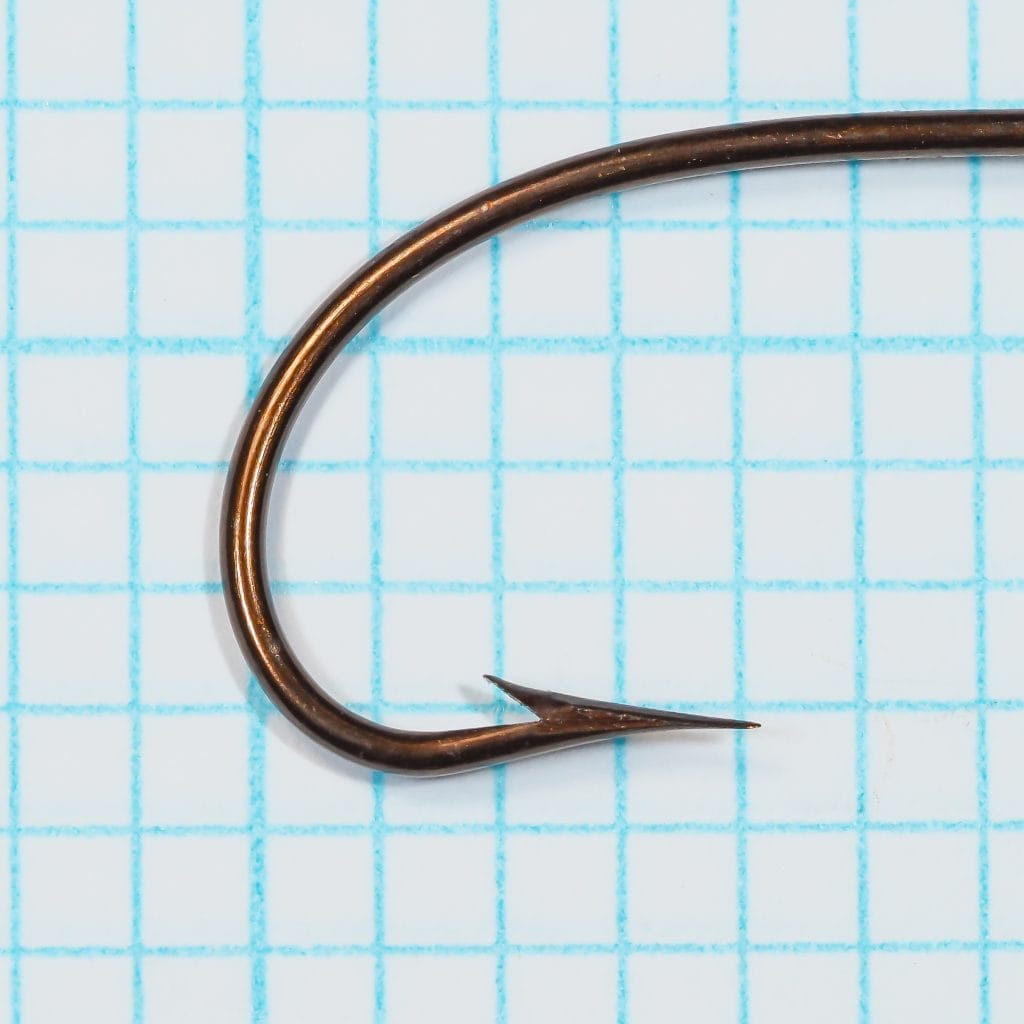
Close-up of the superior point and barb on the Mustad 3369A, showing the near-straight inner taper and fine hook tip on the 1/10-inch measurement grid.
Photographic record
5 cataloged imagesSelect any record to load it above.
5 images shown
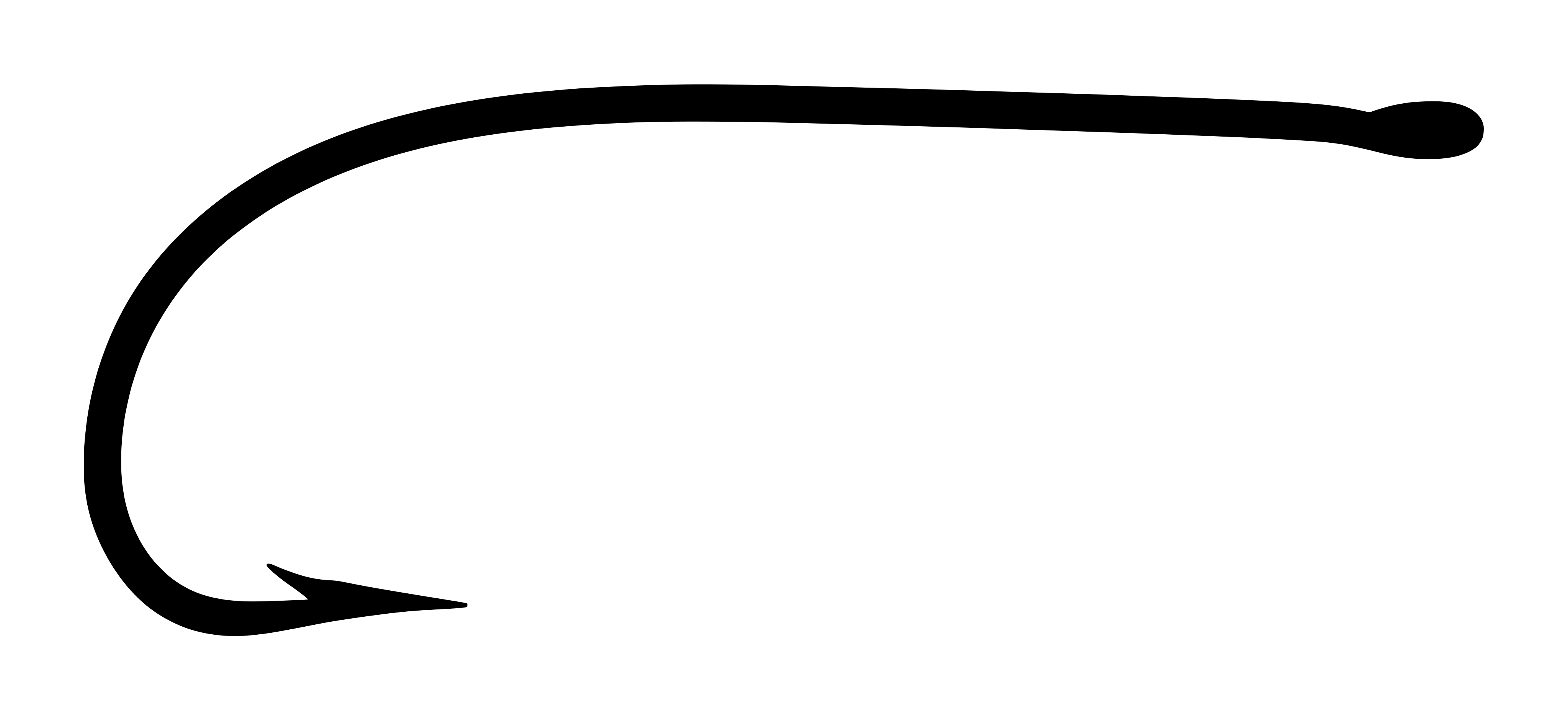
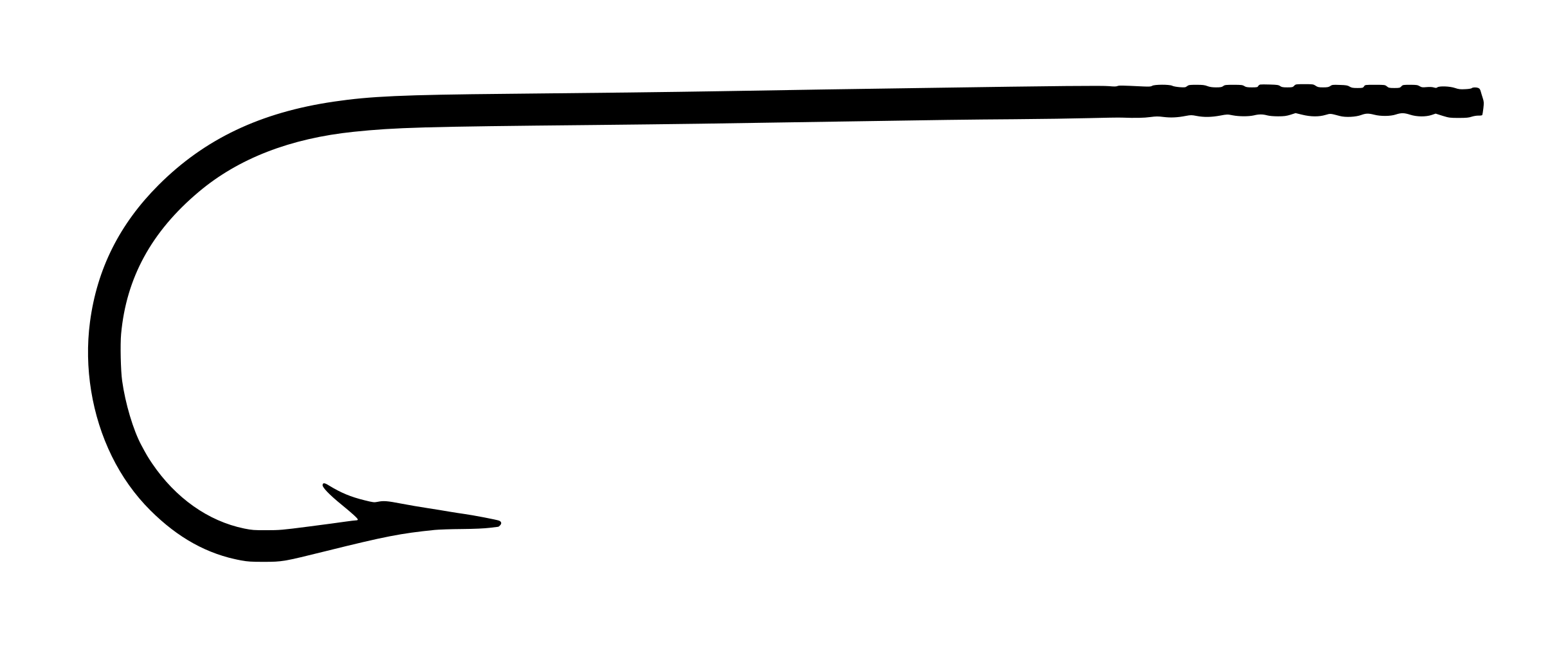
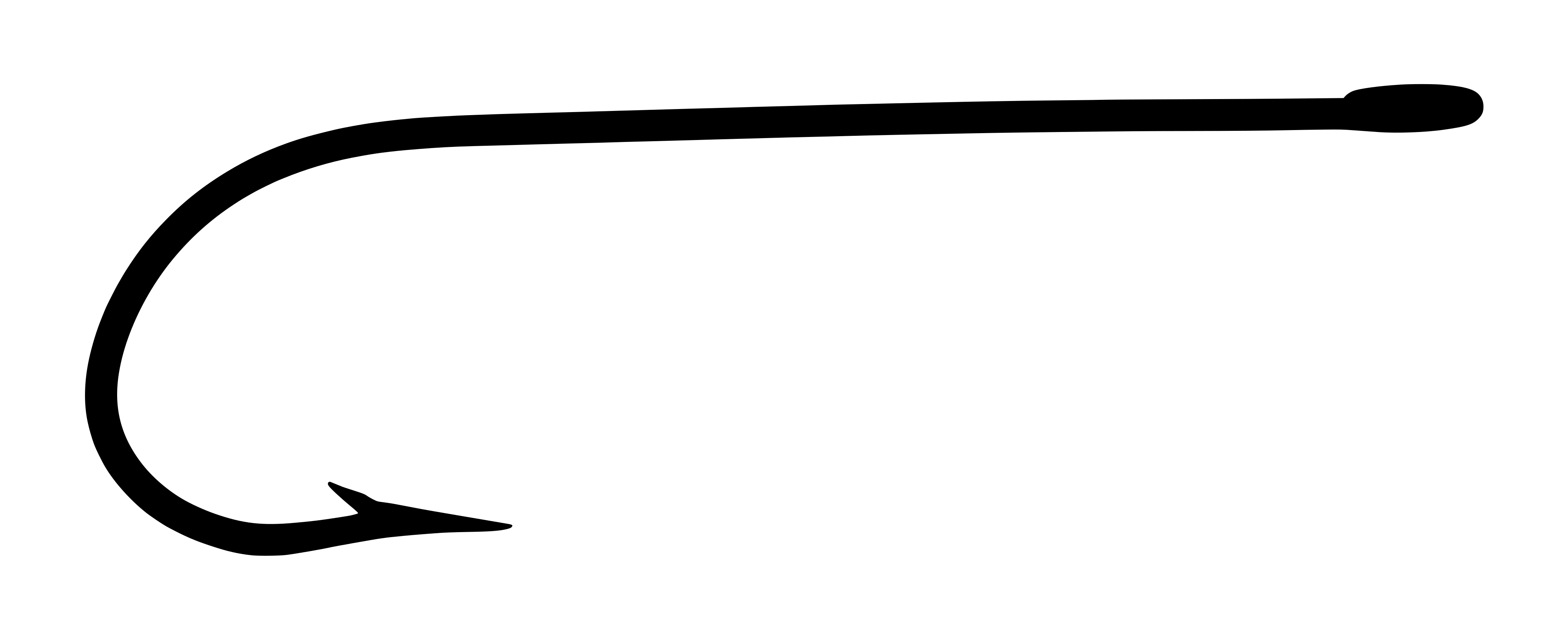
Mustad 3369A Sproat Size No. 1 — Point and Barb ProfileClose-up of the superior point and barb on the Mustad 3369A, showing the near-straight inner taper and fine hook tip on the 1/10-inch measurement grid.Open originalMustad 3369A Original Red Card Packaging with Specimen HooksThe complete package presentation: original bright-red Mustad card with eight-line label printing, two specimen No. 1 hooks shown in their stored state, demonstrating the packaging condition and label typography of 1950s–60s Mustad export products.Open originalMustad 3369A Sproat Bend Profile — Extended Shank DetailLateral side view revealing the parabolic Sproat bend curve and the extended shank characteristic of the 3369A variant, with bronzed finish visible on the steel surface.Open originalMustad 3369A Full Hook Profile — Top View with Large Ringed EyeDorsal view of the Mustad 3369A showing the large-diameter ringed eye, the entire extended shank, and the complete bend geometry in the plane of the hook's principal axis.Open originalMustad 3369 A HooksMustad 3369 A HooksOpen original
Technical profile
Mustad 3369A | Sproat Bend | Large Ring Eye | Long Shank | Bronzed | No. 1
Eye
Ball Eye, Straight / InlineLarge-diameter ringed eye formed from terminal wire bent back onto shank P. Ring diameter noticeably larger than standard wet fly hook eye, consistent with stated 'Large ring' specification on label V.
Wire
Fine (1X Fine), Round, Est. ~0.065"-0.072" (~1.65-1.83 mm)
Shank
2X Long — Plain
Bend
Sproat, Narrow gapParabolic curve visible in image 4, characteristic of Sproat pattern P. Depth and roundness consistent with standard Sproat geometry, slightly deeper than Aberdeen but less angular than Limerick E.
Point
Superior (near-straight inner taper)Short, close-cut barb positioned at the base of the point taper P. Barb angle approximately 45 degrees, consistent with standard vintage Mustad cut E.
Finish
Bronzed — Confirmed (stated on packaging)Dark brownish-gold lacquered coating visible in images 1 and 3, consistent with bronzed finish P. Tone is warm and muted, typical of Mustad bronzing process. Some minor patina and wear visible on specimen P.
Both specimen hooks in image 2 are in bright, unused condition with no corrosion or visible wear. Bronzed finish is uniform and well-preserved. Original red card stock shows light handling wear and minor color fading; no creasing or significant damage. Glue line at bottom flap intact.
Engineering Rationale — The Sproat Bend: The Sproat’s parabolic curve was engineered to distribute the mechanical stress of a fighting fish’s runs evenly across the entire bend radius, rather than concentrating it at a single stress point as the Limerick’s angular geometry does. This stress distribution creates superior fatigue resistance—a hook can be straightened by catastrophic force, but is far less likely to snap or crystallize under repeated flexing. The No. 1 size paired with heavy-gauge wire provided sufficient mass to handle large, powerful freshwater species (pike, large bass, salmon kelts) without bending under load. The 1/4-inch shank extension served dual purposes: for bait fishermen, it provided room to rig a worm without crowding the barb; for fly tyers, it created a platform for larger fly bodies and articulated sections. The large-diameter ringed eye accommodated thick hand-twisted gut snoods or, later, modern monofilament leaders without requiring knot-reduction techniques that weakened the connection point.
We have measurement for size 1. Know any others? Submit calipered measurements and we'll review and add them. Thank you!
Historical context
mustad
O. Mustad & Søn — Norwegian Industrial Ascendancy: Founded in 1832 in Gjøvik, Norway (originally as Brusveen Spiger- og Staltradfabrikk, a maker of nails and wire products), the company was restructured by Ole Hovelsen Mustad and his son Hans Mustad, who rebranded it as O. Mustad & Søn. The company’s pivot to hook manufacturing was catalyzed by Mathias Topp’s 1877 invention of the first fully automated hook-making machine—a proprietary technology that Mustad kept secret rather than patenting, securing devastating competitive advantage over Redditch and American hook makers. By the 1950s, Mustad controlled approximately 50% of global hook production, establishing sales offices and manufacturing capacity across multiple continents. The Oslo facility (referenced on this label) served as the primary export hub for European and North American markets. Mustad’s eight-line label system became the global standard for hook documentation, encoding technical specifications in a densely typographic format that communicated across language barriers.
Series History
The Mustad Sproat Series: The Sproat pattern entered Mustad’s catalog in the late nineteenth century as one of several ‘cloned’ regional designs acquired through reverse-engineering or direct purchase of competitor hooks. Unlike the Limerick (Irish) or Aberdeen (Scottish) patterns, the Sproat’s modest geographic origin made it easily defensible in international markets. By the early twentieth century, it had become Mustad’s most versatile general-purpose hook, manufactured in dozens of variants including the base model (Qual. 3366), tinned versions, bronzed bait hooks, long-shank streamers (Qual. 3369 series), and forged heavy-gauge salmon flies. The Qual. 3369 series specifically denoted the ‘long-shank Sproat’ line—introduced to serve both bait fishermen requiring extra shaft length and fly tyers who wanted a robust platform for large streamer bodies. The ‘A’ suffix indicated the 1/4-inch elongation; a ‘B’ variant existed with 3/8-inch extension. This model remained in the catalog through the 1970s, when Mustad’s transition to the modern Signature Series made the arbitrary numeric codes obsolete.
Named Collaborator
William Henry Sproat (exact dates unknown, active circa 1850s–1870s in Scottish angling circles) modified the earlier Limerick hook bend to create what became known as the Sproat pattern. The Sproat introduced a parabolic curve that sat mathematically between the sharply angular Limerick and the rounded Aberdeen, providing superior load distribution and fatigue resistance. While Sproat’s original design predated Mustad’s industrialization, the Norwegian manufacturer recognized the pattern’s mechanical superiority and made it the foundation of their general-purpose hook line. The Sproat pattern became so dominant in twentieth-century fly fishing that it is often taken as a universal standard against which other bends are compared.
Era and Packaging Dating
Oslo — Norway marking on label (not Christiania) indicates post-1925 production. Red paper card stock and letterpress printing method are characteristic of Mustad's mid-twentieth-century export packaging. Key Brand logo style and eight-line label typography match 1950s–1960s Mustad output. Absence of barcode confirms pre-1974 manufacture. 'Made in Norway' statement typical of post-WWII export packaging. Specific combination of design elements (red card, Oslo designation, this exact typography) most consistent with 1950–1965 timeframe.
From Scottish Tradition to Global Standard
The Sproat pattern's success demonstrates Mustad's industrial strategy of strategic 'cloning'—rather than inventing proprietary designs, they systematically reverse-engineered the best hooks from regional fishing traditions worldwide and then out-manufactured competitors through industrial efficiency. By 1960, this strategy had made 'Sproat' the most globally distributed hook pattern in history. What began as a modest Scottish refinement of the Limerick became, through Norwegian industrial scaling, the default hook geometry for three generations of anglers across five continents.
Design lineage and influence
The Sproat’s Evolution and Influence: The Sproat pattern emerged from Scottish and Northern English fishing traditions as a refinement of the Limerick design. Where the Limerick sacrificed mechanical efficiency for ornamental fly-tying aesthetics (the sharp angular bend provided a flat platform for salmon fly wings), the Sproat’s parabolic curve optimized for pure structural efficiency. This balance—not as delicate as the rounded Aberdeen, not as rigid as the Limerick—made it ideally suited to general-purpose bait and fly fishing. Mustad’s industrialization of the Sproat design set the pattern as the global default; by mid-twentieth century, ‘Sproat’ was synonymous with ‘general-purpose hook.’ Modern hooks from other manufacturers (Tiemco, Partridge, Daiichi) continue to offer Sproat-pattern alternatives, though the original Mustad 3366 (and its variants like the 3369A) remain the historical reference standard. The parabolic Sproat geometry directly influenced the development of contemporary round-bend hooks and contributed conceptual precedent to modern forged hook designs.
Best matchRelated by Attribute
Computed automatically from catalog data — updated as new hooks are added.
Matches: Bend, Gap, Eye, Eye Orient., Point +2 moreDiffers: Shank: 2X Long vs 3X Long; Wire: Fine (1X Fine) vs Standard; Finish: Bronzed vs Tinned +2 more
Matches: Bend, Eye, Eye Orient., Finish, Forging +3 moreDiffers: Shank: 2X Long vs 1X Long; Wire: Fine (1X Fine) vs Standard; Gap: Narrow vs Standard +1 more
Matches: Bend, Eye, Eye Orient., Point, Forging +2 moreDiffers: Shank: 2X Long vs 1X Long; Wire: Fine (1X Fine) vs Extra-Fine; Gap: Narrow vs Standard +2 more
Matches: Shank, Eye, Eye Orient., Forging, Application +2 moreDiffers: Bend: Sproat vs Carlisle; Wire: Fine (1X Fine) vs Extra-Fine; Gap: Narrow vs Standard +2 more
Originally marketed as a bait hook for live worm fishing, the extra 1/4-inch shank length prevented large-mouthed bass from easily shaking the hook during a jump and protected fragile gut or silk line from being severed by fish teeth. The No. 1 size and heavy wire made it suitable for larger freshwater species including bass, pike, and large trout. The Sproat bend’s parabolic geometry provided superior holding power under the sustained stress of fighting hard freshwater fish.
Secondary Applications
Modern fly tyers favor this hook for streamer patterns including Woolly Buggers, Matuka patterns, Muddler Minnows, and bucktail streamers. The large eye easily accommodates thick tying thread and dubbing. The long shank provides adequate body length for articulated flies.
Modern Signature Series 2XL streamer, round bend with heavy wire; maintains Sproat's structural principles but lacks vintage Sproat's parabolic geometry
Tiemco 7989
Good
Contemporary saltwater/streamer hook, forged construction, large eye; functionally similar for streamer use but different bend profile
Partridge Sproat
Excellent
Redditch-made traditional Sproat pattern (modern production); direct geometric equivalent to vintage Mustad 3366/3369A
Collector notes
Mid-twentieth-century Mustad Sproat variant with distinctive long shank and large ring eye. Scarce in original packaging, with modest collector interest driven by the Sproat pattern's foundational importance in fishing history and the hook's utility for modern streamer tying.
Reference value
$18 – $35 USD estimate
Packaging condition
Very Good — light wear, fully legibleRecorded specimen
Packaging format
GW-M-RedCard-1950sCatalog code
Positive Factors: This is an original red-card Mustad package from the 1950s–60s era, the golden age of Mustad’s global export dominance. The Sproat pattern is historically significant as one of the most widely adopted hook designs of the twentieth century. The specific long-shank, large-ring variant shows manufacturing specialization that reflected Mustad’s ‘cloning’ strategy of regional patterns. The ‘Superior’ designation on the label adds to the appeal for documentation-focused collectors. Excellent condition packaging with original 100-hook contents intact.
Limiting Factors: Size No. 1 is larger and less versatile than smaller bait and streamer sizes, limiting appeal to modern tyers who favor sizes 2–8. Sproat hooks remain in production under modern Mustad numbers, reducing rarity perception. The ‘Long Shank 1/4 Inch’ variant is less commonly encountered than standard Qual. 3366 or 3906B wet flies, but not exceptionally scarce. Market demand is primarily among vintage tackle collectors and fly-tying historians rather than contemporary fishing communities.
Packaging
Bright red paper card stock, classic Mustad eight-line label format. Key Brand logo (skeleton key symbol) upper left. Text in black letterpress: O. MUSTAD & SON / Manufacturers / OSLO — NORWAY / Qual. 3369 A / Superior / Mustad-Sproat Hooks / Large ring Bronzed / Shank 1/4 inch longer than regular / 100 / No. 1 / Made in Norway. Decorative asterisk borders top and bottom. No barcode. Glued closure flap at bottom (partially visible in image 2).
Market Value Notes
Typical asking price for unopened original packaging on eBay: $18–$28. Priced higher ($28–$35) if all 100 hooks are documented present and fishing condition verified. Mint condition card with hand-written provenance or notable collection history commands $30–$40. Loose hooks from broken cards: $0.15–$0.30 per piece. Value driven primarily by packaging condition and original seal integrity; loose hooks are considered commodity items.
Where to Find
eBay listings (search: Mustad 3369A, Mustad Sproat vintage, Mustad red card packaging). Specialist vintage tackle dealers online and at regional fishing tackle shows. Estate liquidations and antique fishing tackle auctions. Less commonly found in local antique shops unless proprietor has fishing tackle knowledge.
Preservation
Storage and Preservation
The bronzed finish on this hook is a lacquer-based coating (alkyd resin) designed to resist moisture and oxidation. Store the original card in a cool, dry environment away from direct sunlight and high humidity. The red paper stock is susceptible to fading if exposed to prolonged UV light; archival storage in a box or cabinet is ideal. Do not remove hooks from the card unless necessary for fishing—the packaging itself is a significant component of the hook’s historical and monetary value.
Loose hooks should be stored in individual compartmented boxes or glassine envelopes to prevent corrosion and galvanic interaction with other metals. A light coating of mineral oil or synthetic gun oil on loose hooks will extend the bronzed finish’s lifespan. Avoid storing near acidic materials (wood shavings, cardboard directly touching hooks) which accelerate corrosion. If the bronzed finish shows surface rust, do not attempt to remove it with abrasive materials—light surface patina on vintage hooks is cosmetically acceptable and does not compromise structural function. Re-varnishing or re-lacquering vintage hooks is not recommended, as it obscures original finish evidence and reduces collector value.
Primary Source
Label Decryption — The Eight-Line Standard
Source: Mustad Label Reference Document: A Comprehensive Typology and Decryption of Vintage O. Mustad & Søn Hook Labels
Line 1: O. MUSTAD & SÖN — Manufacturer identity, establishing Norwegian origin and brand authority.
Line 2: Manufacturers — Explicit assertion of primary manufacturing role (not import agent or jobber), critical for end-user brand loyalty.
Line 3: OSLO — NORWAY — Geographic origin marker. The use of ‘Oslo’ (rather than ‘Gjøvik’ or ‘Christiania’) dates the label definitively to post-1925; the Norwegian capital was officially renamed from Christiania to Oslo on January 1, 1925. Export packaging standardly listed the capital city for international recognition, even though Mustad’s primary factory remained in Gjøvik.
Line 4: Qual. 3369 A — Quality code identifying the specific model tier and variant. The ‘3000–3999’ range denotes mid-tier general-purpose hooks manufactured to exacting dimensional and tempering standards. The ‘A’ suffix indicates the 1/4-inch shank extension.
Line 5: Superior — This line is reserved exclusively for hook point specification. On this label, ‘Superior’ denotes the point style—a near-straight inner taper characteristic of superior-point geometry, providing durability and reliable penetration without the extreme delicacy of hollow points.
Line 6: Mustad-Sproat Hooks — The overarching bend pattern name, following Mustad’s strategy of industrializing regional hook designs. ‘Sproat Hooks’ identifies the geometric category and fishing tradition.
Lines 7–8: Large ring Bronzed / Shank 1/4 inch longer than regular — Anatomical modifiers specifying the eye type (large-diameter ring), the metallurgical finish (bronzed lacquer), and the key shank elongation. These modifiers transform the base Sproat pattern into a specialized variant suited to larger baits and streamer flies.
Bottom: 100 / No. 1 / Made in Norway — Quantity per box (100 hooks), physical hook size (No. 1), and manufacturing origin certification for post-WWII export compliance.
Size Note
Size Documentation and the Sproat 1/4-Inch Extension
The documented size is No. 1, a large hook in the vintage numeric scale. For context, modern fly hook sizing standards do not directly correspond to pre-1974 Mustad size numbering, particularly for bait hooks and streamers. A vintage Mustad No. 1 approximates a modern size 1/0 or small 2/0 in gap width, though wire gauge and overall architecture differ significantly. The hook’s total length of approximately 1.59 inches places it at the upper end of practical fly-tying sizes but well within the bait-fishing range.
The critical anomaly is the 1/4-inch shank extension. Standard Mustad Sproat hooks (Qual. 3366) feature a shank length approximately 0.84–0.90 inches. The 3369A adds 0.25 inches, yielding a total shank of approximately 1.08–1.15 inches—a 25–30% elongation. This specific extension was intentional, targeting two distinct markets: (1) bait fishermen who required additional shaft length to rig soft baits (earthworms, maggots, cut bait) without crowding the barb, and (2) fly tyers assembling large streamer bodies that demanded extended platforms. The large-diameter ringed eye (approximately 0.15–0.18 inches in diameter versus 0.10–0.12 inches on standard wet flies) was engineered to accommodate thicker hand-twisted leaders and modern monofilament without requiring diminishing-knot reduction techniques.
Additional
The Sproat Pattern — A Case Study in Industrial 'Cloning'
The Mustad 3369A embodies the core strategy that transformed Mustad from a regional Norwegian metal works into the world’s dominant hook manufacturer: systematic reverse-engineering of regionally successful designs and then industrial mass-production to dominate global markets. The Sproat pattern did not originate with Mustad. Rather, it was developed in Scottish and Northern English angling traditions as a refinement of the earlier Limerick design—a compromise between the ornamental, angular Limerick (favored for elaborate Atlantic salmon flies) and the utilitarian, wide-gape Aberdeen (favored for delicate live bait).
Mustad recognized the Sproat’s mechanical superiority—its parabolic curve distributed load stress evenly across the bend radius, making it far more fatigue-resistant than the Limerick’s angular point concentration—and acquired production rights or independently re-engineered the pattern. By 1920, the Sproat was the centerpiece of Mustad’s general-purpose line. The Qual. 3366 (standard shank) became ubiquitous; variants like the 3369A (long shank) and 3906B (smaller, wet fly) proliferated to address specialized market segments.
This strategy had profound competitive consequences. Redditch, England—the historical center of hook manufacturing—was overwhelmed. American hook makers (Pflueger, Wright & McGill) found themselves unable to compete on price or volume. By 1950, Mustad’s control of global hook distribution was so complete that ‘Mustad hook’ had become nearly generic, like ‘Kleenex’ for tissues. The Qual. 3369A, in its modest red card packaging, represents the culmination of this industrial ascendancy: a design perfected over decades, manufactured at a scale no competitor could match, and distributed to fishing communities across five continents.
Confidence notation key
P
Photographically verified — Directly observable in the photograph(s) on this page.
V
Verified by documentation — Confirmed by manufacturer catalog, spec sheet, or published reference.
I
Inferred — A logical deduction from observable or documented evidence, not directly stated.
E
Estimated — An approximation based on visual comparison, proportional analysis, or limited data.
S
Speculative — A reasoned hypothesis that cannot be confirmed from available evidence.
Claims with no notation are confirmed by multiple independent sources. All photographs on garrenwood.com are taken on a measurement grid where each square equals 1/10 inch (0.1″ / 2.54 mm).