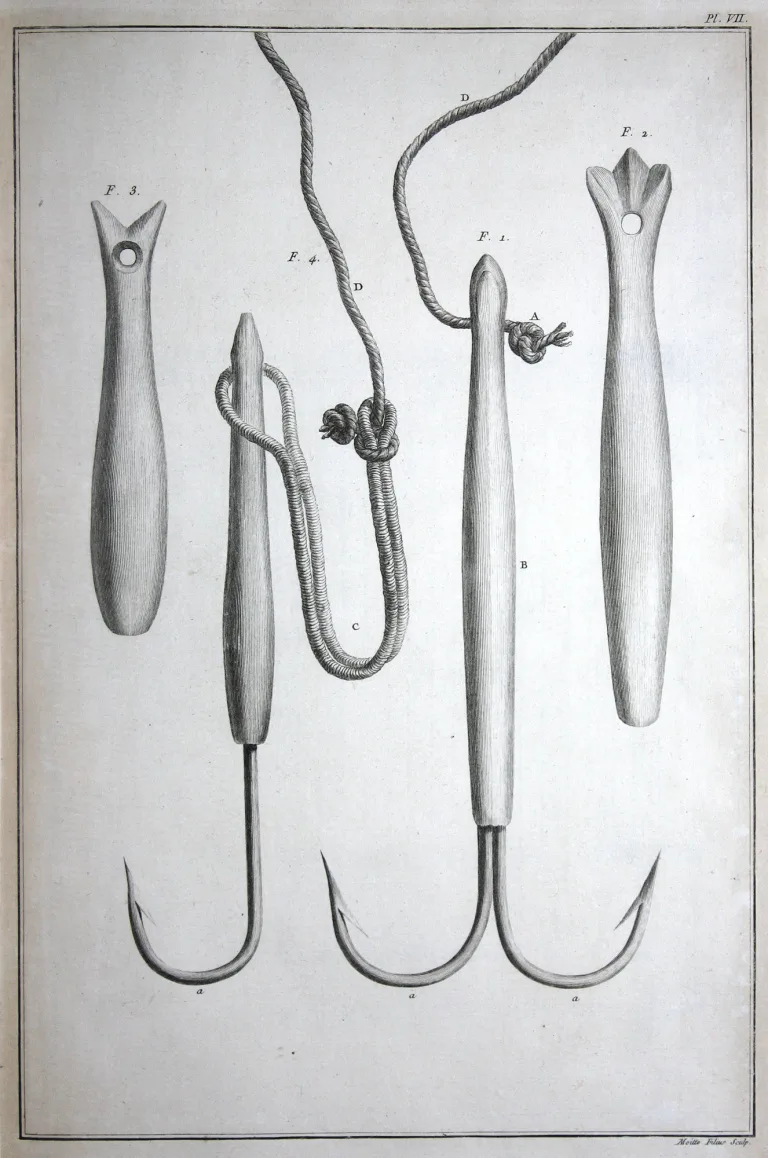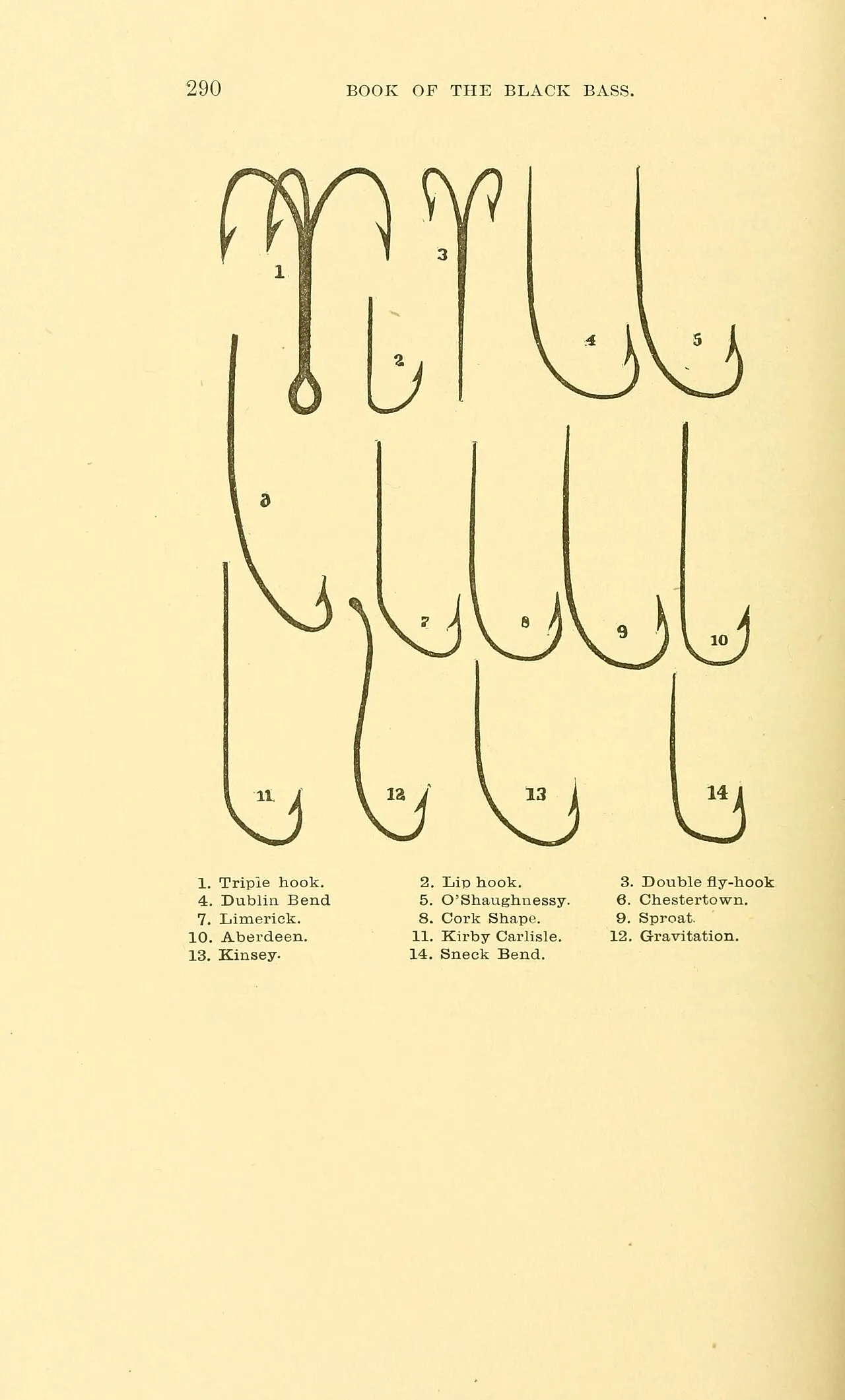
Ron Reinhold once wrote that the identity of most antique hooks is in extreme jeopardy because they were separated from their packaging long ago. He is right, and the corollary is that a hook still in its packet is worth several times a loose one, not because the paper is valuable but because it is evidence. A hook packet is a small printed document, and like any document it can be read. This article goes through a packet line by line: what the maker put on it, what each element means, and what it can tell you about date, market and quality that the hook alone cannot.
The forms a packet takes
Hooks were sold in three kinds of paper. The wrap or envelope is the needle-trade form: a printed rectangle of paper folded around the hooks, usually holding 25, 50 or 100, sealed with a fold or a spot of glue. The box is a small card box, often with a printed label on the lid, holding wraps or loose hooks; Mustad’s yellow boxes with the asterisk border are the best-known. The card is a printed card with hooks, often snelled hooks, held in slits or under a paper strip, for retail display. Each form has its own vocabulary, but they all carry the same core information.
The maker
The maker’s name, when present, is the anchor. “S. Allcock & Co. Limited, Standard Works, Redditch” or “O. Mustad & Søn, Gjøvik, Norway” settles the question. Be alert to three complications. First, the name may be a dealer’s, not a maker’s: Hardy, Farlow, Abbey & Imbrie, Herter’s and hundreds of smaller tackle houses sold hooks under their own labels, and the hooks inside came from Redditch, Kendal or Norway. Second, the name may be a brand rather than a firm: “Key Brand” is Mustad, “Sealey” is Edgar Sealey of Redditch, “Diamond” was used by several. Third, the corporate form changes with time. “S. Allcock & Co.” becomes “S. Allcock & Co. Limited” after incorporation, and “Ltd” or “Limited” on a British packet dates it after that event for that firm.
The pattern and the number
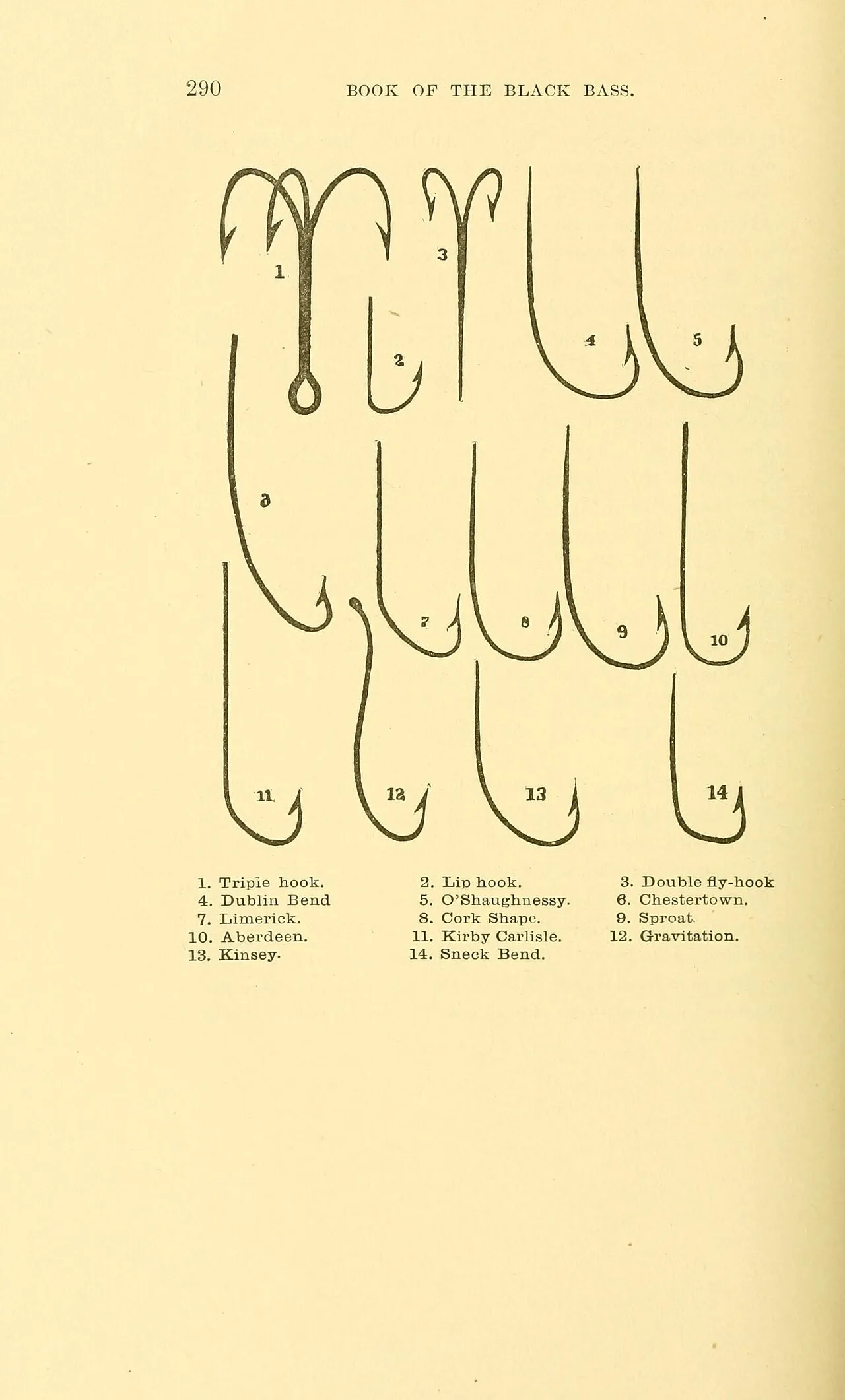
English packets usually name the pattern: “Limerick”, “Round Bend”, “Sneck Bend”, “Kirby”, “Sproat”, “Model Perfect”, and often qualify it: “Forged”, “Hollow Point”, “Superfine Wire”, “Down Eyed”, “Up Eyed”, “Tapered Eye”. Mustad packets rely on the quality number instead, “Quality 3906”, “No. 94840”, and the number is the pattern; a Mustad box with no number is unusual and worth a second look.
The size
The size is printed, stamped or hand-written, and which of those it is matters. A printed size was set when the packet was designed, so the packet was made for that size. A rubber-stamped or hand-written size means a generic packet filled to order, which was normal practice for small makers and dealers. If the size is given twice, one in brackets, the packet is British and from roughly 1890 to 1940, and the second number is Pennell’s new scale. If the packet is from Kendal, remember that the scale may run the other way; the site’s article on hook sizes explains this.
The count
“100 hooks”, “1/2 gross”, “25”, “1 dozen snelled”. The count tells you the market. Wholesale wraps of 100 and boxes of 1,000 went to tackle dealers and fly dressers; a gross or half-gross is a British trade count; small packets of 10 or 25 are retail, and usually later. Snelled hooks were sold by the dozen, on cards or in folded wraps, and the length of the snell is often printed as well (“9 inch gut”, “double gut”).
The language
Language is the most underrated dating clue. Mustad printed packets in Norwegian for the home market, in German and French for the Continent, in English for Britain, the Empire and America, in Spanish and Portuguese for South America, and in several Asian languages for the Far East, and the mix of languages on a given packet tracks the company’s export strategy decade by decade. A Mustad box with German first and English second is earlier than one with English first; a box with only English and a US importer’s name is post-war. Redditch packets are English, but “Made in England” on its own is a twentieth-century mark; nineteenth-century packets say “Redditch” and assume you know where that is.
Trade marks and printing
Trade marks date packets with more precision than anything else on them, because their registration and redesign dates are documented. Allcock’s stag, Mustad’s key and Partridge’s bird all went through versions, and a packet with an early version of the mark is early. Printing method helps too. Engraved or lithographed labels with fine ruled borders and several colours are nineteenth and early twentieth century; letterpress on cheap paper is interwar; offset printing with photographic elements is post-war; and any packet with a bar code is after 1975.
Does the packet match the hooks?
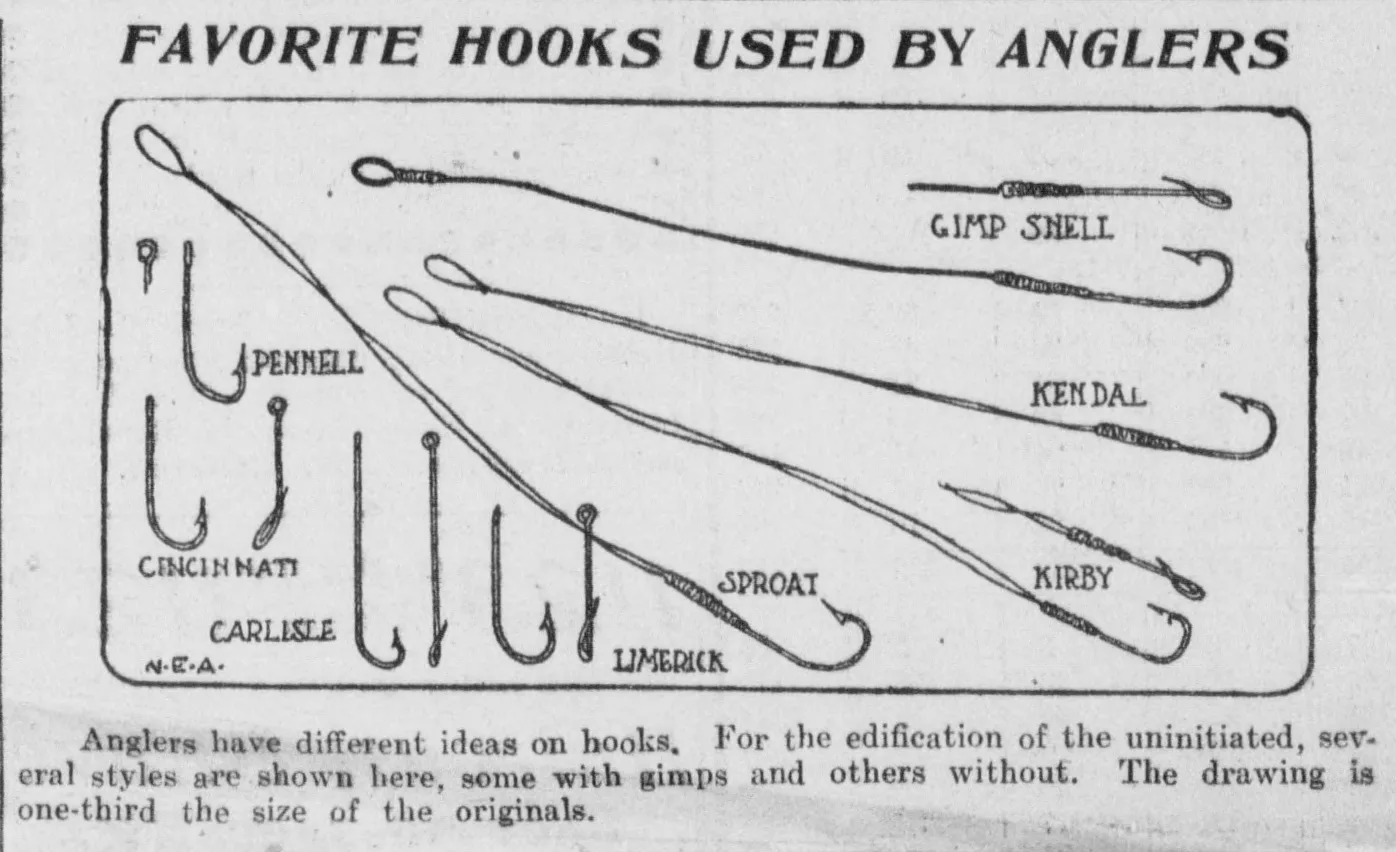
Finally, the question every packet has to answer: are these the hooks it was sold with? Open the wrap and check. The count should be right or nearly so; a wrap of 100 with 40 in it has been used, which is fine, but a wrap of 100 with 100 hooks of a different pattern has been refilled. The finish should match what is printed: a “Japanned” packet with bronzed hooks is wrong. The eye should match: “Down Eyed” with ringed hooks is wrong. And the hooks should be uniform. A mixed handful in a good packet is a dealer’s leftovers, and the packet is the collectable, not the contents. This is where the compare tool earns its keep: put one of the hooks beside the documented pattern and the match, or the mismatch, is obvious at true scale.
Keeping the paper
Once you have read a packet, keep it with its hooks, and keep it flat. The paper is the provenance, and the site’s Print Lab can produce a spec card to sit beside it so that the packet itself is never handled more than it has to be.
Source and further reading
Ron Reinhold, “Facts and Folklore About Hooks” and “Antique Hook Manufacturers”, on the restored Ronn Lucas Sr. site. The packet and box photographs throughout this site’s Mustad and Allcock sections.
Image note: The illustrations are public domain reproductions from Wikimedia Commons and are credited in their captions. Packet photographs from the collection accompany the individual hook entries.