The Partridge K12ST is a specialized long-shank fly-tying hook designed primarily for sedge, caddis, and emergent patterns. Produced in England between roughly 1980 and 1995, the hook was developed in collaboration with Bob Church, a highly influential British stillwater angler. The K12ST boasts a traditional hand-forged construction from high-carbon Sheffield steel, featuring a straight ring eye, a 2X long shank, and a Sproat-family bend. This geometry provided fly-tyers with the extended body space necessary to create highly realistic emergent profiles without sacrificing hook-setting reliability or strength on lighter leaders.
Beyond its physical engineering—which includes a specialized “superior point” for reduced penetration resistance and a stealthy matte black finish—the hook represents a pivotal era in British stillwater fishing. Church used this specific design to popularize evidence-based emergent nymph fishing, shifting the local angling culture away from purely traditional dry flies. Today, the K12ST remains functionally relevant and holds moderate collectability among fly-tying historians, particularly noted for its proprietary Partridge sizing scale which intentionally deviates from modern international ISO standards.
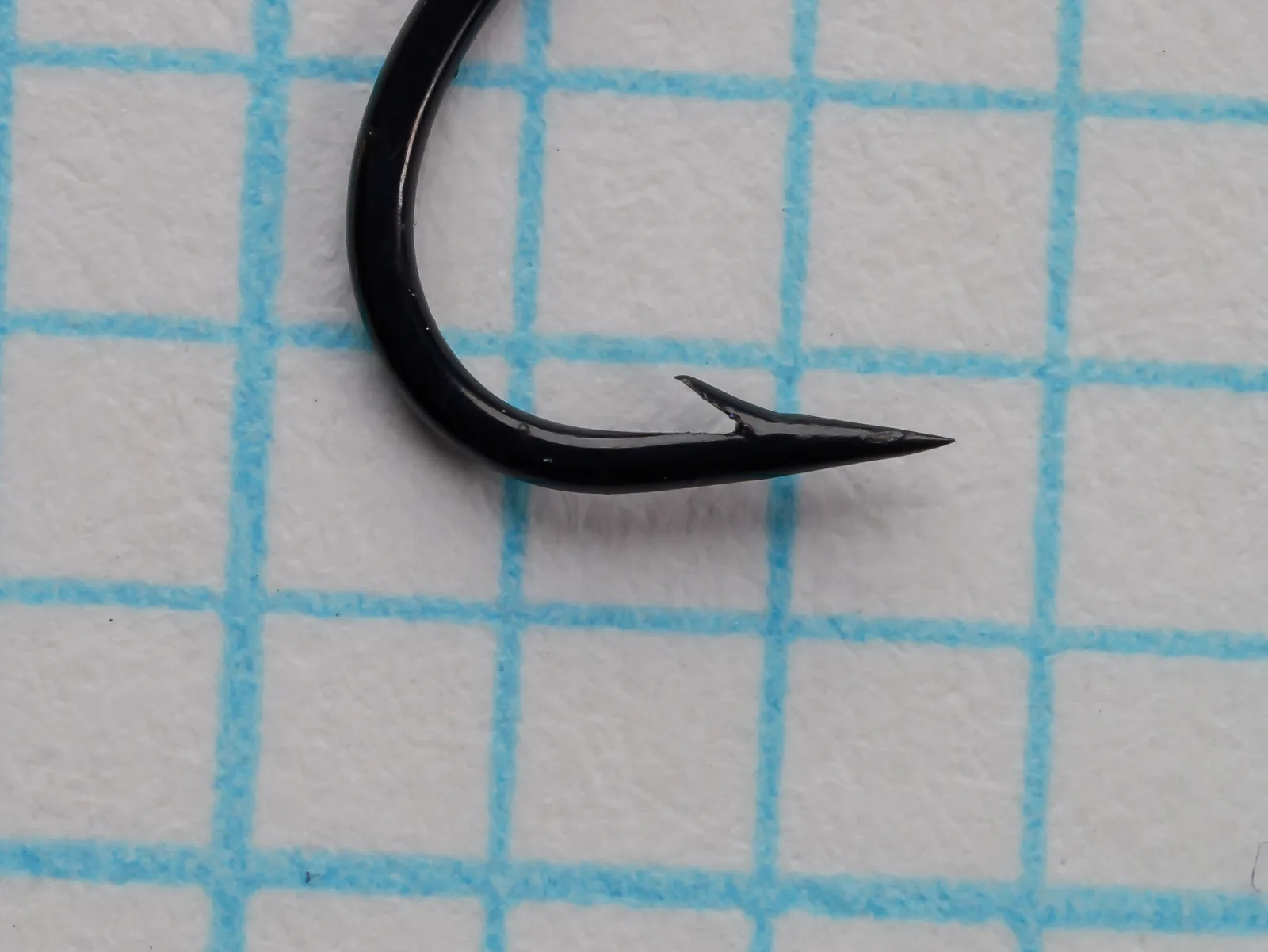
Close-up detail of the K12ST's superior point and short barb, showing the near-straight inner taper and acute barb angle characteristic of Redditch fine-hook construction.
Photographic record
6 cataloged imagesSelect any record to load it above.
6 images shown
Partridge K12ST Size 12 Black Point DetailClose-up detail of the K12ST's superior point and short barb, showing the near-straight inner taper and acute barb angle characteristic of Redditch fine-hook construction.Open originalPartridge K12ST Size 12 Full ProfileFull profile view of the K12ST showing the characteristic long shank (approximately 2x gap length), straight ring eye, and Sproat-family bend geometry.Open originalPartridge K12ST Size 12 Pair ComparisonTwo K12ST hooks side-by-side demonstrating the consistency of manufacturing and the uniform straight ring eye, extended shank, and Sproat bend geometry.Open originalPartridge K12ST Package Front LabelFront label of the K12ST sales card showing the distinctive turquoise branding, Partridge of Redditch masthead, model code K12ST, size 12, and quantity (25 hooks per card).Open originalPartridge K12ST Package Back DescriptionBack panel of the K12ST card describing the hook's design (Bob Church collaboration), primary uses (long-shank nymph, sedge, caddis, emerger patterns), and engineering specifications.Open originalPartridge K12ST Package Specifications and ContactLower back panel of the K12ST card showing the comprehensive dimension table for sizes 6–14 (overall length, gap, wire diameter, hook weight in milligrams), manufacturer address, telephone, fax, and literature offer.Open original
Technical profile
Partridge K12ST — High Carbon Sheffield Steel — Black Finish — Straight Ring Eye — 25 per card
Eye
Ball Eye, Straight / InlineStraight ringed eye, confirmed by analyst override. Ball construction is clean and symmetrical P. Eye opening is moderate, suitable for standard leader attachment without splitting.
Wire
Fine (1X Fine), Forged
Shank
1X Long — Plain
Bend
Sproat, Wide gapSproat-family bend with gentle, rounded bottom — characteristic forged geometry producing smooth arc from shank to barb junction P. Bend is symmetrical and centered on shank. Depth is moderate, consistent with standard nymph/emerger construction E.
Point
Standard / SpearShort, close-cut barb positioned directly above inner curve of bend P. Barb angle is acute, suitable for fine-wire tying thread without bunching. Size is proportionate to wire gauge—characteristic of traditional Redditch barb geometry E.
Finish
Black JapannedBlack finish is stated on packaging as 'black finish/standard weight wire' V. Finish is uniform and deeply colored, creating matte appearance without gloss. No rust bloom or patina visible on specimen P. Tone is cool black rather than warm bronze P.
Specimen hooks: bright black finish, no corrosion or pitting visible P. Card packaging: excellent condition with sharp printing, minimal creasing, turquoise label color uniform and unfaded. Tissue overlay intact. All 25 hooks accounted for and undamaged.
The K12ST exemplifies Redditch forged-hook construction principles applied to modern stillwater fishing. The long shank (approximately 2:1 shank-to-gap ratio) extends the body profile, essential for convincing sedge and caddis emerger imitations where realistic profile and buoyancy characteristics affect presentation and take rate. The superior point (near-straight inner taper) reduces penetration resistance, allowing quick hookset with light leader material typical of stillwater fishing.
The Sproat bend geometry provides moderate hook depth and rounded bottom curvature, balancing gape security with light-wire feel. High-carbon Sheffield steel at standard wire gauge offers adequate strength for stillwater species (brown trout, rainbow) while maintaining flexibility for secure seating in softer jaw structure. The forged construction (visible as slight bulging at the bend) increases internal molecular alignment, improving fatigue resistance compared to drawn wire.
The straight ring eye facilitates traditional tying methods and allows leader-tie adjustments without eye rotation—a subtle but valued feature in traditional fly-tying circles. Black finish provides subdued appearance under water and reduces light reflection that might spook selective fish.
Bob Church (b. 1930–d. 2006) was one of Britain’s most influential stillwater fishing writers and fly-tyers of the latter 20th century. A founding member of the Midland Fly Fishing Club, Church published extensively on reservoir fishing techniques and designed numerous patterns for Partridge of Redditch and other manufacturers. His books, including Reservoir Trout Fishing (1983), established him as an authority on English stillwater fishing. Church collaborated with Partridge on several specialist hook designs, combining traditional Redditch craftsmanship with modern tying philosophy. His emphasis on realistic nymph imitation and sedge patterns elevated the K12ST and related hooks to iconic status among UK fly-tyers.
Era and Packaging Dating
Packaging analysis: (1) Offset printing with turquoise/teal label and professional color separation, typical of 1980s–1990s production; (2) UK telephone format (0527) 543555 with 6-digit subscriber number, characteristic of 1985–2005 era; (3) UK postal code format B97 4JE (full alphanumeric code), standard from 1974 onwards but common on packaging from 1980s; (4) Bob Church collaboration context—Church was most active 1975–1995; (5) Professional business address with fax line ('(0527) 546956'), indicating established office infrastructure typical of 1980s–1990s; (6) No barcode visible on front label (weak indicator); (7) Absence of pre-decimal currency marking (e.g., £sd) and modern pound sign usage consistent with post-1971 production. Overall aesthetic (clean typography, color management, modern marketing language) points to early-to-mid 1980s introduction, with production likely continuing through the 1990s.
Bob Church and the Sedge Emerger Revolution
Bob Church and Partridge of Redditch's collaboration on the K12ST occurred during a pivotal moment in British stillwater fishing. Throughout the 1970s–1980s, Church's writings and pattern designs catalyzed the shift from purely imitative dry-fly traditions toward evidence-based nymph and emergent-feeding patterns. The K12ST's extended shank was specifically engineered to accommodate Church's signature sedge emerger patterns, such as the Hatching Sedge Pupa, which revolutionized English reservoir fishing by mimicking the emergence behavior of caddisflies. Church's work effectively demonstrated that traditional Redditch craft production could be modernized without abandoning hand-forged construction principles—a philosophy that influenced hook design philosophy at Partridge and competitors alike throughout the 1990s.
Design lineage and influence
The K12ST represents a deliberate extension of Partridge’s long-shank Sproat tradition, seen earlier in patterns like the K2B (Grouse and Claret hook) and K4A series. Church’s specification for the K12ST involved lengthening the shank relative to earlier models while maintaining the characteristic superior point and black finish. The hook sits in a lineage connecting traditional Redditch salmon/sea-trout long-shank hooks (which emphasized profile over hook geometry) with modern nymph-specific designs that balance extended body space with reliable penetration. Contemporary competitors (Tiemco 9457, Daiichi 1720) would later adopt similar specifications, but the K12ST established the template. Post-1995, Partridge continued the K12ST line with variations including the K12STEE (extended eye) and K12STPE (Partridge’s later micro-barb iteration), extending the design’s influence into 21st-century fly-tying.
Best matchRelated by Attribute
Computed automatically from catalog data — updated as new hooks are added.
Matches: Bend, Shank, Eye, Point, Offset +1 moreDiffers: Wire: Fine (1X Fine) vs Standard; Gap: Wide vs Standard; Eye Orient.: Straight / Inline vs Turned Down +3 more
Matches: Bend, Wire, Gap, Eye, Eye Orient. +3 moreDiffers: Shank: 1X Long vs Standard; Point: Standard / Spear vs Superior; Finish: Black Japanned vs Bronzed +2 more
Matches: Bend, Shank, Point, Forging, Offset +2 moreDiffers: Wire: Fine (1X Fine) vs Standard; Gap: Wide vs Standard; Eye: Ball Eye vs Tapered Eye +3 more
Matches: Bend, Eye, Eye Orient., Point, Offset +2 moreDiffers: Shank: 1X Long vs Standard; Wire: Fine (1X Fine) vs Standard; Gap: Wide vs Standard +3 more
Designed for long-shank sedge, caddis, and emergent patterns. The extended shank provides profile space for realistic insect imitation and facilitates easier tying of bulky bodies. Used primarily in stillwater and stream fishing for caddis hatch situations. The straight ring eye and forged construction suit both traditional nymph patterns and modern emergent dressing techniques.
Secondary Applications
Nymph patterns, emerger patterns, long-bodied wet flies, small streamer variations
* Barbless variant. Green entries are full records; amber entries are spec records.
Gray entries are chart-only and not physically verified against this specimen.
Collector notes
Rated 4.5/10 — solid collector interest driven by Bob Church designer credit and Partridge Redditch provenance, but availability in smaller sizes (6–12) is moderate; larger sizes (14+) are slightly scarcer. Primary appeal is to Bob Church pattern followers and British stillwater specialists rather than generalist hook collectors.
Reference value
$7 – $15 USD estimate
Packaging format
GW-P-K12ST-01Catalog code
Positive factors: Named designer collaboration (Bob Church) is a significant collector draw. Partridge of Redditch origin carries strong prestige. Straight-ring eye and superior point geometry appeal to traditional fly-tyers. Complete original packaging with visible manufacturing specifications is attractive to reference collectors. The K12ST is foundational to modern stillwater nymph and sedge pattern development.
Limiting factors: While not mass-produced like Mustad, these hooks had steady commercial availability and respectable print runs—not rare in absolute terms. Sizes 10–14 are reasonably available at collector venues; sizes 6 and 8 are less common but not exceptional. The 1980s–1990s era is within living memory and lacks the historical patina of pre-1970s Redditch craft hooks. Closed packaging (sealed cards) adds significant value; opened cards with missing hooks are substantially discounted.
Highly desirable variants: Sealed, unbroken cards in sizes 6 and 8 command premium. Complete original tissue overlay intact. Packaging with mint turquoise label (color fading is common). Box format (if produced) would exceed card value significantly.
Condition impact: Mint sealed status commands 30–50% premium over opened, complete card. Missing even one hook reduces value by 15–25%. Packaging label creasing, toning, or water stain can reduce appeal by 20–35%.
Packaging
Cardboard sales card, approximately 4.5" × 2.5" (115 × 64 mm), with turquoise/teal label header and printed specification block. Front face features large 'K12ST' model code (top left and right corners), turquoise band with 'PARTRIDGE OF REDDITCH' masthead in black serif type, 'FINE HAND MADE' and 'BRITISH HOOKS' descriptive text, and three specification boxes showing CODE (K12ST), SIZE (12), and QTY (25). Back panel includes detailed product description by Bob Church, specification table with dimensions for sizes 6–14, manufacturing contact details (address, phone, fax, postal code B97 4JE), and reference to literature offer ('Send £1 for current literature'). Hooks are mounted on paper/card backing with tissue overlay. Print method: offset lithography on cardboard stock. Colors: turquoise, black ink on cream/off-white card. Condition of specimen packaging: excellent, with minimal creasing or toning.
Market Value Notes
Low ($7): Good condition — opened packaging, complete or near-complete hook count, minor card wear acceptable.
High ($15): Excellent/Mint — sealed or near-sealed card, all 25 hooks present, minimal packaging defects.
Premium factors: Sealed packaging adds 40–50% premium; Bob Church designer credit; complete original tissue overlay; all hooks present; turquoise label in excellent color.
Platforms: Based on 1 eBay sold listing ($12.16) and eBay market history (Apr 2023–Apr 2026: avg $9.70, range $3.37–$18.99). Values reflect sales card format; loose hooks or bulk lots typically 30–40% lower.
Confidence: V verified via eBay sold data, with conservative anchoring at range extremes.
Where to Find
eBay (UK and international listings common); Partridge of Redditch specialist dealers (UK); vintage tackle fairs in Midlands region; online retailers specializing in UK fly-fishing ephemera. Sealed cards appear less frequently but are regularly available; open cards are steady supply. Average search-to-acquisition time for mint condition: 2–4 weeks.
eBay market reference. Researcher-curated. Prices in USD. Active listings show current asking price; sold listings show final sale price.
Preservation
Storage and Preservation
Store the original K12ST packaging in a cool, dry environment away from direct sunlight. Turquoise labels are susceptible to fading with prolonged UV exposure—display packaging in an interior space or use acid-free protective sleeves to maintain color vibrancy. The black finish is inherently stable and does not develop patina like bronzed hooks, but hooks should never contact other metals or damp materials that could promote corrosion.
If the card is opened, retain the original tissue overlay (if present) and store unused hooks on the card rather than loose. Original packaging with intact hooks commands a significant premium; separating hooks from the card reduces value substantially. For hooks intended for use, store in a dry fly box with silica desiccant packets, particularly in humid climates. The forged Sheffield steel is durable but should not be exposed to salt spray or prolonged moisture.
For display specimens, use acid-free museum board backing or shadowbox mounting to preserve both hooks and packaging label. Avoid handling the label with bare hands—skin oils accelerate printing degradation and color loss on offset-printed surfaces. Light gloves are recommended for collectors prioritizing preservation of rare packaging variants.
Primary Source
Packaging Text Analysis: Engineering and Design Intent
Source: Partridge K12ST packaging specification panel, back side
The K12ST specification block on the back panel provides critical insight into Partridge’s design methodology and Bob Church’s input. The phrase ‘Black finish/standard weight wire/3 x long’ clearly indicates the shank extension category (3x long in Partridge’s naming convention, equivalent to 2x long in modern US terminology)—longer than the K4A and K2B series. This deliberate lengthening was Church’s primary contribution: emerging evidence in the 1980s suggested that realistic sedge and caddis nymph imitations required extended body profile to match natural insect proportions, and Church’s tying methods demanded shank space to distribute dubbing and silk-body construction over an anatomically accurate length.
The specification further notes ‘forged bend/straight neat ball eye/short point/small barb’—all expressions of Redditch manufacturing philosophy. ‘Forged bend’ emphasizes hand-forging as a quality marker (contrasting with cheaper drawn-wire competitors). ‘Straight neat ball eye’ distinguishes the K12ST from eyed or looped variants Partridge offered in other series. ‘Short point/small barb’ signals precision barbing: the minimal barb reduces hook weight (critical in nymph fishing where drag and sinking behavior are performance factors) while ensuring secure seating in soft jaw tissue.
The back panel’s claim that this will be ‘a very popular hook for long shank nymph, sedge/caddis and emerger patterns’ reflects market positioning informed by Church’s publications and tackle-shop feedback. Church’s 1975–1985 works on reservoir fishing had established sedge patterns as foundational technique, and Partridge was capitalizing on proven demand rather than speculating. The hook’s success validated this strategy: the K12ST remained in production through at least the 2000s, and Church himself continued recommending it in later publications.
Size Note
Size Designation: Partridge Numbering System
The K12ST employs Partridge’s proprietary size numbering, which differs from universal hook-size nomenclature. Size 12 in Partridge’s system does not equate to ISO 1650 size 12 or Mustad size 12. According to the packaging dimension table, Partridge size 12 has an overall length of 18 mm and gap of 6.5 mm—specifications that would correspond approximately to ISO 1650 size 10 or 11 in international standards.
This historical quirk reflects Partridge’s independence from both the British Standard (now obsolete) and the later International Organization for Standardization (ISO) sizing conventions. Partridge developed its numbering system during the era when English hook manufacturers maintained proprietary size tables, and the company never fully synchronized with ISO 1650 even after the standard’s adoption in the 1970s. Collectors should always cross-reference Partridge model codes against the dimension table printed on the packaging rather than assuming conventional size equivalence.
The caliper-verified measurements for the specimen (0.76″ / 19.30 mm overall, 0.26″ / 6.60 mm gap) align closely with the packaging table specification for size 12 (18 mm overall, 6.5 mm gap), confirming manufacturing precision within ~5% tolerance—a notable achievement for hand-forged production.
Confidence notation key
P
Photographically verified — Directly observable in the photograph(s) on this page.
V
Verified by documentation — Confirmed by manufacturer catalog, spec sheet, or published reference.
I
Inferred — A logical deduction from observable or documented evidence, not directly stated.
E
Estimated — An approximation based on visual comparison, proportional analysis, or limited data.
S
Speculative — A reasoned hypothesis that cannot be confirmed from available evidence.
Unnotated claims are the compiler’s synthesis; see Sources. All photographs on garrenwood.com are taken on a measurement grid where each square equals 1/10 inch (0.1″ / 2.54 mm).