Selected size
10
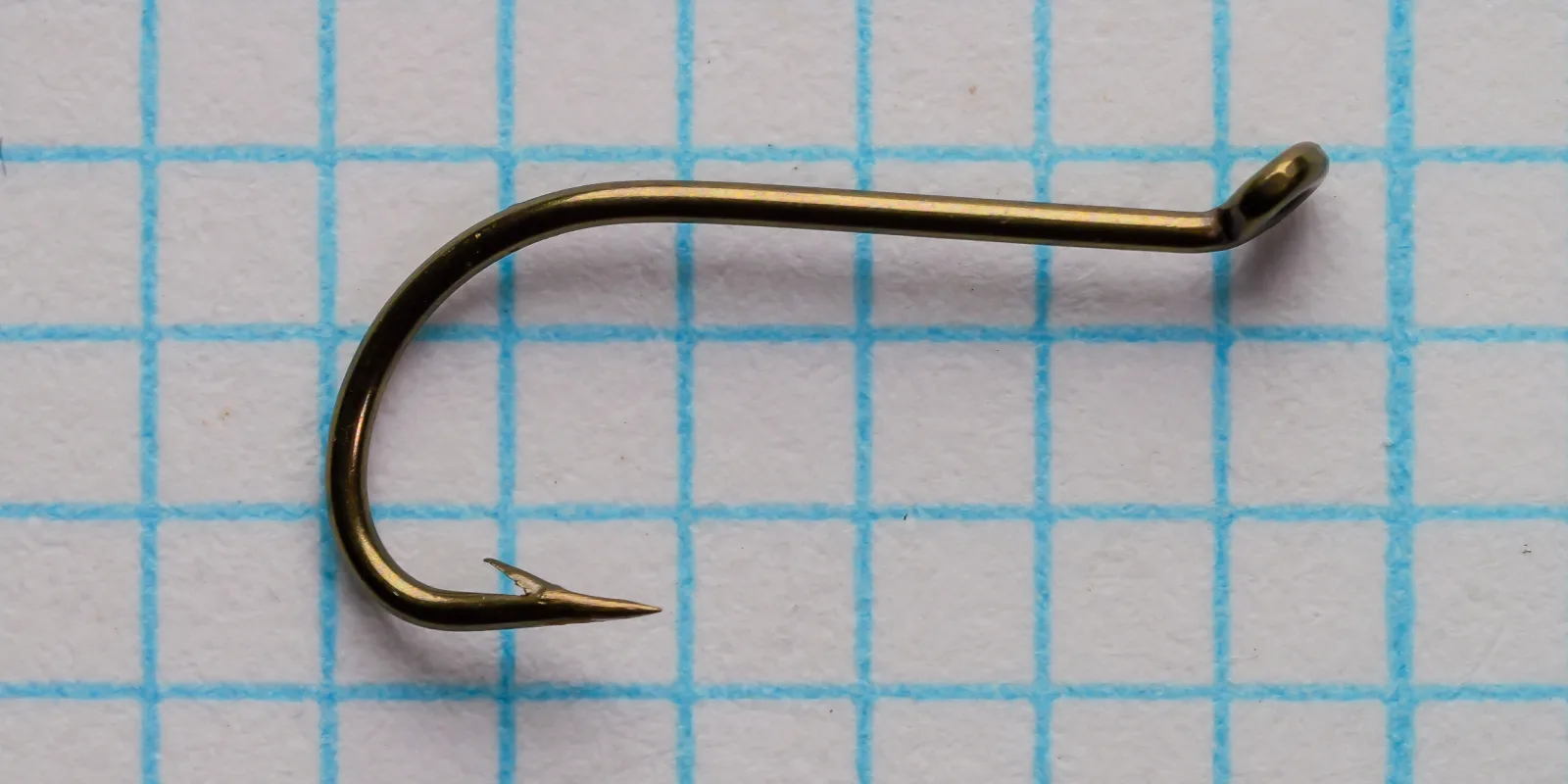
Physical specimen
- Overall Length
- 14.2 mm P
- Shank Length
- 10.2 mm
- Gap Width
- 5.6 mm P
- Confidence
- P Physical specimen
Physical measurement with calipers
 Garren WoodFishing Hook Reference

Save this hook to your account to build a list you can come back to.
The Albert Partridge Widegape Up Eye Hook, model B, size No. 10, is a classic British trout hook manufactured by Partridge of Redditch during the mid-20th century. This is a small, fine-wire general-purpose pattern with a looped up-eye, sproat-style bend, and superior point geometry — designed for wet fly, dry fly, and nymph fishing across a broad range of trout conditions.
The specimen is manufactured from high-carbon Sheffield steel in a bronzed finish, a warm reddish-brown tone characteristic of traditional Redditch production. The hook exhibits Partridge’s signature refined craftsmanship: smooth, evenly-forged bend, precise barbing, and balanced proportions that were the hallmark of English fly-hook manufacture at mid-century.
Dating and era evidence: The green-tinted lithographic card stock, absent barcode, absence of postcode on the Redditch address, and ‘FINEST HAND MADE’ messaging place this in the 1930-1960 window, most likely 1945-1960. The presence of ‘ALBERT PARTRIDGE’ branding (rather than the later formal ‘A.E. Partridge & Sons Ltd.’) and the card’s layout style support a pre-1970 Redditch-era origin.
Collecting significance: Model B is a scarce code outside specialist Redditch circles. The widegape specification and fine wire make this suited to modern tyers working with small wet flies and nymphs, and original packaging in green card is distinctly less common than later Fishing Matters–era reissues. The superior-point geometry and compact shank place this in Partridge’s core trout-pattern tradition.
3 cataloged imagesSelect any record to load it above.
3 images shown
Partridge Model B — Looped Up-Eye, Sproat Bend, Standard Shank, Standard Wire, Superior Point, Bronzed Finish
The superior-point geometry on this hook reflects a specific engineering choice by Partridge designers. A superior point features a near-straight inner taper from the barb to the tip, with a nearly flat inner (concave) face. This geometry offers a balance between hook-point sharpness and durability — the near-straight taper penetrates readily into a trout’s mouth, while the broader inner profile resists bending or breaking under load. In contrast, a hollow point (concave inner face with an inward curve) is sharper but more fragile; a spear point (symmetrical taper) is more durable but slightly duller.
The sproat bend (rounded bottom, gentle upsweep) is a foundational British pattern family dating to the 19th century. This geometry distributes hook stress evenly across the bend, making it well-suited to fine wire and hand-forging techniques. The widegape specification indicates an increased distance between the point and the inner shank, accommodating bulkier nymph bodies and soft-hackle wraps without crowding the eye.
High-carbon Sheffield steel, as printed on the card, was the premium material for English fly-hook manufacture. Sheffield steelworks had a historic reputation for consistent carbon content and workability. High-carbon steel (typically 0.7–0.9% carbon) is harder and holds a sharper point than mild steel, but is also more brittle if work-hardened excessively. The forging and tempering process (controlled heating and quenching) is critical to achieving the correct balance. This hook likely received a standard temper — sufficient hardness to hold a point, without excess brittleness.
Physical measurement with calipers
This entry documents an early example of Partridge Model B Widegape Up Eye in original Redditch-era green-card packaging. The green-tinted card format is distinctly uncommon in the garrenwood.com database; most surviving Redditch-era Partridge cards are in cream or tan stock. The absence of both barcode and postcode on the Redditch address provides a useful primary-source dating anchor (pre-1974) for cross-referencing other British hooks in similar packaging.
We don't have measured sizes for this hook yet. Own one? Submit calipered measurements and we'll review and add them. Thank you!
Sources: this specimen and its packaging.
The ‘Model B Widegape Up Eye’ does not belong to a named series per Partridge’s documented catalog tradition. Rather, it represents a standalone pattern code within the broader trout-hook range, likely designed as an economical or regional alternative to the more celebrated named patterns (Captain Hamilton, Bartleet). Unlike the Bartleet series (CS10 family with /1, /2, /3, /4 variants) or the L-series Captain Hamilton patterns, Model B does not appear in surviving modern catalogs or contemporary documentation, suggesting it was discontinued or had limited distribution prior to the Mustad acquisition.
The code ‘B’ itself is consistent with Partridge’s simple-letter nomenclature inherited from the Redditch trade tradition, wherein single letters often denoted broad hook families or specifications (e.g. L for looped trout, K for curved-shank specialty, M for salmon). The ‘Widegape’ specification indicates an increased gap between the point and inner shank — a characteristic that would appeal to nymph and wet-fly tyers seeking room for fur and feather without crowding the eye.
Production dating: The green-card packaging and ‘hand made’ messaging suggest Model B was produced primarily during the mid-20th century (1945–1960s), possibly continuing into the 1970s under Bramley’s ownership. The hook may have been retained in limited production for trade-order customers (e.g., specific retailers or regional fly shops) even after the main Partridge brand shifted focus to the named-collaborator patterns that became standard from the 1980s onward.
Green-tinted card stock with period-correct lithographic printing characteristic of mid-20th-century Redditch packaging. 'Made in England' marking visible on card P. No barcode present, consistent with pre-1974 era. Postcode absent from Redditch address, supporting pre-1974 production. Logo font and layout (oval Partridge nameplate with decorative end-marks) match Bramley-era (1970-1996) revival catalogs, but card construction and paper stock match earlier Redditch-era materials (1930s-1950s). Card reads 'FINEST HAND MADE BRITISH HOOKS' and 'ALBERT PARTRIDGE' — a naming convention pre-dating formal A.E. Partridge & Sons Ltd. incorporation (1933). The combination of hand-made messaging, absent barcode, absence of postcode, and paper stock suggests 1930-1960 range, most likely 1945-1960.
The Partridge Model B Widegape appears in only a handful of surviving original Redditch-era catalogs, and its exact design lineage is not well-documented in modern hook references. Unlike the famous Bartleet and Captain Hamilton patterns (which have continuous histories), Model B may represent a regional or retailer-specific variant produced on trade commission. The green-card packaging itself is a rarity in today's market — most surviving Redditch cards are in cream or tan stock; the lime-green colour appears primarily in the 1950s era, making this packet a useful dating anchor for collectors cross-referencing other green-card Partridge hooks.
The Partridge Model B sits within the broader British sproat-bend trout-hook tradition that dates to the 1860s-1880s. The sproat family includes hooks from competing Redditch makers (Allcock, Milward, Edgar Sealey) and represents a fundamentally different design philosophy from the earlier Limerick and Dublin patterns that dominated salmon tying. Sproat bends prioritize a rounded bottom and gentle upward return, distributing stress and permitting finer wire gauges — a critical innovation as fly tyers moved toward smaller, more delicate patterns for clear-water trout fishing.
Partridge adopted and refined the sproat geometry through the work of Albert Edwin Partridge (later A.E. Partridge & Sons Ltd., 1933). The Captain Hamilton bend (Partridge’s signature sproat variant, designed c. 1903) became the flagship for the manufacturer’s trout line, but the simpler Model B Widegape likely served as an entry-level or economical alternative for retailers and individual tyers who wanted Partridge quality without the premium pricing of the named-designer patterns.
No direct successor code appears in modern Partridge catalogs, though the L-series trout patterns (L3A Captain Hamilton Dry, L2A Wet) represent the evolutionary continuation of this design tradition. The Model B was likely discontinued when Partridge rationalized its catalog during the Mustad era (1996–2009), though some production may have continued for regional or wholesale customers through the 1970s-1980s.
| Silhouette | Hook Model | Match | Compare |
|---|---|---|---|

|
S1938 No. 7 — S 1938 | 77% | Compare |

|
3911 No. 4 — Mustad 3911 | 60% | Compare |
The Albert Partridge Widegape Up Eye Hook, model B, is a general-purpose British trout hook designed for small wet flies, dry flies, and nymphs — primarily sizes 10-14. The looped up-eye accepts thread wrapping without slipping, and the widegape geometry accommodates fur and feather bodies of varied bulk without crowding the eye. The superior-point geometry (near-straight inner taper) offers a balance between penetration and durability, suited to traditional soft-hackle wets and emerging-insect patterns on chalkstreams and limestone rivers of England and Wales.
Soft-hackle wets (Partridge and Orange, March Brown, Greenwell's Glory), small dry flies (Ephemerid duns, small Wulffs), simple emergent nymphs
| Hook | Match Quality | Notes |
|---|---|---|
| Partridge L3A Captain Hamilton Dry | Good | Same manufacturer, looped up-eye, sproat bend, but finer wire and slightly shorter shank; designed specifically for dry fly rather than wet/nymph versatility |
| Daiichi 1180 Curved Dry | Moderate | Modern looped up-eye sproat-bend pattern; wire gauge similar but point geometry is hollow rather than superior |
| Tiemco TMC 200R | Moderate | Modern turned-down eye dry-fly hook; equivalent in size and application but different eye orientation and finish |
Rated 4.5/10 — Model B is uncommon in original Redditch packaging; the green-card format and 'hand made' messaging are distinctly scarcer than later Fishing Matters reissues. Collector interest is moderate among Redditch specialists and mid-20th-century packaging enthusiasts. Size 10 is readily available in later production; vintage Redditch-era specimens in original packaging add meaningful premium.
Collectability Drivers: This is an original Redditch-era hook in period-correct green-tinted card packaging with ‘FINEST HAND MADE BRITISH HOOKS’ messaging. The absence of a barcode and postcode, combined with the paper stock and lithographic print quality, place it firmly in the 1930-1960 window — a golden era for British fly-hook manufacture. Model B (Partridge’s catalog designation for the Widegape Up Eye) is less frequently encountered than the more famous Partridge dry-fly and salmon patterns, making original carded specimens moderately scarce.
Limiting Factors: Model B lacks the historical prominence of Partridge’s Captain Hamilton trout patterns or the Bartleet salmon irons, so collector demand is narrower. The widegape specification appeals to nymph and wet-fly tyers but not the broader dry-fly community. As a non-signature pattern (no named designer credit), it lacks the cachet of later Partridge collaborator hooks.
Variant Desirability: The green-card format is more desirable than any later reprint. Original packaging in this era is increasingly scarce as many cards were opened and hooks used. Complete, unopened cards command a premium. Sizes 10-12 in Redditch-era packaging are most desirable; larger sizes remain common.
Condition Factors: Card condition is critical. The green tint and lithographic printing are prone to fading and foxing with age. Original tissue and intact hook count elevate value significantly. Corrosion on hooks is uncommon with bronzed finish but does occur with careless storage; rust stains on the card devalue both packaging and hooks.
Card sales packet, approximately 2.5" × 4" (6.4 × 10.2 cm), lime-green tinted card stock with black lithographic printing. Header area features oval 'PARTRIDGE OF REDDITCH' nameplate with decorative double-line flourishes on either side; beneath it reads 'FINEST HAND MADE BRITISH HOOKS.' Lower section contains three information boxes: left box reads 'CODE B', centre box shows 'SIZE 10' (with '10' hand-stamped or pen-marked in blue ink), right box reads 'QTY 25.' Below the main label line reads 'ALBERT PARTRIDGE' in bold type, followed by 'WIDEGAPE UP EYE HOOKS' and 'HIGH CARBON SHEFFIELD STEEL.' A rectangular cutout at the top of the card provides hanging display access. Small text reading 'MADE IN ENGLAND' is visible in fine print. No barcode, no postcode, no EAN marking — all consistent with pre-1974 origin. Original tissue wrapper not visible but likely present within sealed card. Card exhibits light aging, minor toning to the green tint, and faint foxing spots on reverse; lithographic registration is clean and precise.
Low ($8): Good condition — card shows light wear and toning, all 25 hooks present, packaging intact with minor creasing.
High ($18): Excellent condition — card nearly mint, original tissue present, all hooks bright with no corrosion, no creasing or foxing.
Premium factors: Original Redditch-era green-card packaging, absence of barcode and postcode (pre-1974 indicator), 'hand made' messaging, complete hook count, tissue integrity.
Platforms: eBay UK sales (specialist Redditch hook listings), Classic Fly Rod Forum marketplace, UK tackle dealers and fairs.
Confidence: E estimated — limited direct eBay sold-listing data for Model B specifically. Estimate derived from comparable Redditch-era carded hooks (Allcock, Milward, Edgar Sealey Model B patterns) which typically achieve $6-22 depending on packaging condition and format. Model B has narrower specialist appeal than branded collaborator patterns, placing it at the lower end of this range.
eBay UK (search 'Partridge Redditch Model B' or 'Partridge Widegape'), Classic Fly Rod Forum marketplace, UK tackle dealers specialising in vintage English hooks (particularly those handling Redditch estate collections), annual fly-fishing fairs in England and Wales.
Store this hook and its original packaging in a cool, dry environment away from direct sunlight and sources of moisture. The bronzed finish is stable and resistant to corrosion under normal conditions but can develop patina (dark oxidation) with prolonged humidity exposure — a process many collectors consider desirable but which reduces the reflective properties of the finish.
Original card packaging should be stored flat or in a protective archival sleeve to prevent creasing, foxing, and pigment fading. The lime-green lithographic printing is sensitive to light; prolonged UV exposure will cause the green tint to fade toward beige or tan. Consider storing the card in a dark archival box or portfolio away from window light.
If the hooks are removed from the card for tying, store the card separately to preserve its integrity as a reference specimen. Do not attempt to restore or clean the card’s printing or foxing spots — any attempted cleaning risks permanent damage to the lithographic surface.
Avoid contact between the hooks and other metals, which can initiate galvanic corrosion. Store in acid-free tissue or kraft paper if hooks are separated from the original card. Inspect periodically for any signs of rust or discoloration; if light surface oxidation develops, it may be gently removed with a dry cotton cloth — never use liquid cleaners or abrasive materials.
The original packaging card displays a hand-stamped or pen-marked size designation ’10’ in blue ink within the ‘SIZE’ box on the card face. This marking is consistent with mid-20th-century Redditch production practice, where individual size numbers were often applied by hand rather than pre-printed, allowing for flexibility in packing mixed-size assortments or custom orders.
The quality and colour of the blue ink suggests it was applied with a fountain pen or similar writing instrument, typical of factory or retail packing stations of the 1940s-1960s era. No additional handwritten notations (price, date, retailer name, tyer initials) are visible on the visible surfaces of the packaging.
The presence of hand-application marking (rather than complete pre-printed sizing) is another indicator of the Redditch-era production period and suggests this card may have been part of a larger batch of blank-printed cards that were subsequently hand-sized and assembled for retail distribution.
Source: Partridge Model B card packaging, original lithographic print
‘FINEST HAND MADE BRITISH HOOKS’ — This claim appears prominently on the card header and reflects the marketing emphasis placed by Partridge and competing Redditch makers on hand-crafted production. During this era (1930-1960), ‘hand made’ was a premium signifier, contrasting Redditch and Sheffield output with increasingly mechanized Continental (particularly German) and American production. The claim is literally accurate: hooks were forged by hand at the forge (with power-assist bellows and trip hammers, not fully manual work) and finished by hand-filing and hand-point sharpening.
‘ALBERT PARTRIDGE’ — The use of the personal name ‘Albert Partridge’ rather than the formal company designation ‘A.E. Partridge & Sons Ltd.’ suggests a transition phase in branding. The formal incorporation occurred in 1933, but cards and catalogs using the personal name ‘Albert Partridge’ continued to circulate well into the 1950s-1960s, particularly for retail-level packaging. This naming convention is useful for dating: if a Partridge-branded card reads ‘Albert Partridge’ (personal name) rather than the full corporate entity, it generally places the production in the 1933-1970 window.
‘HIGH CARBON SHEFFIELD STEEL’ — This material specification is historically accurate. Sheffield steelworks were (and are) renowned for high-quality carbon steel suitable for cutlery, tools, and fine wire. High-carbon steel (typically 0.7-0.9% carbon content) offers superior point retention and durability compared to mild steel, justifying the premium pricing associated with Redditch and Sheffield products. The claim underscores Partridge’s commitment to material quality and serves as a differentiator from lower-cost competitors.
‘WIDEGAPE’ — A functional descriptor indicating an increased distance between the point and the inner shank wall, accommodating bulkier fly bodies. This specification language was standard in the Redditch trade and allowed tyers to select patterns suited to their intended fly styles (heavy nymphs and soft hackles vs. slim dry flies).
| P | Photographically verified — Directly observable in the photograph(s) on this page. |
| V | Verified by documentation — Confirmed by manufacturer catalog, spec sheet, or published reference. |
| I | Inferred — A logical deduction from observable or documented evidence, not directly stated. |
| E | Estimated — An approximation based on visual comparison, proportional analysis, or limited data. |
| S | Speculative — A reasoned hypothesis that cannot be confirmed from available evidence. |
Unnotated claims are the compiler’s synthesis; see Sources. All photographs on garrenwood.com are taken on a measurement grid where each square equals 1/10 inch (0.1″ / 2.54 mm).
Your cart is empty.


