Wright & McGill (Eagle Claw)
USA · 1925 · Eagle Claw
The Wright & McGill Co.: A Century of American Hook Making
1925: The Foundation in Flies The Wright & McGill Co. began not with stamped steel, but with thread and feather. In 1925, Drew McGill and Stan Wright founded the company in Denver, Colorado, with a simple goal: to tie high-grade fishing flies that outperformed anything else on the market. Their early success, such as the famous Wiltless Wing Fly, established a strong reputation for quality among anglers. However, they soon realized that even the best-tied fly was only as good as the hook underneath it.
The Colorado River Epiphany The turning point in fishhook history occurred in the late 1920s. While fly fishing on the upper Colorado River, Drew McGill found himself frustrated. The trout were rising, but they were incredibly difficult to hook. Taking a break to smoke his pipe, McGill watched a pair of eagles circling above. When one swooped down and effortlessly gripped a branch with its powerful talons, an idea struck him.
McGill realized that the penetrating power of the eagle’s talon came from its sweeping curve and direct line of pull. He took his fishing pliers and physically altered the shape of his flies right there on the riverbank, curving the points slightly inward. The modified hooks instantly improved his catch rate. Returning to Denver, he set out to manufacture this new design, utilizing high-carbon steel to forge a hook with a sweeping curve and a sharper point that aligned directly with the pull of the leader.
1938: The Birth of the Eagle Claw By 1938, Wright & McGill officially registered the “Eagle Claw” trademark. This revolutionary design was the first major improvement in fishhook geometry in hundreds of years. The forged, double-offset hook swept the nation. Those early high-carbon steel hooks became the gold standard of the era—in fact, the quality of that original metallurgy is a primary reason why many of these vintage hooks are still highly sought after and carefully restored by hook historians today.
Decades of Innovation and Expansion Through the mid-20th century, Wright & McGill grew into a tackle powerhouse. While they expanded into legendary bamboo and fiberglass fly rods (such as the Granger and Trailmaster lines), hook manufacturing remained the beating heart of the company. As the needs of fly tiers evolved—from classic dry fly presentations to the heavy-wire, wide-gape jig hooks required to tie modern euro style nymphs—the company continuously adapted its wire forming and tempering processes.
They consistently pushed the boundaries of hook technology:
-
- 1985: Introduced Lazer Sharp hooks, pioneering the first American-made needlepoint hook.
-
- 2002: Launched the TroKar line, utilizing patented Surgically Sharpened Technology (SST) for competition-level penetration.
Present Day: 100 Years of American Craftsmanship Today, the company is globally recognized as Eagle Claw Fishing Tackle Co., though the Wright & McGill name remains a cornerstone of their heritage. Celebrating their 100th anniversary, they stand proudly as the only major fishhook manufacturer still operating in the United States.
Under the leadership of Drew McGill—the grandson of the founder—the company continues to forge its hooks in Denver, Colorado, using American-made wire. Recently, the company expanded its footprint by breaking ground on a new, state-of-the-art manufacturing facility in Cheyenne, Wyoming, to further modernize their production. From the hands of a frustrated angler on the Colorado River to producing over a billion hooks, Wright & McGill’s legacy is permanently set in the history of American angling.
From Forge to Laser: Understanding the Steel
For the collector and the fly tyer, understanding the difference between a vintage Wright & McGill hook and a modern Eagle Claw is about more than just age—it is about the metallurgy and the philosophy of the edge.
The Classic Era: High-Carbon Steel (1920s – 1980s)
The vintage hooks found in those iconic yellow boxes were forged from classic high-carbon steel. This material is the favorite of traditionalists and restorers for a specific reason: it is “alive.”
-
- The Temper: These hooks were tempered to be tough but slightly pliable. If a hook snagged a rock, it might bend rather than snap, allowing the angler to retrieve it and bend it back.
-
- The Point: Before chemical sharpening, points were ground mechanically. This meant they were incredibly durable but often required a touch-up with a hook file before fishing. For the modern restorer, this is a benefit—these hooks can be honed to a needle-sharp edge again and again.
-
- The Finish: You will often see these described as “Bronzed” or “Japanned.” These traditional lacquer and heat treatments protected the steel but were not impervious to the elements. This is why finding a box of vintage hooks often involves a little rust removal—a labor of love that reveals the grey, honest steel beneath.
The Modern Era: Vanadium & Chemical Sharpening (1985 – Present)
As fishing evolved, so did the demand for harder, sharper steel. The introduction of the Lazer Sharp and TroKar lines marked a shift toward high-tech manufacturing.
-
- The Alloy: Modern hooks often incorporate vanadium and higher carbon content. This creates a much stiffer, stronger metal with a smaller diameter wire. However, this hardness comes with a trade-off: modern hooks are more brittle. They do not bend; they hold their shape until they break.
-
- The Point: Modern hooks are chemically sharpened (acid-etched) or surgically ground (like the TroKar). Out of the package, they are sharper than any hand-filed hook could ever be. However, once that point is dulled on a rock, it is difficult to restore manually.
-
- The Finish: Modern plating technologies, such as Black Pearl, Platinum Black, and Sea Guard, offer superior corrosion resistance, meaning the “ritual” of drying your flies to prevent hook rot is less critical than it was in the past.
At a Glance: Vintage vs. Modern
| Feature | Vintage Wright & McGill | Modern Eagle Claw / TroKar |
| Base Material | Standard High-Carbon Steel | High-Carbon / Vanadium Steel |
| Sharpening | Mechanical Grind (Fileable) | Chemical/Surgical (Hard to file) |
| Flexibility | Moderate (Will bend before breaking) | Low (Stiff, may snap under high stress) |
| Restoration | Highly Restorable (Rust removal/polishing) | Difficult (Plating often flakes) |
| Best For | Classic Wet Flies, Traditional Dry Flies | Euro Nymphs, Competition Fishing |
Sidebar: The Restorer’s Guide to Vintage High-Carbon Hooks
Finding a dusty box of classic Wright & McGill hooks often means dealing with a bit of surface rust. Because these are forged from classic high-carbon steel, they are highly restorable, but the process requires a gentle touch to ensure you don’t ruin the original temper of the wire.
Here is how to bring those vintage points back to life:
1. Safe Rust Removal Avoid heavy abrasives like sandpaper or aggressive wire wheels, which can heat the fine wire of the hook and permanently destroy the temper, making it brittle.
-
- Chelating Baths: The safest method is soaking the hooks in a non-toxic chelating rust remover (like Evapo-Rust) or standard white vinegar. These solutions dissolve rust chemically without eating away at the good steel or generating heat.
-
- The Process: Soak the hooks for 1 to 12 hours, checking periodically. Once the rust has dissolved into a black sludge, rinse them thoroughly in water, then immediately neutralize them with a quick bath in water mixed with baking soda.
2. Polishing the Steel Once the rust is gone, you will be left with dull, bare high-carbon steel.
-
- Dry the hooks completely (a hair dryer works well).
-
- Use 0000 steel wool to gently buff the surface. This removes any remaining residue and brings out a clean, gray shine without altering the hook’s diameter or point geometry.
3. Refinishing and Protecting Bare high-carbon steel will begin rusting again almost immediately if exposed to moisture. You have a few options for refinishing them to match their historical look:
-
- Cold Bluing: A liquid gun blue (available at sporting goods stores) can be applied with a cotton swab. This chemically darkens the steel, providing a finish very similar to vintage “Japanned” or bronzed hooks, while offering a mild layer of corrosion resistance.
-
- Wax Coating: For hooks meant for display or dry storage, a light coat of micro-crystalline wax (like Renaissance Wax) seals out oxygen and moisture completely without adding noticeable bulk.
-
- Tying as Protection: If you plan to fish them, the thread and head cement used during the fly tying process naturally protect the shank. Just remember to thoroughly dry your flies after a day on the water!
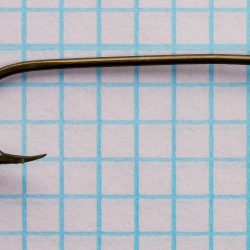
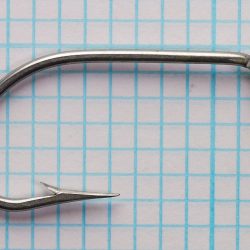
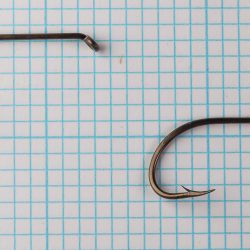
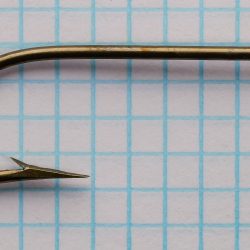
| Model | Name | Specification | Application | Era | Rating | |
|---|---|---|---|---|---|---|
|
|
100 | Wright & McGill Model 100 |
Sproat
Standard
Bronzed
|
Dry
Wet
|
c. 1955-1965 | |
|
|
1197N | Eagle Claw 1197N |
Sproat
Standard
Bronzed
|
Bait
SW
|
c. 1970-1985 | |
|
|
255SS | Eagle-Claw 255SS O'Shaughnessy |
Standard
Nickelled
|
Wet
Streamer
Bait
|
c. 1965-1975 | |
|
|
80 | Eagle Claw |
Sproat
Standard
Bronzed
|
Dry
Wet
Nymph
|
c. 1930-1950 |