
Mustad Hooks – 3808

Mustad 3808
Mustad 3808c. 1900–1924
Save this hook to your account to build a list you can come back to.
Record summary
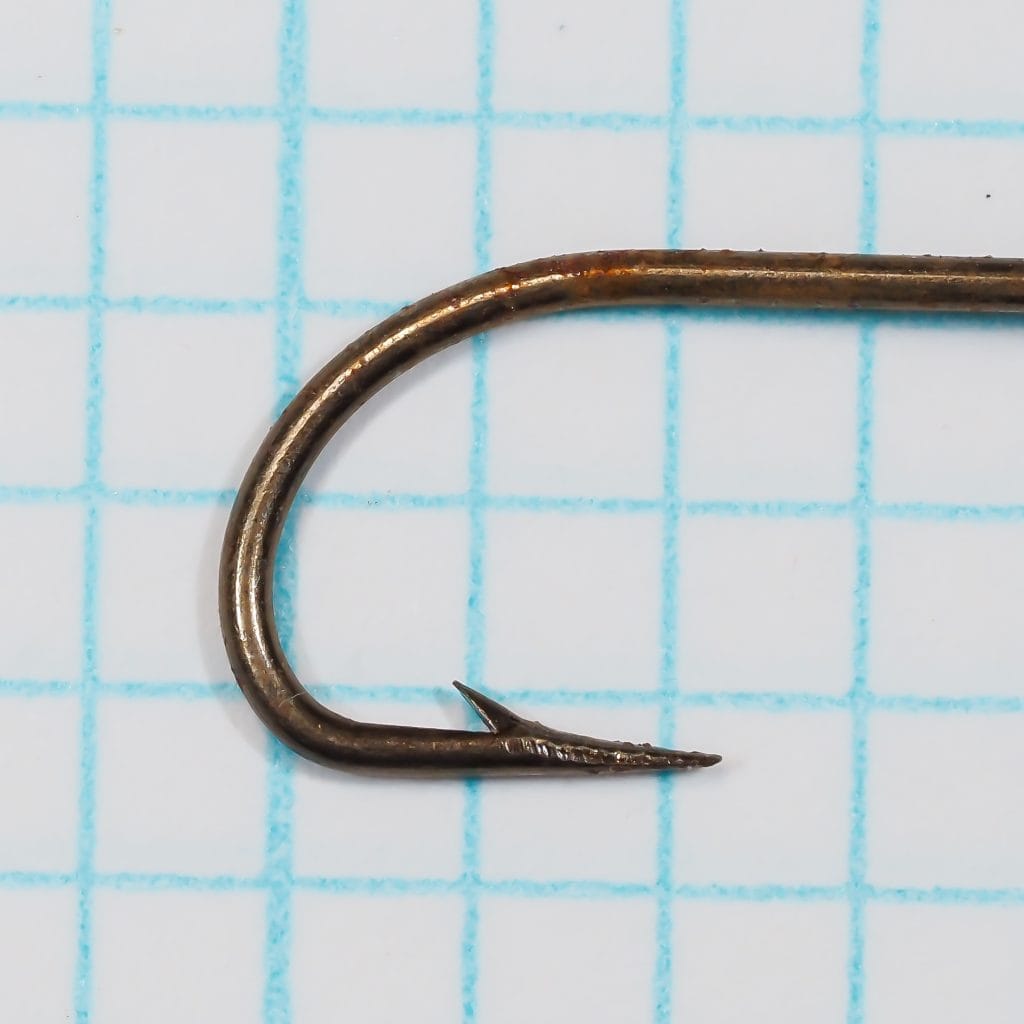
The Mustad 3808 is a vintage O’Shaughnessy bend hook manufactured by O. Mustad & Son in Christiania, Norway, dated to the 1900–1924 period. The hook features a ringed (straight) eye, extra-heavy round wire, and a hollow point ground to exceptional sharpness for penetration with minimal applied pressure.
The “Christiania” location designation on the original label is critical for dating: the Norwegian capital was officially renamed to Oslo on January 1, 1925. Any Mustad box bearing “Christiania” is conclusively pre-1925, establishing this as a genuine artifact from the firm’s initial aggressive push into American and global export markets.
The 3808 was engineered as a high-quality bait hook for freshwater and light saltwater use, with the ringed eye allowing direct knotting to line or leader attachment. The combination of extra-heavy wire with an unforgéd round profile (rather than the flattened/forged construction typical of later O’Shaughnessy patterns) reflects an earlier manufacturing approach relying on wire gauge rather than cold-forging for structural strength.
Surviving examples with clean, original packaging are increasingly rare in the collector market. The model’s status as a pre-1925 Christiania product, combined with its specialized engineering and limited modern documentation, positions it as a significant artifact for tackle historians and vintage angling equipment collectors.
Photographic record
2 cataloged imagesSelect any record to load it above.
2 images shown
Technical profile
- Eye
- Ball Eye, Straight / Inline The eye is a simple, uniform circular loop formed by bending the terminal wire back onto the main shank—the standard ringed (ball) eye configuration of the era. The loop is cleanly formed and symmetrical. P
- Wire
- Extra-Heavy (2X+), Round
- Shank
- Standard — Plain
- Bend
- O'Shaughnessy, Standard gap The O'Shaughnessy bend is clearly visible, featuring a slightly incurved geometry with a heavy, sturdy, well-proportioned curve. The bend is not forged (the wire remains round in cross-section throughout), relying instead on extra-heavy gauge wire for structural strength. This is an earlier manufacturing approach; later O'Shaughnessy patterns typically employed cold-forging to flatten the bend. P
- Point
- Hollow Point (concave inner face) The barb is small and close-cut, typical of hollow-point grinding designs where the sharp, concave taper from tip to barb base demands minimal barb mass to maintain structural integrity without creating a catch point that would increase penetration resistance. P
- Finish
-
Bronzed — Inferred (photographically likely) The finish is described on the original label as 'Singed Rustproof.' This was a specific heat-treatment process used by Mustad to create a dark, matte, rust-resistant surface. The specimen exhibits a warm bronze-gold tone consistent with period singed/heat-treated finishes, distinct from japanning (which is more glossy and opaque) and from standard bronzing (which is cooler in tone). V
The specimen shows patina and minor surface oxidation consistent with age, though no significant corrosion. The hooks retain their structural integrity and general profile. The original package label shows significant toning and age-related wear with faded printing, characteristic of turn-of-century label stock and hand-stamped/letterpress production. P
The hollow-point geometry is the critical engineering feature of this hook. Unlike a wedge-like spear point that requires significant applied force to penetrate, the hollow point features a distinctly concave, sweeping profile ground from the very tip down to the base of the barb. This creates an exceptionally fine, razor-sharp tip that flares rapidly toward the barb.
The primary mechanical advantage of the hollow point is its ability to achieve initial penetration with absolute minimal applied pressure. Historically, this point geometry was deemed essential for soft-mouthed fish (such as crappie, panfish, and certain trout species) where aggressive hook-setting would merely tear friable mouth tissue and result in lost fish. The rapid flare ensures that once the incredibly sharp tip penetrates past the barb, the hook holds securely in soft tissue without creating an overly large entry wound that could tear open under fight pressure.
The extra-heavy, round (unforgéd) wire construction prioritizes absolute strength and mass—suitable for bait fishing where hook leverage and penetration are managed by the angler’s active pressure on the line, rather than by rod and line dynamics in fly presentation. The ringed eye allows direct knotting, supporting the active bait-fishing methodology of the era.
Size & scale lab
No measurement data recorded for this size.
Own this hook? Help us measure it.
We don't have measured sizes for this hook yet. Own one? Submit calipered measurements and we'll review and add them. Thank you!
Sources & Documentation
Sources: this specimen and its packaging.
Historical context
O. Mustad & Son
Series History
The Quality 3808 belongs to Mustad’s mid-tier product line, occupying the 3000–3999 quality code range reserved for hooks manufactured to exacting dimensional and tempering standards. This tier represented the mainstream professional and serious amateur angling market, positioned between economy models (1000–2999) and premium specialist hooks (4000+).
The O’Shaughnessy pattern itself originated in Ireland and evolved into a standard for heavy-duty saltwater and big-game applications across multiple manufacturers. Mustad’s adoption of this pattern reflects the company’s “industrial cloning” strategy—reverse-engineering highly localized, regionally successful hook patterns and producing them with Norwegian industrial efficiency for global export.
The 3808 specifically combines the O’Shaughnessy bend with a hollow-point ground designed for rapid penetration in soft-mouthed species and light-tackle presentations. Unlike later O’Shaughnessy variants that employed cold-forging for bend reinforcement, the 3808 relied on extra-heavy round wire, suggesting it was engineered primarily for bait fishing rather than the heavy saltwater trolling applications that later defined the O’Shaughnessy category.
The model designation itself—a four-digit quality code—places it within the era prior to Mustad’s transition to alphanumeric naming conventions around 2001–2009. The presence of the arbitrary numeric code on the original eight-line typographic label is the definitive hallmark of a true vintage Mustad product.
Era and Packaging Dating
The label clearly prints 'CHRISTIANIA - NORWAY' as the manufacturing location. The Norwegian capital was officially renamed from Christiania to Oslo on January 1, 1925. Therefore, any Mustad box bearing the Christiania designation can be conclusively dated to 1924 or earlier, establishing this as a genuine antique from the firm's initial major push into American and global export markets. The original label exhibits characteristics consistent with hand-stamped or early offset letterpress production on period paper stock (slightly yellowed, faded red/pink ink). No barcode is present, confirming pre-1974 manufacture. The typography and layout follow Mustad's formalized eight-line label format documented during the 1890s–1920s period.
The Norwegian Giant: 50% of Every Hook Caught
By the mid-twentieth century, Mustad's dominance in global hook production was so complete that manufacturing estimates suggested 1 out of every 2 fish hooks used worldwide bore the "Key Brand" trademark. The company's refusal to patent their automated hook-making machine—instead relying on absolute factory secrecy—proved far more effective than any patent could have been. Mustad guarded their machinery and manufacturing processes so zealously that competing hook makers in Redditch and Japan could never reverse-engineer their technology, maintaining Mustad's technological advantage for generations.
Design lineage and influence
The O’Shaughnessy pattern traces its origins to Irish hook-making traditions and evolved as a heavy-duty pattern favored for Atlantic salmon and saltwater applications. When Mustad adopted the pattern for mass production, they employed their characteristic strategy of industrial standardization and export expansion.
The hollow-point variant of the O’Shaughnessy (represented by the 3808) represents a specialization within the broader pattern family, optimizing for finesse bait fishing rather than heavy saltwater trolling. This stands in contrast to later forged O’Shaughnessy variants (such as the modern Mustad 34007) which emphasize brute strength for big-game and offshore applications.
The 3808’s engineering philosophy—heavy round wire plus hollow grinding—directly influenced subsequent Mustad bait hook designs throughout the twentieth century. Modern descendants would include various tinned and stainless O’Shaughnessy patterns, though the specific combination of pre-1925 manufacture, singed finish, and unforgéd construction makes the 3808 a unique historical document within the O’Shaughnessy lineage.
Best matchRelated by Attribute
| Silhouette | Hook Model | Match | Analysis | Compare |
|---|---|---|---|---|
| 3413 No. (unspecified) — Qual. 3413 O'Shaughnessy | 80% | Compare | ||

|
8080 No. 6 — Mustad 8080 | 79% | Compare | |

|
3811 No. 3/0 — O'Shaughnessy | 79% | Compare | |
| 7935 C No. (unspecified) — Mustad 7935 C | 77% | Compare | ||

|
7731 A No. (unspecified) — Sea Demon | 75% | Compare |
Cross-reference & comparisons
Bait Fishing
Saltwater
Primary Application
The Mustad 3808 was originally designed as a high-quality bait hook for freshwater and light saltwater use. The ringed eye allows the hook to swing freely on a knot or be attached directly to a wire leader, typical of the active bait-fishing methodology of the early twentieth century. The hollow-point geometry optimizes for rapid penetration in soft-mouthed fish, making it particularly suited to species such as crappie, panfish, and smaller trout where a violent hook-set would result in lost fish due to torn mouth tissue.
In the modern context, vintage examples like the 3808 are rarely used for active fishing; instead, they serve as reference specimens for tackle historians, collectors, and fly-tiers interested in understanding the evolution of hook design and manufacturing. Some tyers do incorporate similar-profile vintage hooks into wet-fly and streamer patterns where the extra-heavy wire and hollow point provide the desired sink rate and historical authenticity.
Secondary Applications
Display and collection, tackle history reference, wet-fly and streamer tying (specialized applications only)
Classic Fly Patterns
Not typically used for modern fly tying; primarily a bait hook.
Modern Equivalents
| Hook | Match Quality | Notes |
|---|---|---|
| Mustad 34007 O'Shaughnessy (Stainless) | Good | Same bend pattern; modern forged construction and stainless steel finish provide superior corrosion resistance. Lacks the historical character and unforgéd round-wire construction of the vintage 3808. |
| Mustad 3407 O'Shaughnessy (Tinned) | Good | Classic tinned finish and heavy-wire construction closer in spirit to the original 3808; slightly narrower modern availability. |
| Partridge Patriot (O'Shaughnessy style) | Moderate | Contemporary English maker; O'Shaughnessy-inspired geometry but different point grinding and forging approach. |
Collector notes
Uncommon to scarce. Positive factors: pre-1925 Christiania designation provides definitive dating; specialized hollow-point O'Shaughnessy design; excellent documentation on original packaging. Limiting factors: model lacks broad modern recognition; unforgéd construction makes it less mechanically impressive than later forged variants; bait-hook category attracts narrower collector base than dry-fly hooks.
Factors Driving Collectability: The presence of ‘Christiania’ on the label is the single most significant factor—any Mustad artifact bearing this pre-1925 designation commands attention from serious collectors. The hook exemplifies the specialized, non-homogenized design philosophy of the early vintage era, with distinct hollow-point geometry engineered for specific fishing conditions. Original packaging adds substantial value; clean, unfaded labels are increasingly rare. The 3808 represents a transitional moment in manufacturing history (unforgéd heavy wire before the widespread adoption of cold-forging), making it valuable to industrial and metallurgical historians.
Limiting Factors: The model number lacks the iconic recognition of ultra-famous Mustad patterns like the 3906 wet fly hook or the 94840 dry fly hook. Bait hooks attract a narrower collector base than fly hooks, and the O’Shaughnessy pattern is less romanticized in angling literature than Sproat, Limerick, or Aberdeen patterns. The specimen’s condition (patina, faded packaging) is appropriate to age but detracts from the eye appeal that drives premium pricing for mint examples. Documentation on this specific model code is limited in modern tackle reference literature.
Packaging
Original card packaging with red/pink letterpress-printed label. Label measures approximately 3" × 2" and adheres to Mustad's formalized eight-line typographic format. Line 1: 'O. MUSTAD & SON' (manufacturer title). Line 2: 'MANUFACTURERS' (industrial role). Line 3: 'CHRISTIANIA - NORWAY' (location and dating evidence). Line 4: 'Qual. 3808' (quality code). Line 5: 'Hollow Point' (point style identifier). Line 6: 'O'Shaughnessy Hooks' (pattern name). Lines 7–8: 'Ringed / Singed Rustproof / Extra Strong / Made in Norway' (anatomical modifications and finishes). Bottom corner: '100' (quantity per box) and 'No. 6' (hook size). Decorative Key Brand trademark logo (downward-pointing skeleton key) positioned in upper left quadrant. Paper stock exhibits period yellowing and slight edge wear. Printing shows typical letterpress characteristics (slight ink pooling, variable impression depth). No barcode present.
Where to Find
eBay (period packaging lots), specialist vintage tackle dealers, UK and European tackle fairs, occasional appearance in estate sales and antique fishing-tackle auctions. Complete packets with original boxes are significantly rarer than individual loose hooks.
Preservation
Storage and Preservation
Store the original packaging in a cool, dry environment away from direct sunlight and moisture. The singed/heat-treated finish is stable but susceptible to surface patina development with prolonged humidity exposure. Many collectors consider this patina development desirable and historically appropriate; do not attempt to polish or remove it unless the specimen is showing active corrosion.
If the hooks must be removed from the original card, store them individually in small glassine envelopes or acid-free paper, separated from other metals to prevent galvanic corrosion. Avoid contact with steel wool, abrasive polishes, or acidic materials.
The original label should be carefully preserved and never altered, laminated, or sealed with tape or adhesive. The label itself is a primary historical document that confirms the dating and manufacturing context. If framing the complete package for display, use UV-protective glass or acrylic and acid-free mounting materials to prevent light degradation of the paper stock and ink.
Periodic inspection (every 6–12 months) for signs of corrosion or rust blooming is recommended, particularly if stored in uncontrolled environments. Light surface oxidation is normal and acceptable; active rust formation indicates the need for re-evaluation of storage conditions.
Primary Source
Eight-Line Label Decryption
Source: Mustad 3808 original packaging label; Mustad Label document, garrenwood.com reference archive
The Mustad 3808 label exemplifies the standardized eight-line label format that Mustad employed globally across decades of export. Understanding each line reveals the precise engineering specifications and market positioning of the hook:
Line 1: O. MUSTAD & SÖN — The full, unabbreviated manufacturer title, establishing corporate authority and brand identity.
Line 2: MANUFACTURERS — Explicitly differentiating Mustad from import agents and regional repackagers who frequently purchased bulk hooks and relabeled them under secondary brand names. This distinction was historically imperative in preserving brand loyalty.
Line 3: CHRISTIANIA – NORWAY — Geographic origin and the single most critical dating element. The capital of Norway was officially renamed from Christiania to Oslo on January 1, 1925. The presence of ‘Christiania’ definitively establishes production before 1925.
Line 4: Qual. 3808 — The quality/model code placed the hook in Mustad’s mid-tier (3000–3999) product line, indicating exacting dimensional and tempering standards suitable for professional and serious amateur angling.
Line 5: Hollow Point — The exclusive point-style identifier. According to Mustad’s labeling rules, Line 5 is reserved exclusively for defining the geometric shape or quality grade of the hook point, never for wire gauges, shank lengths, or eye types. The hollow-point designation specifies the concave, sweeping profile ground from tip to barb base.
Line 6: O’Shaughnessy Hooks — The pattern name, reflecting Mustad’s industrial cloning strategy. The O’Shaughnessy originated in Ireland but was mass-produced by Mustad to standardized specifications for global export.
Lines 7–8: Ringed / Singed Rustproof / Extra Strong / Made in Norway — The final modifiers specifying anatomical features (ringed eye), metallurgical finish (singed rustproof), wire strength category (extra strong), and final origin certification (Made in Norway). These lines synthesize supplementary technical details essential for matching the hook to specific environmental conditions and rigging techniques.
Additional
Unforgéd vs. Forgéd O'Shaughnessy Construction
The Mustad 3808 employs unforgéd, round-wire construction in an era when the O’Shaughnessy pattern was increasingly associated with cold-forged (flattened) bend geometry. This represents a deliberate engineering choice rather than an omission.
In cold-forging, the hook is placed in a mechanical drop-press and the bend section is flattened along its lateral sides, dramatically increasing the structural rigidity and tensile strength of the steel at the critical stress point. This process was revolutionary for heavy saltwater and big-game applications where massive fish or sustained fighting pressure could straighten a standard hook.
The 3808’s reliance on extra-heavy round wire instead of forging suggests the hook was engineered primarily for active bait fishing—freshwater and light saltwater applications where hook leverage and penetration are managed by the angler’s active pressure on the line, rather than by the immense strain of deep-water trolling or big-game fighting. The extra-heavy gauge provided sufficient structural integrity for these applications without the additional manufacturing step of cold-forging.
By the 1930s–1950s, as O’Shaughnessy patterns became increasingly dominant for heavy saltwater and offshore trolling, virtually all variants employed forging as standard. The 3808’s unforgéd construction thus marks it as an earlier design philosophy, prior to the complete standardization of forging across the O’Shaughnessy family.
Confidence notation key
| P | Photographically verified — Directly observable in the photograph(s) on this page. |
| V | Verified by documentation — Confirmed by manufacturer catalog, spec sheet, or published reference. |
| I | Inferred — A logical deduction from observable or documented evidence, not directly stated. |
| E | Estimated — An approximation based on visual comparison, proportional analysis, or limited data. |
| S | Speculative — A reasoned hypothesis that cannot be confirmed from available evidence. |
Unnotated claims are the compiler’s synthesis; see Sources. All photographs on garrenwood.com are taken on a measurement grid where each square equals 1/10 inch (0.1″ / 2.54 mm).