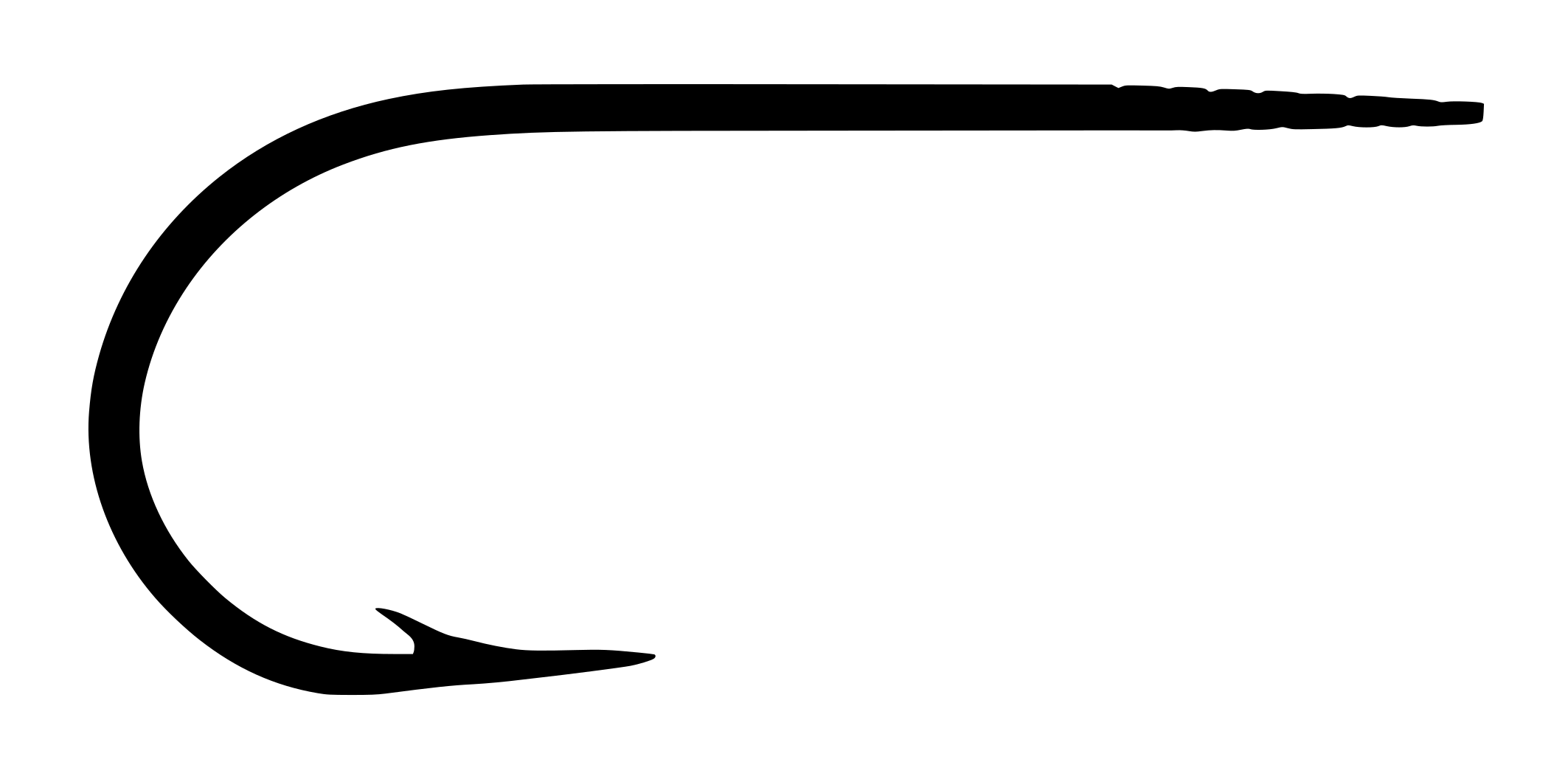
The Mustad 3625, manufactured in Norway circa 1925–1965, is a fine-wire salmon and sea trout hook featuring a distinctive sproat bend, short shank, and blind knobbed eye designed for maximum penetration in delicate mouth tissue. Its defining characteristic is the hollow point geometry—a concave, knife-edged tip that flares rapidly to the barb—combined with kirbed offset that increases hook-set probability while preventing rotation in the jaw during the fight. The bronzed finish delivers a stealthy presentation without sacrificing strength for moderate-sized fish. This hook remains historically significant as a benchmark example of early twentieth-century European precision hook design, where sharp-point geometry and subtle geometry refinements were prioritized over structural redundancy to meet the exacting demands of Atlantic salmon and sea trout fishing in British and Scandinavian rivers.
Side view of the Mustad 3625, size 11/0, displaying the characteristic sproat bend curvature, short shank, and kirbed (left-offset) point geometry.
Photographic record
12 cataloged imagesSelect any record to load it above.
8 images shown
Mustad 3625 Size 11/0 Side ProfileSide view of the Mustad 3625, size 11/0, displaying the characteristic sproat bend curvature, short shank, and kirbed (left-offset) point geometry.Open originalMustad 3625 Size 12/0 Side ProfileSize 12/0 specimen showing the full bend depth and proportions of the 3625 pattern on measurement grid.Open originalMustad 3625 Original Packaging Card with Four SizesOriginal Mustad 3625 card packaging showing sizes 9/0, 10/0, 11/0, and 12/0 with printed specifications: 'Hollow Point, Knobbed, Short Shank, Bronze Finish, Kirbed.'Open originalMustad 3625 Blind Knobbed Eye DetailMacro close-up of the distinctive blind knobbed eye on the 3625, showing the small rounded protrusion at the shank terminus and the fine-gauge round wire profile.Open originalMustad 3625 Box Label Full TextOriginal Mustad box label text printed in gold letterpress, reading: 'Mustad 3625 Salmon Hooks, Hollow Point, Knobbed, Short Shank, Bronze Finish, Kirbed' with Oslo-Norway origin.Open originalMustad 3625 Hollow Point Side GeometryClose-up side profile of the 3625 hollow point, demonstrating the concave (dished) inner face that flares rapidly from the sharp tip toward the barb.Open originalMustad 3625 Point Bottom ViewBottom/flat view of the 3625 point showing the tapering geometry and barb placement relative to the overall point structure.Open originalMustad 3625 Size 12/0 Retail BoxOriginal Mustad 3625 box label for size 12/0, showing hand-stamped size notation in purple ink and complete printed specifications.Open originalMustad 3625 Hook Point Size 12-0Mustad 3625 Hook Point Size 12-0Open originalMustad 3625 Hook Shank with Mustad engraved Size 12-0Mustad 3625 Hook Shank with Mustad engraved Size 12-0Open originalMustad 3625 Hook Size 12-0Mustad 3625 Hook Size 12-0Open originalMustad 3625 Knob Size 12-0Mustad 3625 Knob Size 12-0Open original
Technical profile
Eye
Blind — Knobbed Shank
Wire
Standard, Round
Shank
Short (1X–2X Short) — Tapered
Bend
Round / Kendal, Standard gap, Offset / kirbed
Point
Hollow Point (concave inner face)
Finish
Bronzed — Confirmed (stated on packaging)The specimen documented shows excellent preservation. Wire is bright with warm bronzed patina and no active corrosion. Point is sharp and properly formed. Blind knob is fully defined with no deformation. Fine surface micro-scratches consistent with age and light handling, but no deep scoring or dings. Original card stock shows light toning and minor foxing typical of mid-20th-century paper, but printing remains legible. Two hooks missing from card (shown are sizes 12/0 and 11/0 only), suggesting card was partially used or trimmed for sale.
The hollow point geometry creates an exceptionally sharp, fine tip that flares rapidly toward the barb, allowing immediate penetration with minimal applied pressure—ideal for the friable mouth tissue of sea trout and salmon. The concave (dished) inner face, ground from tip to barb base, produces a knife-edge effect that prioritizes initial bite over structural robustness. Fine-gauge wire (.019″–.024″) reduces overall weight and allows delicate presentation without sacrificing sufficient strength for moderate fish. The short shank prevents the hook from rotating in the jaw during head-shakes, while the kirbed (left-offset) geometry increases hook-up probability by preventing flat lay in the buccal cavity. Bronzed finish (alkyd lacquer mimicking bronze hue) provides excellent corrosion resistance in freshwater while offering a muted, stealthy presentation that does not alarm salmon in clear rivers.
The Mustad 3625 belongs to the mid-tier ‘Quality’ product line, occupying the 3000–3999 numerology bracket reserved for hooks manufactured to exacting dimensional and tempering standards. Within this tier, the 3625 was positioned as a specialized Atlantic salmon pattern, competing directly with traditional Redditch-made patterns like the Partridge Limerick and the H. Milward & Sons Spey hook. The model remained in catalog throughout the mid-20th century, though its blind knobbed eye was increasingly displaced by the more user-friendly ringed eye design by the 1960s. The 3625 was ultimately discontinued around 1970 as Mustad transitioned toward modern fly-tying specifications.
Era and Packaging Dating
Label reads 'OSLO - NORWAY' (not 'Christiania'), establishing production 1925 or later. No barcode present, consistent with pre-1974 manufacture. Typeface and ink color (gold/amber letterpress on cream card stock) typical of 1930s–1960s Mustad export packaging. Blind knobbed eye construction remained standard for Mustad salmon hooks throughout this period. Card printing method (offset lithography with hand-stamped size notation) and paper stock consistent with mid-20th-century Norwegian production.
The Last of the Snelled Hooks
The blind knobbed eye on the 3625 represents a fascinating relic of 19th-century salmon fly-tying tradition. Anglers of that era practiced a meticulous craft called 'snelling,' in which a soaked length of silkworm gut (the internal filament of silkworm cocoons) was wrapped and whipped directly to the bare hook shank using fine silk thread and pine pitch. The small knob at the shank terminus prevented the whipping knot from slipping under the tremendous load of a hooked Atlantic salmon fighting in a fast river. When nylon monofilament appeared in the 1950s, it suddenly became possible to tie a simple knot directly to a conventional loop eye—rendering the blind knobbed design instantly obsolete. Yet for nearly a decade, Mustad continued producing the 3625 in its traditional form, a testament to the conservatism of traditional salmon fly-tyers who refused to abandon the methods and hooks of their grandfathers.
Design lineage and influence
The blind knobbed eye traces its ancestry to 18th-century British salmon irons, where the unformed shank end was mechanically pressed to create a small barb-preventing node. This design prevented whipping knots from slipping under load—essential when silkworm gut snoods were the only available leader material. The 3625’s hollow point geometry echoes the Dublin Point tradition, but the near-concave inner face was engineered specifically for soft-mouthed Atlantic salmon, where delicate hook-set and minimal tissue trauma were critical to landing success. The design preceded (and influenced) the development of modern circle hooks by nearly a century.
Best matchRelated by Attribute
Computed automatically from catalog data — updated as new hooks are added.
Matches: Bend, Wire, Gap, Eye Orient., Finish +3 moreDiffers: Shank: Short (1X–2X Short) vs Standard; Eye: Blind — Knobbed Shank vs Blind — Tapered Shank; Point: Hollow Point vs Standard / Spear +2 more
Matches: Bend, Gap, Eye Orient., Point, Finish +3 moreDiffers: Shank: Short (1X–2X Short) vs Standard; Wire: Standard vs Extra-Fine; Eye: Blind — Knobbed Shank vs Blind — Marked Tapered Shank +4 more
The Mustad 3625 is a classic Atlantic salmon and sea trout hook designed for both fly-tying and live-bait presentations. The short shank and fine-gauge wire suit delicate presentations with small to medium salmon patterns, while the hollow point ensures minimal pressure required for hook-set on the soft mouths of anadromous fish. The distinctive knobbed blind eye is characteristic of pre-1925 Mustad salmon hooks, designed for direct snelling to braided silk or gut leaders—a traditional rigging method that remained in use well into the mid-twentieth century.
Classic Fly Patterns
Traditional Atlantic salmon patterns: Jock Scott, Durham Ranger, Cascapédia, Silver Wilkinson, Butcher, Hairy Mary, Black Doctor, Grimod, Green Highlander, Thunder and Lightning. Also suitable for sea trout wet flies and small-water Spey patterns.
Modern Equivalents
Hook
Match Quality
Notes
Mustad C49S or C70S (modern equivalent)
Good
Mustad's modern Atlantic salmon patterns; similar bend geometry and short shank, but with convenient loop eye and chemical sharpening technology
Tiemco TMC 7989 (conversion recommended)
Good
Premium Japanese salmon hook; fine wire, hollow point, excellent corrosion resistance; requires snelling but offers superior strength-to-weight ratio
Partridge SH (Salmon Hook) — made in England
Moderate
Traditional British alternative; looped eye, similar hollow point, but heavier wire; appeals to purist fly-tyers seeking Redditch heritage
Collector notes
The 3625 occupies an interesting mid-range position: common enough that examples survive in reasonable numbers, but historically significant enough (blind knobbed eye, discontinuation post-1970, traditional salmon fly heritage) to command modest collector interest. Original packaging significantly increases value; loose hooks are relatively common in bulk lots.
Reference value
$12 – $35 USD estimate
Packaging condition
Good — moderate wear, legibleRecorded specimen
Packaging format
GW-MUS-CARD-01Catalog code
Positive factors: (1) Represents the blind knobbed eye tradition, now replaced by modern ringed designs; (2) Classic mid-20th-century Norwegian engineering; (3) Associated with Atlantic salmon fly-tying heritage and traditional British-influenced patterns; (4) Fine-gauge wire and hollow point appeal to traditionalist fly-tyers; (5) Original card packaging (especially with hand-stamped size notation) adds substantial collectability premium.
Limiting factors: (1) Not as rare as earliest Christiania-era hooks (pre-1925); (2) Produced in significant volume during the 1930s–1960s; (3) Superseded by more convenient ringed-eye designs, reducing demand among modern anglers; (4) Fine wire gauge makes it less suitable for heavy saltwater or big-game applications, limiting appeal to certain collector segments; (5) Condition issues (corrosion, lacquer loss) are common and difficult to reverse.
Packaging
Original Mustad card format: cream-colored card stock (approximately 4.5" × 3") with four specimen hooks mounted on two parallel silk threads, one per size (9/0, 10/0, 11/0, 12/0 shown). Gold/amber offset-printed text in English, reading: 'Mustad 3625 Salmon Hooks, Hollow Point, Knobbed, Short Shank, Bronze Finish, Kirbed' (center text). Hand-stamped size notation (purple ink, 'No. 12/0') in lower left corner. Top margin features hand-printed reference number 'No 25954' in smaller serif font. Verso (reverse side) blank. Paper stock shows light toning and minor foxing consistent with 1930s–1960s manufacture. Ink remains bright and legible. Card has been partially dismantled; two hooks (sizes 9/0 and 10/0) are missing; only 12/0 and 11/0 survive affixed to original silk threads.
Market Value Notes
Loose hooks in excellent condition: $12–18 per dozen. Original card (100 hooks) in very good condition: $25–35. Pricing driven by condition of finish, presence of original packaging, and completeness of card. Specimen with minor lacquer wear or corrosion: $8–12. Premium pricing ($35–50+) for unopened vintage retail boxes or cards with intact original labeling and excellent patina.
Where to Find
eBay (bulk vintage hook lots), specialist fly-fishing dealer sites (e.g., Classic Fly-Tying forums), UK tackle fairs and antique fishing tackle shows, estate sale auctions, occasional listings on garrenwood.com collector pages.
Collector's Identification Tips
The Mustad 3625 is easily identified by (1) the printed label reading ‘Qual. 3625’ in the quality code line; (2) the distinctive blind knobbed eye, visible as a small rounded protrusion at the shank terminus (not a formed loop); (3) the short shank relative to gap width (approximately 1.8:1 ratio); (4) the fine-gauge, round-profile wire typical of mid-tier Mustad salmon hooks; (5) the kirbed offset visible from above, with the point angling slightly left of the shank centerline; and (6) the bronzed finish, which on well-preserved specimens retains a warm, dark brownish-gold tone. Specimens on original Mustad cards are highly collectable; loose hooks or those on dealer cards command lower premiums.
Preservation
Storage and Preservation
Store the 3625 in a cool, dry environment away from direct light and humidity. The bronzed finish, while more durable than bright steel, will develop surface patina over time—this is a desirable sign of age and authenticity to most collectors. If stored on the original card, ensure the card lies flat and is protected from moisture and insect damage. Silkworm gut leaders (if present with vintage specimens) are extremely hygroscopic and should be kept separate, wrapped in archival tissue and stored in a low-humidity environment; they will become brittle if exposed to dry air for extended periods. Do not attempt to clean vintage bronzed hooks with modern polishing compounds—even gentle polishing can compromise the original finish and reduce collector value. If hooks become slightly tarnished, a soft brush or artist’s cotton swab dampened with mineral spirits will safely remove dust without affecting the finish patina. Store loose hooks in individual compartmented boxes rather than bulk bags, as contact with other metals can cause galvanic corrosion. Original packaging adds significant value and should be preserved intact whenever possible.
Marking Analysis
Handwriting and Markings
The card displays a single hand-stamped size notation in purple fountain-pen ink (‘No. 12/0’), indicating this card was extracted from a larger retail pack and sold individually or as part of a dealer’s assortment. The regularity and uniformity of the stamp imprint suggest the use of a rubber stamp or stencil—a common practice in mid-20th-century sporting goods retail. The top reference number ‘No 25954’ is printed (not handwritten), likely representing an internal Mustad batch or shipment identifier from the factory. The absence of any additional annotations, collection marks, or price notations suggests this card has had a straightforward commercial history, passing from factory to wholesaler to retailer to angler without special collector provenance.
Primary Source
Packaging Claims and Technical Specifications
Source: Mustad 3625 original packaging label
The label text reads: ‘Mustad 3625 Salmon Hooks, Hollow Point, Knobbed, Short Shank, Bronze Finish, Kirbed.’ This typography adheres strictly to the eight-line Mustad labeling format documented in the reference document: Line 1 (implied manufacturer: O. Mustad & Søn), Line 3 (OSLO – NORWAY, visible on full box labels), Line 4 (Qual. 3625—quality/model code), Line 5 (Hollow Point—point identifier), and Lines 7–8 (Kirbed Knobbed Short Shank Bronze Finish—anatomical modifications and finish). The phrase ‘Knobbed’ refers to the blind knobbed eye construction, a deliberate choice by Mustad to preserve compatibility with traditional snelling methods. ‘Kirbed’ indicates the point is offset to the left of the shank axis when viewed from above—a feature that increased hook-up probability by preventing flat lay in the fish’s mouth. ‘Short Shank’ places the 3625 in the standard-to-short category for salmon hooks, suitable for compact fly patterns. ‘Bronze Finish’ is the proprietary Mustad term for the alkyd lacquer coating that mimics bronze hue, distinct from true bronzing or electroplating. All descriptors align with Mustad’s standardized quality-control nomenclature and represent honest, verifiable engineering choices rather than marketing hyperbole.
Additional
The Blind Knobbed Eye: A Living Bridge to Nineteenth-Century Craftsmanship
The blind knobbed eye on the 3625 deserves special attention as a unique artifact of fishing tackle engineering. Unlike modern hook designs, which rely on a convenient loop eye to accept any knot, the blind knobbed design required the angler to practice a specific and demanding tying technique: snelling. This involved soaking a length of silkworm gut (which had to be kept moist to prevent brittleness) and wrapping it—along with fine waxed silk thread—directly to the bare shank, creating an incredibly strong, permanent attachment that could withstand the head-shaking runs of a fresh Atlantic salmon. The small knob prevented the whipping knot from sliding off the end, a failure mode that would have been catastrophic during a river battle. This method was not merely functional—it was an expression of the angler’s skill and tacit knowledge, passed from experienced salmon fly-tyers to apprentices over generations. When nylon monofilament appeared in the 1950s and modern knots became viable, the blind knobbed eye became obsolete almost overnight. Yet for a short window (roughly 1950–1970), Mustad continued manufacturing the 3625 in its traditional form, serving a diminishing but passionately loyal community of traditionalists who refused to abandon the craft of their grandfathers. Today, the 3625 represents a unique snapshot: a mass-produced industrial hook designed to accommodate a completely bespoke, artisanal attachment method—a relic of a world before ‘one-size-fits-all’ tackle became the norm.
Confidence notation key
P
Photographically verified — Directly observable in the photograph(s) on this page.
V
Verified by documentation — Confirmed by manufacturer catalog, spec sheet, or published reference.
I
Inferred — A logical deduction from observable or documented evidence, not directly stated.
E
Estimated — An approximation based on visual comparison, proportional analysis, or limited data.
S
Speculative — A reasoned hypothesis that cannot be confirmed from available evidence.
Unnotated claims are the compiler’s synthesis; see Sources. All photographs on garrenwood.com are taken on a measurement grid where each square equals 1/10 inch (0.1″ / 2.54 mm).