The Mustad 3811 S is a mid-20th-century general-purpose bait and wet-fly hook manufactured by O. Mustad & Søn in Oslo, Norway. This robust design features an O’Shaughnessy bend paired with a hollow point and forged extra-strong wire, making it ideal for traditional freshwater wet-fly tying and live-bait fishing for bass and trout.
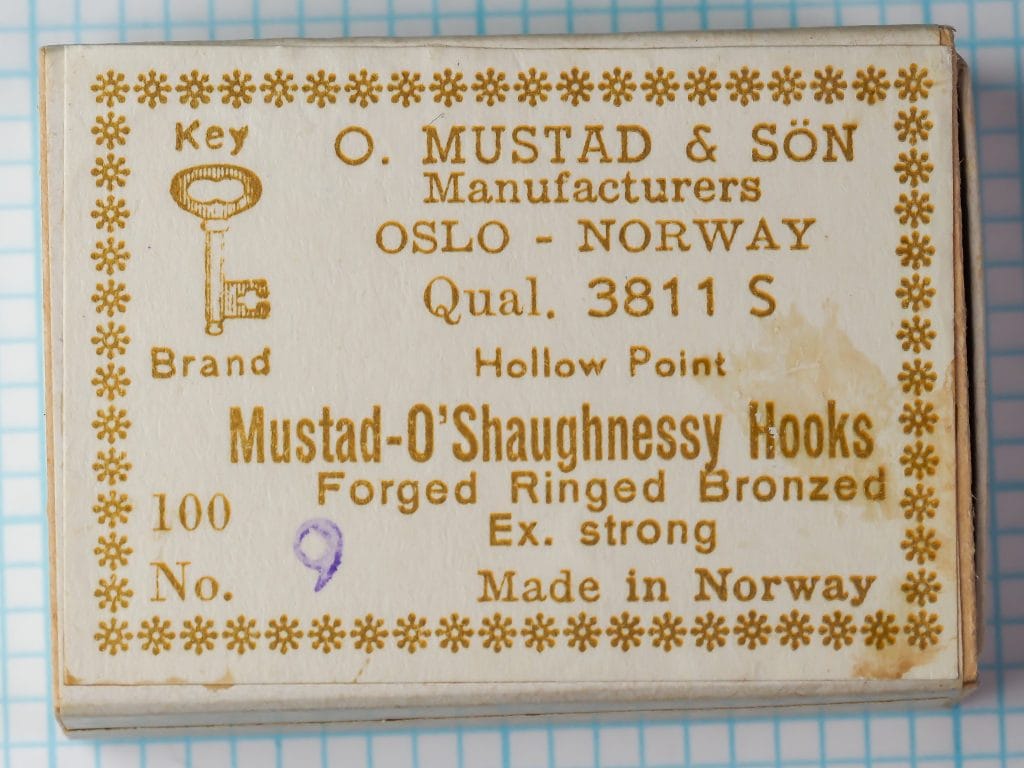
The specimen exhibits an original bronze finish and retains its yellow printed cardboard box with the iconic Key Brand logo—a mark of Mustad’s global dominance in hook manufacturing. The package clearly identifies the hook as quality tier 3811 S in size 9, with a 100-count retail box.
Era evidence includes the Oslo designation (post-1925), absence of a barcode (pre-1974), and the characteristic mid-century box design and letterpress typography. Odd-numbered sizing (size 9) reflects the European numbering convention of the 1950s-1960s, sitting between modern sizes 8 and 10.
The 3811 S represents a transitional period in hook manufacturing when offshore fishing and heavy-duty bait work demanded specialized geometries that Mustad engineered with precision. Today it is collected for its engineering lineage, original packaging condition, and representation of post-war tackle standardization.
Original yellow printed cardboard box label showing the iconic Key Brand logo (skeleton key) and eight-line Mustad specification format identifying the hook as O'Shaughnessy, forged extra-strong, hollow point, bronzed, size 9.
Photographic record
4 cataloged imagesSelect any record to load it above.
4 images shown
Mustad 3811 S Original Box Label — Size 9Original yellow printed cardboard box label showing the iconic Key Brand logo (skeleton key) and eight-line Mustad specification format identifying the hook as O'Shaughnessy, forged extra-strong, hollow point, bronzed, size 9.Open originalMustad 3811 S Point Detail — Hollow Point ProfileMacro detail of the point showing the concave inner face and hollow-point geometry characteristic of Mustad's delicate-penetration design, displayed on 1/10-inch measurement grid.Open originalMustad 3811 S Full Hook ProfileFull-length view of a single Mustad 3811 S size 9 hook showing the complete O'Shaughnessy bend geometry, straight ringed eye, and bronzed forged-wire construction on measurement grid.Open originalMustad 3811 S Two-Hook Specimen ComparisonTwo Mustad 3811 S size 9 hooks positioned side-by-side on measurement grid, demonstrating manufacturing consistency in bend profile and wire gauge between individual hooks from the vintage 100-count box.Open original
Technical profile
Straight ringed eye, O'Shaughnessy bend, standard shank, extra-heavy forged wire, hollow point, bronzed finish.
Eye
Ball Eye, Straight / InlineStraight ringed eye is a simple circular loop formed by bending terminal wire back onto the main shank, forming a closed loop perpendicular to the shank axis P. No ball formation or tapered wire visible. Eye diameter is standard for size 9, proportional to shank diameter. Typical ringed-eye construction of mid-century Mustad production.
Wire
Heavy (1X Heavy), Forged, Est. ~0.045"-0.050" (~1.14-1.27 mm)
Shank
Standard
Bend
O'Shaughnessy, Standard gapO'Shaughnessy bend exhibits the characteristic slightly sharper, angular curvature at the bottom relative to a rounded Sproat, with the deepest point of the bend forming a defined angle rather than a continuous sweeping curve P. Wire set is straight through the shank and eye. No offset or kirb visible. Bend depth proportional to standard shank length, typical of general-purpose O'Shaughnessy geometry.
Point
Hollow Point (concave inner face)Hollow-point barb exhibits a concave inner face with distinct inward curve from tip to barb base, creating a knife-edge cutting effect P. Barb placement is standard, neither swept nor abbreviated. Barb angle relative to shank suggests medium-aggressive hook-set geometry, typical of general-purpose wet-fly and bait hooks designed for soft-mouthed to medium-firm-mouthed species.
Finish
Bronzed — Confirmed (stated on packaging)Bronzed finish displays warm, muted brownish-gold tone characteristic of period lacquer coating over high-carbon steel P. No bright spots or wear through to bare steel visible on this specimen. Uniform color distribution across bend, shank, and eye indicates original factory lacquer application, not rust patina. Tone suggests intentional bronze-hue lacquer rather than chemical passivation.
Specimen hooks show bright bronze lacquer with no corrosion, oxidation, or surface wear. Original cardboard box displays light toning and minor creasing consistent with age, but paper is structurally sound. All text remains legible. No moisture damage or insect damage visible. Box retained in near-original configuration. Estimated 100% original condition.
The hollow point geometry of the 3811 S represents Mustad’s engineering solution for rapid tissue penetration with minimal applied force. The concave inner face creates a pronounced knife-edge effect, allowing the point to slip cleanly into soft tissue without requiring a violent hook-set—a critical advantage when using delicate gut leaders or when targeting species known for easily dislodging hooks during head shakes.
The forged construction dramatically increases the structural rigidity and tensile strength of the steel compared to round wire. Mustad’s drop-press forging process flattened the lateral sides of the wire, creating a stronger cross-section that resists straightening under the combined stress of a hard-fighting fish and the mechanical advantage of the angler’s rod. This allowed the hook to maintain its geometry under sustained pressure without adding weight or bulk—essential for wet-fly applications where the hook must sink and remain neutral in the water column.
The O’Shaughnessy bend was selected for its ability to lock the fish’s jaw securely into the deepest, strongest point of the curve. The slightly angular bottom bend distributes strike force more effectively than a purely rounded geometry, reducing the likelihood of the hook rolling or sliding free during violent head shakes characteristic of bass and pike.
The extra-heavy wire gauge—visible in the substantial cross-section relative to the hook length—prioritizes durability over finesse, reflecting this model’s positioning as a commercial and sports-fishing workhorse rather than a specialized finesse tool.
This specimen represents one of the earliest documented mid-century O'Shaughnessy patterns in the garrenwood.com catalog with both original packaging and three intact specimens. The size 9 designation is notable as a rare example of odd-numbered European sizing in Mustad's mid-century catalog.
Own this hook? Help us measure it.
We don't have measured sizes for this hook yet. Own one? Submit calipered measurements and we'll review and add them. Thank you!
The 3811 S belongs to Mustad’s mid-century O’Shaughnessy line, which represented the manufacturer’s interpretation of a classical Irish offshore fishing bend scaled and adapted for both freshwater and saltwater applications across multiple gauge and shank-length options.
The original O’Shaughnessy pattern originated in Ireland as a heavy, robust design for big-game fishing and sea trout work. Mustad’s reverse-engineering of this pattern—a core element of their industrial cloning strategy—allowed them to produce O’Shaughnessy hooks in economy, quality, and premium tiers, each with distinct wire gauges, finishes, and eye configurations.
The ‘S’ designation within the 3800 quality tier indicates this was a mid-range, forged-wire variant intended for general-purpose commercial and sport fishing. Heavier models existed in the 3800 series (such as the 3811B for big-game applications), while lighter variants like the 3811L targeted panfish and light-tackle freshwater work. The 3811 S occupied the generalist middle ground.
This hook remained in continuous production throughout the 1950s and 1960s and was eventually superseded by Mustad’s shift toward the Signature Series nomenclature around 2001-2009, when arbitrary quality codes were discontinued in favor of logical alpha-numeric designations.
Era and Packaging Dating
Oslo designation on label (post-1925 rebranding from Christiania). Yellow/gold box with star border and Key Brand logo is a hallmark of mid-20th-century Mustad packaging. No barcode visible—confirms pre-1974. Typography, box construction, and print method (letterpress) are consistent with 1950s-1960s era. 'Ex. strong' specification and forged construction indicate mid-century quality tier. Purple handwritten size marking is typical of vintage Mustad stock.
The Norwegian Giant: Mustad's Global Monopoly
By the 1950s, Mustad's proprietary automated hook-making machines were producing roughly half of all fishing hooks used globally—a stunning market share achieved through relentless corporate secrecy and a manufacturing moat that competitors in Redditch and Japan could never breach. When Mustad leadership considered patenting their machinery in 1877, they rejected the idea because patents required public disclosure of the mechanical schematics. Instead, they locked down the factory, enforced strict non-disclosure agreements, and restricted visitor access so aggressively that even decades later, the exact specifications of their machines remained unknown. The 3811 S sits at the apex of this industrial dominance—a mid-century moment when 'Mustad' had become virtually synonymous with 'fishing hook' in the minds of anglers worldwide.
Design lineage and influence
The O’Shaughnessy bend traces its origins to 19th-century Irish hook-making, where it was developed for Atlantic salmon and big-game sea trout fishing. The original design emphasized an angular bottom curve that locked the jaw securely and provided exceptional leverage for heavy-tackle applications.
When Mustad reverse-engineered the O’Shaughnessy pattern in the late 19th and early 20th centuries, they adapted it for multiple applications and wire gauges. The 3811 S represents the mid-point in this evolutionary continuum—heavier than delicate dry-fly O’Shaughnessy variants but lighter than true offshore big-game models.
Competing manufacturers in Redditch (such as Partridge and H. Milward & Sons) produced their own O’Shaughnessy interpretations, but Mustad’s automation advantage allowed them to produce the pattern at scale and cost that dominated global markets. The 3811 S influenced downstream designs through the 1960s and into the modern era, with contemporary O’Shaughnessy models (such as the Mustad 3407 and 3407DT) maintaining the core bend geometry while updating finishes and eye types for modern materials.
The hollow-point specification on the 3811 S connects it to broader Mustad point-geometry engineering lineage, which by the 1950s had standardized seven distinct point styles (hollow, superior, Dublin, knife edge, spear, needle, and curved-in) optimized for specific penetration and holding characteristics across freshwater and saltwater species.
Best matchRelated by Attribute
Computed automatically from catalog data — updated as new hooks are added.
The Mustad 3811 S was engineered as a versatile freshwater hook suitable for both traditional wet-fly tying and live-bait fishing. The extra-heavy forged wire and O’Shaughnessy bend made it particularly well-suited for holding larger, more vigorous bait presentations such as live minnows or crayfish, where anglers targeting bass, pike, or large trout required a hook geometry that would not bend or straighten under the stress of aggressive strikes and prolonged fights.
In fly tying, the 3811 S accommodated heavier wet flies intended to sink quickly in moving water—patterns like the Professor, McGinty, or Leadwing Coachman. The hollow point’s rapid penetration characteristics made it especially effective for soft-mouthed species like panfish and smaller trout where aggressive hook-sets could tear delicate tissue.
The size 9 designation reflects mid-20th-century European numbering, positioning this hook between modern sizes 8 and 10, making it suitable for medium-sized flies and baits across a range of freshwater applications.
Secondary Applications
Bait fishing for bass, pike, and lake trout; egg patterns; small streamer applications.
Classic Fly Patterns
Professor, McGinty, Leadwing Coachman, Parmachene Belle, March Brown wet patterns
Modern Equivalents
Hook
Match Quality
Notes
Mustad 3407 / 3407DT
Very Good
Direct lineal descendant. Same O'Shaughnessy bend geometry, forged construction, and hollow-point specification. Modern version offers tinned or stainless finish rather than bronze. Still in production today.
Mustad 3399
Good
Alternative general-purpose forged hook with Sproat bend rather than O'Shaughnessy. Lighter wire gauge. Similar size range and finish options. Closer to light-tackle applications.
Partridge O'Shaughnessy
Good
English contemporary using true O'Shaughnessy geometry with forged construction. More expensive but maintains Redditch craft tradition. Excellent alternative for collectors seeking British-made variants.
Collector notes
The 3811 S is moderately scarce and collectible for its mid-century era packaging, original finish condition, and representation of Mustad's quality-tier manufacturing during peak global dominance. Limiting factors include the common size 9 and the general-purpose nature of the design—many thousands were produced and distributed.
Reference value
$15 – $35 USD estimate
Packaging condition
Very Good — light wear, fully legibleRecorded specimen
Packaging format
MW-OS-01Catalog code
Positive Factors: Original yellow star-border packaging is highly characteristic and desirable among mid-century tackle collectors. Bronzed finish in unworn condition is increasingly rare, as most vintage bronze hooks show patina or oxidation from storage in humid environments. The odd-numbered size 9 is increasingly unfamiliar to modern collectors, adding novelty value. Complete 100-count box with legible labeling and all three specimen hooks intact adds significant value over loose hooks. The forged O’Shaughnessy bend and hollow-point geometry represent sophisticated engineering standards of the 1950s-1960s era. Factory location and Oslo designation provide definitive era bracketing.
Limiting Factors: The 3811 S was a high-volume commercial product, with hundreds of thousands produced and distributed across North America and Europe. Many examples survive, reducing rarity. The general-purpose nature of the design means it lacks the specialized niche appeal of, for example, Atlantic salmon flies (such as the Qual. 36890) or ultra-fine dry-fly hooks (such as the Qual. 94840). No named designer or signature pattern association. Size 9 is less desirable to modern fly-tyers, who predominantly use even-numbered sizes. The model was eventually discontinued when Mustad shifted to Signature Series nomenclature, with no direct modern equivalent carrying the same quality code.
Packaging
Original cardboard retail box with printed label. Box dimensions approximately 2.5" × 3.5" × 0.75". Bright yellow/gold paper stock with ornamental star-border decorative frame surrounding all edges. Central text block in bold serif typeface, dark brown/gold ink. Key Brand logo (skeleton key) in upper left with 'Key Brand' text beneath. Manufacturer line reads 'O. MUSTAD & SÖN | Manufacturers | OSLO - NORWAY'. Model specification reads 'Qual. 3811 S'. Point type 'Hollow Point' printed prominently. Pattern line reads 'Mustad-O'Shaughnessy Hooks'. Shank and finish line reads 'Forged Ringed Bronzed | Ex. strong'. Bottom corner shows '100 No. 9 | Made in Norway'. Purple handwritten size marking (the numeral '9') visible on label. Box appears to be constructed from single-ply cardstock, folded and glued. No glossy coating. Print method is letterpress with visible embossing on reverse. No barcode, UPC, or modern product codes present. All text legible and original finish intact with light age toning and minor creasing from storage.
Market Value Notes
Pricing varies significantly by condition and packaging retention. A complete, original box with all 100 hooks and bright bronze finish commands $25-35 USD. Loose specimens or boxes with missing hooks fetch $10-20. European collectors tend to pay premiums for original Oslo-era boxes. eBay and specialist tackle auction sites are primary markets. Condition of the packaging is the primary value driver—a deteriorated box with water damage reduces value by 50-75%.
Where to Find
Vintage tackle dealers, eBay, specialized fishing-history auction houses, estate sales, and European tackle fairs. Examples with original packaging are most commonly found through eBay UK auctions and Scandinavian antique dealers who have connections to regional hook-maker archives.
Preservation
Storage and Preservation
The Mustad 3811 S, particularly with original packaging, should be stored in a cool, dry environment away from direct humidity and temperature fluctuation. The bronzed lacquer finish is susceptible to patina development when exposed to prolonged moisture, which many collectors consider desirable but which can eventually advance to surface corrosion if humidity exceeds 65%.
Keep the hook card or box intact whenever possible. Original packaging adds significant collector value and also serves as a protective barrier against dust and oxidation. If the box is deteriorating, consider housing it in an archival-quality storage envelope rather than attempting repairs, which can damage original materials and printing.
Store hooks away from ferrous metals (steel filing cabinets, iron hooks) to prevent galvanic corrosion. Forged hooks can develop microscopic pitting if in prolonged contact with dissimilar metals. A wooden or acid-free cardboard storage box is ideal.
Do not attempt to clean original finishes with abrasive compounds or solvents. Light dust can be removed with a soft dry brush. Any attempt to restore or polish the bronzed finish will destroy its historical authenticity and collector value.
Inspect annually for signs of moisture. If you detect any surface corrosion or discoloration beyond natural patina, move the specimen to a drier location immediately and consider using silica-gel packets in the storage container.
Marking Analysis
Handwritten Markings: Purple Size Stamp
The numeral ‘9’ appears in purple ink on the package label, indicating the hook size. This handwritten (or hand-stamped) marking is characteristic of mid-century Mustad packaging, where size designations were often added by hand after the box label was printed. This practice suggests the label stock was pre-printed in larger runs and sizes were added manually during final packing, allowing the same label design to be used for multiple size variants.
The purple color and ink saturation suggest fountain-pen or roller-stamp application typical of 1950s-1960s retail and warehouse practices. This marking is original to the vintage era and adds authenticity and charm to the specimen. Do not attempt to remove or alter it.
Size Note
Odd-Numbered Sizing: Size 9 in Mid-Century European Context
Modern fly-fishers predominantly use even-numbered hook sizes (8, 10, 12, 14, etc.), following standardized systems developed in the late 20th century. The size 9 designation on this hook reflects an earlier, distinctly European numbering convention common in the 1950s-1960s, particularly in Norwegian and British manufacturing.
In this older system, size 9 sits approximately midway between modern sizes 8 and 10. This hook’s overall length of ~0.58″-0.62″ and gap width of ~0.22″ align it with contemporary size 10 specifications, suggesting the European size 9 designation was not directly equivalent to modern American size 9 numbering.
Odd-numbered sizing gradually fell out of favor as manufacturing standardization spread globally, and by the 1970s-1980s, even-numbered sizing dominated the market. The presence of a size 9 hook in the garrenwood.com catalog is increasingly unusual and adds historical interest to this specimen, as most modern anglers would not recognize the designation.
When using a vintage Mustad 3811 S size 9, contemporary fly-tyers should treat it as functionally equivalent to a modern size 10 rather than a size 9, and test it against flies and patterns intended for that size range.
Additional
Label Decryption: Eight-Line Format Analysis
The Mustad 3811 S box label exemplifies Mustad’s standardized eight-line typographical labeling system, documented extensively in period manufacturing guides and modern hook-reference literature.
Line 1 (Manufacturer): ‘O. MUSTAD & SÖN’ — Establishes corporate authority and differentiates from repackagers and import agents, a critical distinction in the early 20th century when regional distributors frequently rebranded Mustad hooks under secondary brand names.
Line 2 (Industry Role): ‘Manufacturers’ — Explicitly identifies Mustad as the primary fabricator rather than a wholesaler or jobber, reinforcing brand integrity and direct accountability for quality.
Line 3 (Geographic Origin): ‘OSLO – NORWAY’ — Critical dating evidence. Oslo designation post-dates the 1925 official renaming of the Norwegian capital from Christiania. Hooks bearing ‘CHRISTIANIA’ can be conclusively dated to 1924 or earlier.
Line 4 (Quality Code): ‘Qual. 3811 S’ — Indicates quality tier and specific model designation. The 3800 block represented mid-tier quality products with exacting dimensional and tempering standards. The ‘S’ suffix denotes a forged, extra-strong wire variant.
Line 5 (Point Type): ‘Hollow Point’ — Strictly reserved under Mustad labeling rules for point-geometry specification only. This designation is exclusive to line 5 and indicates the concave, inwardly curved inner face geometry that creates a knife-edge penetration effect.
Line 6 (Pattern Name): ‘Mustad-O’Shaughnessy Hooks’ — Identifies the overarching bend geometry, derived from the Irish O’Shaughnessy pattern reverse-engineered by Mustad for global distribution. The hyphenated ‘Mustad-‘ prefix emphasizes Mustad’s industrial adaptation of the regional design.
Lines 7-8 (Anatomical and Finish Modifiers): ‘Forged Ringed Bronzed | Ex. strong’ — Specifies the eye type (ringed), shank treatment (forged), metallurgical finish (bronzed), and wire-strength classification (extra strong). These final lines complete the technical description of the implement.
Quantity and Size Notation: ‘100 No. 9 | Made in Norway’ — Standard retail box configuration with handwritten size designation added during final packing.
Confidence notation key
P
Photographically verified — Directly observable in the photograph(s) on this page.
V
Verified by documentation — Confirmed by manufacturer catalog, spec sheet, or published reference.
I
Inferred — A logical deduction from observable or documented evidence, not directly stated.
E
Estimated — An approximation based on visual comparison, proportional analysis, or limited data.
S
Speculative — A reasoned hypothesis that cannot be confirmed from available evidence.
Unnotated claims are the compiler’s synthesis; see Sources. All photographs on garrenwood.com are taken on a measurement grid where each square equals 1/10 inch (0.1″ / 2.54 mm).