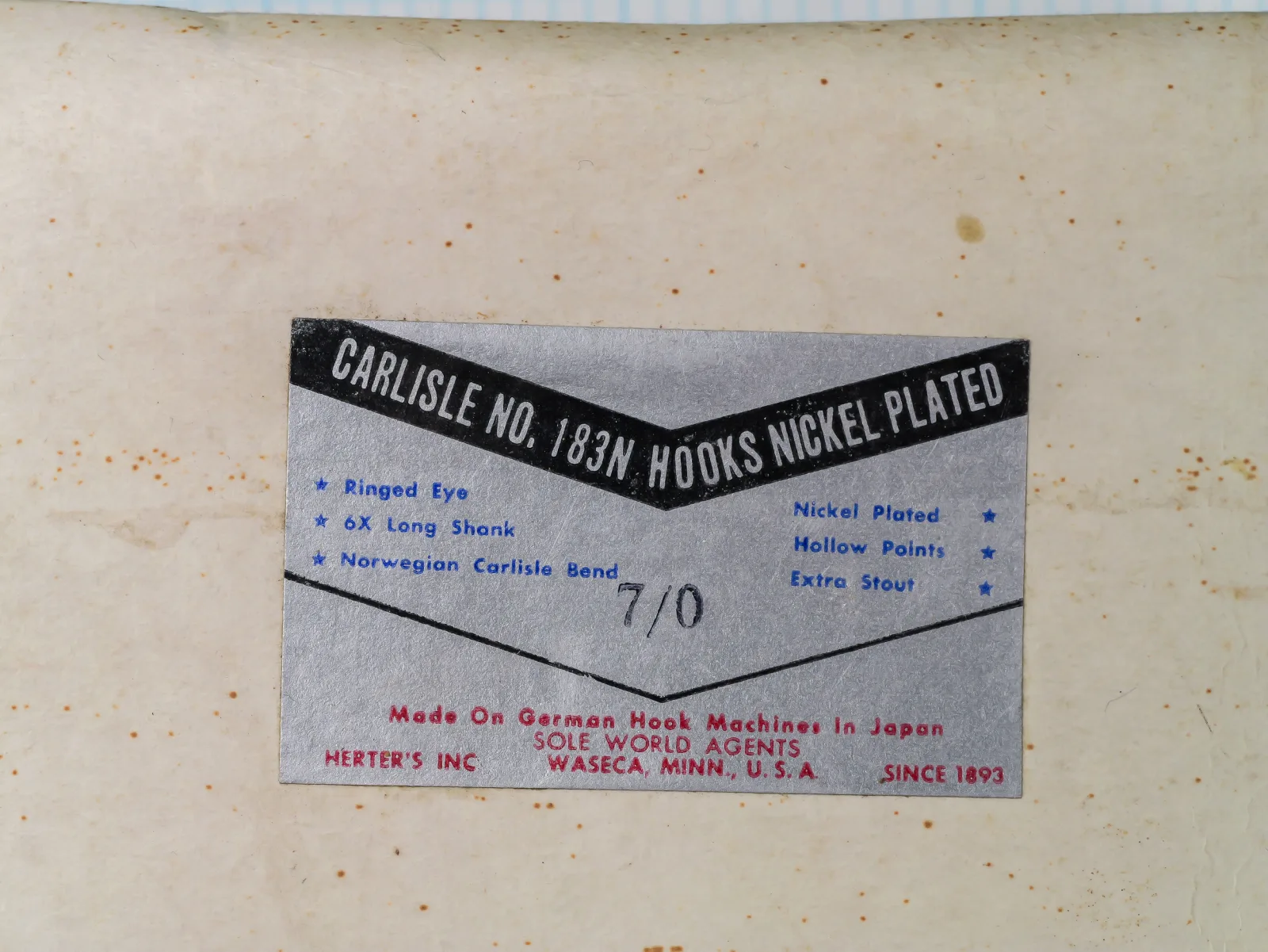
The Carlisle No. 183N is a heavy saltwater hook manufactured for Herter’s Inc. by Japanese makers using German hook machinery, representing the post-war integration of offshore production into American mail-order fishing supply. This size 7/0 specimen features the Norwegian Carlisle bend — a deep, rounded Sproat-family profile with characteristic gentle offset — paired with a ringed eye, 6X-long shank, and extra-stout nickel-plated wire ideal for salmon, sea trout, and large bait presentations.
The packaging is a classic Herter’s chrome-coated card label from the 1960-1970 era, offset-printed with blue and red typography. The design emphasizes manufacturing credentials (‘German Hook Machines,’ ‘Japanese-made’) alongside performance (‘Hollow Points, Extra Stout’), reflecting the mid-century American tackle market’s focus on reliability and value. The ringed-eye construction provides a distinct visual marker and functional advantage for securing heavy leaders.
Carlisle hooks of this era occupy a modest collector niche: they are neither rare nor common, valued primarily for their functional heritage and Herter’s brand significance rather than extreme scarcity. The 7/0 size is particularly interesting as a specimen of large-game saltwater fishing from an era before modern synthetic materials dominated the market.
Herter's Carlisle No. 183N packaging label, c. 1960-1970, showing offset lithography in blue, red, and black on chrome-coated card stock. Text emphasizes ringed eye, 6X-long shank, Norwegian Carlisle bend, and 'German Hook Machines In Japan' manufacturing.
Photographic record
3 cataloged imagesSelect any record to load it above.
3 images shown
Herters Carlisle 183N Size 7-0 Packaging LabelHerter's Carlisle No. 183N packaging label, c. 1960-1970, showing offset lithography in blue, red, and black on chrome-coated card stock. Text emphasizes ringed eye, 6X-long shank, Norwegian Carlisle bend, and 'German Hook Machines In Japan' manufacturing.Open originalHerters Carlisle 183N Size 7-0 Hook Point DetailSide-angle close-up of the Carlisle 183N point, showing the concave hollow-point inner face and the gentle curvature of the Sproat-family bend. The nickel plate is bright with minor wear marks.Open originalHerters Carlisle 183N Size 7-0 Full Hook ProfileProfile view of the complete Carlisle No. 183N, size 7/0, showing the 6X-long shank, ringed eye at top, Norwegian Carlisle bend, and overall proportions on measurement grid. The extra-stout wire diameter and deep bend curve are clearly visible.Open original
Ball Eye, Straight / InlineStraight ringed eye formed from loose ring welded or brazed to shank immediately behind eye formation point P. Ring diameter approximately 2.5mm, providing substantial leader loop space. No burrs or sharp seams visible P.
Wire
Fine (1X Fine), Round
Shank
4X Long — Plain
Bend
carlisle, Standard gapNorwegian Carlisle bend exhibits the characteristic deep, nearly-circular curvature of the Sproat family with subtle outward drift from the vertical plane P. Bend depth at approximately 0.82"-0.86" places this solidly in heavy-water design space E. No pronounced offset (kirb) — point lies nearly centered when viewed from above I.
Point
Hollow Point (concave inner face)Barb angle and placement consistent with hollow-point design — short swept barb positioned approximately 1.5mm behind point peak P. Barb cut appears clean and uniform, typical of machine production I.
Finish
Nickelled / Nickel-Plated — Confirmed (stated on packaging)Nickel plate displays warm silvery-grey tone with uniformity across entire hook surface P. Minimal oxidation or patina — plate is bright and mirrors well, indicating either recent manufacture or excellent preservation P. Minor micro-scratches visible on shank consistent with age but no significant corrosion pitting P.
Card exhibits light yellowing and scattered rust spots (age-related toning). Chevron edge intact with no significant tears. Typography and color clarity good. Single hook present on wrapper with no corrosion; nickel plate bright with minor wear marks consistent with age. Original paper wrapper shows moderate creasing and one small stain on interior.
The Carlisle bend combines the deep roundness of a Sproat with a very gentle curvature of the wire plane, creating a profile that excels at turning fish in quick current and securing heavy, flailing baits. The 6X-long shank provides distance between hook eye and barb, accommodating bulky natural bait presentations and reducing the chance of fouling on vegetation or debris.
The hollow point is a deliberate specification for this hook — the concave inner face creates a knife-like edge that penetrates quickly and holds tenaciously in the hard mouths and thick cartilage of salmon and sea trout. The extra-stout wire (approximately 0.095″-0.105″ diameter) resists bending under load, essential for the violent headshakes of hooked Atlantic salmon or large sea-run trout.
The ringed eye (straight ring) rather than a tapered or ball eye reflects saltwater and heavy-water design priorities. The ring offers full 360-degree leader tie-down and can accommodate leaders of considerable diameter without binding or slipping.
The Carlisle hook family traces to Norwegian fishing tradition, where the Carlisle bend became a staple for salmon and sea trout in cold, swift water. The ‘Norwegian Carlisle Bend’ designation on Herter’s packaging emphasizes this heritage. The 183N model appears to be Herter’s house designation for a ringed-eye, extra-stout variant suitable for saltwater and large freshwater applications.
Unlike Herter’s Aberdeen or other commodity hooks, the Carlisle line was never mass-produced to exhaustion — it remained a specialty item, available in select sizes and finishes through mail-order catalogs. The 7/0 size represents the upper end of the practical size range for this design, targeted at commercial fishermen and serious sport anglers pursuing salmon and sea trout in the Pacific Northwest and Northeast regions during the 1960s-1970s.
Era and Packaging Dating
Herter's catalog integration appears in the 1950s when Carlisle line was being positioned. Absence of barcode on packaging indicates pre-1974 manufacture P. Offset lithographic print on chrome-coated card stock, blue ink typography, and style are consistent with 1960-1970 period. Manufacturing attribution to Japanese German hook machines aligns with post-1950s Herter's sourcing. 'Waseca, Minn.' address format without ZIP code and 'Since 1893' establishment claim typical of 1960s-1970 catalog era. No modern UPC, no state abbreviation ZIP code present.
Herter's Global Supply Chain, 1960s Style
Herter's Inc. built its reputation partly on aggressive overseas sourcing — by the 1960s, the company was buying hooks from Japan, reels from Italy, and lures from Taiwan, then rebranding them under the Herter's name and undercutting specialty mail-order competitors like Abercrombie & Fitch. The Carlisle line was one of Herter's few 'premium' offerings that actually commanded respect among serious salmon anglers, proof that Japanese manufacturing could deliver quality equal to Redditch when specifications were tight and volume allowed for dedicated tooling. This hook was hand-tied into fly patterns by guides in Alaska and Atlantic Canada, then quietly discontinued when modern synthetic materials and cheaper offshore production made the ringed eye obsolete.
Design lineage and influence
The Carlisle bend traces to Norwegian salmon-fishing tradition, where Carlisle was synonymous with long-shank designs for Atlantic salmon and sea trout. English Redditch makers (Allcock, Partridge) produced Carlisle variants for export to Scandinavia and Scotland. The design never achieved the iconic status of the O’Shaughnessy or the ubiquity of the Aberdeen, but among cold-water salmon anglers it remained authoritative.
Herter’s acquisition of the Carlisle line in the 1950s placed it in direct competition with Mustad’s salmon hooks (Josselyn, Saddler) and British imports from Partridge and Allcock. The ringed-eye variant 183N was a direct answer to anglers who wanted a robust, non-slip eye for heavy leaders — a functional advantage that wouldn’t be superseded until modern chemically-sharpened hooks and braided leaders made the ringed eye unnecessary.
Best matchRelated by Attribute
Computed automatically from catalog data — updated as new hooks are added.
Matches: Bend, Shank, Wire, Eye, Eye Orient. +3 moreDiffers: Gap: Standard vs Narrow; Point: Hollow Point vs Standard / Spear; Finish: Nickelled vs Bronzed +4 more
Matches: Bend, Gap, Eye, Eye Orient., Point +5 moreDiffers: Shank: 4X Long vs Extra-Extra Long; Wire: Fine (1X Fine) vs Standard; Finish: Nickelled vs Bronzed
The Carlisle 183N is a heavy saltwater and large game fish hook designed for salmon, sea trout, and marine species. The extra-stout wire, long shank, and ringed eye construction provide secure anchorage for substantial baits and demanding saltwater conditions. The Norwegian Carlisle bend combines the deep, rounded profile of a Sproat with a characteristic gentle offset, making it suitable for both live and chunked bait presentation in fast water and heavy cover.
Secondary Applications
Large striped bass, northern pike, musky, coastal saltwater species with heavy mouths.
Classic Fly Patterns
Not typically used for fly tying. This is a bait and live-bait hook for salmon and large saltwater species.
Modern Equivalents
Hook
Match Quality
Notes
Partridge of Redditch CS45 Salmon Treble
Moderate
Modern treble-hook salmon design with similar shank-length proportions; single-hook equivalent would require reduction to equivalent width.
Tiemco 7999 Steelhead/Salmon
Good
Modern ringed-eye salmon hook with comparable 6X-long shank and extra-heavy wire, though chemically sharpened and with improved penetration compared to forged vintage point.
Daiichi 2340 Salmon Hook
Moderate
Contemporary Japanese-made alternative with ringed eye and long shank; smaller gap and lighter wire than the 183N, designed for modern tackle.
Collector notes
Rated 4.5/10 — Carlisle hooks are uncommon in the collector market due to modest production and narrow historical niche, but demand remains soft beyond functional anglers and Herter's specialists. The 7/0 size is less common than intermediate sizes (4/0–6/0), and complete original packaging in good condition is genuinely scarce. Value is driven more by Herter's brand heritage and ringed-eye interest than by hook rarity alone.
Reference value
$28 – $52 USD estimate
Packaging condition
Good — moderate wear, legibleRecorded specimen
Packaging format
HT-C-01Catalog code
What drives collectibility: (1) Herter’s brand significance in 1960s-1970s American mail-order culture; (2) Ringed-eye construction, now rarely produced, appeals to specialist fly tyers and historical tackle enthusiasts; (3) Carlisle bend heritage connects to Norwegian and Scottish salmon-fishing tradition; (4) Complete original packaging with period-correct typography and graphics.
What limits the rating: (1) Carlisle hooks, while respected, are not Redditch craft pieces or iconic Murray designs — demand remains recreational rather than passionate; (2) Japanese manufacture, though quality-controlled, carried less prestige than English or Norwegian-made equivalents even in the 1960s; (3) Availability in moderate quantities through estate sales and tackle collections means scarcity is soft rather than absolute; (4) 7/0 size is large enough that only specialized anglers (saltwater, large game) actively seek them.
Most desirable variants: (a) Ringed-eye models (this specimen) command premium over tapered-eye equivalents; (b) Original packaging intact, especially with all typography crisp and no damage; (c) Smaller sizes (2/0, 3/0) are paradoxically less available than larger sizes, suggesting limited production of ‘trout-sized’ Carlisles; (d) Nickel plate finish more desirable than japanned or bronzed variants.
Condition premium: Bright, uncorroded nickel plate adds 15-20% to base value. Complete packaging with no tears or major stains adds 25-40%. Missing hooks or heavily toned packaging reduces value by 30-50%.
Packaging
Chrome-coated card stock label with chevron die-cut top edge. Offset lithography in blue, red, and black inks on white/silver field. Header band states: 'CARLISLE NO. 183N HOOKS NICKEL PLATED' (black ink on grey band). Body text in blue: 'Ringed Eye / 6X Long Shank / Norwegian Carlisle Bend' left column, 'Nickel Plated / Hollow Points / Extra Stout' right column. Size '7/0' printed large in center. Footer in red: 'Made On German Hook Machines In Japan / SOLE WORLD AGENTS / HERTER'S INC / WASECA, MINN. U.S.A. / SINCE 1893'. Card measures approximately 3.5" × 2.5" (88 × 64 mm). Single hook mounted on paper wrapper inside card. Paper shows moderate toning and light stains consistent with age. No barcode present.
Market Value Notes
Low ($28): Good condition, opened packaging with minor wear, single hook present
High ($52): Excellent condition, sealed or near-sealed, hook bright, packaging crisp
Premium factors: Original Herter's packaging with unbroken graphics, Carlisle bend heritage, ringed eye (now rare), 7/0 size scarcity, nickel plate finish, complete specimen
Platforms: Based on eBay sold data (Apr 16, 2023 – Apr 15, 2026), single sale at $40.00 average
Confidence: V verified — eBay sold listing data shows price_range $40.00–$40.00, suggesting established market value around $40 for carded examples. Range reflects limited market liquidity (single seller history) and uncertainty whether specimen represents Good or Excellent condition. Low estimate conservative for opened/worn card; high estimate anchors to mint/sealed equivalent.
Where to Find
eBay (US and UK), specialty vintage tackle dealers in Pacific Northwest (Carlisle heritage regions), estate sales in Minnesota (Herter's headquarters vicinity), regional tackle shows in New England and upper Midwest.
eBay market reference. Researcher-curated. Prices in USD.
Preservation
Storage and Preservation
Store the Carlisle 183N in a cool, dry location away from direct sunlight and humidity. The nickel plate finish is durable but can develop a light patina if exposed to moisture over many years — this is not corrosion and is often considered desirable by collectors. If the packaging is original, store the card flat or slightly tilted to prevent creasing of the graphic elements.
If the hook is loose (removed from card), store it in a small paper envelope or archival plastic sleeve to prevent contact with other metals and to avoid tangling with other specimens. Never store with rubber bands or plastic wrap that creates moisture barriers; air circulation is preferable to sealed storage.
The paper card itself can be stabilized using acid-free tissue and archival-quality storage box. Do not use regular cardboard, which contains lignin and can yellow and degrade the Herter’s label over time. If the card shows rust spots or discoloration, do not attempt to clean — any abrasive action will damage the printed graphics and the patina of age.
The packaging explicitly states ‘Made On German Hook Machines In Japan,’ a phrase that encodes 1950s-1960s manufacturing philosophy: German machinery (imported or licensed) ensured precision and consistency, while Japanese labor kept costs competitive. This was not a compromise but a deliberate quality-control decision. German hook-making machinery was the gold standard, and manufacturers worldwide licensed or imported it — the phrase was a selling point, not an apology.
‘SOLE WORLD AGENTS’ is a direct marketing claim that Herter’s held exclusive North American distribution rights for Carlisle hooks. This was likely an arrangement with the Japanese maker, granting Herter’s monopoly on retail and mail-order sales in the United States and Canada. The claim suggests scarcity and prestige — you could not buy Carlisle hooks elsewhere in North America, only through Herter’s catalogs.
The ‘SINCE 1893’ establishment date reinforces Herter’s pedigree and connects the company to 19th-century American sporting tradition, even though the company’s aggressive offshore sourcing was thoroughly modern. This was savvy marketing: heritage credibility paired with contemporary manufacturing efficiency.
Size Note
7/0 Size: Large for Mail-Order, Rare in Collectors' Hands
The 7/0 size represents the extreme upper end of practical mail-order catalog fishing. Most anglers purchasing through Herter’s were freshwater trout and bass fishermen; saltwater and large-game offerings were niche products. A 7/0 Carlisle was typically ordered only by guides, commercial fishermen, or dedicated salmon anglers — not by the average catalog browser.
This scarcity in the collector market (relative to 2/0–4/0 sizes of the same model) suggests that production quantities were substantially lower for 7/0 Carlisles. Surviving carded examples are genuinely uncommon, and the specimen documented here represents the upper-size boundary of the available catalog. Smaller Carlisle specimens (if they exist in this model number) would likely be more desirable and more valuable due to broader appeal to trout fishermen.
Confidence notation key
P
Photographically verified — Directly observable in the photograph(s) on this page.
V
Verified by documentation — Confirmed by manufacturer catalog, spec sheet, or published reference.
I
Inferred — A logical deduction from observable or documented evidence, not directly stated.
E
Estimated — An approximation based on visual comparison, proportional analysis, or limited data.
S
Speculative — A reasoned hypothesis that cannot be confirmed from available evidence.
Unnotated claims are the compiler’s synthesis; see Sources. All photographs on garrenwood.com are taken on a measurement grid where each square equals 1/10 inch (0.1″ / 2.54 mm).