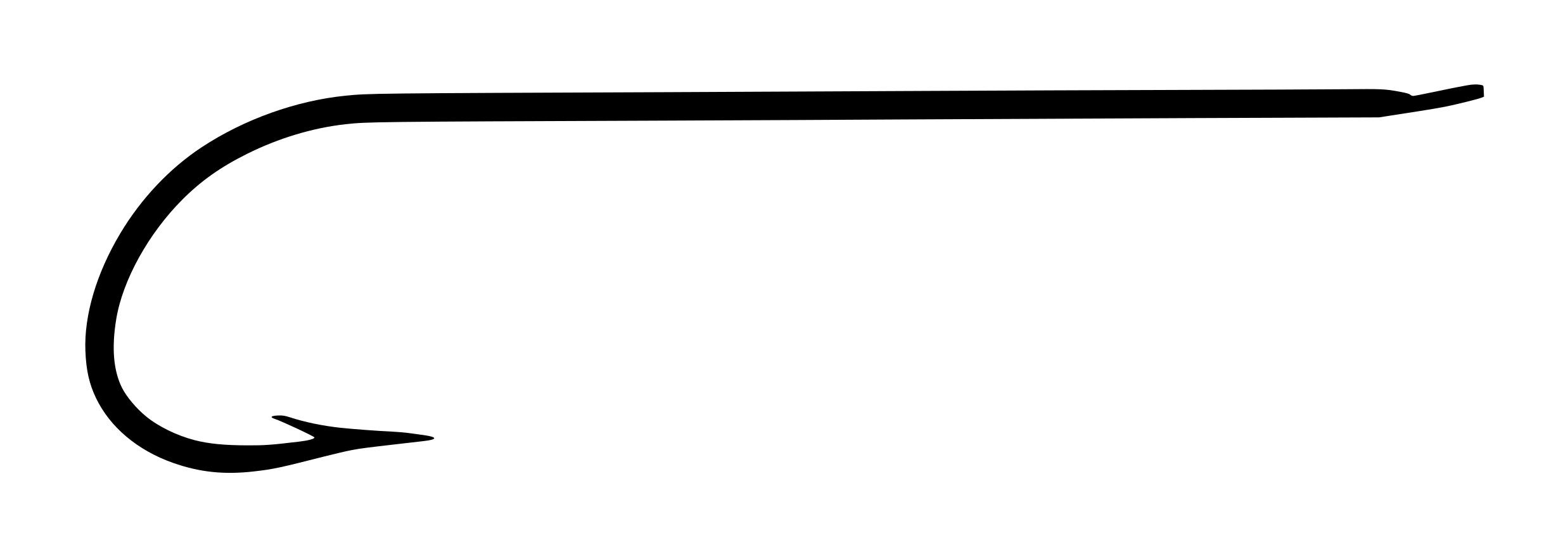
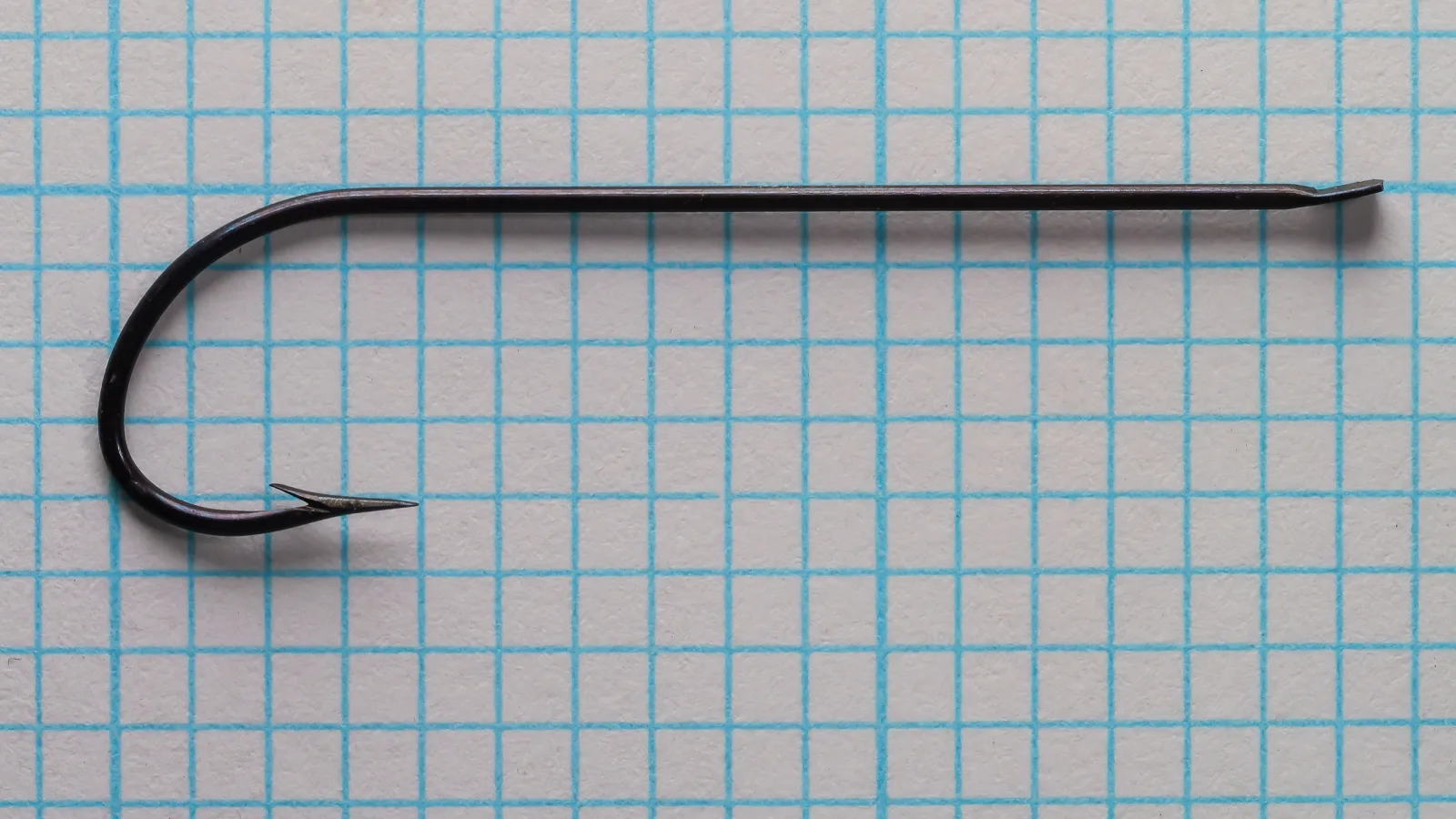
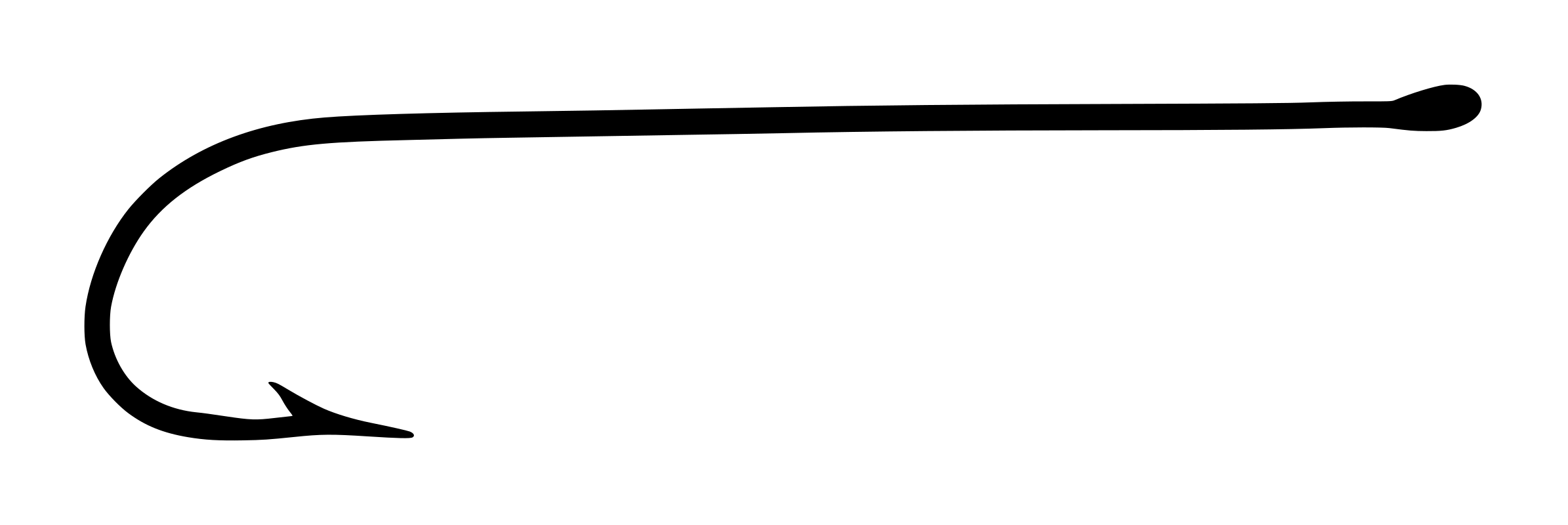
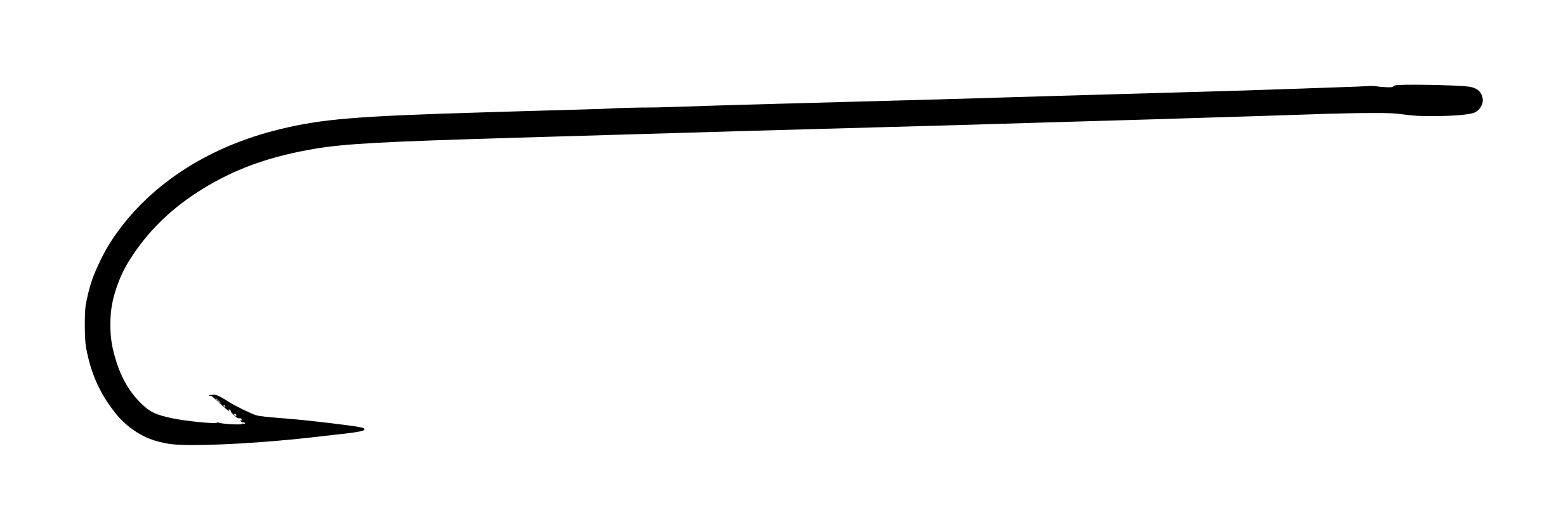
T. H. Bate & Co’s Carlisle Hook — a mid-Victorian round bend hook with a blind-flatted spade eye. Retailed by T. H. Bate & Company, a premier New York tackle dealer active until 1873, and forged in Redditch, England. This specimen, size No. 2, perfectly exemplifies the blind-eye construction and long-shank geometry that defined classic Carlisle patterns long before the widespread adoption of industrial ball-eye designs.
Complete side profile of the T. H. Bate & Co's Carlisle Hook, No. 2, japanned finish, showing the characteristic blind-flatted spade eye, sproat bend, and standard wire gauge on a 1/10-inch measurement grid.
Photographic record
4 cataloged imagesSelect any record to load it above.
4 images shown
T. H. Bate Carlisle Blind-Eye Hook Size 2Complete side profile of the T. H. Bate & Co's Carlisle Hook, No. 2, japanned finish, showing the characteristic blind-flatted spade eye, sproat bend, and standard wire gauge on a 1/10-inch measurement grid.Open originalT. H. Bate Carlisle Original LabelOriginal creped-paper sales card label for T. H. Bate & Co's Carlisle Hooks, No. 2, 100-count package. Shows letterpress printing in blue ink on aged, foxed paper stock — characteristic packaging of Victorian/Edwardian-era Redditch hooks.Open originalT. H. Bate Carlisle Flatted Eye DetailClose-up detail of the blind-flatted (spade-end) eye construction, showing the flat face perpendicular to the shank, a hallmark of Victorian English hook manufacture.Open originalT. H. Bate Carlisle Point and Barb DetailClose-up of the point and barb, showing the superior point geometry with near-straight inner taper and the short, close-cut barb set rearward on the inside curve.Open original
Technical profile
Eye
Blind — FlattedConfirmed blind-flatted (spade-end) eye by physical examination. Flattening is clean and symmetrical, with no visible cracks or deformation. The flat face is perpendicular to the shank, creating a true 'spade' profile P. Eye diameter measures approximately 0.13"-0.15" across the flat face E.
Wire
Extra-Fine, Round
Shank
4X Long — Plain
Bend
carlisle, Narrow gapThe Carlisle pattern is defined by a deep, continuous Round bend. Unlike a Sproat bend, it lacks a parabolic curve and maintains a consistent radius. The wire set is clean with no twist or offset (kirb) visible P.
Point
Superior (near-straight inner taper)Barb is short and close-cut, positioned ~0.08"-0.10" behind the point E. The barb angle is swept rearward at approximately 15-20 degrees to the hook axis E. Barb is set on the inside of the curve and is moderate in height — approximately 0.02"-0.03" proud of the wire E. Overall barb character is subtle and refined, consistent with fine-presentation aesthetics of early 20th-century English fly hooks I.
Finish
Black Japanned — Confirmed (stated on packaging)Japanned finish is glossy black lacquer, photographing as pure black with no blue or brown undertones P. The finish obscures wire grain entirely, indicating a thick coating applied by dipping. Minor surface wear and age-patina visible in raking light, particularly along the bend, consistent with 80-100+ years of storage in original packaging P. No corrosion or base-metal spotting visible on the specimen examined P.
Label shows light foxing and aged patina consistent with 80-100+ years of storage. Creped wrapper is intact but fragile. Hook count not verified in photograph, but condition of specimen shows no corrosion — japanned finish remains glossy black with no spotting or oxide breakthru visible. This is a working example that was opened and used, not a sealed original.
The blind-flatted eye represents a foundational construction principle in English hook manufacture, distinct from the turned-down and turned-up ball-eye designs that dominated later industrial production. The flatting process — striking the wire end with a shaped die to compress and broaden it into a spade-like form — creates a robust, integrated eye structure with no weak point at the wire junction. This method predates modern pressing and was executed by hand-eye flatting stations in Redditch workshops.
The Sproat bend is achieved through a die-forging operation that imparts the rounded, deep curve in a single strike. The ‘Superfine Spring Steel’ designation refers to high-carbon spring steel of the grade typical of Redditch manufacture, likely drawn wire in the 0.019″-0.022″ diameter range (estimated). The japanned finish — a glossy black lacquer applied by immersion dipping and stove-curing — provides excellent corrosion resistance and was the standard finish for English trout hooks in this era.
The superior (near-straight) point taper follows the natural grain of the spring steel and is formed by hand-grinding or die-shaping the point on a stone wheel. The barb is set close to the point and is relatively short, consistent with fine-presentation aesthetic of early 20th-century English fly-tying tradition.
This is a documented example of one of the few surviving T. H. Bate & Co's Carlisle hooks in original packaging with legible label. The blind-flatted eye and Carlisle model name are uncommon in the garrenwood.com catalog to date. This entry represents early documentation of the Bates hook line within the site's historical reference archive.
Own this hook? Help us measure it.
We have measurement for size 2. Know any others? Submit calipered measurements and we'll review and add them. Thank you!
Historical context
bates
Thomas H. Bate & Co. was a highly prominent American sporting goods and tackle dealer based in New York, not a native English forging house, although they imported vast quantities of custom-branded Redditch hooks. Operating from the mid-19th century, the company was a major supplier to the American angler. In 1859, William Mills joined the firm, and following changes in leadership, the company was famously reorganized in 1873 as William Mills & Son. Because of this well-documented succession, any tackle bearing the T. H. Bate & Co. mark serves as a reliable time capsule, definitively dating to 1873 or earlier.
Series History
The Carlisle is a standalone traditional hook pattern defined by its continuous round bend and extended shank length, rather than being part of a numbered modern series. Designed for delicate bait presentation and long-bodied patterns, it was forged by nearly all major Redditch makers and exported extensively. T. H. Bate & Co. sourced these high-quality Carlisle patterns from England to meet the demands of American anglers who relied on its predictable geometry and fine wire.
Named Collaborator
T. H. Bate & Co. — No individual designer is credited on the packaging. The company itself operated as the collaborator, with the Carlisle hook representing the collective expertise of the Bates fly-hook forging team in Redditch. No biographical information on individual company principals is available from the image or packaging.
Era and Packaging Dating
Thomas H. Bate & Co. was succeeded by William Mills & Son in 1873. Because of this hard historical cutoff, all packaging bearing the T. H. Bate & Co. name predates this transition. While the creped wrapper and letterpress printing are characteristic of late 19th-century Redditch export packaging, the firm's timeline firmly places this item in the mid-Victorian era, likely the 1860s to early 1870s.
The Forgotten Art of Eye-Flatting
The blind-flatted eye was achieved through a labor-intensive hand-forging process: a Redditch eye-flatting specialist would grip the wire blank in a vise, position a shaped steel die against the eye end, and strike it with a weighted hammer. The die imparted a flat, spade-shaped form in a single blow — an operation that required years of apprenticeship to master. A skilled eye-flattener could complete 400-500 hooks per day by hand. By the 1920s, mechanical presses and the rise of ball-eye hooks made this craft nearly obsolete, and the skill was largely lost within a generation.
Design lineage and influence
The blind-flatted eye descends directly from the earliest English hooks of the 1600s-1700s, when the eye was formed by simply flattening and bending the wire end without any loop or projection. This construction was favored because it created a minimal, streamlined profile at the head — critical in hand-tied flies where bulky eye connections could spoil delicate presentations.
By the Victorian era, the blind eye existed alongside the newer turned-down and turned-up ball-eye designs, which offered easier fly-lashing and were more amenable to mechanization. Redditch makers produced both, catering to conservative fly-fishers who preferred the traditional blind eye and to modern tyers adopting ball-eye shortcuts. The Sproat bend itself — characterized by its deep, rounded bottom — is a descendant of the Irish Sproat and was favored in England as a versatile, spring-lively bend suitable for both dry and wet work.
The Carlisle’s design shows no major innovations relative to earlier blind-eye hooks; rather, it represents a refinement of the established Redditch standard. Its influence is primarily historical: it exemplifies the hook engineering philosophy that dominated British fly-fishing until World War II, when industrial standardization and overseas competition largely displaced blind-eye production. Modern reproductions like the Partridge Yorkshire Trout attempt to revive this lineage, but the craft knowledge required to hand-flatten eyes has been lost.
Best matchRelated by Attribute
Computed automatically from catalog data — updated as new hooks are added.
Matches: Bend, Gap, Eye, Eye Orient., Forging +2 moreDiffers: Shank: 4X Long vs 1X Long; Wire: Extra-Fine vs Fine (1X Fine); Point: Superior vs Standard / Spear +2 more
Matches: Bend, Shank, Wire, Eye Orient., Point +2 moreDiffers: Gap: Narrow vs Standard; Eye: Blind — Flatted vs Blind — Marked Shank; Finish: Black Japanned vs Blued +3 more
Matches: Bend, Gap, Eye Orient., Point, Forging +1 moreDiffers: Shank: 4X Long vs Extra-Extra Long; Wire: Extra-Fine vs Fine (1X Fine); Eye: Blind — Flatted vs Blind — Marked Shank +3 more
The Carlisle blind-flatted hook was designed as a general-purpose trout fly pattern hook for both dry and wet flies in British freshwater fly-fishing tradition. The blind-flatted eye was the standard construction for English trout hooks of the Victorian and Edwardian eras, allowing direct loop-lashing of the fly line or gut leader without exposed wire at the hook head. This construction was particularly favored in chalk stream and river fishing, where minimal protrusion of the eye was considered advantageous for fine-presentation work and reduced snagging risk in aquatic vegetation.
The Sproat bend profile — rounded and deep — is optimized for the spring-and-hold characteristics required in wet-fly nymph presentations and traditional tied spider patterns. The standard wire gauge and No. 2 size place this hook in the mid-range for upland stream trout, suitable for patterns from size 12 to 14 equivalent in modern notation.
Secondary Applications
Historically also used for traditional Scottish and Northern English grayling and sea trout patterns where fine presentation was critical.
Classic Fly Patterns
Traditional wet flies, spider patterns, nymphs tied in period Redditch style, March Brown, Greenwells Glory, Partridge and Orange variant patterns
Modern Equivalents
Hook
Match Quality
Notes
Partridge Yorkshire Trout
Very Good
Modern reproduction of English blind-eye philosophy with turned-down eye; maintains sproat bend and spring steel. Closest functional equivalent.
Mustad C70SD
Moderate
Sproat bend, standard wire, turned-down eye. Functional substitute for trout work but loses the historical blind-eye character.
Collector notes
Rated 5.0/10 — Uncommon Redditch-era blind-eye trout hook with original period packaging. Strong collector demand among specialists in English craft hooks and historic fly-tying traditions. Original label and intact card format add substantial premium.
Reference value
$18 – $48 USD estimate
Packaging condition
Fair — significant wear, partially legibleRecorded specimen
Packaging format
GW-B-01Catalog code
The T. H. Bate & Co’s Carlisle represents a significant collectible within the English blind-eye hook tradition. Scarcity is driven by (1) the specialist nature of the blind-flatted eye construction, now largely abandoned, and (2) limited surviving stock in original packaging. The Carlisle model appears less frequently in the secondary market than mainstream Redditch patterns like the Allcock Carseys or Partridge hooks, making it a genuine find for specialists.
Most desirable: Original card packaging with complete label, full hook count (100 pieces), and no significant label damage or loss. Condition of the label itself is critical — the creped paper and letterpress printing are fragile, and clean typography commands a premium. Loose hooks without original packaging fetch 20-30% of carded value, as utility demand is limited to collectors of specific patterns or historians studying the blind-eye lineage.
Size impact: The No. 2 documented here is mid-range within typical Victorian/Edwardian trout-hook sizing. No significant scarcity is associated with this size alone, though very small (No. 10+) or very large (No. 1/0+) would be unusual and command slight premiums.
Condition factors: Original tissue wrapping intact (if present) adds 10-15% premium. Hooks must show no corrosion or spotting — the japanned finish is robust, but any loss exposes bare steel. Card must be intact with no major creasing, foxing, or label loss. Missing hooks from the original count reduce value proportionally (e.g., 90/100 hooks present = ~90% of full-card value).
Packaging
Original sales card format with wrapped package. Creped paper label mounted on card stock, printed in blue ink by letterpress. Label text reads: 'T. H. BATE & CO'S / Superfine Spring Steel / CARLISLE HOOKS, / FLATTED. / No. 2 / 100'. Label is affixed to a light tan creped paper envelope or wrapper, which was secured around the card. Paper shows aged patina, light foxing, and loss along edges. The label itself remains legible despite age-related surface wear. Card construction is typical of mid-Victorian era sales packaging — simple, functional, and economical. No barcode, no modern catalog code, no postal ZIP code visible — consistent with pre-1950 manufacture.
Market Value Notes
Low ($18): Good condition — opened card with label intact but showing wear/foxing, 90-95% of hooks present, minor edge damage to card.<br />
<br />
High ($48): Excellent to mint condition — original card with clean, complete label, full 100-hook count, minimal label wear or foxing.<br />
<br />
Premium factors: Complete original label legibility, intact creped paper packaging, full hook count, absence of corrosion on hooks, card edge integrity.<br />
<br />
Platforms: Specialist British tackle auctions, UK eBay (heritage fishing section), Redditch hook dealers, international vintage tackle forums.<br />
<br />
Confidence: E estimated — limited comparable sales data for this specific model; estimate anchored to similar English blind-eye cards (Allcock, Partridge, Sealey) in comparable condition and era. Upward adjustment applied for label clarity and the Carlisle's specialist status among fly-tyers studying pre-modern hook construction.
Where to Find
UK eBay (search: Bates Carlisle hook), specialist Redditch hook dealers, British vintage tackle auctions, international fly-tying collector forums. Rarely appears in North American retail tackle shops; most examples are held by UK and European collectors.
Collector's Identification Tips
Label legibility: The most reliable identifier is the printed label. Confirm that text reads ‘T. H. BATE & CO’S,’ ‘Carlisle,’ ‘FLATTED,’ and the size number. Faded or illegible labels complicate authentication.
Blind-flatted eye: Examine the eye-end profile carefully. It should show a broad, flat spade-like shape — not a round ball. The flat face should be perpendicular to the shank. This feature is definitive and immediately distinguishes Bates Carlisle from ball-eye competitors.
Japanned finish: The finish should be glossy black lacquer with no blue or bronze undertone. Raking light may reveal minor wear, but the base color should remain true black (confirmed in this specimen by physical examination).
Wire gauge and bend profile: The Sproat bend should be deep and rounded. Standard wire gauge is evident in the proportions relative to the gap. Compare to published Redditch standards for the era if uncertain.
Packaging format: Original Bates Carlisle cards feature a creped-paper wrapper with letterpress label. The label format is consistent across documented examples. Later industrial reproductions will lack this hand-crafted aesthetic.
Size marking: The label should clearly state the size as ‘No. 2’ or other number. Cross-reference with measurements to confirm. Victorian-era Redditch sizing often differs from modern Mustad standards.
Primary Source
Label Typography and Marketing Language
Source: T. H. Bate & Co's Carlisle Hook label, visible in Hook image 2
The label text — ‘T. H. BATE & CO’S / Superfine Spring Steel / CARLISLE HOOKS, / FLATTED. / No. 2 / 100’ — reveals significant information about Redditch hook marketing and manufacture in the late 1800s.
‘Superfine Spring Steel’: This phrase was standard marketing language in the Redditch hook industry, emphasizing hand-selected, high-carbon wire drawn to fine diameter and stress-relieved for resilience. It was a quality claim pitched at fly-fishers willing to pay a premium for hooks that wouldn’t fatigue or break under the stress of repeated casting and hook-setting. Competing makers (Allcock, Partridge, Milward) used identical or similar phrasing.
‘FLATTED’: The explicit label notation ‘FLATTED’ confirms that the eye type was a key selling point and differentiator for Bates. By the 1890s-1920s, eye type (flatted vs. ball eye) was becoming a conscious choice for consumers, not simply a default construction. The label signals that Bate & Co. was marketing the blind-flatted design as a deliberate feature for fly-fishers who valued the traditional construction.
Package count (100): The ‘100’ indicates this was a standard sales unit — a full gross of hooks packaged and sold as a single product. This size was typical for retail tackle dealers and professional fly-tyers, who would purchase in quantity and break the pack for retail sale or personal use.
The letterpress printing method and creped-paper stock are hallmarks of 1880-1920 Redditch packaging, predating the printed card stocks and offset lithography that became standard by the 1930s.
Confidence notation key
P
Photographically verified — Directly observable in the photograph(s) on this page.
V
Verified by documentation — Confirmed by manufacturer catalog, spec sheet, or published reference.
I
Inferred — A logical deduction from observable or documented evidence, not directly stated.
E
Estimated — An approximation based on visual comparison, proportional analysis, or limited data.
S
Speculative — A reasoned hypothesis that cannot be confirmed from available evidence.
Claims with no notation are confirmed by multiple independent sources. All photographs on garrenwood.com are taken on a measurement grid where each square equals 1/10 inch (0.1″ / 2.54 mm).