The Mustad 3700 is a classic mid-20th-century Carlisle hook manufactured by O. Mustad & Søn in Oslo, Norway, during the 1950s-1970s. Size 4/0 with a long shank, moderate-width gape, and distinctive hollow point grinding — a mechanical specification designed to enable rapid penetration with minimal applied force on large live-bait applications. The blued finish and ringed straight eye are characteristic of Mustad’s bait-hook production standard of the era.
This hook embodies Mustad’s industrial ‘pattern cloning’ strategy: reverse-engineering the regional English Carlisle design and mass-producing it with Norwegian manufacturing precision and efficiency. The hollow point represents a Mustad-specific biomechanical refinement — the concave inner face creates an extraordinarily sharp, knife-edge profile that penetrates soft tissue cleanly without requiring the brute force typical of standard spear-point hooks.
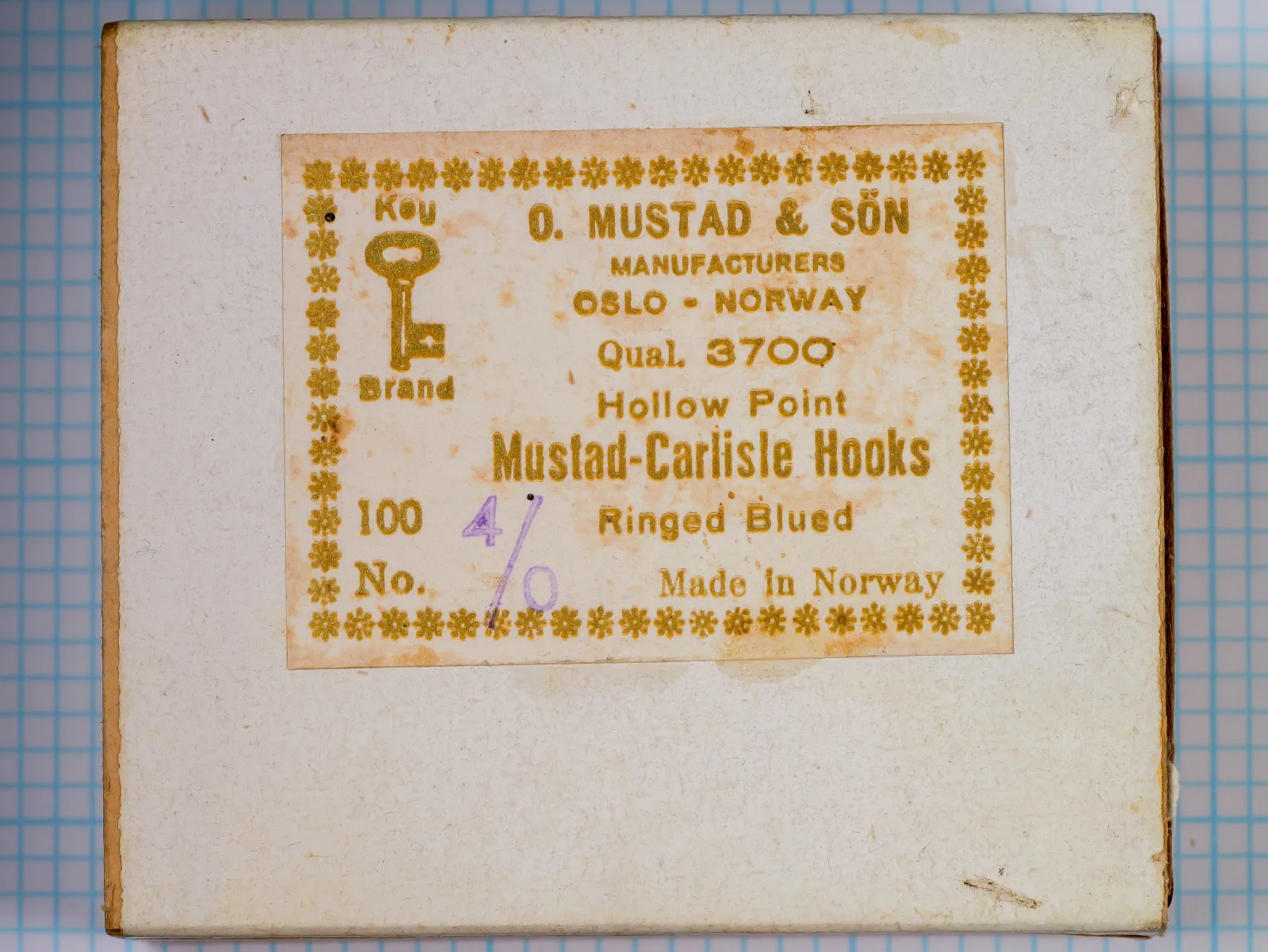
For collectors, the 3700 holds modest but genuine significance as an authentic ‘Made in Norway’ mid-century specimen with original cardboard packaging featuring Mustad’s iconic eight-line label format and gold-printed Key Brand logo. The presence of the hand-stamped size notation and the arbitrary ‘Qual. 3700’ numeric code confirm this as a vintage product from the classic labeling era, predating Mustad’s transition to the modern Signature Series (~2001-2009).
Today, the 3700 appeals equally to vintage fishing tackle collectors seeking authentic mid-century bait hooks, fly tyers looking for large-profile streamer foundations, and fishing historians documenting Mustad’s global industrial dominance. Modern functional equivalents exist (Mustad 3261, Eagle Claw 214), but the original 3700 remains a touchstone of mid-century Scandinavian hook manufacturing reputation.
Mustad 3700 Box and Label size 4-0
Photographic record
3 cataloged imagesSelect any record to load it above.
3 images shown
Mustad 3700 Box and Label size 4-0Mustad 3700 Box and Label size 4-0Open originalMustad 3700 Hook Point size 4-0Mustad 3700 Hook Point size 4-0Open originalMustad 3700 Hook size 4-0Mustad 3700 Hook size 4-0Open original
Technical profile
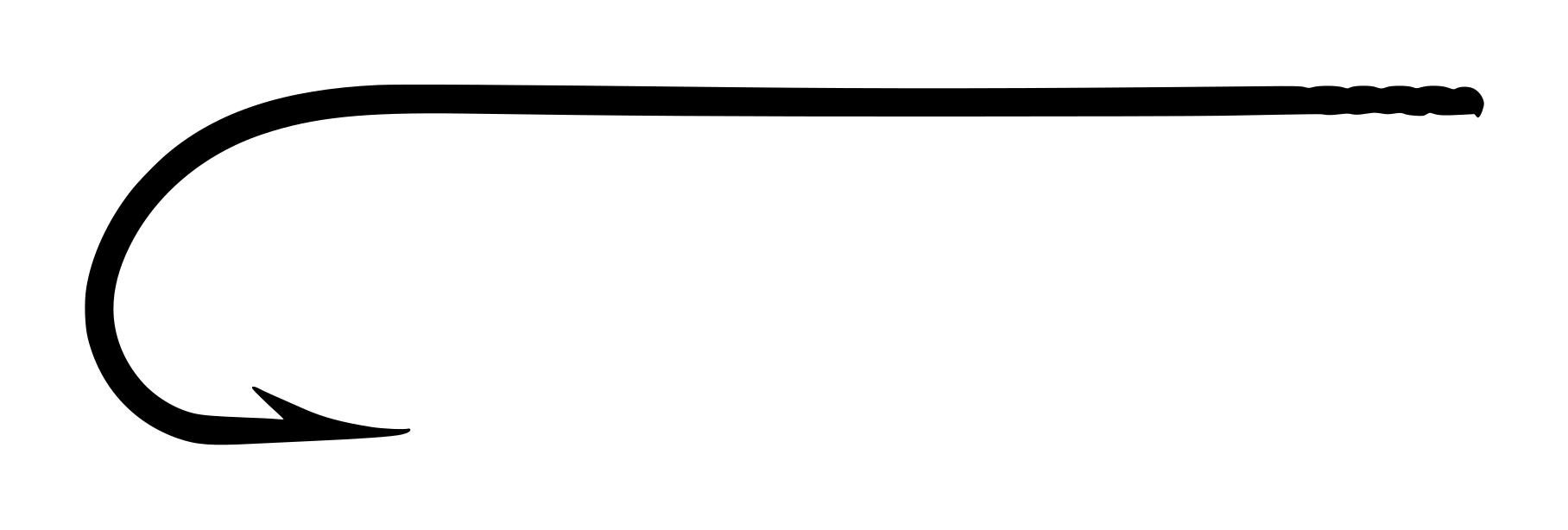
Straight Ring Eye | Sproat Bend | Long Shank (Carlisle) | Standard Wire | Hollow Point | Blued Finish
Eye
Ball Eye, Straight / InlineRing eye is circular and evenly formed, parallel to the shank axis — a classic straight eye typical of Carlisle bait hooks P. Eye diameter is proportional to the 4/0 wire gauge. No observable deformation, bending, or flattening. Wire termination is smooth and well-finished P.
Wire
Fine (1X Fine), Round, Est. ~0.040"-0.048" (~1.0-1.2 mm)
Shank
4X Long — Plain
Bend
carlisle, Standard gap, Offset / kirbedBend geometry exhibits the parabolic Carlisle shape characteristic of Mustad's design lineage — a smooth, rounded bottom curve without the sharp angular transition of Limerick patterns P. Bend is centered on the shank with no observable lateral offset. Wire curvature is symmetrical and even, suggesting quality cold-forging or mandrel-based forming process I.
Point
Hollow Point (concave inner face)Barb is small and tightly cut, positioned close to the point at approximately 20-30 degrees from horizontal P. Barb height is proportional to the 4/0 wire gauge — not excessively long but sufficiently pronounced for secure hook-holding. Cut appears clean with no ragged edges P.
Finish
Blued — Confirmed (stated on packaging)Blued finish displays characteristic dark gray-blue tone with subtle warm undertones P. Surface is relatively uniform across shank and bend, with slight peachy-gray patina developing on the upper portion of the shank — typical of aged chemical passivation finishes. No bright metallic areas visible; finish fully covers substrate. Tone is distinctly cooler than bronzed hooks, characteristic of Mustad's blued finish chemistry of the period E.
Hook specimen shows blued finish intact with minimal corrosion (light surface patina visible on upper shank in profile view). Point is sharp, undamaged, and retains original grinding geometry. Barb is clean and unmissed. Ring eye is smooth and undamaged. Packaging shows light toning consistent with 60+ years of storage; no significant tears, creases, or water damage visible.
The hollow point geometry on the 3700 reflects Mustad’s biomechanical engineering philosophy. Unlike a standard spear point — which features a straight, wedge-like taper from the barb to the tip requiring significant penetration force — the hollow point employs a concave inner face ground from the barb to the tip. This creates an extraordinarily sharp, knife-edge profile that flares rapidly toward the barb. The mechanical advantage is rapid initial penetration with minimal applied pressure; historically, this was essential for soft-mouthed fish species (trout, crappie, panfish) where aggressive hook-sets would tear friable mouth tissue, resulting in lost catches. On a large 4/0 hook, where brute force alone might tear the bait or the fish’s jaw, the hollow point geometry ensures the incisive tip penetrates cleanly and the rapid barb flare secures the hook in tissue without creating excessive wound channels that could enlarge during the fight. The blued finish provides moderate corrosion resistance suitable for freshwater bait fishing — the chemical passivation process creates a dark oxide layer that protects the high-carbon steel substrate while offering a non-reflective, stealthy presentation in clear water. The round wire profile (non-forged) maintains flexibility and reduces stress concentrations in the bend, appropriate for live bait applications where the hook absorbs dynamic shock from large, thrashing fish. The ringed straight eye is optimized for direct knot attachment with the simple clinch or improved clinch knot — efficient for commercial and recreational bait anglers who prioritized speed over ornamental presentation.
The Mustad 3700 belongs to the ‘Quality’ tier product line (Qual. 3000-3999 range) — Mustad’s mid-tier catalog segment representing hooks manufactured to exacting dimensional and tempering standards, positioned between economy models (1000-2999) and premium specialized hooks (4000+). The 3700 is explicitly badged as ‘Mustad-Carlisle,’ indicating that Mustad reverse-engineered and standardized the regional Carlisle pattern from English blacksmith tradition for global industrial production. The Carlisle family encompasses multiple Mustad model numbers, each introducing variations in wire gauge, eye type, finish, and point geometry. The hollow point specification on the 3700 represents a mechanical refinement over standard spear-point Carlisle variants, designed to enhance penetration speed on large hooks where applied force is limited. The 3700 remained in production throughout the 1950s-1970s as evidenced by the ‘Oslo’ designation (post-1925 manufacture) and mid-century packaging aesthetics. The series eventually transitioned to the modern Signature Series nomenclature (~2001-2009), at which point the arbitrary ‘Qual. 3700’ designation was discontinued. The 3700 represents the classic ‘Quality’ Carlisle era and is no longer in production under this model code, though modern equivalents such as the Mustad 3261 continue the Carlisle lineage with updated manufacturing techniques.
Era and Packaging Dating
Location line shows 'OSLO - NORWAY' (not 'Christiania'), confirming manufacture post-January 1, 1925. Gold floral decorative border on packaging is consistent with Mustad mid-century export labeling (1930s-1970s). Eight-line label format with arbitrary 'Qual.' numeric code (Qual. 3700) is characteristic of the classic labeling era, not the modern Signature Series introduced ~2001-2009. Paper stock shows age-appropriate toning and slight yellowing typical of 1950s-1960s cardboard. Typography and printing method (offset letterpress) align with mid-20th-century production. Hand-stamped purple ink size notation suggests retail inventory marking of the era. No barcode visible (barcodes became standard after 1974), reinforcing pre-1974 manufacture.
The Democratization of the Carlisle
The Carlisle pattern originated in the historic Carlisle region of England and was designed by regional blacksmith-hook makers to prevent deep hooking of live baits — a critical concern for anglers using delicate silk lines and fragile fish mouths. Mustad's industrial 'cloning' of this pattern and mass production in Norway during the 1950s-1960s made the Carlisle affordable for American and European subsistence and sport fishers, effectively democratizing a pattern that had previously been a luxury of affluent English anglers. The hollow point grind on the 3700 was Mustad's mechanical improvement on the classic Carlisle geometry, allowing faster penetration without increasing force — a biomechanical innovation that reflected the company's obsession with manufacturing efficiency and customer satisfaction during its mid-century dominance.
Design lineage and influence
The Mustad 3700 descends directly from English blacksmith-made Carlisle patterns originating in the Carlisle region. The Carlisle design itself is a refinement of 19th-century Irish and English live-bait hook traditions, distinguished by its extra-long shank and moderate-width gape — geometry specifically engineered to prevent deep throat hooking and to protect delicate fishing lines from sharp-toothed predators. Mustad’s industrial adoption of the Carlisle pattern in the late 19th and early 20th centuries represented strategic ‘pattern cloning’ — a business model wherein Mustad identified successful regional designs and replicated them at industrial scale with their proprietary manufacturing advantages. The hollow point grinding on the 3700 was a Mustad-specific mechanical enhancement, differentiating their version from traditional blacksmith Carlisles. Competing manufacturers including Eagle Claw, Pflueger, and later Japanese makers produced equivalent Carlisle designs, but Mustad’s Norwegian production reputation and quality control dominance during the mid-20th century established the 3700 as a benchmark. Modern descendants include the Mustad 3261 (which maintains Carlisle geometry but without the distinctive hollow point grind on most modern iterations) and the Eagle Claw 214 (a direct functional equivalent targeting American bait-fishing markets). The Carlisle pattern’s influence persists in contemporary fly-tying — the geometry informs modern hook designs for large streamers and saltwater patterns, though the original live-bait context has largely been superseded by fly-fishing applications.
Best matchRelated by Attribute
Computed automatically from catalog data — updated as new hooks are added.
Matches: Bend, Shank, Wire, Eye, Eye Orient. +4 moreDiffers: Gap: Standard vs Narrow; Point: Hollow Point vs Superior; Finish: Blued vs Bronzed +3 more
Matches: Bend, Shank, Wire, Eye, Eye Orient. +5 moreDiffers: Gap: Standard vs Narrow; Point: Hollow Point vs Standard / Spear; Finish: Blued vs Bronzed +2 more
The Mustad 3700 in size 4/0 is primarily designed for live bait fishing with large minnows, crayfish, or nightcrawlers, targeting pike, pickerel, bass, and catfish. The long shank protects the leader from sharp teeth, and the wide gape accommodates substantial baits without gut-hooking. The hollow point enables rapid penetration with minimal applied force — essential on a large hook where significant mechanical force is required to set cleanly. In modern fly-tying circles, the 3700 is valued for creating oversized, long-profile streamer patterns that mimic baitfish silhouettes.
Not typically used for fly tying in the traditional sense; however, modern fly tyers employ the 3700 for large streamer patterns such as Muddler Minnow variants, Woolly Buggers, and custom pike flies.
Modern Equivalents
Hook
Match Quality
Notes
Mustad 3261
Excellent
Direct descendant, same Carlisle pattern and size range, maintains the long-shank bait-hook geometry but modern manufacturing lacks the hollow point grind specification
Eagle Claw 214
Very Good
Classic American bait hook equivalent, Carlisle-style geometry, widely available and affordable, similar size range
Gamakatsu SS15
Good
Modern Japanese equivalent for large live-bait applications, similar shank length and gape, stainless steel construction
Collector notes
The Mustad 3700 is a collectible mid-century hook with modest to strong collector interest driven by its identity as a 'Made in Norway' specimen, distinctive hollow point grind, and the nostalgia factor of large vintage bait hooks. Rarity is moderate — examples appear regularly on eBay and vintage tackle specialist sites, but original cardboard packaging in good condition significantly increases desirability. Limiting factors include the abundance of modern equivalents (Mustad 3261, Eagle Claw 214) and the hook's primary association with bait fishing rather than the more collectible fly-tying tradition.
Reference value
$8 – $25 USD estimate
Packaging condition
Good — moderate wear, legibleRecorded specimen
Packaging format
GW-M-01Catalog code
Positive factors: Authentic Norwegian manufacture during Mustad’s peak production era (1950s-1960s); distinctive hollow point geometry documented on label; original cardboard packaging with intact eight-line label adds significant value; large 4/0 size appeals to saltwater and pike-fishing collectors; blued finish is aesthetically characteristic of mid-century bait hooks; numeral quality code ‘Qual. 3700’ is iconic of the pre-Signature Series catalog system.
Limiting factors: Bait hook classification places it outside the premium fly-tying collector niche; moderate availability on secondary market reduces scarcity premium; modern manufacturing equivalents are readily available and inexpensive; blued finish susceptible to patina and corrosion, requiring careful storage; hooks in this size often show usage wear, and mint examples command significantly higher prices.
Packaging
Standard Mustad mid-century cardboard hook box, 2.75" × 2.25" (estimated). Cream-colored stock with ornamental gold-printed decorative border (leaf/floral motif) surrounding all four edges. Eight-line typographic label in centered gold offset print, featuring Key Brand logo (downward-pointing skeleton key) in upper left quadrant. Label text: 'O. MUSTAD & SÖN / MANUFACTURERS / OSLO - NORWAY / Qual. 3700 / Hollow Point / Mustad-Carlisle Hooks / 100 No. [4/0 hand-stamped in purple ink] / Ringed Blued / Made in Norway'. Decorative asterisk borders separate each line. Paper shows age-appropriate toning (cream-to-light-tan patina). No visible barcode or modern UPC. Box closure appears to be original horizontal tuck-flap design typical of 1950s-1960s hook packaging.
Market Value Notes
Pricing ranges reflect condition of cardboard packaging and hook specimen. Loose, used 4/0 examples: $5-12 USD. Mint hooks on original card with clean label: $15-25 USD. Premium pricing (up to $35+) for examples showing original factory box closure, minimal toning, and documented provenance. eBay and vintage tackle dealer markets are primary venues. Rarity and collectability vary by geographic market — higher prices in Scandinavian countries and among Norwegian manufacturing enthusiasts.
Where to Find
eBay vintage fishing tackle auctions, specialist vintage tackle dealers (particularly those focusing on Scandinavian or European hooks), tackle memorabilia shows, occasional antique fishing equipment auctions. Less commonly found in UK and US general antique markets compared to English-manufactured hooks.
Preservation
Storage and Preservation
Store this hook and its original cardboard packaging in a cool, dry environment away from direct humidity and temperature fluctuation. The blued finish is susceptible to patina development and surface oxidation when exposed to moisture; this darkening is normal for aged blued hooks and is often considered desirable by collectors. Original packaging should be stored flat or upright in an archival-quality acid-free storage box to prevent color transfer and further toning. Avoid direct sunlight exposure, which can fade the gold-printed label ink and discolor the cardboard stock. If the hook is removed for use, store separately in a dry, sealed container with silica gel packets to prevent corrosion. Do not store with other metals — brass, copper, or stainless steel in proximity can cause galvanic corrosion through moisture contact. The value of this specimen is significantly enhanced by the presence of original packaging in good condition; keep the card and box together whenever possible. For display purposes, mount in an archival-quality case with inert materials (Plexiglas, acid-free backing board) to protect from dust and moisture while allowing clear visibility of both hook and label.
Marking Analysis
Hand-Marked Size Notation
The size notation ‘4/0’ is hand-stamped in purple ink directly on the label, likely applied at the point of retail inventory or during box closure quality control. This purple stamp is consistent with Mustad’s mid-century labeling practices, wherein individual hook sizes were denoted by hand stamp rather than pre-printed on each box variant. The stamping pressure is uniform and the ink color is saturated, suggesting application by a mechanical stamp press rather than manual handwriting. This practice was common in the 1950s-1960s when hook box varieties were standardized and individual size SKUs were marked during fulfillment rather than stored as unique pre-printed variants. The presence of this hand mark does not diminish collectability; rather, it documents the era-specific manufacturing workflow and adds authenticity to the specimen P.
Primary Source
Decoding the Eight-Line Label
Source: O. Mustad & Søn vintage hook label; 'A Comprehensive Typology and Decryption of Vintage O. Mustad & Søn Hook Labels' reference documentation
The label exemplifies Mustad’s standardized eight-line typographic format that remained consistent across decades of global export. Each line serves a specific, strictly defined function: Line 1 (‘O. MUSTAD & SÖN’) establishes corporate authority and brand identity. Line 2 (‘MANUFACTURERS’) differentiates Mustad from import agents and repackagers, ensuring brand loyalty directly from end-users regardless of distribution channel. Line 3 (‘OSLO – NORWAY’) provides geographic origin and serves as a critical chronological marker — ‘Oslo’ confirms post-January 1, 1925 manufacture (the city was renamed from Christiania to Oslo on that date). Line 4 (‘Qual. 3700’) specifies the quality model code within Mustad’s hierarchical product tier system (3000-3999 = mid-tier quality hooks). Line 5 (‘Hollow Point’) is strictly reserved for point geometry specification per Mustad’s labeling rules — this line exclusively defines the penetrative geometry and cannot denote wire gauge, shank length, or eye type. Line 6 (‘Mustad-Carlisle Hooks’) identifies the overarching bend pattern — the Carlisle, reverse-engineered from English blacksmith tradition and standardized for mass production. Lines 7-8 (‘100 No. 4/0 / Ringed Blued / Made in Norway’) specify box quantity, size, eye type, finish, and country of origin. This eight-line structure was engineered to communicate vast technical data across linguistic barriers to international wholesalers and retailers before the advent of modern barcoding and standardized global marketing V.
Additional
The Hollow Point Specification — A Manufacturing Innovation
The ‘Hollow Point’ designation on the Mustad 3700 represents a distinct mechanical specification within Mustad’s quality-control system — not merely a marketing descriptor but a precisely engineered grinding geometry. The hollow point is created through a controlled mechanical grinding process wherein the inner face of the terminal wire (the side facing the inside of the hook) is dished out or concaved from the barb to the tip, creating a thin, knife-edge profile that tapers to an extremely sharp microscopic point. This contrasts sharply with a ‘Superior Point’ (also found on Mustad vintage labels), which features a near-straight, flat inner taper. The hollow point’s concave geometry creates two distinct mechanical advantages: first, the rapidly flaring profile from tip to barb allows the incisive point to penetrate soft tissue with minimal resistance — essential for large hooks where anglers cannot apply excessive force without tearing the bait or fish jaw. Second, the sharp, concave edge creates a ‘knife-like’ cutting action rather than a pure punching action, reducing the penetration force required while maximizing holding security once the barb engages. This specification was particularly favored on large bait hooks (3/0, 4/0, 5/0) and is a hallmark of Mustad’s mid-20th-century quality engineering. Modern hook manufacturers rarely employ this hollow point geometry, preferring chemically sharpened or laser-ground alternatives, making vintage hollow point specimens like the 3700 valuable documentation of historical manufacturing precision.
Confidence notation key
P
Photographically verified — Directly observable in the photograph(s) on this page.
V
Verified by documentation — Confirmed by manufacturer catalog, spec sheet, or published reference.
I
Inferred — A logical deduction from observable or documented evidence, not directly stated.
E
Estimated — An approximation based on visual comparison, proportional analysis, or limited data.
S
Speculative — A reasoned hypothesis that cannot be confirmed from available evidence.
Unnotated claims are the compiler’s synthesis; see Sources. All photographs on garrenwood.com are taken on a measurement grid where each square equals 1/10 inch (0.1″ / 2.54 mm).