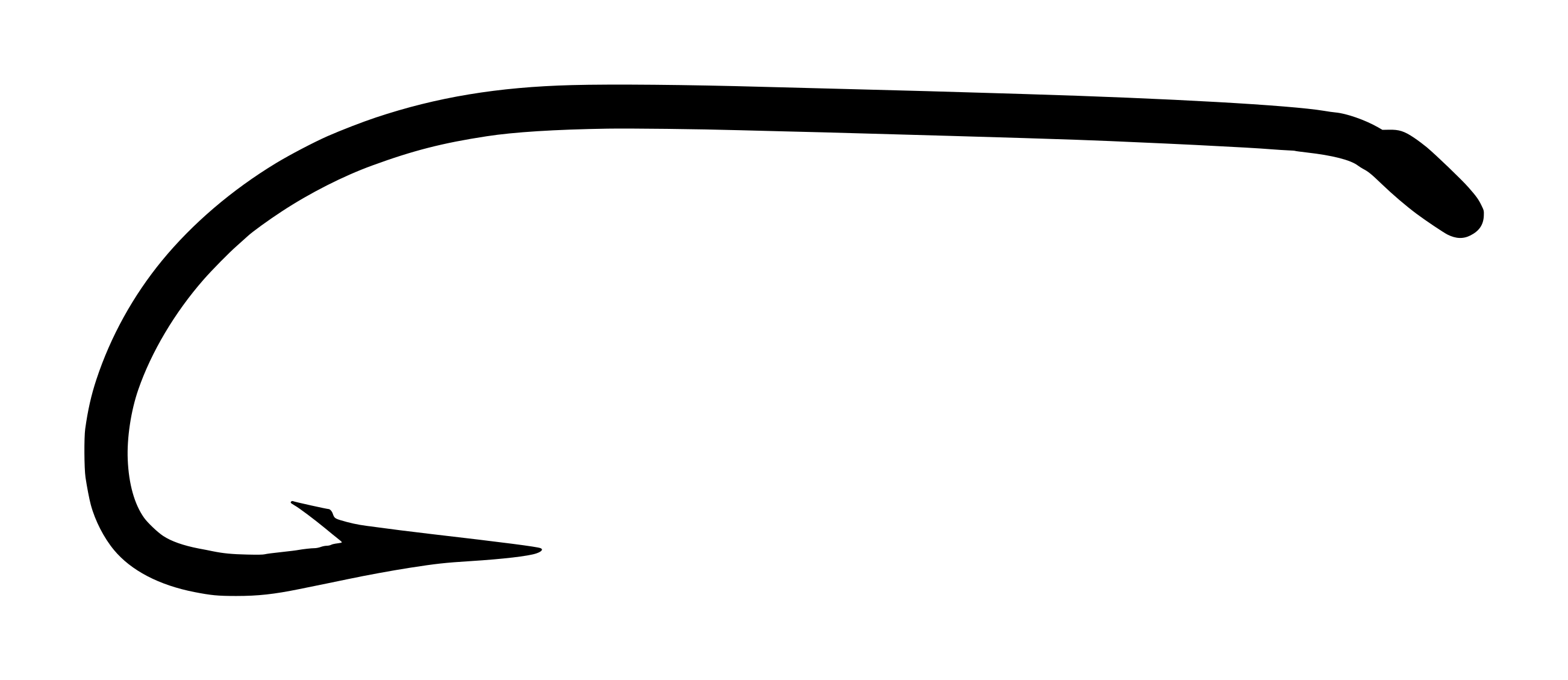
The Mustad 1928 represents a classic Norwegian interpretation of the traditional salmon hook design, featuring a long 2X shank and strong limerick bend. This heavy-wire hook was designed specifically for Atlantic salmon and large sea trout fishing, accommodating the substantial fly dressings characteristic of traditional salmon patterns.
The turned-downd eye and superior point geometry reflect Mustad’s focus on functional excellence in their salmon hook line. The bronzed finish provides moderate corrosion resistance while maintaining the traditional appearance preferred by salmon anglers of the era.
Dating from approximately the 1920s-1940s based on the model designation and documentation style, this hook represents an important period in Mustad’s expansion of their salmon hook offerings to compete with established British manufacturers in Redditch.
Close-up of the Mustad 1928 superior point showing the characteristic near-straight inner taper and well-proportioned barb.
Photographic record
3 cataloged imagesSelect any record to load it above.
3 images shown
Mustad 1928 Point Detail Size 1/0Close-up of the Mustad 1928 superior point showing the characteristic near-straight inner taper and well-proportioned barb.Open originalMustad 1928 Full Profile Size 1/0Complete side profile of the Mustad 1928 showing the long 2X shank, limerick bend, and turned-up tapered eye on measurement grid.Open originalMustad 1928 Documentation Size 1/0Two Mustad 1928 hooks with period handwritten documentation showing model designation and size marking.Open original
Technical profile
Eye
Tapered Eye, Turned DownCleanly tapered turned-down eye with smooth transitions P. Eye opening properly aligned with hook shank axis P.
Wire
Fine (1X Fine), Round, Est. ~0.05" (~1.3mm) E
Shank
2X Long — Plain
Bend
Limerick, Narrow gapClassic limerick geometry with angular bottom transition and moderate depth P. Well-formed corners with consistent wire set throughout the bend P.
Point
Superior (near-straight inner taper)Well-proportioned barb cut at optimal angle for fish retention without excessive tissue damage P.
Finish
Bronzed — Confirmed (stated on packaging)Warm bronze tone consistent with traditional bronzing process P. Even coloration with no visible wear or patina development P.
Hook shows excellent preservation with bright bronze finish and no corrosion. Handwritten documentation appears period-appropriate.
The superior point geometry provides excellent penetration characteristics essential for salmon fishing, where hook sets often occur at considerable distances. The limerick bend offers optimal strength distribution under the severe loading conditions typical of large fish encounters. The long 2X shank accommodates the substantial body materials and wing dressings characteristic of traditional salmon flies, while the turned-down tapered eye ensures proper leader alignment and reduces stress concentration at the eye junction.
Size & scale lab
Physical specimen Catalog record
Selected size
1/0
Physical specimen
Overall Length
39.8 mm
Shank Length
30.4 mm
Gap Width
11.2 mm
Wire Diameter
1.02 mm
Weight
.372g
Confidence
P
Physical specimen
Physical measurement with calipers
Selected size
(unspecified)
Physical specimen
Overall Length
66 mmE
Shank Length
33 mmE
Gap Width
18 mmE
Bend Depth
20 mmE
Confidence
P
Physical specimen
Grid-derived from photograph (1/10" grid)
Own this hook? Help us measure it.
We have measurement for size 1/0. Know any others? Submit calipered measurements and we'll review and add them. Thank you!
Historical context
mustad
O. Mustad & Son, founded in 1877 by Ole Mustad in Gjøvik, Norway, grew from a small forge operation into the world’s largest hook manufacturer. The company’s rise coincided with Norway’s emergence as a major fishing nation, and Mustad hooks became synonymous with quality and reliability in both commercial and sport fishing applications.
By the 1920s, Mustad had established itself as a serious competitor to the traditional British hook makers of Redditch, offering Norwegian engineering precision and industrial-scale production capabilities. The company’s salmon hook line was developed to challenge the dominance of British manufacturers in this prestigious market segment.
Series History
The Mustad 1928 appears to be a standalone model rather than part of a broader numbered series, with the designation likely indicating either the year of introduction or a specific catalog reference. This hook represents Mustad’s entry into the competitive salmon hook market, designed to offer Norwegian manufacturing quality at a competitive price point.
The model was positioned as an alternative to established British salmon hooks, featuring similar proportions and geometry but manufactured with Mustad’s industrial processes and quality control standards. Production likely continued through the 1940s before being superseded by updated designs.
Era and Packaging Dating
Handwritten notation format and style suggests pre-1950s era. Model number 1928 likely indicates introduction year or catalog designation from the late 1920s period.
Norwegian Challenge to Redditch
The model number 1928 likely commemorates either the year of introduction or a significant catalog designation, representing Mustad's ambitious expansion into the prestigious salmon hook market traditionally dominated by British manufacturers. This was part of a broader Norwegian industrial strategy to compete in high-value fishing tackle segments.
Design lineage and influence
The design follows established salmon hook proportions developed by British manufacturers in Redditch during the 19th century. Mustad adapted these proven geometries while applying Norwegian manufacturing techniques and quality control standards. The model competed directly with hooks from Allcock, Partridge, and other established salmon hook makers.
Best matchRelated by Attribute
Computed automatically from catalog data — updated as new hooks are added.
Matches: Bend, Shank, Eye Orient., Point, Finish +3 moreDiffers: Wire: Fine (1X Fine) vs Standard; Gap: Narrow vs Standard; Eye: Tapered Eye vs Ball Eye +1 more
Matches: Bend, Shank, Wire, Gap, Shank Feat. +2 moreDiffers: Eye: Tapered Eye vs Looped Eye; Eye Orient.: Turned Down vs Turned Up; Point: Superior vs Hollow Point +3 more
Matches: Bend, Shank, Wire, Eye Orient., Finish +3 moreDiffers: Gap: Narrow vs Standard; Eye: Tapered Eye vs Looped Eye; Point: Superior vs Standard / Spear +2 more
The Mustad 1928 is a classic long-shank salmon and sea trout hook designed for large wet flies and streamers. The long 2X shank provides extended body space for substantial fly dressing, while the limerick bend offers strong fish-holding power. The turned-down eye allows for straight leader alignment and strong knots.
Secondary Applications
Large streamer patterns, tube fly construction
Classic Fly Patterns
Jock Scott, Green Highlander, Silver Doctor, Thunder and Lightning, large wet flies
Modern Equivalents
Hook
Match Quality
Notes
Mustad 36890
Good
Similar long shank salmon hook design with updated metallurgy
Collector notes
Modest interest due to historical significance as early Mustad salmon hook, but limited by common availability.
Reference value
$5 – $15 USD estimate
Packaging condition
Good — moderate wear, legibleRecorded specimen
The Mustad 1928 appeals to collectors interested in the development of Norwegian hook manufacturing and the competition with traditional British makers. The model represents an important transitional period when Mustad was establishing itself in premium market segments.
Collectability is constrained by the relatively common survival rate of these hooks and the lack of unique manufacturing features that distinguish them from contemporary competitors. Value is primarily historical rather than based on scarcity or exceptional design innovation.
Packaging
Handwritten documentation on grid paper showing 'Mustad 1928' and '1/0' size designation. Paper appears period-appropriate with blue grid lines.
Market Value Notes
Higher values for complete original packaging or documentation. Individual hooks have minimal premium over fishing value.
Where to Find
Antique tackle dealers, estate sales, online auctions. Occasionally found in old fly tying collections.
Preservation
Storage and Preservation
Store in a dry environment to prevent bronzing from developing patina or corrosion. The bronze finish is relatively stable but can darken with humidity exposure. Original documentation should be preserved with the hook as it provides important provenance and size verification. Handle carefully to avoid point damage, as resharpening vintage hooks can affect their collector value. Store separately from other metal objects to prevent galvanic interaction.
Marking Analysis
Documentation Analysis
The handwritten notation ‘Mustad 1928’ and ‘1/0’ appears in period-appropriate ink on grid paper consistent with tackle dealer or collector documentation from the mid-20th century. The penmanship style and paper stock suggest this documentation was created during the hook’s active production period rather than as later collector notation.
Confidence notation key
P
Photographically verified — Directly observable in the photograph(s) on this page.
V
Verified by documentation — Confirmed by manufacturer catalog, spec sheet, or published reference.
I
Inferred — A logical deduction from observable or documented evidence, not directly stated.
E
Estimated — An approximation based on visual comparison, proportional analysis, or limited data.
S
Speculative — A reasoned hypothesis that cannot be confirmed from available evidence.
Claims with no notation are confirmed by multiple independent sources. All photographs on garrenwood.com are taken on a measurement grid where each square equals 1/10 inch (0.1″ / 2.54 mm).