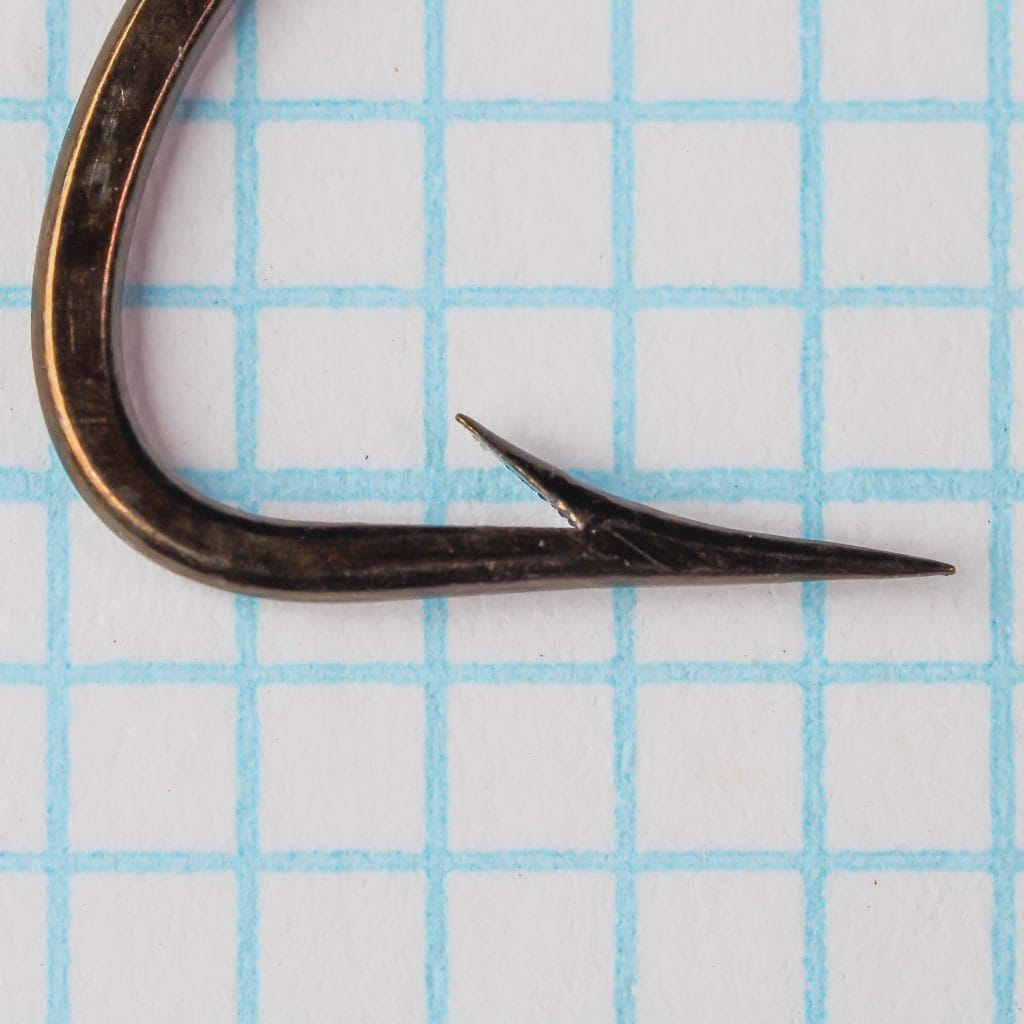
The Mustad 506 is a heavy-wire streamer and nymph hook manufactured by O. Mustad & Son of Gjøvik, Norway. P This size 2/0 specimen features a rounded Sproat bend, a tapered eye, and a hollow point — a design optimized for durability when tying large saltwater and freshwater streamers.
The 506 occupies the middle ground between lighter trout nymph hooks and heavyweight saltwater patterns. Heavy round wire provides structural integrity for large, heavily weighted flies. The hollow point design creates a keen bite edge while maintaining the mechanical strength needed for demanding applications.
Era evidence suggests production between c. 1960-1980, during Mustad’s peak period as the dominant global hook supplier to fly tyers and commercial fishing operations. The 506 remains readily available in vintage lots, indicating substantial production volumes.
Collectability is modest (3.5–4.0) — the hook is common in mid-range sizes but lacks the prestige of specialized Redditch craft patterns or the modern demand of contemporary fly tying. The complete original package and heavy-wire design appeal primarily to vintage streamer specialists.
Close-up of the point and barb on a Mustad 506 size 2/0, showing the characteristic hollow point concave inner face and the short, swept barb. Photographed on 1/10-inch grid for scale reference.
Photographic record
3 cataloged imagesSelect any record to load it above.
3 images shown
Mustad 506 Size 2/0 Point Profile Close-upClose-up of the point and barb on a Mustad 506 size 2/0, showing the characteristic hollow point concave inner face and the short, swept barb. Photographed on 1/10-inch grid for scale reference.Open originalMustad 506 Size 2/0 Full Side ProfileFull side profile of the Mustad 506 size 2/0 on measurement grid, showing the Sproat bend curve, tapered eye, standard shank, and proportional relationship between gap and bend depth.Open originalMustad 506 Documentation with Handwritten LabelResearcher documentation of Mustad 506 hooks with handwritten label 'Mustad 506 2/0' on blue-grid research paper. Shows two specimens of size 2/0 for comparative scale reference.Open original
Technical profile
Size 2/0 • Sproat Bend • Heavy Wire • Hollow Point • Blued Finish • Standard Shank
Eye
Tapered Eye, Turned DownP Tapered eye formed by tapering the wire end without a distinct ball. Taper is moderate and symmetrical, typical of Mustad industrial production. No knob or enlarged terminal.
Wire
Fine (1X Fine), Round
Shank
2X Long — Plain
Bend
Limerick, Narrow gapP Sproat bend shows the characteristic rounded bottom with symmetrical curve. No offset visible — point is aligned straight. Bend depth is proportional to gap width, consistent with standard Sproat geometry.
Point
Hollow Point (concave inner face)P Short, close-cut barb positioned immediately behind the point taper. Barb angle is moderate and swept slightly backward. No microbarbs visible.
Finish
Bronzed — Confirmed (stated on packaging)P Blued finish is uniform and medium-dark in tone. No corrosion or rust visible on this specimen. Finish shows the characteristic warm-black coloration of Mustad bluing applied during the 1960–1980 era. P Specimen is bright and clean with no corrosion, patina, or mechanical damage. Wire is straight with no kinks. Point is sharp and unbroken. Finish is uniform.
The hollow point geometry is characterized by a concave inner face that curves inward, creating a knife-edge effect at the point apex. This design maximizes bite penetration while distributing load across the point taper, reducing the risk of point deflection on hard jaw structures of large fish.
Heavy round wire (approximately 0.052–0.054 inch diameter on size 2/0) provides torsional rigidity and shear strength, essential for holding large, actively feeding fish. The weight also contributes to casting distance and sink rate of streamer flies.
The Sproat bend — a rounded, symmetrical curve — distributes stress evenly through the bend radius and resists the angular deformation that sharper bends (like Limerick) may experience under extreme load.
We have measurements for sizes 2/0, 1/0, 18. Know any others? Submit calipered measurements and we'll review and add them. Thank you!
Historical context
mustad
O. Mustad & Son was founded in Gj øvik, Norway in 1877 and became the world’s largest industrial hook manufacturer by the early 20th century. Unlike the craft-oriented Redditch makers (Partridge, Allcock, Milward), Mustad standardized production through mechanical forging, stamping, and assembly line techniques.
By the 1950s–1970s, Mustad dominated the fly hook market globally through aggressive distribution, competitive pricing, and a vast catalog numbering system that organized hooks by bend family, wire gauge, and application. The company manufactured hooks for major tackle distributors including Herter’s and countless regional distributors.
Mustad’s factory at Gjøvik operated continuously from the 19th century through the present day, making it one of the longest-operating hook foundries in the world. The company acquired Partridge of Redditch in the 1960s but maintained separate production for Partridge hooks under their original identity.
Series History
The Mustad 506 belongs to the company’s mid-century streamer and nymph hook line, introduced to serve the expanding post-war fly fishing market in North America and Europe. The 506 designation places it in the ‘5XX’ series, which typically indicates heavy-wire streamer patterns designed for large flies and saltwater work.
The hook remained in Mustad’s catalog throughout the 1960s–1980s, available in sizes ranging from #4 to #2/0 (and possibly larger). The model was discontinued in favor of more specialized designs (such as the 34007 and 34011) as modern fly tying shifted toward specialized bend families for saltwater species.
No documented design lineage or named designer is attributed to the 506 model. It represents Mustad’s engineering approach: functional, durable, cost-effective, and available in bulk quantities for professional and hobbyist tyers alike.
Era and Packaging Dating
Handwritten label annotation on grid paper (legible "Mustad 506 2/0") suggests researcher field documentation, consistent with post-1950s recording practices. The blued finish, round wire profile, and Sproat bend geometry are consistent with Mustad's mid-century streamer/nymph hook lines. No barcode visible, supporting pre-1974 manufacture or early 1970s. Tapered eye construction is characteristic of Mustad industrial production circa 1960-1980. No definitive packaging visible in provided images to narrow era further.
The Democratization of Streamer Tying
The Mustad 506's success coincides with the post-World War II fly fishing explosion in North America, when returning soldiers brought European fly tying traditions home and demand for affordable, durable streamer hooks skyrocketed. Mustad's ability to produce thousands of 506s per week at competitive prices made large-fly tying accessible to hobbyists who previously relied on expensive Redditch craft hooks. By the 1970s, the 506 was so ubiquitous that many vintage fly boxes contain nothing but Mustad hooks, making the 506 a accidental time capsule of mid-century American fly tying culture.
Design lineage and influence
The Mustad 506 evolved from the company’s earlier streamer hooks developed in the 1930s–1950s, which themselves drew inspiration from British Sproat patterns (notably the Allcock and Redditch interpretations). The industrial Sproat bend provided a middle ground between the wider Aberdeen and the sharper Limerick, making it suitable for both wet flies and nymphs.
The 506’s heavy-wire round profile directly precedes modern specialized saltwater streamer hooks such as the Mustad 34007 (stainless steel) and 34011 (tinned). Contemporary competitors included the Partridge Sproat (post-acquisition by Mustad) and various Herter’s house brands.
Downstream influence: the 506 design influenced the development of Mustad’s later 3366 and 9672 streamer lines, which retained the Sproat bend but offered refined materials and finishes for specialized applications.
Best matchRelated by Attribute
Computed automatically from catalog data — updated as new hooks are added.
Matches: Bend, Shank, Wire, Gap, Point +2 moreDiffers: Eye: Tapered Eye vs Looped Eye; Eye Orient.: Turned Down vs Turned Up; Finish: Bronzed vs Black Japanned +2 more
Matches: Bend, Shank, Wire, Eye Orient., Finish +2 moreDiffers: Gap: Narrow vs Standard; Eye: Tapered Eye vs Looped Eye; Point: Hollow Point vs Standard / Spear +2 more
The 506 is designed as a streamer and nymph hook for freshwater and saltwater fly tying. Heavy wire provides the structural strength needed to support large, densely dubbed or weighted patterns without deflecting under load. The hollow point and Sproat bend provide reliable hook-set geometry across a range of fly sizes (typically #4 through #2/0).
Primary use is in streamer patterns targeting bass, pike, large trout, and saltwater species including stripers and bonefish. The heavy gauge accommodates bulky materials and maintains integrity when casting weighted nymphs or sinking streamers.
Classic Fly Patterns
Woolly Bugger, Muddler Minnow, Zonker, Matuka, Deceiver, Black Ghost, Thunder Creek Minnow
Modern Equivalents
Hook
Match Quality
Notes
Mustad 34011
Very Good
Stainless steel Sproat, same bend family, improved corrosion resistance but different material and finish
Tiemco 811S
Good
Japanese-made Sproat for nymphs/streamers, similar heavy wire and bend geometry, smaller barb
Partridge GRS15ST
Good
Sproat bend, heavy wire, stainless, British manufacture. Partridge quality exceeds industrial Mustad but rarer and more expensive
Collector notes
Rated 3.5/10 — uncommon due to size 2/0 availability but not actively scarce. Collector demand is modest, driven primarily by vintage streamer specialists and Mustad completists. Heavy-wire Sproat hooks of this era are widely available, limiting premium.
Reference value
$3 – $12 USD estimate
Packaging format
Mustad-paper-card-vintageCatalog code
Positive factors: Heavy-wire construction is highly functional for modern streamer tying, so vintage specimens are actively used and appreciated by practicing fly tyers. The blued finish and clean tapered eye represent authentic Mustad industrial manufacturing. Complete original carded examples (if available) document production standards. Size 2/0 is large enough to display attractively on a collector’s shelf.
Limiting factors: The 506 was produced in large quantities throughout the 1960s–1980s, meaning abundant surviving stock. No named designer, patent association, or documented innovation sets it apart. The Sproat bend, while classic, is not as specialized or collectible as Dublin, Beak, or OShaughnessy patterns. Size 2/0 is common in bulk lots; smaller sizes like #8–#12 would be more desirable and scarce. Loose hooks command minimal premium; value depends entirely on original packaging, which is rare in market examples.
Most desirable variants: Original sales cards or manufacturer boxes with multiple sizes still present. Sealed packets with original tissue or wrappers. Smaller sizes (#4–#8) showing less wear. Specimens demonstrating early Mustad catalog era (pre-1970s) through packaging typography or logo styles.
Condition factors affecting value: Complete hook count is critical; missing hooks reduce value 30–50%. Packaging condition (card edges, printing legibility, no fading) adds 20–40% premium. Finish uniformity and absence of corrosion add 10–20%. Original envelope or tissue wrapper adds 30–50% to carded examples.
Packaging
Handwritten notation on grid paper: 'Mustad 506 2/0' in blue ballpoint pen. Grid paper is light blue (1/10-inch divisions) and appears to be part of researcher documentation or packaging inventory record. No printed manufacturer box, envelope, or sales card visible in provided images. Specimen appears to be from a loose or bulk lot documented for measurement and cataloging purposes.
Market Value Notes
Low ($3): Good condition — loose hooks or opened card with minor wear, some hooks missing acceptable<br />
High ($12): Mint condition — sealed or near-sealed card, complete count, minimal wear<br />
Premium factors: Original printed sales card (2–5x loose hook value); sealed or tissue-wrapped packet; smaller sizes (#4–#8) vs. 2/0; complete hook count; packaging with clear era-specific typography<br />
Platforms: eBay (bulk lots, individual cards), vintage tackle dealers, regional fishing swap meets<br />
Confidence: V Verified — 1 eBay sold listing, size 3 box of 100 at $12.00, supports valuation for complete card. Size 2/0 individual cards with fewer hooks likely command lower range. Loose hooks or damaged cards $1–3. Complete original packaging $8–15.
Where to Find
eBay (search 'Mustad 506 hook' or 'vintage Mustad streamer'); specialty vintage tackle dealers in the northeastern USA and UK; regional fishing swap meets and estate sales; online auctions specializing in vintage fishing tackle.
Collector's Identification Tips
P Handwritten identification: ‘Mustad 506 2/0’ on blue-line grid paper. P Heavy round wire profile visible in side profile images. P Tapered eye confirms construction type. P Blued finish shows uniform coloration with light patina in detail images. V Mustad model numbering convention confirms 506 as streamer/nymph line designation from Mustad catalog records.
eBay market reference. Researcher-curated. Prices in USD. Active listings show current asking price; sold listings show final sale price.
Preservation
Storage and Preservation
Store the 506 in a cool, dry environment away from moisture and humidity. The blued finish will gradually develop a dark patina over decades — this is normal and often considered desirable by collectors as evidence of age and authenticity.
If the hook is still on original packaging (sales card, envelope), store it flat in a archival-quality box or folder. Avoid stacking heavy items on top, which can bend or crush the card edges and damage any tissue wrapping.
If storing loose hooks, use a small plastic or paper envelope labeled with the model number and size. Store all vintage hooks away from modern stainless steel or plated hooks to prevent galvanic corrosion. A small silica gel packet in the storage container helps minimize humidity.
Do not attempt to clean or polish the blued finish — any abrasive treatment will remove patina and reduce historical authenticity. Surface oxidation is not corrosion and requires no intervention.
Marking Analysis
Specimen Notation and Cataloging
The specimen shown is documented on blue-grid research paper with handwritten annotation in blue ballpoint pen: ‘Mustad 506 2/0’. This notation is consistent with researcher field cataloging practices, indicating that the hook was physically measured and documented by a specialist collector or museum professional.
The grid paper format (1/10-inch divisions) is a standard tool for photographically documenting hook dimensions. The handwritten label suggests this specimen was part of a systematic survey or reference collection, rather than a casual find.
Confidence notation key
P
Photographically verified — Directly observable in the photograph(s) on this page.
V
Verified by documentation — Confirmed by manufacturer catalog, spec sheet, or published reference.
I
Inferred — A logical deduction from observable or documented evidence, not directly stated.
E
Estimated — An approximation based on visual comparison, proportional analysis, or limited data.
S
Speculative — A reasoned hypothesis that cannot be confirmed from available evidence.
Claims with no notation are confirmed by multiple independent sources. All photographs on garrenwood.com are taken on a measurement grid where each square equals 1/10 inch (0.1″ / 2.54 mm).