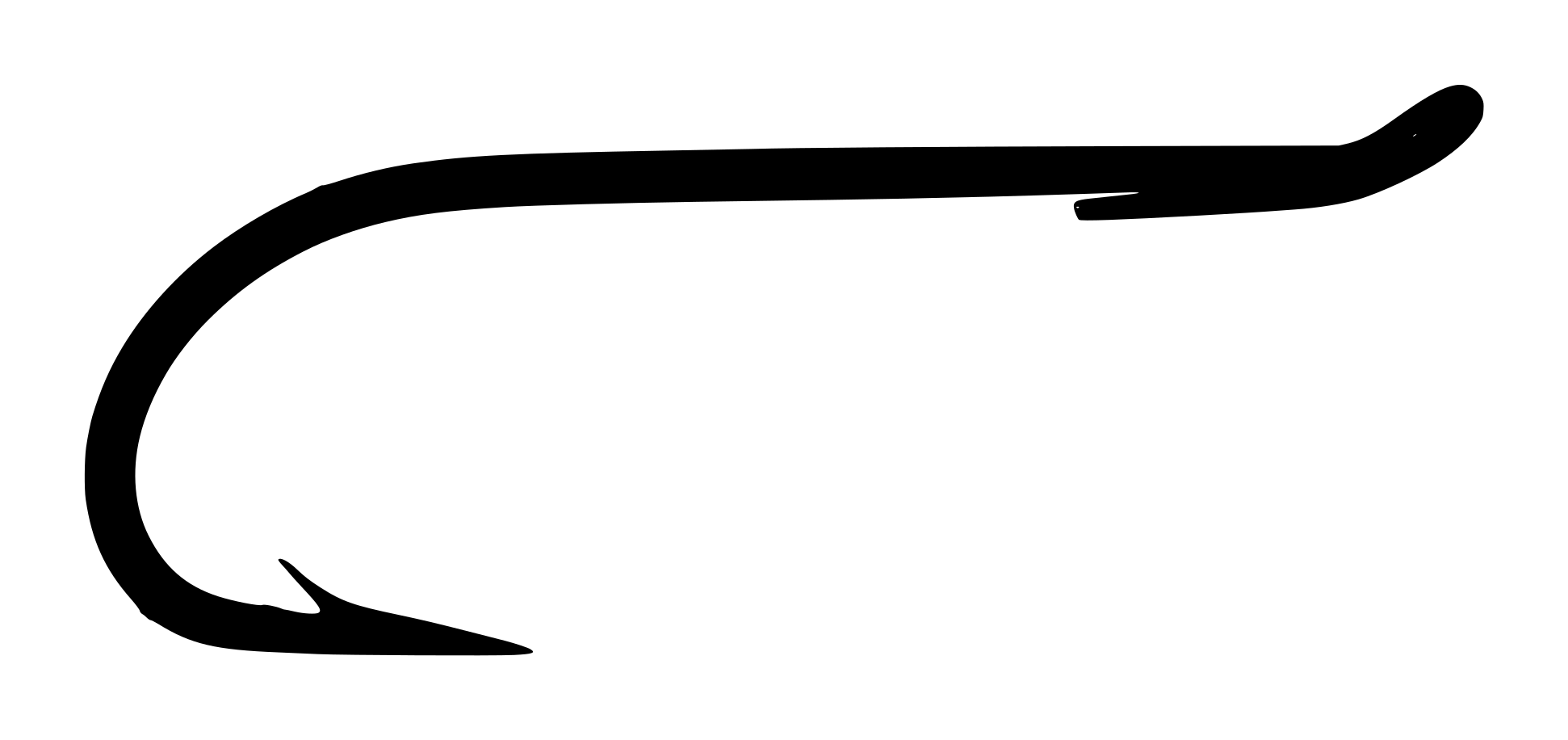
The Partridge CS42 Bomber is a mid-weight dry-fly hook designed for buoyant salmon and steelhead patterns, particularly Wulff and Bomber styles. Manufactured by Partridge of Redditch, one of the world’s oldest and most respected fly-hook makers, the CS42 combines a modified Limerick bend, looped-up eye, and bronze finish in a standard-wire gauge suitable for full-hackle collars and hair wings. This example is a modern production run from the Fishing Matters era (post-2009), packaged in clear clamshell retail format with white card insert and green Partridge branding.
Era evidence: The modern logo styling, plastic clamshell packaging, and print quality are consistent with current Partridge branding and 2010s–2020s retail distribution. This is a reissue of the vintage Redditch-era CS42 pattern, which was placed on hold during the Singapore-to-Wuxi transition (c. 2008) but was subsequently restored to production under the Fishing Matters Heritage line.
Collectability: Modern CS42 production is readily available retail and common; vintage English-made Redditch CS42 (pre-2007) commands a modest premium. This hook is valued more for its functional importance to salmon and steelhead tyers than for rarity, making it a working hook rather than a collecting rarity. Rated 4.5/10 on the collectability scale.
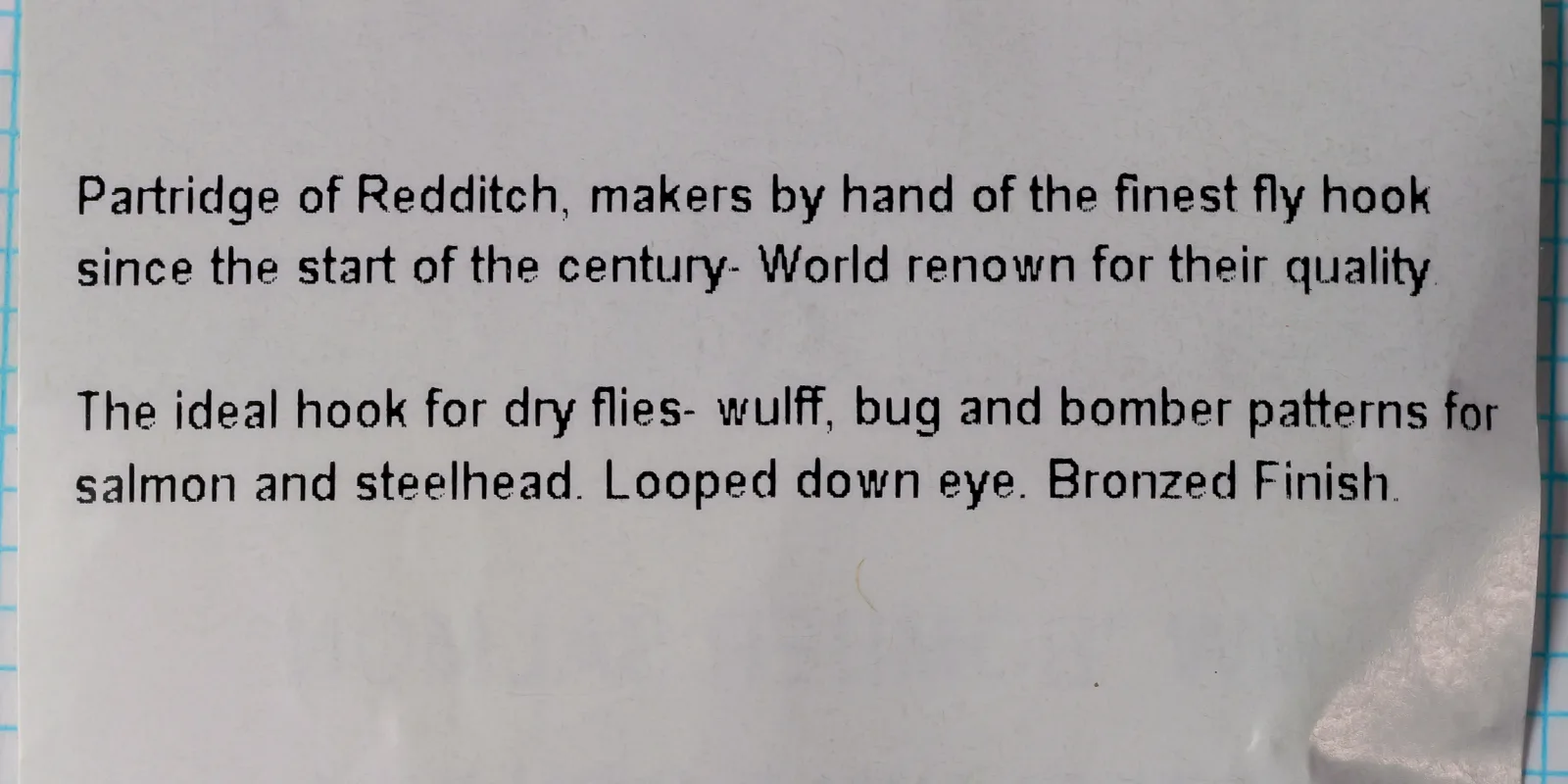
Package promotional copy emphasizing Partridge's century-long heritage in Redditch hook manufacturing and their world reputation for quality craftsmanship.
Photographic record
7 cataloged imagesSelect any record to load it above.
7 images shown
Partridge of Redditch Brand Heritage TextPackage promotional copy emphasizing Partridge's century-long heritage in Redditch hook manufacturing and their world reputation for quality craftsmanship.Open originalPartridge CS42 Size 2 Eye DetailFront view of the looped-up eye and hook head of the CS42, showing the cleanly formed eye loop and proportional eye diameter relative to standard wire gauge.Open originalPartridge CS42 Size 2 Bend Profile and BarbSide profile view of the CS42 showing the modified Limerick bend, barb placement (approximately 1/3 distance from point), and overall curve geometry on measurement grid.Open originalPartridge CS42 Size 2 Full ProfileFull side profile of the CS42 Hook on measurement grid, showing overall hook length, shank-to-gap proportions, eye loop, and bend depth.Open originalPartridge CS42 Size 2 Hook Pair ComparisonTwo Partridge CS42 hooks positioned side by side on measurement grid for consistency verification and visual comparison of bend geometry and finish uniformity.Open originalPartridge CS42 Package Label DetailsProduct information card insert showing the CS42 model designation, pattern name, size, quantity, and reference code for inventory.Open originalPartridge CS42 Retail Clamshell PackageComplete retail clamshell package showing the green 'PARTRIDGE OF REDDITCH' logo branding, product information, and displayed hooks visible through clear plastic window.Open original
Technical profile
Eye
Looped Eye, Turned DownTurned-Down eye is cleanly formed, round profile, without visible welding irregularities. Loop diameter is proportional to wire gauge. Eye alignment appears centered relative to shank axis P.
Wire
Fine (1X Fine), Forged
Shank
2X Long — Plain
Bend
Limerick, Standard gapModified Limerick-derivative bend with characteristic forged reinforcement and smooth angular profile. Bend shows pronounced vertical depth relative to gap width. Wire set is clean and symmetrical, without obvious offset or twist P.
Point
Standard / SpearBarb is short and close-cut, angled slightly rearward toward the bend. Placement is approximately 1/3 distance from point tip toward shank. Barb geometry is standard for Partridge salmon/dry hooks P.
Finish
Bronzed — Confirmed (stated on packaging)Bronze finish exhibits warm reddish-gold tone characteristic of Partridge bronze P. Tone is consistent across all visible hook samples, indicating uniform plating application. No evidence of patina or corrosion on specimen hooks. Finish is warmer and more uniform than traditional japanned-black alternatives — consistent with Redditch-era quality standards.
Specimen hooks in photograph are bright and uncorroded. Finish is uniform bronze with characteristic warm tone under direct light. Card packaging shows minimal wear, excellent color registration, and clear printing. All 25 hooks appear present in the package. No visible handling damage or patina development.
The modified Limerick bend on the CS42 provides a balance between the deep angular geometry of classical Limerick irons and the smoother action required for dry-fly patterns. The forging process (visible as slight wire deformation in the bend radius) imparts additional strength and prevents bend deformation under the stress of large salmon or steelhead strikes. The standard wire gauge (approximately 0.032″–0.038″ diameter) provides adequate mass for casting buoyant fur and hair patterns while remaining light enough for prolonged false-casting. The looped-up eye orientation prevents thread from catching on the eye shank during tying and allows quick eye penetration when setting the knot. The bronze finish provides excellent corrosion resistance in freshwater and is valued for its traditional appearance and warm aesthetic in presentation fishing.
The CS42 Bomber belongs to the broader CS (Specialist Code) family, which encompasses salmon, streamer, saltwater, predator, and competition patterns. The Bomber pattern itself is a modern dry-fly innovation designed for salmon and steelhead dry-fly fishing, emerging in the mid-20th century as an alternative to traditional full-dressed feather-wing patterns. The CS42 designation within Partridge’s catalog places it among the medium-weight salmon dry hooks, alongside patterns like the CS42/R (reissue notation). The pattern combines a modified Limerick bend with standard forged wire and a looped-up eye, making it suitable for both classical Wulff-style patterns and modern buoyant dry designs. The CS42 has remained in continuous production from the Redditch era through modern Fishing Matters production, indicating enduring demand among salmon and steelhead tyers. During the Mustad transition (1996–2008), the CS42 was listed on the ‘on-hold’ SKU list during the Singapore-to-Wuxi consolidation but was subsequently reissued and remains in current production as a Heritage-line pattern.
Era and Packaging Dating
Packaging has modern 'PARTRIDGE OF REDDITCH' logo in green serif lettering on black background. Format is clear plastic clamshell with printed white card insert — standard Fishing Matters era retail packaging (post-2009 acquisition by Fishing Matters Ltd). No country-of-origin marking visible on label portion, but clamshell format and print quality are consistent with 2010s–2020s production. Logo style and color scheme match current Partridge branding on partridge-of-redditch.co.uk. This is a reissue of the vintage Redditch-era CS42 Bomber pattern within the modern Heritage/contemporary line.
The Bomber Revolution — From Canadian Backwater to Scottish Institution
The Bomber pattern originated in Eastern Canada in the 1950s as a high-floating dry fly designed to create surface disturbance that attracts salmon and steelhead in low, clear water conditions — a practical innovation that departed from the elaborate full-dressed feather-wing tradition of Victorian salmon fly tying. The pattern gained widespread adoption on Scottish and Norwegian rivers in the 1960s–1970s, where it proved devastatingly effective during summer low-water periods when traditional flies were rejected. Partridge's CS42 represents the hook manufacturer's endorsement of this modernist approach, and it remains a staple in the arsenal of both traditional dressers and contemporary spey casters more than 70 years after its invention.
Design lineage and influence
The Limerick bend family predates Partridge by over a century, originating in 18th–19th century English hook manufacturing tradition. Partridge’s modification of the Limerick for dry-fly and salmon use reflects the broader Redditch tradition of adapting classical bend families to new applications. Contemporary competing designs include the Mustad 36890 (Limerick salmon dry), the Daiichi 2051 Alec Jackson Spey (Bartleet-derivative), and Hardy’s indigenous patterns. The CS42 sits in a lineage of moderate-gape salmon dries that emphasizes balance between flotation support (requiring light wire) and durability (requiring some reinforcement). Modern successors include the Partridge SUD/SLD Patriot series (lighter competition dries) and the Absolute Predator series (heavier predator patterns), but the CS42 remains the canonical Redditch-era reference for classical Bomber/Wulff-style salmon dry construction.
Best matchRelated by Attribute
Computed automatically from catalog data — updated as new hooks are added.
Matches: Bend, Shank, Wire, Eye Orient., Finish +3 moreDiffers: Gap: Standard vs Narrow; Eye: Looped Eye vs Tapered Eye; Point: Standard / Spear vs Superior +5 more
Matches: Bend, Shank, Wire, Eye Orient., Finish +3 moreDiffers: Gap: Standard vs Narrow; Eye: Looped Eye vs Tapered Eye; Point: Standard / Spear vs Hollow Point +5 more
Matches: Bend, Shank, Wire, Eye, Forging +3 moreDiffers: Gap: Standard vs Narrow; Eye Orient.: Turned Down vs Turned Up; Point: Standard / Spear vs Hollow Point +5 more
Matches: Bend, Gap, Eye, Point, Forging +4 moreDiffers: Shank: 2X Long vs Standard; Eye Orient.: Turned Down vs Turned Up; Finish: Bronzed vs Black Japanned +3 more
The CS42 Bomber is a dry-fly hook engineered for buoyant, high-floating patterns used in salmon and steelhead fishing. The standard wire gauge and looped-up eye support traditional Wulff-style and Bomber-pattern construction with full-hackle collars and hair wings. The modified Limerick bend provides a moderate gape and reliable hook-set geometry for aggressive rises on fast water. Primary uses include low-water summer salmon on Scottish and English rivers, and summer steelhead on North American rivers. The hook is also used for stimulator and surface-disturbance patterns targeting large brown trout.
Secondary Applications
Large trout dries, sea trout surface patterns, experimental terrestrial imitations on moving water
Classic Fly Patterns
Bomber, Wulff patterns (Grizzly Wulff, Royal Wulff), stimulator patterns, surface disturbance patterns for salmon and steelhead
Modern Equivalents
Hook
Match Quality
Notes
Partridge CS42 (current production)
Excellent
Identical model in continuous modern production; directly equivalent
Mustad 36890
Good
Limerick salmon dry, similar gape and wire, looped-up eye; functionally equivalent for Bomber patterns
Daiichi 2051 Alec Jackson Spey
Good
Looped-up eye, suitable for dry patterns, though Bartleet bend rather than Limerick; slightly different geometry
Green entries are full records; amber entries are spec records.
Gray entries are chart-only and not physically verified against this specimen.
Collector notes
Rated 4.5/10. The CS42 Bomber is a classic Redditch-era pattern with historical significance and steady collector demand among salmon and steelhead tyers, but modern production (post-2009 in China) is readily available retail. Vintage English-made CS42 hooks command a modest premium; modern production is common. Size 2 is standard range, not particularly scarce.
The CS42 Bomber is collectible primarily for its historical lineage as a Redditch classic and for its functional importance in salmon and steelhead Wulff/Bomber pattern traditions. Vintage English-made Redditch CS42 packages (pre-2007, marked ‘Made in England’) are increasingly difficult to find and command a 20–30% premium over modern production. The hook is continuously produced today, making modern examples abundant and inexpensive.
Limiting factors: (1) Modern production is readily available retail, reducing scarcity; (2) Size 2 is a common working size, not rare; (3) Complete 25-hook packages in Mint condition are more valuable than opened or incomplete cards. Vintage Redditch-era packaging with original tissue or sealed wrapping carries a 50–100% premium. Collectors prize the bronze finish on vintage examples; modern black nickel variants are less desirable to traditionalists.
Most desirable: Sealed vintage Redditch packages (pre-1996); complete Bramley-era boxes (1970–1996); original tissue wrapper intact. Least desirable: Loose hooks without original packaging; opened modern retail cards with missing hooks.
Packaging
Clear plastic clamshell package with hinged hang-hole. Printed white card insert with black text. Header label reads 'PARTRIDGE OF REDDITCH' in large green outlined serif lettering on black background. Content label states 'MW "BOMBER SALMON" STEELHEAD DRY FLY / SIZE 2 / QTY 25 / REF CS42'. Black printed symbol of a flying insect (bomber silhouette) in lower left corner of card. Package sealed with clear plastic clamshell over hooks displayed on white card backing. Modern retail format consistent with Fishing Matters era packaging post-2009.
Preservation
Storage and Preservation
Store in a cool, dry environment away from moisture and direct sunlight. The bronze finish will develop a warm patina (oxidation layer) over time, which many collectors find desirable; however, prolonged exposure to humidity can accelerate corrosion. Original retail packaging (clamshell or card) should be kept intact — sealed packages command higher premiums and offer superior protection compared to loose hooks. If hooks are removed from packaging, store them in a breathable paper envelope or vintage-style card packet to prevent moisture trapping. Avoid contact with other metals, rubber bands, or acidic materials (such as wooden fly boxes treated with cedar oil), which can accelerate corrosion. Inspect periodically for any white or green corrosion spots, which indicate active oxidation; if observed, dry thoroughly and consider light dry-brushing with a soft cloth. The looped eye, while robust, should not be squeezed or bent — inspect periodically to ensure the eye retains its original shape.
The explicit dual designation ‘BOMBER SALMON’ and ‘STEELHEAD DRY FLY’ on the package label indicates Partridge’s intent for this hook to serve both Atlantic salmon (European and North American rivers) and Pacific steelhead (primarily Pacific Northwest North America) fishing traditions. The Bomber pattern emerged as a revolutionary summer low-water dry in Eastern Canada in the 1950s and achieved canonical status in British and Scandinavian salmon fishing by the 1970s. Partridge’s inclusion of this hook in its Heritage reissue line (post-2009) reflects a deliberate choice to maintain historical continuity with the classic salmon dry tradition, distinguishing it from lighter competition dries (SUD/SLD Patriot) marketed for modern nymph/tournament work. The ‘DRY FLY’ descriptor is somewhat unusual in Partridge’s catalog labeling, suggesting this reissue may have been adapted for a market (possibly North American steelhead) with different vernacular expectations.
Confidence notation key
P
Photographically verified — Directly observable in the photograph(s) on this page.
V
Verified by documentation — Confirmed by manufacturer catalog, spec sheet, or published reference.
I
Inferred — A logical deduction from observable or documented evidence, not directly stated.
E
Estimated — An approximation based on visual comparison, proportional analysis, or limited data.
S
Speculative — A reasoned hypothesis that cannot be confirmed from available evidence.
Unnotated claims are the compiler’s synthesis; see Sources. All photographs on garrenwood.com are taken on a measurement grid where each square equals 1/10 inch (0.1″ / 2.54 mm).