The Mustad Quality 3866 represents a distinctive chapter in Norwegian hook manufacturing, featuring the angular sneck bend that sets it apart from conventional curved profiles. This size 6/0 specimen showcases the traditional blind eye (tapered shank) construction that required snelling with gut or silk, making it a bridge between classical angling techniques and industrial hook production P.
Dating from approximately 1940-1960, this hook exemplifies Mustad’s systematic cataloging approach during their golden age, as evidenced by the ‘Qual.’ prefix and ‘H.P.’ (Hollow Point) designation on the accompanying notation card. The bronze finish and heavy wire gauge reflect the robust construction demanded for saltwater applications and large salmon flies V.
For collectors, the 3866 offers both historical significance and practical insight into pre-modern hook design philosophy. The sneck bend’s angular geometry was believed to provide superior penetration and holding power, while the hollow point represented advanced manufacturing for its era I.
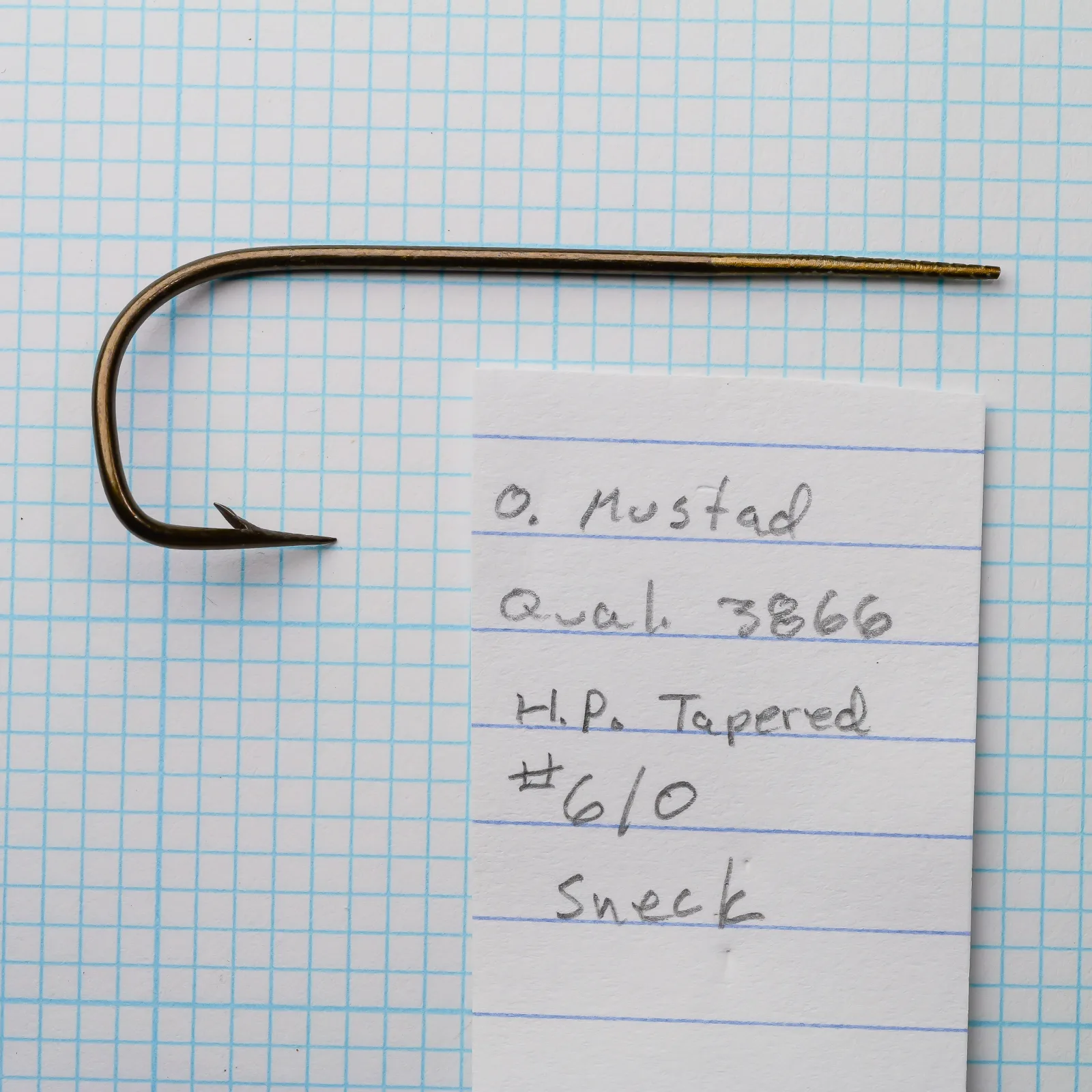
Complete view of the Mustad Quality 3866 sneck hook with original handwritten notation card showing model specifications, size 6/0, on measurement grid.
Photographic record
3 cataloged imagesSelect any record to load it above.
3 images shown
Mustad 3866 Quality Sneck Hook Size 6/0 with DocumentationComplete view of the Mustad Quality 3866 sneck hook with original handwritten notation card showing model specifications, size 6/0, on measurement grid.Open originalMustad 3866 Quality Sneck Hook Point Detail Size 6/0Close-up detail of the Mustad 3866's hollow point construction showing the concave inner face and sharp tip geometry, size 6/0, on measurement grid.Open originalMustad 3866 Quality Sneck Hook Profile Size 6/0Side profile view of the complete Mustad 3866 showing the tapered blind eye shank and distinctive angular sneck bend, size 6/0, on measurement grid.Open original
Technical profile
Eye
Blind — Marked Tapered ShankTraditional tapered shank terminates in a fine point, designed for whipping gut or silk loops using thread binding techniques P
Wire
Fine (1X Fine), Round, Est. ~0.045"-0.055" (~1.1-1.4 mm) E
Shank
2X Long — Tapered
Bend
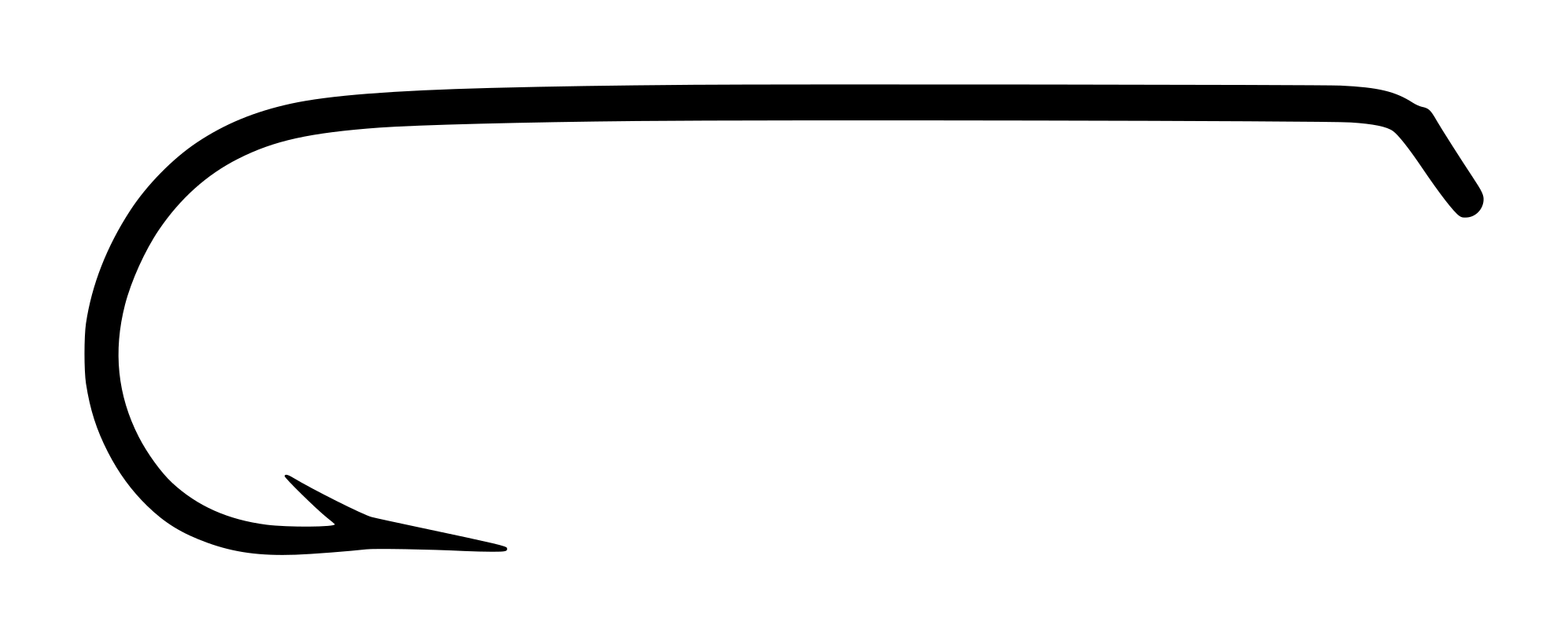
Sneck, Standard gap, Offset / kirbedClassic sneck geometry with distinctly angular transitions rather than smooth curves, creating the characteristic 'squared-off' profile that distinguishes this bend family P
Point
Hollow Point (concave inner face)Single barb with moderate depth and close-cut profile, positioned to complement the hollow point geometry P
Finish
Bronzed — Confirmed (stated on packaging)Warm bronze tone with even coverage throughout, showing typical patina development consistent with traditional lacquer-based bronze finishes of the era P
Hook shows excellent preservation with intact finish and sharp point, notation card exhibits age-appropriate toning but remains fully legible
The hollow point construction involves grinding a concave curve behind the barb, creating a knife-edge effect that reduces penetration resistance while maintaining structural strength. This manufacturing technique was particularly valuable in large sizes where point penetration becomes increasingly challenging P.
The sneck bend’s angular geometry provides mechanical advantages in hook-setting, with the squared corners creating multiple contact points that resist rotation once embedded. The tapered shank construction distributes stress loads more effectively than abrupt diameter changes, critical for heavy-wire applications I.
Notable as documented example of Mustad's Quality series sneck bend hooks with period-appropriate notation
Own this hook? Help us measure it.
We have measurement for size 6/0. Know any others? Submit calipered measurements and we'll review and add them. Thank you!
Historical context
mustad
O. Mustad & Son, established in 1832 in Gjøvik, Norway, emerged as the world’s dominant hook manufacturer through systematic industrial production methods. Founded by Ole Mustad, the company transformed from a small ironworks into a global fishing tackle empire, eventually controlling an estimated 40% of worldwide hook production by the mid-20th century V.
The Gjøvik factory became renowned for its consistent quality control and innovative cataloging systems, with the ‘Quality’ series representing their premium offerings during the 1940s-1960s period. Mustad’s Norwegian location provided access to high-grade iron ore and established trade routes to global fishing markets, establishing the foundation for their enduring international presence V.
Series History
The Quality 3866 belonged to Mustad’s premium ‘Quality’ series, denoted by the ‘Qual.’ prefix that distinguished these hooks from standard production models during the 1940s-1960s era. The sneck bend design featured ‘a unique hook with a squared-off bend’ that was ‘a top choice for targeting fish with small mouths and delicate bites’, though the 6/0 size suggests applications for much larger species V.
The series represented Mustad’s response to traditional British hook-making styles, incorporating the angular sneck geometry that had been perfected in Redditch workshops. The blind eye construction maintained compatibility with gut leader systems that remained standard in salmon fishing and saltwater applications well into the 1960s I.
Era and Packaging Dating
The handwritten notation card with 'Qual. 3866' and 'H.P. Tapered' terminology matches Mustad's classic cataloging system from the 1940s-1960s period. The abbreviation 'H.P.' for Hollow Point and 'Qual.' prefix were characteristic of this era before modern packaging formats.
The Door Latch Connection
The sneck bend derives its name from the 'sneck' or door latch found in traditional British cottages, reflecting the hook's angular geometry. Despite its association with small-mouth species, the 6/0 size 3866 was likely intended for large saltwater predators where the angular profile could prevent fish from working the hook loose during extended fights.
Design lineage and influence
Best matchRelated by Attribute
Computed automatically from catalog data — updated as new hooks are added.
Matches: Bend, Shank, Gap, Eye Orient., Forging +1 moreDiffers: Wire: Fine (1X Fine) vs Standard; Eye: Blind — Marked Tapered Shank vs Blind — Marked Shank; Point: Hollow Point vs Superior +3 more
The Mustad 3866 was specifically designed for heavy saltwater bait fishing and classic Atlantic salmon fly tying. The large 6/0 size with hollow point and tapered shank construction made it ideal for snelling to gut leaders for large saltwater species, while the distinctive sneck bend provided the angular geometry favored in traditional exhibition salmon flies P.
Secondary Applications
Suitable for large predator species in both fresh and saltwater environments, particularly where traditional gut leader construction is required
Classic Fly Patterns
Classic Atlantic salmon patterns, exhibition flies requiring traditional appearance
Modern Equivalents
Hook
Match Quality
Notes
Partridge CS10/6
Good
Maintains blind eye construction for traditional salmon fly tying, though bend profile differs
Mustad 38912
Moderate
Similar sneck bend geometry but features modern ringed eye instead of tapered shank
Collector notes
Historically significant model with distinctive sneck bend and traditional tapered shank construction, but limited by common 6/0 size.
Reference value
$15 – $35 USD estimate
Packaging condition
Good — moderate wear, legibleRecorded specimen
Packaging format
MW-HN-01Catalog code
The 3866 represents an important link to traditional hook-making practices, with its blind eye construction and angular sneck geometry appealing to collectors of classic salmon flies and vintage tackle. The hollow point designation and Quality series branding add authenticity value. However, the 6/0 size was relatively common in saltwater applications, preventing it from achieving highest rarity status I.
Packaging
Handwritten notation card on lined paper showing O. Mustad, Qual. 3866, H.P. Tapered, #6/0, and Sneck specifications in pencil
Market Value Notes
Pricing reflects historical significance and sneck bend rarity, with premium for complete documentation. Condition and provenance documentation significantly impact value.
Store in a low-humidity environment to prevent bronze finish degradation. The traditional lacquer-based bronze coating is susceptible to atmospheric moisture, leading to patina development that some collectors find desirable. Maintain the hook on its original notation card rather than loose storage, as the handwritten documentation significantly enhances historical value. Avoid contact with dissimilar metals to prevent galvanic corrosion, particularly important given the tapered shank’s vulnerability at the fine point P.
Marking Analysis
Notation Card Documentation
The handwritten notation displays characteristics consistent with mid-20th century tackle shop or collector documentation practices. The use of ‘Qual.’ abbreviation matches Mustad’s official cataloging terminology from the 1940s-1960s period, while ‘H.P.’ represents the standard abbreviation for Hollow Point during this era. The pencil inscription on lined paper suggests practical field or shop notes rather than formal catalog documentation, adding authenticity to the specimen’s provenance V.
The ‘Qual. 3866’ designation provides direct evidence of Mustad’s premium product classification system during the mid-20th century. This prefix distinguished higher-grade hooks from standard production models, typically featuring enhanced point sharpening, superior wire quality, and more consistent manufacturing tolerances. The notation’s format and terminology align precisely with documented Mustad cataloging practices from the 1940s-1960s period V.
Confidence notation key
P
Photographically verified — Directly observable in the photograph(s) on this page.
V
Verified by documentation — Confirmed by manufacturer catalog, spec sheet, or published reference.
I
Inferred — A logical deduction from observable or documented evidence, not directly stated.
E
Estimated — An approximation based on visual comparison, proportional analysis, or limited data.
S
Speculative — A reasoned hypothesis that cannot be confirmed from available evidence.
Claims with no notation are confirmed by multiple independent sources. All photographs on garrenwood.com are taken on a measurement grid where each square equals 1/10 inch (0.1″ / 2.54 mm).