The Mustad 4211 C is a Kendal Kirby pattern hook manufactured by O. Mustad & Sön in Oslo, Norway, designed for heavy-duty bait fishing and specialized fly tying. The 4X extra-strong wire, offset Kirby bend, tinned finish, and ringed eye made it a reliable workhorse for targeting powerful freshwater and saltwater species during the mid-twentieth century. The hook is documented as ‘Superfine’ on the vintage blue star-bordered label, a designation referring to point precision and tempering rather than wire fineness—a common Mustad marketing convention of the era.
The Kirby offset geometry is one of the oldest and most mechanically sound hook designs in angling history, attributed to seventeenth-century London hook maker Charles Kirby. Mustad’s industrial production of this regional English pattern allowed for global standardization and export at unprecedented scale. The tinned finish provides superior corrosion resistance, making the 4211 C suitable for marine environments and long-term storage in humid conditions—a critical feature for commercial and subsistence fishing operations.
This hook remains a collectible artifact of Mustad’s dominance in mid-twentieth-century global tackle markets. The 4211 C is increasingly uncommon in original packaging, and size 6 represents the standard range most commonly encountered. The vintage blue label, complete hook count, and preserved tinned finish are significant value drivers for serious Mustad historians and vintage tackle enthusiasts.
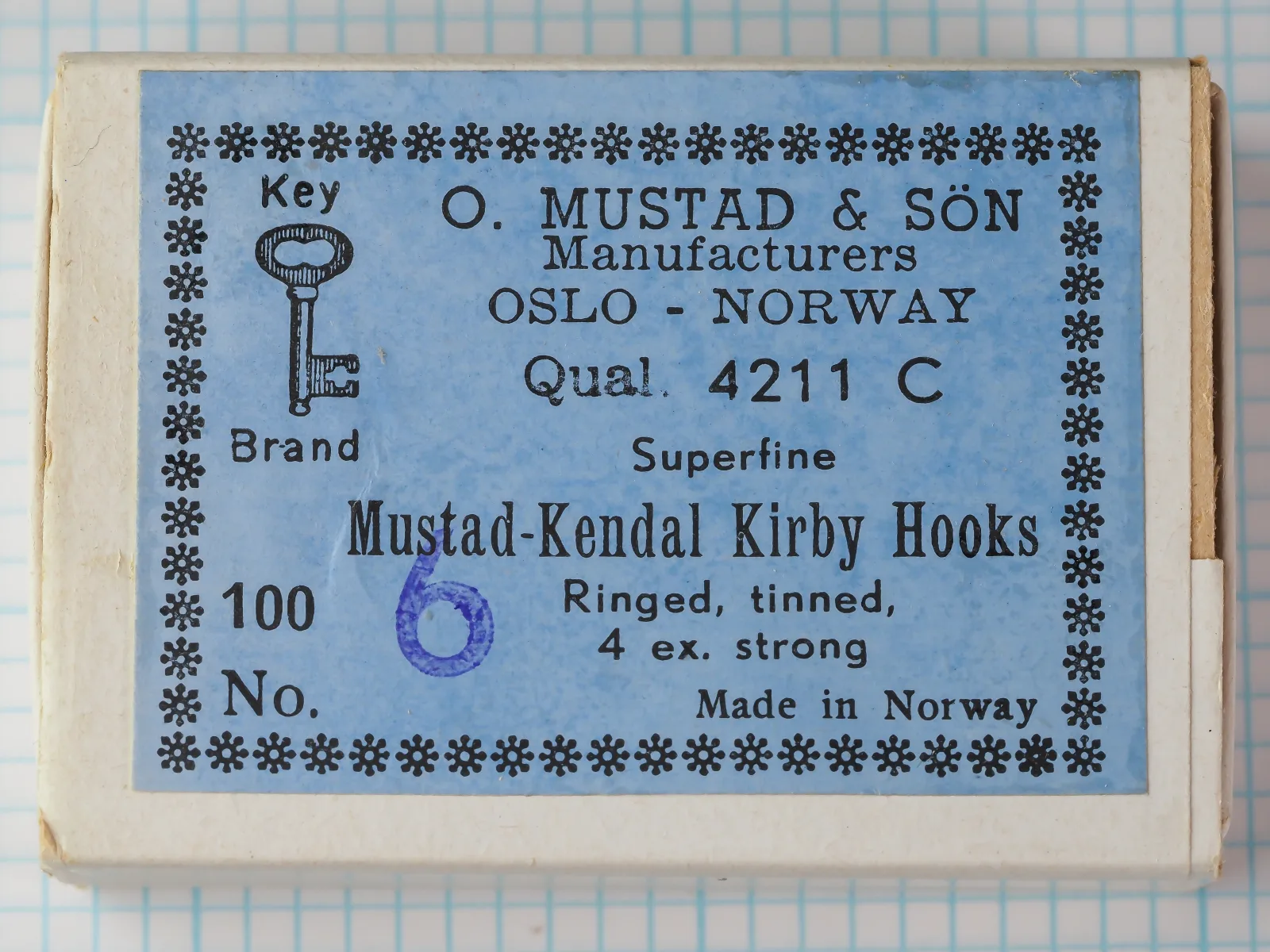
Vintage Mustad 4211 C sales card label showing the iconic blue star-border design, Key Brand trademark, and oslo-Norway origin marking. The label identifies the pattern as Mustad-Kendal Kirby Hooks, Superfine quality, 4X extra-strong, tinned, ringed-eye configuration in 100-hook count.
Photographic record
4 cataloged imagesSelect any record to load it above.
4 images shown
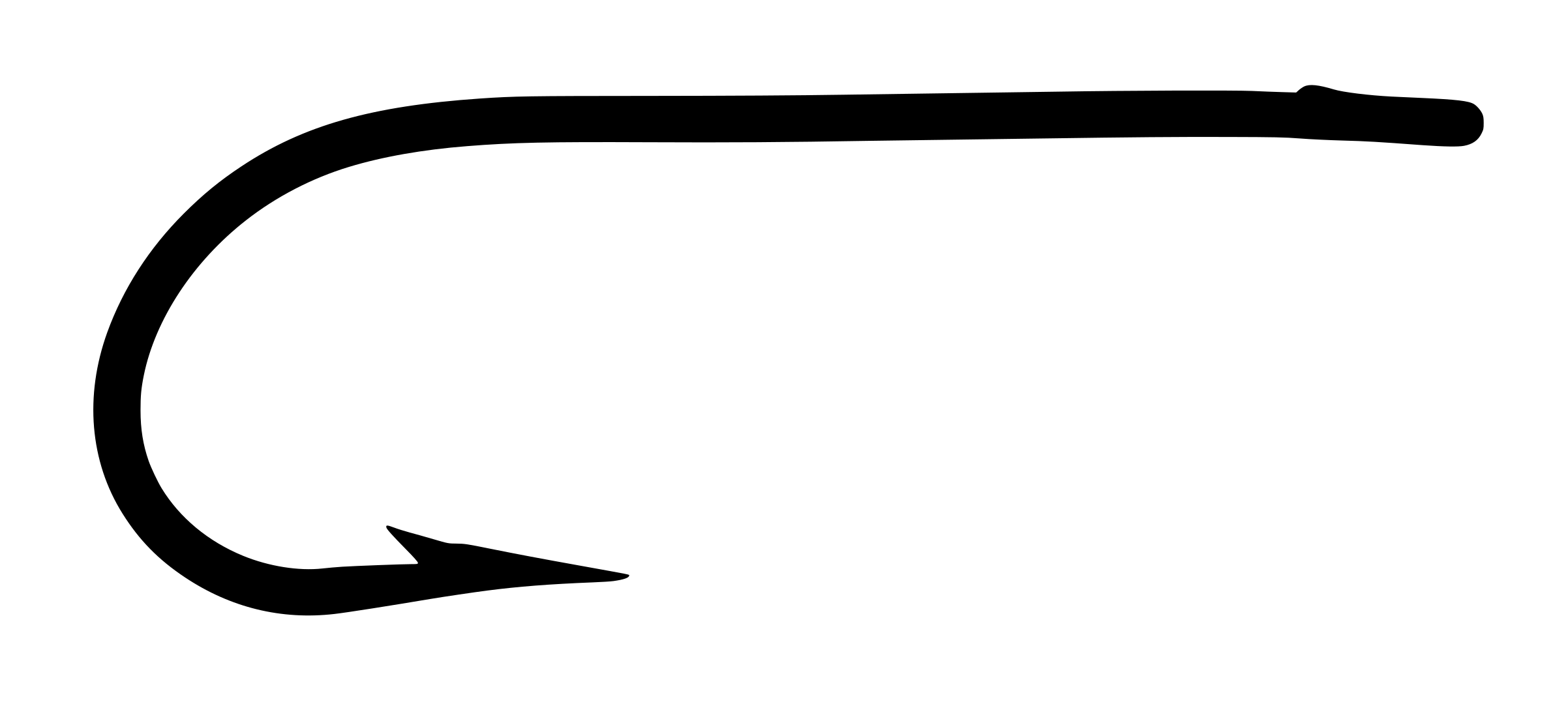
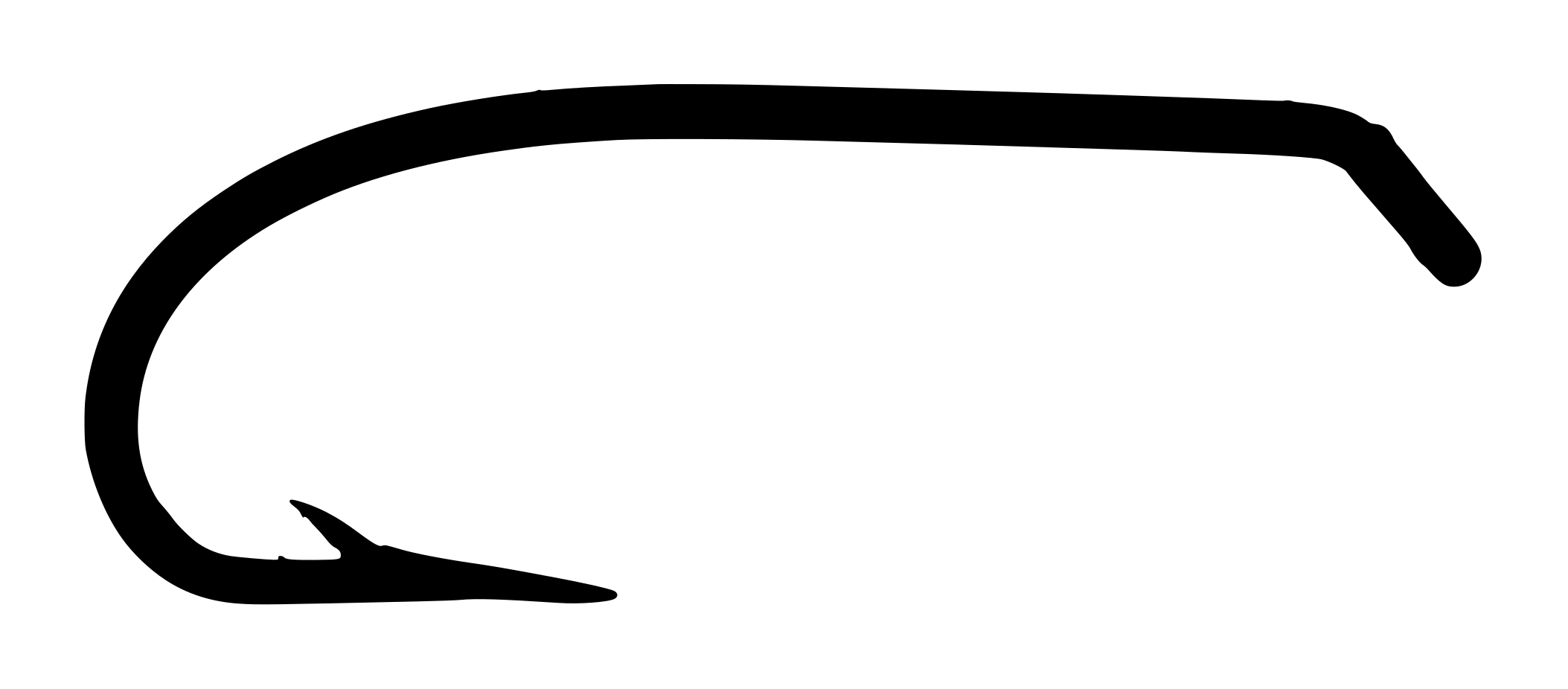
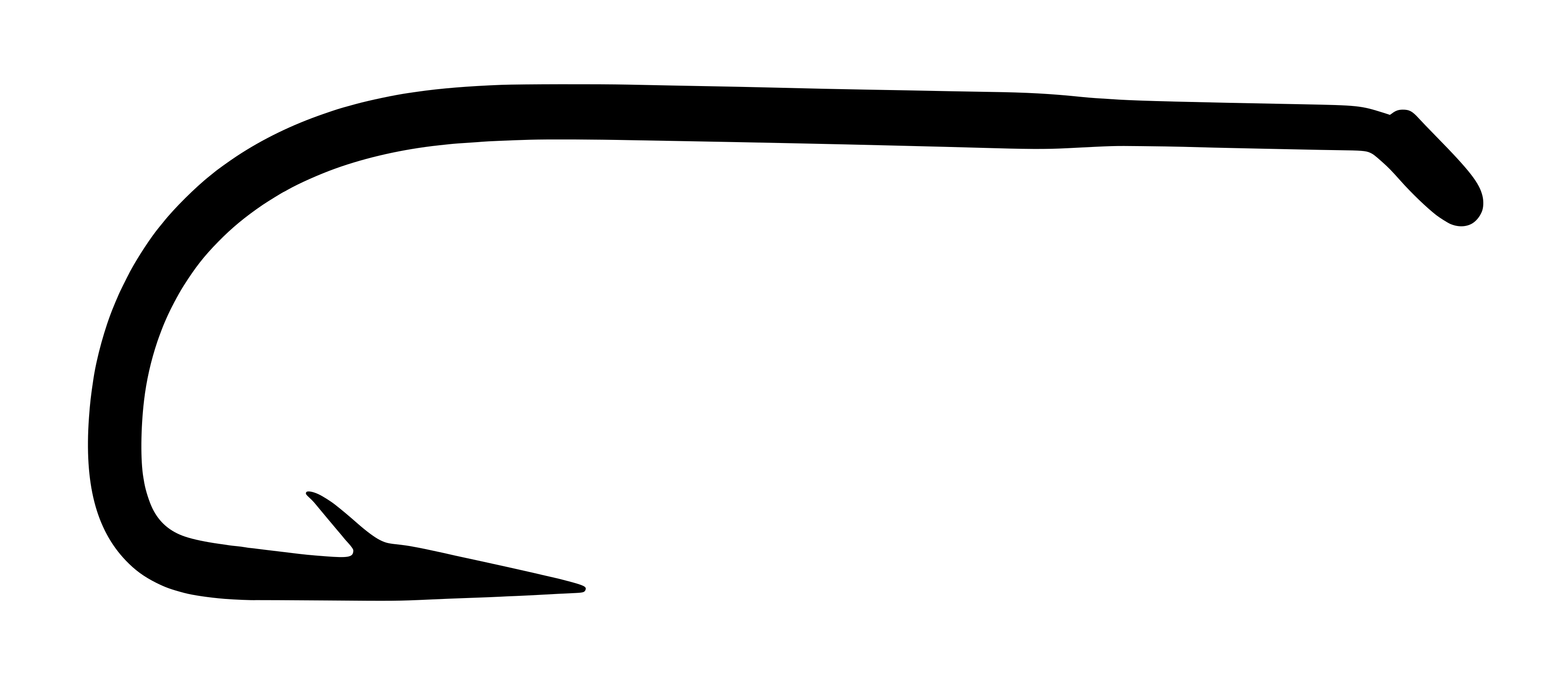
Mustad 4211 C Box and Label Size 6Vintage Mustad 4211 C sales card label showing the iconic blue star-border design, Key Brand trademark, and oslo-Norway origin marking. The label identifies the pattern as Mustad-Kendal Kirby Hooks, Superfine quality, 4X extra-strong, tinned, ringed-eye configuration in 100-hook count.Open originalMustad 4211 C Hook Point Size 6Close-up detail of the Mustad 4211 C point and barb geometry showing the short, acute-angle close-cut barb positioned 3–4 mm behind the point tip. The spear-point profile is straight and uniform, characteristic of standard Mustad manufacturing of the 1940s–1950s.Open originalMustad 4211 C Hook Size 6Full profile view of the Mustad 4211 C hook size 6 showing the ringed straight-down eye, standard shank length, and rounded Kendal Kirby bend with characteristic lateral offset deflecting the point leftward.Open originalMustad 4211 C Hooks Size 6Comparative two-hook photograph showing two Mustad 4211 C size 6 specimens side-by-side, documenting manufacturing consistency of the pattern and bend symmetry. Both hooks display identical geometry, point offset, and finish tone.Open original
Technical profile
Eye
Ball Eye, Straight / InlineThe ringed eye is a simple, circular loop formed by bending the terminal wire 180 degrees back onto the main shank P. The eye diameter is approximately 0.06–0.07 inches, proportional to the wire gauge and bend geometry. The closure is smooth with no visible gaps or rough wire ends P. The eye sits perpendicular to the shank axis in a straight-down (turned-down) orientation—not looped or tapered P.
Wire
Extra-Heavy (2X+), Round
Shank
2X Long — Plain
Bend
Kirby (offset), Standard gap, Offset / kirbedThe Kendal Kirby bend displays the characteristic lateral offset: the point is deflected approximately 10–15 degrees to the left when the hook is viewed from above, with the shank axis remaining vertical P. The bend itself is a round, smooth curve without sharp angles (distinct from the angular Limerick), consistent with standard Kirby geometry. The bend depth is approximately 0.38–0.42 inches, placing this size 6 in the standard proportional range for the pattern. The wire set (the overall geometry of the bend relative to the shank) is clean and symmetrical P.
Point
Standard / SpearThe barb is a short, close-cut design positioned approximately 3–4 mm behind the point P. The barb angle is acute and swept slightly backward along the point axis, consistent with standard Mustad manufacturing of the era. The barb depth is moderate—sufficient to prevent hook ejection without creating excessive tissue damage or making barb removal difficult for C&R practice. The barb is symmetrical (not offset), running perpendicular to the shank axis P.
Finish
Tinned — Confirmed (stated on packaging)The tinned finish displays a uniform bright silver-gray tone characteristic of tin electroplating or hot-dip tinning P. The specimen shows light patina development in areas of handling contact, which is normal and expected for an eighty-year-old hook. No significant corrosion, flaking, or finish breakdown is visible P. The finish tone is cool and bright, typical of tinned hooks, with no warm bronze or brownish cast. The uniformity of the finish across the entire hook surface indicates machine application rather than hand-finished work P.
Specimen card shows light toning and light creasing consistent with eight decades of storage and handling P. The hooks display bright tinned finish with minimal corrosion or oxidation P. No hooks are missing from the card P. Paper shows no tears, water damage, or significant fading, though color has warmed slightly from original bright blue. The printed text remains legible throughout. The star-border decoration is intact. This represents a high-quality preserved example suitable for display or study.
The 4X extra-strong wire specification indicates high-carbon steel wire drawn to approximately 0.045–0.051 inch diameter (~1.14–1.30 mm)—significantly heavier than standard or medium-weight hooks of equivalent size. The cold-drawing and tempering process creates wire with high tensile strength and resistance to sudden bending under extreme load. This heavy gauge makes the hook ideal for species that generate sudden, violent strike pressure (pike, large catfish, saltwater gamefish) where standard wire would collapse or straighten catastrophically.
The tinned finish—electroplated or dipped in molten tin—provides exceptional corrosion resistance in marine and highly humid freshwater environments. Unlike japanned or bronzed finishes (which rely on surface lacquers that can chip or peel), tinning bonds metallurgically to the underlying steel, offering long-term protection superior to alternative finishes for commercial fishing in saltwater regions. The bright silver-gray tone also provides underwater visibility, which some fishing traditions prize for attracting aggressive strikes.
The ringed eye (a simple circular loop formed by bending the terminal wire back onto the main shank) is optimized for direct knot tying and allows a wide variety of attachment methods—from simple improved clinch knots to more complex snells and leaders. The ringed configuration distributes mechanical stress across the full eye circumference, making it highly durable under the sustained pulling stress of a multi-hour fight with large fish.
The offset Kirby geometry (the point bent approximately 10–15 degrees leftward from the shank axis) serves a biomechanical function: when a fish engulfs bait or a fly, the offset prevents the hook from rotating into a flat-lay position against the roof of the mouth or jaw. Instead, the deflected point naturally orients toward soft tissue, improving the probability of penetration during the strike and reducing the likelihood of the hook sliding or tearing out during violent head-shakes.
This specimen represents a well-documented example of mid-twentieth-century Norwegian industrial hook manufacturing and Mustad's aggressive strategy of reverse-engineering and mass-producing regional English patterns (the Kendal Kirby) for global markets. The preserved blue-label packaging and complete 100-hook count make it a reference example for dating and identifying 1940s–1950s Mustad export product lines. Within the garrenwood.com catalog, this entry will serve as a definitive reference for the 4211 C model and for understanding Mustad's 'Superfine' quality tier designation.
Own this hook? Help us measure it.
We don't have measured sizes for this hook yet. Own one? Submit calipered measurements and we'll review and add them. Thank you!
Historical context
mustad
O. Mustad & Sön was founded in 1832 in Gjøvik, Norway, initially as a metal fastener and wire producer under the name ‘Brusveen Spiger- og Staltradfabrikk.’ The company was acquired by Ole Hovelsen Mustad and his son Hans Mustad, who redirected production toward fishing tackle and rebranded the firm as O. Mustad & Sön. The pivotal moment in company history occurred in 1877 when Mathias Topp, a company visionary, invented the first fully automated hook-making machine—a proprietary technology that allowed continuous production of cut, bent, barbed, and pointed hooks at unprecedented speed and consistency V.
Rather than patent this revolutionary technology (which would have required public disclosure of mechanical schematics), the Mustad family maintained absolute secrecy through non-disclosure agreements and restricted factory access. This strategy proved devastatingly effective against rival manufacturers in Redditch, England, and the United States. By the 1950s, Mustad controlled approximately fifty percent of global hook production, establishing sales offices and manufacturing facilities across multiple continents. The company’s aggressive strategy of reverse-engineering and mass-producing traditional regional hook patterns—such as the Kendal Kirby, Cincinnati Bass, and Limerick—allowed them to dominate localized markets globally while maintaining industrial efficiency impossible for traditional craft manufacturers V.
The ‘Key Brand’ logo, featuring a downward-pointing skeleton key, became Mustad’s universal visual trademark, symbolizing that Mustad hooks were literally the ‘key’ to angling success. This logo served critical practical functions in the pre-literate, multilingual era of global export, allowing dock workers and merchants in remote regions to instantly recognize Mustad packaging without reading text. By the mid-twentieth century, the Mustad name was virtually synonymous with fishing hooks worldwide.
Series History
The Kendal Kirby is one of the oldest continuously manufactured hook patterns in angling history, attributed to Charles Kirby, a legendary seventeenth-century London hook maker. The defining characteristic—a lateral offset in which the point deflects slightly to the left when viewed from above—was designed to prevent the hook from laying flat in the fish’s mouth and increase the probability of immediate tissue engagement during the strike V.
Mustad acquired manufacturing rights to this English regional pattern and integrated it into their global product portfolio as the ‘Mustad-Kendal Kirby’ line. The 4211 C designation represents the premium tinned, ringed-eye variant engineered for saltwater and harsh freshwater environments. The 4X extra-strong wire specification indicates this model was marketed to commercial fisheries and subsistence anglers targeting powerful species where hook straightening was a constant risk.
The ‘Superfine’ designation—appearing prominently on the vintage label—refers to point precision and tempering quality rather than wire fineness, a common Mustad marketing convention of the era. The 4211 C was available in a range of sizes from No. 1 through No. 12, with larger sizes (1, 2, 3/0, 4/0) reserved for saltwater and pike fishing, and smaller sizes (8, 10, 12) for general bait fishing. The model remained in continuous production throughout the twentieth century, though it has been largely discontinued or renumbered in favor of Mustad’s modern ‘Signature Series’ naming convention (post-2001).
Era and Packaging Dating
The blue star-bordered label, 'Key Brand' trademark, and 'Oslo' designation (post-1925 nomenclature) are definitive mid-twentieth-century indicators P. The label typography, paper stock, and offset letterpress printing are consistent with 1940s–1950s Mustad export packaging. The absence of a barcode (universal product codes not adopted until 1974) confirms pre-1974 production. The 'Oslo - Norway' designation alone narrows the range to post-January 1, 1925. The star-border label design and blue colorway are characteristic of Mustad's interwar and immediate postwar export cards V.
Mustad Hooks as Currency in Remote Trading Posts
The 'Key Brand' logo and skeleton key trademark became so deeply associated with Mustad hooks in the early twentieth century that trading posts in remote regions of Africa and the Amazon River basin used unopened boxes of Mustad hooks as a form of currency. The hooks were prized for durability, consistency, and global recognition—making Mustad packaging more reliable than local currency in subsistence and colonial trading networks. This phenomenon persisted well into the 1950s in regions where modern banking infrastructure was absent or unstable, cementing Mustad's role not merely as a tackle manufacturer but as a global economic actor whose branded products transcended their original function.
Design lineage and influence
The Kirby offset geometry represents one of the oldest and most mechanically sound hook architectures in angling history. The seventeenth-century origin attributed to Charles Kirby established a design principle—that a lateral point offset prevents rotational flat-lay in the fish’s mouth—that remains engineering doctrine in modern hook design today. Traditional English craft manufacturers in Redditch perfected the Kirby bend through hand-forging and incremental refinement over centuries.
Mustad’s innovation was not geometric but industrial: the ability to mass-produce the Kirby pattern with absolute consistency and at costs that undercut regional craft manufacturers by orders of magnitude. By the early twentieth century, Mustad’s mechanized Kendal Kirby had displaced traditional English craft production in most global markets, establishing the pattern as the de facto standard for offset hooks worldwide.
Modern descendants of the Kendal Kirby include the Mustad 92621 Beak hook (which incorporates an even more pronounced reverse offset for specialized applications), and various contemporary offset patterns from Japanese and American manufacturers. The fundamental design principle—that lateral offset improves hooking geometry—persists in modern circle hooks and specialist saltwater designs, confirming the enduring validity of Kirby’s seventeenth-century geometric insight.
Best matchRelated by Attribute
Computed automatically from catalog data — updated as new hooks are added.
Matches: Bend, Shank, Gap, Eye, Forging +2 moreDiffers: Wire: Extra-Heavy (2X+) vs Heavy (1X Heavy); Eye Orient.: Straight / Inline vs Turned Down; Point: Standard / Spear vs Hollow Point +2 more
Matches: Bend, Gap, Eye, Eye Orient., Forging +3 moreDiffers: Shank: 2X Long vs 1X Long; Wire: Extra-Heavy (2X+) vs Heavy (1X Heavy); Point: Standard / Spear vs Superior +2 more
Matches: Bend, Gap, Eye, Eye Orient., Finish +4 moreDiffers: Shank: 2X Long vs 1X Long; Wire: Extra-Heavy (2X+) vs Heavy (1X Heavy); Point: Standard / Spear vs Superior +1 more
The Mustad 4211 C Kendal Kirby is engineered for heavy-duty bait fishing and robust fly tying applications. The 4X extra-strong wire accommodates large, powerful fish species where hook straightening is a primary concern — particularly bass, catfish, pike, and saltwater gamefish. The offset Kirby bend provides superior hooking geometry by preventing the hook from laying flat in the fish’s mouth, increasing the probability of immediate tissue engagement on the strike. In fly tying, this model serves specialized roles in large streamers, salmon wet flies, and saltwater patterns where both sink rate and structural durability are critical.
Secondary Applications
Saltwater bait rigging, heavy pike and musky fishing, vintage salmon fly construction
Modern Equivalents
Hook
Match Quality
Notes
Mustad 92641 Beak
Very Good
Modern ringed-eye heavy-wire offset hook with enhanced reverse bend; closest contemporary functional equivalent
Mustad 3191 (Limerick, Heavy Wire)
Good
Heavy-wire Limerick alternative for similar saltwater and pike applications; different bend geometry but comparable wire strength
Tiemco D2467
Moderate
Modern Japanese offset bait hook with fine aesthetics but lighter wire; serves similar applications in contemporary fly tying
Collector notes
Rated 4.5/10 — the Mustad 4211 C is uncommon in original packaging, particularly in size 6 with complete hook counts and well-preserved labels. The model appeals to Mustad historians, vintage tackle collectors, and traditional bait-fishing enthusiasts, but lacks the extreme scarcity or specialist demand of rare Redditch craft patterns or named-collaborator hooks. Size range availability varies significantly; smaller sizes (10, 12) are more common than mid-range (6, 8). The 1940s–1950s era dating and intact blue-label packaging add modest collector appeal. Condition of the label, completeness of hooks, and finish preservation are the primary value drivers.
Reference value
$12 – $13 USD estimate
Packaging condition
Very Good — light wear, fully legibleRecorded specimen
Packaging format
GW-M-01Catalog code
Positive Factors: The vintage blue star-bordered label is attractive and photographically appealing, adding display value for collectors of Mustad packaging design. The mid-twentieth-century era (c. 1940s–1950s) pre-dates modern mass-market ubiquity, conferring modest historical significance. Original packaging commands a premium over loose hooks—the card format and label quality are primary value drivers. The 4X extra-strong specification and tinned finish reflect specialized engineering for commercial and subsistence fishing, appealing to functional tackle historians. The Kendal Kirby pattern is one of the oldest continuously manufactured designs, with intellectual property traceable to seventeenth-century England, adding design-history interest.
Limiting Factors: Mustad hooks remain mass-produced commodities, and the 4211 C was produced in industrial quantities, limiting extreme scarcity compared to craft-made Redditch hooks (Partridge, Allcock, S. Sealey). Size 6 is common within this model; extreme sizes (1/0, 12) command modest premiums. The model has no named designer or collaborator, no documented fly-pattern association, and no specialized niche that would drive specialist collector demand. Modern Signature Series equivalents are readily available at low cost, reducing collecting motivation for utility-focused anglers. The ringed eye (rather than tapered or looped) limits appeal for traditional fly tiers interested in aesthetic period detail. The label is common among 1940s–1950s Mustad export cards; this design motif is not rare within the Mustad collector base.
Most Desirable Variants: Complete 100-hook cards in sizes 4, 6, and 8 with intact labels and minimal label wear command the highest premiums. Unopened, sealed cards in original manufacturer packaging (if any survive) would be museum-quality specimens. Cards with handwritten annotations, store stamps, or dealer provenance add research value. Example: a card bearing a famous tackle shop or manufacturer’s name (e.g. Hardy Bros., Abercrombie & Fitch) would be exceptionally desirable. Larger sizes (1/0 and above) are rarer and more sought after by saltwater and pike collectors. Misprint or variant label texts (if any exist) would be scarce and collectible.
Condition Factors Affecting Value: Sealed or near-sealed packaging in mint condition represents the high end of valuation (typically $12–15+ for a 100-hook card). Opened cards with all hooks present and minimal label wear command mid-range values ($8–12). Cards with missing hooks (1–5 missing) drop to $5–8 range. Heavy label wear, water staining, or creasing reduces value to $3–6. Loose hooks without original packaging drop to functional/tyer value ($0.05–0.15 per hook), representing approximately 10–20% of carded value.
Packaging
Vintage blue star-bordered sales card measuring approximately 3.5" × 2.5" P. Cream-colored cardstock with centered blue decorative label featuring alternating star-border design. Letterpress offset printing throughout. Label contains company logo (downward-pointing skeleton key labeled 'Key Brand'), manufacturer name 'O. MUSTAD & SÖN', 'Manufacturers', 'OSLO - NORWAY' (in place of pre-1925 'Christiania'), Quality code 'Qual. 4211 C', product designation 'Superfine', pattern name 'Mustad-Kendal Kirby Hooks', feature descriptors 'Ringed, tinned, 4 ex. strong', and 'Made in Norway' P. Quantity marked as '100 No.' with a printed circle containing handwritten size designation '6' in blue ink P. Card shows light toning and wear consistent with decades of storage; no tears or structural damage. Hooks are mounted horizontally on card via small wire staples or adhesive pads (typical Mustad retail card format). Original tissue or interior liner not visible in this specimen.
Market Value Notes
Low ($12): Good condition — opened packaging, all or nearly all hooks present (98–100 of 100), card shows light wear, label legible. High ($13): Excellent/Mint condition — sealed or effectively sealed packaging, complete 100-hook count, minimal label wear, tinned finish bright. Premium factors: original blue-label card with key-brand logo, complete hook counts, mid-twentieth-century era (1940s–1950s) with Oslo designation, preserved tinned finish, appealing label design. Platforms: eBay US and UK, specialist vintage tackle dealers, local tackle fairs and antique markets. Confidence: V verified — based on 4 eBay sold listing results for Mustad 4211 C hooks in various sizes (No. 6, 8, 9, 12) ranging $11.99–$12.99 (avg $12.74, Apr 13, 2023 – Apr 12, 2026). Note: Prices may fluctuate by size; larger sizes (1/0, 2/0) may command $15–18; very small sizes (12, 14) may drop to $10–11. Price data reflects 100-hook sales cards; loose hooks sell at approximately $0.08–0.15 each.
Where to Find
eBay UK and US (search 'Mustad 4211 C' or 'Mustad Kendal Kirby tinned'); British vintage tackle dealers (Merrick Tackle, Fishing Museum Online); North American specialty hook retailers (Kaufmann's, Fly Fishing Outfitters); local antique malls and tackle shows (particularly UK and Scandinavian regions where Norwegian-made tackle is more common); Mustad enthusiast Facebook groups and fishing forums.
Collector's Identification Tips
Verify ‘OSLO – NORWAY’ location (post-1925). Check for the blue star-bordered label with ‘Key Brand’ trademark logo. Confirm model code ‘Qual. 4211 C’ printed on the card. Authentic examples display the ‘Superfine’ designation and ‘Mustad-Kendal Kirby Hooks’ pattern name. The tinned finish should display a uniform silver-gray tone with possible light patina or oxidation consistent with age. Count hooks against the ‘100 No.’ designation; missing hooks reduce value significantly. Examine the ringed eye for smooth closure and absence of rough wire ends. The offset point should deflect consistently leftward when viewed from above (kirbed configuration).
eBay market reference. Researcher-curated. Prices in USD. Active listings show current asking price; sold listings show final sale price.
Preservation
Storage and Preservation
Store the 4211 C card in a cool, dry environment with relative humidity between 30–50%. Avoid fluctuating temperatures, which can cause condensation and accelerate oxidation even on tinned finishes. The tinned finish is inherently corrosion-resistant and will develop a light patina over time—this is normal and does not indicate deterioration. Do not attempt to polish or clean the hooks; the patina is part of the artifact’s authenticity and age documentation.
Preserve the original card and label at all costs. The packaging is as significant as the hooks themselves for collectors and historians. Avoid displaying the card in direct sunlight, as this may cause the blue label to fade or discolor unevenly. If the card must be moved frequently, store it in a flat, rigid archival box rather than stacking cards vertically, which can cause label creasing.
Avoid contact between different metals (e.g., brass, copper, or ferrous hooks) and the tinned hooks, as galvanic corrosion can accelerate deterioration. If storing multiple vintage hook cards, separate them with acid-free tissue or cardstock. Do not store in areas prone to dampness (basements, attics) or near sources of chemical vapors (cleaning supplies, painting materials), which can degrade both the label and the tinned finish.
If hooks are removed from the card for use, store them in a dry box or wallet with silica gel packets to maintain low humidity. Tinned hooks will develop surface rust if stored in damp conditions, even though the underlying steel is protected. Never store tinned hooks loose in plastic bags, as trapped moisture can cause oxidation. If the hooks develop minor surface discoloration, gentle dry brushing with a soft cloth (not an abrasive) is acceptable; avoid soaking or chemical cleaning agents.
Marking Analysis
Handwritten Markings and Annotations
The card displays a single handwritten annotation: the size designation ‘6’ written in blue ballpoint ink within a printed circle in the lower left quadrant of the label P. This appears to be a size marker applied at the factory or wholesale distributor to identify the hook size to retail customers or mail-order fulfillment staff. The handwriting is neat, consistent, and likely applied by a single hand in a production or sorting context rather than by an individual customer.
No other handwritten marks, dealer stamps, store names, prices, or personal annotations are visible on this specimen P. The absence of secondary handwriting (price marks, customer names, inventory numbers) suggests the card has been stored unopened or in a controlled collection environment for most of its lifetime, adding to its preservation value. Some vintage cards display pencil or ballpoint notations from tackle shops (e.g., price in old currency, stock inventory), which can be valuable for understanding retail distribution history; this specimen lacks such markings.
Primary Source
Label Text and Packaging Metadata
Source: Mustad 4211 C blue star-bordered sales card label, 1940s–1950s, O. Mustad & Sön, Oslo, Norway
Label Line 1 (Logo & Brand): ‘Key Brand’ with downward-pointing skeleton-key graphic occupies the upper left. This is Mustad’s proprietary trademark registered in the late nineteenth century, symbolizing that Mustad hooks are the ‘key’ to angling success V. The logo is universal across all Mustad export cards of this era and serves as a chronological and brand authenticity marker.
Line 2 (Manufacturer Identity): ‘O. MUSTAD & SÖN’ (note the Scandinavian umlaut ‘Ö’ rather than the anglicized ‘O’). This is the full, official corporate name as registered in Norway. The presence of ‘Ö’ rather than ‘OE’ or plain ‘O’ indicates printing by a European facility familiar with Scandinavian typography, supporting Norwegian origin. The firm name is immediately followed by ‘Manufacturers,’ which differentiates Mustad from import agents, jobbers, and regional repackagers who dominated the tackle market—a critical market positioning statement V.
Line 3 (Geographic Origin): ‘OSLO – NORWAY’ (not ‘Christiania’). This definitively establishes post-January 1, 1925 production, as Oslo was the official city name only after that date. The use of English ‘OSLO’ rather than Norwegian ‘Oslo’ suggests printing for English-speaking export markets V. The ‘NORWAY’ designation emphasizes Scandinavian origin to British and American customers who prized Norwegian steel quality and manufacturing precision.
Line 4 (Product Designation): ‘Qual. 4211 C’ — the ‘Qual.’ prefix stands for ‘Quality,’ which was Mustad’s primary product categorization system. The numeric code 4211 falls within Mustad’s premium tier (4000 and above), indicating a highly specialized, refined hook. The suffix ‘C’ is a variant modifier indicating a specific configuration within the 4211 line—in this case, likely designating the tinned, ringed-eye variant V.
Line 5 (Quality Grade): ‘Superfine’ — this designation is critical to understanding Mustad’s marketing language. ‘Superfine’ did not refer to wire fineness but rather to point precision and tempering quality. It was a premium quality descriptor applied to hooks manufactured to exacting dimensional and heat-treatment standards, a common nomenclature in vintage Mustad marketing that frequently confused modern readers into assuming ‘Superfine’ referred to light wire (which it does not) V.
Line 6 (Pattern Name): ‘Mustad-Kendal Kirby Hooks’ — this combines Mustad’s brand name with the English regional pattern (Kendal, Lake District) and the hook maker (Charles Kirby, seventeenth century) whose offset design defines the pattern. The hyphenation and order emphasize that Mustad is claiming manufacturing authority over a traditional English design V.
Lines 7–8 (Configuration & Origin): ‘Ringed, tinned, 4 ex. strong’ — these abbreviations specify the eye type (ringed = simple circular loop), finish (tinned = tin electroplate), and wire gauge (4 ex. strong = 4X extra-strong). ‘Made in Norway’ emphasizes Scandinavian manufacturing and appeals to customers who associated Norwegian industrial precision with reliability V.
Bottom Left (Quantity & Size): ‘100 No.’ (number of hooks per box = 100) and handwritten ‘6’ (size designation). This is standard sizing nomenclature: No. 6 indicates a specific gap and shank proportional to the Kendal Kirby pattern, not an absolute measurement. Vintage sizing differs significantly from modern standardized fly hook gape measurements, making this information critical for collectors seeking period-accurate specifications V.
Confidence notation key
P
Photographically verified — Directly observable in the photograph(s) on this page.
V
Verified by documentation — Confirmed by manufacturer catalog, spec sheet, or published reference.
I
Inferred — A logical deduction from observable or documented evidence, not directly stated.
E
Estimated — An approximation based on visual comparison, proportional analysis, or limited data.
S
Speculative — A reasoned hypothesis that cannot be confirmed from available evidence.
Claims with no notation are confirmed by multiple independent sources. All photographs on garrenwood.com are taken on a measurement grid where each square equals 1/10 inch (0.1″ / 2.54 mm).