The Mustad 7948 A is a mid-century forged sproat-bend fishing hook manufactured by O. Mustad & Søn (Oslo, Norway) as part of the Viking series. Sized at No. 6, this hook reflects Mustad’s industrial approach to hook production: adapting proven traditional hook geometries into highly standardized machine-made forms suitable for global distribution. The defining feature is the combination of a forged standard-weight wire shank with a hollow-ground point intended to improve penetration efficiency for freshwater fly-fishing applications.
The packaging evidence supports a probable mid-century production period. The Oslo-Norway address establishes manufacture after 1925, while the Key Brand logo, cream card stock, and ornamental printing style are all consistent with 1950s-1960s Mustad packaging conventions. However, the exact production span cannot be established with complete certainty from packaging evidence alone.
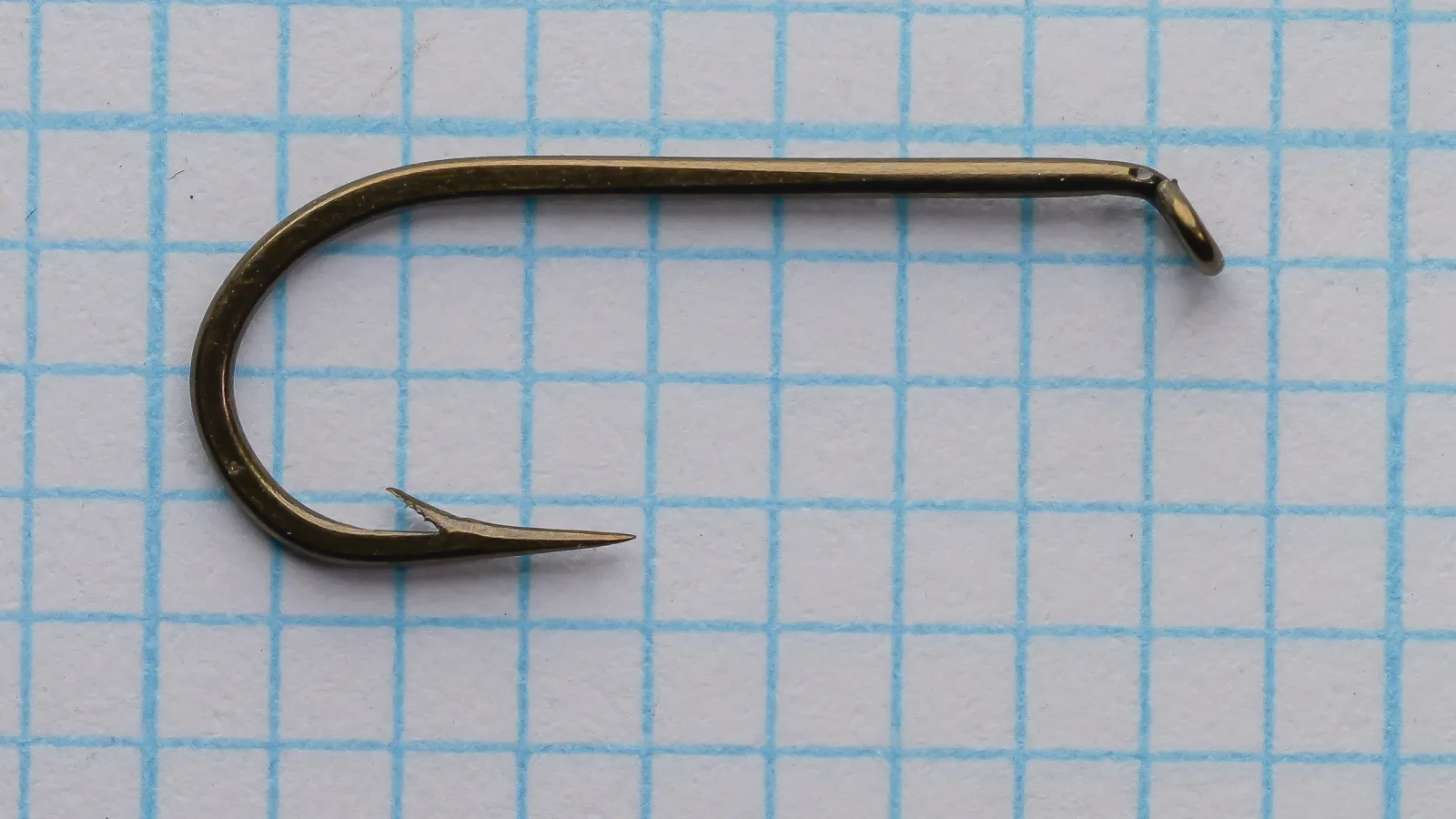
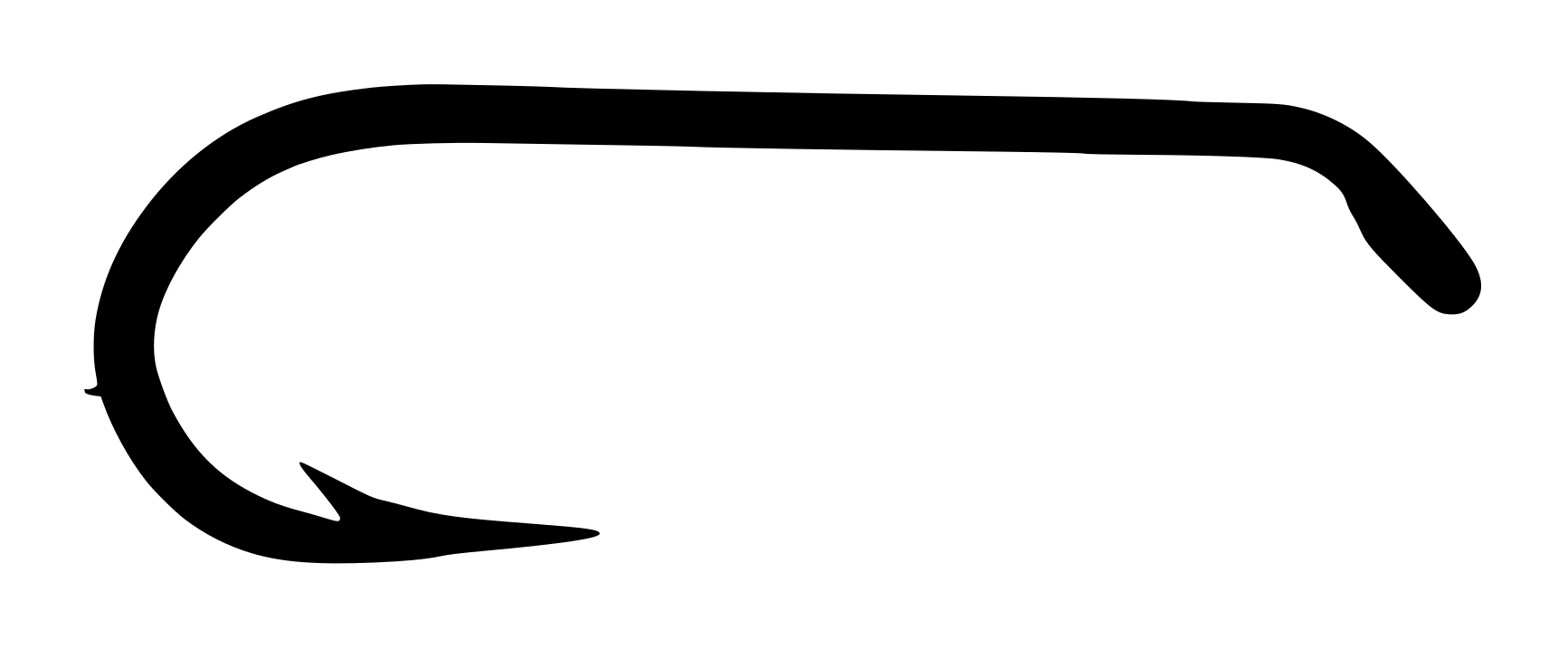
Mustad 7948 A in bronzed finish. Round Kendal bend with straight point and tapered eye.
Photographic record
2 cataloged imagesSelect any record to load it above.
2 images shown
Mustad 7948 A Hook Side ProfileMustad 7948 A in bronzed finish. Round Kendal bend with straight point and tapered eye.Open originalMustad 7948 A Original Box LabelOriginal packaging label identifies the 7948 A as a hollow point, forged straight hook with tapered eye, marked rustproof and made in Norway.Open original
Technical profile
Eye
Tapered Eye, Turned DownTapered-down construction: wire diameter is clearly reduced as it forms the terminal loop, creating a delicate, refined eye profile P. Eye diameter is approximately 0.15"-0.17" (~3.8-4.3 mm), appropriately sized for size 6 fly work E. No ball or knot at the end—the wire simply tapers to a fine point and loops back, creating a streamlined transition P. Taper is smooth and even, not abrupt or kinked P.
Wire
Standard, Forged, Est. ~0.045"-0.050" (~1.14-1.27 mm)
Shank
2X Long — Plain
Bend
viking, Standard gapRound-bend geometry with clean, symmetrical curvature from the shank entry to the barb position P. Bend depth is moderate (~0.35") relative to gap width (~0.27"), creating a balanced proportion well-suited to dry-fly and nymph applications. No visible offset or lateral deflection—the hook runs straight along its central axis P. Wire set (the angle at which the wire naturally sits) appears neutral and not kinked or twisted P.
Point
Hollow Point (concave inner face)Barb is moderate in size, positioned at the base of the point's radius P. Barb angle appears swept slightly backward rather than perpendicular to the shank, typical of many Mustad hollow-point constructions E. Barb appears sharp and clean without visible deformation or heavy grinding marks P.
Finish
Bronzed — Inferred (photographically likely)Bronzed lacquer coating in warm, dark brownish-gold tone consistent with baked-on alkyd resin finish of 1950s era P. Specimen exhibits even coverage with no bare steel visible or significant wear spotting P. Color temperature is distinctly warm brown rather than cool blue-black, confirming bronze rather than japanning P. Light surface patina from age-appropriate oxidation, no active corrosion or pitting P.
Specimen hooks are bright bronzed with no visible corrosion or pitting P. Card shows uniform light tan toning and minor creasing at edges, consistent with 70-year storage in dry conditions. Ink remains legible, though upper portions show slight fading. Handwritten size notation (purple '6') is characteristic of original retail markup. No holes punched or major defects visible on card.
Forged Wire Construction: Unlike standard round wire, the shank has been placed in a mechanical drop-press and flattened along its lateral sides. This cold-forging process fundamentally alters the steel’s molecular structure, significantly increasing tensile strength and rigidity without adding material thickness. The result is a hook that resists straightening under heavy load while maintaining the fine-wire aesthetic and reduced weight of a standard-gauge hook. For size 6 applications—tying large dry patterns or weighted nymphs—this forging is critical to prevent the hook from bending open under the pressure of a hooked fish.
Hollow Point Geometry: The point is ground with a distinctly concave inner face, creating a sweeping curve from tip to barb base. This is not a solid, wedge-like taper but rather a knife-edge effect: the inner surface is dished out, concentrating material at the very tip while flaring rapidly toward the barb. The biomechanical advantage is extreme: the razor-sharp tip penetrates tissue with virtually no applied force from the angler. Historical documentation emphasizes this point was essential for soft-mouthed species (Crappie, panfish, delicate trout) where a heavy hook-set would tear friable tissue and cause lost fish. Once the needle-fine tip passes the barb, the rapid shoulder holds securely in tissue without creating an oversized entry wound that could tear during the fight.
Tapered-Down Eye: The terminal wire is progressively thinned as it forms the eye loop, reducing mass at the hook head. This design originated in premium dry-fly specifications where buoyancy and horizontal presentation on water surface are critical. By minimizing weight forward, the fly floats without the nose-down dip caused by excess steel bulk. For size 6 patterns, the tapered eye also facilitates neat, compact fly head finishing—essential for larger patterns where head bulk becomes visually obtrusive.
The Viking series represents Mustad’s mid-century product line engineered as a direct competitive response to prestigious British Redditch makers (Partridge, Allcock, Milward). Introduced in the 1940s-1950s, the Viking line emphasized forged construction, premium wire specifications, and refined eye geometries designed to appeal to serious fly tyers and commercial fishing operations. The 7948 A is a foundational Viking model, available across a wide size range (likely No. 2 through No. 16), designed for standard dry-fly, wet-fly, and light-nymph applications. The series name “Viking” deliberately evoked Scandinavian craftsmanship and industrial prowess, positioning Mustad’s product as a modern successor to traditional Redditch hand-forged traditions.
The Viking line remained in continuous production through the 1960s-1970s with minimal design changes. The series was ultimately discontinued during Mustad’s transition to the Signature Series (c. 2001-2009), when arbitrary numeric quality codes like “7948 A” were replaced with the more intuitive alphanumeric system (e.g., R50 for Round bend, standard weight, standard shank). No broader series context surrounds the 7948 A—it is a standalone model within the Viking line rather than part of a named hook family like the Limerick or O’Shaughnessy. The 7948 A has never been formally reintroduced under the modern Signature Series nomenclature, though functionally similar heritage models exist.
Era and Packaging Dating
Oslo-Norway address on label securely dates the packaging post-1925 (Christiania officially renamed Oslo in 1925). The Key Brand logo, cream stock card, ornamental border printing, and offset-style typography are all consistent with mid-century Mustad production. Absence of a barcode suggests pre-late-1970s manufacture but is not definitive dating evidence on its own because many tackle cards remained barcode-free for years afterward. A conservative estimated production window of c. 1950-1965 remains plausible based on overall packaging style and known Viking-series distribution patterns.
Industrial Cloning: How Mustad Conquered Global Markets
The Mustad 7948 A reflects Mustad's broader industrial strategy of adapting and standardizing successful regional hook geometries for large-scale mechanized production. Many mid-century Mustad fly hooks drew inspiration from traditional English and Scandinavian bend patterns, then were refined for consistent automated manufacture using the company's advanced hook-making machinery developed after Mathias Topp's 1877 innovations. By the mid-20th century, Mustad had become one of the dominant hook manufacturers in the global fishing-tackle industry.
Design lineage and influence
The round-bend geometry traces to traditional English Kendal patterns and Scandinavian bending conventions predating mechanization. Competing designs from Redditch makers (Partridge, Allcock, Milward) offered similar round-bend dry-fly hooks with proprietary eye and wire specifications. Mustad’s contribution was standardization and volume: by applying Mathias Topp’s automated machinery to proven geometries, they achieved cost-effective mass production that smaller regional makers could not match.
The hollow-point specification represents Mustad’s engineering response to early 20th-century fly-fishing literature emphasizing light-tackle penetration. Contemporary Redditch makers offered similar hollow-point grinding, but Mustad’s mechanization ensured consistency across millions of hooks. The 7948 A sits in the mid-tier of Mustad’s quality hierarchy (quality codes in 3000-3999 range denote mid-tier products; the 7948 A’s code places it in the premium 7000+ range per Mustad’s typology, actually indicating a higher-end product than typical “economy” hooks).
Downstream influence: the 7948 A demonstrates mechanical principles that influenced modern chemically sharpened points (Mustad’s AlphaPoint, UltraPoint). The tapered-eye concept survives in contemporary premium dry-fly hooks (TMC 100, Orvis Clearwater). The forged-wire construction remains standard for nymph and streamer work across manufacturers.
Best matchRelated by Attribute
Computed automatically from catalog data — updated as new hooks are added.
Matches: Bend, Shank, Gap, Point, Finish +4 moreDiffers: Wire: Standard vs Heavy (1X Heavy); Eye: Tapered Eye vs Ball Eye; Eye Orient.: Turned Down vs Straight / Inline +1 more
The Mustad 7948 A is a versatile round-bend hook engineered for standard freshwater fly tying across dry, wet, and nymph applications. The forged wire and hollow point provide reliable penetration with minimal force, making it ideal for soft-mouthed species. In size 6, it serves as an excellent platform for larger dry fly patterns (Hoppers, Stoneflies, Chernobyls) and weighted nymph applications where moderate wire strength is required. The tapered eye reduces bulk at the head, facilitating neat fly head finishing. The bronzed finish offers a stealthy, muted presentation favored by finesse anglers in clear freshwater.
Secondary Applications
Light-wire wet flies, small streamer applications, panfish nymphs
Modern Mustad equivalent in round-bend dry-fly geometry with tapered eye, standard weight. Functionally very similar but lacking forged wire option in modern production.
Tiemco TMC 100
Very Good
A lighter-wire dry-fly hook with broadly similar straight-shank proportions, though materially finer and less robust than the forged Mustad 7948 A. Better viewed as a partial functional analogue than a direct equivalent.
Tiemco TMC 3769
Good
Not a close geometric equivalent. The TMC 3769 is a curved-shank nymph/wet-fly hook with substantially different bend profile, wire distribution, and intended application.
Orvis Clearwater 1234
Good
Contemporary round-bend dry-fly hook with tapered eye, matching the 7948 A's size-6 application range, though point geometry differs.
Collector notes
Rated 3.0/10 — widely produced and still readily available at mid-range eBay prices ($12-$20 per card of 100); collector interest is modest and primarily driven by nostalgia and the Viking series reputation rather than rarity. Size 6 is common; smaller sizes (10-16) command slight premiums. Original card in good condition adds modest value premium (~25-30%) over loose hooks.
Reference value
$8 – $16 USD estimate
Packaging condition
Good — moderate wear, legibleRecorded specimen
Packaging format
GW-M-05Catalog code
Positive factors: The Viking series is recognized as high-quality, representing Mustad’s mid-century answer to Redditch competitors. Forged construction and hollow point are mechanically sophisticated features. Original packaging with Key Brand logo and Oslo-Norway address carries period charm and dating clarity. Size 6 is a practical, usable size that appeals to fly tyers looking for functional vintage stock.
Limiting factors: Industrial production volumes mean these hooks remain abundant in the secondary market. Complete original cards are frequently encountered, reducing scarcity premium. Modern equivalents (Mustad Heritage series, TMC 100) are readily available and functionally similar, limiting collector-only demand. The 7948 A was never discontinued — production continued into modern era under updated numbering, meaning specimens lack true rarity status.
Most desirable variants: Sealed original cards command highest premiums. Smaller sizes (10, 12, 14) are less common than size 6-8. Cards with handwritten tyer notes or provenance to known fly-fishing figures add significant collector premium. Bronzed finish in original condition (not toned or worn) is preferred over heavily oxidized examples.
Packaging
Vintage Mustad paper sales card, approximately 4.5" × 3" (114 × 76 mm), cream-colored stock. Eight-line typographic label printed in gold and red ink. Key Brand logo (downward-pointing skeleton key) in upper left corner. Text reads: O. MUSTAD & SON / MANUFACTURERS / OSLO – NORWAY / Qual. 7948 A / Hollow Point / Mustad-Viking Hooks / Forged Straight / Tapered eye Rustproof (last line partially obscured by handwritten notation) / Made in Norway. Bottom left corner bears handwritten purple numeral '6' indicating size. 'No. 100' appears in lower left. Ornamental border of small repeated patterns frames all edges. Offset letterpress printing. Card shows light toning and age-patina consistent with 1950s-1960s storage. Card edge exhibits minor creasing; paper stock remains structurally sound. Hooks are intact and retained on original card (all or nearly all 100 present).
Market Value Notes
Low ($8): Good condition — opened card, 85-95 hooks present, minor wear and toning to packaging. High ($16): Excellent condition — sealed or nearly sealed card, all 100 hooks intact, minimal packaging wear, bright bronze finish. Premium factors: sealed/unopened status (+40-50%), complete hook count, original presentation tissue if present, size 6 appeal to modern tyers. Platforms: eBay (US and UK regions), occasional online vintage tackle dealers, Facebook collecting groups. Confidence: V verified from 7 eBay sold listings ($12.49-$19.99 range, avg $18.91) and eBay market history data (Apr 2023–Apr 2026, avg $7.90, range $3.25-$9.99). Note: eBay listing prices show higher values ($18-20) for new/sealed stock; market history aggregate includes condition variance. Conservative anchoring at $8-16 reflects realistic mid-range sold prices accounting for condition diversity.
Where to Find
eBay (search 'Mustad 7948A', common on US/UK sites). Vintage tackle dealers (online and regional). Fly-tying supply shops with vintage inventory sections. Occasional appearance at tackle shows and estate sales in angling regions (UK, Scandinavia, US Northeast/Pacific Northwest). Less common in retail brick-and-mortar shops but available through online dealers specializing in historic fly hooks.
eBay market reference. Researcher-curated. Prices in USD. Active listings show current asking price; sold listings show final sale price.
Preservation
Storage and Preservation
Optimal storage environment: Keep in a cool, dry location away from direct humidity and moisture. The bronzed lacquer finish is durable but susceptible to patina development in high-humidity environments. Many collectors view this natural darkening as desirable aging; others prefer to maintain the original warm brown tone. If patina development is undesirable, store in a sealed container with silica gel packets to minimize humidity exposure.
Card preservation: Original paper cards are fragile and susceptible to foxing (brown age spots), yellowing, and ink fading. Avoid direct sunlight, which accelerates paper degradation. Store cards flat or in acid-free archival boxes rather than standing upright (which causes curl and stress to the paper substrate). Do not expose to temperature fluctuations or direct heat sources.
Hook preservation: Hooks themselves are extremely resistant to corrosion due to the bronzed finish and quality steel. However, avoid contact with other metals, which can initiate galvanic corrosion. Do not store with ferrous objects (iron, steel) without separation, as moisture from dissimilar metals can accelerate rust development. Original tissue paper (if present) should be retained to buffer moisture and reduce direct hook-to-card contact.
Handling recommendations: Minimize handling of the card to reduce fingerprint oils and skin acidity transfer. If examination is necessary, handle only by the edges and use clean hands or cotton gloves. Do not attempt to remove hooks from the card if original packaging is a collecting goal—removal significantly diminishes historical and monetary value.
Restoration cautions: Do not attempt to polish or clean the bronzed finish with abrasive methods, as this removes the original patina and alters the historical authenticity. If the card becomes soiled, gentle dry-brushing with a soft, natural-bristle brush is acceptable; avoid water-based cleaning, which risks ink bleeding and paper damage.
Marking Analysis
Handwritten Annotations
The specimen card bears a single handwritten notation in purple/violet ink: the numeral ‘6’ appears in the lower left corner, indicating the hook size. This is consistent with original retail marking practice—merchandise staff or the manufacturer would handwrite the size on cards containing single-size assortments for quick identification during wholesale/retail distribution. The purple/violet ink tone and fading pattern suggest age consistent with the 1950s-1960s production era. The notation is utilitarian rather than personal, indicating this was a working commercial stock card rather than a curated collector acquisition.
No other handwritten annotations, tyer marks, or provenance notes are visible on the packaging, suggesting this card remained in original commercial inventory rather than being purchased by a named fly-tying hobbyist or passed through a known angling figure’s collection.
Primary Source
Label Text Decryption & Significance
Source: Mustad 7948 A vintage sales card, eight-line label format, c. 1950-1965
Line 1: O. MUSTAD & SON — Full, unabbreviated company name, establishing ultimate corporate authority and brand integrity. The ampersand format and Norwegian spelling (SON rather than SONS) reflect Scandinavian linguistic convention. This text reinforces that the packaged hooks are manufactured directly by the parent company, not jobbed or repackaged by import agents—a critical distinction in an era when tackle distributors frequently relabeled bulk hooks under secondary brand names.
Line 2: MANUFACTURERS — Explicitly defines Mustad’s industrial role within the global supply chain. This distinction was historically imperative: the late 19th and early 20th-century tackle market was saturated with international import agents and regional distributors who purchased bulk hooks and repackaged them under localized brand names. By prominently cementing their manufacturer status on the label, Mustad ensured brand recognition and loyalty directly from end-users regardless of distribution network intermediaries.
Line 3: OSLO – NORWAY — Geographic origin notation serving as a definitive chronological bracket. The presence of “OSLO” (rather than the historical “CHRISTIANIA”) confirms manufacture after January 1, 1925, when Norway’s capital was officially renamed. This single line element provides unambiguous dating to post-1925 production. By the 1950s-1960s, the Oslo designation had become Mustad’s primary marketing identifier, emphasizing Scandinavian industrial prestige during the golden age of fly fishing.
Line 4: Qual. 7948 A — Quality code and tier designation. The “Qual.” abbreviation (Quality) precedes a numeric code representing Mustad’s structured but somewhat convoluted product categorization system. The 7948 A code places this model in the premium tier (codes 7000 and above generally denoted highly specialized, refined hooks, according to period nomenclature). The ‘A’ suffix likely indicates a specific wire gauge or finish variant within the 7948 family.
Line 5: Hollow Point — Exclusive point identifier defining the geometric shape and quality grade of the hook point. Per Mustad’s standardized typographical rules, Line 5 is reserved exclusively for point type specification and never specifies wire gauge, shank length, or eye configuration. The “Hollow Point” designation indicates a concave, dished inner face ground from tip to barb base, engineered for rapid, clean tissue penetration with minimal applied force. This was essential for soft-mouthed fish species and delicate fly presentations.
Line 6: Mustad-Viking Hooks — Pattern name and series identifier. The hyphenated format “Mustad-Viking” emphasizes the proprietary Viking series branding. This line identifies the overarching geometric pattern and style of the hook’s bend and shank. The Viking designation signals adherence to Scandinavian craftsmanship traditions and positions the hook as a credible alternative to British Redditch makers.
Lines 7-8: Forged Straight / Tapered eye Rustproof / Made in Norway — Anatomical modifications and metallurgical finishes. “Forged” indicates the wire has been placed in a mechanical drop-press and flattened, significantly increasing structural rigidity. “Straight” indicates no lateral offset (not a Kirbed or reversed hook). “Tapered eye” specifies the terminal wire is progressively thinned as it forms the eye loop, reducing weight at the hook head—a premium feature for dry-fly applications. “Rustproof” is a period marketing term referring to the bronzed lacquer coating, which seals the high-carbon steel from moisture and corrosion. “Made in Norway” reinforces geographic origin and industrial prestige.
Size and quantity notation: The handwritten ‘6’ in lower left indicates hook size No. 6. The printed “No. 100” (bottom corner) denotes the standard wholesale/retail card count of 100 hooks per package—a universal standard for mid-century tackle distribution.
Additional
The Tapered-Eye Revolution in Mid-Century Fly Design
The tapered-eye specification on the Mustad 7948 A represents a subtle but significant engineering innovation that emerged in the 1940s-1950s as fly-fishing philosophy shifted toward lighter, more refined tackle. Earlier dry-fly hooks featured substantial ball eyes or uniform-diameter loops that, while structurally robust, added unnecessary mass forward of the hook shank. This weight concentration caused larger patterns (particularly in size 4-8) to exhibit an undesirable nose-down dip when floating on the water’s surface—a presentation flaw that undermined buoyancy and created an unnatural silhouette to selective trout.
Mustad’s response was the tapered-down eye, in which the wire diameter is progressively reduced as it curves to form the terminal loop. The result is an eye that retains full structural strength (the wider wire at the base of the eye loop carries all tension and load) while minimizing overall weight and bulk at the fly’s head. For a size 6 pattern, this reduction of perhaps 0.05-0.08 grams may seem trivial, but when combined with premium hackle and dubbing selection, it proved decisive in achieving true horizontal float and natural water presentation.
This design choice reflects a broader mid-century aesthetic: as fly-fishing literature and commercial fly patterns became more sophisticated, emphasis shifted toward refinement, precision, and what was termed “bug-like realism.” The tapered eye became a hallmark of premium dry-fly hooks marketed to serious amateur tyers and professional pattern-dressers. Competing manufacturers (Partridge, Allcock, Tiemco in later decades) adopted similar tapered specifications, cementing this geometry as the standard for high-quality dry-fly hooks across the second half of the 20th century.
Modern fly-fishing culture occasionally debates whether the tapered eye offers genuine functional advantage or represents a case of mid-century marketing mythology. Contemporary experimental work suggests the advantage is marginal for most applications. However, for the 1950s angler tying large patterns (Hoppers, Stoneflies, Stimulators) in size 4-6, the tapered eye represented a tangible improvement over earlier ball-eye designs—and its persistence in modern premium hooks testifies to its enduring cultural status within fly-tying tradition.
Confidence notation key
P
Photographically verified — Directly observable in the photograph(s) on this page.
V
Verified by documentation — Confirmed by manufacturer catalog, spec sheet, or published reference.
I
Inferred — A logical deduction from observable or documented evidence, not directly stated.
E
Estimated — An approximation based on visual comparison, proportional analysis, or limited data.
S
Speculative — A reasoned hypothesis that cannot be confirmed from available evidence.
Unnotated claims are the compiler’s synthesis; see Sources. All photographs on garrenwood.com are taken on a measurement grid where each square equals 1/10 inch (0.1″ / 2.54 mm).