Selected size
3
Catalog record
- Overall Length
- 29.2 mm V
- Shank Length
- 18.4 mm V
- Bend Depth
- 9 mm V
- Wire Diameter
- 0.9 mm V
- Confidence
- V Catalog record only
 Garren WoodFishing Hook Reference
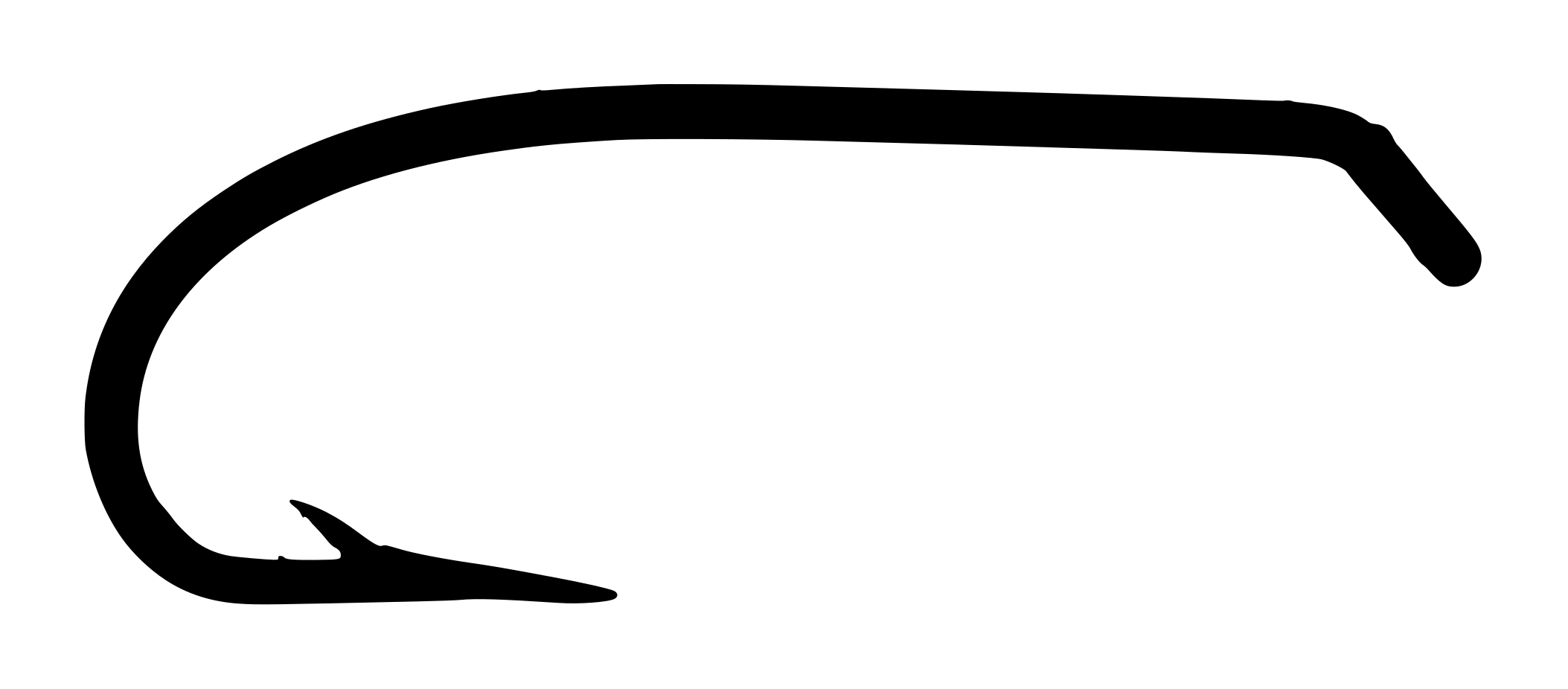
Save this hook to your account to build a list you can come back to.
Mustad 3399 A Sproat is a mid-tier wet fly and nymph hook manufactured in Oslo from approximately 1925 to 1960, featuring a parabolic Sproat bend, turned-down ball eye, extra-heavy wire, and bronzed finish. The Superior point geometry—a near-straight inner taper optimized for both soft-tissue penetration and resistance to dulling on hard substrates—reflects Mustad’s engineering approach to designing a single pattern capable of serving diverse freshwater conditions and target species. The 3399 A occupied a significant position in Mustad’s quality hierarchy, representing the moment when industrial precision manufacturing made regional fishing patterns globally accessible to fly tyers and anglers who had previously relied on specialist regional tackle. Its continued regard among traditionalist fly tyers and its rarity in original packaging speaks to both the volume of its original production and the utilitarian wear patterns that consumed most examples during the mid-twentieth-century fishing era.

7 cataloged imagesSelect any record to load it above.
7 images shown
Turned down Ball | Sproat | 1X long | Extra heavy Wire | Superior Point | Bronzed
The Superior point geometry represents a significant engineering compromise engineered by Mustad specifically for commercial and recreational applications where a single hook design needed to perform across diverse environmental conditions and target species. The near-straight inner taper (as opposed to the concave ‘dished-out’ inner face of a hollow point) concentrates the penetration force at the tip while distributing the load more evenly across the structure of the point. This design resists rolling, dulling, and fracturing when encountering hard substrates (bone, cartilage, rocky stream bottoms) while still maintaining sufficient sharpness for soft-tissue penetration.
The Sproat bend’s parabolic geometry is mathematically optimized to distribute the strain of a fighting fish evenly across the entire arc of the bend. Unlike the sharp Limerick (which concentrates stress at the angular bottom) or the full round Aberdeen (which exhibits different stress distribution), the Sproat curves in a continuous, sweeping arc that mathematically smooths the load distribution. This makes it highly resistant to straightening out or fracturing under sustained, sudden tension—critical for commercial fisheries where loss-of-tackle downtime translates directly to lost revenue.
The small ball eye construction is characteristic of its era: the turning-down of the wire end to form a small loop was simple, rapid to produce on automated machinery, and sufficiently durable for the braided and silk lines of the early-to-mid twentieth century. As modern monofilament and fluorocarbon lines became standard, the small ball eye remained functional, though many modern tyers prefer the larger eyes of contemporary hooks for cleaner knot-tying geometry.
The standard round wire profile (as opposed to forged or flattened stock) represents a production-cost optimization: round wire could be produced at scale with fewer specialized machinery steps than forged or flattened variants. For the mid-tier market that the 3399 A targeted, this balance between cost and performance was critical. The bronzed finish—a baked alkyd-resin lacquer mimicking the appearance of bronze—provided excellent freshwater corrosion resistance while avoiding the higher cost of true tinning (electroplating) or the weight penalty of heavy japanning. The muted, natural appearance of bronzed finish was highly favored by freshwater anglers and fly tyers seeking to avoid unnatural flash.
Grid-derived from photograph (1/10" grid)
We have measurements for sizes 3, 6, 10, 12. Know any others? Submit calipered measurements and we'll review and add them. Thank you!
O. Mustad & Søn (O. Mustad & Son) was founded in 1832 in the remote village of Gjøvik, Norway, initially as a general metal goods factory specializing in nails, steel wire, and fasteners. The company was taken over by Ole Hovelsen Mustad and his son Hans Mustad, who recognized the explosive global demand for fishing hooks following the industrialization of fishing tackle in the mid-nineteenth century. The defining innovation came in 1877 when Mathias Topp, an engineer within the firm, invented the first fully automated hook-making machine—a revolutionary technology that allowed raw steel wire to be continuously fed, cut, bent, barbed, and pointed at unprecedented speed and consistency.
Rather than patent this technology (which would have required public disclosure of the mechanical specifications), the Mustad family implemented a strategy of intense corporate secrecy, non-disclosure agreements, and restricted factory access. This approach proved devastatingly effective against rival manufacturing centers in Redditch, England, and emerging hubs in Japan and the United States. By the mid-twentieth century, Mustad had captured approximately 50% of the global hook production market. The company’s strategy of industrial ‘cloning’—reverse-engineering regional hook patterns favored by local blacksmiths or anglers in specific geographic areas (Cincinnati bass hooks, Limerick salmon hooks, Virginia bait hooks) and producing them at Norwegian industrial scale—allowed Mustad to corner localized markets globally while maintaining the cultural authenticity of each pattern.
The company established sales offices and manufacturing facilities across multiple continents and made the word ‘Mustad’ virtually synonymous with the fishing hook itself. The formalized eight-line label system documented in Mustad’s own technical guides represents an attempt to create a universal, highly technical language of tackle identification capable of bridging linguistic barriers and communicating complex engineering specifications to international wholesalers, regional retailers, and individual anglers.
The Qual. 3399 A occupies a specific position within Mustad’s mid-twentieth-century product hierarchy. The model code ‘3399’ places it within the 3000–3999 ‘Quality’ tier—mid-tier products manufactured to exacting dimensional and tempering standards, distinct from both economy models (1000–2999) and premium specialized hooks (4000+). The suffix ‘A’ typically indicates a variant or revision of the baseline model, though Mustad’s documentation on this specific nomenclature is limited.
The Sproat bend itself has a rich history predating Mustad’s involvement. The parabolic geometry was perfected by Irish regional craftsmen and became one of the most universally applicable hook profiles in angling history. Mustad’s adoption and mass production of the Sproat pattern—alongside the competing Limerick and Aberdeen geometries—represents a critical moment in the democratization of tackle. Prior to industrial reproduction, these patterns were the specialized province of regional blacksmiths whose work commanded premium prices and was jealously guarded by local fishing communities. By producing the Sproat at scale with consistent quality, Mustad made the geometry accessible to commercial fisheries and sport anglers worldwide.
The Superior point designation on the 3399 A is significant: it represents Mustad’s proprietary classification of a near-straight inner taper optimized for balanced penetration and durability. This point style was marketed as suitable for all-purpose, high-reliability applications—neither the delicate tissue penetration of a hollow point nor the blunt force of a spear point, but a calculated engineering compromise.
The 3399 A remained in production through at least the mid-twentieth century. The transition from the traditional arbitrary quality-code system (94840, 3399, 3906, etc.) to Mustad’s modern Signature Series—which began around 2001–2009—marked the official end of the classic labeling era for this and all vintage Mustad hooks. The presence of the traditional ‘3399 A’ code on an eight-line paper label serves as the definitive hallmark of a true vintage Mustad product from the pre-2001 industrial era.
Packaging bears 'OSLO - NORWAY' designation. The Norwegian capital was officially renamed from Christiania to Oslo on January 1, 1925; therefore this label dates to 1925 or later. The presence of traditional eight-line Mustad label format, absence of barcode (not adopted until 1974), letterpress print quality, and ornamental border design are consistent with mid-20th-century production. Pink paper stock and styling typical of 1930s–1960s export packaging. The 'Qual. 3399 A' model code format is consistent with Mustad's pre-2001 quality-tier system, before the Signature Series transition. No specific manufacturer date indicators (phone format, postal codes) visible that would narrow the window further; era window c. 1925-1960 reflects the known production span for this model code.
The Sproat bend owes its origins to Irish blacksmiths working in the late 1800s, decades before Mustad's industrial adoption. What made the Sproat revolutionary was not its discovery but Mustad's decision to produce it at scale with complete manufacturing consistency—something that regional craftsmen, by definition, could never achieve. When Mustad began exporting Sproat-pattern hooks to British fisheries in the 1890s, they directly competed with hand-forged Irish hooks that had cost three to five times more and often showed the subtle variations inherent in hand-labor production. Within two decades, Mustad's industrial Sproat had essentially eliminated the Irish regional hook-making tradition, not through superior engineering, but through economic displacement. Ironically, today's collectors prize vintage hand-forged Irish Sproats precisely because they are rare and show the subtle imperfections that mark human craft—the very characteristics that Mustad's industrial uniformity rendered economically obsolete.
The Sproat bend emerges from the Irish regional hook-making tradition of the 1870s–1890s, perfected by craftsmen whose names are now lost to history. The parabolic geometry represents a mathematical refinement of earlier round bends (the Aberdeen, the Kendal) and a deliberate rejection of the angular Limerick, which concentrated stress at a single point. Irish Sproat hooks were hand-forged in limited quantities and commanded premium prices due to their rarity and the master-craftsmen reputation associated with their creation.
Mustad’s adoption of the Sproat pattern in the 1890s initiated a process of reverse-engineering, standardization, and mass production that transformed the hook from a specialized luxury good into a globally accessible commodity. By the 1920s–1950s, the Sproat had become the de facto standard for fly tyers, salmon fishermen, and commercial anglers across the British Isles, Scandinavia, and North America. The 3399 A represents one of Mustad’s flagship mid-tier expressions of this geometry.
Contemporary competitors included the Limerick (more angular, favored for Atlantic salmon), the Aberdeen (more open and round, favored for delicate live-bait presentations), and various specialized geometries (Dublin, O’Shaughnessy, Cincinnati). However, the Sproat’s mathematical optimality—its even stress distribution and balanced performance across diverse conditions—ensured its dominance in the mid-tier commercial market. The geometry remains in production today by Mustad and other manufacturers, though modern hooks often employ different point styles and wire gauges that were unavailable to mid-twentieth-century engineers.
| Silhouette | Hook Model | Match | Analysis | Compare |
|---|---|---|---|---|
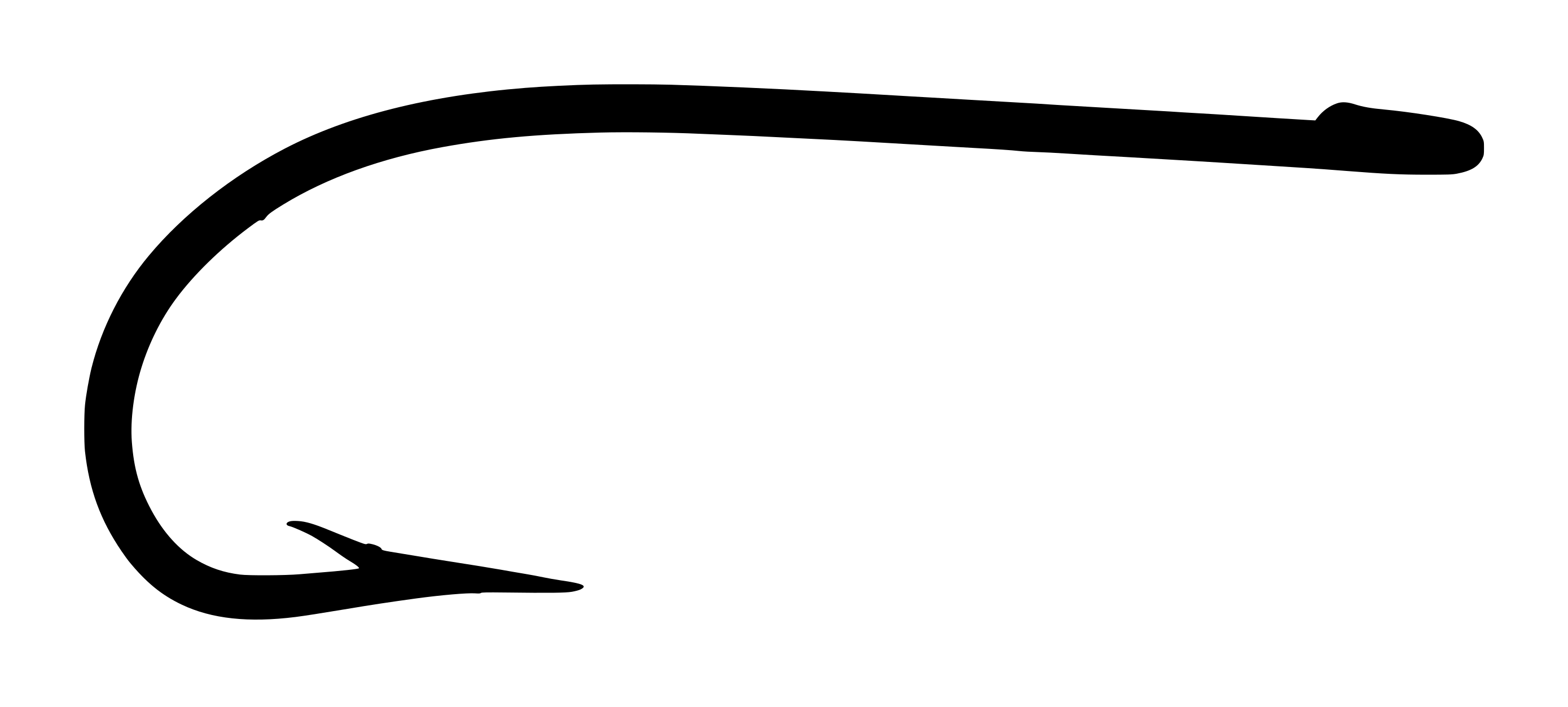
|
3389 No. 8 — Mustad 3389 | 85% | Compare | |
| Pacific Bass — Pacific Bass | 78% | Compare | ||
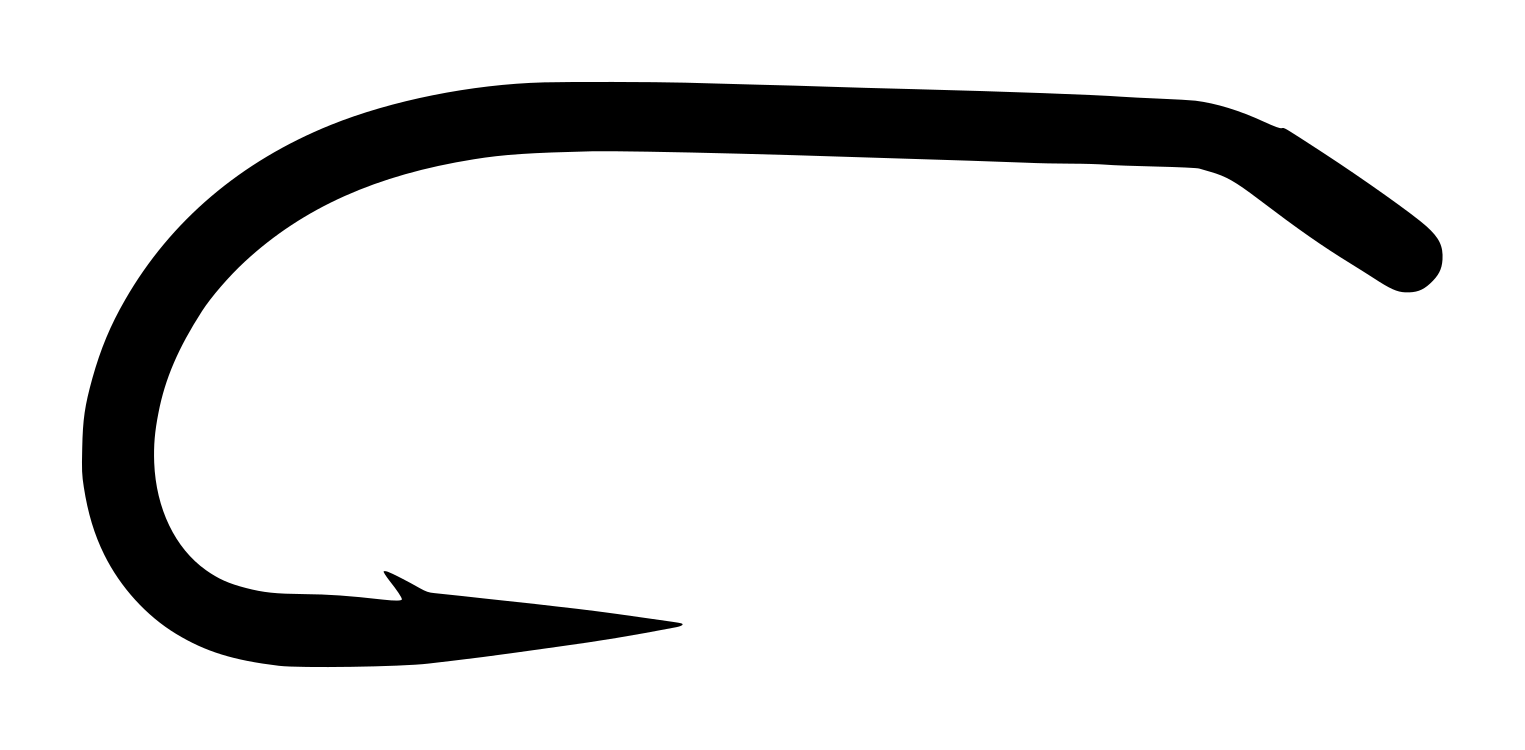
|
S80-3906 — Nymph Sproat | 77% | Compare | |

|
541 No. 10 — Mustad 541 | 76% | Compare | |
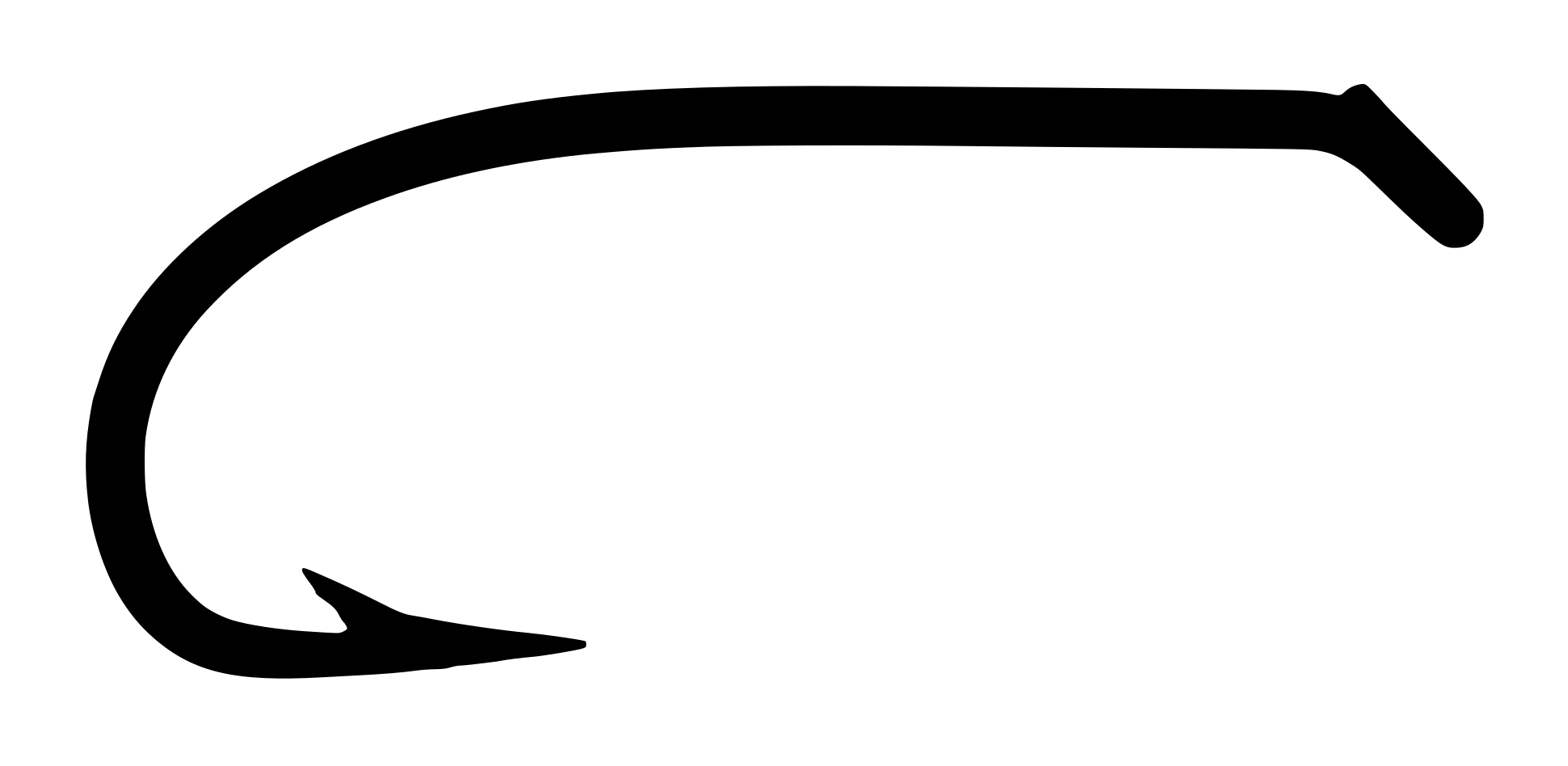
|
W 205 No. 12 — Sproat Hook | 76% | Compare |
| Silhouette | Hook Model | Match | Compare |
|---|---|---|---|
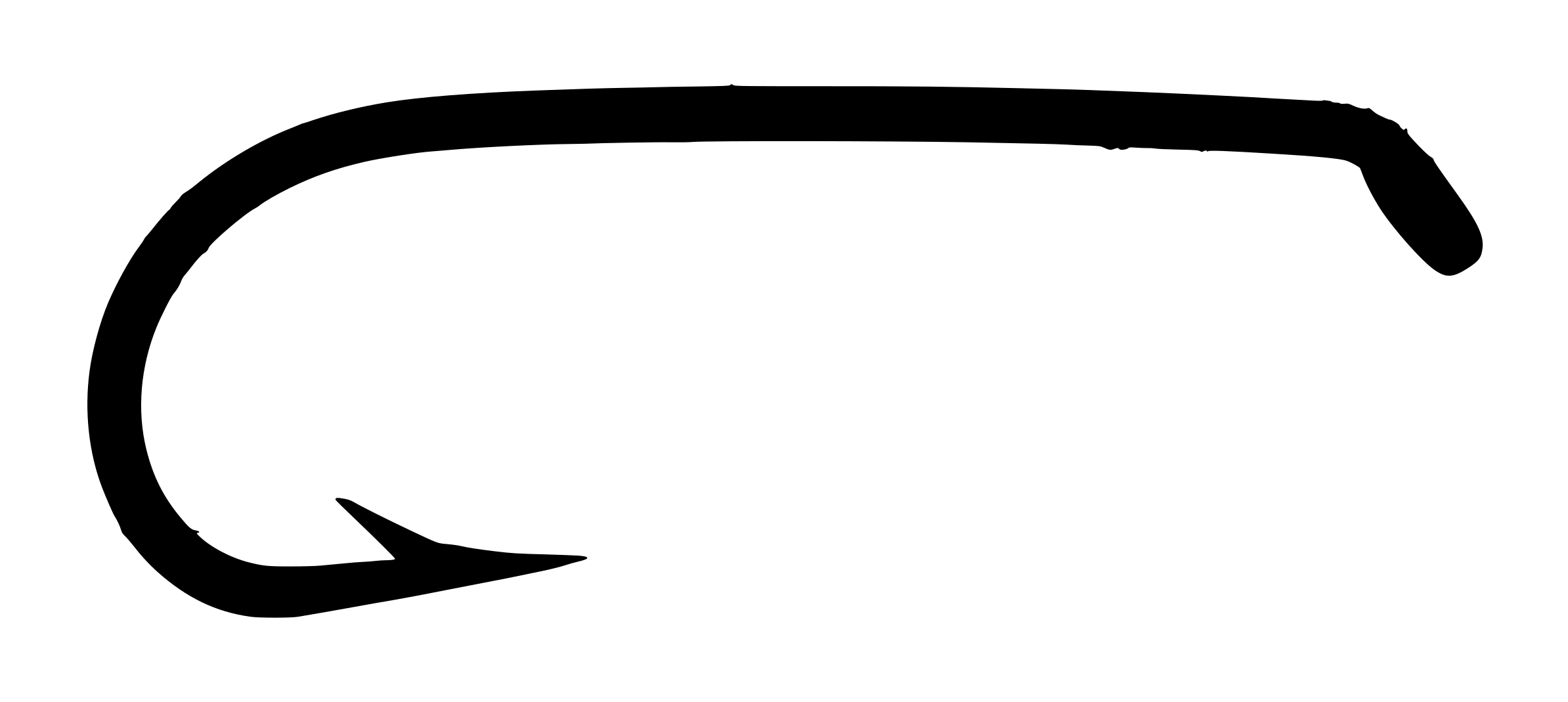
|
Nyack Extra Stout — Nyack Extra Stout | 99% | Compare |
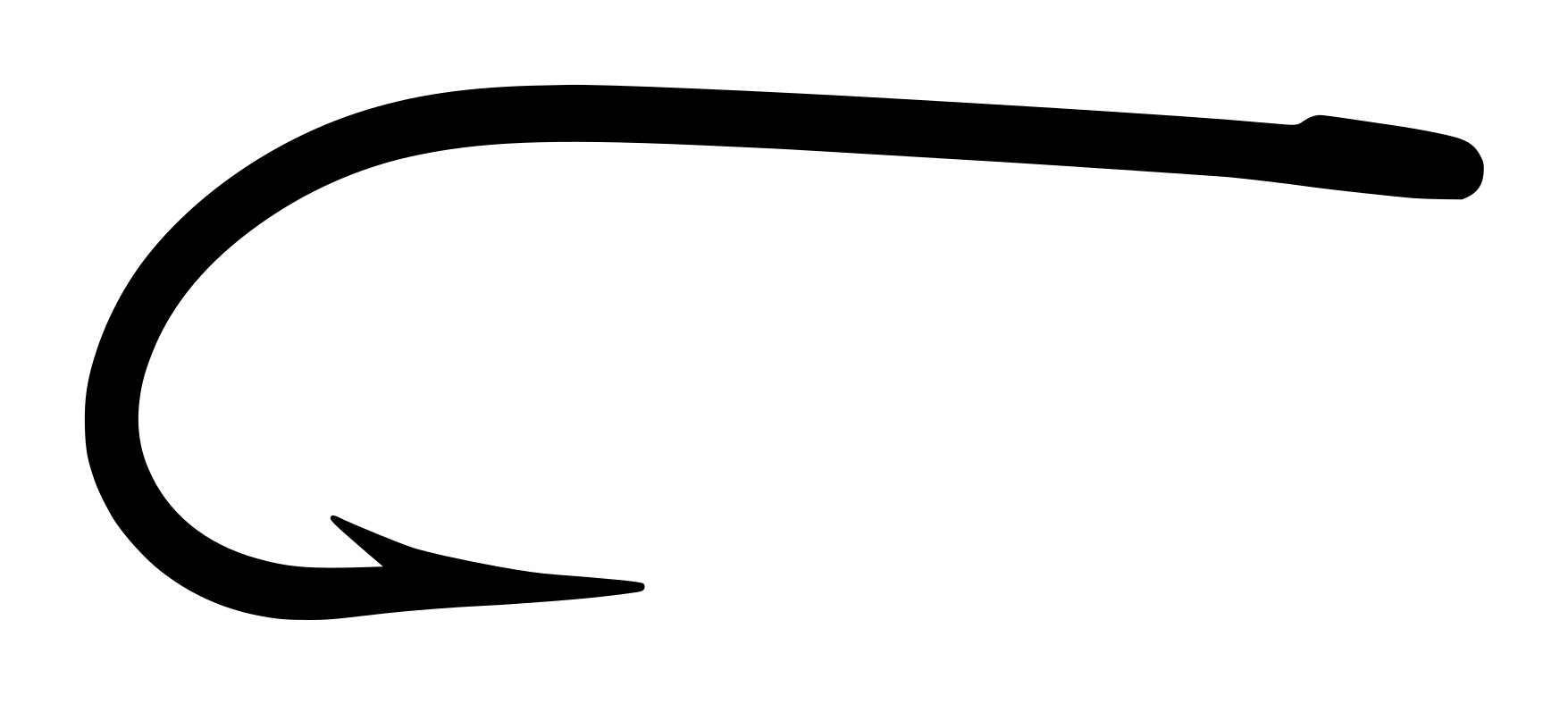
|
4211 No. true — Kendal Kirby Hooks | 99% | Compare |
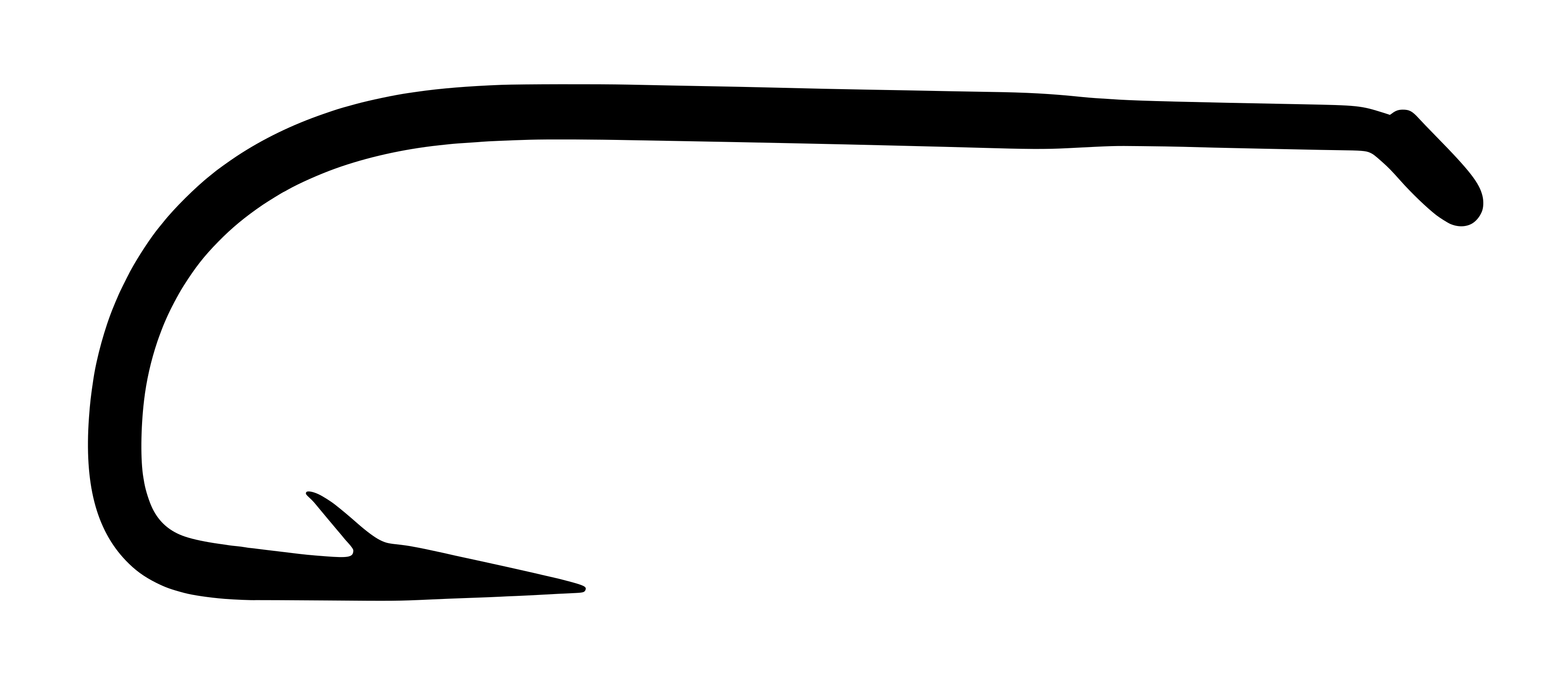
|
1810 TDE No. 8 — 1810 TDE | 99% | Compare |

|
2320 No. 6 — Mustad-Kirby Sea Hooks | 98% | Compare |

|
4211 C No. 6 — Mustad 4211 C — Kendal Kirby | 98% | Compare |
The Mustad 3399 A is a general-purpose, mid-tier sport angling hook optimized for both bait fishing and wet fly applications. The parabolic Sproat bend distributes load evenly across the arc, making it highly resistant to straightening under sustained tension from fighting fish. The Superior point provides an engineering compromise between delicate penetration and robust durability, suitable for a wide range of freshwater species including trout, panfish, and small bass. The standard wire gauge and small ball eye are characteristic of its era’s commercial and sport market positioning.
Small live baitfish (dace, roach, minnow), terrestrial insects (grasshopper, cricket), earthworm presentations.
Not typically used for named fly patterns in modern angling; historical wet fly use in general patterns (soft-hackles, spiders, drowned-dun presentations).
| Hook | Match Quality | Notes |
|---|---|---|
| Mustad C49S (Sproat, standard wire, small eye) | Very Good | Modern continuation of the Sproat pattern with comparable wire gauge and eye size. Mustad's contemporary mid-tier Sproat offering. Equivalent functionality and geometry. |
| Tiemco 7989 (Sproat bend dry fly hook) | Good | Sproat-pattern geometry with tapered eye and lighter wire suitable for dry flies. Different eye construction and wire profile from vintage 3399 A, but same fundamental bend geometry. |
| Partridge of Redditch N (Sproat pattern) | Good | English-made Sproat from the historic Redditch tradition. Similar aesthetic and geometry to the Mustad 3399 A. Slightly heavier wire gauge in some sizes. |
The Mustad 3399 A is modestly uncommon and attracts some historical interest, primarily from collectors of mid-twentieth-century commercial tackle and vintage fly-tying historians. Original packaging with intact hooks significantly enhances collectability.
Positive Factors: The Qual. 3399 A represents a critical moment in hook manufacturing history—the industrial democratization of precision regional patterns. The Sproat bend is universally recognized as one of the most mechanically sound geometries ever engineered, and the Superior point exemplifies Mustad’s proprietary design philosophy. Original packaging with complete eight-line label is highly valued by tackle archivists, as it documents the formalized classification system that Mustad used for over a century. The Oslo-marked label provides definitive post-1925 dating. The mid-tier 3000–3999 quality classification places this hook at the intersection of commercial reliability and careful craftsmanship. Any example with original factory packaging commands significant collector interest.
Limiting Factors: The 3399 A was produced in enormous quantities—Mustad’s business model was built on high-volume, low-cost manufacturing—which means surviving examples are relatively common in the used tackle market. This abundant production history depresses rarity value. The small size (No. 12) and modest wire gauge make it less visually impressive to casual collectors than larger, heavier-duty hooks. Modern Sproat-pattern hooks remain widely available, reducing the perceived urgency of acquiring vintage examples. Partial or opened boxes command only modest premiums. The bronzed finish, while beautiful, is susceptible to patina development with age and humidity exposure, and heavily oxidized examples lose collectability appeal.
Original pink paper label affixed to cardstock box containing 100 hooks. Label dimensions approximately 3.5" x 4.5" (89 x 114 mm). Format is the classic eight-line Mustad typographic label, centerpiece by downward-pointing skeleton key logo with 'Key Brand' inscription. Print method is letterpress on pink paper stock (faded to warm salmon tone with age). Ornamental border of repeated asterisk/star symbols frames all four edges. Text in black ink, clearly legible despite age-related toning. 'O. MUSTAD & SON' (Line 1), 'MANUFACTURERS' (Line 2), 'OSLO - NORWAY' (Line 3), 'Qual. 3399 A' (Line 4), 'Superior' (Line 5), 'Mustad-Sproat Hooks' (Line 6), 'T.d. small ball-eye Bronzed' (Lines 7–8). Quantity notation 'No. 100' in lower left corner, preceded by asterisks. 'Made in Norway' printed at bottom. Box construction is lightweight cardstock with glued seams; evidence of careful handling and light storage. No water stains or foxing beyond normal age-related patina. Label remains fully adhered to box with no separation or peeling.
Original boxes with complete packaging and all 100 hooks intact command $12–18 USD at specialist dealers and Facebook vintage tackle groups. Opened boxes or partial lots fetch $8–12 USD. Single hooks loose in the market are valued at $0.10–0.20 each. Value drivers include label condition, completeness of box contents, absence of corrosion, and presence of original paper packaging. Bronzed finish condition significantly affects price; heavily patinated examples command 20–30% discounts. The Oslo-marked label provides definitive post-1925 dating, which may appeal to era-specific collectors. eBay completed listings (2023–2024) for complete Mustad 3399 A boxes average $12–15; specialty dealers (Tandy, vintage tackle forums) price higher ($15–20) due to curation and historical documentation.
Original boxes with packaging appear most frequently on eBay (search 'Mustad 3399'), Etsy vintage tackle stores, and specialist dealers such as Antique Fishing Hooks (UK), Vintage Tackle Collector groups on Facebook, and regional tackle antique fairs in England and Scandinavia. Less common in North American markets. Single hooks occasionally appear in bulk vintage hook lots. Original documentation (Mustad catalogs, sales literature) is extremely rare; few examples have been archived.
Model Code Verification: The eight-line label should clearly display ‘Qual. 3399 A’ on Line 4. Absence of this code, or substitution with modern Signature Series nomenclature (e.g., ‘R50’), indicates a post-2001 hook. Authentic vintage examples will show the traditional arbitrary numeric codes.
Geographic Origin: Line 3 of the label should read ‘OSLO – NORWAY’ (not ‘CHRISTIANIA – NORWAY’ for post-1925 examples). The Oslo designation is critical for dating: Christiania-marked examples predate January 1, 1925, while Oslo-marked examples postdate this date. This single-line descriptor is one of the most reliable dating tools for vintage Mustad.
Point Style Nomenclature: Line 5 should display ‘Superior’ as a standalone designation or paired with another descriptor. Confirm that packaging does NOT say ‘Superior Point’ or ‘Sup. Pt.’—if it does, the point_style would be set to ‘superior’ (near-straight geometry). If packaging says only ‘Superior’ without ‘Point,’ this is a brand-line name, not a point classification. Examine the actual point geometry under magnification: Superior points show a nearly flat inner face with a straight taper, while Hollow points exhibit a pronounced concave inner face.
Finish Authentication: Bronzed finish on authentic vintage Mustad 3399 A examples will show a warm, brownish-gold tone with uniformity across all surfaces. The lacquer should not show crazing, flaking, or uneven wear. Any evidence of chemical darkening or heavy patina suggests later storage conditions rather than original manufacturing. Compare against known reference images from garrenwood.com or specialist tackle collections.
Label Condition and Printing: The ornamental star border design (rows of small asterisks) framing the pink label is characteristic of 1930s–1960s Mustad export packaging. Letterpress printing creates slight embossing and ink variation that offset printing does not replicate; examine the texture of printed text under angled light. Modern reproductions will show offset printing flatness.
Box Construction: Original boxes are typically constructed from relatively light cardstock with glued seams. The paper stock will have aged to a warm pink or cream tone; avoid examples with bright, uniform color (indicating modern reproduction or excessive restoration). Edge wear and minor handling marks are expected and desirable; pristine condition may indicate later storage rather than period-authentic aging.
Hook Count: The quantity designation ‘No. 100’ on the label indicates a box of 100 hooks. Verify actual hook count when possible; original sealed boxes with all 100 hooks command significant premiums. Opened boxes or partial lots reduce collectability proportionally.
Store the Mustad 3399 A box in a cool, dry environment away from direct moisture and humidity. The bronzed finish is susceptible to patina development with age, humidity, and exposure to atmospheric acids—a process that collectors often find desirable for its visual character but that accelerates in damp conditions. Original packaging should be stored flat or at a slight angle to prevent stress on glued seams; avoid standing vertically for extended periods, as the weight of 100 hooks can stress the cardstock.
Keep the box away from other metals to prevent galvanic corrosion. Separate any ferrous (steel or iron) items, as they may initiate oxidation on the hooks through electrochemical processes. Avoid contact with brass, copper, or aluminum unless separated by inert material.
If the box is opened, individual hooks should be kept on the original card or paper backing rather than loose in containers, as loose hooks may damage one another and are at higher risk of corrosion from contact with other metals or moisture. Do not store in plastic bags or airtight containers without desiccant packets, as condensation can develop inside sealed plastic.
Handle the original label carefully: do not attempt to clean it, and avoid flexing or folding the box in ways that stress the label adhesion. Gentle dusting with a soft, dry brush is acceptable; avoid water, solvents, or aggressive cleaning methods that may damage the letterpress print or accelerate toning.
If corrosion begins to develop on individual hooks, do not attempt to clean them with abrasive methods or harsh chemicals. Light surface corrosion (blue or brown patina) does not affect function and may be preserved as evidence of age. Deep rust or active corrosion can be arrested by storing in a dry environment or by very gentle dry brushing with a soft brass brush. Never use steel wool or acidic solutions.
Source: Mustad Label Reference Document: 'A Comprehensive Typology and Decryption of Vintage O. Mustad & Søn Hook Labels' (garrenwood.com research archive)
Line 1: ‘O. MUSTAD & SON’ — Manufacturer name, unabbreviated. ‘O.’ stands for Ole (the son-in-law who took over the original factory). The formal company designation established brand authority and precluded distributors from repackaging under secondary labels.
Line 2: ‘MANUFACTURERS’ — Critical distinction from import agents and jobbers. In the late 1800s and early 1900s, the tackle market was saturated with international traders who would purchase bulk hooks and repackage them under localized brand names. By cementing their role as primary manufacturers, Mustad ensured direct brand loyalty from anglers and retailers.
Line 3: ‘OSLO – NORWAY’ — Geographic origin and definitive dating marker. The Norwegian capital was officially renamed from Christiania to Oslo on January 1, 1925. Any Mustad label bearing ‘OSLO’ can be conclusively dated to 1925 or later. Conversely, ‘CHRISTIANIA – NORWAY’ labels predate 1925 and represent the company’s initial major push into American and global export markets.
Line 4: ‘Qual. 3399 A’ — Product Code
Line 5: ‘Superior’ — Point classification.
Line 6: ‘Mustad-Sproat Hooks’ — Bend pattern and hook family. The Sproat is a parabolic, mathematically optimized bend geometry that distributes load evenly across the arc, resisting straightening and fracturing under sustained tension. The ‘Mustad-‘ prefix indicates Mustad’s industrial replication of a regional Irish pattern.
Lines 7–8: ‘T.d. small ball-eye Bronzed’ — Anatomical modifications and finish. ‘T.d.’ = turned-down eye. ‘Small ball-eye’ specifies the eye configuration. ‘Bronzed’ = baked alkyd-resin lacquer mimicking bronze hue, providing excellent freshwater corrosion resistance while maintaining natural appearance. Additional modifiers (if present) might specify shank length (‘Extra long’), wire treatment (‘Forged’), or special construction (‘Sliced’). These lines synthesize multiple technical variables into a complete product description.
Quantity and Size: ‘No. 100’ indicates box contains 100 hooks. Size designation ‘No. 12’ (or other size number) follows standard industry numeric scaling: small sizes (16, 12, 8) progress to larger integers (1, 2), then utilize the ‘aught’ scale (1/0, 3/0, 8/0) for large saltwater hooks. Vintage sizing often differs significantly from modern standardized measurements, as regional bait hooks employed regionally-specific metrics.
The vintage Mustad sizing system for the No. 12 is NOT directly equivalent to modern fly-hook size standards developed in the late 20th century. Modern size No. 12 fly hooks (as defined by Tiemco, Partridge, and contemporary Mustad lines) typically measure approximately 0.65″–0.75″ overall length with a gap of approximately 0.21″–0.23″. In contrast, the vintage Mustad Qual. 3399 A size No. 12 documented herein measures 0.6″ overall length with a gap of 0.18″—noticeably smaller and more narrow.
This discrepancy reflects the evolution of hook sizing nomenclature over the twentieth century. Vintage Mustad hooks, particularly regional bait patterns (Cincinnati, Virginia) and some wet-fly/salmon patterns, employed sizing metrics that differed significantly from modern standardized measurements. The 3399 A No. 12 appears to have occupied a positioning closer to what modern anglers would call a ‘No. 14’ or even ‘No. 16’ in contemporary fly-hook sizing.
Consequently, anglers or collectors attempting to use or tie with vintage Mustad hooks should not assume direct size equivalency with modern hooks bearing the same numeric designation. Physical measurement with calipers is essential for accurate pattern matching and for determining appropriate fly-tying applications.
| P | Photographically verified — Directly observable in the photograph(s) on this page. |
| V | Verified by documentation — Confirmed by manufacturer catalog, spec sheet, or published reference. |
| I | Inferred — A logical deduction from observable or documented evidence, not directly stated. |
| E | Estimated — An approximation based on visual comparison, proportional analysis, or limited data. |
| S | Speculative — A reasoned hypothesis that cannot be confirmed from available evidence. |
Claims with no notation are confirmed by multiple independent sources. All photographs on garrenwood.com are taken on a measurement grid where each square equals 1/10 inch (0.1″ / 2.54 mm).
Your cart is empty.