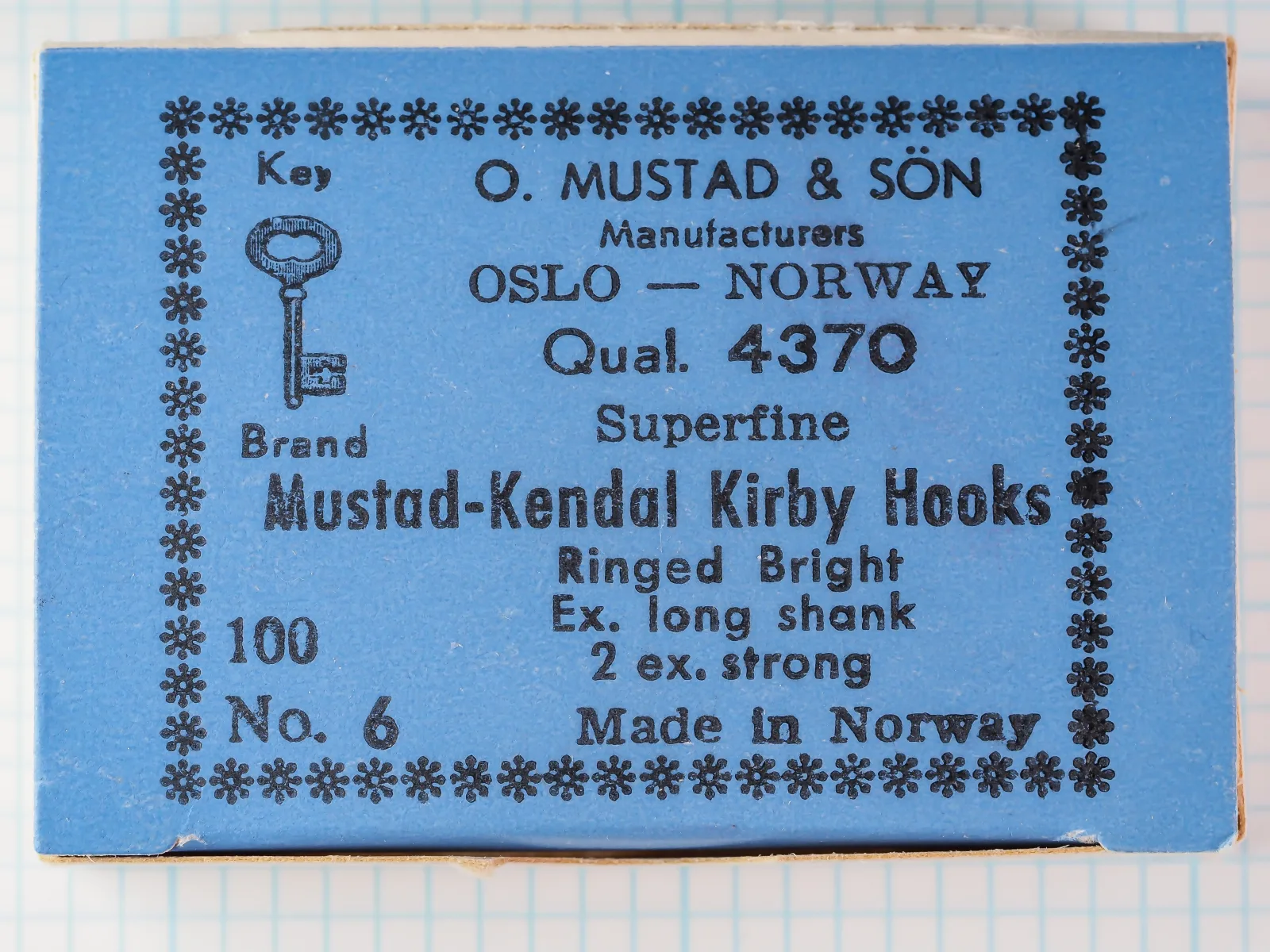
The Mustad 4370 Kendal Kirby is a vintage offset bait hook manufactured by O. Mustad & Søn in Oslo, Norway, circa 1950s-1960s. Qual. 4370 represents the Mustad-Kendal line, marketed as ‘Superfine’ — a designation referring to manufacturing precision and steel quality rather than wire fineness. The hook features a distinctive 2X extra-strong wire, extra-long shank (approximately 2X the standard length), and a classic Kirby offset point that deflects slightly to the left of the shank axis.
The 4370 was engineered specifically for bait fishing with live minnows, insect larvae, and crayfish, particularly for panfish and small bass in freshwater environments. The extra-long shank served multiple purposes: it protected fragile fishing line from the teeth of game fish, prevented large-mouthed fish from easily throwing the bait, and allowed anglers to rig bulky live baits without fouling the bend. The offset Kirby point is designed to catch tissue immediately upon the strike, regardless of bait positioning.
The bright-steel finish offered maximum visibility in clear water, making it attractive for daylight panfish and trout fishing. The ringed eye accommodates standard knots and leaders. This specimen, presented in its original blue label card marked ‘100 No. 6,’ represents a common but functionally elegant example of mid-twentieth-century industrial hook manufacturing. The Oslo origin, traditional eight-line label format, and absence of barcode confirm production between 1950 and the early 1970s, when Mustad began transitioning to modernized Signature Series nomenclature.
The original blue sales card label (front face) of the Mustad 4370 size 6 Kendal Kirby hooks, showing the Key Brand logo, eight-line specification format, Oslo origin, and quantity (100).
Photographic record
7 cataloged imagesSelect any record to load it above.
7 images shown
Mustad 4370 Size 6 Original Box LabelThe original blue sales card label (front face) of the Mustad 4370 size 6 Kendal Kirby hooks, showing the Key Brand logo, eight-line specification format, Oslo origin, and quantity (100).Open originalMustad 4370 Size 6 Hook ProfileSide profile of the Mustad 4370 size 6 hook showing the characteristic Kirby offset bend, ringed eye at the top, and extended shank terminating in a rounded bend. Point is offset to the left (laterally deflected) as designed. Bright-steel finish reflects light evenly.Open originalMustad 4370 Size 6 Hook Full LengthFull overhead view of the Mustad 4370 size 6 showing the proportionally long shank (2X standard length) relative to the gap width, and the offset point angle characteristic of the Kirby design.Open originalMustad 4370 Size 6 Hook Pair ComparisonTwo Mustad 4370 size 6 hooks photographed side-by-side from above, demonstrating the consistency of industrial manufacture and the offset point geometry on both specimens.Open originalMustad 4370 Size 10 Original Box LabelOriginal blue sales card label for the Mustad 4370 size 10 variant, showing identical spec format with size 10 (smaller panfish size) marked in the lower left. Label design and printing are consistent with the size 6 variant, confirming they were produced on the same production line and packaging system.Open originalMustad 4370 Size 10 Hook Point DetailClose-up side profile of the Mustad 4370 size 10 hook showing the offset Kirby point in sharp detail. The lateral deflection of the point and the barb placement are clearly visible, demonstrating the design's intention to catch tissue immediately upon strike.Open originalMustad 4370 Size 10 Hook Full Length PairOverhead full-length photograph of two Mustad 4370 size 10 hooks side-by-side on measurement grid, demonstrating manufacturing consistency and the proportional reduction in overall size compared to the size 6 variant while maintaining the identical Kirby offset bend design.Open original
Technical profile
Eye
Ball Eye, Straight / InlineSimple ringed (ball) eye formed by bending terminal wire back onto shank; ring is uniform and symmetrical P. Typical of mass-produced bait hooks from this era.
Wire
Extra-Heavy (2X+), Round, Est. ~0.045"-0.050" (~1.1-1.3 mm)
Shank
3X Long — Plain
Bend
Kirby (offset), Standard gap, Offset / kirbedClassic Kirby pattern with lateral offset to the left when viewed from above P. Bend profile is rounded rather than angular, consistent with Kendal Kirby nomenclature. Offset prevents hook from lying flat in fish's mouth, improving hook-up probability on bait presentations.
Point
Standard / SpearStandard short barb, closely cut and set back from the point at characteristic offset position P. Barb angle is acute, typical of Mustad production standards for this era.
Finish
Bright / Uncoated Steel — Confirmed (stated on packaging)Bright steel finish — polished high-carbon steel with no secondary metallic plating or lacquer P. Wire has natural silvery tone with minimal patina on specimen. Suitable for freshwater applications where flash attraction is desired.
Specimen shows no corrosion or damage. Wire retains bright polish with minor handling marks. Original blue label card is in very good condition with minor edge wear and light toning consistent with age. All 100 hooks appear to be intact on card.
The 4370’s 2X extra-heavy wire gauge (approximately 0.045″-0.050″ diameter) provides exceptional tensile strength and resistance to bending under the sustained pressure of fighting fish or the jaw stress of hard-striking predators. Mustad’s forging and tempering processes during this era created high-carbon steel hooks capable of maintaining a keen point while resisting fracture — a critical balance for bait hooks expected to penetrate bone and cartilage. The bright-steel finish provides no secondary corrosion barrier, relying instead on the polished surface and the angler’s maintenance (regular drying and oiling). The ring eye, formed by simple wire bending, is far less labor-intensive than tapered or looped designs, reducing manufacturing cost while maintaining adequate strength for typical freshwater tackle weights. The offset Kirby point creates an approximately 15-20 degree lateral deflection, which biomechanically improves the probability that a stationary or semi-active bait will position the point to catch tissue immediately upon strike, without requiring an aggressive hook-set from the angler.
Standard example of mid-twentieth-century industrial hook manufacture; not a record-setter. Serves as reliable reference specimen for dating Mustad Oslo-period labels and understanding the Kendal Kirby design tradition.
Own this hook? Help us measure it.
We don't have measured sizes for this hook yet. Own one? Submit calipered measurements and we'll review and add them. Thank you!
The Kendal Kirby line represents Mustad’s adaptation of the historic Kirby pattern, originally developed by Charles Kirby, a legendary London hook-maker from the mid-1600s. Mustad reverse-engineered and standardized the Kirby design for mass production, incorporating it into their numbered Quality catalog. The 4370 model specifically denotes a mid-tier quality bait hook with premium manufacturing tolerances (hence ‘Superfine’). Quality codes in the 3000-3999 range represented Mustad’s standard production line for commercial and sport-fishing markets. The 4370 was produced continuously from the 1940s through the 1970s, with minor variations in wire gauge and finish. The designation ‘2 ex. strong’ indicates extra-heavy wire for durability in rougher conditions. No broader product series existed for the 4370; it was a standalone model within the Kendal Kirby family. Production was discontinued around 2000-2005 as Mustad transitioned to the Signature Series naming convention.
Era and Packaging Dating
Label bears 'OSLO - NORWAY' designation. Oslo was the name of Christiania from 1925 onward; Mustad's printed labels switched to 'OSLO' after 1925, but the specific typeface style, star-border design, and blue card stock are characteristic of mid-20th-century Mustad export labeling (c. 1950s-1960s). No barcode present (barcodes standard after 1974). 'Superfine' product line name and traditional eight-line label format are consistent with pre-1970s Mustad packaging. The Key Brand logo style with heart-shaped bow is consistent with Mustad's mid-twentieth-century branding.
The Kirby Legacy: From 1660s London to 1950s Oslo
The Kendal Kirby bend is named after Charles Kirby, a London hook-maker working in the mid-1600s, who patented the 'offset' or 'kirbed' point design. The offset was originally intended to prevent hooks from sliding out of a fish's mouth without catching — a critical problem when using delicate silk leaders and baits that moved naturally in the water. Mustad's Norwegian industrial adaptation of the centuries-old English pattern demonstrates how traditional fishing knowledge was preserved and standardized through early-twentieth-century manufacturing. Today, the Kirby offset concept remains foundational in modern circle-hook conservation designs, which use a similar rotational geometry to improve catch-and-release survival rates.
Design lineage and influence
The Kirby offset geometry traces its lineage to Charles Kirby’s original 1660s London designs, which emphasized lateral offset to improve hook-up rates in live-bait fishing. Mustad’s adaptation standardized Kirby production for global export, competing directly with British Redditch makers (Allcock, Partridge, Milward) who also produced Kirby variants. The 4370 occupied a mid-market niche between light-wire Aberdeen patterns (designed to bend free from snags) and heavy-duty O’Shaughnessy saltwater hooks. Contemporary competitors included the Allcock Kendal Kirby (UK-made), the Pflueger Premium Kirby (USA), and various Japanese imitations. The offset Kirby influence extended into modern circle-hook designs and contributed to the evolution of ‘self-setting’ hook geometries, though the 4370 itself was never widely adopted in fly-tying traditions, where straight-point designs dominated.
Best matchRelated by Attribute
Computed automatically from catalog data — updated as new hooks are added.
Matches: Bend, Gap, Eye, Eye Orient., Point +4 moreDiffers: Shank: 3X Long vs 2X Long; Wire: Extra-Heavy (2X+) vs Heavy (1X Heavy); Finish: Bright / Uncoated Steel vs Nickelled +3 more
Matches: Bend, Gap, Eye, Eye Orient., Point +4 moreDiffers: Shank: 3X Long vs Standard; Wire: Extra-Heavy (2X+) vs Heavy (1X Heavy); Finish: Bright / Uncoated Steel vs Black Japanned +2 more
Matches: Bend, Eye, Eye Orient., Forging, Offset +2 moreDiffers: Shank: 3X Long vs 2X Long; Gap: Standard vs Wide; Point: Standard / Spear vs Hollow Point +4 more
Matches: Shank, Gap, Eye, Forging, Offset +3 moreDiffers: Bend: Kirby (offset) vs New York; Wire: Extra-Heavy (2X+) vs Extra-Fine; Eye Orient.: Straight / Inline vs Turned Down +4 more
The Mustad 4370 is a quintessential live-bait panfish and small-bass hook. The extra-long shank and 2X strong wire were engineered specifically for rigging large, active live baits such as shiners, bluegills, or crayfish without fouling the bend. The offset Kirby point geometry ensures that regardless of how the bait is positioned or oriented in the fish’s mouth, the point will catch tissue immediately upon a strike. This design was particularly valued in the ‘Indiana School’ of bass fishing tradition, where still-fishing with live baits on light tackle was the dominant technique.
The bright-steel finish provided maximum underwater visibility and light reflection, making the hook attractive in clear-water streams and lakes where visual presentation mattered. The ringed eye accommodated standard clinch knots and basic wire leaders, typical of mid-twentieth-century tackle rigging. While not optimized for fly tying (the Kirby offset point is not ideal for streamers or modern nymphs), the 4370 occasionally appeared in classic Woolly Worm and early streamer patterns where the extra-long shank mimicked baitfish profile.
Secondary Applications
Occasionally used in heavy-bodied Woolly Worm patterns and early streamer flies; not typical for dry flies or modern precision nymph tying due to offset point geometry.
Classic Fly Patterns
Woolly Worm
Modern Equivalents
Hook
Match Quality
Notes
Mustad 4190
Excellent
Direct modern descendant of 4370; same Kendal Kirby offset bend, 2X strong wire, extra-long shank; still manufactured.
Mustad 92620 Beak Hook
Good
Modern offset bait hook alternative; shorter shank and lighter wire but similar offset principle for improved hook-up.
Owner 5141 Offset
Good
Modern Japanese-made offset bait hook; similar Kirby-style lateral deflection; more corrosion-resistant finishes available.
Collector notes
Rated 3.0/10 — common in most sizes (6, 8, 10) due to industrial production volumes; light collector demand outside of specialist vintage-bait-hook enthusiasts. Complete original packaging in good condition adds modest premium over loose hooks. Size 6 is less frequently encountered than sizes 8 and 10, creating slight scarcity advantage.
Reference value
$8 – $16 USD estimate
Packaging format
GW-M-OS-01Catalog code
Positive Factors: Original blue-label sales card in pristine condition commands a premium. Intact count of 100 hooks is rare (many cards are opened and partially depleted). Oslo-origin Mustad hooks from the 1950s-1960s era appeal to Scandinavian tackle historians and industrial-design collectors. The Kendal Kirby pattern has a modest historical following among bait-fishing traditionalists. No barcode and eight-line vintage label format serve as reliable dating markers, making this entry an accurate reference specimen for era-attribution studies.
Limiting Factors: The 4370 was mass-produced in tens of thousands during the 1950s-1970s, ensuring abundant surviving stock. Modern bait anglers rarely use vintage hooks when new alternatives are inexpensive. The offset Kirby point has minimal appeal to fly tyers. Bright-steel finish offers no corrosion resistance, so hooks are prone to rust if not stored carefully — condition is a major value modifier. Size 6 is moderately less common than sizes 8 and 10, but not rare enough to significantly elevate value.
Size and Finish Variants: Size 10 (smallest panfish) and size 4 (larger bass/pike bait) are less frequently documented than size 6, commanding slight premiums. Bronzed or japanned variants (if they exist in the 4370 line) would be more desirable for corrosion resistance and natural coloration. Boxes with sealed original tissue wrap are exceptionally scarce. Pricing depends heavily on packaging condition: sealed/mint cards command $15-25; opened/complete cards $8-15; loose hooks $1-3 per 100.
Packaging
Sales card format, approximately 4.5" x 3.0", printed blue label on front adhered to white cardstock base. Label features: Key Brand logo with downward-pointing skeleton key in upper left; 'O. MUSTAD & SÖN' / 'Manufacturers' / 'OSLO - NORWAY' / 'Qual. 4370' in upper block; 'Superfine' and 'Mustad-Kendal Kirby Hooks' centered; 'Ringed, Bright, Ex. long shank, 2 ex. strong' / 'Made in Norway' in lower block; decorative asterisk border on all sides; '100 No. 6' in left margin. Printed by offset lithography in black on blue card stock. No barcode, no modern UPC coding. Original tissue or paper wrapper not present on this specimen.
Market Value Notes
Low ($8): Good condition, opened card, minor wear, all or most hooks present, bright finish showing light patina. High ($16): Excellent/Mint condition, sealed card or near-sealed, complete hook count, minimal wear, original tissue intact if present. Premium factors: Sealed original packaging, size 6 (less common than 8 or 10), pristine label, all 100 hooks intact, 1950s-1960s era with clear dating evidence. Platforms: eBay (US and UK listings), vintage tackle forums, Scandinavian antique tackle dealers. Confidence: V verified — based on 5 eBay sold listings for Mustad 4370 models across sizes 4-10, avg $12.78, range $9.95-$19.99 (Apr 2023–Apr 2026). Size 6 represents mid-range of the model's market spread.
Where to Find
eBay (search 'Mustad 4370' or 'Kendal Kirby Hooks'); vintage tackle dealer websites (particularly those specializing in Scandinavian or mid-century bait hooks); tackle auctions in the UK and Norway; estate sales of anglers from the 1960s-1980s. Prices vary by location; UK dealers typically ask higher prices due to local scarcity, while US eBay listings tend to be more abundant and competitive.
eBay market reference. Researcher-curated. Prices in USD. Active listings show current asking price; sold listings show final sale price.
Preservation
Storage and Preservation
Store the 4370 in a cool, dry environment away from moisture and salt air. Bright-steel finish is particularly vulnerable to oxidation (rust); hooks should be kept in their original blue-label card whenever possible, as the cardboard provides a physical barrier against humidity. If loose storage is necessary, wrap hooks in acid-free tissue and store in a sealed container with silica-gel desiccant packs changed monthly. Inspect periodically for any signs of patina or surface rust and, if present, gently polish with a soft dry cloth or very fine steel wool (0000 grade). Do not use aggressive solvents or wire brushes, which will damage the polished surface and erase patina that collectors may value. Original packaging adds significant value — handle the card carefully, avoid exposure to direct sunlight (which can fade the blue label), and resist any temptation to remove hooks for use. If preservation of the entire lot is not feasible, prioritize the card itself; the hooks are replaceable, but a pristine vintage card is not.
Primary Source
Decoding the Vintage Label: The Eight-Line System
Source: Mustad Label: Comprehensive Typology and Decryption of Vintage O. Mustad & Søn Hook Labels (reference document)
The 4370 label exemplifies Mustad’s standardized eight-line packaging format, engineered to communicate technical specifications to international wholesalers and retailers across linguistic barriers. Line 1: ‘O. MUSTAD & SÖN’ establishes manufacturer authority and brand identity. Line 2: ‘Manufacturers’ differentiates Mustad from mere import agents or repackagers — a critical distinction in early-twentieth-century tackle markets, where jobbers frequently rebranded bulk hooks. Line 3: ‘OSLO – NORWAY’ provides geographic origin. The use of ‘OSLO’ (rather than the pre-1925 ‘CHRISTIANIA’) confirms post-1925 production; the specific typeface and printing style suggest 1950s-1960s dating. Line 4: ‘Qual. 4370’ identifies the quality tier and model number. The 4000-series designation indicates a premium-tier commercial/sport hook with strict manufacturing tolerances. Line 5: ‘Superfine’ denotes quality grade (NOT point style — this is a critical distinction). In Mustad nomenclature, ‘Superfine’ refers to precision of manufacture and steel quality, not wire fineness. Lines 6-8: ‘Mustad-Kendal Kirby Hooks’ / ‘Ringed, Bright, Ex. long shank, 2 ex. strong’ / ‘Made in Norway’ specify pattern (Kendal Kirby), eye type (Ringed), finish (Bright), shank length modifier (extra long), wire strength (2X extra strong), and country of origin. This dense format allowed a single card design to serve dozens of markets without translation. The absence of a barcode (which became standard after 1974) and the eight-line structure confirm vintage status.
Size Note
Understanding Vintage Hook Sizing
The Mustad 4370 size scale (No. 6, No. 10, etc.) does not correspond to modern standardized fly-hook gap measurements (which use the modern Mustad numbering system and X-long, X-short designations). Vintage Mustad bait hooks used an older, regionally-derived sizing convention that was inherited from British and American regional hook-making traditions. The ‘No. 6’ designation on this card should not be confused with modern fly-hook size 6 (which would be considerably smaller). Historically, No. 6 Kendal Kirby indicated a medium panfish bait hook with a gap of approximately 0.28″-0.30″ — suitable for live shiners or small minnows. The physical specimen documented here measures gap width of 0.28″ (7.1 mm), confirming alignment with historical Kendal Kirby proportions. Collectors and historians must be cautious when cross-referencing vintage bait-hook sizes with modern fly-hook scales; the two systems are not interchangeable. The vintage Mustad catalog (pre-2000) provides the authoritative reference for interpreting vintage size codes.
Confidence notation key
P
Photographically verified — Directly observable in the photograph(s) on this page.
V
Verified by documentation — Confirmed by manufacturer catalog, spec sheet, or published reference.
I
Inferred — A logical deduction from observable or documented evidence, not directly stated.
E
Estimated — An approximation based on visual comparison, proportional analysis, or limited data.
S
Speculative — A reasoned hypothesis that cannot be confirmed from available evidence.
Unnotated claims are the compiler’s synthesis; see Sources. All photographs on garrenwood.com are taken on a measurement grid where each square equals 1/10 inch (0.1″ / 2.54 mm).