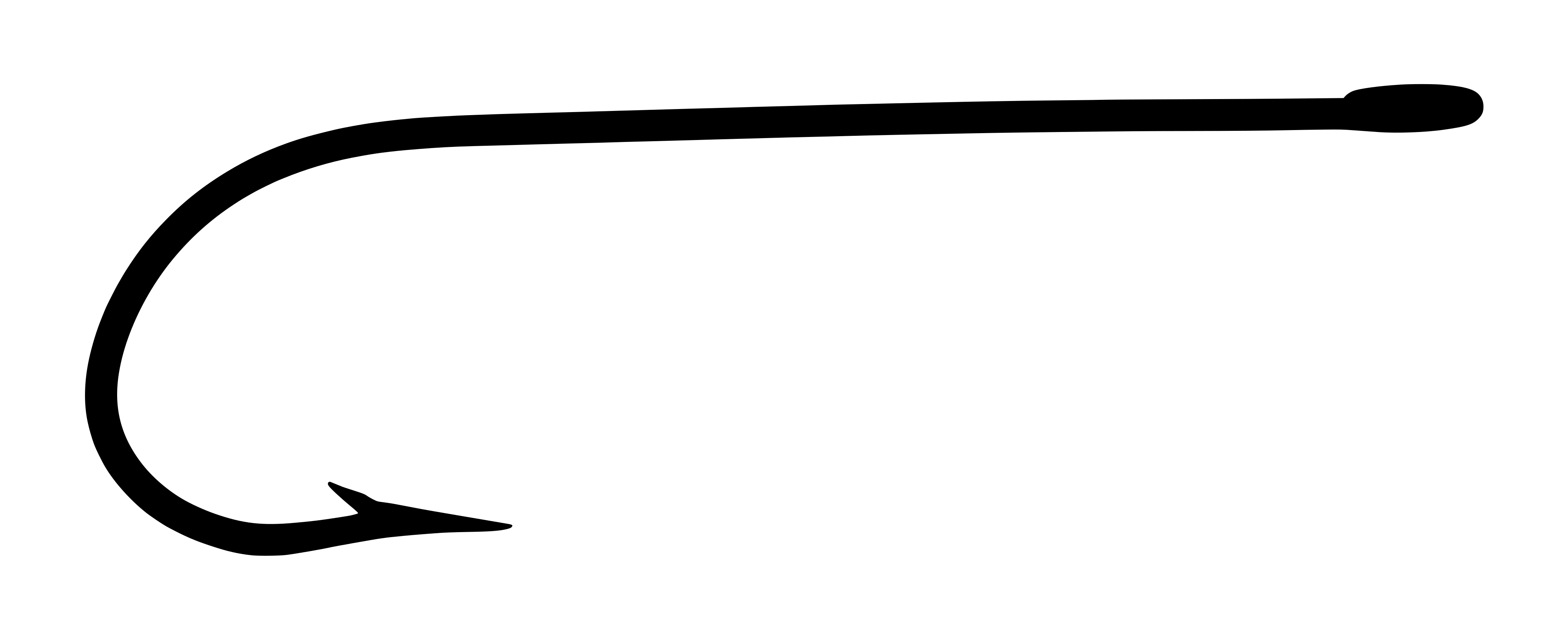
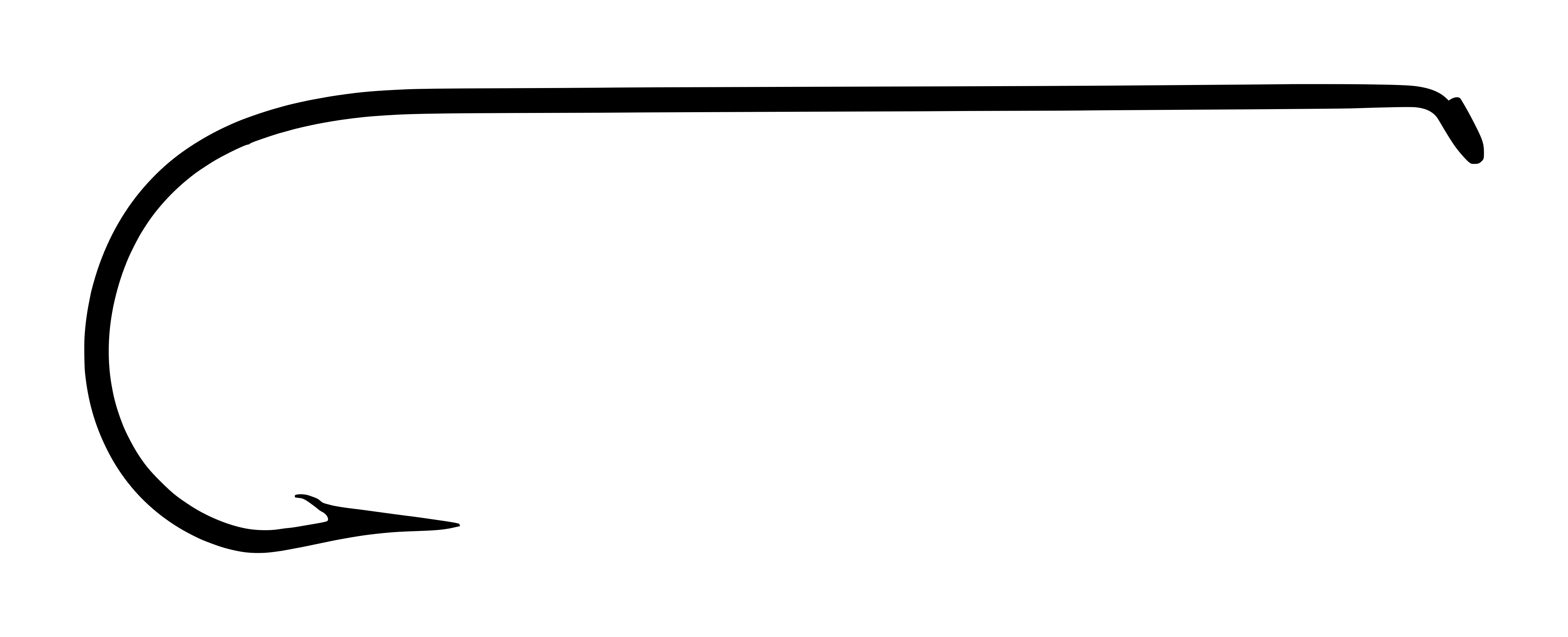
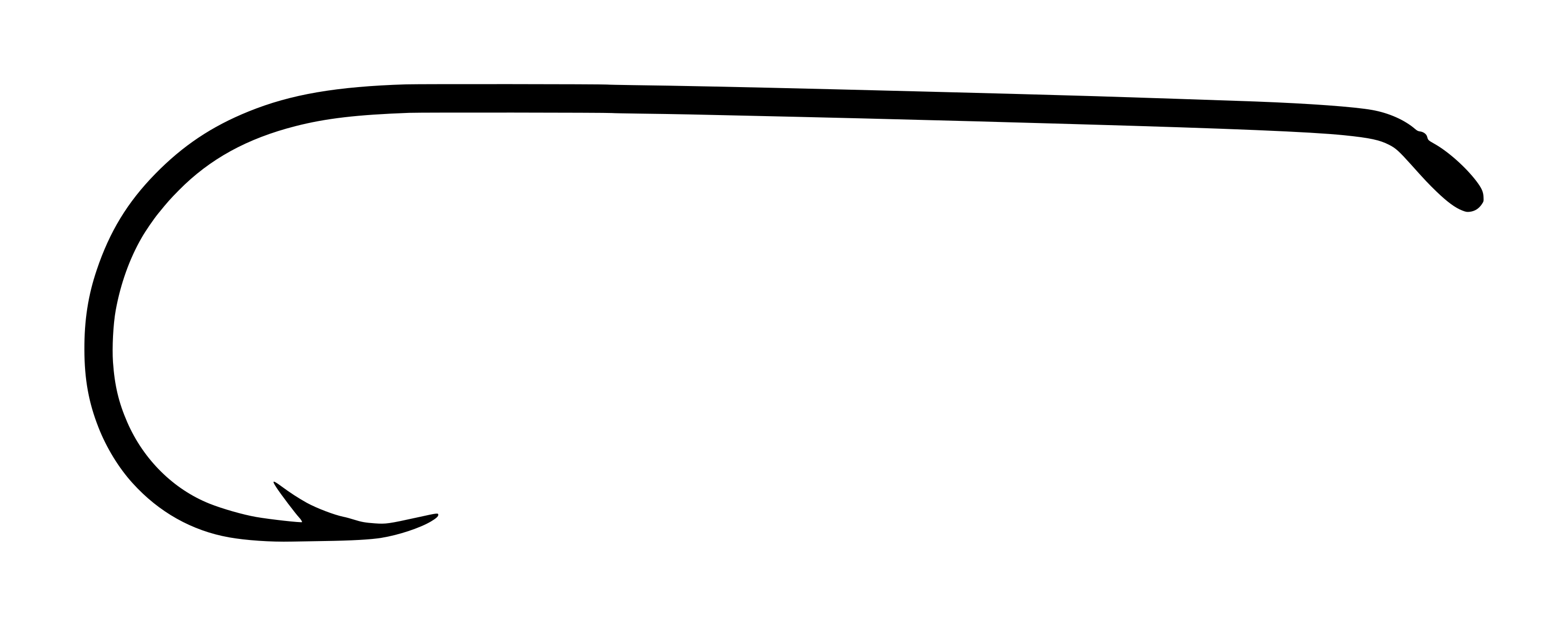
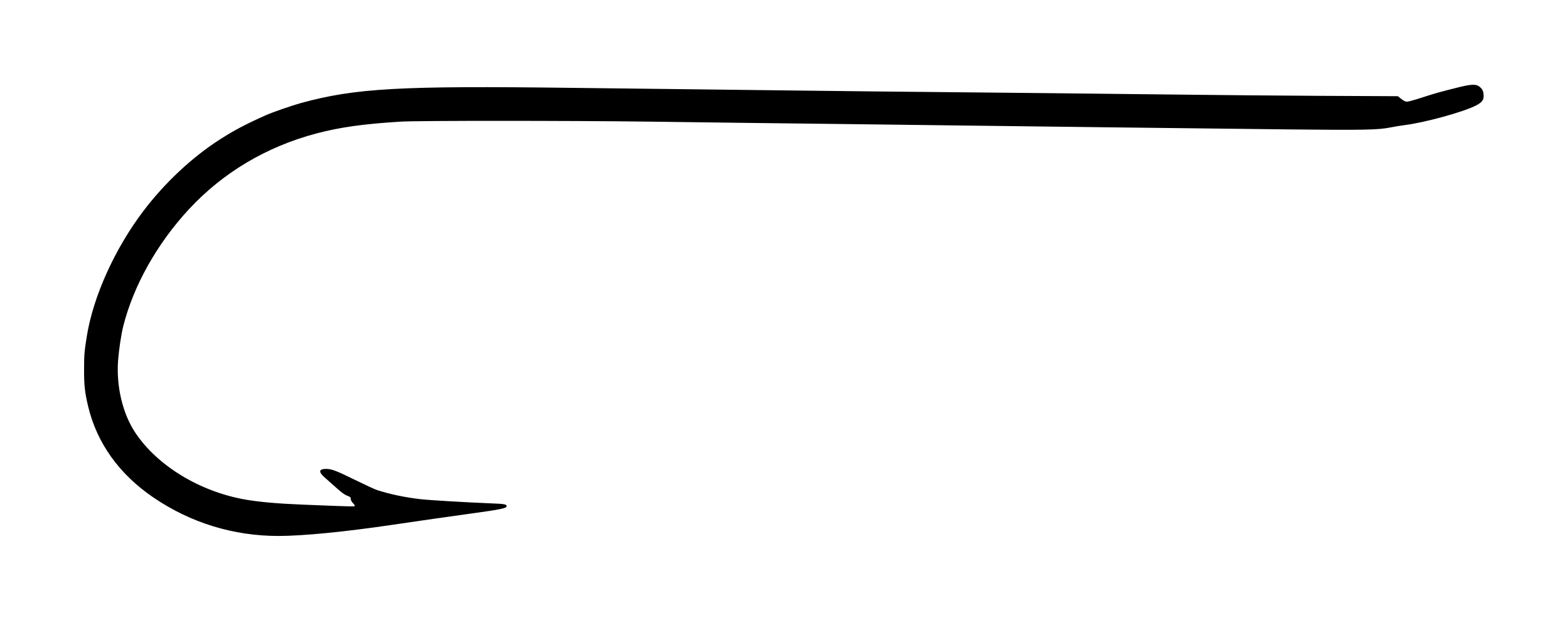
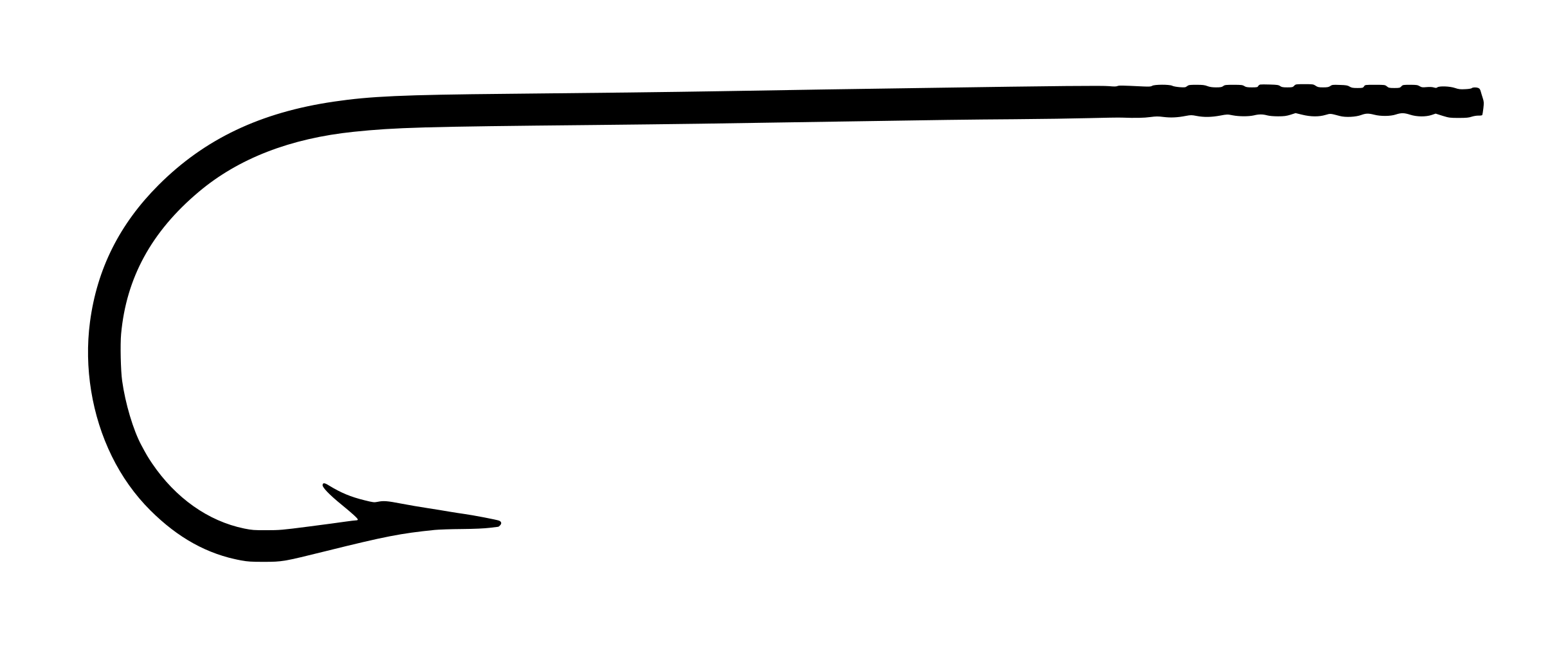
The Mustad 3429 is a standard-shank, round-bend bait and wet-fly hook manufactured by O. Mustad & Son in Oslo, Norway. This specimen, size 7/0, exemplifies the company’s mid-twentieth-century approach to freshwater trout hooks, combining a superior point with a ringed eye and bronzed finish.
The designation ‘New York Trout Hooks’ on the label reflects Mustad’s industrial strategy of reverse-engineering and mass-producing regional patterns favored by American anglers. The 3429 belongs to the quality tier centered around model codes in the 3000-3999 range, representing mid-tier products manufactured to precise dimensional and metallurgical standards.
The Oslo origin mark and eight-line label format establish manufacture between 1925 and the early 1960s. The absence of a barcode and the preservation of the classic arbitrary quality code (Qual. 3429) confirm this hook predates Mustad’s transition to the Signature Series naming system around 2001. The bronzed finish and ringed eye are consistent with a general-purpose freshwater pattern suitable for both live-bait rigging and soft-hackle fly presentation.
For collectors, the 3429 represents the standard commercial product of Mustad’s industrial golden age—competent engineering for mass markets rather than premium craft, but valuable as a documentary artifact of early-twentieth-century tackle standardization and international commerce.
Original Mustad eight-line label card for the 3429 New York Trout Hooks, size 7/0, showing Superior point designation, Ringed Bronzed finish notation, and Oslo manufacture mark. The label format and typography are characteristic of Mustad export packaging from c. 1925-1960.
Photographic record
3 cataloged imagesSelect any record to load it above.
3 images shown
Mustad 3429 New York Trout Hooks Size 7/0 Vintage Label CardOriginal Mustad eight-line label card for the 3429 New York Trout Hooks, size 7/0, showing Superior point designation, Ringed Bronzed finish notation, and Oslo manufacture mark. The label format and typography are characteristic of Mustad export packaging from c. 1925-1960.Open originalMustad 3429 Size 7/0 Hook Point Detail Superior GeometryClose-up photographic detail of the Mustad 3429 hook point showing the near-straight inner taper characteristic of a superior point. The barb geometry and shank marking pattern are visible on the measurement grid.Open originalMustad 3429 Size 7/0 Hook Full Profile Measurement GridFull-length photograph of the Mustad 3429 hook on measurement grid, showing the overall proportions, round New York bend profile, standard shank length, and ringed (ball) eye construction. The bronzed finish tone is visible across the entire hook length.Open original
Technical profile
Eye
Ball Eye, Turned Down
Wire
Extra-Fine, Round, Est. ~0.059"-0.062" (~1.5-1.6 mm)
Shank
3X Long — Plain
Bend
New York, Standard gap, Offset / kirbedRound bend characteristic of the New York pattern, proportional depth relative to standard, symmetric wire set P
Point
Superior (near-straight inner taper)
Finish
BronzedWarm brownish-gold lacquer tone typical of bronzed finish, uniform coverage visible on specimen with light patina consistent with age P
Specimen hooks show light patina consistent with age but no structural corrosion or pitting. Original label exhibits light toning and edge wear typical of c. 100-year-old kraft card stock. No barcode or price markings visible, confirming pre-1974 manufacture. Label text remains clearly legible. Card shows minor creasing and corner wear but is structurally intact.
The superior point geometry employed on the 3429 features a near-straight inner taper that concentrates penetration force at the tip while maintaining structural integrity. This design balances the delicate, rapid tissue penetration of a hollow point against the durability and resistance to rolling or dullness that heavy-tackle anglers demand. The superior point was engineered as Mustad’s premium, all-purpose solution for commercial and sport markets, particularly well-suited to freshwater species with moderate jaw hardness.
The round-bend New York pattern provides proportional stress distribution across the entire bend arc, making it mechanically sound for the moderate loads typical of freshwater bait and wet-fly fishing. The ringed (ball) eye is formed by bending the terminal wire back onto the shank, creating a simple, durable loop highly efficient for mass production and compatible with direct knot attachment.
The bronzed finish—a baked-on lacquer coating formulated to mimic the color of bronze metal—provides excellent rust resistance in freshwater environments while offering a muted, naturalistic color profile favored by stealthy bait anglers and fly tyers seeking to minimize unnatural flash.
The New York Trout Hooks series represents Mustad’s application of their industrial ‘cloning’ strategy to American regional patterns. By reverse-engineering and mass-producing hook designs favored by local blacksmiths and regional anglers in specific geographic areas—such as the Cincinnati bend from the American Midwest or the New York pattern from the northeastern United States—Mustad successfully cornered localized markets on a global scale.
The New York pattern itself is characterized by a round bend of proportional depth, suitable for both bait and fly applications in freshwater trout fisheries. The 3429 model number places it within Mustad’s mid-tier quality bracket (3000-3999 range), indicating manufacturing to precise dimensional and tempering standards rather than economy or premium specialist segments.
The series underwent no major documented design modifications during its production run. The consistent application of the superior point, ringed eye, and bronzed finish across documented 3429 specimens from the 1930s through 1960s indicates standardized, stable production parameters. The model remained in the Mustad catalog through the transition period of the early 2000s before being eventually superseded by the Signature Series naming convention, though exact discontinuation date is not documented.
Era and Packaging Dating
Label bears OSLO - NORWAY designation, establishing manufacture after January 1, 1925, when Christiania was renamed Oslo. Absence of barcode (UPC system not introduced until 1974) confirms pre-1974 production. Eight-line Mustad label format with arbitrary numeric quality code (Qual. 3429) is characteristic of the classic era prior to the Signature Series transition (c. 2001). Letterpress printing on kraft card stock and decorative asterisk border pattern consistent with Mustad export packaging c. 1925-1960. The 'Made in Norway' statement on the label and Oslo origin align with mid-twentieth-century Norwegian manufacture. No postal code format or later design elements visible. Production likely concentrated in 1930s-1950s peak export period.
Norwegian Precision Meets American Regionalism
The Mustad 3429 exemplifies the global reach of Norwegian industrial hook manufacturing. During the 1920s-1960s, Mustad established sales offices and distribution networks across North America, Europe, and beyond, penetrating regional markets by producing locally favored patterns under the Mustad name. The 'New York Trout Hooks' designation on the label reflects this strategy: American anglers recognized the familiar New York bend from their local tackle makers, but now purchased it from a Norwegian manufacturer benefiting from mechanical precision and cost efficiency that American and British craftsmen could not match. This 3429, manufactured in Oslo, was likely shipped across the Atlantic in bulk wholesale boxes, then repackaged by regional distributors or sold directly to tackle shops and mail-order catalogs across the northeastern United States.
Design lineage and influence
The New York pattern descends from American regional fly-fishing traditions of the late nineteenth and early twentieth centuries, when local tiers and tackle makers developed specialized hooks suited to specific trout fisheries. The round bend is a foundational form predating formal hook standardization, appearing in English patterns such as the Sproat and representing a balance point between the extreme curvature of specialized patterns and the angular geometry of heavier-duty bends like the Limerick.
The superior point itself represents a refinement of earlier Mustad point geometries, engineering the near-straight taper to achieve a middle ground between the delicate penetration of hollow points and the brute durability of spear points. This design philosophy emerged during the 1920s-1930s as Mustad consolidated its global market position and sought to develop ‘all-purpose’ hooks capable of serving multiple market segments.
The 3429 influenced no documented downstream signature patterns in the fly-tying tradition, functioning instead as a utilitarian commercial hook. Its design principles are echoed in contemporary Mustad round-bend patterns, though modern equivalents utilize significantly different metallurgical and finish technologies.
Best matchRelated by Attribute
Computed automatically from catalog data — updated as new hooks are added.
Matches: Shank, Wire, Gap, Eye, Eye Orient. +5 moreDiffers: Bend: New York vs Aberdeen; Point: Superior vs Standard / Spear; Offset: Offset / Kirbed vs Straight +2 more
Matches: Shank, Wire, Gap, Eye Orient., Point +4 moreDiffers: Bend: New York vs Aberdeen; Eye: Ball Eye vs Tapered Eye; Offset: Offset / Kirbed vs Straight +3 more
Matches: Bend, Gap, Eye, Forging, Offset +2 moreDiffers: Shank: 3X Long vs 2X Long; Wire: Extra-Fine vs Fine (1X Fine); Eye Orient.: Turned Down vs Straight / Inline +5 more
Matches: Shank, Wire, Gap, Eye, Point +4 moreDiffers: Bend: New York vs Aberdeen; Eye Orient.: Turned Down vs Straight / Inline; Offset: Offset / Kirbed vs Straight +3 more
Matches: Shank, Wire, Eye, Eye Orient., Finish +5 moreDiffers: Bend: New York vs Aberdeen; Gap: Standard vs Wide; Point: Superior vs Beak / Reversed +2 more
The Mustad 3429 is engineered as a general-purpose bait and wet-fly hook suited to freshwater trout fishing. The standard shank and ringed eye allow versatile rigging with live bait presentations or nymph and soft-hackle fly patterns. The superior point geometry provides reliable penetration across a range of trout species without excessive barb resistance, making it effective for both still-water and light current applications.
Classic Fly Patterns
Not typically associated with named fly patterns; primarily used as a blank for general wet-fly and soft-hackle tying or live-bait rigging
Modern Equivalents
Hook
Match Quality
Notes
Mustad 3906B
Good
Similar quality tier and ringed eye; Sproat bend instead of New York round; modern production but same manufacturer lineage
Tiemco TMC 2499SP-BL
Moderate
Contemporary round-bend wet-fly hook with ringed eye; modern wire and finish; same general application but vastly different metallurgy
Partridge GRS15ST
Moderate
Round-bend wet-fly pattern in modern British craft tradition; similar applications but different aesthetic and manufacturing philosophy
Collector notes
The 3429 is moderately uncommon in surviving examples and attracts modest collector interest as a documentary artifact of mid-twentieth-century Mustad industrial production. Original packaging significantly enhances value, as does the superior point classification, which appeals to historians of hook geometry.
Reference value
$8 – $18 USD estimate
Packaging condition
Good — moderate wear, legibleRecorded specimen
Packaging format
GW-MUSTAD-LABEL-08LINE-V1Catalog code
Positive factors: Authentic vintage Mustad eight-line label format is highly desirable to tackle archivists and packaging historians. The Oslo origin designation confirms pre-1925 manufacture boundary and is a sought-after detail for era dating. The model number 3429 falls within the documented ‘quality’ tier (3000-3999), indicating precision manufacturing rather than economy production. Original packaging substantially increases value—intact label cards command premium prices. The New York pattern designation reflects Mustad’s strategic market penetration of American regional preferences and is historically significant. Size 7/0 is large enough to be visually impressive and useful for actual fishing, not purely decorative.
Limiting factors: The 3429 is not a rare model—surviving examples appear regularly on secondary markets, indicating substantial original production volume. No named designer or celebrity angler association elevates demand. The superior point, while technically refined, is less exotic to collectors than hollow points or specialized Dublin/knife-edge geometries. The standard shank and round bend are unremarkable compared to more distinctive patterns like the Limerick or O’Shaughnessy. Most collectors seek either premium fly-tying hooks or specialized big-game saltwater patterns; mid-tier general-purpose trout hooks occupy a less fashionable collecting niche. Bronzed finish is less desirable than japanned or tinned finishes among serious collectors.
Packaging
Eight-line kraft card label with decorative asterisk border pattern. Letterpress printing in black on tan kraft stock. Dimensions approximately 3.75" x 2.5" (9.5 cm x 6.4 cm). Key Brand logo with skeleton key graphic in upper left. Text layout follows rigid Mustad typographic hierarchy: Line 1: 'O. MUSTAD & SÖN' (manufacturer title); Line 2: 'MANUFACTURERS'; Line 3: 'OSLO - NORWAY'; Line 4: 'Qual. 3429' (quality code); Line 5: 'Superior' (point identifier); Line 6: 'Mustad-New York Trout Hooks' (pattern name); Line 7: '100 No.' (quantity); Line 8: 'Ringed Bronzed Made in Norway'. Decorative asterisk borders frame entire label. Card stock shows light toning and edge wear consistent with c. 100-year age. No barcode present.
Market Value Notes
Pricing reflects condition of packaging and specimen completeness. Original card with intact label in excellent condition: $12-18 USD. Card with worn label or edge damage: $8-12 USD. Loose hooks without original packaging: $2-5 USD. Premium pricing driven by label clarity, size (larger sizes command higher value), and absence of corrosion. Bronzed finish specimens slightly undervalued compared to japanned equivalent. Sales appear primarily on eBay and general vintage tackle platforms; rarely seen at specialist fly-tying or salmon hook dealers.
Where to Find
eBay vintage fishing tackle category; general antique tackle dealers; estate sales and house clearances (often encountered in collections of deceased anglers); occasional appearance at tackle fairs and sporting antique shows in northeastern United States; less commonly listed on dedicated fly-fishing retailers or specialty hook dealers.
Preservation
Storage and Preservation
Store the original packaging in a cool, dry environment away from direct sunlight and moisture. Kraft card stock is susceptible to accelerated aging and brittleness when exposed to humidity; maintain relative humidity below 50%. The bronzed lacquer finish on the hooks themselves is stable but can develop slight patina with age, which many collectors consider desirable and authentic rather than detrimental.
Keep the card in a horizontal or vertical position rather than folded; bend stress can crack the brittle card stock. Avoid handling the label excessively, as the letterpress ink can be displaced by friction. Do not attempt to clean the card or hooks—patina and toning are part of the historical record and add collecting value. Original packaging substantially enhances value; hooks stored loose in a container are worth significantly less than those on the intact original card.
If you plan to use any of the hooks for actual fishing, remove them carefully to avoid tearing the card. Store remaining hooks on the original card in archival conditions. Contact with other metals or iron-based materials can cause galvanic corrosion; keep separate from modern stainless or carbon steel items.
Line 1: ‘O. MUSTAD & SÖN’ — The full, unabbreviated manufacturer name establishes ultimate corporate authority and brand identity, distinguishing Mustad as the primary manufacturer rather than an import agent or regional repackager.
Line 2: ‘MANUFACTURERS’ — This assertion was historically imperative in an era when international jobbers and distributors frequently purchased bulk hooks and repackaged them under secondary, localized brand names. Mustad’s explicit claim of manufacturer status ensured brand retention and customer loyalty at the end-user level.
Line 3: ‘OSLO – NORWAY’ — The geographic origin provides critical dating information. Oslo was known as Christiania until January 1, 1925, when the Norwegian capital was officially renamed. Any Mustad box bearing ‘Christiania’ can be conclusively dated to 1924 or earlier. The ‘Oslo’ designation on this 3429 establishes manufacture no earlier than 1925, generally representing the mid-twentieth-century boom in global tackle exportation.
Line 4: ‘Qual. 3429’ — This numeric code represents a highly structured product categorization system. The 3000-3999 range indicates ‘quality’ mid-tier products manufactured to precise dimensional and tempering standards, as opposed to economy models (1000-2999) or premium/specialist hooks (4000+). This tier designation directly communicates manufacturing tolerances to international wholesalers and retailers.
Line 5: ‘Superior’ — This line is exclusively reserved for defining the geometric shape and quality grade of the hook point. ‘Superior’ in this context describes a near-straight inner taper point geometry designed for all-purpose reliability and durability, not a quality descriptor of the entire hook. This distinction is crucial for hook geometry classification.
Line 6: ‘Mustad-New York Trout Hooks’ — This identifies the overarching bend pattern and shank proportion. The ‘New York’ designation reflects Mustad’s industrial strategy of reverse-engineering regional American hook patterns and producing them with Norwegian mechanical efficiency for global export.
Lines 7 & 8: ‘Ringed Bronzed’ and ‘Made in Norway’ — These final lines specify the eye type (ringed/ball eye formed by bending terminal wire back onto shank), the metallurgical finish (bronzed lacquer coating for freshwater rust resistance and muted appearance), and the point of manufacture.
Bottom Corner: ‘100 No.’ — Standard retail and wholesale boxes of the vintage era contained 100 hooks, a convention that persisted throughout Mustad’s classic era.
Size Note
Size Classification and Vintage Scaling
The documented size of this specimen is 7/0 (seven-aught), following the ‘aught’ scale system for large hooks. In modern fly-fishing conventions, size progression ascends through standard sizes (16, 14, 12, 10, 8, 6, 4, 2) before transitioning to the aught scale (1/0, 2/0, 3/0, etc., with increasing size numbers). Size 7/0 is considered quite large—suitable for saltwater streamer patterns, pike/bass fishing, or sturdy bait rigs.
However, vintage Mustad sizing, particularly in regional bait hooks, often utilized scaling metrics that differ significantly from modern standardized fly-hook gape measurements. The 7/0 designation on this 3429 reflects Mustad’s proprietary sizing system of the era rather than strict adherence to modern American hook-size conventions. Collectors should exercise caution when attempting to match vintage Mustad sizes to modern equivalents, as the correlation is not perfect. Physical caliper measurement (gap width ~0.94″ / 23.88 mm) provides the most reliable cross-reference to contemporary standards.
Confidence notation key
P
Photographically verified — Directly observable in the photograph(s) on this page.
V
Verified by documentation — Confirmed by manufacturer catalog, spec sheet, or published reference.
I
Inferred — A logical deduction from observable or documented evidence, not directly stated.
E
Estimated — An approximation based on visual comparison, proportional analysis, or limited data.
S
Speculative — A reasoned hypothesis that cannot be confirmed from available evidence.
Unnotated claims are the compiler’s synthesis; see Sources. All photographs on garrenwood.com are taken on a measurement grid where each square equals 1/10 inch (0.1″ / 2.54 mm).