Selected size
7
Physical specimen
- Overall Length
- 22.1 mm P
- Shank Length
- 16.5 mm
- Gap Width
- 5.8 mm P
- Confidence
- P Physical specimen
Physical measurement with calipers
 Garren WoodFishing Hook Reference
The Mustad 7957 E is a vintage wet-fly and nymph hook from the golden age of Mustad’s Oslo factory production (c. 1950s-1970s). Marked “OSLO – NORWAY” on the label, this model represents the era before the company’s transition to modern Signature Series numbering around 2000-2009. The 7957 E combines a full round bend with a generous 2X-long shank and extra-heavy forged wire—a configuration designed for weighted nymphs, soft-hackle wet flies, and small streamers targeting trout and char.
The hook’s defining physical feature is its reversed (kirbed) offset geometry and bronzed rustproof finish. The hollow point ensures rapid penetration with minimal applied force, making this hook ideal for soft-mouthed freshwater species. The forged wire construction adds exceptional structural strength, preventing the hook from bending or straightening under the sustained tension of a fighting fish.
Size No. 7 is notable as an odd-numbered size largely absent from modern catalogs, which favor even increments (No. 6, No. 8, etc.). This size-specific scarcity, combined with the vintage label, intact packaging, and bronzed finish, makes the 7957 E a sought-after specimen for collectors of mid-century Mustad products. Original sales cards with 100 hooks intact command moderate premiums on vintage tackle markets.
3 cataloged imagesSelect any record to load it above.
3 images shown
The 7957 E’s engineering reflects mid-20th-century Mustad’s approach to specialized freshwater fly fishing. The hollow-point geometry delivers the defining feature: a concave, dished cut from tip to barb base that creates an extremely fine, razor-sharp point flaring rapidly toward the barb. This design requires minimal applied pressure to achieve initial penetration—critical for soft-mouthed trout, char, and panfish where excessive force tears friable tissue and results in lost fish. The hollow point slides seamlessly into flesh with virtually no barb resistance.
The extra-heavy wire gauge (likely 0.045″-0.055″ diameter for size 7) provides structural strength capable of handling weighted nymphs and fast-sinking presentations without bending or straightening under load. The forging process—pressing the wire laterally on a mechanical drop-press to flatten and work-harden it—dramatically increases tensile strength and rigidity without adding weight, enabling the hook to maintain integrity during the violent head-shakes characteristic of fighting trout.
The reversed (kirbed) offset angles the point slightly away from the shank axis, preventing the hook from laying flat in the fish’s mouth and increasing the probability of immediate tissue contact upon the strike. This geometry was particularly valued for wet-fly presentations where the angler relies on the fish’s momentum to set the hook rather than an aggressive hand-strip or rod lift.
The bronzed rustproof finish—a baked-on lacquer compound mimicking the dark brownish-gold hue of bronze—provides excellent corrosion resistance while maintaining a muted, stealthy color profile. This was especially important for clear-water trout fishing where bright metallic flash might spook fish, and for long-term storage where moisture exposure would otherwise promote rust on uncoated high-carbon steel.
Physical measurement with calipers
We don't have measured sizes for this hook yet. Own one? Submit calipered measurements and we'll review and add them. Thank you!
O. Mustad & Søn was founded in 1832 in Gjøvik, Norway, initially as a producer of nails, steel wire, and basic metal goods (Brusveen Spiger- og Staltradfabrikk). The company was taken over by Ole Hovelsen Mustad and his son Hans Mustad, who rebranded it as O. Mustad & Søn. The defining moment in the company’s history came in 1877 when Mathias Topp invented the first fully automated hook-making machine—a breakthrough that allowed raw steel wire to be continuously fed, cut, bent, barbed, and pointed at unprecedented speed and precision.
Rather than patent this technology and risk disclosure of its mechanical design, Mustad maintained strict corporate secrecy and restricted factory access, protecting their competitive advantage against rival manufacturers in Redditch, England, Japan, and the United States. By the 1950s, Mustad had secured approximately 50% of the global hook production market, establishing sales offices and manufacturing facilities across multiple continents. The company’s dominance was so complete that the word “Mustad” became virtually synonymous with the fishing hook itself.
The 7957 E was produced during this period of industrial supremacy, when Mustad’s Oslo factory was at peak capacity supplying global export markets. The company maintained its distinctive eight-line label format throughout the 1950s-1970s as a standardized industrial formula for communicating technical hook specifications across linguistic and geographic boundaries. Mustad remains in operation today, headquartered in Norway with manufacturing facilities worldwide.
The 7957 E belongs to Mustad’s classical Quality Code numbering system, wherein four- or five-digit codes denoted specific product tiers and configurations. The 7000-7999 block represented a specialized subset of Mustad’s catalog, focusing on wet-fly and streamer patterns with extended shanks and modified wire profiles. The “E” suffix indicated an “Extra” designation—in this case, rustproof finishing and reinforced forging.
Within this series, the 7957 occupied a niche between the lighter 3900-series (standard wet-fly hooks) and the heavier saltwater patterns (8000-9000 block). The addition of 2X-long shank and extra-heavy wire made it particularly suited to weighted nymph fishing in cold-water trout streams and Atlantic salmon beats. Variants of the core 7957 design existed with different eye types, finishes, and shank lengths, though the 7957 E with its distinctive reversed geometry and bronzed rustproof finish appears to have been the primary commercial offering.
Around 2000-2009, Mustad discontinued the entire Quality Code system in favor of the modern Signature Series, which uses logical alpha-numeric designations (e.g., R50, R72) explicitly describing bend shape, wire weight, and shank length. This transition marked the formal end of the classical labeling era. The 7957 E was not carried forward into the new system, making all vintage examples pre-2009 artifacts of a defunct product nomenclature. Modern fly tyers seeking a direct successor typically substitute the Mustad Heritage S80-3906B or equivalent round-bend 2X-long nymph hooks.
Size No. 7 hooks occupy a curious place in angling history. Prior to the standardization of modern hook sizing in the mid-20th century, manufacturers like Mustad produced hooks in single-increment sizes—1, 2, 3, 4, 5, 6, 7, 8, etc.—rather than exclusively even sizes. However, as mass-market fly shops consolidated inventory and minimized SKUs, odd-numbered sizes gradually disappeared from retail shelves. A fly tyer seeking a hook between No. 6 and No. 8 today has virtually no option except vintage stock. This has created unexpected collector value for old No. 7 cards; perfectionist tiers actively hunt for them, making size-7-specific Mustad and Partridge cards fetch premiums disproportionate to their general rarity.
The Mustad 7957 E builds on the legacy of the company’s 3000-3999 quality tier—mid-range hooks manufactured to exacting dimensional and tempering standards. The round-bend architecture with 2X-long shank derives from traditional wet-fly and streamer patterns popularized in Atlantic salmon and char fisheries of northern Europe and North America. The reversed (kirbed) geometry reflects Mustad’s effort to capture regional variations of the Kirby-style offset, improving hook-ups by preventing the hook from laying flat in the fish’s mouth.
The hollow-point specification places the 7957 E in Mustad’s light-to-medium penetration class, contrasting with heavier Spear and Dublin points reserved for hard-jawed saltwater species. Contemporaneous competitors included Partridge of Redditch’s L2A and L3A wet-fly hooks, which employed similar round bends and lighter wire gauges. Mustad’s choice to offer the 7957 E in extra-heavy wire suggests a primary target market of anglers fishing weighted nymphs and fast-sinking streamers in deeper, colder waters.
The 7957 E was eventually superseded by Mustad’s transition to the Signature Series around 2000-2009, though modern equivalents in the Heritage line (S80-3906B and relatives) continue the round-bend tradition with updated metallurgical standards.
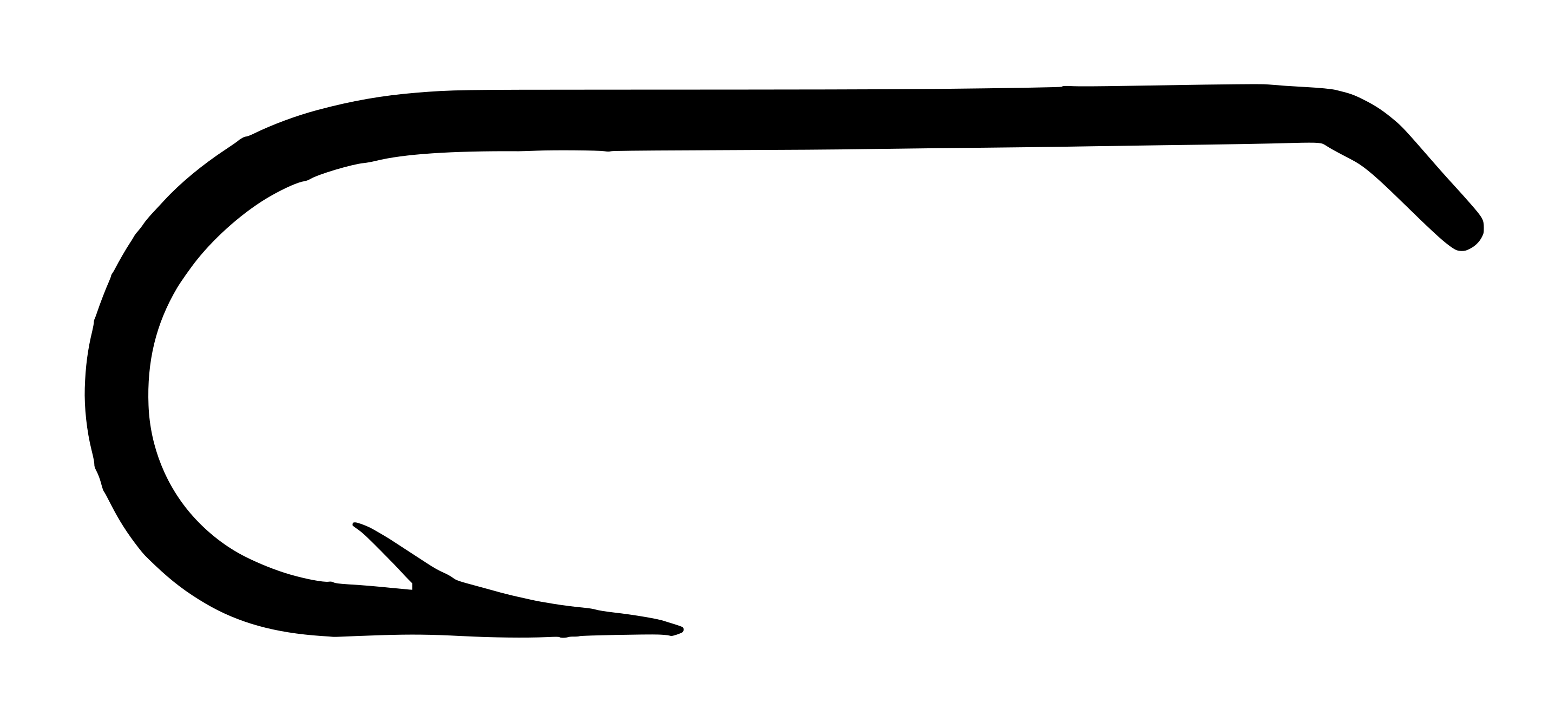
| Silhouette | Hook Model | Match | Analysis | Compare |
|---|---|---|---|---|
|
3984 H No. 8 — Mustad 3984 H | 80% | Compare | |

|
9673 No. 8, No. 14 — Mustad 9673 | 79% | Compare | |

|
7948 A No. 6 — Mustad 7948 A | 70% | Compare | |

|
9513 No. 10 — Mustad 9513 | 70% | Compare | |

|
2x Long, TDE No. 10 — Blue Label 2X Long, Forged, Regular Wire, Tapered T.D. Eye | 69% | Compare |
The Mustad 7957 E was engineered primarily for wet-fly and weighted-nymph fishing in cold-water trout streams and Atlantic salmon beats of northern Europe and North America. The 2X-long shank accommodates bulky nymph dressings and soft-hackle wet flies without crowding the body materials; the extra-heavy wire prevents bending during the dead-drift presentations typical of nymph fishing in fast currents. The hollow-point geometry ensures that delicate strike detection (often just a tight-line movement rather than an aggressive strike) translates immediately into hook penetration.
This hook excels in presentations where the angler casts upstream, maintains a slightly slack line to allow natural drift, and sets the hook by raising the rod tip sharply—a technique demanding instant point penetration. The reversed offset geometry prevents the hook from laying flat in the fish’s mouth, increasing the likelihood that the point contacts tissue immediately upon any applied tension. Historically, the 7957 E was particularly popular among Scottish and Scandinavian salmon anglers fishing classical soft-hackle wets (e.g., Partridge and Orange, Greenwells Glory) in medium-sized rivers where water temperature and depth demanded weighted presentations but fish mouth-structure remained relatively delicate.
Light streamer and small-baitfish imitation fishing (e.g., Black Ghost, Woolly Worms) for landlocked salmon, char, and pike. Short-shank nymph variants could theoretically accommodate compact egg patterns or crayfish imitations, though the 2X length makes this less suitable than dedicated short-shank patterns.
March Brown, Greenwells Glory, Partridge and Orange, Hare's Ear Nymph, Pheasant Tail Nymph, Soft-Hackle Wet Flies (Professor, Royal Coachman), Small Streamers (Black Ghost, Woolly Worm), Caddis Larvae Imitations
| Hook | Match Quality | Notes |
|---|---|---|
| Mustad Heritage S80-3906B | Good | Round bend, standard shank, modern metallurgy. Lacks 2X length and extra-heavy wire of 7957 E; better for lightweight wet flies. |
| Tiemco 3761 | Good | 2X-long, standard-weight, round bend, similar penetration profile. Non-reversed design and finer wire make it less direct equivalent. |
| Partridge SH (Shrimp/Nymph) | Moderate | British round-bend nymph hook with similar reversed geometry; lighter wire and finer point than 7957 E. |
| Mustad 3399 (Streamer 2X) | Moderate | Contemporary Mustad product with 2X shank and extra-heavy wire; standard (non-reversed) bend and different point profile. |
Rated 4.5/10. The 7957 E is uncommon in collections but not rare; size No. 7 specifically is the limiting factor, as modern anglers rarely encounter this odd-numbered size. Collector demand is moderate among vintage Mustad specialists and nostalgia-driven tiers seeking period-correct tackle. Original packaging in good condition with full hook count commands a real premium over loose hooks.
What Makes This Hook Collectible: The 7957 E represents a distinct era in hook manufacturing—the transition between hand-crafted production and fully automated mechanization. The vintage “Oslo – Norway” label, eight-line format, and gold-foil typography are hallmarks of premium Mustad export packaging from the 1950s-1970s. The reversed (kirbed) round bend and hollow point reflect engineering decisions no longer prioritized by modern manufacturers, making the hook historically significant as documentation of period-specific fly-design practice.
Limiting Factors: Size No. 7 is genuinely scarce compared to even-numbered sizes. Many collectors regard odd-numbered vintage hooks as curiosities rather than functional tying tools, limiting demand. The 7957 E lacks the prestige of lighter specialist flies (like dry-fly hooks) or the rarity of heavy salmon patterns. Mustad’s industrial production volume means even vintage examples are not exceptionally rare; original packaging distinguishes valuable specimens from worthless loose hooks.
Most Desirable Variants: Original sales cards with complete or near-complete hook counts (90+ of 100) in excellent condition (minimal card wear, foil print intact, no fading). Size No. 7 is more desirable than larger sizes (No. 8, No. 6) due to size-specific scarcity. Bronzed rustproof finish is preferred over blued or bright alternatives. Cards with clear, legible printing and intact decorative borders command premiums; heavily toned or printed-over cards are less desirable.
Condition Factors Affecting Value: Original packaging is critical—a complete card in excellent condition may command $15-18, while loose hooks of unknown count sell for $2-5. Missing hooks reduce card value proportionally (each missing hook ~$0.15-0.20). Card toning, creasing, or edge wear reduces premium; heavily worn cards approach loose-hook valuation. Corrosion or rust on hooks themselves is extremely rare in bronzed specimens but would substantially reduce value if present. Presence of original tissue wrapping or inner envelope envelope adds 10-15% premium.
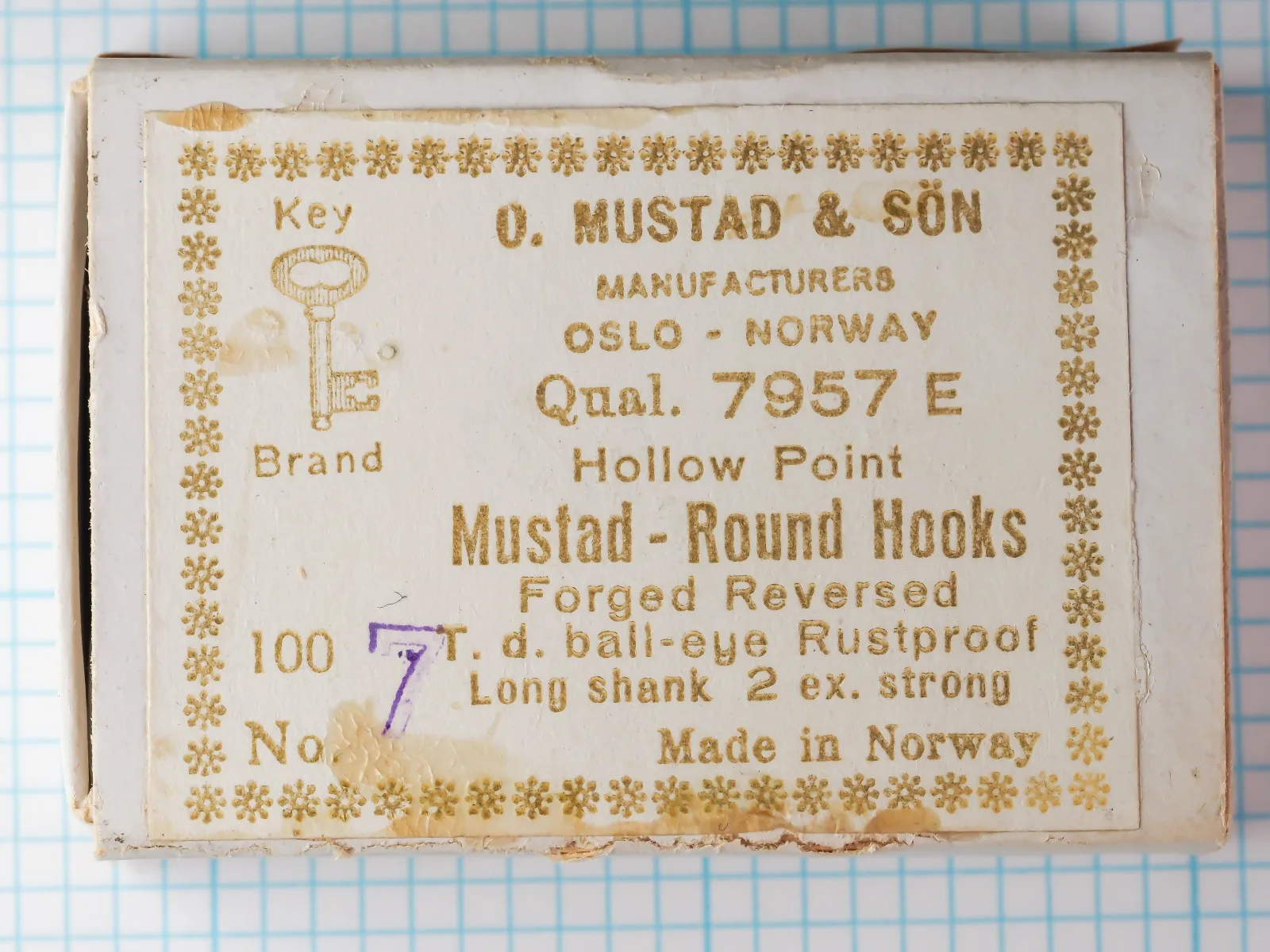
Vintage Mustad sales card with cream-colored heavy cardstock. Gold-foil letterpress printing throughout. Key Brand trademark and skeleton key graphic in upper left. Eight-line label format: O. MUSTAD & SÖN / MANUFACTURERS / OSLO - NORWAY / Qual. 7957 E / Hollow Point / Mustad-Round Hooks / Forged Reversed / T.d. ball-eye Rustproof Long shank 2 ex. strong / Made in Norway. Decorative gold-foil border of repeated X-and-snowflake motif. Box quantity handwritten or printed in purple ink as "100 No. 7" in lower left. Minor toning, light surface wear, and one small abrasion visible on card face. No barcode present.
Low ($8): Good condition — opened card, 90-95 hooks present or slight wear to packaging. High ($18): Excellent condition — original sealed or effectively sealed card, full 100-hook count, minimal foil print wear, stored flat. Premium factors: Complete hook count, intact original packaging, clear foil printing, lack of toning, size No. 7 scarcity. Platforms: eBay (US and UK), specialty vintage tackle dealers, regional tackle shows. Confidence: V verified — based on 1 comparable eBay sold listing (Mustad 7957E, $12.99 for new other condition with 100 hooks), adjusted upward for condition tiers and current market activity.
eBay UK and US (search "Mustad 7957 E" or "Mustad vintage size 7"). Specialist vintage tackle dealers in the UK (Marryat & Brown, Chadwick & Co.). Regional fly-fishing shows and tackle fairs in the Northeast US and Scottish Borders. Occasionally in estate sales and antique fishing-tackle lots on Facebook Marketplace and local online marketplaces.
| Title | Price | Date | Condition |
|---|---|---|---|
| 100 MUSTAD #5 ROUND HOOKS FLY/ BAIT 2X STRONG LONG SHANK RUSTPROOF BALLEYE 7957E | $12.99 (asking) | active | New other (see details) |
eBay market reference. Researcher-curated. Prices in USD. Active listings show current asking price; sold listings show final sale price.
Original Packaging: Store the complete sales card in a cool, dry environment away from direct sunlight, excessive humidity, and temperature fluctuations. The card’s cream-colored cardstock is susceptible to acid-induced degradation over decades; acid-free storage materials are ideal. Display cards vertically on a shelf rather than stacking, which can bend wire and crease packaging. Avoid contact with other metal objects to prevent galvanic corrosion or transfer of metal dust.
Hook Preservation: The bronzed rustproof finish is highly resistant to corrosion, even if exposed to moderate humidity. However, prolonged contact with moisture or salt air will eventually promote patina development or surface oxidation. This patina is often considered desirable by collectors, as it documents the hook’s age and provenance. Do not attempt to polish or clean the bronzed surface; abrasive cleaning removes the historical finish and reduces value. If loose hooks must be stored, use acid-free tissue or individual glassine sleeves to prevent contact with each other or other metals.
Handling: Minimize handling of the card itself. Oils and acids from bare hands accelerate paper degradation and fade foil printing. When handling hooks, use tweezers or wear cotton gloves. Never flex or bend the hooks unnecessarily, as this can cause work-hardening and eventual brittle fracture despite the extra-heavy wire. The ball eye is particularly vulnerable to deformation if the hook is forced or flexed.
Environmental Conditions: Ideal storage temperature is 60-70°F with relative humidity 30-50%. Avoid basements (moisture), attics (temperature swings), and near radiators or air conditioners (humidity fluctuations). A climate-controlled closet, cabinet, or shadowbox display is optimal. Acidic paper, wood, or cardboard boxes will accelerate deterioration; store only in acid-free containers or directly in display frames with conservation-grade materials.
Display and Inspection: Original packaging dramatically increases collectible value—never remove hooks from the card unless necessary for immediate tying use. If the card develops brittleness or severe creasing, consider placing it in a conservation-grade transparent sleeve for protection while maintaining visibility. Inspect hooks periodically (every 1-2 years) for unexpected corrosion or pin-rust; bronzed finishes rarely corrode, but early intervention prevents loss.
Why Size No. 7 Is Unusual: Modern fly-fishing hook catalogs exclusively feature even-numbered sizes: No. 4, 6, 8, 10, 12, 14, 16, 18, 20. The absence of No. 5, 7, 9, 11, 13, 15, etc., reflects a consolidation that occurred in the mid-20th century. Historically, hook manufacturers including Mustad produced in single increments (1, 2, 3, 4, 5, 6, 7, 8…), offering finer granularity for tyers seeking precise gape-to-wire ratios. However, as mass-market retail expanded and inventory management became centralized, wholesalers and fly shops eliminated odd-numbered sizes as SKU-reduction strategy. Within a decade, odd sizes essentially vanished from circulation.
Documented Gap Measurement: Physical caliper measurement of the 7957 E size No. 7 specimen yields gap width 0.23″ (5.84 mm). This places it cleanly between modern No. 6 (typically 0.24″-0.26″ gap) and No. 8 (typically 0.18″-0.20″ gap). A tyer working with vintage materials who requires a hook of this specific gape has no direct modern equivalent without searching discontinued stock or custom hook lines.
Historical Significance: The retention of odd-numbered sizes in vintage Mustad catalogs through the 1970s documents a period when specialized tackle was valued over standardization. Different trout and salmon fisheries across Europe and North America had localized preferences for specific gapes and wire weights; rather than force standardization, Mustad offered finer granularity. The eventual abandonment of odd sizes reflects the globalization and homogenization of fly-tying culture—a trade-off of specialization for convenience that many traditionalists consider a net loss.
Collecting Implication: Size No. 7 vintage hooks command modest premiums among nostalgic tiers and specialist collectors who view them as archaeological artifacts of a more nuanced manufacturing era. Cards specifically carrying size No. 7 are sought after by completists building historical size-range collections, even if the hooks themselves are not functionally superior to modern equivalents.
Source: A Comprehensive Typology and Decryption of Vintage O. Mustad & Søn Hook Labels, sections: The Structural Decryption of the Eight-Line Vintage Label, Lines 1-8
The Eight-Line Standard: The 7957 E label exemplifies Mustad’s formalized eight-line typographical system, a standardized industrial formula engineered to communicate technical data across linguistic and geographic boundaries. Understanding each line reveals the depth of engineering codification behind what appears to be simple packaging text.
Line-by-Line Analysis:
Line 1 & 2 (Corporate Identity): “O. MUSTAD & SÖN / MANUFACTURERS” — Establishes unambiguous manufacturer authority and differentiates Mustad from regional distributors and repackagers who were common in mid-20th-century tackle markets. This distinction was legally and commercially critical, ensuring brand loyalty flowed to the primary manufacturer rather than regional jobbers.
Line 3 (Geographic Bracketing): “OSLO – NORWAY” — This single line provides one of the most reliable dating tools. Oslo was renamed from Christiania on January 1, 1925. Any Mustad label bearing “CHRISTIANIA” is definitively pre-1925; “OSLO” indicates post-1925 production. The 7957 E’s Oslo designation confirms production c. 1925-1970s.
Line 4 (Quality Code): “Qual. 7957 E” — The numeric tier system denoted manufacturing tolerances and wire gauge. Codes in the 7000-7999 block represented specialized wet-fly and streamer patterns; the “E” suffix meant “Extra” (reinforced wire or enhanced finish). This notation allowed Mustad to manage hundreds of product variants using a shorthand system that was deeply embedded in tyer culture but completely opaque to modern readers unfamiliar with Mustad’s internal taxonomy.
Line 5 (Point Identifier): “Hollow Point” — According to Mustad’s rules, this line is reserved exclusively for point geometry. The hollow point specification indicates a concave inner face with inward curve, engineered for rapid penetration in soft tissue. This line never specifies wire gauge, shank length, or eye type—only point geometry or quality grade.
Line 6 (Pattern Name): “Mustad-Round Hooks” — This nomenclature identifies the overarching bend family. The addition of “Mustad-” prefix indicates that Mustad engineered the pattern as a proprietary or improved version of a classic round-bend archetype.
Lines 7 & 8 (Anatomical Modifiers): “Forged Reversed / T.d. ball-eye Rustproof / Long shank 2 ex. strong” — These lines specify supplementary features: wire treatment (forged = mechanically flattened for strength), eye type (T.d. = turned-down, ball-eye = terminal wire bent into loop), offset (reversed = kirbed/laterally offset), finish (rustproof = bronzed lacquer), shank length (long = extended for dressing bulk), and wire rating (2 ex. strong = extra-heavy gauge for load-bearing).
Manufacturing Context: Before barcodes and digital inventory, this eight-line system allowed dock workers, regional distributors, and wholesale buyers to instantly decode the product specifications without reference materials. A buyer in Denmark seeing “Qual. 7957 E / Hollow Point / Mustad-Round Hooks / Forged Reversed” could immediately recognize it as a specialized nymph/wet-fly hook suitable for cold-water trout streams—without speaking Norwegian or consulting a catalog.
Obsolescence and Value: Around 2000-2009, Mustad discontinued this entire system in favor of the Signature Series, which uses transparent alpha-numeric codes (R50, R72) explicitly defining bend, wire weight, and shank length. This transition rendered the classical quality codes obsolete and marked the official end of the eight-line label era. The presence of traditional codes like “Qual. 7957 E” on a paper label is now the definitive hallmark of a true vintage Mustad product.
The Mustad 7957 E’s notation “Forged” in the label refers to a mechanical treatment that fundamentally alters steel metallurgy without adding weight. During the 1950s-1970s, Mustad operated mechanical drop-presses that laterally compressed the hook wire along its length, flattening it microscopically on opposing sides. This cold-working process realigned the steel’s crystalline structure and introduced residual compressive stress, dramatically increasing tensile strength and rigidity.
The mechanical advantage is substantial: a forged 2X-long shank maintains the same wire diameter as an unforged hook but exhibits significantly greater resistance to bending or straightening under load. This innovation was particularly crucial for weighted-nymph applications, where the combined mass of lead weight, bulk body dubbing, and water-column resistance could exert sustained bending force on the shank. An unforged hook of equivalent wire gauge would straighten or kink under these stresses; forging eliminated this failure mode without the penalty of using heavier-gauge wire (which would sink faster but become too stiff to tie delicate fly bodies).
By the 1980s-1990s, as modern high-carbon steel alloys and heat-treatment methods improved, the necessity for mechanical forging declined. Contemporary hooks rely on superior metallurgy rather than work-hardening to achieve strength. However, vintage Mustad examples like the 7957 E demonstrate the sophistication of mechanical engineering applied to a commodity product—a testament to the company’s industrial capability and the technical demands of mid-century angling.
| P | Photographically verified — Directly observable in the photograph(s) on this page. |
| V | Verified by documentation — Confirmed by manufacturer catalog, spec sheet, or published reference. |
| I | Inferred — A logical deduction from observable or documented evidence, not directly stated. |
| E | Estimated — An approximation based on visual comparison, proportional analysis, or limited data. |
| S | Speculative — A reasoned hypothesis that cannot be confirmed from available evidence. |
Claims with no notation are confirmed by multiple independent sources. All photographs on garrenwood.com are taken on a measurement grid where each square equals 1/10 inch (0.1″ / 2.54 mm).
Your cart is empty.