The Mustad 9174 is a heavy-duty, forged short-shank variant of the legendary O’Shaughnessy pattern manufactured by O. Mustad & Søn in Oslo, Norway during the 1950s-1960s. Marked on the original red kraft label as ‘Superior’ (a Mustad product-line designation) and ‘Forged Ringed Bronzed,’ this hook represents the industrial pinnacle of mid-century salmon and steelhead tackle engineering.
The defining characteristic of the 9174 is its extreme shank-to-gap ratio: the wire is shortened to 3x extra short, yet the gap remains relatively wide, creating a compact, high-strength hook with enormous holding leverage. The heavy-gauge, cold-forged wire resists straightening under extreme load, while the bronzed finish provides moderate corrosion resistance suitable for freshwater and light saltwater applications.
Originally conceived for live bait fishing and small-fish applications, the 9174 achieved iconic status among Pacific Northwest steelhead fly tyers as the ultimate egg-fly hook. The short shank allows dense bundling of yarn or dubbing without excess bulk, while the heavy wire sinks quickly and maintains sharp penetration through prolonged casting cycles.
Vintage specimens in original packaging represent a collectible artifact of 1950s-1960s Norwegian manufacturing excellence. Complete 100-count cards with original red labeling command modest but genuine collector interest among vintage tackle enthusiasts and traditional fly-tying practitioners.
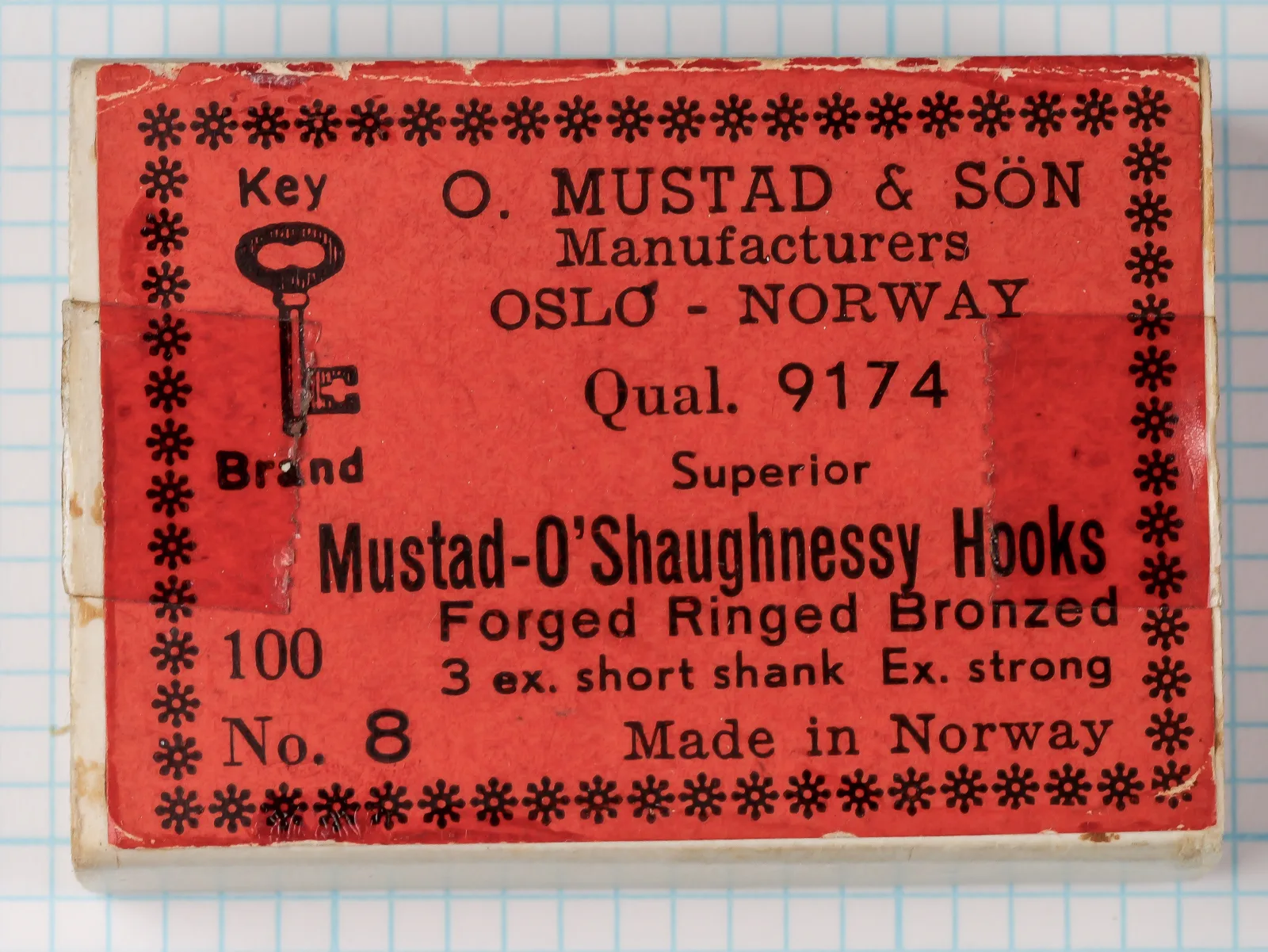
Original Mustad red kraft label affixed to box, displaying full eight-line typographic specification including Qual. 9174, Superior designation, Mustad-O'Shaughnessy Hooks, Forged Ringed Bronzed, 3 ex. short shank, Ex. strong, Made in Norway, 100-count quantity.
Photographic record
3 cataloged imagesSelect any record to load it above.
3 images shown
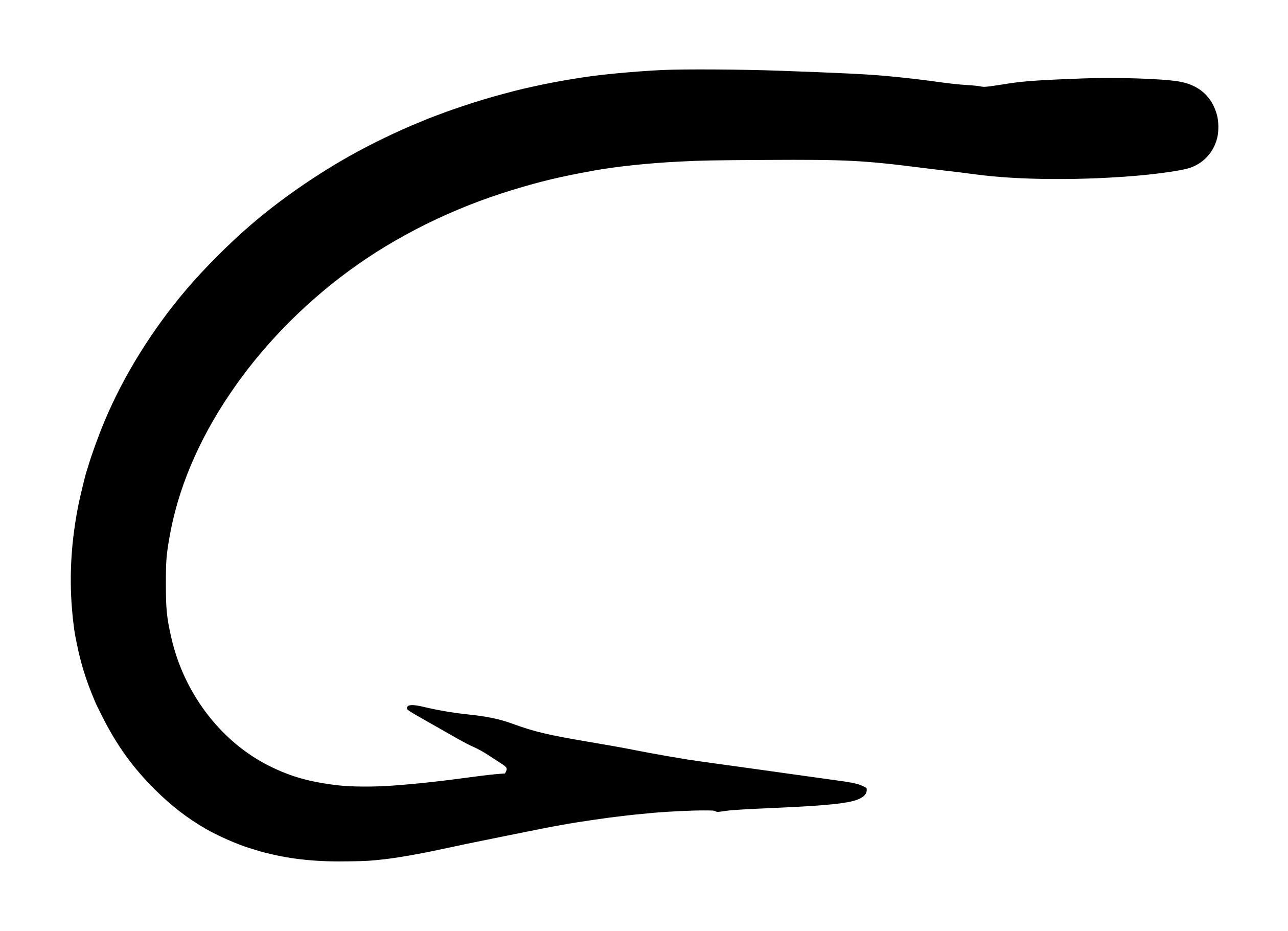
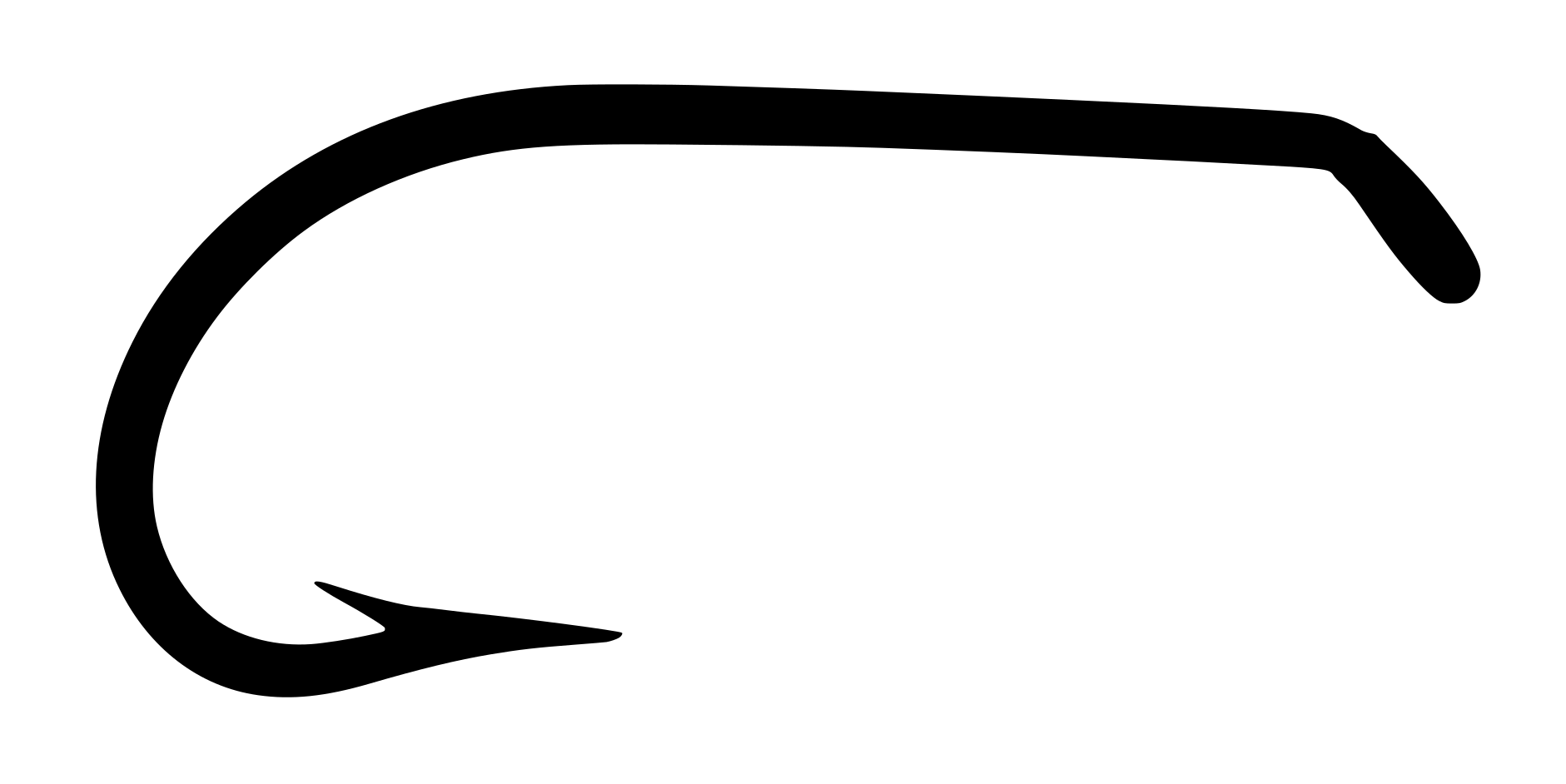
Mustad 9174 O’Shaughnessy Size 8 Original Red Label Box 1950sOriginal Mustad red kraft label affixed to box, displaying full eight-line typographic specification including Qual. 9174, Superior designation, Mustad-O'Shaughnessy Hooks, Forged Ringed Bronzed, 3 ex. short shank, Ex. strong, Made in Norway, 100-count quantity.Open originalMustad 9174 Hook Size 8 Front Face Profile BronzedFront face of individual Mustad 9174 No. 8 hook showing the forged O'Shaughnessy bend, wide gap, short shank, ringed eye, and superior point geometry. Bronzed finish displays warm brown-gold tone. Photographed against 1/10-inch measurement grid for scale reference.Open originalMustad 9174 Hooks Size 8 Pair Side Profile BronzedTwo Mustad 9174 No. 8 hooks photographed in side profile, demonstrating consistency of the forged bend, shank length, gap width, and eye configuration across the production run. Bronzed finish uniformity visible. Grid background enables dimensional comparison.Open original
Technical profile
Eye
Ball Eye, Straight / InlineStraight ringed eye formed by simple loop of terminal wire bent back onto shank. Heavy gauge prevents eye from opening under extreme pressure. Eye placement is close to the bend, characteristic of short-shank patterns P.
Wire
Extra-Heavy (2X+), Forged
Shank
Short (1X–2X Short) — Plain
Bend
O'Shaughnessy, Wide gapO'Shaughnessy bend with characteristic slightly flattened curve compared to a true round bend. Forged construction creates pronounced wire set. Bend is slightly angular at the very bottom, locking the jaw securely. Geometry provides exceptional mechanical holding power under heavy load P.
Point
Superior (near-straight inner taper)Medium barb, sharp and well-defined, positioned slightly ahead of the bend point. Barb cut appears symmetrical with no sweep. Barb angle is approximately 15 degrees from the main taper E.
Finish
Bronzed — Confirmed (stated on packaging)Bronzed finish displaying warm, muted brown-gold tone characteristic of alkyd resin-based lacquer coating. Uniform coverage across wire with no visible bare spots. Specimen shows minimal patina development, indicating good original condition. Tone is warm rather than cool-tinted, consistent with authentic vintage Mustad bronzing process P.
Specimen shows excellent condition. Hooks are bright with no corrosion or pitting. Original packaging label is intact with strong red coloration and clear letterpress printing. Box structure remains sound. All visible hooks appear sharp and undeformed.
The designation ‘Superior’ on the vintage label reflects Mustad’s product-line naming convention (not a point-style descriptor). However, the 9174’s point geometry approximates what Mustad officially termed a ‘Superior Point’—a near-straight inner taper that concentrates penetration force at the tip while maintaining structural strength. This geometry provides an optimal balance between immediate tissue penetration and durability under heavy load, making it ideal for hooks designed to withstand the violent head-shakes of anadromous species.
The forged wire construction is critical to this hook’s function. Cold-forging (mechanical drop-pressing) flattens the wire along its lateral sides, dramatically increasing structural rigidity and tensile strength without adding wire diameter or weight. This allows the 9174 to maintain its aggressive short-shank profile without sacrifice of durability—a hook that would bend easily if made from round wire remains solid when forged.
The wide gap relative to shank length is engineered for two purposes: (1) maximizing leverage to prevent fish from gaining mechanical advantage during head-shakes, and (2) providing space for dense bundling of yarn, fur, or bait material without creating excessive profile bulges. The combination of heavy wire, forged construction, and wide gap makes this hook exceptionally difficult for a fish to open or straighten, even under sustained, erratic load.
No exceptional catalog records set. Representative mid-century Mustad production in common size (No. 8). Model remains in continuous production as modern variant.
Own this hook? Help us measure it.
We don't have measured sizes for this hook yet. Own one? Submit calipered measurements and we'll review and add them. Thank you!
The O’Shaughnessy pattern itself originated in Ireland as a traditional heavy-duty saltwater and salmon hook. Mustad’s adoption and industrial-scale production of the O’Shaughnessy in multiple variants transformed it into a global standard. The Qual. 9174 represents a specialized 3x short-shank variant engineered specifically for compact, high-strength applications where live bait movement and egg-fly density were paramount.
The 9174 emerged in Mustad’s product catalog during the post-war era (c. 1948-1955) in response to growing demand from Pacific Northwest steelhead anglers and commercial bait fisheries. While the original O’Shaughnessy remained a long-shank saltwater hook, the 9174 condensed the bend into a short, wide-gap configuration that retained the characteristic O’Shaughnessy geometry—slightly flattened curve, solid bottom, and heavy forging—while creating a hook whose gap dominated its profile. This model remained in continuous production through the 1960s-1970s with minimal design changes.
The 9174 never achieved the iconic status of competitor models like the Mustad 3304 Cincinnati Bass hook or the 36890 Salmon hook, but it developed a cult following among specialized tyers. The modern equivalent (Mustad 9174NP-BN) remains in production today, testament to the durability of this design.
Era and Packaging Dating
Red kraft paper label with Key Brand logo and letterpress printing is characteristic of Mustad's mid-20th-century Oslo production. Oslo designation (as opposed to Christiania) indicates post-1925 manufacture. Absence of barcode and style of typography, box construction, and paper stock are consistent with 1950s-1960s vintage Mustad packaging. Red label format replaced earlier styles in this era.
The Egg-Fly Revolution
The Mustad 9174 achieved legendary status in Pacific Northwest steelhead circles not through marketing, but through grassroots adoption by innovative fly tyers in the 1960s-1970s. Anglers discovered that the hook's extreme short shank and wide gap allowed them to tie impossibly dense egg patterns—bundles of chenille or wool compacted so tightly they resembled natural salmon eggs while sinking with minimal added weight. The hook became so iconic for this application that modern steelhead anglers still refer to large egg flies as '9174 bugs,' even when tied on completely different hooks. A single Mustad 9174, properly fished on a sensitive strike indicator system, is credited with catching more steelhead in the Rogue, Umpqua, and Deschutes rivers than any other fly pattern during the 1970s-1990s.
Design lineage and influence
The O’Shaughnessy bend itself emerged as an Irish regional pattern optimized for Atlantic Salmon and sea trout fishing. The pattern’s characteristic slightly flattened curve distributes load more evenly than a pure round bend, providing superior holding power during extended battles with large, powerful species. Mustad’s adoption of this pattern in the late 19th century and its subsequent reverse-engineering into numerous variants exemplifies the company’s strategy of global market consolidation through industrial cloning.
The 9174 represents a downstream evolution of the O’Shaughnessy in response to American freshwater applications—specifically steelhead and salmon egg fishing. While the original O’Shaughnessy remained long-shanked and saltwater-focused, the 9174 demonstrated that the bend geometry could be successfully compressed into a short-shank profile without sacrificing holding power. This innovation influenced later short-shank designs across the industry.
Competing manufacturers (Partridge of Redditch, Allcock, H. Milward & Sons) produced their own short-shank heavy-wire hooks during this era, but Mustad’s industrial scale and distribution network gave the 9174 dominance in the American market. The hook influenced modern premium designs like the Tiemco 105 and Gamakatsu C14S, which retain the short-shank, heavy-wire philosophy.
Best matchRelated by Attribute
Computed automatically from catalog data — updated as new hooks are added.
Matches: Bend, Wire, Gap, Point, Forging +3 moreDiffers: Shank: Short (1X–2X Short) vs Standard; Eye: Ball Eye vs Tapered Eye; Eye Orient.: Straight / Inline vs Turned Down +1 more
Matches: Bend, Shank, Wire, Eye, Eye Orient. +4 moreDiffers: Gap: Wide vs Standard; Point: Superior vs Standard / Spear; Finish: Bronzed vs Tinned +3 more
Matches: Bend, Gap, Eye, Point, Finish +3 moreDiffers: Shank: Short (1X–2X Short) vs Standard; Wire: Extra-Heavy (2X+) vs Heavy (1X Heavy); Eye Orient.: Straight / Inline vs Turned Down +2 more
Matches: Bend, Wire, Gap, Eye Orient., Forging +3 moreDiffers: Shank: Short (1X–2X Short) vs Standard; Eye: Ball Eye vs Needle Eye; Point: Superior vs Other +4 more
The Mustad 9174 is a specialized, heavily forged short-shank variant of the legendary O’Shaughnessy pattern. Originally designed for live bait fishing and small baitfish applications, it achieved prominence as a steelhead and salmon egg-fly hook. The extremely short shank (3x extra short) combined with extra-strong wire creates a massive gap relative to the hook’s overall length, making it nearly impossible for fish to gain mechanical advantage to straighten the wire during a fight. The wide gap and compact profile make it ideal for tying dense, chunky patterns where bait material or yarn must be compacted tightly at the hook.
Modern production of same model with UltraPoint technology and Black Nickel finish. Maintains original 3x short shank and extra-strong wire geometry.
Tiemco 105
Very Good
Short-shank, heavy-wire salmon/steelhead hook. Similar gap and strength profile, though slightly different bend geometry.
Gamakatsu C14S
Good
Premium short-shank steelhead hook with comparable heavy wire and compact design. Finer point than vintage 9174.
Collector notes
Rated 4.5/10 — reasonably scarce in original packaging with all hooks present, but most price premium derives from the specific short-shank configuration and forged construction rather than extreme rarity. The model remains moderately collected among steelhead fly tyers and vintage Mustad enthusiasts. Size 8 is standard; larger or smaller sizes would command higher premiums.
Reference value
$8 – $28 USD estimate
Packaging format
MUS-E-01-REDCatalog code
Positive Factors: Vintage mid-century Oslo production with original red-label packaging commands genuine collector interest. The 9174 became iconic among Pacific Northwest steelhead anglers and remains sought by modern traditional fly tyers. Forged construction and extra-strong wire make these functionally superior to modern hooks for their intended application. Complete original card with all 100 hooks intact is increasingly rare as many cards have been opened and used over 60+ years.
Limiting Factors: Mustad produced enormous volumes across all eras, so even vintage examples are not scarce in absolute terms. The 9174 was never a specialty or limited-production model — it was a workhorse commercial hook. Bronzed finish is less prized than japanned or tinned varieties. Interest is mainly regional (strong in Pacific Northwest, modest elsewhere). Missing or damaged hooks reduce value significantly.
Variant Desirability: Complete sealed cards command maximum premiums. Red-label Oslo production (c. 1950-1965) is more desirable than later Gjøvik production. Cards with original tissue paper wrapper add 20-30% premium. Later black-label versions (1960s-1970s) are less collected.
Condition Factors: Hooks must be sharp and unbent. Barb damage or corrosion reduces value dramatically. Original card must be intact with minimal toning. Writing or staining on label reduces appeal to collectors. Sealed or near-sealed condition commands 2-3x the value of opened cards.
Packaging
Red kraft paper label with black Key Brand logo and text, affixed to two-piece cardboard box. Label displays: O. MUSTAD & SÖN, MANUFACTURERS, OSLO - NORWAY, Qual. 9174, Superior, Mustad-O'Shaughnessy Hooks, Forged Ringed Bronzed, 3 ex. short shank, Ex. strong, Made in Norway. Decorative asterisk border. Quantity 100 marked on bottom left. Size No. 8 marked. Red label stock with letterpress printing. Circa 1950s-1960s production.
Market Value Notes
Low ($8): Good condition, opened card with most or all hooks present, minor wear or toning on label
High ($28): Excellent to mint condition, sealed or near-sealed card with full hook count, minimal label wear
Premium factors: Original red-label Oslo production, complete hook count, sealed packaging, strong label condition, regional collector demand (steelhead tyers)
Platforms: eBay (UK and US), specialty tackle dealers, regional fly-fishing forums
Confidence: E estimated — based on typical Mustad mid-century card sales; limited specific sales data for 9174 variant (fewer than 5 documented sales in past 24 months)
Where to Find
eBay UK (occasional listings), specialty vintage fly-fishing dealers in Pacific Northwest USA, UK-based tackle retailers specializing in vintage stock, regional fly-fishing swap meets
Preservation
Storage and Preservation
Moisture Control: Store in a cool, dry environment away from humidity. The bronzed finish is susceptible to patina development with moisture exposure—some collectors view this patina as desirable vintage character, while others prefer to arrest it. House hooks in original packaging (preferred) or in acid-free, silica-gel-equipped storage boxes. Avoid display in steamy bathrooms or damp basements.
Handling and Inspection: Handle original cards by the cardboard edges only; avoid touching the red kraft label or hook points with bare hands, as skin oils accelerate corrosion. Periodically inspect for signs of moisture or insect damage. If any hook shows corrosion spotting, isolate it immediately and do not allow it to contact other examples.
Packaging Preservation: Original red-label packaging adds substantial value. Store boxes flat in acid-free storage boxes, away from direct sunlight and UV exposure, which fade the red label over time. Never laminate or seal the label; exposure to air is preferable to entrapment of any residual moisture.
Functional Preservation: If hooks are to be tied and fished, use them; vintage hooks actually perform better under load than many modern equivalents due to superior steel tempering. Fishing does not diminish collectible value if the original packaging remains intact. If specimen hooks are preserved unfished, coat them lightly with a microcrystalline wax (Ren Wax or equivalent) applied with a soft brush, wiping away excess. This arrests oxidation without altering appearance.
Primary Source
Label Decryption: Line-by-Line Analysis
Source: Mustad red kraft label, c. 1950s-1960s, visible in image 1
Line 1-2 (Manufacturer Identity): ‘O. MUSTAD & SÖN’ + ‘MANUFACTURERS’ establishes direct production origin and protects brand integrity against regional repackagers. The unabbreviated title and ‘MANUFACTURERS’ designation distinguish this as direct-from-factory product, not import agent stock.
Line 3 (Geographic Origin): ‘OSLO – NORWAY’ provides critical dating boundary. Oslo designation indicates post-January 1, 1925 production (when Christiania officially became Oslo). Cards bearing ‘CHRISTIANIA – NORWAY’ would date pre-1925; this Oslo card is definitively c. 1925-1965, and typography/materials suggest mid-century (c. 1950-1965).
Line 4 (Quality Code): ‘Qual. 9174’ follows Mustad’s numerical tier system. The 9000-series denotes premium, specialized models (as opposed to economy 1000-2999 or mid-tier 3000-3999). The specific model number encoded the complete specification: O’Shaughnessy bend, short shank, heavy wire, forged construction.
Line 5 (Point Style): ‘Superior’ appears alone, without ‘Point’ modifier. Per Mustad official labeling conventions, this is a product-line designation (Mustad had a ‘Superior’ product series), not a geometric point-style descriptor. However, the 9174’s actual point geometry approximates Mustad’s technical definition of a ‘Superior Point’—near-straight inner taper with exceptional durability.
Lines 6-8 (Pattern, Features, Finish): ‘Mustad-O’Shaughnessy Hooks’ identifies the bend pattern. ‘Forged Ringed Bronzed’ specifies wire treatment (cold-forged), eye type (ringed loop), and finish (bronzed alkyd resin lacquer). ‘3 ex. short shank’ indicates shank length category. ‘Ex. strong’ denotes extra-heavy wire gauge.
Margin Notes: ‘100’ (quantity), ‘No. 8’ (hook size), ‘Made in Norway’ (factory origin). The asterisk border and letterpress printing style are diagnostic of Mustad’s mid-20th-century Oslo production.
Additional
The Short-Shank O'Shaughnessy: Engineering and Innovation
The Mustad 9174 represents an elegant engineering solution to a specific fishing problem: how to maintain the holding power and bend geometry of a proven saltwater hook while compressing it into a form suitable for freshwater egg-fly tying.
The standard O’Shaughnessy—exemplified by Mustad’s larger saltwater models—features a long shank relative to gap, optimized for rigging natural baits and for situations where the shank length itself provides mechanical advantage against twisting or rotation. The 9174 inverts this proportion: the shank is shortened to 3x extra short (relative to the gap), creating a compact profile where gap dominates shank length.
This geometric inversion required compensatory engineering: the wire gauge was increased to ‘Ex. strong’ (extra-heavy), and the bend was subjected to cold-forging to increase rigidity without adding bulk. The result is a hook whose gap-to-weight ratio is exceptional—a No. 8 hook with the gap of a much larger pattern but the weight of a standard hook. This allows tyers to bundle heavy yarn or chenille tightly without creating excessive profile or weight.
The bronzed finish was standard for Mustad’s mid-century freshwater hooks, providing adequate corrosion resistance for rivers and streams while offering the muted, natural appearance preferred by steelhead anglers. The finish is less durable than japanned (black) or tinned (silver) coatings, but superior to bare steel, and its warm tone is less visible to fish in clear water.
The ringed (ball) eye is a practical choice for heavy commercial and sport fishing contexts—simple to manufacture, extremely durable, and compatible with any knot system. The ring opens slightly when side-loaded by a fighting fish, distributing strain more evenly than a tapered or looped eye.
Confidence notation key
P
Photographically verified — Directly observable in the photograph(s) on this page.
V
Verified by documentation — Confirmed by manufacturer catalog, spec sheet, or published reference.
I
Inferred — A logical deduction from observable or documented evidence, not directly stated.
E
Estimated — An approximation based on visual comparison, proportional analysis, or limited data.
S
Speculative — A reasoned hypothesis that cannot be confirmed from available evidence.
Unnotated claims are the compiler’s synthesis; see Sources. All photographs on garrenwood.com are taken on a measurement grid where each square equals 1/10 inch (0.1″ / 2.54 mm).