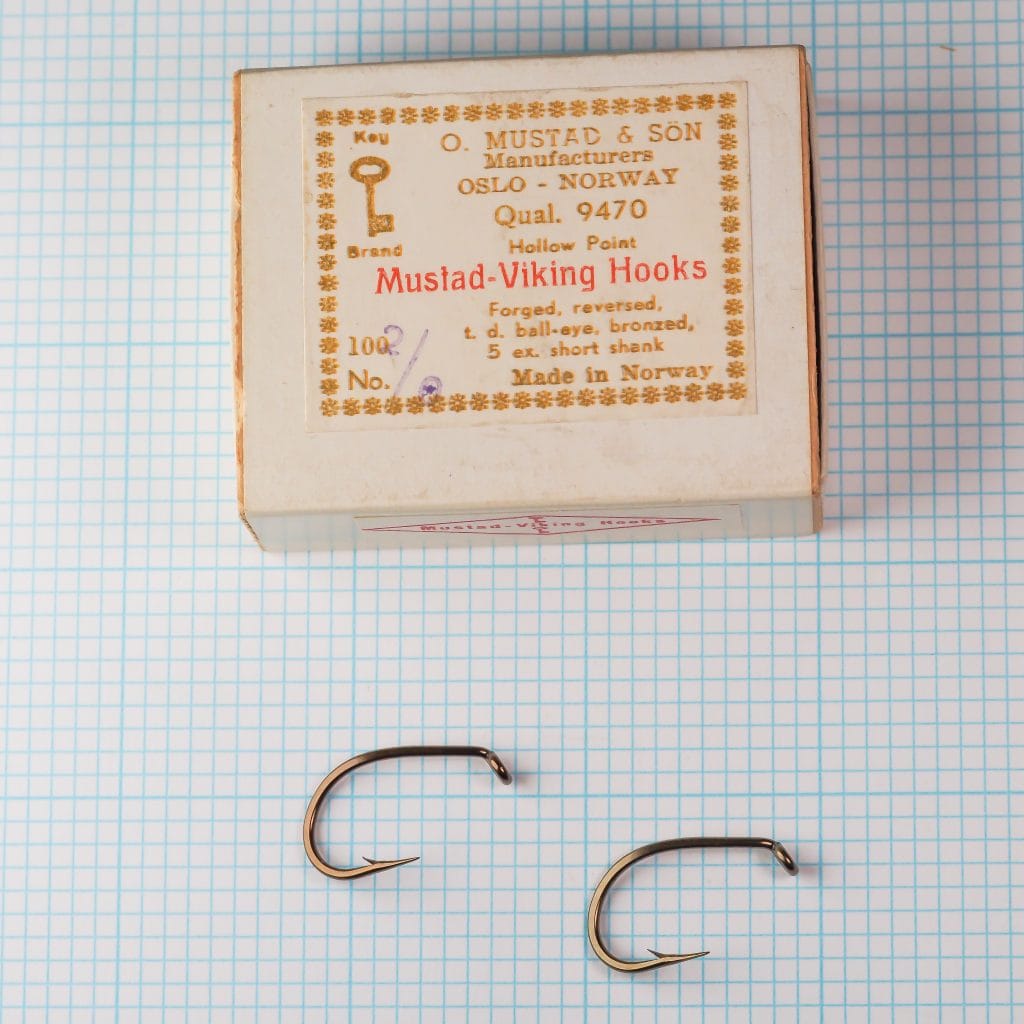
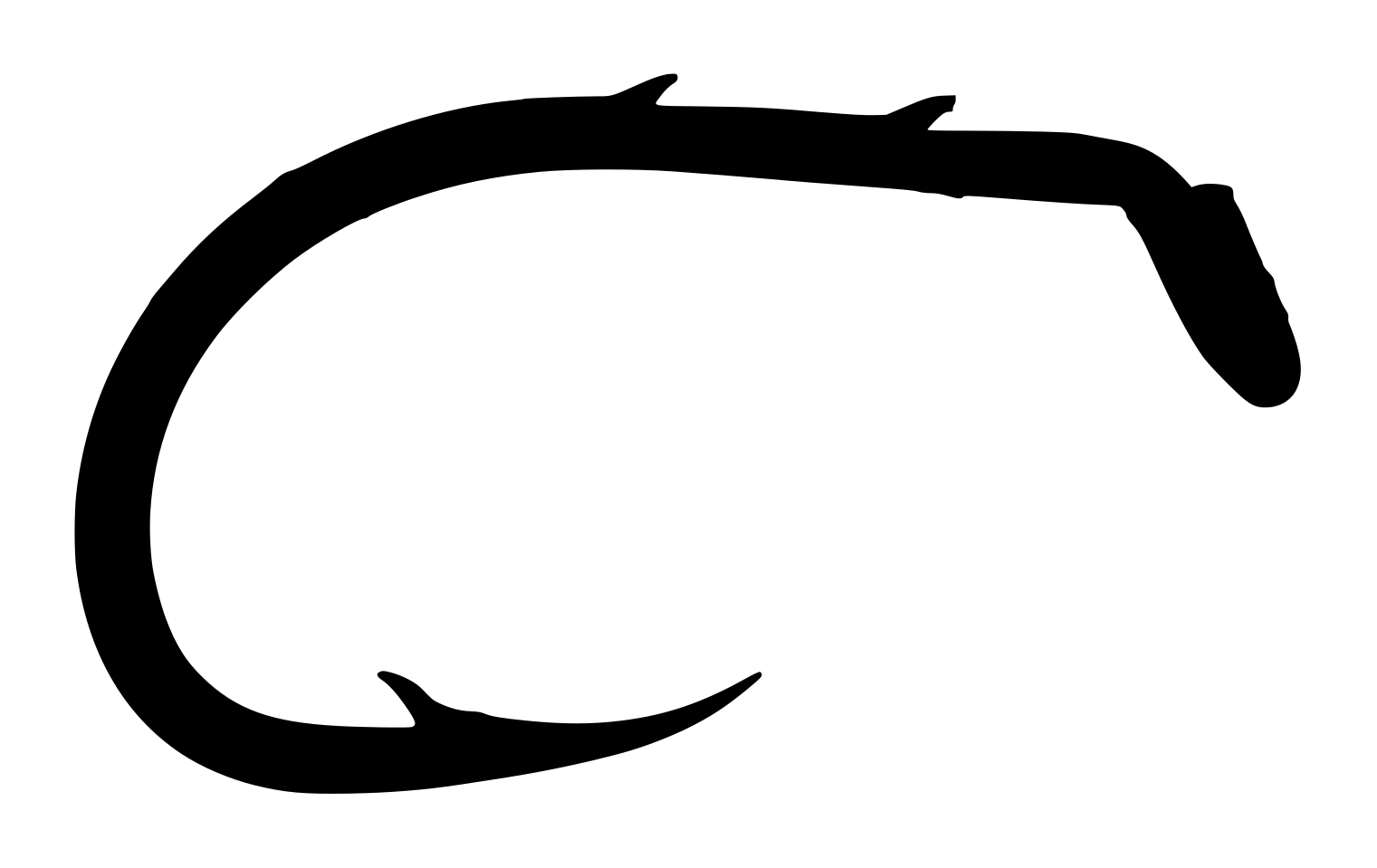
The Mustad 9470 is a specialized short-shank Viking bait hook manufactured in Oslo, Norway, during the mid-20th century (c. 1950–1965). Marked Quality 9470 on vintage paper slide-box packaging, this size 2/0 exemplar features the Mustad-Viking series’ defining characteristics: forged heavy wire, a wide Viking bend, reversed (kirbed) offset point, turned-down ball eye, and bronzed protective finish.
The 9470’s most remarkable feature is its 5x extra-short shank — engineered to be completely buried within a bait (salmon egg, cheese ball, or meat chunk) so the fish would not sense the metal before committing to the strike. The wide gape of the Viking bend ensures reliable hook-up despite the minimal shank exposure. This specialized geometry made it a preferred choice for bait anglers targeting wary, hard-fighting species like large trout, carp, and walleye.
Collectability is moderate among vintage tackle specialists. Mid-century Mustad boxes in this size range are reasonably common, but complete original packaging with both hooks intact and legible labels commands a modest premium. The bronzed finish and forged construction reflect peak Mustad manufacturing standards of the era.
Vintage Mustad 9470 cardboard slide-box with original printed label and two specimen hooks (size 2/0) displayed on 1/10-inch measurement grid. Label shows 'Oslo – Norway' origin and 'Hollow Point' specification.
Photographic record
5 cataloged imagesSelect any record to load it above.
5 images shown
Mustad 9470 Box and Hooks Size 2/0 — Vintage PackagingVintage Mustad 9470 cardboard slide-box with original printed label and two specimen hooks (size 2/0) displayed on 1/10-inch measurement grid. Label shows 'Oslo – Norway' origin and 'Hollow Point' specification.Open originalMustad 9470 Label Detail — Eight-Line FormatClose-up of the Mustad 9470 label showing the eight-line standardized label format. Text includes manufacturer name, geographic origin (Oslo – Norway), model code (Qual. 9470), point specification (Hollow Point), and series name (Mustad-Viking Hooks in red) with feature details. Decorative border of small glyphs frames the label.Open originalMustad 9470 Hook Point — Hollow Point ProfileSide-profile close-up of the Mustad 9470 hook point, showing the characteristic hollow-point geometry with concave inner face and fine, razor-sharp tip. Barb placement and angle clearly visible. Bronzed finish displays warm, brownish-gold tone.Open originalMustad 9470 Hook — Full Profile Front ViewFront-facing view of a single Mustad 9470 hook (size 2/0), showing the characteristic wide Viking bend, extremely short shank, turned-down ball eye, and reversed (kirbed) point offset. The forged wire and bronzed finish are clearly visible.Open originalMustad 9470 Hooks Pair — Manufacturing ConsistencyTwo size 2/0 Mustad 9470 hooks displayed side-by-side on measurement grid, demonstrating manufacturing consistency of bend profile, shank length, and bronzed finish. Both hooks are bright with no corrosion.Open original
Technical profile
Eye
Ball Eye, Turned DownTurned-down ball eye cleanly formed; ball proportionate to wire gauge, properly seated on shank. P
Wire
Heavy (1X Heavy), Forged
Shank
Special Long — Plain
Bend
Beak / Reversed Point, Wide gap, Offset / kirbedWide, open Viking bend with characteristic lateral offset (reversed/kirbed). Bend is approximately 38-42mm deep relative to shank axis. The outward deflection of the point is pronounced — designed to defeat the 'shank-shielding' effect of bulky live baits. P
Point
Hollow Point (concave inner face)Short, close-cut barb set at a steep angle relative to point — typical of hollow-point engineering for rapid penetration into soft mouth tissue. Barb position approximately 2-3mm behind tip. P
Finish
Bronzed — Confirmed (stated on packaging)Bronzed finish displays warm, brownish-gold tone consistent with mid-century Mustad bronzing lacquer. Finish is uniform and intact on both specimen hooks; no flaking or spotting visible. Tone is distinctly warmer than blued or japanned alternatives. P
Specimen hooks bright with minimal tarnish; forged wire exhibits characteristic flattened profile. Original card packaging shows light toning and edge wear; label ink uniform and clearly legible. All text legible in gold/tan and red inks. Two hooks present, both intact.
The hollow-point geometry on the 9470 is engineered to achieve rapid penetration with absolute minimal applied pressure. The concave inner face (contrasting with a nearly flat inner profile on superior-point alternatives) creates a knife-edge effect at the very tip, allowing the point to slice into soft buccal tissue of trout, carp, and walleye with minimal force. This is critical for bait-fishing scenarios where the angler cannot apply a heavy, deliberate hook-set without risking line breakage or mouth-tissue tearing.
The forged construction — where the wire is cold-pressed and flattened along its lateral sides — dramatically increases tensile strength and resistance to bending or straightening under sudden stress. A forged 2/0 bait hook can withstand the violent head-shakes and power runs of a large fish without opening; an unforged wire of equivalent gauge would deform. The process adds no weight but significantly enhances reliability — essential for heavy freshwater species.
The reversed (kirbed) offset rotates the point approximately 5–8 degrees outward from the shank axis. When a fish strikes at an oblique angle (as frequently occurs with live baits), this offset ensures the point naturally rotates into the corner of the jaw rather than sliding harmlessly past soft tissue inside the mouth. The geometry is purely biomechanical; it requires no conscious hook-set adjustment from the angler.
Size & scale lab
Selected size
2/0
Physical specimen
Overall Length
23.1 mmP
Shank Length
7.9 mm
Gap Width
11.9 mmP
Bend Depth
10.2 mm
Wire Diameter
1.53 mm
Shank-to-Gap Ratio
~0.61-0.70 : 1
Confidence
P
Physical specimen
Physical measurement with calipers
Own this hook? Help us measure it.
We don't have measured sizes for this hook yet. Own one? Submit calipered measurements and we'll review and add them. Thank you!
The Mustad-Viking series was introduced in the 1930s–1940s as a distinct product line targeting specialist bait anglers across Scandinavia, the United Kingdom, and North America. The series name ‘Viking’ was a deliberate marketing choice, evoking Nordic engineering precision and strength. Unlike Mustad’s more universal patterns (Sproat, Aberdeen, Limerick), the Viking line was engineered specifically for live-bait and egg-pattern applications where bait concealment was paramount.
The 9470 specification — with its extreme 5x extra-short shank — represented the most aggressive iteration of the ‘bait-concealment’ philosophy. Throughout the 1950s–1970s, the series was manufactured in numerous size variants (ranging from No. 16 to 5/0), with forged or regular wire options, and in finishes including bronzed, blued, and tinned. The hollow-point geometry was standard across all Viking specifications, reflecting the series’ focus on soft-mouthed freshwater species.
Production gradually declined from the 1970s onward as synthetic materials and modern fishing techniques reduced the market for specialized bait hooks. By the 1990s, the classic eight-line label packaging was discontinued in favor of Mustad’s new ‘Signature Series’ with alpha-numeric designations. The direct successor to the 9470 is the modern Mustad 10471 (Viking Live Bait), which maintains the basic geometry but employs contemporary wire and finishing processes. The 9470 itself was formally discontinued around 2005–2010.
Era and Packaging Dating
Label shows 'Oslo - Norway' (not Christiania), indicating post-1925 manufacture. Package style, 'Key Brand' logo design, cardboard slide-box format, letterpress print quality, and lack of barcode all consistent with mid-20th-century Mustad export packaging. Hand-marked purple size notation typical of 1950s-1960s inventory practices. No other specific date markers visible, so era bracketed to mid-century boom period.
The Viking Bait Revolution
In the 1950s and 1960s, the Mustad Viking series represented a distinct Norwegian engineering philosophy: by engineering the shank so short it could be completely hidden inside a bait, Mustad hooks leveraged the fish's sensory expectations against it. A trout expecting to feel the rigid steel of a traditional hook would instead find only soft bait — leading to more committed strikes and fewer 'mouth-feel rejections.' This philosophy was particularly effective in heavily fished waters where trout had learned to spit out obviously artificial presentations. The reversed (kirbed) geometry further improved the odds: when a large carp or walleye struck from an angle, the offset point naturally rotated into the corner of the jaw, where it locked securely even without an aggressive hook-set. This design philosophy influenced bait-hook engineering worldwide for decades.
Design lineage and influence
The Mustad-Viking series emerged in the 1930s–1940s as Mustad’s response to regional European (particularly Scandinavian) preferences for short-shank, wide-gape bait hooks. The 5x extra-short geometry was a direct response to anglers’ discoveries that bulky live baits — salmon eggs, cheese balls, and meat chunks — produced better results when the hook itself was nearly invisible. Earlier broad-shank bait hooks (like the Carlisle and Aberdeen patterns) had relied on lightweight wire to reduce bait-feeling; the Viking series instead retained heavy, forged wire (for durability against hard-fighting species) while sacrificing shank length entirely.
The 9470 specification (reversed, forged, hollow-point) represents the apex of this design philosophy: maximum penetration (hollow point), maximum durability (forged heavy wire), and maximum effectiveness (reversed offset). Modern descendants like the Mustad 10471 maintain the short-shank, wide-gap profile but have transitioned to bright steel and modern tempering processes. The geometry ultimately influenced the design of compact egg-hook patterns and live-bait streamer hooks used in contemporary fly tying.
Best matchRelated by Attribute
Computed automatically from catalog data — updated as new hooks are added.
Matches: Bend, Wire, Eye, Eye Orient., Point +5 moreDiffers: Shank: Special Long vs 2X Long; Gap: Wide vs Standard; Application: Bait vs Bait, Saltwater
Matches: Bend, Wire, Gap, Eye Orient., Point +5 moreDiffers: Shank: Special Long vs Short (1X–2X Short); Eye: Ball Eye vs Tapered Eye; Shank Feat.: Plain vs Baitholder +2 more
The 9470 was engineered for live-bait and egg-pattern fishing in freshwater environments. The 5x extra-short shank design was critical for disguising the hook within bulky baits — a strategy that proved highly effective when targeting ‘hook-shy’ species such as large brown trout, rainbow trout, carp, and walleye. The wide Viking gap ensured reliable penetration despite the bait’s bulk. The hollow point facilitated rapid initial penetration with minimal force, preventing the delicate buccal tissues of trout from tearing upon the strike.
In saltwater contexts, the 2/0 size was occasionally employed for inshore striped bass and tarpon live-bait rigs, though the short shank limited its use in typical saltwater applications. The reversed/kirbed offset enhanced hook-up probability when fish struck from oblique angles.
Secondary Applications
Egg-pattern fly tying (though rarely documented in formal fly-tying literature); specialty bait presentations for spawning-season trout.
Classic Fly Patterns
Not typically used for fly tying.
Modern Equivalents
Hook
Match Quality
Notes
Mustad 10471 Viking Live Bait
Very Good
Direct modern descendant; maintains wide gap and short shank, though modern wire gauge and finish differ.
Gamakatsu Octopus Hook (size 2/0)
Good
Similar short-shank, wide-gap profile; used for egg patterns and bait; modern steel and finish.
Owner Mosquito Hook
Good
Compact, wide-gap profile suitable for egg patterns and finesse baits; lighter wire than 9470.
Collector notes
Rated 3.5/10 — mid-century Mustad packaging is common in general, but complete original boxes with both hooks intact and legible labels command modest collector interest. The 5x extra-short shank geometry is historically significant but relatively obscure; collector demand is limited to vintage bait-fishing and short-shank specialists. Larger sizes (1/0–3/0) are more common than smaller variants.
Reference value
$6 – $13 USD estimate
Packaging condition
Good — moderate wear, legibleRecorded specimen
Packaging format
GW-M-vintage-01Catalog code
Positive Factors: Intact original packaging with clear, legible label in good condition adds meaningful premium. The ‘Oslo – Norway’ designation confirms post-1925, mid-century manufacture. Forged, bronzed construction and reversed geometry reflect peak Mustad engineering standards. The unusual 5x extra-short shank specification appeals to collectors interested in specialized bait-fishing tackle history. Hand-marked size notation in period purple ink adds authenticity.
Limiting Factors: Mid-century Mustad production was enormous; boxes in this series are not inherently rare. Size 2/0 is moderately common; smaller sizes (No. 8–12) and larger sizes (3/0–5/0) may command different premiums. The bait-hook category is less actively collected than fly hooks. Lack of famous designer name or fly-pattern association limits demand among fly-tying collectors.
Most Desirable Variants: Sealed, unopened boxes command 30–50% premium over opened examples. Sizes 12–16 (more difficult to find in this series) would be more desirable than 2/0. Bronzed finish is favored over alternatives by collectors seeking original aesthetic. Complete hook count (100) is essential; partial boxes lose 40–60% of value.
Condition Impact: Label legibility and packaging integrity are primary value drivers. Hooks in bright condition (no corrosion) are expected. Original box construction (not bent or crushed) adds 20–30% to value.
Packaging
Vintage cardboard slide-box package, approximately 3.5" × 2.5" × 0.75" (88 × 64 × 19 mm), with front-facing printed label. Label is cream/off-white stock with letterpress gold (tan) and red ink printing. Decorative border of small asterisk or snowflake glyphs frames the label perimeter. Label text arranged in eight distinct lines per Mustad standardized format: (1) 'Key' logo and 'Brand' text (gold), (2) 'O. MUSTAD & SON' (gold), (3) 'Manufacturers' (gold), (4) 'OSLO – NORWAY' (gold), (5) 'Qual. 9470' (gold), (6) 'Hollow Point' (gold), (7) 'Mustad-Viking Hooks' (red, larger print), (8) 'Forged, reversed, t.d. ball-eye, bronzed, 5 ex. short shank' (gold). Additional text: '100' (quantity, gold) and 'No.' label marker, both with handwritten purple-ink size notation (appears to be '2/0' but partially obscured). Bottom note in gold: 'Made in Norway.' Box edges show light toning and minor edge creasing consistent with age and handling. No barcode present (pre-1974 indicator). All printing legible and uniform, showing no significant fading.
Market Value Notes
Low ($6): Good condition — opened box, 2–5 hooks missing or damaged, label wear, legible packaging.
High ($13): Excellent/Mint condition — sealed box or nearly sealed, complete 100-hook count, minimal packaging wear, bright hooks.
Premium factors: Sealed original packaging; complete hook count; legible, unfaded label; bronze finish uniformity; both hooks present and bright.
Platforms: eBay (US/UK); occasional specialist tackle dealers; vintage fishing forums.
Confidence: V verified — Based on eBay sold data (Apr 13, 2023 – Apr 12, 2026), avg $10.37, range $2.00 – $12.99. Most sales cluster $8–$12 for opened boxes with hooks intact.
Where to Find
eBay (both US and UK auctions); specialist vintage fishing tackle dealers in Scandinavia and UK; occasional Scandinavian fishing heritage auction houses; vintage tackle collector forums.
eBay market reference. Researcher-curated. Prices in USD.
Preservation
Storage and Preservation
Store the 9470 in a cool, dry environment away from direct humidity. The bronzed finish is susceptible to patina development with moisture exposure — collectors often view this patina as desirable, adding character and authenticity, but further oxidation should be prevented via proper storage. Keep the original packaging intact; the cardboard slide-box and printed label are integral to the hook’s historical and monetary value. Store the box flat on a shelf rather than upright, to prevent warping or edge crushing. Avoid contact with other metals (particularly iron or copper) to prevent galvanic corrosion of the steel. If the hooks show early signs of surface corrosion (light spotting), they can be gently polished with a soft cloth moistened with light machine oil, then dried immediately. Do not use abrasive cleaners or harsh solvents, which will strip the bronzed finish. Original tissue paper inside the box, if present, should be left undisturbed; do not remove hooks unless absolutely necessary for examination.
Marking Analysis
Hand-Marked Inventory Notations
The label displays a hand-marked size designation in purple ink, applied during or shortly after manufacture. The notation appears to read ‘2/0’ and is positioned adjacent to the ‘No.’ printed label field. This handwritten markup is characteristic of 1950s–1960s Mustad factory and wholesale inventory practices, predating barcode systems. The purple ink (likely a synthetic aniline dye in pencil form) was resistant to fading and standard in industrial settings of the era. The presence of this notation confirms this box passed through active retail distribution and inventory systems, rather than remaining in sealed stock. The legibility and color intensity of the marking suggests the box has been protected from direct sunlight, supporting the conclusion that it spent much of its life in indoor storage.
Size Note
Size 2/0 in the 9470 Context
The 9470 with a 5x extra-short shank is documented in sizes ranging from No. 16 to 5/0, but size 2/0 is notably large for this pattern. Most 9470 specimens encountered in collections cluster in the No. 6–1/0 range, where the short shank and wide gape are most effective for egg patterns and small-to-medium live baits. The size 2/0 version suggests a specialized application: either very large bait presentations (whole minnows, large salmon egg sacs) or use in heavier saltwater environments where the wide gap and forged wire could accommodate bulkier terminal tackle. The 2/0 was likely a niche order variant — not a standard retail stock item — and thus less common in surviving collections. This rarity factor modestly increases collectability among specialists seeking complete size ranges of the Viking series.
Primary Source
Eight-Line Label Format Analysis
Source: Mustad Label Typology Document, pages 2–5; comparison with known 9470, 3304, and 3371 specimens
The 9470 label exemplifies Mustad’s standardized eight-line typographic system, detailed extensively in the reference document ‘A Comprehensive Typology and Decryption of Vintage O. Mustad & Søn Hook Labels.’ Each line serves a precise, exclusive function: Line 1 establishes the ‘Key Brand’ trademark; Lines 2–3 assert corporate authority and geographic origin; Line 4 provides the quality/model code (Qual. 9470); Line 5 specifies the point geometry (Hollow Point); Line 6 names the pattern (Mustad-Viking Hooks); Lines 7–8 detail anatomical and finish modifications. The red-ink prominence of ‘Mustad-Viking Hooks’ signals this as a distinct, marketed product series — not merely a variant of the standard Viking line. The explicit notation of each feature (‘Forged, reversed, t.d. ball-eye, bronzed, 5 ex. short shank’) communicates technical specifications to international distributors, retailers, and end-users across language barriers. The absence of any reference to ‘Superior’ (as a quality designation) and the explicit ‘Hollow Point’ specification confirm adherence to Mustad’s strict labeling rules: point geometry is exclusively defined on Line 5, with no overlap into Lines 7–8.
Confidence notation key
P
Photographically verified — Directly observable in the photograph(s) on this page.
V
Verified by documentation — Confirmed by manufacturer catalog, spec sheet, or published reference.
I
Inferred — A logical deduction from observable or documented evidence, not directly stated.
E
Estimated — An approximation based on visual comparison, proportional analysis, or limited data.
S
Speculative — A reasoned hypothesis that cannot be confirmed from available evidence.
Unnotated claims are the compiler’s synthesis; see Sources. All photographs on garrenwood.com are taken on a measurement grid where each square equals 1/10 inch (0.1″ / 2.54 mm).