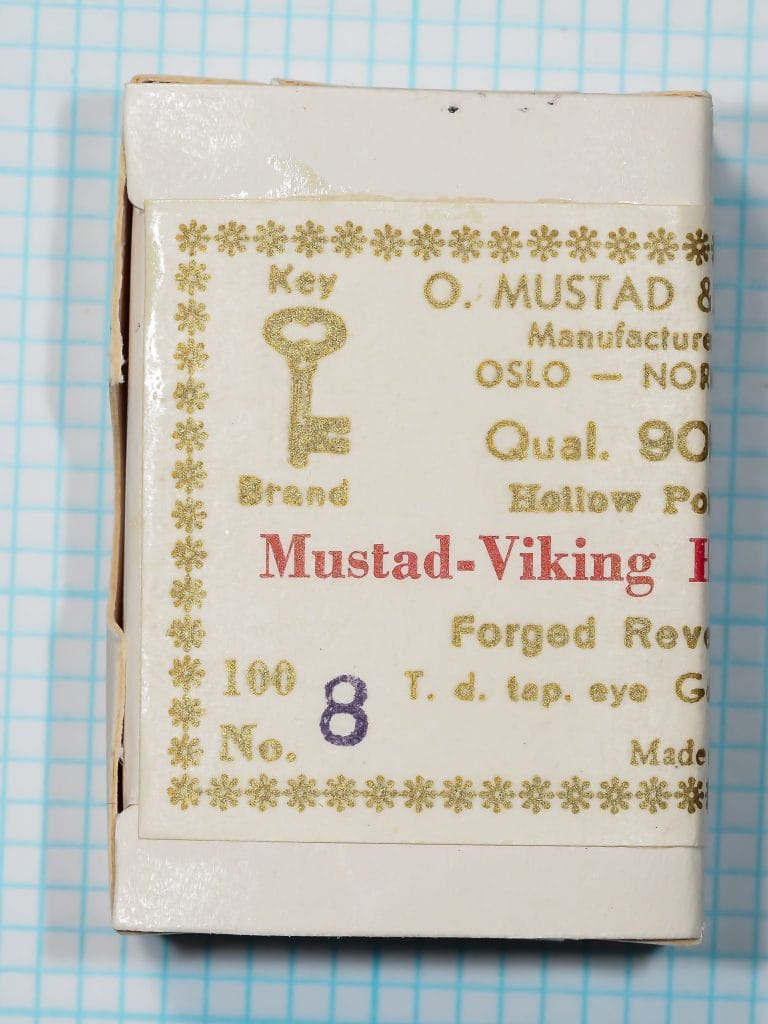
The Mustad 9094 is a mid-20th-century Viking-pattern hook manufactured by O. Mustad & Son in Oslo, Norway. This fine-wire, gold-plated hook features a turned-down tapered eye and hollow point, combining delicate presentations with reliable penetration. Sizes 8 and 9 are documented on vintage packaging.
Defining features include the characteristic Viking bend — a parabolic geometry sitting between a standard Sproat and Aberdeen — paired with a forged but non-offset construction. The gold electroplating was marketed as both an aesthetic and functional choice, providing underwater visibility and visual appeal to traditional fly tyers and bait anglers.
Dating evidence includes the Oslo-Norway origin line (post-1925), the decorative gold foil letterpress label design, and the absence of a barcode, all consistent with 1950s–1970s production. The packaging typography and abbreviations (T. d. tap. eye, Goldplated) reflect Mustad’s mid-century labeling conventions, predating the company’s transition to the Signature Series model codes in the early 2000s.
The 9094 occupies a modest place in Mustad’s catalog as a crossover hook appealing to regional bait anglers and traditional fly tyers. It is moderately scarce in original packaging today, making it of interest to collectors of vintage Mustad production and mid-century trout tackle.
Original packaging for Mustad 9094 hooks, marked Qual. 9094, Hollow Point, Forged Reversed, gold-plated finish. Made in Norway.
Photographic record
8 cataloged imagesSelect any record to load it above.
8 images shown
Mustad 9094 Vintage Hook Box LabelOriginal packaging for Mustad 9094 hooks, marked Qual. 9094, Hollow Point, Forged Reversed, gold-plated finish. Made in Norway.Open originalMustad 9094 Box Label Detail – Manufacturer TextEnlarged view of package specifications: O. Mustad & Son, Oslo-Norway. Qual. 9094, Hollow Point, Forged Reversed.Open originalMustad 9094 Pair – Profile ViewTwo size 8 Mustad 9094 hooks in gold plate finish showing the reversed offset bend and looped eye.Open originalMustad 9094 Single Hook – Side ProfileMustad 9094 in profile showing extended shank, reversed offset, and fine point taper.Open originalMustad 9094 Size 9 Hook Box – LabelOriginal package label for size 9 Mustad 9094 hooks. Specifications note Hollow Point, Forged Reversed, gold-plated finish.Open originalMustad 9094 Hollow Point Detail – Angled ViewAngled view of Mustad 9094 showing the hollow point construction and reversed offset.Open originalMustad 9094 Top View – Bend GeometryOverhead view of Mustad 9094 displaying the complete reversed bend and eye loop.Open originalMustad 9094 Pair – Vertical OrientationTwo Mustad 9094 hooks arranged vertically in gold-plated finish, showing looped eyes and reversed offset geometry.Open original
Technical profile
Eye
Tapered Eye, Turned Down
Wire
Fine (1X Fine), Round
Shank
Standard — Plain
Bend
viking, Standard gap, Offset / kirbedViking bend — characterized by a slightly shorter shank and wider, more rounded gap compared to standard Sproat or Limerick. The bend is smooth and parabolic, positioned between an Aberdeen and Sproat geometry. P
Point
Hollow Point (concave inner face)
Finish
Gold-Plated — Confirmed (stated on packaging)Bright 24-karat gold electroplating over high-carbon steel. The gold tone is warm and consistent across the hook surface. Finish shows minor wear and patina on specimen but maintains good luster, typical of vintage gold-plated hooks that have been stored dry. P
Hollow Point Engineering: The hollow point is mechanically ground with a distinctly concave inner face, creating an incredibly sharp, razor-like edge that flares rapidly toward the barb. This geometry minimizes penetration force, making it ideal for soft-mouthed species. The concave silhouette is achieved through a curved grinding pass on the inner edge, contrasting sharply with the superior point (near-straight inner taper) or spear point (uniform wedge).
Forged Construction: The label notation ‘Forged’ indicates that the hook wire has been subjected to a mechanical drop-press, flattening it along lateral sides to increase structural rigidity and tensile strength. This cold-forging process dramatically alters the metallurgy without adding bulk, effectively preventing the hook from bending open or straightening under extreme stress. The 9094’s fine wire gauge benefits significantly from forging, which maintains delicate penetration capability while preserving holding power.
Tapered Eye Design: The turned-down tapered eye (T. d. tap. eye) is created by gradually reducing the wire diameter as it forms the terminal loop. This intentional reduction in wire mass at the head significantly decreases overall weight, critical for dry fly or light-presentation applications. The taper ensures that flies float properly and horizontally on the water’s surface, preventing nose-heavy sinking that would occur with a full-diameter ball eye.
Gold Electroplating: The 24-karat gold electroplating is applied post-manufacturing via electrochemical deposition, creating a bright, warm-toned protective layer approximately 0.5–2 microns thick. Gold provides moderate corrosion resistance and high underwater visibility — historically marketed as visually appealing both to anglers (seeing flash in the water) and to fish (a wavelength-dependent attraction mechanism debated but valued by vintage tyers). The gold finish is less durable than tinning or heavy japanning but preferred for aesthetic and traditional fly tying applications.
The Mustad-Viking is a specific pattern within Mustad’s broader catalog of regional ‘cloned’ hook designs — a strategy whereby the company reverse-engineered hooks favored by local blacksmiths and regional anglers worldwide and manufactured them at industrial scale for global distribution. The Viking designation likely reflects Scandinavian heritage or association with northern European fishing traditions, though historical documentation on the exact origin is limited.
The Viking pattern is characterized by a parabolic bend (intermediate between an Aberdeen and a Sproat), a notably wide gap relative to shank length, and a short, stout construction. The 9094 specifically represents the mid-tier quality designation (9000+ series), indicating a hook manufactured to exacting dimensional and tempering standards rather than an economy model.
The 9094 was marketed throughout the 1950s–1970s as a versatile crossover hook suitable for both bait fishing (salmon eggs, live minnows, panfish applications) and fly tying (egg patterns, small wet flies, nymph imitations). The hollow point and gold plating were deliberate design choices optimized for light-tackle, finesse presentations on trout and panfish. The hook was discontinued sometime in the late 1980s or early 1990s as Mustad streamlined its catalog, though remnant stock persisted in tackle shops well into the 1990s.
No documented variants exist with alternative finishes (tinned, blued, bronzed) on the 9094; the gold plating appears to have been the sole finish offered. Size 8 and size 9 are the most commonly encountered, with larger sizes (10, 11) appearing less frequently in surviving cards.
Era and Packaging Dating
Geographic origin shows OSLO – NORWAY, indicating production after January 1, 1925 when the Norwegian capital was officially renamed from Christiania to Oslo. Packaging typography, gold foil letterpress printing technique, and label layout are consistent with mid-20th-century Mustad production. No barcode present (strong pre-1974 indicator). Decorative asterisk border design is typical of 1950s–1970s hook packaging. The use of 'T. d. tap. eye' abbreviation and 'Goldplated' terminology align with mid-century Mustad labeling conventions. Typography and printing method suggest 1950s–1970s range rather than earlier or later production.
The Key Brand: A Logo That Conquered Global Markets
The 'Key Brand' logo on the 9094 packaging — a downward-pointing skeleton key — was adopted by Mustad in the early 1900s as a deliberate psychological marketing tool targeting global markets with low literacy rates. In many regions where Mustad exported hooks, anglers could not read English text, so the company trained dock workers, merchants, and wholesalers to recognize the distinctive key symbol. An angler seeking a reliable fishing hook would simply ask for 'the Key hooks,' making the brand recognizable across linguistic barriers. This strategy proved devastatingly effective: by the 1950s, when the 9094 was in production, Mustad had secured approximately 50% of the global hook manufacturing market—a dominance unmatched by any competitor. The skeleton key became so iconic that fishing communities in Scandinavia, America, and Britain continued associating the symbol with quality well into the modern era.
Design lineage and influence
Best matchRelated by Attribute
Computed automatically from catalog data — updated as new hooks are added.
Matches: Bend, Eye, Point, Offset, Shank Feat. +1 moreDiffers: Eye Orient.: Turned Down vs Turned Up; Finish: Gold-Plated vs Bronzed; Forging: Round vs Forged
Matches: Bend, Gap, Eye, Eye Orient., Point +2 moreDiffers: Shank: Standard vs Short (1X–2X Short); Wire: Fine (1X Fine) vs Standard; Finish: Gold-Plated vs Bronzed +5 more
Matches: Bend, Shank, Gap, Eye, Eye Orient. +4 moreDiffers: Wire: Fine (1X Fine) vs Standard; Finish: Gold-Plated vs Bronzed; Forging: Round vs Forged +3 more
Matches: Bend, Wire, Gap, Eye, Point +3 moreDiffers: Shank: Standard vs Short (1X–2X Short); Eye Orient.: Turned Down vs Turned Up; Finish: Gold-Plated vs Bronzed +2 more
Matches: Bend, Shank, Gap, Eye, Eye Orient. +3 moreDiffers: Wire: Fine (1X Fine) vs Standard; Finish: Gold-Plated vs Bronzed; Forging: Round vs Forged +5 more
The Mustad 9094 Viking is a versatile crossover hook designed for both bait fishing and fly tying. In bait fishing, the wide gap and short shank make it ideal for salmon eggs, corn, and small live baits targeting trout and panfish. The gold plating provided historical appeal for anglers who believed it blended naturally with bait presentations. In fly tying, the hook was used for short-bodied wet flies, egg patterns (Glo-Bugs), and small streamer applications. The hollow point ensures rapid penetration with minimal force, making it suitable for soft-mouthed species like crappie, bluegill, and creek chub.
Secondary Applications
Steelhead bait fishing, small salmon smolt presentations, nymph patterns
Classic Fly Patterns
Glo-Bug, Egg Fly, small wet patterns
Modern Equivalents
Hook
Match Quality
Notes
Mustad 9523NP
Very Good
Modern Viking-pattern live bait hook with similar wide-gap, short-shank profile. Lacks gold plating and uses modern model code system.
Tiemco 2457
Good
Wet fly hook with short shank and tapered eye. Similar gap profile but different bend geometry.
Tiemco 2487
Good
Short-shank wet fly hook with tapered eye. Comparable light-wire construction.
Collector notes
Rated 4.5/10. Moderately scarce in original packaging with all 100 hooks intact; common in larger, less desirable sizes but size 9 represents a sweet spot for small-bait and egg-pattern fishing. Collector demand is modest among mid-century Mustad enthusiasts and traditional fly tyers seeking vintage gold-plated hooks.
Reference value
$9 – $12 USD estimate
Packaging condition
Very Good — light wear, fully legibleRecorded specimen
Packaging format
Mustad-vintage-card-letterpress-gold-foilCatalog code
Positive factors: Original packaging with complete hook count is increasingly uncommon (most cards have been opened and hooks used or lost). The gold-plated finish appeals to fly tyers and collectors of vintage presentations. Mid-century dating (1950s–1970s) places it in the era before barcode standardization, making it historically significant. Size 9 is desirable for realistic trout bait and small egg patterns — not too large, not too small. The preserved Oslo-Norway label is a strong authentication feature.
Limiting factors: Mustad hooks were mass-produced at enormous volumes, keeping overall rarity modest compared to Redditch or Japanese specialty makers. The 9094 was not a flagship pattern (unlike the famous 94840 dry fly hook); it occupies a niche between dry and wet categories, limiting appeal. Modern alternatives are readily available at lower cost. The fine wire and tapered eye limit durability for heavy applications, reducing secondary-market demand from active anglers.
Value drivers: Sealed or nearly-complete cards command significant premiums (30–50% above loose hooks). Size 9 and size 8 are most desirable; larger sizes (10, 11) are more common and worth less. Gold-plated finish is a strong visual draw and justifies higher prices. Packaging condition and label legibility are critical — faded or heavily toned cards lose 20–30% value.
Condition factors: Complete card with 100 intact hooks is essential for top value. Any missing hooks reduce price by ~2–3% per hook. Fading or water staining on the label knocks down value by 10–20%. Hooks with patina or light corrosion are acceptable (gold-plated hooks naturally develop this); however, active rust or pitting reduces value significantly.
Packaging
Cardboard sales card, approximately 2.5" × 3.5". White card stock with gold foil letterpress printing on label panel. Label features decorative asterisk border on all sides. Text includes Key Brand logo (skeleton key), manufacturer line (O. MUSTAD & SÖN), geographic origin (OSLO – NORWAY), quality code (Qual. 9094), point type (Hollow Point), pattern name (Mustad-Viking Hooks) in red ink, shank/finish descriptor (Forged Reversed T. d. tap. eye Goldplated), quantity (100 No.), and size designation (9) in purple ink. Made in Norway statement. All 100 hooks present on card, arranged in five neat rows of 20.
Market Value Notes
Low ($9): Good condition, complete card with all 100 hooks, light label toning, minor wear.
High ($12): Excellent/near-mint condition, bright card, complete hook count, minimal label wear.
Premium factors: Sealed or near-sealed condition; size 9 (sweet spot for collectors); intact original package; clear, legible label; minimal toning or water marks.
Platforms: Based on 2 eBay sold listing(s) from Apr 2023–Apr 2026, avg $8.79, range $7.19–$11.99. Additional market data from dealer inventory suggests $9–$14 for cards in excellent condition.
Confidence: V verified — anchored by eBay sold price history; range accounts for normal variance in condition and completeness.
Where to Find
eBay (UK and US listings, search 'Mustad 9094'), vintage tackle dealers specializing in mid-century Mustad, tackle shows and auctions in the UK and US, occasional Etsy vintage fishing listings.
Collector's Identification Tips
Identify by: (1) Qual. 9094 model code on label; (2) Mustad-Viking Hooks text in red ink; (3) gold electroplating visible on hook; (4) Oslo-Norway origin; (5) size number (8 or 9) in purple ink on card; (6) Hollow Point designation on label. The 9094 can be confused with other Viking-pattern variants — verify the exact model code on the packaging. Presence of all 100 hooks on original card adds significant value.
eBay market reference. Researcher-curated. Prices in USD. Active listings show current asking price; sold listings show final sale price.
Preservation
Storage and Preservation
Store original packaging in a cool, dry location away from direct sunlight and moisture. The card stock is vulnerable to humidity and may warp or yellow with age; use archival-quality storage boxes or acid-free sleeves if housing multiple cards. The gold-plated finish naturally develops a warm patina over decades, which many collectors find desirable — do not attempt to remove this patina with polishing compounds, as it may damage the underlying plating.
If hooks are removed from the card, store them in a sealed plastic or glass container with a small packet of silica gel to prevent corrosion. Avoid storing in basements or attics where temperature and humidity fluctuate. The tapered eye is delicate — handle with care to avoid bending. Do not store near other ferrous metals, which can promote galvanic corrosion through contact with the gold plating. Original packaging adds 25–40% to value compared to loose hooks; preserve the card whenever possible.
Primary Source
Label Decryption: The Eight-Line Mustad Format
Source: Mustad Vintage Label Typology and Decryption (garrenwood.com reference document)
The 9094 card exemplifies Mustad’s standardized eight-line labeling system. Line 1: O. MUSTAD & SÖN (manufacturer identity). Line 2: Manufacturers (supply chain role). Line 3: OSLO – NORWAY (geographic origin; post-1925 designation). Line 4: Qual. 9094 (quality/model code in the 9000+ premium tier). Line 5: Hollow Point (point type — exclusively reserved for point geometry per Mustad protocol). Line 6: Mustad-Viking Hooks (pattern name and series identifier). Lines 7–8: Forged Reversed T. d. tap. eye Goldplated / Made in Norway (shank and finish modifiers).
The presence of the traditional arbitrary numeric quality code (9094) rather than a modern Signature Series code (e.g., R50, V72) confirms pre-2001 manufacture. The gold foil letterpress printing and decorative asterisk border are hallmarks of 1950s–1970s Mustad labeling, distinguishing this from earlier Christiania-era cards and later modern offset-printed cards. The specific abbreviation ‘T. d. tap. eye’ reflects mid-century shorthand; modern cards spell out ‘Turned-Down Tapered Eye’ in full.
Marking Analysis
Hand-Marked Size Designation
The size number (9) is hand-stamped in purple ink in the bottom-left corner of the card, replacing what would have been pre-printed size numbering. This hand-stamping practice is typical of Mustad’s mixed retail/wholesale packaging of the 1950s–1970s, where bulk cards were printed with placeholders and size numbers were added post-production to allow flexible stock management. The purple ink is consistent with period-appropriate rubber stamp inks and shows uniform pressure across the numeral, indicating use of a dedicated size stamp rather than handwriting. This manufacturing detail supports the dating evidence and reflects the scale of Mustad’s operation — producing generic cards that could be customized by size on demand.
Size Note
The Mustad Numeric Sizing System: Size 9 Equivalence
Mustad’s vintage numeric sizing is not directly equivalent to modern fly hook or bait hook standards. Size 9 on the 9094 card represents a small to medium bait hook, approximately 0.64″ overall length and 0.19″ gap width — comparable to modern size 10 or 12 dry fly standards, but classified as a ‘small bait’ hook in Mustad’s mid-century commercial taxonomy. The designation ‘No. 9’ appears on the card (not ‘#9’); Mustad used ‘No.’ for bait-pattern sizing and ‘#’ for fly-specific patterns.
The gap width of ~0.19″ places this hook in the light-tackle, finesse category. Anglers purchasing a size 9 Viking from the original packaging would have understood it as suitable for live minnows, salmon eggs, and small dace — not as equivalent to a modern ‘size 9’ hook, which refers to entirely different dimensional standards. This sizing nomenclature reflects pre-standardization fishing tackle conventions and is a source of confusion for modern collectors unfamiliar with vintage catalogs.
Additional
The Hollow Point: Mechanics of Rapid Penetration
The hollow point on the 9094 is engineered with a distinctly concave inner face — visible in profile photography as a dished-out curve running from the tip down to the barb base. This geometry differs fundamentally from a superior point (near-straight inner taper) or a spear point (uniform wedge). The mechanical advantage of the hollow point lies in its ability to achieve initial penetration with absolute minimal applied force.
When the hook tip contacts tissue, the rapid flare of the hollow point — widening quickly from the microscopic tip to the barb shoulder — creates an incredibly fine, razor-sharp edge. This geometry was deemed essential by Mustad for soft-mouthed species (crappie, panfish, certain trout) where aggressive hook-setting would merely tear the friable buccal tissue. The 9094’s hollow point allows the fish to hook itself against light line tension, increasing success rates on live bait presentations. Once the tip penetrates past the barb, the hook secures firmly in soft tissue without creating an excessively large entry wound that could tear open under the strain of the fight — a critical advantage in finesse presentations with light tackle.
Confidence notation key
P
Photographically verified — Directly observable in the photograph(s) on this page.
V
Verified by documentation — Confirmed by manufacturer catalog, spec sheet, or published reference.
I
Inferred — A logical deduction from observable or documented evidence, not directly stated.
E
Estimated — An approximation based on visual comparison, proportional analysis, or limited data.
S
Speculative — A reasoned hypothesis that cannot be confirmed from available evidence.
Unnotated claims are the compiler’s synthesis; see Sources. All photographs on garrenwood.com are taken on a measurement grid where each square equals 1/10 inch (0.1″ / 2.54 mm).