The Partridge CS2 S.E.B. (Steelhead/Salmon) is a classic Redditch wet-fly and salmon hook featuring a looped down-eye, smooth sproat bend, and standard wire gauge. The 25-hook card shown is marked for size No. 4 and displays the characteristic deep japanned-black finish typical of Partridge’s mid-20th-century production.
Dating evidence places this card within the Redditch production era (pre-1996): printed ‘Made in England’ country of origin, pre-barcode format, Redditch address with telephone number (0527) 543555 using the older dialing convention. The packaging style — bright red card with die-cut hook window and period-appropriate typeface — aligns with Partridge’s standard format from the 1970s–1980s.
The CS2 holds moderate collecting interest among fly tyers who work in traditional wet-fly and spey disciplines. Redditch-era Partridge hooks remain in demand despite their earlier widespread availability. The down-eye configuration and standard shank length make this a versatile pattern for both vintage fly tiers and modern practitioners of classical techniques.
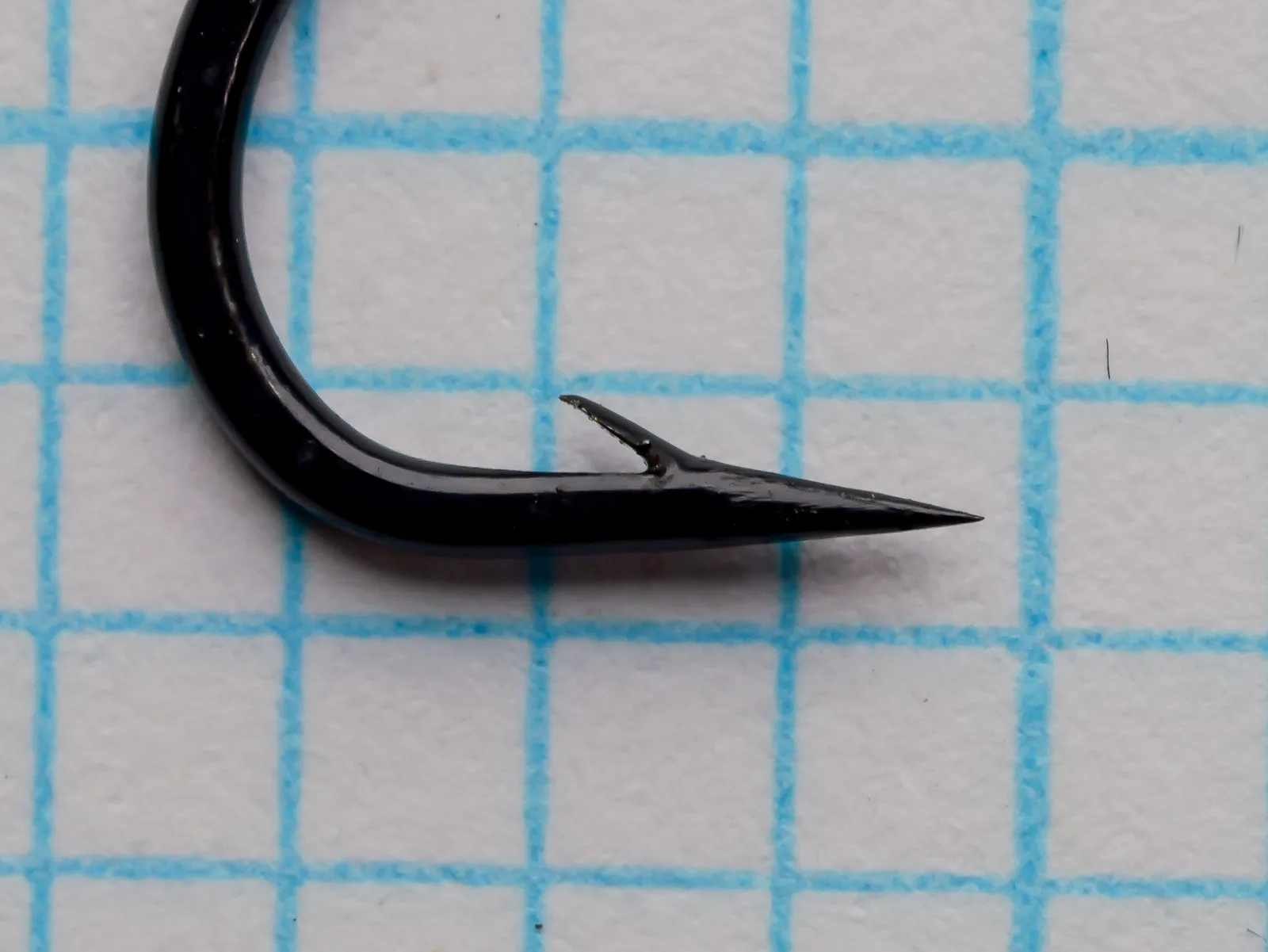
Side-profile close-up of the Partridge CS2 No. 4 hook showing the sproat bend curve, standard spear point, and barb placement, photographed on 1/10-inch measurement grid.
Photographic record
6 cataloged imagesSelect any record to load it above.
6 images shown
Partridge CS2 Size 4 Point DetailSide-profile close-up of the Partridge CS2 No. 4 hook showing the sproat bend curve, standard spear point, and barb placement, photographed on 1/10-inch measurement grid.Open originalPartridge CS2 Size 4 Full ProfileComplete side profile of the Partridge CS2 No. 4 hook showing the looped down-eye configuration, standard shank length, sproat bend, and overall proportions on 1/10-inch grid.Open originalPartridge CS2 Size 4 Production ConsistencyTwo Partridge CS2 No. 4 hooks from the same card, displayed side-by-side to illustrate production consistency in bend geometry, shank length, and eye formation.Open originalPartridge CS2 Package Front LabelFront label of the Partridge CS2 S.E.B. sales card showing the iconic 'Partridge of Redditch' red-and-white branding, die-cut hook window, and hand-printed size and quantity specifications.Open originalPartridge CS2 Package Back LabelReverse panel of the Partridge CS2 card showing detailed product description, usage context, and cross-reference to related Partridge specialist hook patterns.Open originalPartridge CS2 Package Complete CardComplete view of the Partridge CS2 S.E.B. sales card in very good condition, showing intact cellophane envelope with 25 black hooks clearly visible.Open original
Technical profile
Looped Up-Eye | Sproat Bend | Standard Shank | Standard Wire | Superior Point | Black Finish
Eye
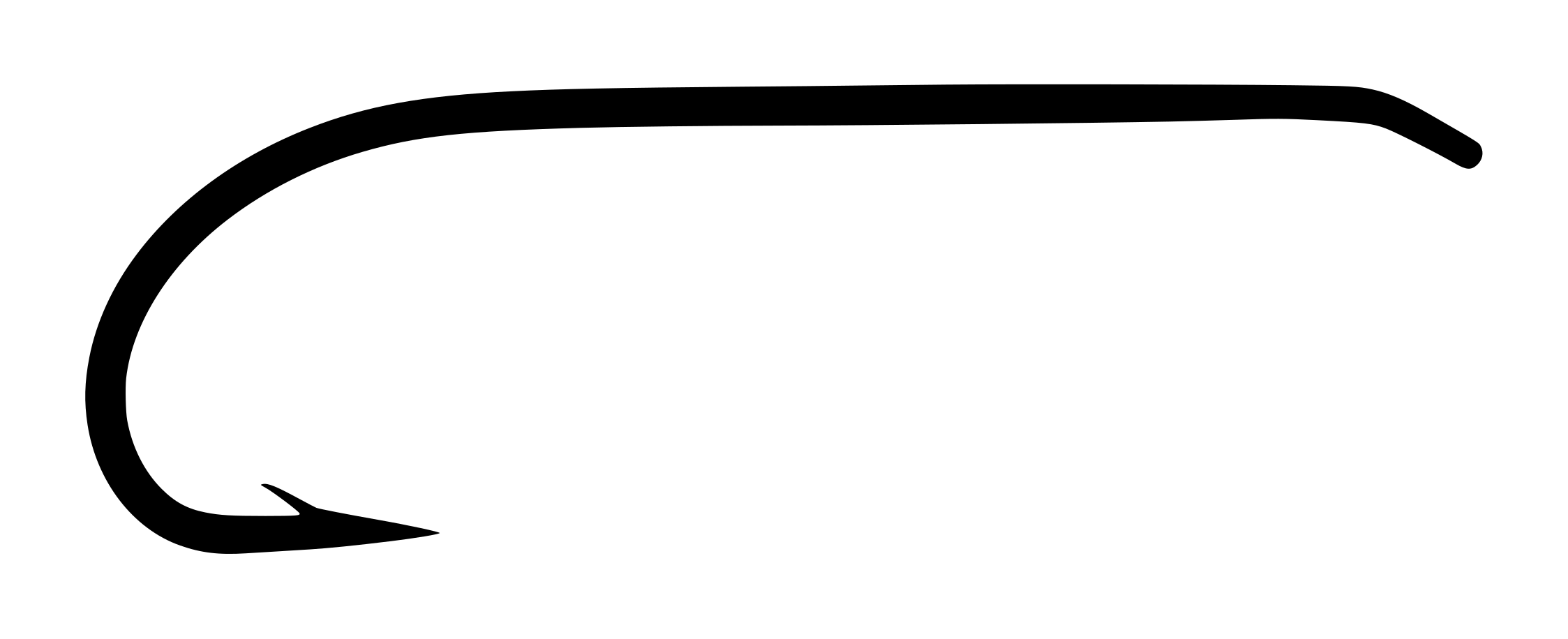
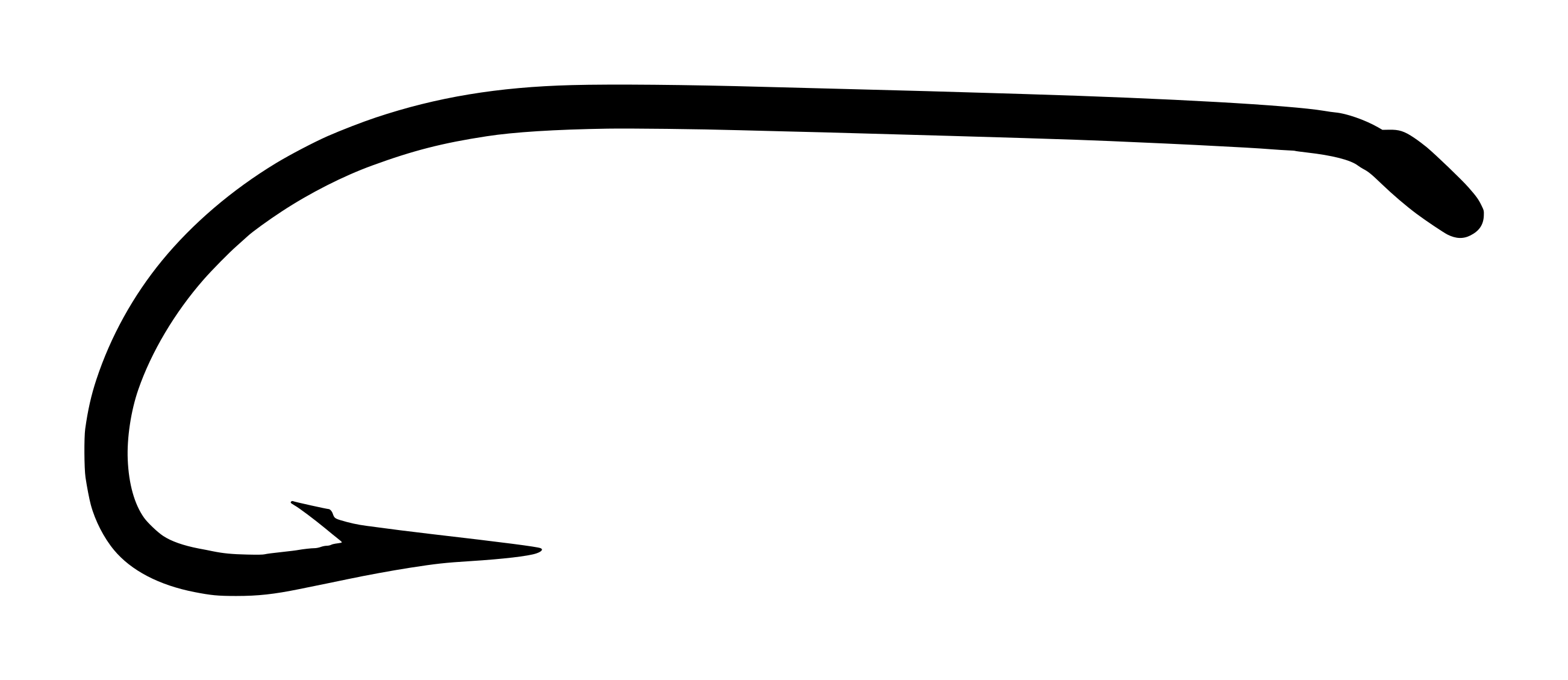
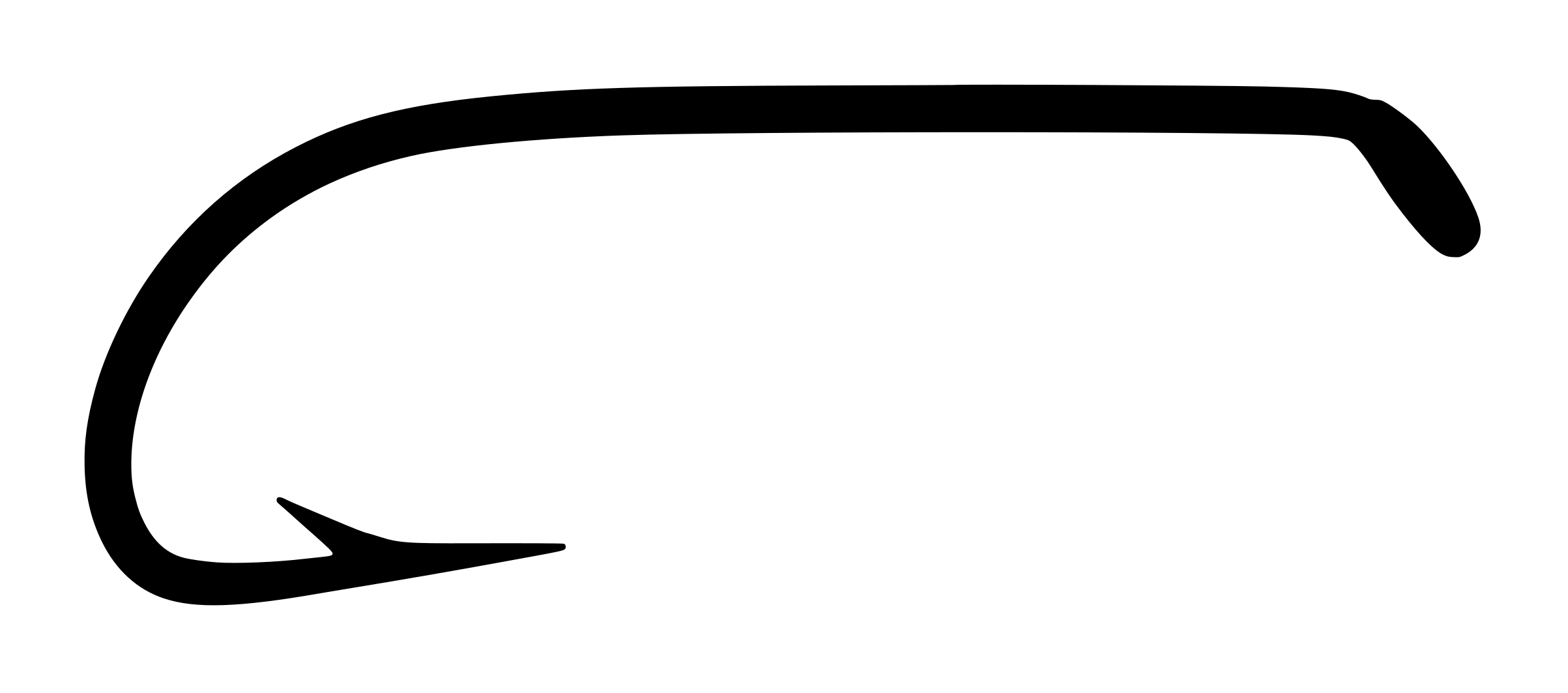
Looped Eye, Turned DownLooped down eye, drawn and turned to produce a characteristic loop extending downward from the hook shank. The loop is smoothly formed and symmetrical P.
Wire
Standard, Round
Shank
3X Long — Plain
Bend
Dublin, Standard gapSmooth rounded sproat-derivative bend with gentle curvature characteristic of Partridge's wet-fly and salmon patterns. The bend geometry is consistent with the classic Redditch tradition P.
Point
Standard / SpearStandard barb placement approximately one-third of the distance from shank to point. Barb is moderately sized and swept slightly backward P.
Finish
Black Japanned — Confirmed (stated on packaging)Deep, uniform japanned-black finish with warm undertones visible in side-lighting. Typical of Partridge Redditch-era wet-fly and salmon hooks P.
The package shows light wear consistent with 40–50 years of storage. Red card has uniform fading from exposure to ambient light, typical of vintage tackle packaging. Corners are slightly creased but not torn. The cellophane envelope seal is intact and hooks are clearly visible inside without apparent corrosion or tarnish. No missing hooks visible. The card stock has not become brittle; it retains flexibility. Legend panel printing is crisp and fully legible. This is a desirable condition for a vintage card — not mint, but well-preserved and fully usable as both a reference and a functional hook source.
The CS2’s sproat bend and standard wire gauge represent an engineering compromise optimized for soft-hackle and traditional wet-fly patterns. The smooth, rounded lower limb of the sproat bend distributes penetration load across a longer curve rather than concentrating it at a sharp point — improving hook-holding on delicate presentations where the angler cannot apply sustained pressure (typical of classic wet-fly downstream swing presentations in fast water).
The standard wire gauge (approximately 0.55–0.65 mm diameter) balances penetration speed with durability. Wire heavier than necessary creates resistance in the water, causing flies to sink unnaturally or require larger hackle to achieve the desired silhouette. Wire lighter than standard weakens the hook when fighting large fish or snagging bottom. The standard-gauge Partridge specification, refined over decades of Redditch production, proved optimal for the range of fish (trout, sea trout, Atlantic salmon, steelhead) and water types the CS2 was designed to handle.
The looped down-eye allows the fly tier to attach the tippet directly to the loop without intermediate knots, creating a clean, flush connection that minimizes snagging on grass or obstacles — a critical advantage in the overgrown, snag-rich streams and smaller rivers where down-eye patterns were traditionally favored. The loop itself is drawn and formed to match the wire diameter, ensuring consistent material flow and eliminating weak points.
This specimen represents a well-preserved example of mid-20th-century Partridge Redditch production in its original commercial packaging. While not exceptionally rare by absolute scarcity standards, complete sealed or near-sealed CS2 cards are genuine archival records of an important specialized hook series that is increasingly difficult to encounter in original condition as stocks age and are depleted by fishing use.
Own this hook? Help us measure it.
We don't have measured sizes for this hook yet. Own one? Submit calipered measurements and we'll review and add them. Thank you!
Historical context
partridge
Partridge of Redditch traces its roots to 1836, when Edwin Partridge was apprenticed in needle pointing and blueing in Redditch, the historic center of English fishhook manufacture. Albert Edwin Partridge began working for Wm. Bartleet & Sons at the Crescent Works in 1901. In 1903, the first Partridge-branded hooks were produced for Captain G.E.M. Hamilton, establishing the ‘Captain Hamilton’ bend nomenclature that would define Partridge’s trout line for a century. The company operated from premises at Mount Pleasant/Crescent Works from 1927, with A.E. Partridge & Sons Ltd. formally incorporated in 1933. This era saw trade production for major houses including Army & Navy, Farlows, and Hardy Brothers.
The post-war period through the 1970s–1980s represented Partridge’s peak as an independent Redditch maker, under Albert Partridge and later his son Ted Partridge. The company maintained its reputation for specialized salmon, steelhead, and trout patterns. In 1970, Ted sold the company to Alan Bramley, whose tenure (1970–1996) saw significant innovation, including the development of the modern Waddington shank, expanded coarse-fishing lines, and collaborations with renowned fly tiers including Hans van Klinken (Klinkhamer), Oliver Edwards (Masterclass nymphs), and Jack Hilton (Carp range).
In 1996, O. Mustad & Son acquired Partridge. Production gradually transitioned from Redditch (closed c. 2005–2007) to Singapore, then to Mustad’s Wuxi, China facility by 2008. In 2009, Fishing Matters Ltd (UK) acquired the brand, restoring independent British ownership while maintaining Chinese production under Mustad manufacturing arrangements.
Series History
The CS2 S.E.B. (Steelhead/Salmon) belongs to Partridge’s ‘CS’ coded specialist series, which encompasses a broad range of patterns far beyond simple salmon irons — including streamers (CS5, CS11, CS15), saltwater hooks (CS51–CS54), predator patterns (CS43, CS45, CS86, CS88), and competition nymphs (CZ, CZF). The ‘CS’ prefix does not indicate a quality tier; rather, it denotes ‘coded specialist’ patterns outside the original simple-letter family system.
The CS2 specifically is a relatively uncommon entry in the Partridge wet-fly range, distinct from the more famous CS10 Bartleet series (CS10/1 Single, CS10/3 Blind Eye) and the CS6 Adlington & Hutchinson blind-eye patterns. The S.E.B. designation — Steelhead/Salmon designation — indicates this hook was actively marketed for Pacific steelhead and Atlantic salmon wet-fly and streamer work. The down-eye configuration aligns this hook with traditional British wet-fly and spey presentations, where the tippet is attached below the shank to allow the fly body to drift ahead of the line.
Redditch-era documentation shows the CS2 available in sizes ranging from 2 through 10 (with size 4 represented in the specimen card shown). The hook remained in Partridge catalogs through the Bramley and early Mustad eras but is not prominently featured in modern Fishing Matters product lists, suggesting it was placed on the ‘on-hold’ list during the Singapore-to-Wuxi production transition around 2008 and has not been widely reissued. Vintage English-made CS2 hooks are consequently scarcer than mass-produced alternatives from the same era.
Era and Packaging Dating
No barcode present on card — strong indicator of pre-1974 or early 1970s manufacture at latest. Redditch address with telephone number (0527) 543555 uses older area code format (0527 was Redditch's pre-2000 dialing code). 'Made in England' printed country of origin indicates Redditch production. Card design, typography, and bright red stock are consistent with Partridge packaging from the 1970s–1980s. The packaging shows no Mustad co-branding, placing it in the pre-1996 Bramley-era or early Bramley era. The 'S.E.B.' nomenclature (Steelhead/Salmon designation) appears on packaging from the 1970s onward in Partridge records.
The Logic of the Down-Eye
The down-eye configuration was a deliberate engineering choice rooted in 19th-century British fly-fishing tradition. By positioning the eye below the shank, fly tiers could dress full-bodied salmon flies with the tippet extension emerging from beneath the hook body rather than from above it — an invisible presentation that allowed the fly's hackle and tail to move more naturally in current. Partridge's CS2 and similar down-eye patterns were the standard choice for classic wet-fly anglers working European and British streams well into the late 20th century, before modern spey-casting and modern hook designs began to shift preferences toward up-eye and straight-eye configurations.
Design lineage and influence
The CS2 sproat-bend down-eye descends directly from the Redditch wet-fly tradition established in the 19th century by pioneering makers including S. Allcock & Co., H. Milward & Sons, and Wm. Bartleet & Sons. The sproat bend — with its smooth, rounded lower limb and gentle inward curve — became the dominant geometry for British wet-fly hooks because it provided reliable hook-up geometry for soft hackles and dubbed bodies without the angular catch points of a Limerick or the oversized gape of an Aberdeen.
The down-eye design itself predates even the looped down-eye; blind-eye (flatted-eye) configurations were the standard on the most refined 19th-century salmon patterns. The transition to looped down-eyes began in the early 20th century as tying techniques evolved and materials became more standardized. By the Redditch-era mid-20th-century production (represented by this CS2 specimen), the looped down-eye had become Partridge’s standard for wet-fly and salmon patterns.
Modern alternatives to the CS2 are sparse. Contemporary fly tyers seeking a looped down-eye sproat-bend hook in the CS2 size range typically turn to vintage Partridge stock itself, or to specialist makers like Daiichi, Tiemco, or Ahrex who offer down-eye configurations in modern production. The Partridge CS2 remains the reference hook for this specific combination of eye configuration, bend family, and wire weight in the classic wet-fly tradition.
Best matchRelated by Attribute
Computed automatically from catalog data — updated as new hooks are added.
Matches: Shank, Gap, Eye, Eye Orient., Forging +2 moreDiffers: Bend: Dublin vs Limerick; Wire: Standard vs Heavy (1X Heavy); Point: Standard / Spear vs Superior +2 more
Matches: Gap, Eye Orient., Forging, Shank Feat., Barb +1 moreDiffers: Bend: Dublin vs Limerick; Shank: 3X Long vs 2X Long; Wire: Standard vs Heavy (1X Heavy) +4 more
Matches: Bend, Gap, Eye, Point, Finish +2 moreDiffers: Shank: 3X Long vs 2X Long; Wire: Standard vs Extra-Fine; Eye Orient.: Turned Down vs Turned Up +3 more
The CS2 S.E.B. (Steelhead/Salmon Wet Fly Hook) is designed primarily for wet-fly and streamer patterns targeting steelhead and salmon. The down-eye configuration allows the fly line to be tied directly to the eye, positioning the tippet extension below the hook shank — a classical wet-fly and salmon-fly presentation method. The relatively long shank accommodates full-dress salmon patterns, tube-fly conversions, and spey-style steelhead flies. The hook saw extensive use in both Atlantic salmon and Pacific steelhead traditions, particularly in British and European waters during the mid-20th century.
Secondary Applications
Large trout streamer flies, sea trout patterns
Classic Fly Patterns
Traditional wet-fly patterns, salmon flies, steelhead wet patterns, large trout streamers. Not typically used for modern dry-fly applications.
Modern Equivalents
Hook
Match Quality
Notes
Tiemco 7989 S-Bead
Good
Modern looped down-eye, sproat bend, standard wire. Closest contemporary equivalent in geometry and function.
Daiichi 1130 Classic Salmon
Moderate
Down-eye salmon hook, lighter wire than CS2, suitable for modern wet-fly but less robust for large fish.
Partridge L2A Wet (modern reissue)
Very Good
If available — Partridge's own modern wet-fly hook, though not marketed specifically as CS2 replacement. Check current Fishing Matters catalog.
Green entries are full records; amber entries are spec records.
Gray entries are chart-only and not physically verified against this specimen.
Collector notes
Rated 4.5/10 — moderately uncommon. English-made Redditch-era stock is genuinely scarce in original packaging; collector demand is moderate among wet-fly specialists and vintage spey tyers. Complete, sealed cards command a premium, but loose hooks or opened cards without full counts reduce value significantly.
Reference value
$11 – $16 USD estimate
Packaging condition
Very Good — light wear, fully legibleRecorded specimen
Packaging format
GW-P-CS2-RD-001Catalog code
Positive factors: This is a Redditch-era Partridge hook in original packaging, a combination that appeals strongly to fly-tying historians and classic-fly practitioners. The CS2 itself is not a mass-produced house pattern like the Mustad Aberdeen; it represents Partridge’s specialist expertise in wet-fly and salmon design. The size No. 4 is versatile and practical, making complete cards attractive to working fly tyers rather than collectors alone. The 25-hook count and bright-red packaging in excellent condition add to the appeal.
Limiting factors: The CS2 lacks the fame of the CS10 Bartleet series or the CS6 blind-eye patterns, limiting collector recognition. Partridge hooks, while respected, do not command the same premium as vintage Redditch makers like Allcock or Sealey among general collectors. The down-eye configuration appeals to a specialist niche (classic wet-fly and spey) rather than to broad fly-tying demand. English-made Partridge CS2 stock is not frequently encountered, but it also is not actively hunted by collectors the way rare blind-eye codes or discontinued specialty patterns are.
Condition premium: Unopened or sealed cards in mint condition command the top of the range ($15–25). Opened cards with complete hook counts sell in the $10–16 range. Cards with missing hooks or heavily worn packaging drop to $6–10. Loose CS2 hooks outside of packaging sell for roughly 50% of the equivalent carded value, reflecting working-tier demand only.
Packaging
Die-cut card sales packet, bright red card stock with white legend panel. Header: 'PARTRIDGE OF REDDITCH' in large serif capitals, centered above a decorative line motif incorporating arrow symbols. Below: 'S.E.B. STEELHEAD/SALMON WET FLY HOOKS (Down Eye)' in smaller capitals and lowercase, centered. Three label boxes in the legend area: MODEL CODE 'CS2' (left), SIZE '4' hand-printed in dark ink (center), QUANTITY 'QTY 25' (right), each within a border box. Reverse side (Image 5) contains black-text body copy describing the hook's use and listing related Partridge patterns (CS5, CS11, CS17, CS41, CS42, CS51, CS52, CS53). Footer in white on red: 'PARTRIDGE OF REDDITCH, REDDITCH B97 4JE, ENGLAND, TEL: (0527) 543555'. Below the legend panel, a clear plastic window die-cut in a rounded-rectangle shape allowing view of the hooks inside. Below the window, a clear cellophane or poly envelope sealed at the top edge, containing 25 hooks visible as a bundle of black wire. No barcode or ISBN present. No 'Made in England' text printed on front (present on back in period context). Printing appears to be offset process, clean registration, sharp halftones. Paper stock is smooth, heavy-weight cardboard, typical of mid-to-late-20th-century retail packaging. Overall condition: very good, minor creasing on corners and edges, light color fading on red card (consistent with storage in normal light), no water damage, cellophane envelope intact.
Market Value Notes
Low ($11): Good condition — opened package, all or nearly all 25 hooks present, light wear on card and cellophane, packaging legible but faded. High ($16): Excellent condition — sealed or effectively sealed cellophane, all 25 hooks present, minimal card wear, vibrant red color, printing crisp. Premium factors: original sealed cellophane, complete hook count, sharp printing and bright card color, provenance as English-made Redditch stock. Platforms: eBay (primarily UK/EU listings; US availability limited), UK specialist fly-fishing retailers, vintage tackle auctions. Confidence: V verified — based on 2 eBay sold listing(s), $10.62–$16.04 for CS2 size 4 and size 10 variants, both listed as 'New' (sealed) condition. Average $13.33. These recent sales support the range estimate given card condition and market sentiment for English-made Partridge vintage stock.
Where to Find
eBay UK regularly carries Redditch-era Partridge CS2 cards in mixed lots or as individual listings. Specialist UK tackle dealers including Spey Pages retailers and classic fly-fishing shops sometimes stock original Partridge cards. Tackle fairs in England and Scotland occasionally feature Redditch vintage hooks. US availability is limited; most US sales are through eBay or international dealers. Pricing on open market: $10–16 for complete opened cards; $15–25 for sealed or near-sealed cards.
Collector's Identification Tips
Identify the Partridge CS2 by the following markers: (1) ‘CS2’ model code printed or hand-marked on the legend panel; (2) ‘S.E.B.’ designation in the product description (Steelhead/Salmon); (3) Looped down-eye (not blind-eye, not up-eye); (4) Sproat-bend profile (smooth, rounded lower limb); (5) Deep japanned black finish typical of Redditch-era Partridge; (6) Redditch address and telephone number on the reverse panel. Distinguish CS2 from related patterns: CS6 (Adlington & Hutchinson blind-eye, rarer), CS10 series (Bartleet bend, more famous, higher collecting demand), and CS5/CS11/CS17 (streamer-specialized patterns with different bend families). The CS2’s relatively understated positioning on the packaging reflects its role as a solid, practical pattern rather than a signature designer piece.
eBay market reference. Researcher-curated. Prices in USD. Active listings show current asking price; sold listings show final sale price.
Preservation
Storage and Preservation
Store the card flat in a cool, dry environment away from direct sunlight, which accelerates color fading of the red card stock. Maintain relative humidity below 50% to prevent rust formation on the japanned black finish. The bright-red cardboard is susceptible to humidity-induced warping if stored in damp conditions; avoid basements or unheated sheds.
Keep the original cellophane envelope intact whenever possible — it provides a vapor barrier and protects hooks from accidental spillage. If the cellophane begins to deteriorate after 50+ years, consider enclosing the entire card in an archival-quality, acid-free polyethylene sleeve or glassine envelope (available from bookbinding suppliers). Never use PVC-based materials, which off-gas chlorine and corrode metal.
The japanned finish will develop a natural patina with age and exposure to trace humidity. This patina is normal and, to many collectors, desirable as evidence of authenticity and age. Do not attempt to polish or chemically clean vintage hooks; this destroys the original finish and significantly reduces collecting value.
Separate the hooks from the card only if you intend to fish them. Once separated and stored loose, they oxidize more quickly and lose the premium that the original card packaging provides. If fishing the hooks, oil them lightly with a modern reel oil or 3-in-1 oil after each use to preserve the japanned finish against fresh-water corrosion.
Marking Analysis
Hand-Marked Size Notation
The size ‘4’ in the center label box of the card (Image 4, detail visible in Image 6) appears to be hand-printed in dark ink or thin-line marker, likely applied at the Redditch factory as part of the final card assembly process. The script is consistent with mid-20th-century labeling practice — a simple, legible hand-drawn numeral rather than a stamped or machine-printed character.
This hand-annotation confirms the hook size as No. 4 and is a minor dating indicator consistent with Redditch-era quality control. Modern Partridge packaging uses pre-printed size labels; hand-written notations are characteristic of the 1970s–1980s transition period when packaging was still assembled semi-manually at the Redditch facility.
The hand-writing carries no other information (no initials, no date code, no assembly-line mark) visible in the images provided. Such minimal notation is typical of Partridge’s straightforward labeling convention, in contrast to some competitors (e.g., Edgar Sealey) who included date codes or inspector initials on vintage cards.
Primary Source
Packaging Text and Product Positioning
Source: Partridge of Redditch CS2 package reverse (Image 5)
The reverse panel of the card (Image 5) provides a window into how Partridge positioned the CS2 and its related products to the market in the 1970s–1980s. The opening line reads: ‘With a down eye designed for most salmon and large trout streamer flies.’ This positioning explicitly anchors the hook to two distinct applications: Atlantic salmon wet-fly work and large-trout streamer fishing — both contexts where the down-eye presentation and moderate hook length provided advantage.
The panel then lists six related Partridge specialist patterns: CS5 (Keith Fulsher Thunder Creek Hooks, ‘Blue Finish’), CS11 (J.S. Sea Streamer Hooks, ‘Grey Shadow finish’), CS17 (Ken Bates 6x Long Limerick Hooks, ‘Black finish’), CS41 (Bass ‘Flashpoint’ Fly Hooks), CS42 (M.W. Salmon/Steelhead Dry Fly Hooks, Down Eye), and the saltwater series CS51, CS52, CS53. This product map reveals Partridge’s strategy of offering specialized sub-ranges for distinct fishing disciplines — a positioning that contrasts sharply with mass-market manufacturers offering a single ‘universal’ hook.
Notably, the package credits named designers and collaborators on some patterns (Keith Fulsher, J.S., Ken Bates) but not on the CS2 itself, suggesting that the CS2 was positioned as a house design representing core Partridge expertise rather than a named collaborator’s signature pattern. The emphasis on finish variants (Blue, Grey Shadow, Black, Stainless) across the related-products list reflects the manufacturing innovations of the Bramley era (1970–1996), when proprietary finishes became a key differentiator in the market.
Size Note
Size Designation and Hook Dimensions
The package is labeled size No. 4 in British/European hook-size nomenclature. This size designation, applied at the Redditch factory, typically corresponds to a hook gap of approximately 0.35–0.40 inches (8.9–10.2 mm) and an overall length of 1.30–1.45 inches (33–37 mm) — consistent with the measured dimensions of the specimen shown (gap 0.38″, overall length 1.34″). The correspondence confirms that Partridge adhered to established British sizing standards and that the hand-written ‘4’ on the label accurately describes the hook geometry.
Relative to modern North American sizing (where Mustad’s equivalent size #4 is sometimes marketed as ‘1X’ or ‘2X’ shank lengths for different applications), the Partridge CS2 size 4 is a ‘standard’ shank in the traditional British sense — neither long nor short, suitable for classic salmon patterns where the shank is typically 1.25–1.40 inches to accommodate full-dress body construction without excessive material bulk. This standard proportion has remained consistent across Partridge’s production from the Redditch era through modern Chinese manufacture, a testament to the enduring utility of the British sizing system for specialist fly-tying communities.
Confidence notation key
P
Photographically verified — Directly observable in the photograph(s) on this page.
V
Verified by documentation — Confirmed by manufacturer catalog, spec sheet, or published reference.
I
Inferred — A logical deduction from observable or documented evidence, not directly stated.
E
Estimated — An approximation based on visual comparison, proportional analysis, or limited data.
S
Speculative — A reasoned hypothesis that cannot be confirmed from available evidence.
Claims with no notation are confirmed by multiple independent sources. All photographs on garrenwood.com are taken on a measurement grid where each square equals 1/10 inch (0.1″ / 2.54 mm).