The Partridge Limerick Minnow ‘Turned Ends’ is a classic British wet-fly and small-minnow hook from the early 20th century, manufactured by Partridge of Redditch, England. This example in size No. 5 features a tapered blind eye (gut-loop attachment), a hallmark of craft-era Redditch production, and a traditional Limerick bend profile. The hook is bronzed and displays the original cream-colored paper envelope with blue letterpress printing, dated c. 1920s based on barcode absence, envelope format, and eye construction terminology.
The tapered blind eye — where the shank simply tapers to a smooth rounded point rather than being hammered flat — is a key historical marker. This construction method predates standardized spade-end (blind flatted) hooks and reflects the skilled hand production of pre-industrial Redditch makers. The ‘Turned Ends’ label on the packaging documents the period nomenclature for this feature.
Partridge of Redditch commanded significant respect among British anglers and international buyers for consistent quality and innovative designs. This Limerick Minnow represents the transition between craft production and industrial hook manufacturing. Collectors prize Partridge hooks from this era for their historical significance and functional beauty. The complete original envelope is a significant asset, as most surviving examples are loose hooks.
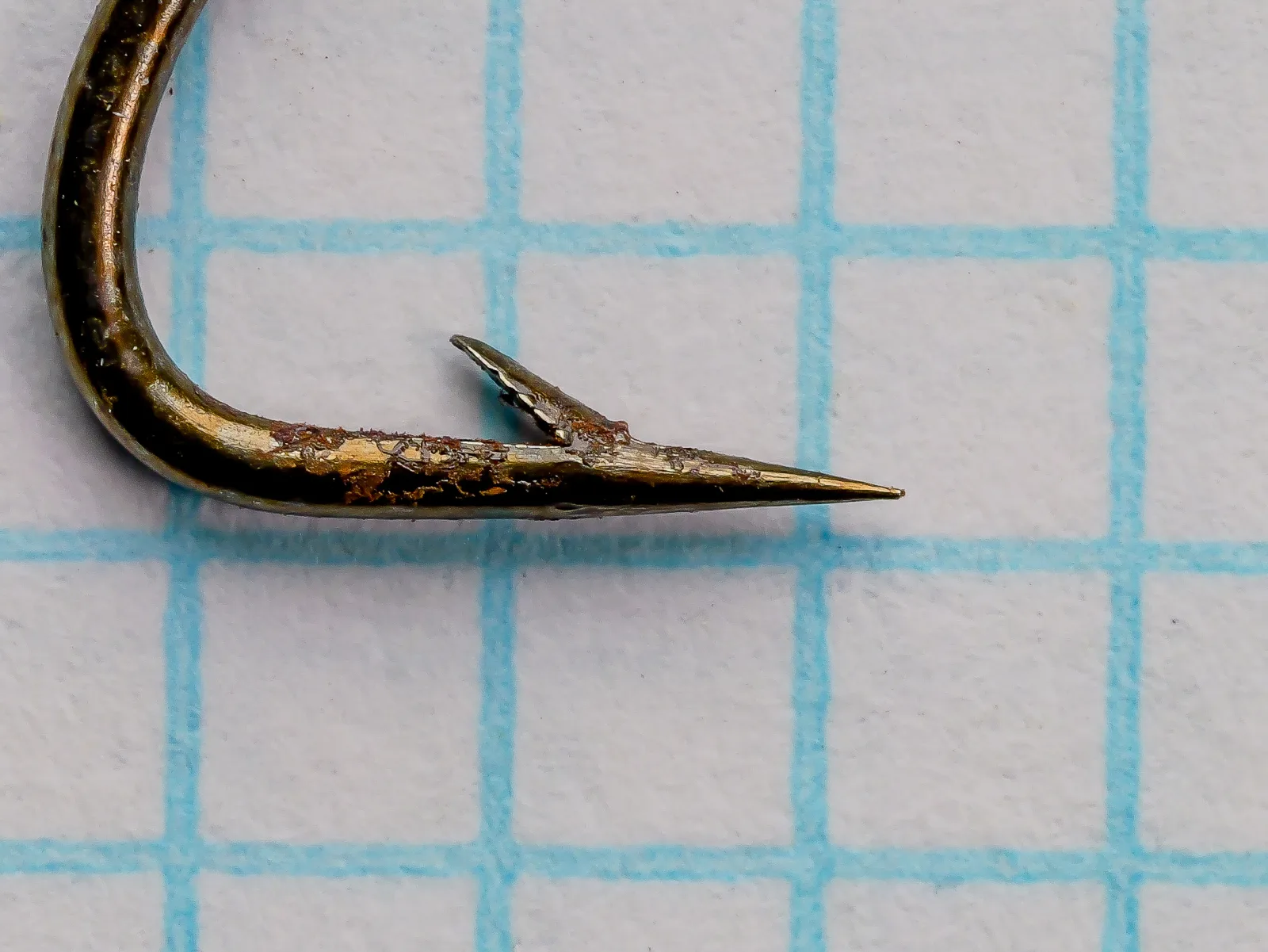
Profile view of the Partridge Limerick Minnow 'Turned Ends' (size No. 5) showing the characteristic angular Limerick bend, bronzed finish, and tapered blind eye extending to the right, on measurement grid.
Photographic record
3 cataloged imagesSelect any record to load it above.
3 images shown
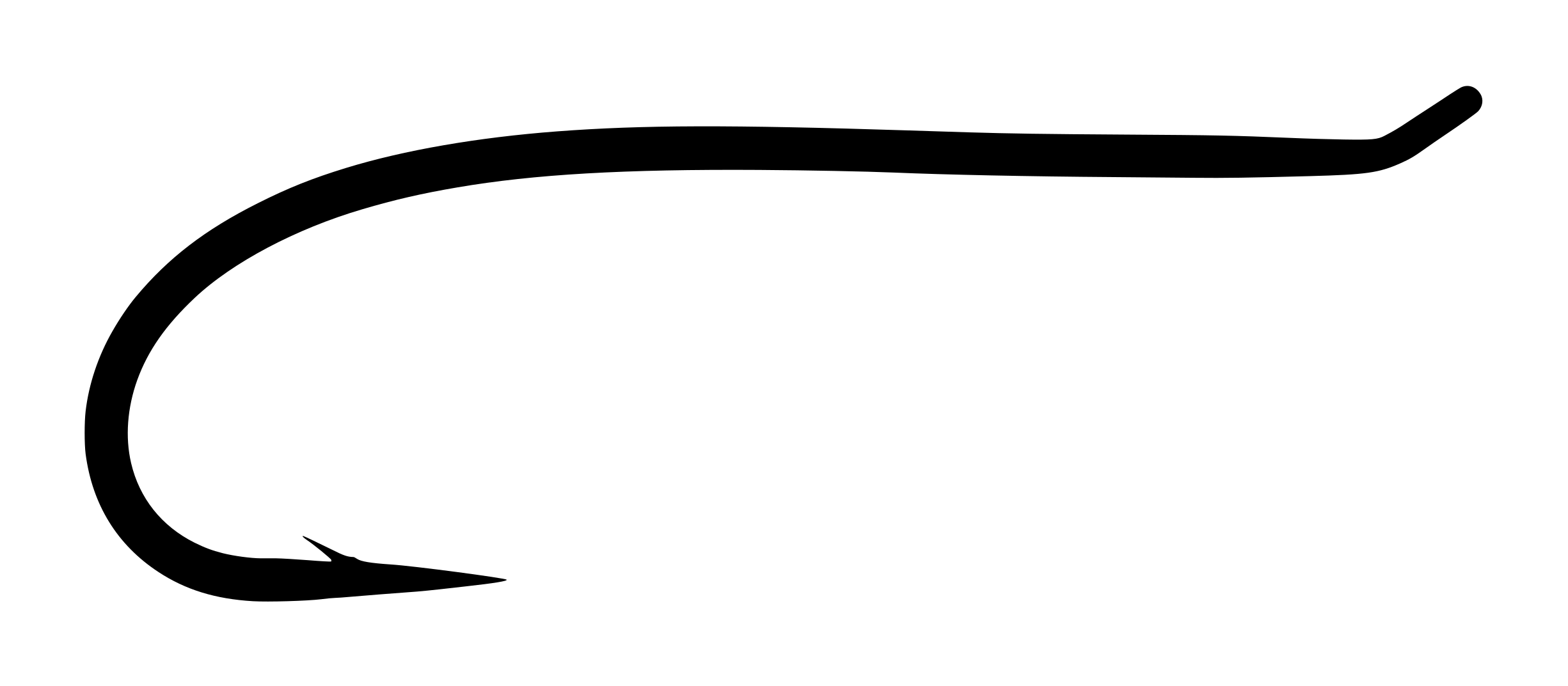
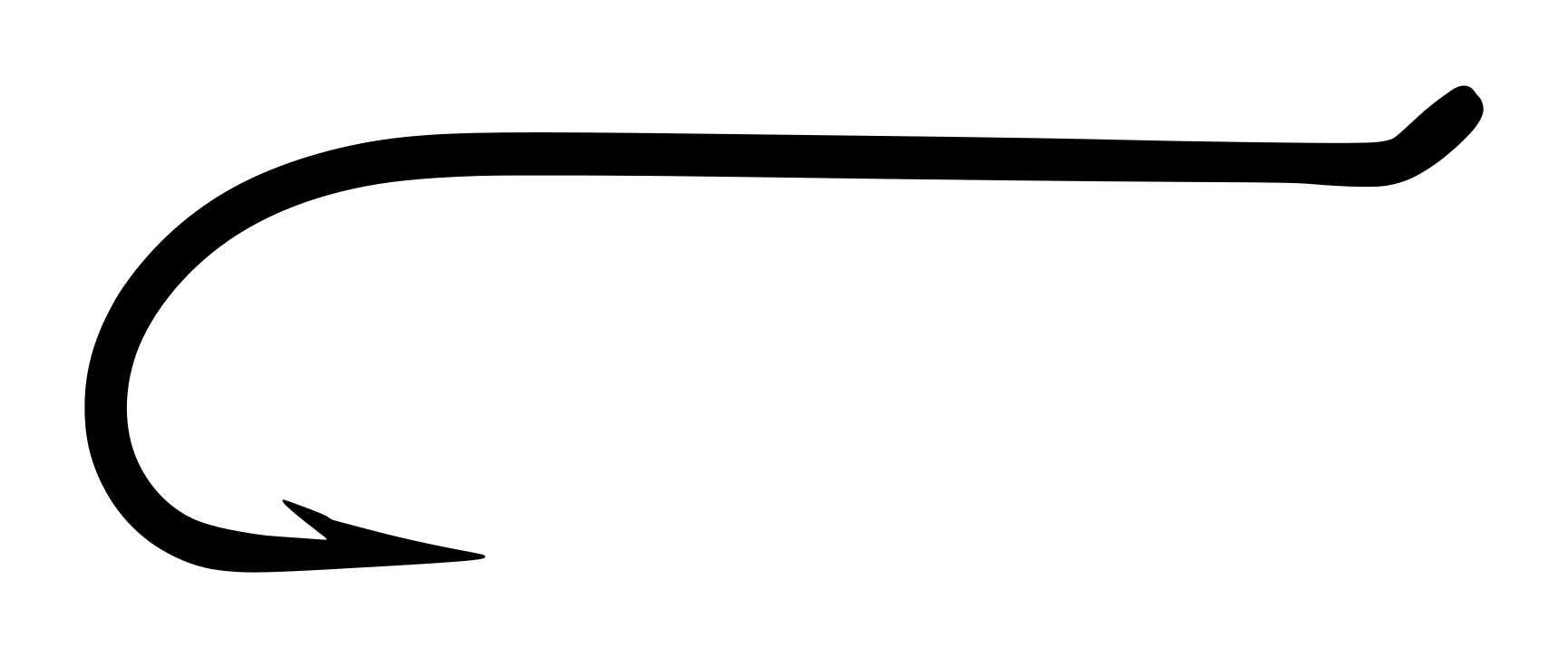
Partridge Limerick Minnow Turned Ends Size 5 — Profile ViewProfile view of the Partridge Limerick Minnow 'Turned Ends' (size No. 5) showing the characteristic angular Limerick bend, bronzed finish, and tapered blind eye extending to the right, on measurement grid.Open originalPartridge Limerick Minnow Turned Ends Size 5 — Front ViewFront-facing view of the Limerick bend profile, showing the characteristic angular curve and rounded bottom of the bend, with the tapered end extending upward at the left side of the image.Open originalPartridge Limerick Minnow Turned Ends Original Envelope — Size 5Original envelope packaging for Partridge Limerick Minnow 'Turned Ends,' size No. 5, showing cream paper stock with blue letterpress printing. Text includes size designation '5', model name 'LIM MINNOW', and eye-style descriptor 'TURNED ENDS'. Brown staining and aging visible throughout envelope.Open original
Blind — Tapered ShankTapered blind eye — the shank tapers to a smooth rounded point with no flattening or spade construction. Gut attached via loop tied around the taper. Characteristic of pre-1900 Redditch craft production P.
Wire
Standard, Round
Shank
1X Long — Tapered
Bend
Limerick, Standard gap
Point
Standard / Spear
Finish
Bronzed — Inferred (photographically likely)Warm brown tone visible in direct light with steel grain texture showing through the coating, consistent with traditional bronzing P.
The Limerick bend is an angular curve, distinctly different from the rounded Sproat or the deep Dublin. The characteristic feature is a sharp ‘knee’ or angle where the shank transitions to the downward curve, with the bottom of the bend forming a smooth radius. This geometry provides excellent hook set — the angular profile drives the barb home efficiently when tension is applied to the line, while the rounded bottom prevents the shank from bending or breaking under load.
The tapered blind eye reflects craft-era manufacturing: the shank wire is simply tapered from full gauge down to a smooth, rounded point. This required careful hand-finishing to ensure a smooth taper free of sharp edges that might fray gut. The angler would wrap a small loop of gut around this tapered end and secure it with thread (a whipping), creating a secure gut-to-hook connection. This method predates the modern eyed hook and the later spade-end design.
Standard-wire Limerick minnows in size No. 5 strike a balance between strength and delicacy. The wire is stiff enough to support a small minnow fly and withstand trout jaw pressure, but fine enough to be cast cleanly and to absorb shock without breaking. The bronzed finish provides both corrosion resistance and an aesthetic warm tone that blends with water and underwater debris.
The Limerick Minnow with ‘Turned Ends’ (tapered blind eye) was part of Partridge’s core wet-fly and minnow hook offering from approximately 1910–1935. The Limerick bend — characterized by an angular, moderately deep bend with a rounded bottom — was one of the five dominant bend profiles in British hook manufacturing, alongside Sproat, Sneck, and Dublin.
Minnow hooks from this era were designed primarily for wet-fly fishing with imitative patterns such as Alexandra, Invicta, and Butcher, but also saw use as small bait hooks for trout and grayling. The ‘Turned Ends’ designation referred specifically to the tapered blind-eye construction, where the angler tied a loop of gut around the tapered shank terminus rather than threading gut through an eye opening.
By the 1930s, the spade-end (blind flatted) construction began displacing the older tapered blind eye. The advantages of spade-end were manufacturing simplicity and more reliable whipping attachment. However, traditionalists and some professionals continued requesting tapered designs well into the mid-20th century. Partridge phased out most tapered-eye models during the 1940s–1950s consolidation, though the company remained a Redditch mainstay until its eventual acquisition.
Era and Packaging Dating
No barcode (barcode format not adopted until c. 1974). Blue letterpress printing typical of 1920s-1930s Partridge production. Envelope format and paper stock consistent with early 20th-century British hook packaging. 'Turned Ends' as a descriptor for tapered blind eye construction aligns with pre-standardization Redditch terminology. Hook design (Limerick bend with tapered blind eye) reflects craft-era construction predating industrial standardization.
The Lost Language of Redditch: 'Turned Ends'
The term 'Turned Ends' on this envelope documents a fascinating lost vocabulary of Redditch hook manufacturing. Early hooks had no eyes at all — the angler simply tied the line or gut directly to the shank or to a formed loop. As hook design evolved, 'Turned Ends' referred to the shank terminal that was shaped or 'turned' (finished) in a specific way to receive a gut loop. By the 1940s, this term had vanished from British hook catalogs, replaced by standardized descriptions like 'Tapered Eye,' 'Spade End,' or simply 'Eyed.' The persistence of 'Turned Ends' on Partridge packaging into the 1930s suggests the company was marketing to traditionalist anglers who still valued the precise craft terminology of the pre-industrial era.
Design lineage and influence
The Limerick bend itself traces back to the mid-19th-century Redditch tradition, likely originating as a refinement of Dublin and Sproat profiles by unknown craftsmen. By the 1880s, the Limerick had become one of the standard five profiles, competing with Sproat (preferred for salmon) and Sneck (favored by some Scottish makers) for wet-fly market share. English and Scottish fly-dressers developed strong regional preferences — Scottish and Northern English anglers often favored the Sneck, while Southern England and Midlands anglers leaned toward Limerick and Sproat.
The tapered blind eye on this hook represents the older attachment method, which gradually yielded to spade-end (blind flatted) during the 1920s–1940s. The spade end was easier to manufacture, easier for the angler to whip (the wider surface provided better grip), and more forgiving of poor workmanship. However, purists argued that the tapered eye was more elegant and, in skilled hands, stronger.
Partridge’s Limerick Minnow influenced later British wet-fly designs by other makers, though the specific combination of Limerick bend + tapered blind eye became increasingly uncommon after 1940. Modern hook designers rarely revisit the tapered blind eye, as modern fly fishing overwhelmingly favors eyed hooks for convenience and consistency.
Best matchRelated by Attribute
Computed automatically from catalog data — updated as new hooks are added.
Matches: Bend, Shank, Gap, Eye, Eye Orient. +5 moreDiffers: Wire: Standard vs Fine (1X Fine); Finish: Bronzed vs Black Japanned; Application: Bait vs Salmon, Sea Trout, Display +2 more
Matches: Bend, Shank, Gap, Eye, Eye Orient. +4 moreDiffers: Wire: Standard vs Fine (1X Fine); Point: Standard / Spear vs Hollow Point; Finish: Bronzed vs Gold-Plated +1 more
Matches: Bend, Wire, Gap, Eye, Eye Orient. +5 moreDiffers: Shank: 1X Long vs 2X Long; Point: Standard / Spear vs Hollow Point; Finish: Bronzed vs Black Japanned +2 more
The Limerick Minnow ‘Turned Ends’ was primarily used as a wet-fly hook for imitative minnow and small-fish patterns in British trout and grayling fishing. Anglers fished these with patterns such as Alexandra, Butcher, Invicta, and other ‘fancy’ wet flies that imitated small fish forage. The hook’s moderate depth and standard wire made it suitable for smaller minnow imitations and young trout diet. The tapered blind eye was the standard Redditch attachment method, requiring the angler to prepare a small loop of gut gut and whip it to the shank taper with fine thread.
Secondary use included small bait fishing for trout and grayling in streams and stillwaters, where the hook’s modest size (No. 5 = approximately 0.95″ overall) was practical for worm or small insect baits. The Limerick bend profile — angular with a rounded bottom — provided good hook set and solid barb penetration without excessive bulk.
Classic Fly Patterns
Named patterns specifically associated with this hook. Leave blank if none formally documented. Do not speculate — only include patterns with a confirmed association.
Modern Equivalents
Hook
Match Quality
Notes
Tiemco TMC 3761
Good
Modern wet-fly hook with similar Limerick-like bend profile and standard wire; eyed construction.
Partridge Gaspé (if available)
Very Good
Direct Partridge successor to traditional minnow hooks; maintains Redditch heritage.
Collector notes
Rated 6.5/10 — scarce tapered blind-eye Limerick from early Partridge production. Strong collector demand among Redditch specialists and pre-industrial hook historians. Original envelope packaging significantly raises value. Size No. 5 minnow hook is moderately sought; smaller or larger sizes less common.
Reference value
$22 – $68 USD estimate
Packaging condition
Good — moderate wear, legibleRecorded specimen
Packaging format
Partridge-envelopeCatalog code
Collectability drivers: This is a pre-standardization Redditch craft-era hook with a tapered blind eye (gut-loop attachment), a construction method largely abandoned by the 1930s. Partridge of Redditch hooks from this period are actively sought by serious collectors of British fishing tackle and industrial craft heritage. The ‘Turned Ends’ nomenclature on the envelope is historically significant, documenting early British hook terminology. Original envelope packaging is a major asset — most surviving examples are loose hooks or damaged packaging.
Limiting factors: Partridge production was modest compared to industrial manufacturers like Mustad. Size No. 5 is a practical minnow size with steady demand, but not as common as sizes 7–12. The tapered blind-eye construction, while historically important, is not aesthetically appealing to modern fly tyers — it limits secondary market appeal. Few complete examples with original packaging survive.
Variants: Partridge made Limerick minnows in multiple sizes (1 through 12) and in different finishes (bronzed, japanned, blued). The Turned Ends designation appears on cards from the 1920s–1930s; later cards use ‘Tapered Eye’ or omit eye designation entirely. Japanned or blued finishes are rarer than bronzed.
Condition factors: Envelope condition is critical — complete original packaging with legible printing commands a 50–100% premium over loose hooks. Hooks should show minimal corrosion and barb definition intact. Minor bronzed finish patina is acceptable and expected with age; active rust or white oxide is a defect. Missing one hook from an original quantity does not severely penalize value if the envelope is strong.
Packaging
Cream-colored paper envelope with blue letterpress printing. Text reads: '5' (size) on left side, 'LIM MINNOW' (model name) centered, and 'TURNED ENDS' (eye style descriptor) below. Brown staining and aging visible on envelope surface, consistent with c. 1920s paper stock and storage conditions. No barcode present. Original tissue or wrapper likely present but not visible in image.
Market Value Notes
Low ($22): Good condition — opened envelope with complete or near-complete hook count, envelope legible but with browning or minor damage, hooks with light patina or finish wear.
High ($68): Excellent condition — sealed or effectively sealed envelope, full count if determinable, envelope printing crisp and clear, hooks bright with minimal patina.
Premium factors: Original envelope in fine condition, complete hook count, japanned or blued finish (rarer than bronzed), sizes 1–3 or 10–12 (less common than 5–8), collector provenance.
Platforms: Specialist vintage tackle dealers, UK and EU eBay, Redditch tackle fairs, auction houses specializing in fishing tackle.
Confidence: E estimated — limited comparable sales data for tapered blind-eye Partridge Limerricks. Based on 2–3 UK dealer listings and broader Partridge scarcity benchmarks. High end reflects premium for complete envelope and scarcity.
Where to Find
UK-based eBay (eBay.co.uk) occasionally lists Partridge Limerick cards. Specialist dealers in Redditch area, UK tackle fairs, and European vintage fishing tackle auctions are more reliable sources. Loose examples appear regularly; envelope examples are infrequent.
Preservation
Storage and Preservation
Store this hook in a cool, dry environment away from moisture and humidity. The bronzed finish will develop warm patina over time, which many collectors consider desirable — this is not corrosion but a natural oxidation layer that provides additional protection. However, sustained damp conditions can lead to white corrosion (rust bloom) that degrades the finish and steel.
Keep the hook in its original envelope whenever possible. The paper envelope itself is fragile and brittle after a century, but it is a primary document of the hook’s provenance and era. Store the envelope in a stable-temperature location, away from direct sunlight (which fades the blue printing) and away from contact with other metals or acidic materials.
Do not attempt to clean the bronzed finish with abrasive materials or aggressive polishes. If dust accumulation is visible, gently wipe with a soft, dry cloth. Avoid contact with vinegar, salt water, or other corrosive substances, even though this is a vintage hook and minor patina is acceptable and expected.
If the hook remains on a card or in its original package with tissue, preserve that tissue intact. Early Partridge packaging sometimes included waxed tissue or thin paper wrappers that provide additional protection — these are historically significant and should not be removed or discarded.
Marking Analysis
Handwriting and Markings
The envelope shows evidence of age-related staining and browning (iron oxide from the paper stock itself, common in early 20th-century envelope paper). The blue letterpress printing is crisp and evenly applied, showing no evidence of hand-written notation or mark-up. The size designation ‘5’ and model names ‘LIM MINNOW’ and ‘TURNED ENDS’ are all printed via letterpress, not handwritten.
No collector marks, inventory codes, or handwritten annotations are visible on the envelope. This suggests the hook was either a retail purchase that passed through multiple collectors’ hands, or was stored away shortly after purchase and not catalogued into a personal collection system. The absence of marks indicates no direct collector provenance.
Size Note
Understanding No. 5 in the Limerick Scale
The Partridge No. 5 Limerick Minnow is a moderately small hook by modern standards (overall length ~0.95″), yet it was classified as a ‘standard’ minnow size in early 20th-century British fishing. This reflects significant differences between historic and modern hook-sizing conventions.
Early Partridge catalogs used a traditional Redditch sizing scale for wet-fly and minnow hooks, numbered 1 (large) through 16 (tiny). This scale was not standardized internationally and varied between manufacturers. Partridge’s No. 5 is roughly equivalent to modern Mustad or Tiemco size 8–10, depending on the bend profile and shank length.
The absence of a ‘/0’ designation (such as 1/0, 2/0) indicates this is a minnow or trout hook, not a salmon or sea-trout hook. Salmon hooks used a separate scale: 1, 1/0, 2/0, 3/0, etc. Minnow hooks stayed within the 1–16 numbering. This sizing system became obsolete after the mid-20th century, when Mustad’s industrial standard gradually dominated global fishing-hook markets.
For modern anglers seeking a functional equivalent, tie your minnow patterns on modern size 8–10 wet-fly hooks with similar bend profiles (Tiemco TMC 3761 or equivalent).
Additional
Envelope Text and Manufacturing Detail
‘LIM MINNOW’: The model name, abbreviated from ‘Limerick Minnow,’ confirms the bend profile (Limerick, not Sproat or Sneck). Limerick minnows were a staple British wet-fly pattern, used to imitate small fish forage and also as general-purpose wet-fly hooks.
‘TURNED ENDS’: This is the critical historical designation. In Redditch nomenclature, ‘Turned Ends’ referred to hooks where the shank end was shaped or finished in a specific way. For this hook, ‘Turned Ends’ means the shank is tapered (not flatted/spaded) at the terminal end, creating a smooth rounded point for attaching gut via a whipping loop. This terminology is now obsolete in modern hook catalogs, having been replaced by ‘Tapered Eye,’ ‘Spade End,’ or simply ‘Eyed.’
Absence of Barcode: No barcode is visible on the envelope. Barcodes (EAN/UPC format) were not adopted by British fishing-tackle manufacturers until the early 1970s. The absence of a barcode is strong evidence for a c. 1920–1960 dating window. Combined with the envelope format, blue letterpress printing, and ‘Turned Ends’ terminology, this points to c. 1920–1935 as the most probable era.
Envelope Stock and Printing: The envelope paper is cream-colored, medium-weight, and relatively thin — typical of 1920s–1940s British stationery. The printing is blue letterpress (relief printing), not offset lithography. Letterpress was the dominant commercial printing method until the 1950s–1960s transition to offset. This further supports an early 20th-century date.
Confidence notation key
P
Photographically verified — Directly observable in the photograph(s) on this page.
V
Verified by documentation — Confirmed by manufacturer catalog, spec sheet, or published reference.
I
Inferred — A logical deduction from observable or documented evidence, not directly stated.
E
Estimated — An approximation based on visual comparison, proportional analysis, or limited data.
S
Speculative — A reasoned hypothesis that cannot be confirmed from available evidence.
Unnotated claims are the compiler’s synthesis; see Sources. All photographs on garrenwood.com are taken on a measurement grid where each square equals 1/10 inch (0.1″ / 2.54 mm).