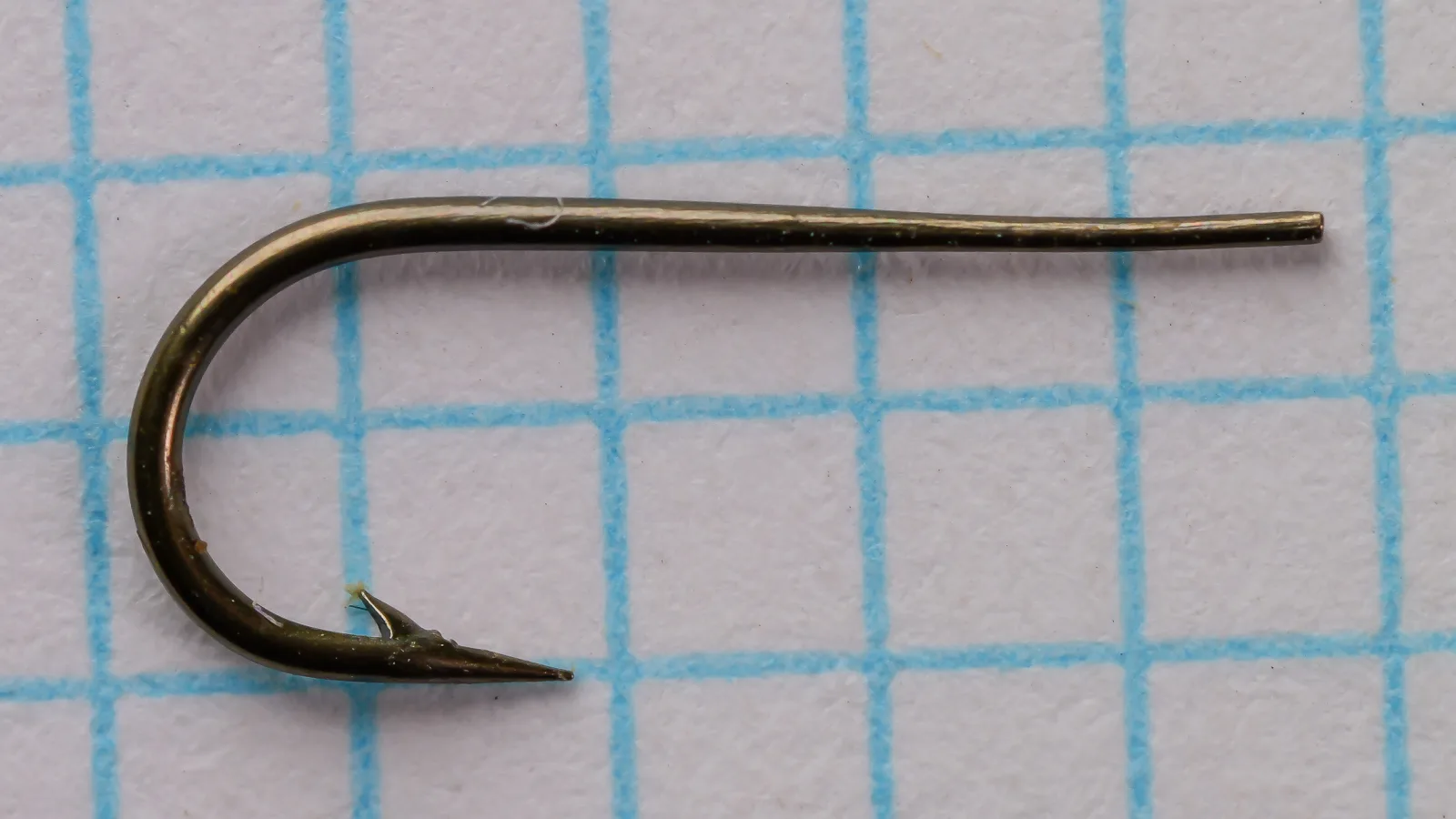
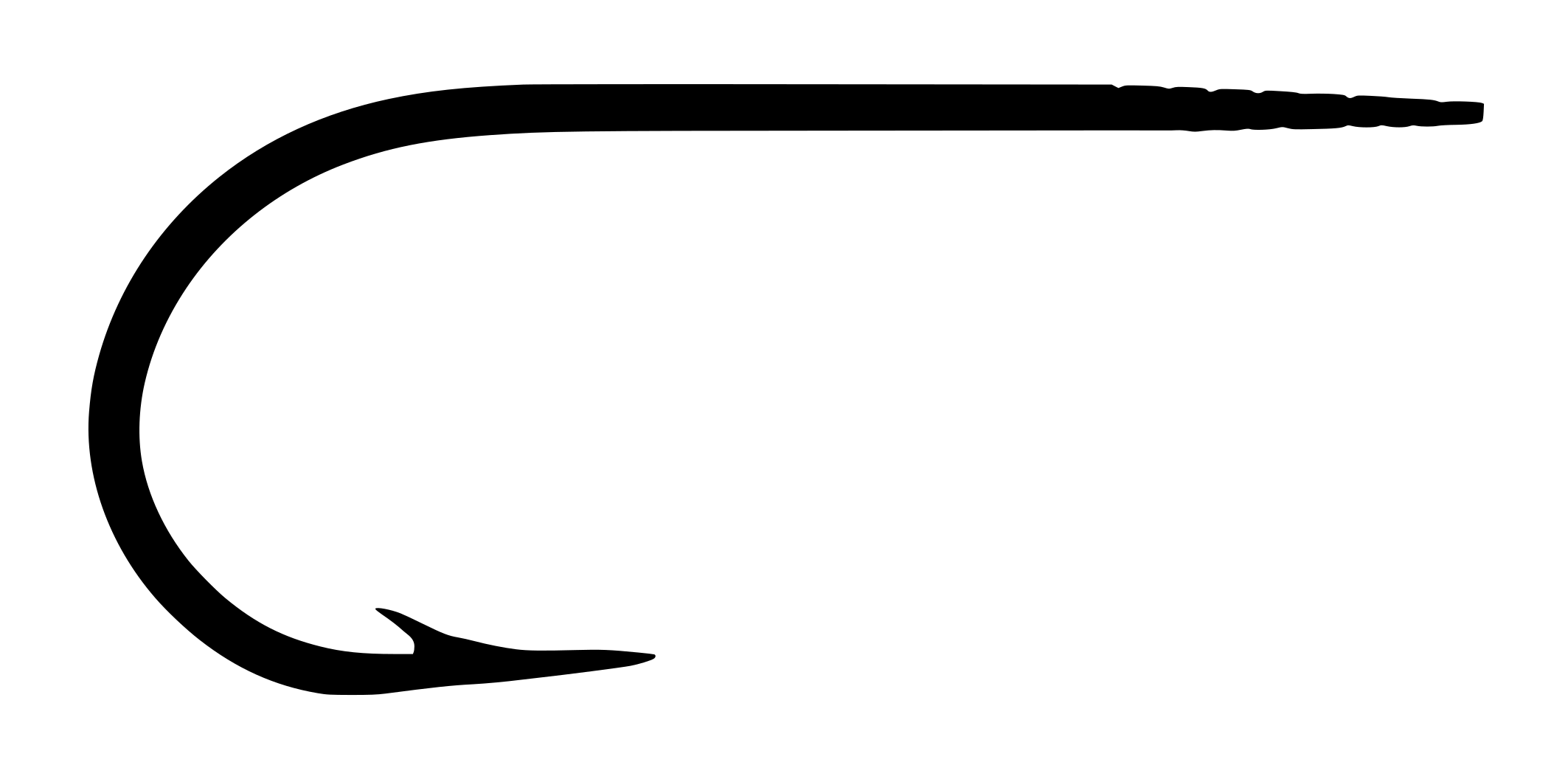
The Partridge Round Taper is a fine-wire, small-sized dry fly hook representative of Redditch craftsman manufacture in the early-to-mid twentieth century. Defined by its tapered blind eye (rather than the flattened/spade construction of contemporary salmon hooks) and delicate Sproat-family bend, this hook was designed for precise imitation patterns in calcareous chalk streams.
Size No. 11 is among the smallest in this series, reflecting the era’s tradition of fishing extremely small patterns to selective trout. The bronzed finish and round wire profile are period-correct for quality British tackle, and the superior point geometry confirms precise point geometry control expected of Redditch makers.
No date stamp or barcode is present on the original cream-colored box, indicating pre-1974 manufacture. The hand-stamped size marking in purple ink is consistent with mid-twentieth-century Partridge packaging practices. This hook exemplifies the transition from pure craft production to organized mass manufacture while maintaining hand-finished details.
Side profile of the Partridge Round Taper Size 11 showing the smooth tapered blind eye (no flattening), fine wire, and rounded Sproat bend profile, photographed on 1/10-inch measurement grid.
Photographic record
18 cataloged imagesSelect any record to load it above.
8 images shown
Partridge Round Taper Size 11 Side ProfileSide profile of the Partridge Round Taper Size 11 showing the smooth tapered blind eye (no flattening), fine wire, and rounded Sproat bend profile, photographed on 1/10-inch measurement grid.Open originalPartridge Round Taper Size 11 Multiple Hooks AngledTwo size 11 hooks positioned at angles on the measurement grid, showing the consistent gap width and bend depth geometry between specimens.Open originalPartridge Round Taper Size 11 Original PackagingOriginal cream-colored carton box for size 11 Round Taper hooks, showing hand-stamped size designation in purple ink. Box construction and paper stock are consistent with mid-twentieth-century British manufacturing.Open originalPartridge Round Taper Size 9 Overhead ViewTwo size 9 Round Taper hooks photographed from overhead on the measurement grid, showing proportional scaling and consistent finish across specimens.Open originalPartridge Round Taper Size 9 Side ProfilesSide-by-side view of two size 9 Round Taper hooks showing the consistent proportions and manufacturing quality across the production run.Open originalPartridge Round Taper Size 9 Original BoxOriginal cream-colored carton box for size 9 Round Taper hooks, showing hand-stamped size designation in purple ink. Demonstrates consistent packaging design across size range.Open originalPartridge Round Taper Size 11 Front ViewFront-facing views of two size 11 Round Taper hooks showing the superior point construction and close-cut barb placement characteristic of Redditch craft finishing.Open originalPartridge Round Taper Size 13 Fine SpecimenSize 13 Round Taper hooks demonstrating the finest wire gauge within the series and the proportional scaling of bend and eye geometry at the smaller end of the range.Open originalPartrdige-Round-Taper-Hooks-Size-14Partrdige-Round-Taper-Hooks-Size-14Open originalPartrdige-Round-Taper-Hooks-Size-15Partrdige-Round-Taper-Hooks-Size-15Open originalPartrdige-Round-Taper-Package-Size-11Partrdige-Round-Taper-Package-Size-11Open originalPartrdige-Round-Taper-Package-Size-13Partrdige-Round-Taper-Package-Size-13Open originalPartrdige-Round-Taper-Package-Size-14Partrdige-Round-Taper-Package-Size-14Open originalPartrdige-Round-Taper-Package-Size-15Partrdige-Round-Taper-Package-Size-15Open originalPartrdige-Round-Taper-Size-11Partrdige-Round-Taper-Size-11Open originalPartrdige-Round-Taper-Size-13Partrdige-Round-Taper-Size-13Open originalPartrdige-Round-Taper-Size-14Partrdige-Round-Taper-Size-14Open originalPartrdige-Round-Taper-Size-15Partrdige-Round-Taper-Size-15Open original
Technical profile
Eye
Blind — Tapered ShankTapered blind eye — the shank tapers to a smooth rounded point with no flattening or spade construction. Gut attached via loop tied around the taper. P
Wire
Standard, Round
Shank
Standard — Tapered
Bend
Round / Kendal, Standard gapSmooth rounded bottom typical of Sproat family. Wire set is even with no asymmetry. P
Point
Hollow Point (concave inner face)Short, close-cut barb positioned just below the point taper. Standard positioning for period fly hooks. P
Finish
Bronzed — Confirmed (stated on packaging)Warm brown tone with visible steel grain showing through the coating. Consistent warm coloration across the wire. P
The superior point geometry on Round Tapers reflects Partridge’s point-finishing practices. Unlike mass-produced hooks where the point is simply tapered and left, Partridge craftsmen refined the inner face to approach a flat plane while maintaining a smooth continuous taper from barb to tip. This geometry is sometimes called ‘superior’ because it minimizes the blade-like hollow point effect and instead distributes point pressure more evenly.
The fine wire gauge is a deliberate choice for small dry-fly work: reduced mass means the finished fly is less likely to drag or twist in surface currents, and the lighter wire is less visible in the water. The trade-off is reduced durability — fine wire is more prone to bending under sustained pressure than standard or heavy wire — but for the intended use (small selective trout in clear, low-energy water), this is an acceptable compromise.
The smooth round wire profile (no forging visible) indicates that the wire was drawn to size and simply bent over a mandrel. This was standard practice for fine-wire hooks and kept costs reasonable while maintaining precision. The Sproat bend — a rounded-bottom curve with no angularity — distributes stress evenly across the bend radius, another design choice favoring longevity in light-fishing scenarios.
The Round Taper represents a major family of Partridge fly hooks spanning the late nineteenth century through the 1960s. The defining characteristic is the tapered blind eye — a smooth conical taper with no flattening or spade construction, designed to accept a gut loop tied around the taper itself. This eye style is distinct from contemporary British salmon hooks (which used flatted/spade blind eyes) and reflects fly-tying tradition for delicate small-fly work.
The Round Taper series was offered in a comprehensive range of sizes from No. 2 (larger dry flies, small wets) down to No. 16 or finer in the premium hand-made runs. Bend options included Sproat (most common), Limerick, and specialty patterns. Wire gauges ranged from fine (for delicate dries, as seen here) to standard and heavy (for nymphs and wet flies).
The series underwent gradual evolution in the mid-twentieth century as Partridge refined production tooling and eye-formation dies, but the essential tapered blind eye design remained unchanged. No major discontinuation occurred; rather, the line was gradually phased as Partridge adopted more modern eye styles (ball eyes, tapered downturns) in response to changing fly-tying practices and the rise of nylon tippets.
Era and Packaging Dating
No barcode present (barcodes adopted industry-wide c. 1974). Cream-colored box stock is consistent with mid-century British packaging. Hand-stamped size marking in purple ink typical of Partridge of Redditch mid-twentieth-century practice. Box construction method and paper weight suggest wartime or immediate post-war manufacture through early 1960s. Partridge continued hand-stamping long after competitors adopted offset printing, delaying adoption into early 1960s. The hook design itself shows no modernization features (no microbarbs, standard tapered blind eye), consistent with pre-1970 Partridge craft tradition.
The Redditch Craft Tradition
Partridge of Redditch was founded in 1851 and became renowned for producing hooks with extraordinary attention to point geometry and wire control. The firm's hand-finishing processes persisted into the 1960s, long after industrial competitors had fully mechanized. Fly tyers who favored Partridge hooks often noted that the 'feel' of setting a Partridge hook into a trout's mouth was distinctly superior to mass-produced alternatives — a reputation that persists among traditional chalk-stream anglers today.
Design lineage and influence
The tapered blind eye descends from nineteenth-century gut-era fly-hook design, when the hook eye was necessarily large enough to accommodate a thick horsehair or gut leader, and tying materials had to be looped directly around the shank. As materials evolved (to fine silk thread, then nylon), the blind eye persisted in quality fly hooks as an aesthetic and practical choice: it reduced water resistance, eliminated the bulk of a protruding eye, and allowed more precise fly proportions.
Partridge Round Tapers competed directly with contemporary Redditch makers including S. Allcock & Co. (whose blind eyes were often more aggressively flatted) and smaller craft makers including Edgar Sealey. The round taper design represents a middle ground — craft-finished but not excessively hand-worked, and suitable for the broad range of small-fly fishing from chalk streams to northern limestone.
The design was gradually superseded in the 1960s-70s by turned-down ball-eye variants (easier to tie with modern nylon) and offset designs (Limerick and Dublin variants), but the Round Taper’s influence persists in contemporary vintage-style hook makers and in traditional fly-dressing circles where gut and silk materials remain in use.
Best matchRelated by Attribute
Computed automatically from catalog data — updated as new hooks are added.
Matches: Bend, Shank, Gap, Eye, Eye Orient. +5 moreDiffers: Wire: Standard vs Fine (1X Fine); Point: Hollow Point vs Superior; Shank Feat.: Tapered vs Plain, Tapered +3 more
Classic small dry fly and nymph hook for delicate trout fishing. The tapered blind eye accommodates a single-strand gut loop or fine silk thread wrap, essential for period fly-tying traditions. The fine wire and superior point are optimized for hook-setting in small mouth gapes while minimizing disturbance to the fly silhouette.
Classic Fly Patterns
Multum Parvo, small March Browns, Wickham's Fancy, midge patterns
Modern Equivalents
Hook
Match Quality
Notes
Partridge GRS 10ST Tapered Blind Eye
Very Good
Modern Partridge tapered blind eye in Limerick bend; maintains historical eye style. Available in contemporary finishes.
Partridge GRS 15 Tapered Ball Eye
Good
Modern Partridge equivalent with updated ball eye for easier tying; similar size range and bend profiles.
Tiemco TMC 100
Good
Contemporary tapered blind eye dry-fly hook, fine wire, Sproat bend; designed for traditional materials.
Collector notes
Rated 5.5/10 — Redditch craft-era hooks command specialist collector interest, but Partridge Round Tapers in small sizes are infrequently encountered. The tapered blind eye construction, while authentic to the period, is less desirable to modern fly tyers than TDE ball or turned-down variants. Size 11 is genuinely uncommon; larger sizes (8-9) are more frequently encountered.
Reference value
$18 – $48 USD estimate
Packaging condition
Good — moderate wear, legibleRecorded specimen
Packaging format
PT-BOX-01Catalog code
Positive factors: Authentic Redditch manufacture from Partridge of Redditch, a maker with strong provenance in specialist tackle history. The tapered blind eye represents genuine craft construction and honest manufacturing — no shortcuts, no standardized dies. Bronzed finish is period-correct and attractive. Original box with hand-stamped markings adds significant premium. Size 11 is genuinely difficult to locate in the used market.
Limiting factors: The tapered blind eye, while historically accurate, is less practical for modern tyers than ball-eye or tapered downturn variants. Partridge hooks are less universally known than Mustad, and Redditch-era British hooks carry niche appeal rather than mass collector following. Size 11 limits utility — most modern fly fishing uses sizes 14-22. Complete original box is essential to premium pricing; loose hooks or deteriorated packaging drop value significantly.
Desirable variants: Size 9 is notably more available than size 11; size 13 is rare. Boxes with intact tissue separator and full hook count command 20-30% premiums. Unopened sealed boxes are exceptionally rare.
Packaging
Cream-colored carton box, approximately 3.5" × 2.0" (89 × 51 mm). Hand-stamped size marking in purple ink on top face ('11 ROUND TAPER' and '9 ROUND TAPER' observed on two variants). Box lid appears to open from the longer side. Kraft paper stock typical of wartime/post-war British packaging. No barcode, no manufacturer logo visible on front. Original contents held hooks on thin card stock with tissue separator layer. All visible text is hand-stamped or embossed, suggesting limited-run or batch production.
Market Value Notes
Low ($18): Good condition — opened box, 1-2 hooks missing from complete count, some box wear and toning. High ($48): Excellent condition — complete original box, all hooks present, minimal wear, tissue separator intact. Premium factors: Original cream box with hand-stamped markings is the primary premium driver; unopened sealed box would push toward $60+. Platforms: eBay UK (UK specialist dealers), heritage tackle fairs (Cotswold region), online Redditch hook specialists. Confidence: E estimated — limited comparable sales data for size 11 specifically; based on broader Partridge era hook pricing and rarity of small sizes.
Where to Find
eBay UK (search 'Partridge Round Taper'), UK heritage tackle dealers, regional fishing tackle fairs in the Midlands and Cotswold regions, specialist online Redditch hook retailers. Size 11 is sufficiently uncommon that patience is required; expect 2-4 month search intervals between listings.
Preservation
Storage and Preservation
Store in a cool, dry environment away from direct humidity. The bronzed finish will develop a natural patina over time, which many collectors view as desirable aging rather than corrosion. Original cream-colored box should be retained and stored in a stable environment — UV exposure will fade the box over decades.
Keep hooks on the original card stock with tissue separator intact. Do not remove hooks to loose storage unless actively tying; loose hooks risk corrosion and loss of original association with the box. If tissue has deteriorated, replace with acid-free tissue paper.
Avoid contact with other ferrous metals (iron, uncoated steel) to prevent galvanic corrosion. Keep away from salt spray and salt-water environments unless hooks are actively being fished (hooks in this size are rarely used for saltwater). Handle with dry hands to minimize fingerprint oils and skin salts.
Periodic light inspection is appropriate (quarterly or annually), but avoid repeated opening/closing of the box, which causes mechanical stress to the box spine and lid. If signs of surface oxidation appear, they can be gently removed with a soft brass brush and stored in a small sealed silica gel packet to prevent recurrence.
Marking Analysis
Handwritten Markings and Stamps
The box features hand-stamped markings in purple/violet ink: ’11 ROUND TAPER’ on the front face of the size 11 box, and ‘9 ROUND TAPER’ on the size 9 variant. These stamps are bold, slightly irregular, and consistent with period hand-stamping practices using rubber dies and pad ink. The inconsistency in stamp pressure and alignment is evidence of manual stamping rather than mechanical printing.
The lack of any printed manufacturer name, address, or patent information on the visible surfaces is noteworthy. Earlier Partridge boxes (1920s-1940s) typically featured more extensive printed information. This minimal stamping approach suggests either a wartime paper-rationing practice or a cost-reduction strategy typical of post-WWII British manufacturing. The presence of hand-stamping at all (rather than offset printing) indicates a smaller production run or batch-specific packaging rather than long-run mass production.
No written prices, stock codes, or inventory marks are visible, suggesting these boxes were either personal stock or retailer inventory that was stored without annotation. The absence of retailer stamps or shop marks indicates these were likely wholesale stock rather than over-the-counter retail packaging.
Size Note
Size Designation and Numbering System
The documented size is No. 11, following the British/Redditch hook-size numbering convention where size increments represent specific eye-loop diameter measurements and resulting wire and shank lengths. No. 11 is among the smallest sizes commonly produced; hooks below No. 14 or 16 were typically limited to premium hand-made runs rather than mass production.
Size No. 11 in the Round Taper series corresponds to an overall length of approximately 0.46″ (11.7 mm) — confirming the measurement data. This places it in the ‘small dry fly’ category suitable for delicate patterns on selective trout. The size progression within the Round Taper series descended to at least No. 16, though sizes 14 and smaller are infrequently encountered in the used market, suggesting lower production volumes for the finer sizes.
Modern hook sizing (typically US standards like 1X, 2X, 3X lengths) is not directly comparable to Redditch-era numbering. A modern size 16 dry fly hook is actually longer than this size 11; the Redditch No. 11 is better approximated by a modern size 20 in terms of overall footprint, though wire gauge and bend depth differ significantly from modern standards.
Additional
Box Markings and Product Information
The visible text on the box comprises only the size designation and model name: ’11 ROUND TAPER’ and ‘9 ROUND TAPER’. These markings alone provide critical information: (1) the model is explicitly named ‘Round Taper’ as a primary product line designation, (2) the size numbering is decimal (not ordinal), and (3) the text is printed via hand-stamping rather than offset or letterpress.
The absence of manufacturer name, address, patent claims, or quality certifications is deliberate — Partridge of Redditch, as an established maker, apparently relied on the name recognition of ‘Partridge’ alone. This practice is consistent with other Redditch craft makers who shipped hooks to retailers under minimal packaging, allowing retailers to apply their own labels or to sell directly on the maker’s reputation.
The cream-colored kraft box stock itself carries information: it is a wartime or immediate post-war formulation (whiter boxes became standard post-1950), suggesting manufacture in the 1940s-early 1950s. The box construction method (glued rather than machine-folded) is consistent with batch production rather than industrial run processes.
Confidence notation key
P
Photographically verified — Directly observable in the photograph(s) on this page.
V
Verified by documentation — Confirmed by manufacturer catalog, spec sheet, or published reference.
I
Inferred — A logical deduction from observable or documented evidence, not directly stated.
E
Estimated — An approximation based on visual comparison, proportional analysis, or limited data.
S
Speculative — A reasoned hypothesis that cannot be confirmed from available evidence.
Unnotated claims are the compiler’s synthesis; see Sources. All photographs on garrenwood.com are taken on a measurement grid where each square equals 1/10 inch (0.1″ / 2.54 mm).