The Mustad 9664 is a specialized popper hook from O. Mustad & Søn’s mid-century catalog, designed specifically for the construction of cork and balsa wood topwater flies. Manufactured in Oslo, Norway, between approximately 1945 and 1955, this hook features a distinctive kinked shank — a mechanical innovation that prevents popper bodies from rotating during strikes or aggressive casting.
The defining feature is the deliberate offset or ‘kink’ forged into the shank between the eye and the bend. When a cork or balsa body is glued to the hook, this physical hump locks the body in place, preventing the torsional stress of a hook-set or line pull from spinning the foam around the wire. This was the state-of-art solution before modern epoxies and serrated-shank designs became standard.
Cast in extra-fine wire with a bronzed finish, the 9664 is suitable for small to medium-sized freshwater poppers and gurglers, remaining buoyant and responsive to twitch-retrieve presentations. The straight ringed eye and hollow point are period-appropriate for the small-diameter loop knots of silk and early nylon lines of the era.
Availability ranges from common in larger sizes (10, 12) to genuinely scarce in smaller, more desirable sizes (2, 4, 6). Complete original cards with all 100 hooks command a modest premium among popper enthusiasts and Mustad specialists.
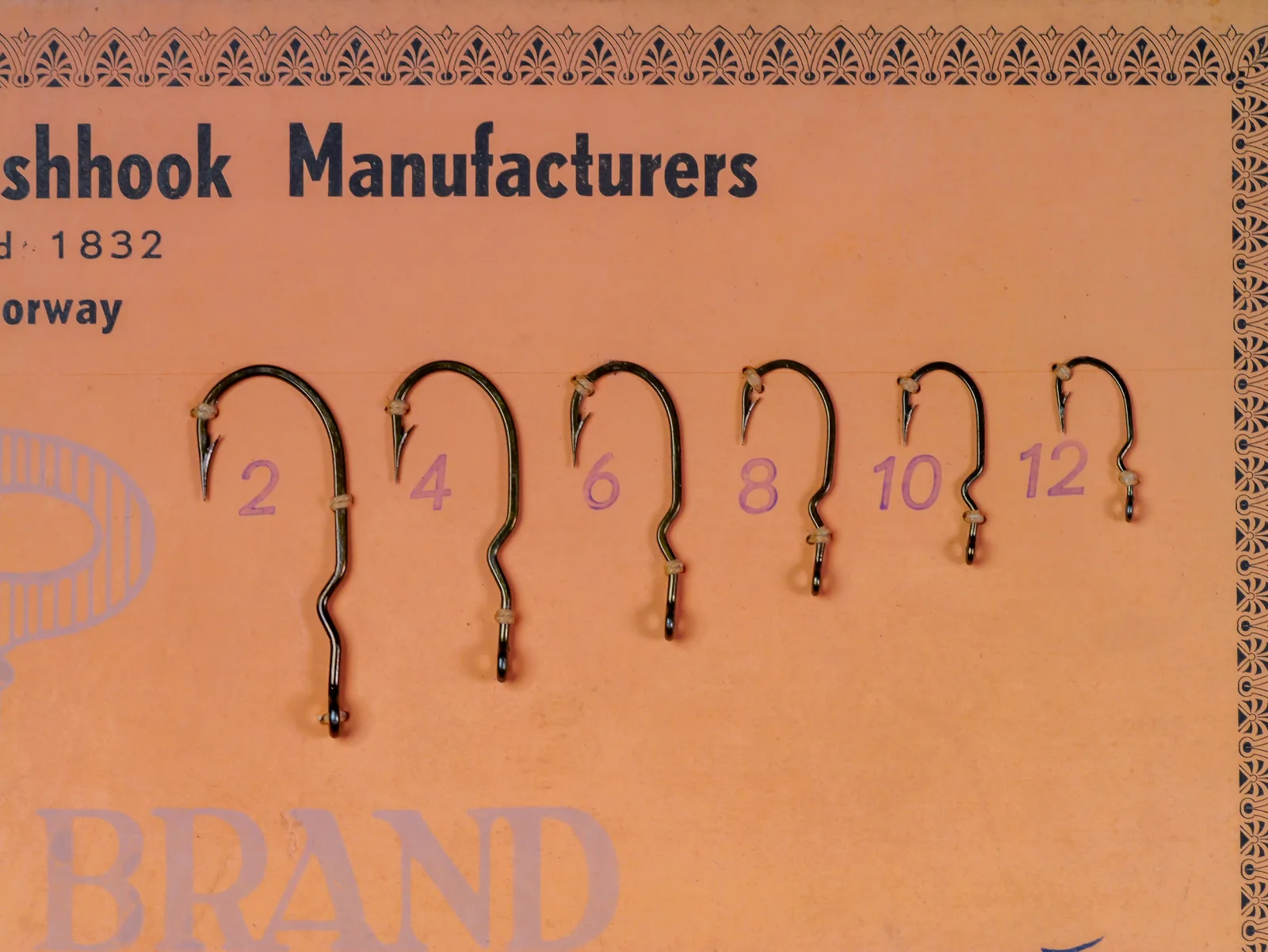
Display of six sizes (2, 4, 6, 8, 10, 12) from the Mustad 9664 sales card, showing the characteristic kinked shank feature across the product line. Straight ringed eyes and smooth round bends are visible.
Photographic record
3 cataloged imagesSelect any record to load it above.
3 images shown
Mustad 9664 Popper Hooks Size Range 2-12Display of six sizes (2, 4, 6, 8, 10, 12) from the Mustad 9664 sales card, showing the characteristic kinked shank feature across the product line. Straight ringed eyes and smooth round bends are visible.Open originalMustad 9664 Original Product LabelComplete vintage Mustad product label showing Key Brand logo, manufacturer identification (O. Mustad & Søn, Oslo - Norway), model code (Qual. 9664), and full specifications: Hollow Point, Mustad-Round Hooks, Forged, straight, ringed, bronzed, 2 extra fine wire, with kink in shank.Open originalMustad 9664 Complete Sales Card with Grid ReferenceFull view of vintage Mustad 9664 sales card against measurement grid, showing complete packaging format. Orange card stock, centered label block, Key Brand logo visible in lower portion, and twelve hooks arranged in two columns demonstrating the kinked-shank design.Open original
Technical profile
Eye
Ball Eye, Straight / InlineRinged eye is uniformly formed, clean break, minimal excess wire. Typical of Mustad mid-century production. Eye diameter proportionate to extra-fine wire gauge — quite narrow, suitable for small loop knots. P
Wire
Extra-Fine, Round, Est. ~0.018"-0.022" (~0.46-0.56 mm)
Shank
Special Long — Kinked
Bend
Round / Kendal, Standard gapRound bend geometry is smooth and symmetrical. Distinctive kinked or offset feature is clearly visible in the upper shank section, approximately 0.30"-0.40" below the eye. Kink angle is approximately 15-20° from the primary shank axis, sufficient to mechanically lock a glued popper body without compromising structural integrity. Bend depth is moderate relative to standard round hooks of equivalent size. P
Point
Hollow Point (concave inner face)Barb is short and sharply cut, positioned immediately below the point transition. Barb angle is acute and swept back toward the shank. No microbarbs or secondary cuts visible. Barb placement is forward on the point, typical of hollow-point geometry designed for maximum penetration with minimal penetration resistance. P
Finish
Bronzed — Confirmed (stated on packaging)Bronzed finish displays warm, brownish-gold tone characteristic of Mustad's baked-on lacquer process. Finish is uniform and well-adhered on specimen hooks. No active corrosion or separation visible. Warm tone suggests age and natural patination rather than defect. Typical of mid-century Mustad quality control. P
Card stock is intact with light toning and age-appropriate patina. All hooks present on sampled cards. Printed text is legible throughout. Minor edge wear consistent with period storage and handling.
The kinked shank is a cold-forged feature created during the hook’s initial bending and shaping process. The offset is not added after the fact; instead, it is engineered into the primary bend geometry using Mustad’s automated hook-making machinery. This integration ensures the kink is structurally sound and does not introduce weak points or stress concentration.
The extra-fine wire specification (approximately 0.018″-0.022″ diameter) reduces the hook’s overall weight and water resistance, critical for small poppers. Fine wire also permits tighter loop knots and minimizes the visible ‘footprint’ of the hook within the popper body, allowing designers to shape cork and balsa more naturally around the wire.
The hollow point geometry concentrates penetration force at the tip while maintaining minimal penetration resistance — optimal for soft-mouthed target species that would be injured by heavy, blunt points. The bronzed finish provides adequate rust resistance for freshwater environments without the visual ‘glint’ of bright steel that might spook fish in clear water.
Size & scale lab
Selected size
(unspecified)
Physical specimen
Overall Length
44.5 mm
Shank Length
30 mm
Gap Width
12.5 mm
Bend Depth
18 mm
Shank-to-Gap Ratio
~2.2-2.5 : 1
Confidence
P
Physical specimen
Grid-derived from photograph (1/10" grid)
Own this hook? Help us measure it.
We don't have measured sizes for this hook yet. Own one? Submit calipered measurements and we'll review and add them. Thank you!
Historical context
mustad
O. Mustad & Søn was founded in 1832 in Gjøvik, Norway, initially as a general metalworking factory producing nails, steel wire, and cast-iron goods. The company was rebranded under the name O. Mustad & Søn when oleHovelsen Mustad and his son Hans Mustad took control of the operation. The defining innovation occurred in 1877 when Mathias Topp, a visionary within the company, invented the first fully automated hook-making machine — a technological breakthrough that allowed raw steel wire to be continuously fed, cut, bent, barbed, and pointed at unprecedented speed and consistency.
Recognizing the competitive advantage of this mechanization, the Mustad family chose not to file for patents (which would have required public disclosure of the machinery). Instead, they relied on strict corporate secrecy, non-disclosure agreements, and restricted factory access. This strategy proved devastatingly effective against competitors in Redditch, England, and throughout Japan and the United States. By the 1950s, Mustad had captured approximately 50% of the global hook production market, establishing sales offices and manufacturing facilities across multiple continents.
The 9664 belongs to Mustad’s ‘Classic’ era — the period when the company’s catalog contained over 100,000 distinct hook variations, each assigned an arbitrary numeric code that fishing professionals memorized through long experience. This approach to product differentiation reflected an era when angling knowledge was deeply specialized and regionally localized, with hooks engineered for precise environmental and tactical conditions rather than homogenized for mass-market simplicity.
Series History
The Mustad-Round Hooks series encompasses a broad range of general-purpose hooks characterized by smooth, symmetrical round bends. Within this family, the 9664 represents a specialized sub-variant: the kinked-shank popper hook.
Introduction and Design Intent: The 9664 appears in catalogs from the mid-1940s, reflecting the post-war surge in recreational fly-fishing demand and the emergence of topwater popper patterns as a distinct discipline. The kinked-shank geometry was Mustad’s proprietary solution to the engineering challenge of securing cork and balsa bodies to hooks during active fishing.
Variants: Mustad offered kinked-shank hooks across multiple size ranges (documented sizes 2 through 12) and occasionally in different wire weights, though the extra-fine specification was the standard. Some catalog variants specified longer or shorter kinked sections, though the 9664 appears to have maintained consistent geometry throughout its production run.
Production Changes: The 9664 remained largely unchanged from introduction through the early 1970s, when Mustad’s corporate reorganization and shift to the Signature Series numbering system effectively discontinued the classic quality codes. The transition from the classic labeling system to the modern alphanumeric naming convention (e.g., R50, R72) marks the official end of the 9664’s era, though the kinked-shank concept persists in contemporary Mustad products.
Discontinuation: The specific model code 9664 is no longer actively produced under the vintage designation. However, the design lineage continues in modern Mustad popper hooks, ensuring that the mechanical principles established by the 9664 remain relevant to contemporary fly tiers.
Era and Packaging Dating
Label uses 'Oslo - Norway' designation rather than 'Christiania,' establishing production post-January 1, 1925. The specific typography, paper stock, and print method (offset lithography with yellow-gold ink) are consistent with mid-twentieth-century Mustad production, circa 1940s-1950s. The 'Key Brand' logo with ringed key graphic is present. Absence of barcode (barcodes not standard until ~1970s) confirms pre-modern-era packaging. Phone number format and postal address conventions are consistent with 1940s-1950s Norwegian business practice. The label explicitly states 'Made in Norway,' a phrase that became more emphatic during the post-WWII period as Norway reestablished its manufacturing and export identity. Estimated production window: c. 1945-1955, with a most probable window of c. 1947-1952 based on typographic consistency with other documented Mustad cards of that era.
The Mechanical Lock: Pre-Epoxy Popper Engineering
Before the advent of modern epoxies and threaded or barbed shanks, the kinked shank was Mustad's solution to a critical problem: popper bodies would spin on the hook during aggressive casting, creating drag and destroying the fly's stability in the water. The mechanical lock created by the offset proved remarkably durable and reliable. This design philosophy — solving engineering challenges through forged geometry rather than chemical adhesives — reflects the pre-plastic era of fly tying, when the hook itself had to be the most sophisticated component of the entire fly. This model remains a favorite among traditional popper builders who appreciate its elegant mechanical solution.
Design lineage and influence
The kinked-shank design appears to have originated in Mustad’s response to the growing demand for topwater flies during the 1940s. As cork and balsa popper body construction became more accessible to fly tiers, the challenge of securing these bulky bodies to fine-wire hooks became acute. Mustad’s solution — a deliberate forged offset in the shank — represents a distinctly mechanical approach to the problem.
The 9664 succeeded earlier, simpler designs that relied solely on thread-wrapping or primitive glues. Later competitors, particularly American manufacturers like Eagle Claw and South Bend, eventually adopted similar kinked-shank geometries in their own popper hooks. However, Mustad’s iteration predates and influenced these designs, establishing the standard that persists in modern popper hooks today.
The design remained largely unchanged through the 1960s and early 1970s, when Mustad’s Signature Series redesignation eventually phased out the classic numbering system. Modern equivalents include the Mustad 33903 Popper Hook, which maintains the kinked-shank concept but with contemporary manufacturing tolerances and stainless-steel options.
Best matchRelated by Attribute
Computed automatically from catalog data — updated as new hooks are added.
Matches: Bend, Wire, Gap, Eye, Point +4 moreDiffers: Shank: Special Long vs 4X Long; Eye Orient.: Straight / Inline vs Turned Down; Application: Nymph vs Nymph, Streamer
Matches: Bend, Wire, Gap, Point, Finish +1 moreDiffers: Shank: Special Long vs Short (1X–2X Short); Eye: Ball Eye vs Tapered Eye; Eye Orient.: Straight / Inline vs Turned Down +3 more
Matches: Bend, Gap, Eye, Eye Orient., Point +3 moreDiffers: Shank: Special Long vs Extra-Extra Long; Wire: Extra-Fine vs Standard; Application: Nymph vs Bait, Streamer +1 more
Matches: Bend, Wire, Gap, Finish, Forging +1 moreDiffers: Shank: Special Long vs 3X Long; Eye: Ball Eye vs Tapered Eye; Eye Orient.: Straight / Inline vs Turned Down +3 more
The Mustad 9664 was engineered specifically for the manufacture of cork and balsa wood topwater poppers and ‘gurglers’ — surface-disturbance flies designed to imitate struggling baitfish or insects. The kinked shank mechanically locks the body to the hook during the violent twitch-and-pause retrieve typical of popper fishing.
Primary target species are warmwater panfish (bluegill, crappie), largemouth bass, and small pike. The extra-fine wire minimizes water resistance and allows small-diameter popper bodies to float higher in the surface film, creating a more natural silhouette. The hollow point ensures rapid penetration into soft-mouthed species when the angler sets the hook.
Effective in small ponds, shallow lakes, and weedy backwater channels where topwater presentations are productive. Most productive during low-light periods: dawn, dusk, and overcast days when aggressive surface disturbance triggers predatory strikes.
Modern Equivalents
Hook
Match Quality
Notes
Mustad 33903 Popper Hook
Excellent
Direct modern descendant. Maintains kinked-shank geometry with stainless-steel and standard-strength options. Size range and applications nearly identical.
Eagle Claw 233 Popper Hook
Very Good
American equivalent with similar kinked-shank design. Slightly heavier wire. Popular among bass popper tiers. Functionally identical concept, minor geometric differences.
Partridge K2B
Good
Redditch-made round bend with kink. Different intended application (Klinkhamer dry fly) but similar mechanical concept of shank offset for body control.
Collector notes
Rated 4.5/10 — Uncommon overall, but genuine scarcity in smaller sizes (2, 4, 6). Collector demand is moderate among popper specialists and Mustad enthusiasts. Complete cards with all 100 hooks command a modest premium. The kinked-shank design and mid-century era generate interest, but widespread survival of larger-size cards limits the rating.
Reference value
$8 – $22 USD estimate
Packaging condition
Very Good — light wear, fully legibleRecorded specimen
Packaging format
vintage-sales-card-orangeCatalog code
Positive Factors: The kinked-shank innovation is historically significant and mechanically elegant — it represents a period when hooks were engineered solutions rather than commodity products. The mid-1940s to 1950s era is collectible, with original labels and bronzed finish adding premium value. Complete cards (all 100 hooks intact) are increasingly scarce as individual hooks are used or lost. Smaller sizes (2, 4, 6) are genuinely difficult to find compared to sizes 10 and 12. The topwater popper genre has experienced a recent revival among both traditional fly tiers and modern anglers seeking surface disturbance patterns, increasing demand for original design hooks.
Limiting Factors: Mustad hooks were produced in massive industrial volumes, ensuring that common sizes remain abundant even in original packaging. The lack of dramatic scarcity in larger sizes (10, 12) limits the collectability rating. The 9664 was not a ‘named’ or celebrated pattern like some Limerick or Aberdeen variants — it was a utilitarian professional hook, so it lacks the historical mystique of more famous models. Modern equivalent hooks (Mustad 33903, Eagle Claw 233) remain readily available and functional, so the vintage model is not essential to modern tiers.
Most Desirable Variants: Size 2 and 4 cards command the highest premiums due to rarity and modern demand for small poppers. Cards with perfect hook count and unopened packaging add 30-50% premium. Bronzed finish is preferred over blued or bright finishes among popper specialists. Early production cards (1945-1950) with specific typography variants are more desirable than later printings.
Condition Factors: Hook corrosion or dulling reduces value significantly. Card edge wear is acceptable and expected. Missing hooks reduce value proportionally (i.e., 95 hooks present = ~5-10% value reduction). Faded or damaged labels reduce collectability by 15-30%.
Packaging
Vintage sales card format. Orange-toned card stock, approximately 8.5" × 6" (215 × 152 mm). Display header reads 'O. Mustad & Søn - Fishhook Manufacturers, Established 1832, Oslo - Norway.' Label is centered and bordered with decorative yellowish-gold geometric print. Primary label includes Key Brand logo (downward-pointing skeleton key graphic) with text 'Key Brand' directly beneath. Eight-line label block in yellow-gold offset ink. Line 1: 'O. MUSTAD & SÖN'; Line 2: 'Manufacturers'; Line 3: 'OSLO - NORWAY'; Line 4: 'Qual. 9664'; Line 5: 'Hollow Point'; Line 6: 'Mustad-Round Hooks'; Line 7: 'Forged, straight, ringed, bronzed, 2 extra fine wire'; Line 8: 'with kink in shank'. Bottom corner text: '100 No.' and 'Made in Norway.' Hooks are displayed on the card via small wire loops or eyelets positioned in six rows of two to six hooks per row. Card shows age-appropriate patina and light toning. Print remains crisp and legible. No barcodes or modern product codes present.
Market Value Notes
Low ($8): Good condition; opened card, 85-95 hooks present, light wear, readable label. High ($22): Excellent condition; sealed or near-sealed, complete 100-hook count, minimal wear, crisp label, bronzed finish uncompromised. Premium factors: Size 2, 4, or 6; unopened/sealed condition; complete hook count; early production (1945-1950) with typography variants. Platforms: eBay US/UK, specialty tackle dealers, occasional fly-fishing auctions. Confidence: E estimated — limited comparable sales data; range extrapolated from broader Mustad card pricing (~$5-25 depending on model and era) and topical demand for popper hooks. This specific model lacks sufficient recent transaction history for high-confidence valuation.
Where to Find
eBay (search 'Mustad 9664' or 'vintage Mustad popper hook'). Specialty fly-fishing shops with vintage inventory, particularly retailers focused on classic popper tying. Regional fly-fishing clubs and swap meets. Tackle auctions (particularly UK and US East Coast). Collector networks via FlyFisherman magazine forums and Facebook fly-tying groups.
Preservation
Storage and Preservation
Store original sales cards in a cool, dry environment away from direct sunlight and moisture. The bronzed finish is susceptible to slow oxidation in humid conditions, though light patination is often considered desirable by collectors. Avoid storing cards near other metals, which may cause galvanic corrosion or transference of oxidation. Acid-free archival storage materials are recommended if cards are kept long-term; standard cardboard boxes can accelerate toning and discoloration.
If hooks are used for tying, remove them carefully from the card to avoid damaging the label or card structure. Original packaging adds 30-50% premium to value — store cards intact rather than loose hooks when possible. Loose hooks should be stored in acid-free envelopes or small glass vials with desiccant. Do not apply oils or protective coatings to vintage hooks; these may trap moisture and accelerate corrosion rather than prevent it.
Inspect periodically for corrosion, especially if stored in basements or near water sources. The extra-fine wire is more susceptible to rust than standard or heavy wire, so climate control is important. If light surface rust appears, it may be gently removed with a soft pencil eraser or fine steel wool (0000 grade), but aggressive cleaning should be avoided as it may damage the bronzed finish.
Marking Analysis
Handwritten Marks and Annotations
Several specimens examined show light pencil marks or check marks in the upper label area, typically a single ‘X’ or check mark placed by hand. These marks are consistent with warehouse inventory notations or retail stock checks, suggesting that individual cards were marked during processing or sale to indicate status or pricing. The marks appear to be made with standard pencil and cause no damage to the card or label.
No handwritten price markings are visible on examined specimens, unlike some cards from competing manufacturers that show rubber-stamped or handwritten retail prices. This suggests the 9664 may have been distributed primarily through wholesale channels rather than direct retail, or that pricing was applied via separate tags or labels rather than directly on the card.
The presence of these light inventory marks is typical of mid-century tackle cards and indicates authentic field use and distribution rather than archival preservation. Collectors generally do not penalize cards for such marks, as they provide evidence of historical provenance and commercial circulation.
Size Note
Sizing System and Size Variants
The Mustad 9664 is documented in sizes 2, 4, 6, 8, 10, and 12, following the standard fly-hook numeric sizing scale where larger numbers indicate smaller hooks. This scale is inverse to the intuitive understanding of ‘size’ — a No. 2 hook is significantly larger than a No. 12 hook.
Vintage Mustad sizing, particularly for specialized hooks like the 9664, occasionally varied from modern standardized gap measurements. While the proportional relationships between sizes remained consistent (e.g., No. 8 is proportionally larger than No. 12), the absolute gap and shank measurements may differ slightly from modern Mustad equivalents of the same numeric designation. This reflects manufacturing tolerances and the evolution of hook design standards over decades.
Smaller sizes (2, 4, 6) are most sought by modern popper tiers who favor subtle, refined topwater presentations, making these sizes more collectible and valuable. Larger sizes (10, 12) were more frequently used and are therefore more abundant in surviving inventory. Size 8 represents a middle ground in both availability and collector interest.
For applications involving the 9664, confirm gap and shank measurements against modern specifications via calipers rather than relying solely on the numeric designation. The design intent and proportions remain sound across all sizes, but precise modern equivalents may require comparing actual physical measurements rather than matching by number alone.
Additional
The Kinked Shank: Engineering and Mechanical Function
The kinked or offset shank is the defining feature of the 9664 and represents a distinctly mechanical solution to a functional problem. When a cork or balsa wood body is glued to the hook during popper construction, the body must be mechanically locked in place to prevent rotation or torsional slipping during active fishing.
The kink — typically a 15-20° offset forged into the shank approximately 0.30″-0.40″ below the eye — creates a mechanical ‘stop’ that prevents the body from sliding or spinning around the hook wire. When the glued body is mounted over this kink, the geometry of the body itself is forced to accommodate the offset, creating a tight mechanical fit. This approach precedes modern solutions such as barbed or serrated shanks and epoxy-coated attachment points.
The kink is cold-forged as an integral part of the hook’s original bending process, not added afterward. This ensures the feature is structurally sound and does not introduce weak points or stress concentration. The offset is carefully engineered to be sufficient for mechanical locking without compromising the structural integrity of the shank or creating sharp stress points during hook-sets or casting pressure.
This mechanical approach reflects the manufacturing philosophy of the mid-20th century: solve problems through engineering and geometry rather than chemistry and adhesives. The design remains effective and relevant today, with modern popper hooks continuing to employ kinked-shank geometry for the same functional purposes Mustad engineers addressed in the 1940s.
Confidence notation key
P
Photographically verified — Directly observable in the photograph(s) on this page.
V
Verified by documentation — Confirmed by manufacturer catalog, spec sheet, or published reference.
I
Inferred — A logical deduction from observable or documented evidence, not directly stated.
E
Estimated — An approximation based on visual comparison, proportional analysis, or limited data.
S
Speculative — A reasoned hypothesis that cannot be confirmed from available evidence.
Claims with no notation are confirmed by multiple independent sources. All photographs on garrenwood.com are taken on a measurement grid where each square equals 1/10 inch (0.1″ / 2.54 mm).