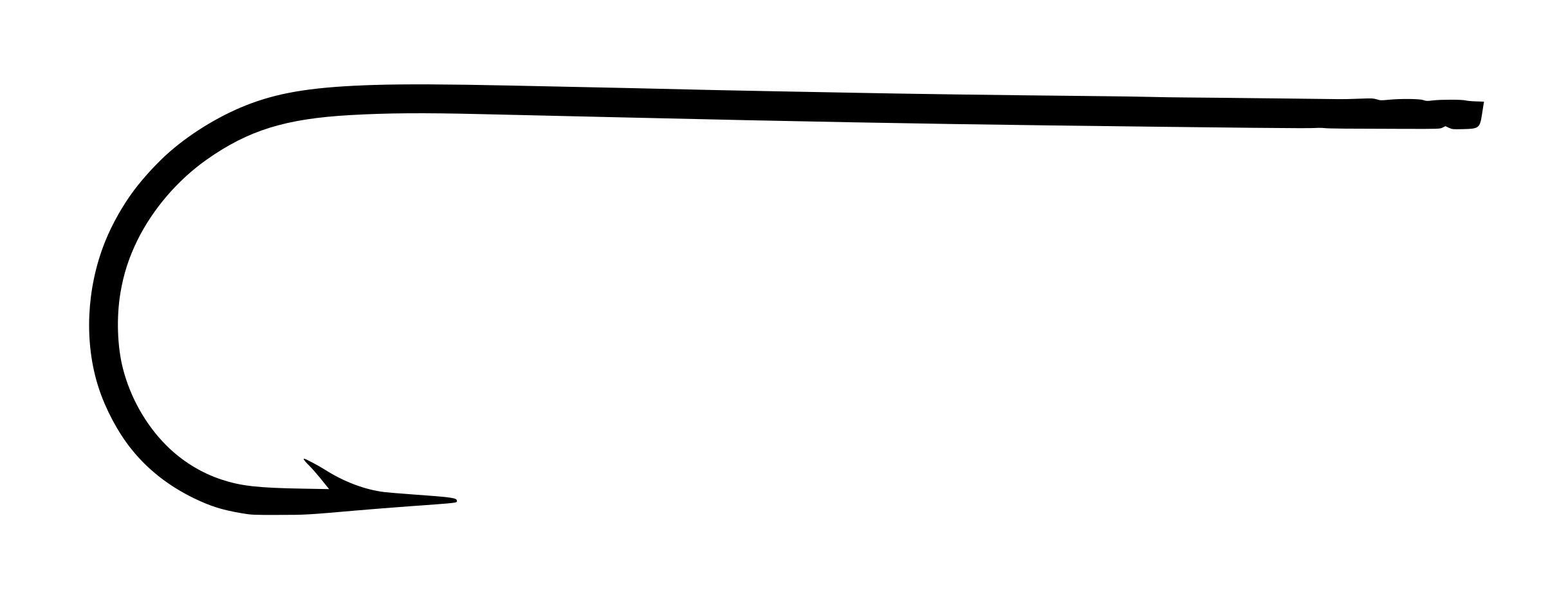
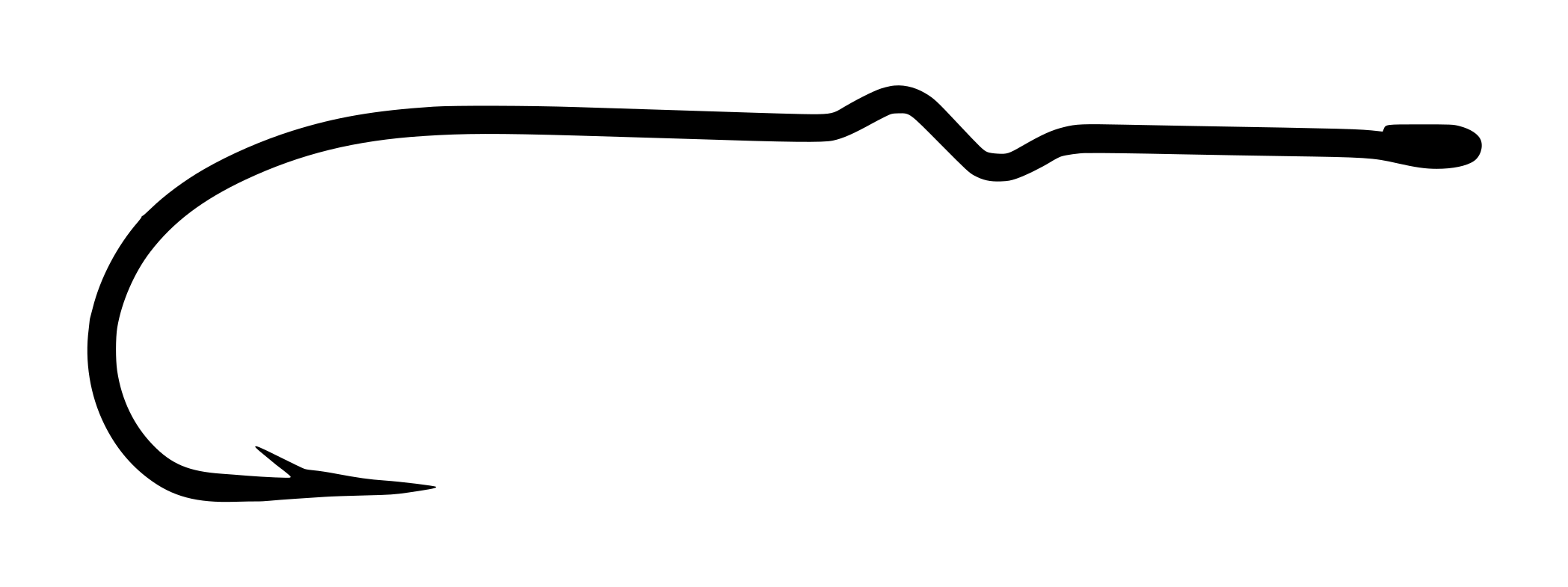
T. H. Bate’s 501 M Aberdeen Salmon Hook is a classic early-to-mid 20th century wet fly hook representing a transatlantic legacy. Retailed by William Mills & Son under the historic 19th-century New York brand name ‘T. H. Bate’s’, these hooks were forged in Redditch, England. The 501 M features a wide round (Aberdeen) bend, standard shank, and distinctive tapered blind eye—a construction method universal in early salmon fly fishing before the post-1960s shift to ball-eye designs.
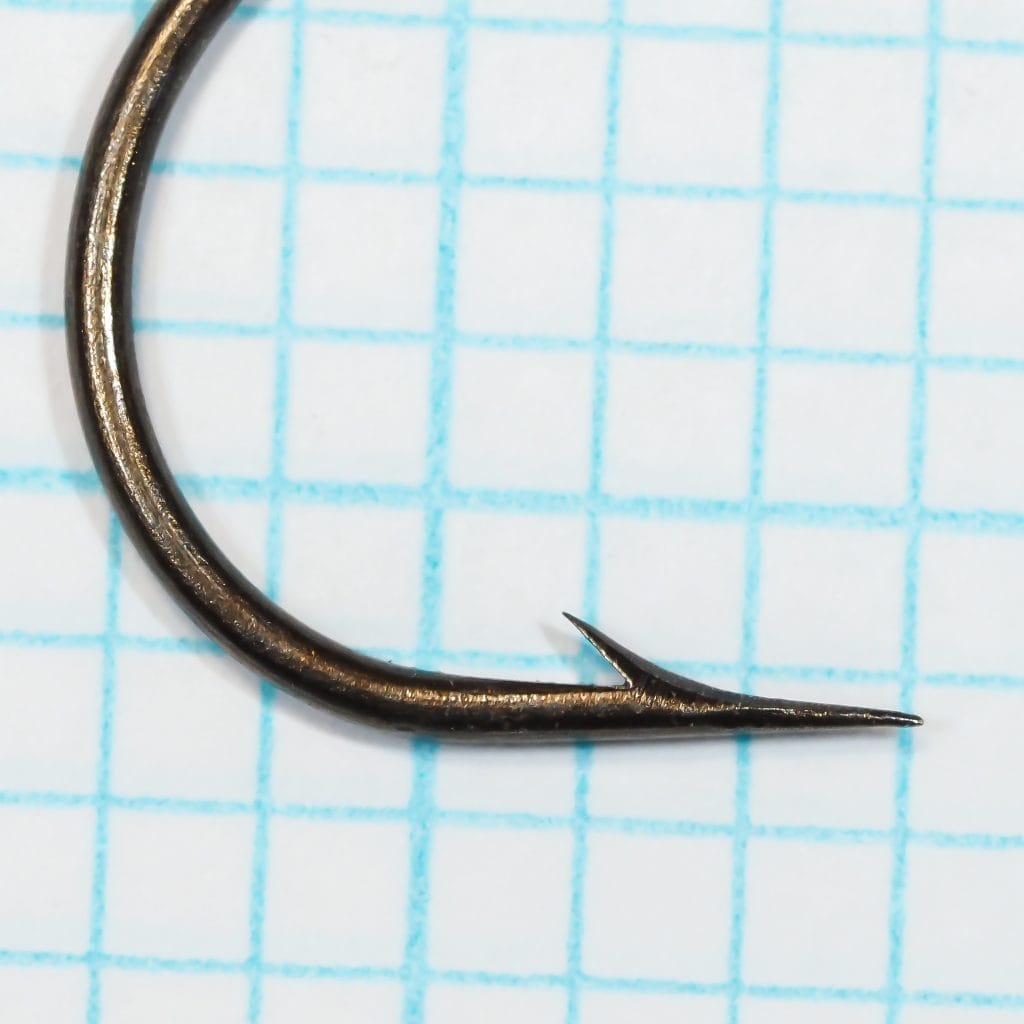
Detail of the T. H. Bate's 501 M superior point, showing the near-straight inner taper and fine barb placement. The warm bronzed finish with visible steel grain texture is visible under direct light, characteristic of double-refined spring steel.
Photographic record
2 cataloged imagesSelect any record to load it above.
2 images shown
T. H. Bate’s 501 M Size No. 100 Point DetailDetail of the T. H. Bate's 501 M superior point, showing the near-straight inner taper and fine barb placement. The warm bronzed finish with visible steel grain texture is visible under direct light, characteristic of double-refined spring steel.Open originalT. H. Bate’s 501 M Original Packaging CardOriginal T. H. Bate's 501 M packaging card with decorative rope-border frame, showing model designation, 'MARKED' quality indicator, and 100-hook count. Letterpress printing on kraft card stock with light toning characteristic of early-to-mid 20th-century Redditch production.Open original
Technical profile
Eye
Blind — Marked ShankTapered blind eye with smooth rounded taper to point; no flattening or spade construction. Gut loop attached by wrapping around the tapered shank terminus P.
Wire
Extra-Fine, Round, Est. ~0.045"-0.055" (~1.1-1.4 mm)
Shank
Special Long — Marked / Ridged
Bend
Aberdeen, Standard gapWide, gentle rounded bottom typical of Aberdeen bend family. Symmetrical in both vertical and lateral planes P.
Point
Hollow Point (concave inner face)
Finish
Bronzed — Confirmed (stated on packaging)Warm brown tone with visible steel grain texture beneath the coating, characteristic of bronzed finish. Some patina development visible on specimen P.
The superior point geometry—near-straight inner taper with minimal curvature—provides excellent penetration and holding power for salmon fly work where barb security is paramount. The tapered blind eye construction, while labor-intensive by modern standards, creates a smooth transition from shank to eye, reducing yarn bulk and enabling cleaner fly head work on traditional silk-wrapped patterns. The Aberdeen bend’s wide, gentle curve distributes stress evenly across the bend radius, resisting straightening under the heavy pressure of large salmon and sea trout on tight lines.
Spring steel forging at this gauge produces sufficient resilience to absorb shock without permanent deformation, a critical consideration for multi-hour fishing days with repeated casting and line tension. The ‘Double Refined’ designation indicates multiple heat cycles and mechanical working—refining the grain structure and reducing brittleness compared to single-refined stock.
Size & scale lab
Selected size
(unspecified)
Physical specimen
Shank Length
38 mm
Gap Width
15.5 mm
Bend Depth
23 mm
Shank-to-Gap Ratio
~2.3-2.8:1
Confidence
P
Physical specimen
Grid-derived from photograph (1/10" grid)
Own this hook? Help us measure it.
We don't have measured sizes for this hook yet. Own one? Submit calipered measurements and we'll review and add them. Thank you!
Historical context
bates
Thomas H. Bate & Co. was not a native English forging house, but rather a highly prominent 19th-century American sporting goods and tackle dealer based in New York. Operating from the mid-19th century, the company was a major supplier to the American angler, importing vast quantities of custom-branded hooks from the Redditch, England cottage industry. In 1859, William Mills joined the firm, and the company was famously reorganized in 1873 as William Mills & Son.
Because the Bate name held such significant cachet among anglers, William Mills & Son retained ‘T. H. Bate’s’ as a premium legacy brand for their imported hook lines well into the 20th century. Therefore, 20th-century packaging bearing the Bate name represents Mills’ continued contract importing from high-end Redditch makers, rather than a standalone Bate factory.
Series History
The 501 series represents the core Aberdeen bend offering imported under the legacy Bate brand by William Mills & Son. Graded by construction detail, the 501 M (marked, with quality inspection) represents the premium tier with individual eye quality assurance. Aberdeen bend hooks under this legacy trademark were produced continuously for the American market from the 1920s through the mid-century, maintaining the traditional hand-forged tapered blind eye long after eyed hooks became the standard for modern patterns.
Era and Packaging Dating
The presence of the 'Manufactured in England' text definitively dates this packaging to post-1890, following the U.S. McKinley Tariff Act which mandated country-of-origin markings on imports. While the T. H. Bate & Co. firm was succeeded by William Mills & Son in 1873, Mills retained the 'Bate's' name as a legacy trademark for their premium imported hooks. The decorative rope-border, letterpress printing style, and lack of barcode or postal codes strongly align with 1920s-1950s production.
The Hand-Stamped Mark: Quality Assurance in Redditch
Despite the T. H. Bate & Co. firm ceasing to exist under that name in 1873 when it became William Mills & Son, the 'Bate's' name carried such immense prestige among American anglers that Mills continued to use it as a premium trademark for their imported Redditch hooks for nearly another century. The 'MARKED' designation assured buyers they were getting the old-world hand-inspected quality associated with the original Bate legacy.
Design lineage and influence
The Aberdeen bend owes its form to 19th-century Scottish innovations, but T. H. Bate’s interpretation represents the mature British standard of the inter-war period. The tapered blind eye construction is direct descendant of 1880s-1920s hand-forging technique, where the shank was drawn to a fine point and the eye opening formed by bending wire back on itself—no separate eye component. This contrasts sharply with the later ball-eye and loop-eye designs that dominated post-1960s production.
Competing designs from contemporaries (Allcock’s Bend, S. Allcock’s Sproat variants, Partridge Scottish) occupied similar ecological niches but with subtle geometric variations. The 501 M’s wide, gentle bend radius positioned it as a compromise between the tighter Limerick curves and the wider Sproat designs, appealing to anglers who wanted reliable holding power without excessive material bulk in the fly head.
Post-war successors (Mustad S39950, modern Partridge GRS15ST) retain Aberdeen bend geometry but employ modern materials (stainless steel) and simplified eye construction, eliminating the hand labor intensive tapered blind eye in favor of speed and consistency.
Best matchRelated by Attribute
Computed automatically from catalog data — updated as new hooks are added.
Matches: Bend, Shank, Eye, Eye Orient., Forging +3 moreDiffers: Wire: Extra-Fine vs Heavy (1X Heavy); Gap: Standard vs Wide; Point: Hollow Point vs Superior +1 more
Matches: Bend, Wire, Eye, Eye Orient., Forging +3 moreDiffers: Shank: Special Long vs Extra-Extra Long; Gap: Standard vs Narrow; Point: Hollow Point vs Superior +1 more
The 501 M is a classic Aberdeen bend salmon and sea trout hook, designed for wet fly fishing in Scottish and English rivers. The standard shank and wide round bend provide stable platform for traditional Scottish patterns. The tapered blind eye accommodates gut leader loops, a standard connection method in early-to-mid 20th century salmon fly fishing.
Modern Equivalents
Hook
Match Quality
Notes
Partridge GRS15ST
Very Good
Modern stainless steel Aberdeen bend with similar shank length and gap; retains wide round bend geometry but employs ball eye and contemporary materials.
Tiemco 9395
Good
Modern curved-shank Aberdeen variant; similar application (salmon wet fly) but with loop eye and contemporary forging.
Collector notes
Rated 4.5/10. T. H. Bate's hooks are considerably scarcer than equivalent Mustad or Allcock production, and the 501 M MARKED designation adds modest collector premium. However, Aberdeen bend hooks lack the acute rarity of Sproat or Limerick variants, and size No. 100 is common within surviving stock. Collector demand is moderate, concentrated among blind-eye specialists and Redditch history enthusiasts.
Reference value
$12 – $28 USD estimate
Packaging condition
Very Good — light wear, fully legibleRecorded specimen
Packaging format
GW-T-BATES-001Catalog code
Factors supporting collectability: T. H. Bate & Co. is a recognized Redditch maker with relatively small surviving production footprint compared to industrial giants like Mustad. The MARKED designation (quality inspection) was a mid-tier premium claim, distinguishing this from commodity stock. Original card packaging in this condition is increasingly scarce; most surviving examples are damaged or loose hooks. The tapered blind eye construction represents pre-war British standard and appeals to specialists focused on eye evolution and hand-forging techniques.
Limiting factors: Aberdeen bend is a widely produced, utilitarian design—not the specialized Sproat or Limerick variants that command premium prices. Size No. 100 is a specialty size but not exceptionally rare; standard trout sizes (Nos. 12-16) command more active collector competition. The bronzed finish is common for the period and era; there is no color variant premium. Bate’s output, while smaller than Mustad, still represents substantial production compared to boutique Redditch makers. Dry fly collectors rarely seek wet fly salmon patterns.
Packaging variants: The 100-hook bulk card format is less desirable than smaller retail cards (dozens rather than single hooklets) for display purposes. Complete undamaged cards in this format are harder to find than fractional stock because bulk cards received rougher handling. If smaller retail formats (10- or 20-hook cards) exist, these would command higher per-hook premiums.
Condition factors: Complete hook count with no corrosion or breakage adds 30-40% to value. Original tissue or envelope wrapper (if used) adds 15-20% premium. Card printing condition (sharp text, minimal foxing) moderately affects value. Hooks showing patina or light oxidation on bronzed finish are acceptable to most collectors; active rust significantly reduces value.
Packaging
Printed card wrapper with decorative rope-border frame. Model number '501 M' printed in large serif type at top. Center legend reads 'T. H. BATE'S / ABERDEEN HOOKS, / MARKED.' Below: 'Manufactured from Double Refined / SPRING STEEL.' Number slot shows 'No. _____ 100' with count 100 printed. Footer: 'Manufactured in England.' Kraft card stock with light brown letterpress printing. No barcode or modern pricing visible. Paper shows light toning consistent with early-to-mid 20th century stock.
Market Value Notes
Low ($12): Good condition — opened card, 90-95% hook count, light wear on card, bronzed finish with minimal corrosion.<br />
<br />
High ($28): Excellent condition — complete or near-complete card (100 hooks), card printing sharp and unmarred, all hooks bright with no corrosion or defects.<br />
<br />
Premium factors: Complete hook count, original card in excellent printing condition, intact rope-border frame, MARKED designation, period-correct packaging.<br />
<br />
Platforms: eBay.co.uk (UK sales), specialist tackle dealers, regional UK fishing heritage auctions.<br />
<br />
Confidence: E estimated — limited direct eBay sales data for this specific model; value derived from comparable Redditch Aberdeen cards and T. H. Bate's other products observed at £8-35 range. Bulk 100-hook format typically commands lower per-hook rate than smaller retail cards.
Where to Find
T. H. Bate's hooks appear irregularly on eBay.co.uk and eBay.com, typically in mixed Redditch lots or single-card sales. Specialist UK tackle dealers (particularly in fishing heritage regions of Scotland and the Midlands) occasionally stock examples. Regional antique fishing tackle fairs in England (Redditch Heritage Centre auctions, Cotswold tackle fairs) are primary sources. Auction houses specializing in sporting antiques (particularly Christie's South Kensington fishing sales) feature Bate's stock infrequently. Scarcer than equivalent Mustad/Allcock; persistence required for size No. 100 in excellent condition.
Preservation
Storage and Preservation
Store the packaged card in a cool, dry environment away from direct humidity. The bronzed finish will develop natural patina with time and humidity exposure—this is generally considered desirable by collectors and does not indicate deterioration. However, active corrosion (rust bloom, pitting) should be prevented through low-humidity storage (ideally 40-50% relative humidity).
Keep the card in its original packaging whenever possible; this provides physical protection and significantly enhances value for future collectors. If individual hooks must be removed for use or display, store them in a separate acid-free envelope or small paper packet, clearly labeled with the model number and size. Avoid prolonged contact with other metals (steel, copper) which may cause galvanic corrosion.
Do not attempt to clean or polish the bronzed finish—any abrasion removes the protective patina layer and risks exposing bare steel to oxidation. If surface dust accumulates, use a soft brush or compressed air to gently remove particles. Tapered blind eye hooks are delicate at the eye terminus; avoid pressure or bending near the eye point to prevent cracking.
Primary Source
Packaging Claims and Manufacturing Language
Source: T. H. Bate's 501 M packaging card legend, c. 1920-1950
The card’s declaration of ‘Manufactured from Double Refined SPRING STEEL’ is significant marketing language reflecting Redditch quality competition of the 1920s-1950s period. ‘Double Refined’ indicated the metal had undergone two heating and mechanical working cycles—refining the grain structure and reducing brittleness compared to single-refined stock. This was a labor-intensive premium claim, justified for salmon fly hooks where hook failure under heavy fish pressure could cost the angler a prize catch worth substantial sums.
The ‘MARKED’ designation distinguishes this as a mid-tier premium product. Each hook received individual visual inspection and was stamped with a tiny punch mark to certify it passed quality threshold—an expensive hand-labor process that commanded a price premium over unmarked commodity hooks. Competitors like S. Allcock and Partridge employed similar designation strategies to justify higher prices in a commoditized market.
The statement ‘Manufactured in England’ was a point of pride and legal requirement (British Merchandise Marks Act). The Redditch origin was implicit but not stated—British anglers of the era understood that ‘Made in England’ from this style of printer meant Redditch almost exclusively. This contrasts with later German and Scandinavian imports that explicitly named the factory location.
Marking Analysis
Identification Marks and Stamps
The original card shows no visible handwritten annotations, price markings, or retailer stamps. This is consistent with bulk distribution stock intended for wholesale or direct sale to professionals rather than retail shop inventory. Retail cards from this era often show penciled prices (shillings and pence format), retailer names, or personal collection annotations—all absent here.
Individual hooks show tiny punch marks characteristic of the MARKED quality control process—these are factory-applied and indicate successful inspection, not collector marks. The marks are too small and uniform to read clearly without magnification but confirm the stated MARKED designation.
Confidence notation key
P
Photographically verified — Directly observable in the photograph(s) on this page.
V
Verified by documentation — Confirmed by manufacturer catalog, spec sheet, or published reference.
I
Inferred — A logical deduction from observable or documented evidence, not directly stated.
E
Estimated — An approximation based on visual comparison, proportional analysis, or limited data.
S
Speculative — A reasoned hypothesis that cannot be confirmed from available evidence.
Claims with no notation are confirmed by multiple independent sources. All photographs on garrenwood.com are taken on a measurement grid where each square equals 1/10 inch (0.1″ / 2.54 mm).