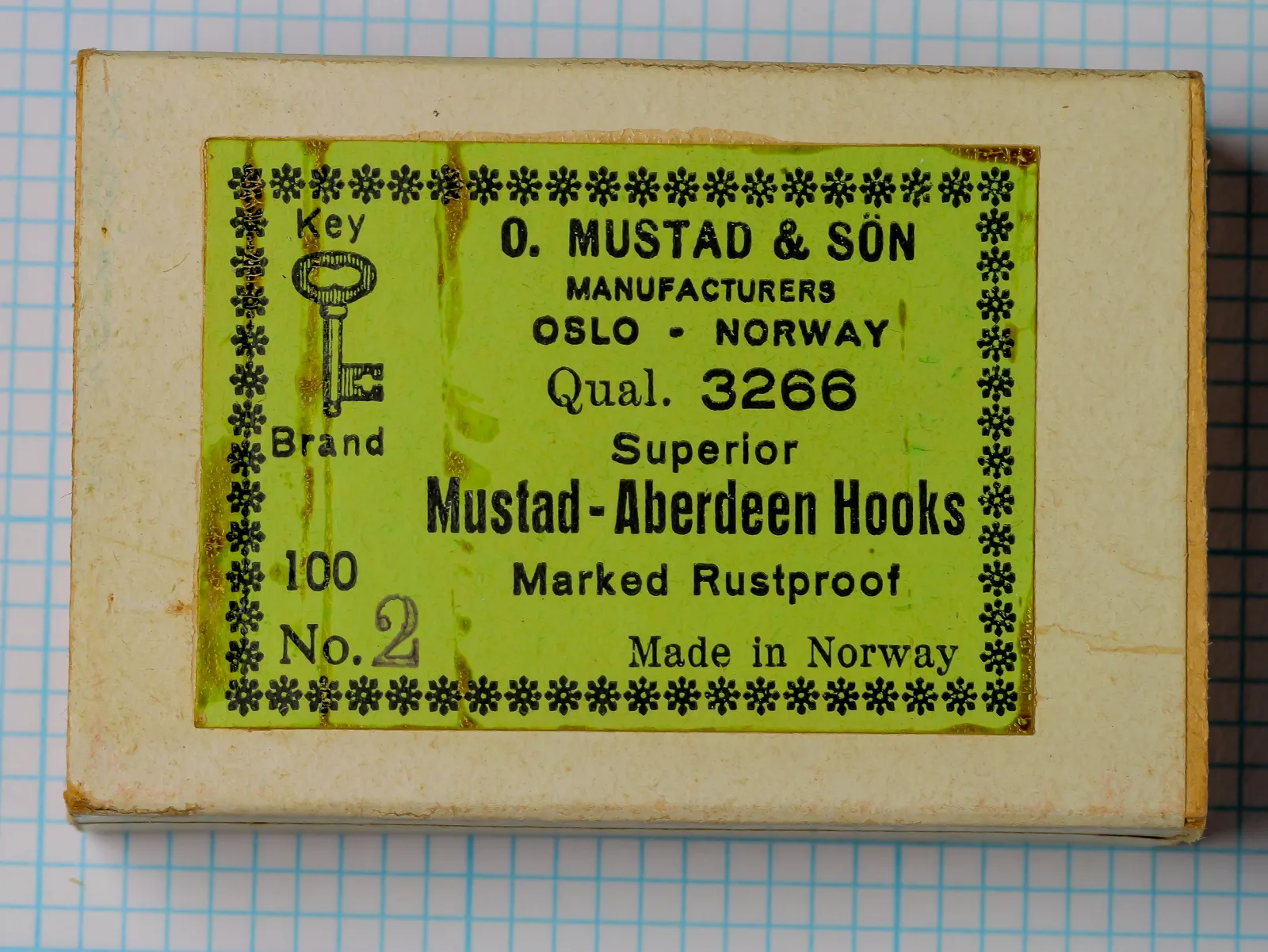
The Mustad 3266 Aberdeen represents a fascinating intersection of traditional hook construction and mid-century Norwegian industrial fishing tackle production. Manufactured by O. Mustad & Son in their Oslo facility, this blind eye Aberdeen features the company’s distinctive Key Brand packaging with its iconic green label and decorative snowflake border P.
What sets this hook apart is its combination of the wide-gap Aberdeen bend with blind eye construction and marked shank features. The eyeless design allows live baits to be threaded directly onto the shank without obstruction, while the raised ridges help secure soft baits in position. Available in sizes No. 1 and No. 2, these hooks were specifically engineered for serious bait fishing applications V.
Dating to approximately 1950-1965 based on packaging evidence, the 3266 represents Mustad’s commitment to traditional construction methods even as eyed hooks dominated the market. The superior point geometry and fine wire gauge demonstrate Norwegian precision manufacturing, while the rustproof bronzed finish ensures durability in freshwater applications P.
For collectors, intact Key Brand packaging significantly enhances value, particularly given the relative scarcity of surviving blind eye Aberdeen hooks. The combination of functional innovation and historical significance makes this a noteworthy example of mid-century Scandinavian tackle engineering.
Mustad-3266-Box-and-Label-Size-2
Photographic record
6 cataloged imagesSelect any record to load it above.
6 images shown
Mustad-3266-Box-and-Label-Size-2Mustad-3266-Box-and-Label-Size-2Open originalMustad-3266-Hook-Point-Size-2Mustad-3266-Hook-Point-Size-2Open originalMustad-3266-Hook-Size-2Mustad-3266-Hook-Size-2Open originalMustad-3266-Box-and-Label-Size-1Mustad-3266-Box-and-Label-Size-1Open originalMustad-3266-Hook-Point-Size-1Mustad-3266-Hook-Point-Size-1Open originalMustad-3266-Hook-Size-1Mustad-3266-Hook-Size-1Open original
Technical profile
Eye
Blind — Marked Shank
Wire
Fine (1X Fine), Round
Shank
2X Long — Marked / Ridged
Bend
Aberdeen, Wide gap
Point
Superior (near-straight inner taper)Standard cut barb positioned close to point with moderate angle, typical of mid-century Norwegian production P.
Finish
Bronzed — Confirmed (stated on packaging)Warm bronze tone with even coverage throughout. No evidence of corrosion or finish degradation on photographed specimens P.
Hooks show bright bronze finish with no corrosion. Packaging exhibits light edge toning but labels remain vibrant and fully legible.
The blind eye construction eliminates the wire eye that could tear delicate baits or create an unnatural presentation. The marked shank features raised ridges that grip soft baits like worms or crickets, preventing them from sliding down during casting or retrieval. The Aberdeen bend’s wide gap and round geometry maximizes hook-setting efficiency while the fine wire minimizes bait damage. The superior point features a nearly straight inner taper for reliable penetration without the aggressive cutting action of hollow point designs P.
The 3266 represented Mustad’s continuation of traditional blind eye construction into the mid-20th century, even as eyed hooks were becoming the market standard. This Aberdeen variant was specifically marketed for bait fishing applications where the eyeless design provided functional advantages. The ‘Qual.’ designation indicated quality grade within Mustad’s extensive catalog system. Production appears to have been discontinued by the 1970s as blind eye hooks lost market share to more versatile eyed designs.
Era and Packaging Dating
Green Key Brand label with snowflake border pattern, Oslo Norway address without postal codes, 'Qual.' quality designation system, letterpress printing on cardboard stock, and absence of modern barcode or plastic elements all indicate 1950-1965 production period.
The Lost Art of Snelling
Blind eye hooks like the 3266 required anglers to master the traditional art of snelling - whipping line directly to the shank with intricate knots. This created a stronger, more streamlined connection than early eyed hooks, but demanded significantly more skill and time. Many old-school bait fishermen considered proper snelling a mark of angling expertise, leading to informal competitions over knot quality and durability.
Design lineage and influence
The Aberdeen bend originated in Scotland and became the standard for live bait presentation worldwide. Mustad’s blind eye variant continued construction methods dating to the 18th century, even as the company pioneered modern industrial hook production. Contemporary alternatives included Allcock’s blind eye patterns from England and domestic American makers like Pflueger, though few matched Mustad’s consistent metallurgy and point geometry.
Best matchRelated by Attribute
Computed automatically from catalog data — updated as new hooks are added.
Matches: Bend, Gap, Eye, Eye Orient., Forging +4 moreDiffers: Shank: 2X Long vs 1X Long; Wire: Fine (1X Fine) vs Extra-Fine; Point: Superior vs Hollow Point +2 more
Matches: Bend, Gap, Eye, Eye Orient., Forging +4 moreDiffers: Shank: 2X Long vs 3X Long; Wire: Fine (1X Fine) vs Extra-Fine; Point: Superior vs Hollow Point +3 more
Matches: Bend, Wire, Gap, Eye, Eye Orient. +4 moreDiffers: Shank: 2X Long vs 3X Long; Point: Superior vs Hollow Point; Finish: Bronzed vs Blued +3 more
Matches: Bend, Gap, Eye, Eye Orient., Point +6 moreDiffers: Shank: 2X Long vs Special Long; Wire: Fine (1X Fine) vs Heavy (1X Heavy); Finish: Bronzed vs Blued +1 more
Designed specifically for live bait fishing where the blind eye construction allows baits like worms, crickets, or minnows to be threaded onto the shank without obstruction from a formed eye. The extra-long shank and wide Aberdeen bend provide excellent bait presentation while the marked shank helps secure soft baits in position P.
Secondary Applications
Traditional snelling, classic fly patterns requiring gut loop eyes
Classic Fly Patterns
Not typically used for fly tying
Modern Equivalents
Hook
Match Quality
Notes
Custom blind eye patterns from boutique makers
Good
No mass-produced equivalent exists - specialists must commission custom tapered eyeless hooks
Collector notes
Elevated by the uncommon blind eye construction and intact Key Brand packaging from Mustad's Norwegian peak period, but availability in two documented sizes limits extreme rarity.
Reference value
$15 – $35 USD estimate
Packaging condition
Very Good — light wear, fully legibleRecorded specimen
Packaging format
MUS-KB-01Catalog code
Positive factors: Blind eye Aberdeen hooks represent a transitional period before eyed hooks became universal. The intact Key Brand packaging with green label and decorative border is highly desirable among Mustad collectors. The marked shank feature adds functional interest.
Limiting factors: Aberdeen pattern itself was widely produced. Two documented sizes suggest reasonable original production numbers. Some collector preference for salmon fly-specific blind eye patterns over bait hooks.
Packaging
Cardboard box with bright green printed label featuring decorative snowflake border pattern. Key Brand logo with vintage key illustration. Black text on green background states manufacturer, model, specifications. Shows age toning on cardboard edges but label remains vibrant.
Market Value Notes
Packaged examples command premium over loose hooks. Condition of card and label significantly affects value. Size No. 1 appears less common than No. 2 in surviving examples.
Authentic examples show ‘O. MUSTAD & SÖN’ with the Norwegian letter ö, ‘OSLO – NORWAY’ address, and ‘Qual. 3266’ model designation. Key Brand label should be bright green with black snowflake border. Beware of reproduction labels or mixed packaging – original cards are specific to this model code.
Preservation
Storage and Preservation
Store in low humidity environment to prevent bronze finish oxidation. Original packaging adds significant collector value – keep hooks on card rather than loose. The cardboard is susceptible to edge browning and should be stored flat in acid-free sleeves. Avoid contact with dissimilar metals to prevent galvanic corrosion. Handle packaging minimally as the green label ink can be fragile on older specimens.
Size Note
Sizing Considerations
The Aberdeen bend family typically runs large relative to other bend styles in equivalent numerical sizes. A No. 2 Aberdeen has a significantly wider gap than a No. 2 Sproat or Limerick pattern. Additionally, blind eye hooks measure differently than eyed equivalents since overall length excludes the eye dimension. Consider these factors when comparing to modern sized hooks or planning applications.
Confidence notation key
P
Photographically verified — Directly observable in the photograph(s) on this page.
V
Verified by documentation — Confirmed by manufacturer catalog, spec sheet, or published reference.
I
Inferred — A logical deduction from observable or documented evidence, not directly stated.
E
Estimated — An approximation based on visual comparison, proportional analysis, or limited data.
S
Speculative — A reasoned hypothesis that cannot be confirmed from available evidence.
Unnotated claims are the compiler’s synthesis; see Sources. All photographs on garrenwood.com are taken on a measurement grid where each square equals 1/10 inch (0.1″ / 2.54 mm).