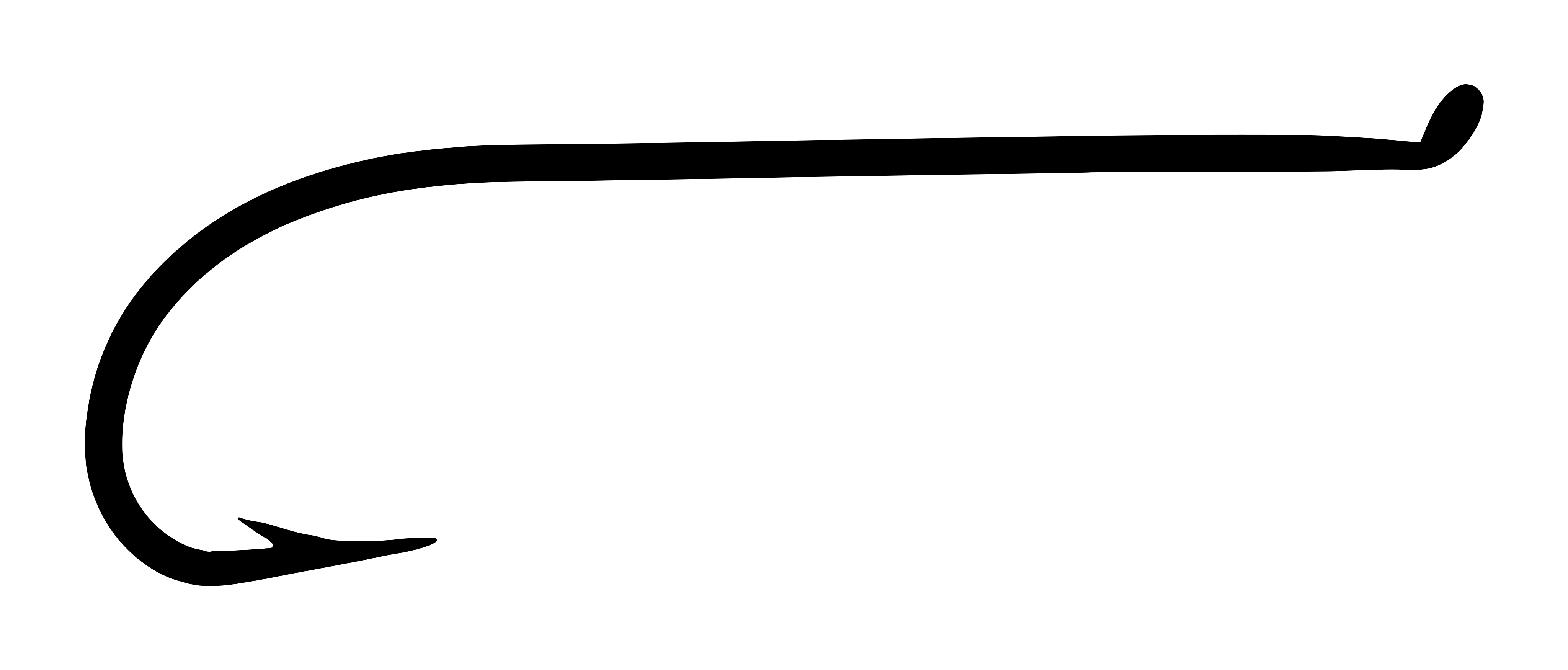
Mustad 3282 Aberdeen Hook represents a purposeful engineering solution for live bait fishing, combining a round Aberdeen bend, ball eye, extra-fine wire, and nickel plate finish across an extra-long shank (approximately 2.7:1 shank-to-gap ratio). The fine wire minimized tissue trauma when threading live minnows, while the extended shank provided leverage for hook removal from panfish without harming the fish or angler. Produced circa 1950–1970 in Norway and distributed globally through Mustad’s Key Brand packaging, this hook exemplifies mid-century tackle democratization—industrial-scale manufacturing that placed reliable, specialized fishing tools within reach of hardware stores and bait shops across North America and Europe.
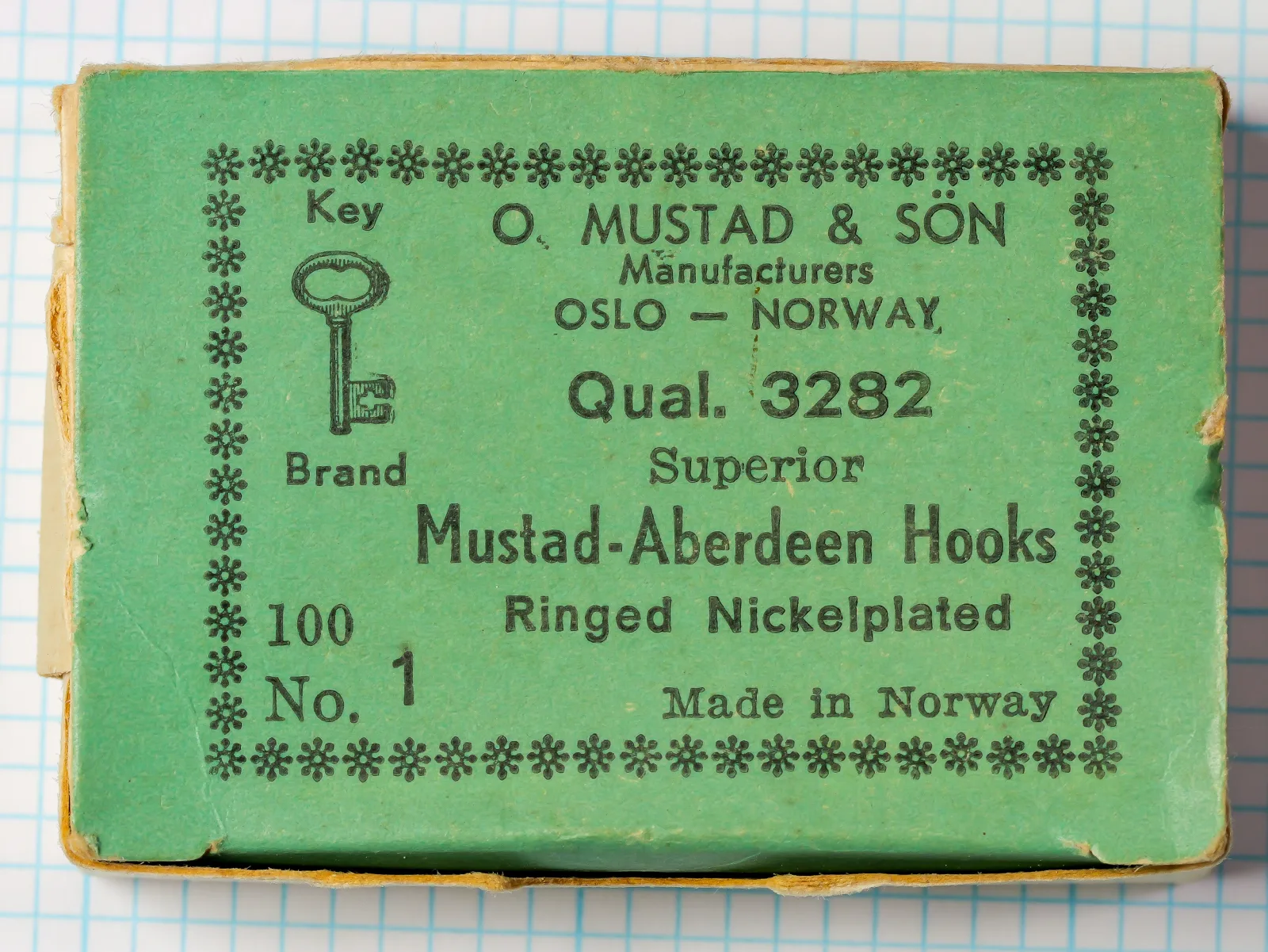
Original green Key Brand cardboard box for Mustad 3282 Aberdeen hooks, size No. 1, showing the iconic asterisk border design and 'O. Mustad & Sön' manufacturer details from the 1950s-1960s era.
Photographic record
3 cataloged imagesSelect any record to load it above.
3 images shown
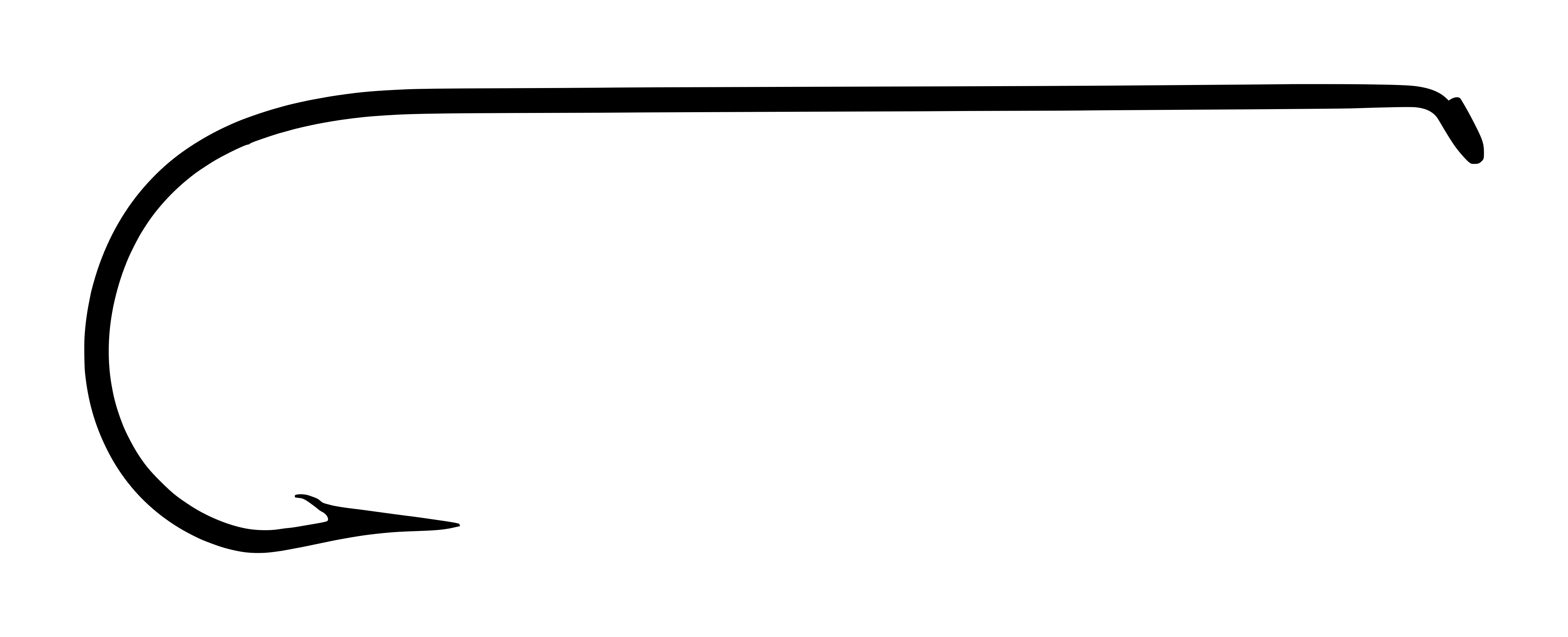
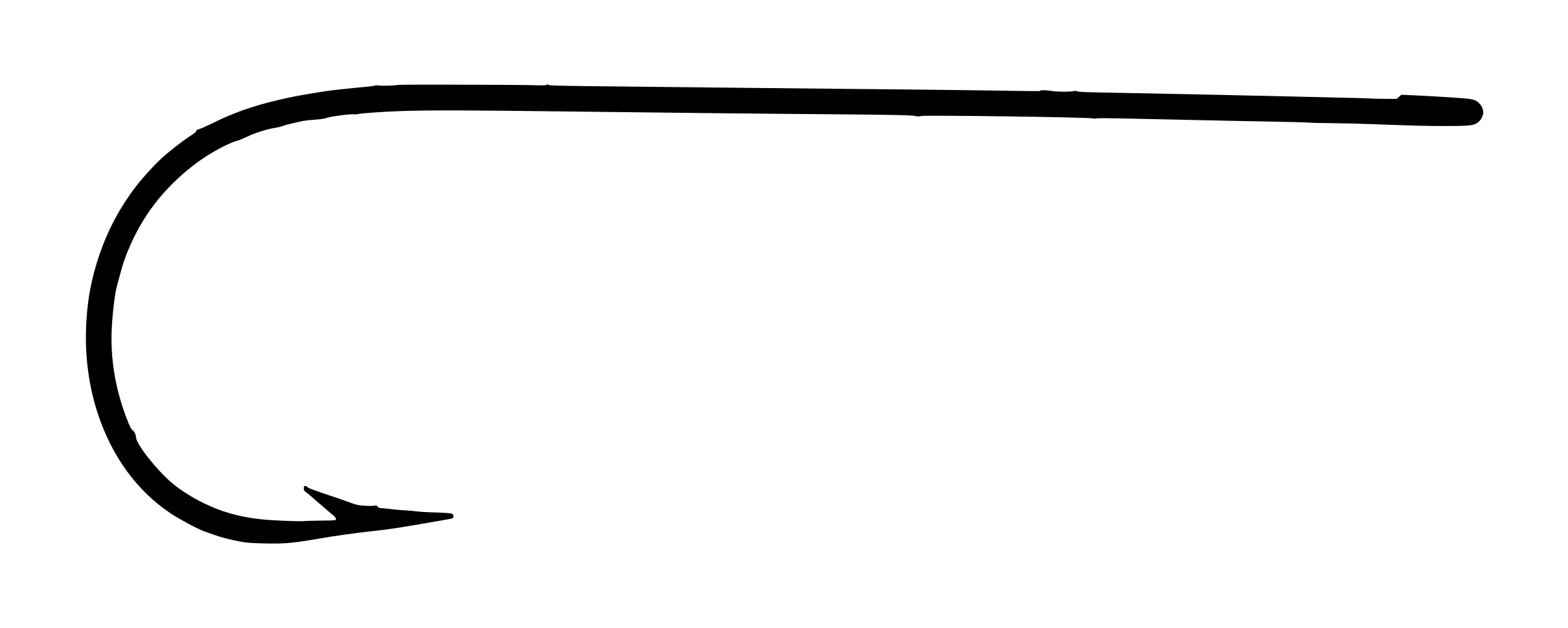
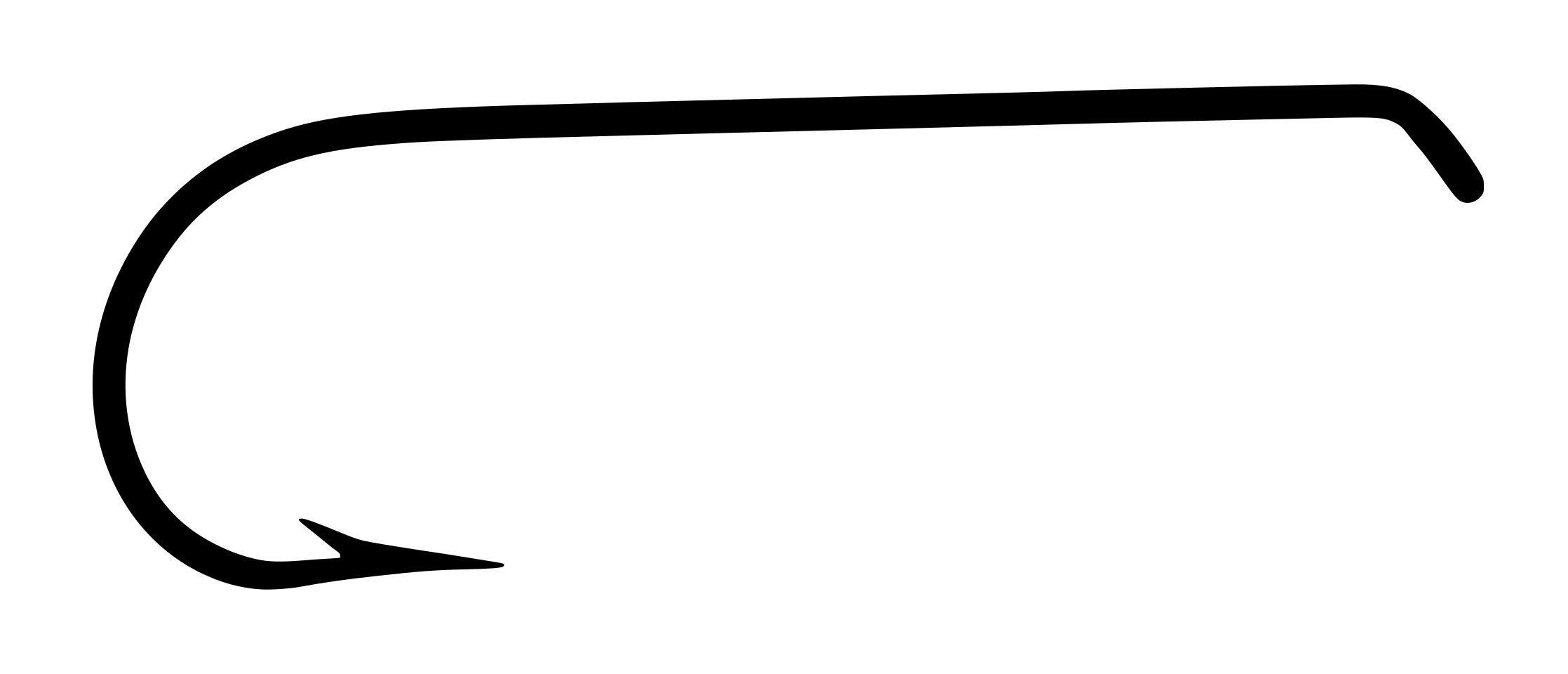
Mustad 3282 Key Brand Box Size No. 1Original green Key Brand cardboard box for Mustad 3282 Aberdeen hooks, size No. 1, showing the iconic asterisk border design and 'O. Mustad & Sön' manufacturer details from the 1950s-1960s era.Open originalMustad 3282 Aberdeen Hook Size No. 1 ProfileFull profile view of a Mustad 3282 Aberdeen hook, size No. 1, on measurement grid showing the characteristic extra-long shank and perfectly round bend geometry.Open originalMustad 3282 Point Detail Size No. 1Close-up detail of the Mustad 3282 Aberdeen hook point and barb, showing the standard spear point geometry and proportional cut barb typical of mid-20th century mass production.Open original
Technical profile
Straight Ball | Aberdeen | 3X long | Extra fine Wire | Spear Point | Nickelled
Eye
Ball Eye, Straight / Inline
Wire
Extra-Fine, Round, Est. ~0.024"-0.028" (~0.6-0.7 mm) E
Shank
3X Long — Plain
Bend
Aberdeen, Standard gap
Point
Standard / Spear
Finish
Nickelled / Nickel-Plated — Confirmed (stated on packaging)Box shows moderate edge wear and corner softening typical of age, but graphics remain clear and legible. Green color retains good saturation. Hooks appear bright with nickel finish intact P.
The Aberdeen pattern’s engineering reflects a specific understanding of live bait fishing mechanics and fish handling requirements. Fine wire construction minimizes tissue displacement when threading live minnows or shiners, reducing trauma that would otherwise cause bait to die prematurely in the water. The perfectly round bend distributes any contact pressure evenly along the bait’s body, avoiding stress concentrations that angular bends would create.
The extra-long shank serves dual mechanical functions: providing extended threading length for larger baitfish, and creating the leverage needed for extracting deeply-swallowed hooks from panfish without killing the fish or injuring the angler’s fingers. At an estimated 2.7:1 shank-to-gap ratio, the 3282 represents one of the most extreme proportional designs in general-purpose hook manufacturing, optimized entirely for function over aesthetics.
We don't have measured sizes for this hook yet. Own one? Submit calipered measurements and we'll review and add them. Thank you!
Historical context
mustad
O. Mustad & Son was founded in 1832 by Ole Mustad in Gjøvik, Norway, beginning as a small wire-working and nail-making operation before evolving into the world’s largest fishing hook manufacturer by the mid-20th century. The company’s transformation from local craftsman shop to industrial giant paralleled Norway’s broader industrialization, with Mustad establishing the technical infrastructure for mass-producing hooks at unprecedented scale while maintaining consistent quality standards across millions of units annually.
By the 1950s, Mustad operated manufacturing facilities across Europe and had established distribution networks spanning every continent, with the Oslo commercial office handling export operations while production remained centered at the original Gjøvik factory. The Key Brand designation represented Mustad’s premium commercial line, positioned above basic utility hooks but below specialized patterns, targeting the vast middle market of general recreational anglers who needed reliable hooks without premium pricing or specialist knowledge.
Series History
The 3282 Aberdeen was part of Mustad’s core bait hook series, introduced in the early 20th century as part of the company’s systematic cataloging of traditional European hook patterns for industrial production. Unlike artisan hook makers who produced Aberdeen patterns in small batches with individual variation, Mustad standardized the Aberdeen geometry for mass manufacturing, creating consistent specifications across size ranges and establishing the pattern as a global standard for live bait fishing.
The series encompassed sizes from tiny No. 12 for ice fishing through large No. 3/0 for saltwater applications, with the extra-long shank designation differentiating it from Mustad’s standard Aberdeen offerings. Production continued with minimal changes through the 1970s, when plastic packaging began replacing the classic cardboard boxes, marking the end of an era in tackle merchandising aesthetics.
Era and Packaging Dating
The green Key Brand cardboard box with asterisk/flower border design, 'O. Mustad & Sön' spelling with umlaut, and 'Oslo - Norway' address format all indicate Mustad's post-war export packaging era. The cardboard box format was standard from the late 1940s through early 1970s, before plastic blister packs became dominant. Typography and print quality consistent with 1950s-1960s commercial packaging standards.
Wartime Service
During World War II, Mustad's hook production was requisitioned for military use, with Aberdeen patterns modified for survival fishing kits carried by downed pilots and naval personnel. The fine wire construction and easy removal characteristics that made the Aberdeen ideal for recreational panfish angling proved equally valuable for emergency food procurement in survival situations, leading to the pattern's inclusion in military survival manuals through the Cold War era.
Design lineage and influence
The Aberdeen bend traces its origins to Scottish fishing traditions, taking its name from the northeast Scottish port city where the pattern was refined for North Sea fishing conditions. Mustad’s industrial interpretation preserved the essential geometry while standardizing dimensions and manufacturing processes, creating a global template that influenced hook makers worldwide throughout the mid-20th century.
The pattern’s success established Aberdeen geometry as a fundamental hook category, with virtually every major manufacturer producing their own Aberdeen variants. However, Mustad’s scale of production and distribution reach meant that the 3282 became the reference standard against which other Aberdeen patterns were compared, effectively defining the pattern for generations of anglers who encountered it as their first fishing hook.
Best matchRelated by Attribute
Computed automatically from catalog data — updated as new hooks are added.
Matches: Bend, Shank, Wire, Gap, Forging +3 moreDiffers: Eye: Ball Eye vs Tapered Eye; Eye Orient.: Straight / Inline vs Turned Down; Point: Standard / Spear vs Superior +1 more
Matches: Bend, Shank, Eye, Eye Orient., Forging +3 moreDiffers: Wire: Extra-Fine vs Fine (1X Fine); Gap: Standard vs Wide; Point: Standard / Spear vs Superior +1 more
Matches: Bend, Wire, Gap, Eye, Forging +2 moreDiffers: Shank: 3X Long vs 2X Long; Eye Orient.: Straight / Inline vs Turned Down; Point: Standard / Spear vs Superior +2 more
The Mustad 3282 Aberdeen was the quintessential live bait hook of the mid-20th century, specifically engineered for threading live minnows, shiners, and killifish without causing fatal trauma P. The extra-long shank design served dual purposes: providing mechanical purchase for removing deeply-swallowed hooks from panfish and flounder, while offering extended threading length for larger baitfish P. Size No. 1 was particularly favored for saltwater flounder fishing along the Atlantic coast, where anglers would drift live killifish or spearing just off the bottom of tidal channels and shallow bays V.
Secondary Applications
General freshwater panfish angling, perch fishing, ice fishing with live bait, bottom fishing for sea trout in estuaries
Classic Fly Patterns
Not typically used for fly tying
Modern Equivalents
Hook
Match Quality
Notes
Mustad 3282DT
Excellent
Direct descendant with identical geometry, modern packaging
Owner SSW
Good
Similar Aberdeen geometry, modern metallurgy
Gamakatsu Octopus
Moderate
Comparable live bait application, different bend style
Collector notes
Common industrial hook with collecting value residing primarily in the iconic Key Brand packaging rather than hook scarcity.
Reference value
$8 – $25 USD estimate
Packaging condition
Good — moderate wear, legibleRecorded specimen
Packaging format
MUS-KB-01Catalog code
Positive factors: The green Key Brand box represents one of the most recognizable pieces of mid-20th century fishing tackle packaging globally, making it a significant reference specimen for collectors of vintage fishing memorabilia. The ‘O. Mustad & Sön’ spelling with umlaut adds dating precision and historical authenticity. Complete box with good label preservation enhances display value.
Limiting factors: The 3282 Aberdeen was produced in enormous quantities for decades, making individual hooks extremely common. Most collectors seek rarer patterns or premium Sheffield steel hooks rather than mass-produced Norwegian industrial hooks. Value depends almost entirely on packaging condition rather than hook rarity.
Packaging
Green cardboard box with distinctive asterisk/flower border pattern. Front face displays 'Key Brand' logo with key symbol, 'O. Mustad & Sön Manufacturers Oslo - Norway', 'Qual. 3282 Superior', 'Mustad-Aberdeen Hooks', '100 Ringed Nickelplated', 'No. 1', and 'Made in Norway'. Box construction is typical mid-20th century folded cardboard with letterpress printing in black ink on green stock.
Market Value Notes
Value driven primarily by packaging condition and completeness. Mint condition boxes with full hook count command premium pricing among vintage tackle collectors. Individual hooks have minimal value outside of display context.
Authenticate by the specific ‘O. Mustad & Sön’ spelling with umlaut on green Key Brand packaging – later versions simplified to ‘Son’ without diacritical marks V. The asterisk/flower border pattern is period-specific to 1950s-1960s production runs V. Hook geometry should show perfectly round Aberdeen bend with no angular departures and extra-long shank proportions approximately 2.7 times the gap width P. Nickel finish should appear bright silver without the warmer tone of tin plating P.
Preservation
Storage and Preservation
Store the complete Key Brand box in a cool, dry environment away from humidity to prevent deterioration of the cardboard packaging, which represents the primary collecting value of this specimen. The green cardboard stock is susceptible to fading with UV exposure, so avoid direct sunlight during display. Original packaging should be handled minimally to preserve the letterpress printing quality and prevent corner damage.
The nickel-plated hooks are relatively stable but should be kept dry to prevent any underlying steel corrosion that could compromise the plating integrity. If removing hooks from the original packaging for examination, use soft-tipped tweezers to avoid scratching the nickel finish. The fine wire gauge makes these hooks more susceptible to deformation than heavier patterns, so handle with appropriate care during inspection.
Primary Source
Key Brand Packaging Claims
Source: Original Key Brand cardboard box labeling, c. 1950-1970
The box face makes several specific quality claims worth analyzing in historical context. The ‘Made in Norway’ marking emphasizes Norwegian steel and manufacturing heritage as quality indicators for the American and European export markets.
‘Ringed Nickelplated’ specifies both the eye construction method (formed ring rather than turned or looped) and the corrosion-resistant finish – significant selling points for saltwater applications. The ‘100’ quantity designation reflects Mustad’s mass-market positioning, offering bulk quantities that competing manufacturers typically reserved for commercial accounts. These packaging claims collectively position the 3282 as reliable, affordable tackle for serious recreational anglers rather than casual fishing.
Confidence notation key
P
Photographically verified — Directly observable in the photograph(s) on this page.
V
Verified by documentation — Confirmed by manufacturer catalog, spec sheet, or published reference.
I
Inferred — A logical deduction from observable or documented evidence, not directly stated.
E
Estimated — An approximation based on visual comparison, proportional analysis, or limited data.
S
Speculative — A reasoned hypothesis that cannot be confirmed from available evidence.
Claims with no notation are confirmed by multiple independent sources. All photographs on garrenwood.com are taken on a measurement grid where each square equals 1/10 inch (0.1″ / 2.54 mm).