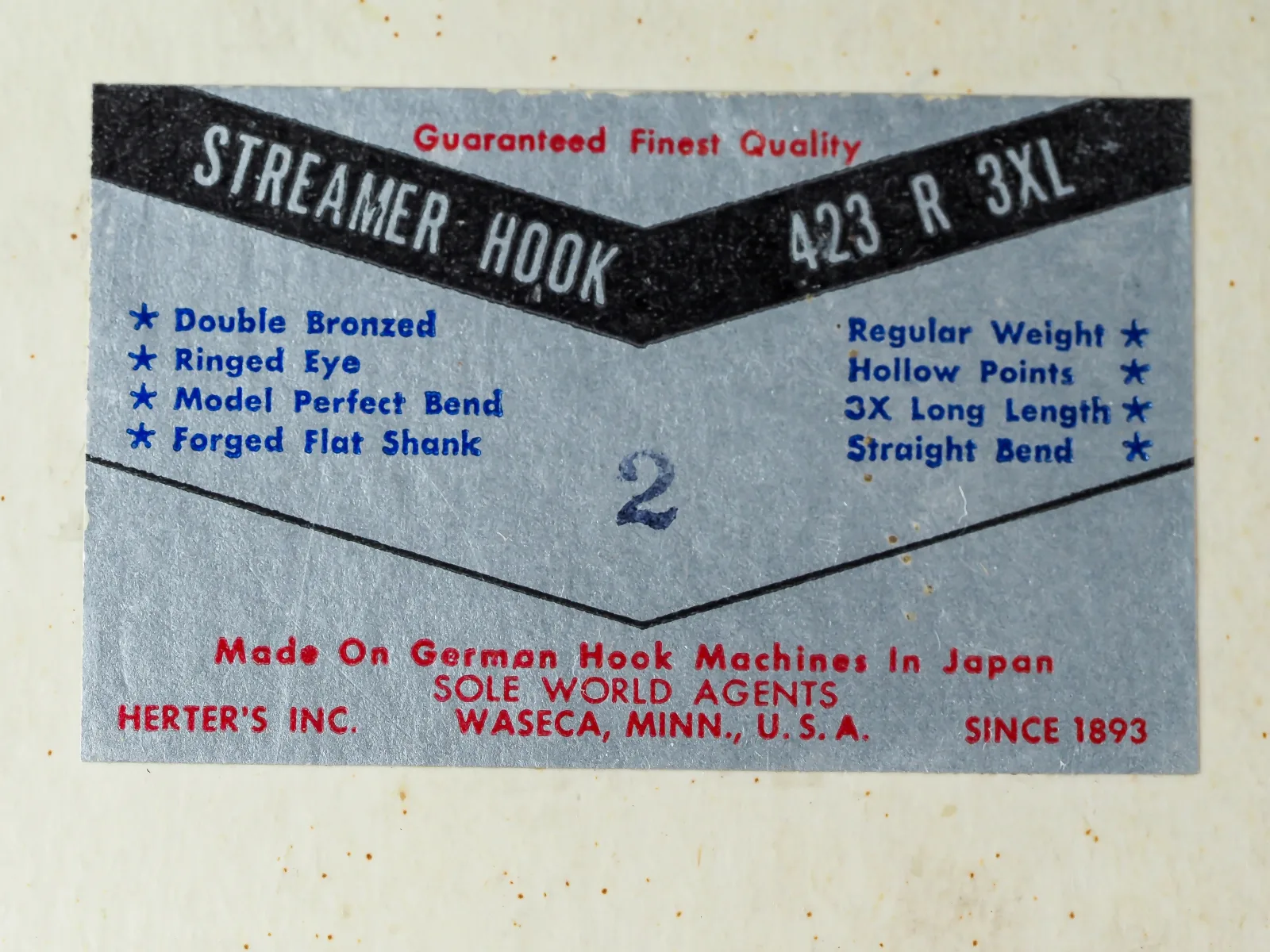
The Herter’s 423-R is a Japanese-manufactured streamer hook of the 1950s-1960s era, produced by Herter’s Inc. of Waseca, Minnesota under license from German hookmaking technology. This size No. 2 specimen exemplifies the “Model Perfect Bend” (Sproat-family) form with a forged flat shank, ringed eye, and distinctly hollow points.
The packaging explicitly identifies the hook as manufactured on German machines in Japan — a transparent acknowledgment of post-war industrial sourcing that was common and unremarkable in the 1950s-60s tackle trade. The double-bronzed finish and straight bend are optimized for wet-fly and streamer fishing, where a smooth, strong shank and robust point are functional priorities.
Herter’s was a major mid-century catalog retailer with direct relationships to Japanese and European manufacturers. The 423-R represents the company’s mainstream streamer offering — well-designed but mass-produced, and now collected more for its packaging typography and industrial-history narrative than for rarity or technical innovation.
Original Herter's 423-R sales card (c. 1950s-1960s) showing letterpress printing with product specifications, manufacturer attribution, and warranty statement. The card documents Herter's sourcing of German-designed hooks manufactured in Japan.
Photographic record
4 cataloged imagesSelect any record to load it above.
4 images shown
Herter’s 423-R Sales Card Size 2Original Herter's 423-R sales card (c. 1950s-1960s) showing letterpress printing with product specifications, manufacturer attribution, and warranty statement. The card documents Herter's sourcing of German-designed hooks manufactured in Japan.Open originalHerter’s 423-R Hook Point Profile Size 2Close-up side profile of the hook point showing the hollow point taper and barb placement. The concave inner face creates a cutting-edge effect characteristic of hollow point design.Open originalHerter’s 423-R Hook Full Profile Size 2Full profile view of the Herter's 423-R streamer hook showing the complete geometry: straight ring eye at top, forged flat shank (middle section), rounded Model Perfect bend, and hollow point. Measurement grid provides precise scale reference.Open originalHerter’s 423-R Hook Comparison Size 2Three Herter's 423-R hook specimens displayed to show consistency in hook sizing and construction quality. All exhibit similar bend profile, point geometry, and finish uniformity expected of mass-manufactured 1950s-era hooks.Open original
Technical profile
Eye
Ball Eye, Straight / InlineRinged eye — separate loose ring at the wire end, characteristic of older European and Japanese streamer hooks P
Wire
Standard, Forged
Shank
3X Long — Plain, Tapered
Bend
perfect, Standard gapModel Perfect Bend — rounded bottom typical of Sproat-family construction, straight (no offset or reversal) P
Point
Hollow Point (concave inner face)Hollow point with pronounced concave inner face creating a knife-edge cutting profile P
Finish
BronzedDouble bronzed finish as stated on packaging, warm brown-bronze patina visible on specimen P
Hooks appear bright bronzed with excellent finish integrity and no visible corrosion. Wire smooth and uniform. Points sharp and well-formed. Card exhibits light surface toning consistent with c. 1950s-1960s paper stock aging; no major creasing or water damage.
The hollow point is manufactured with a pronounced concave inner face, creating a cutting edge perpendicular to the shank — a design that enhances penetration on hard-mouthed fish and reduces slipping in active streamers. The forged flat shank increases bending resistance compared to round wire, a benefit for larger streamer patterns where leverage from the bend during hook-set is substantial.
The 3X Long shank accommodates substantial bodies for sculpin and baitfish imitations, allowing the hook to support heavy dubbing loads without bunching. The straight (non-offset) configuration and Model Perfect (Sproat) bend balance turning radius with point alignment — ideal for streamer work where the fly must turn smoothly on the strike.
The ringed eye allows snell-knot attachment and accommodates thicker leader material, a practical choice for larger streamer presentations where fine tippets are not required.
We don't have measured sizes for this hook yet. Own one? Submit calipered measurements and we'll review and add them. Thank you!
Historical context
herters
Herter’s Inc. was founded in Waseca, Minnesota, and became one of North America’s largest mail-order outdoor retailers in the mid-20th century. The company maintained direct sourcing relationships with manufacturers across Europe and Japan, leveraging post-war industrial recovery and licensing arrangements to acquire hooks, tackle, and fishing gear at volume scale.
Herter’s marketing emphasized value and transparency — packaging often openly acknowledged manufacturing location and technology source. The company supplied both retailers and direct consumers through its extensive catalog, which by the 1950s numbered hundreds of pages and featured thousands of items.
The ‘SINCE 1893’ statement on this card reflects Herter’s claim to heritage, though the actual founding date and early history are not independently verified in tackle literature. By the 1950s-1960s, the company was a household name in American hunting and fishing circles.
Series History
The 423-R Streamer Hook is not documented as part of a named series or family; it appears to be a standalone model designation within Herter’s catalog. The ‘423’ likely refers to a house number assigned to track this specific hook design in Herter’s ordering system, and the ‘R’ suffix denotes the ringed eye variant.
The ‘Model Perfect Bend’ branding suggests alignment with established Sproat terminology, but Herter’s did not innovate on the bend form — this was a standard European/Japanese hook family adapted for the American streamer market.
No documented predecessor or successor models in the 423 line are known. Production status and discontinuation date are not recorded.
Era and Packaging Dating
No barcode present — barcode adoption began c. 1974, placing card pre-1974. Phone number format 'WASECA, MINN.' without area code is consistent with pre-1960s business printing. 'SINCE 1893' founding statement typical of mid-century Herter's catalog material. Letterpress printing method and light blue cardstock color tone consistent with 1950s-early 1960s tackle packaging. Company was actively marketing Japanese-made hooks during this period. 'German Hook Machines' manufacturing attribution reflects post-WWII Japanese industrial recovery and licensing of European hookmaking equipment — dating 1950s onward. Overall evidence points to c. 1950-1965 production window.
Mail-Order Transparency: The Herter's Paradox
Herter's Inc. rose to dominance in American mail-order sporting goods by explicitly marketing items manufactured overseas while claiming heritage back to 1893 — a date that likely refers to an earlier entity or ancestor company, not Herter's direct founding. The phrase 'SINCE 1893' became a trust marker in the mail-order era, when consumers could not inspect goods before purchase. By the 1950s-60s, Herter's catalogs numbered 800+ pages and reached millions of households. The company's transparency about 'German hook machines in Japan' was, paradoxically, a selling point — it proved they had sourced the best available technology and could offer at competitive prices. This marketing approach stands in stark contrast to modern retailers who obscure manufacturing origin.
Design lineage and influence
The Herter’s 423-R follows the Sproat bend family — a British design standardized across European and Japanese manufacturers by the mid-20th century. The Model Perfect Bend variant reflects no innovation but rather the adoption of an established industrial standard. Competitors included Mustad’s Aberdeen and Limerick variants, Partridge of Redditch designs, and numerous other Japanese house models marketed under retailer brands.
The forged flat shank became increasingly common in Japanese production during the 1950s-60s as manufacturing equipment modernized. This feature was not unique to Herter’s; it appears across the streamer hook market of the era.
The ringed eye, historically a marker of older European hooks, persisted in Japanese production through the 1960s, though American and Norwegian manufacturers were transitioning to tapered and ball eyes. The 423-R preserves this older eye technology, suggesting either conservative design or continued alignment with European templates.
No documented downstream influence or derivative models are known.
Best matchRelated by Attribute
Computed automatically from catalog data — updated as new hooks are added.
Matches: Bend, Shank, Gap, Eye, Eye Orient. +3 moreDiffers: Wire: Standard vs Fine (1X Fine); Forging: Forged vs Round; Application: Streamer, Bait vs Streamer, Salmon, Sea Trout +1 more
Matches: Wire, Gap, Eye, Eye Orient., Point +3 moreDiffers: Bend: Perfect vs Round / Kendal; Shank: 3X Long vs Extra-Extra Long; Forging: Forged vs Round +1 more
Matches: Wire, Gap, Eye, Eye Orient., Point +2 moreDiffers: Bend: Perfect vs Carlisle; Shank: 3X Long vs 4X Long; Finish: Bronzed vs Gold-Plated +2 more
Matches: Wire, Gap, Eye, Eye Orient., Point +3 moreDiffers: Bend: Perfect vs Viking; Shank: 3X Long vs 4X Long; Application: Streamer, Bait vs Streamer +2 more
The 423-R is optimized for wet-fly streamer and baitfish-imitator patterns, primarily in freshwater trout contexts. The long shank and hollow point support substantial body dubbing and tied-on wings; the forged wire provides backbone for larger materials. The straight bend and Model Perfect profile are well-suited to active patterns that require quick turning and solid penetration on the strike.
The ringed eye accommodates snell knots and coarser leaders, reducing the need for delicate tying techniques. Historical context suggests use in both hand-tied professional fly applications and commercial production of standard patterns (Muddler Minnow, sculpins, etc.). The size No. 2 is suitable for large reservoir and river streamer fishing where substantial imitations are required.
Secondary Applications
Wet-fly nymph patterns, some bait-holder applications in older traditions
Modern Sproat-bend streamer hook, heavy wire, similar shank length; lacks forged profile but provides equivalent functionality
Tiemco 200R
Good
Contemporary Japanese-made long-shank streamer, 2x-3x length range, tapered eye; closer in modern design philosophy than retro equivalents
Partridge CS48/4
Moderate
Redditch-made Sproat variant, similar bend family but standard (not 3x) shank length
Collector notes
Rated 3.5/10 — Herter's hooks were mass-produced and widely distributed through catalog sales, making them common in survived collections. However, specific model numbers in original 1950s-60s packaging are less frequently encountered than modern re-releases. Primary collector value derives from Herter's brand nostalgia and packaging design typography rather than hook scarcity or technical uniqueness.
Reference value
$4 – $12 USD estimate
Packaging condition
Very Good — light wear, fully legibleRecorded specimen
Packaging format
GW-H-CARD-01Catalog code
Positive Factors: The original packaging design is distinctive and appealing to mid-century Americana collectors. Letterpress printing and the explicit ‘German machines, Japan’ manufacturing statement carry industrial-history interest. Herter’s catalogs and branded tackle have established fan bases among vintage outdoor retailers and nostalgia-focused buyers. Complete cards in good condition command modest premiums over loose hooks.
Limiting Factors: Herter’s hooks, while well-made, were not premium-tier offerings — they competed on price and availability rather than innovation. No specialized collector community focuses on Herter’s hooks specifically. Modern equivalents (Mustad, Tiemco) are cheap and plentiful, reducing demand for older specimens. Size No. 2 is relatively common; smaller or larger sizes may be slightly scarcer. Missing hooks from the card significantly reduce value.
Desirable Variants: Complete unopened cards in mint condition; rarer size ranges (very large or very small); cards with handwritten prices or retailer stamps indicating original stocking history; multi-card lots from estate collections.
Condition Premium: Sealed or effectively sealed cards can command 2-3x the value of opened, depleted cards. Bright, uncorroded hooks are expected; any surface corrosion is a negative factor. Card condition (printing legibility, toning, creasing) is secondary to hook count completeness.
Packaging
Light blue cardstock sales card with black and red letterpress printing. Chevron-style header banner in black containing white text 'STREAMER HOOK' and model number '423 R 3XL'. Upper portion features red text 'Guaranteed Finest Quality'. Left column lists four bullet-pointed features in blue: Double Bronzed, Ringed Eye, Model Perfect Bend, Forged Flat Shank. Right column lists four features: Regular Weight, Hollow Points, 3X Long Length, Straight Bend. Center displays large printed '2' size marker. Lower section contains red text manufacturer attribution: 'Made On German Hook Machines In Japan' / 'SOLE WORLD AGENTS' / 'HERTER'S INC.' / 'WASECA, MINN., U.S.A.' / 'SINCE 1893'. Card shows light age toning and minor handling wear; back unmarked. No barcode present.
Market Value Notes
Low ($4): Good condition, opened card with some hooks missing or worn<br />
High ($12): Mint or excellent condition, complete count, minimal wear, original packaging intact<br />
Premium factors: Complete unopened card, all hooks present and bright, card shows minimal toning or handling wear, Herter's branding appeal, pre-1960 manufacture date<br />
Platforms: eBay, vintage tackle dealer sales, estate auction lots<br />
Confidence: E estimated — limited specific sold data for this model; range based on comparable Herter's carded hooks and general mid-century streamer hook market. Herter's cards rarely exceed $15-20 even in mint condition due to production volume.
Where to Find
eBay (US and UK auctions), estate tackle sales, vintage sporting goods dealers in Midwest US (Herter's distribution was US-focused), occasional tackle fairs and outdoor swap meets.
Preservation
Storage and Preservation
Store Herter’s 423-R hooks on the original card in a cool, dry environment away from direct sunlight. The double-bronzed finish will gradually develop a warm patina over decades — this is normal and collectors generally consider it desirable, as it documents age and storage history.
Avoid prolonged exposure to high humidity (above 60% RH), which can accelerate oxidation and cause spotting. If the card shows signs of dampness, allow it to dry slowly at room temperature; do not apply heat.
Keep the original packaging intact — the card itself is a primary source document for Herter’s marketing and manufacturing attribution, and removing hooks diminishes both historical value and collector appeal. If loose hooks must be stored, keep them in a small dry container with silica gel, separate from other metals to prevent galvanic corrosion.
Periodically inspect for corrosion; minor surface patina is acceptable, but active rust or pitting indicates environmental exposure. If detected, move the hooks to a drier location immediately.
Primary Source
Packaging Text Analysis
Source: Herter's Inc. sales card, model 423-R, c. 1950s-1960s
‘Guaranteed Finest Quality’ — A common mid-century retail claim with no specific technical meaning. This phrase appears across Herter’s entire product line and reflects aspirational branding rather than documented quality standards.
‘Model Perfect Bend’ — Herter’s proprietary terminology for the Sproat-family bend. ‘Perfect’ here is marketing language; the bend is a standard Sproat variant with no documented innovation or patent.
‘Double Bronzed’ — Indicates application of bronzing compound in two passes or layers, allegedly improving finish durability and color consistency. This was a common specification in mid-century Japanese hook production, though technical advantage over single-bronzing was marginal.
‘Forged Flat Shank’ — Accurately describes the wire flattening process, which increases bending resistance. This was a genuine technical specification, not marketing hype, and appeals to streamer tyers requiring wire backbone.
‘Made On German Hook Machines In Japan’ — A transparent acknowledgment of post-war manufacturing sourcing. German companies (Müller-Wellman, etc.) sold hookmaking machinery to Japan in the 1950s. Herter’s transparency here was a competitive advantage, reassuring American customers that they were receiving European-quality hooks at Japanese prices.
‘SOLE WORLD AGENTS’ — An exaggerated claim of exclusive distribution rights. Herter’s was a major distributor but not the sole agent worldwide. This language was typical of mid-century mail-order boilerplate.
Marking Analysis
Handwritten Marks and Stamping
No handwritten marks, stamps, prices, or annotations are visible on the present specimen’s card. The card is printed entirely in letterpress typography — no evidence of retailer markup, original price notation, or stock-control markings.
Absence of handwritten pricing is consistent with mail-order distribution (Herter’s direct-to-consumer sales model), in contrast to tackle-shop cards which typically bore retailer rubber stamps or handwritten prices indicating original stocking location and date.
Additional
The Herter's Distribution Model and Mid-Century Tackle Retail
Herter’s Inc. fundamentally altered American sporting goods retail through massive mail-order catalogs distributed directly to consumers. By the 1950s, Herter’s catalogs reached millions of households and competed with established tackle companies (Pflueger, South Bend, Abbey & Imbrie) by offering equivalent or superior products at lower prices through direct sourcing.
The 423-R exemplifies Herter’s strategy: license proven European designs (Sproat bend), source manufacture to Japan where labor and overhead were minimal, and market transparently without false claims of heritage or American manufacture. This model was controversial — traditional tackle firms accused Herter’s of underselling and devaluing the market — but proved commercially unstoppable.
By the 1970s, Herter’s faced competition from other mass-market retailers and eventually declined. The brand briefly re-emerged in later decades but never recovered its mid-century dominance. Today, original Herter’s packaging and branded hooks represent the industrialization of tackle retail and the postwar economic transformation that made fishing gear accessible to millions who previously could not afford premium European hooks.
Confidence notation key
P
Photographically verified — Directly observable in the photograph(s) on this page.
V
Verified by documentation — Confirmed by manufacturer catalog, spec sheet, or published reference.
I
Inferred — A logical deduction from observable or documented evidence, not directly stated.
E
Estimated — An approximation based on visual comparison, proportional analysis, or limited data.
S
Speculative — A reasoned hypothesis that cannot be confirmed from available evidence.
Claims with no notation are confirmed by multiple independent sources. All photographs on garrenwood.com are taken on a measurement grid where each square equals 1/10 inch (0.1″ / 2.54 mm).