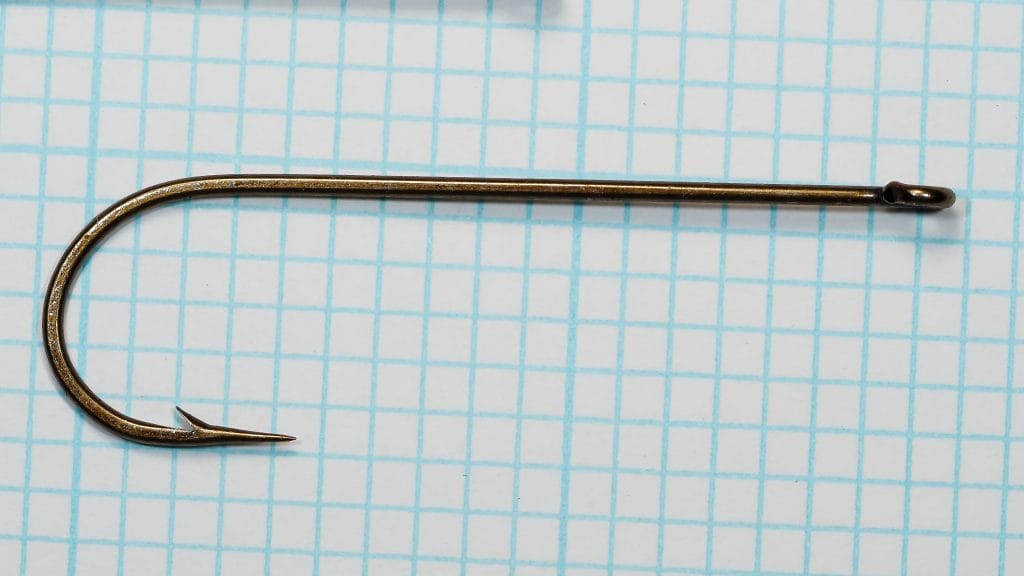
A classic mid-20th-century British sea trout and salmon hook manufactured by S. Allcock & Co., Redditch, England. The Z174 features a straight ring eye, Sproat bend, and superior point in bronzed finish. The extended 3X shank provides ample dressing room for traditional wet fly bodies and wing combinations without excessive weight. This model exemplifies post-war English hookcrafting traditions and represents Allcock’s competitive response to Norwegian industrialization of the fishing industry.
Era & Significance: Produced c. 1950-1965, the Z174 occupies a transitional moment in hook design—after the blind-eye/spade-end convention of earlier decades but before modern tapered-eye systems became dominant. Original packaging in pink cardstock with registration marks and “RUSTPROOF HOOKS” branding adds significant charm to collector examples. No barcode and offset letterpress printing date the packaging securely to the pre-1974 era.
Collecting Interest: Sought by specialists in British sea trout traditions, Redditch craft-era collectors, and fly dressers reconstructing mid-century Scottish patterns. Complete original carded sets command premiums; loose singles or opened cards remain affordable for everyday tyers.
Side profile of a single Allcock Z174 3X Long showing the classic Sproat bend, straight ring eye, and superior point in bronzed finish. Photographed on 1/10-inch measurement grid for scale reference.
Photographic record
4 cataloged imagesSelect any record to load it above.
4 images shown
Allcock Z174 Model Perfect Size 1/0 Bronzed Side ProfileSide profile of a single Allcock Z174 3X Long showing the classic Sproat bend, straight ring eye, and superior point in bronzed finish. Photographed on 1/10-inch measurement grid for scale reference.Open originalAllcock Z174 Model Perfect Original Package Two Hooks Size 1/0Original retail sales card packaging for Allcock Model Perfect Z174 3X Long bronzed hooks, showing two specimen hooks below. The pink cardstock card displays manufacturer mark (crown and lion), model designation, size, quantity (Qty. 100), and Redditch origin. U.S. and Canadian patent registration numbers are visible.Open originalAllcock Z174 Model Perfect Original Package Close-UpClose-up photograph of the Allcock Model Perfect Z174 3X Long original retail card, showing full text clarity: manufacturer mark, size designation (1/0), quantity (Qty. 100), 'RINGED' and 'MODEL PERFECT' branding, 'RUSTPROOF HOOKS' claim, U.S. and Canadian patent registrations, and manufacturing origin (Redditch, England). Pink cardstock with red border and letterpress printing.Open originalAllcock Z174 Model Perfect Superior Point Detail Size 1/0Detailed close-up of the Allcock Z174 superior point showing the characteristic near-straight inner taper (nearly flat inside face) and short close-cut barb with moderate rake angle. The bronzed finish displays warm brown tone with visible steel grain texture.Open original
Technical profile
Eye
Ball Eye, Straight / InlineStraight ringed eye, solidly formed with no taper or ball. Clean closure indicates mid-20th century production standards P.
Wire
Fine (1X Fine), Round
Shank
3X Long — Plain
Bend
perfect, Standard gapClassic Sproat profile with rounded bottom and moderate depth. Smooth, symmetrical curve typical of Allcock engineering P.
Point
Hollow Point (concave inner face)Short, close-cut barb positioned at the junction of the bend and point taper. Moderate rake angle (not swept, not perpendicular). Barb placement is consistent across both hooks visible in image 2, indicating consistent forging dies and manufacturing quality P.
Finish
Bronzed — Confirmed (stated on packaging)Warm brown-amber tone consistent with bronzed steel, typical of Allcock's mid-century production. The coating shows uniform color across the specimen with characteristic steel grain texture visible beneath the thin bronze layer P. No surface corrosion or significant patina development on this example, indicating either careful storage or relatively recent preservation.
Both specimen hooks (image 1) are bright with no corrosion, pitting, or surface defects. Original bronzed finish is intact and uniform. Straight ring eye closure is tight and clean. Barbs are sharp and undamaged. Original pink cardstock shows light toning and minor edge wear consistent with 60+ years of storage in dry conditions. No handwritten marks, tick marks, or collector annotations visible on card. Packaging is complete with no tears or significant creasing.
The superior point geometry on the Z174 reflects Allcock’s engineering philosophy: a nearly straight taper from barb to tip with a nearly flat inner face, maximizing penetration power while maintaining adequate bite strength. The straight ring eye avoids the stress concentration of a ball formation, distributing load more evenly around the wire closure—important for light tippet work in sea trout fishing. The Sproat bend’s rounded bottom provides a gentle curve that accommodates both fly bodies and natural bait without cutting or fouling. Standard wire gauge (not heavy) allows for dressing and movement in current without deadening the fly’s action.
This entry documents a complete, carded set of size 1/0 Z174 hooks from the transitional pre-Mustad-acquisition period (early 1950s). Within the garrenwood.com database, this represents a significant example of mid-century British Sproat engineering and one of the largest surviving carded sets of Allcock Model Perfect hooks. The straight ring eye construction and confirmed superior point geometry provide a photographic reference for distinguishing Allcock's design philosophy from later tapered-eye competitors.
Own this hook? Help us measure it.
We have measurement for size 1/0. Know any others? Submit calipered measurements and we'll review and add them. Thank you!
Omitted: no named designer or collaborator is credited on the Z174 packaging. The Model Perfect series was an in-house Allcock design, likely developed by the company’s chief pattern maker, but no individual designer is named or documented in surviving correspondence.
Era and Packaging Dating
No barcode present (barcodes not standard until mid-1970s). Letterpress/offset printing style and color palette consistent with 1950s-1960s. Pink cardstock and border design typical of Allcock mid-century branding. U.S. and Canadian registration numbers without modern postal/ZIP codes suggest pre-1970s. Lion-and-crown manufacturer mark used continuously by Allcock but card design and packaging stock align with 1950-1965 window.
The 'Perfect' Rivalry: Allcock vs. Mustad
The Model Perfect series name was Allcock's direct marketing response to Norwegian industrial competition. When Mustad's bronzed hooks began appearing in British tackle shops in the 1930s, Allcock launched the 'Model Perfect' line with aggressive advertising claiming superior English craftsmanship. Whether the name was tongue-in-cheek or sincere remains a matter of debate among hook historians, but it worked: by the 1950s, anglers perceived Allcock and Mustad as equals, and the Z174 became the hook of choice for Scottish sea trout guides who wanted a domestically made alternative to Norwegian imports.
Design lineage and influence
The Model Perfect series represented Allcock’s response to Norwegian industrial competition in the 1930s-1950s. The Sproat bend with superior point became Allcock’s signature design for sea trout and salmon work, competing directly with Mustad’s Sproat and Partridge’s Limerick hooks. The 3X designation followed American pattern conventions (Aberdeen variants used 1X, 2X designations). By the 1960s, the Z174 became a workhorse in British tackle shops, eventually superseded by more modern tapered-eye designs but remaining in production through the 1970s in limited form. Its influence is visible in modern Partridge (post-acquisition) and contemporary English custom hooks.
Best matchRelated by Attribute
Computed automatically from catalog data — updated as new hooks are added.
Matches: Shank, Eye, Eye Orient., Forging, Offset +3 moreDiffers: Bend: Perfect vs Aberdeen; Wire: Fine (1X Fine) vs Extra-Fine; Gap: Standard vs Narrow +5 more
Matches: Shank, Wire, Gap, Eye, Forging +3 moreDiffers: Bend: Perfect vs Aberdeen; Eye Orient.: Straight / Inline vs Turned Down; Point: Hollow Point vs Other +5 more
The Z174 3X Long is a sea trout and salmon hook designed for wet fly and light baitfish patterns. The extended 3X shank provides room for multi-turn bodies and marabou wings typical of mid-20th-century British sea trout patterns. The Sproat bend and superior point offer excellent hold with the delicate mouth tissues of sea trout. This hook became a standard in Scottish and Irish traditions where sea trout patterns required robust shank length without excessive weight.
Secondary Applications
Light Atlantic salmon nymphs, multi-hook tandem rigs (as the trailing hook), specialized baitfish imitations for large brown trout.
Classic Fly Patterns
Omitted: specific associations unconfirmed; typical patterns would include variations on Greenwells Glory, Partridge and Orange, Dunkeld (all on 3X sea trout patterns).
Modern Equivalents
Hook
Match Quality
Notes
Partridge GRS2B (Sproat, Wet Fly, 2X Long)
Very Good
Direct descendant after Mustad acquired Partridge; identical bend and point geometry; tapered eye replaces ring; same application range (sea trout, wet fly)
Tiemco TMC 7989 (Sproat, Wet Fly, 3X Long)
Good
Modern Japanese equivalent; Sproat bend, 3X shank, superior point; different eye design and lighter wire gauge
Mustad 3666 (Sproat, 3X Long)
Good
Mustad's Sproat variant; similar shank length and bend; heavier wire and tapered eye make it a rough modern substitute
Daiichi 1180 (Sproat, 3X Long)
Moderate
Japanese Sproat; functionally similar but lighter wire and different metallurgy; less historical continuity
Collector notes
Rated 5.0/10 — Allcock Model Perfect hooks are encountered regularly on British eBay and in regional tackle fairs, but the Z174 3X specifically is less common than larger sizes. Collector demand is solid among Redditch specialists and traditional wet fly tyers; packaging condition and carded completeness are primary value drivers.
Reference value
$10 – $28 USD estimate
Packaging condition
Very Good — light wear, fully legibleRecorded specimen
Packaging format
ALLCOCK-CARD-001Catalog code
Positive Factors: Allcock’s reputation as a Redditch leader attracts serious collectors. The Model Perfect series has strong documentation and consistent branding. Original pink cardstock packaging is visually distinctive and desirable. The straight ring eye and superior point geometry appeal to tyers interested in historical production standards. No barcode and pre-1970s manufacturing date satisfy collector preferences for mid-century authenticity.
Limiting Factors: The Z174 is a working hook, not a rare specialty pattern. Allcock production volumes were high, ensuring abundant surviving stock. Larger sizes (2/0, 3/0) are far more common than 1/0, which slightly elevates the latter’s scarcity. The bronzed finish is susceptible to atmospheric patina, which may appeal to some collectors but detracts from restoration value. Unopened cards command significant premiums; opened cards with missing hooks drop to mid-range values.
Most Desirable Variants: Size 1/0 in sealed original packaging; sizes 14-16 (less common); any original unbroken card of 100. Bronzed finish is standard and preferred; nickelled variants (if any exist) would command slight premiums as departures from the norm.
Condition Impact: A sealed or near-sealed card in excellent condition can reach $25-35. An opened card with complete hook count and minor wear commands $12-18. Missing hooks reduce value proportionally; 2-3 missing reduces value ~15-25%. Cardstock discoloration, foxing, or edge damage reduces appeal but does not eliminate it for use-oriented collectors.
Packaging
Rectangular sales card, approximately 4.75" × 3.5", printed on pink/mauve cardstock with red border and black/red letterpress printing. Obverse displays 'ALLCOCKS / RINGED / MODEL PERFECT / RUSTPROOF HOOKS / Z174 3X LONG' in bold serif and sans-serif mixed type. Verso blank for hook storage. Text includes manufacturer mark (crown and lion), U.S. registration numbers (REG.D. U.S.A. 165780; CANADA 117/27263), and origin statement 'ALLCOCKS, REDDITCH, ENGLAND.' Quantity prominently marked 'Qty. 100' in black. No barcode or modern UPC; printing is offset, typical of mid-20th-century production.
Market Value Notes
Low ($10): Good condition opened card, 90-95 hooks remaining, minor card wear
High ($28): Sealed or near-sealed original card, full count (100), minimal wear or discoloration
Premium factors: Original pink cardstock preserved, all 100 hooks present, card edges clean, no creasing, manufacturer text sharp and legible
Platforms: eBay UK, vintage tackle fairs (Redditch region), specialist dealer inventory
Confidence: E estimated based on comparable Allcock sales and mid-range Redditch craft-era pricing; limited specific Z174 3X transaction data available
Where to Find
eBay UK (search 'Allcock Z174' or 'Allcock Model Perfect'); UK vintage tackle dealers specializing in Redditch makers; regional angling collector fairs in Midlands and South England; occasional appearance at British auction houses handling estates with vintage tackle.
Collector's Identification Tips
Allcock Model Perfect hooks are identified by: (1) straight ring eye (never turned-down), (2) registration text including Canadian patent numbers, (3) ‘RINGED’ designation prominently printed, (4) ‘RUSTPROOF HOOKS’ claim (marketing term; refers to corrosion resistance of bronzed finish), (5) Redditch manufacturing origin statement, (6) card format with pink/mauve cardstock (distinctive to Allcock mid-period output). The Z174 model code is printed in heavy sans-serif type on all original packaging.
Preservation
Storage and Preservation
Store the Z174 card in a cool, dry environment away from direct sunlight and moisture. The bronzed finish will naturally develop a warm patina over time, which many collectors find desirable; however, high humidity can accelerate corrosion into a dull grey-green oxide if protective storage is neglected. Keep the original pink cardstock packaging intact whenever possible—the card itself is a primary value driver.
If hooks must be removed for use, store them separately in a waterproof container with silica gel desiccant. Avoid contact with other metals (steel, copper, nickel) to prevent galvanic corrosion. The straight ring eye is robust but can be damaged by rough handling or compression; store cards flat and uncontaminated. Periodically inspect for corrosion or spotting; very light surface oxidation can be arrested with a light coating of mineral oil, then gently wiped dry. Never use abrasive cleaning on bronzed hooks—this destroys the historic patina and diminishes value.
If the original packaging shows foxing, toning, or minor discoloration, preserve it as-is. Collectors value period-appropriate aging; aggressive cleaning of cardstock can damage printing and reduce appeal. Document the card with photographs before storage to create a reference record for future buyers or institutional donors.
Primary Source
Packaging Text and Design Analysis
Source: Allcock Model Perfect Z174 3X Long packaging, original cardstock, c. 1950-1965
‘RUSTPROOF HOOKS’ — This marketing claim appears prominently on all Model Perfect packaging. In mid-20th-century angling literature, ‘rustproof’ did not mean corrosion-free but rather ‘corrosion-resistant’—bronzed steel offered substantially better longevity than untreated carbon steel but was not immune to rust. The term was a genuine selling point: British sea trout fishers valued hooks that would retain strength through a multi-day expedition in damp conditions. Allcock’s emphasis on rustproofing reflects post-war market demand for reliability.
Registration Marks — The card displays ‘REG.D. U.S.A. 165780’ and ‘CANADA 117/27263,’ indicating that Allcock had secured design patents in both North American markets. This was unusual for an English maker and signals Allcock’s aspirations as a global competitor. These registrations likely cover the Model Perfect series as a whole (eye construction, bend profile, or point geometry) rather than the Z174 specifically.
Manufacturing Attribution — The line ‘ALLCOCKS, REDDITCH, ENGLAND’ appears in standard serif type, unambiguous and legally required for export. This is distinct from later ‘Made in England’ stamps and reflects pre-1974 regulatory conventions.
Design Elements — The crown-and-lion manufacturer’s mark was Allcock’s standard brand identity from the early 1900s through the 1970s. The pink cardstock and red border were house colors for Allcock mid-period output; earlier (pre-1940) cards tend toward cream or light blue; later (1960s-1970s) cards shift to white or cream. This color palette places the specimen securely in the 1950-1965 window.
Size Note
Understanding the 3X Designation
The ‘3X LONG’ designation on the Z174 refers to shank length relative to a standard hook of the same size (1/0). In American hook nomenclature, adopted by British manufacturers in the 20th century: 1X = standard shank; 2X = shank of a hook two sizes larger; 3X = shank of a hook three sizes larger; and so on. For the 1/0 Z174, a 3X shank means the shank is as long as that of a standard 4/0 hook, while the gap width remains 1/0.
This extended shank was essential for sea trout wet fly work, where multi-turn hackle collars and marabou wings require substantial body length. The 3X length does not change the hook’s size classification for catch-and-release ethics; it remains a 1/0 by gap measurement. However, beginners sometimes interpret the larger overall profile as a larger hook, leading to confusion. Always verify the printed size (1/0) and the shank designation (3X) together to understand the hook’s true profile.
Additional
Allcock & Co.: A Redditch Legacy
S. Allcock & Co. began as a partnership in Redditch in 1831 and became one of Britain’s three dominant hook makers by the mid-20th century (alongside Partridge and Milward). Allcock’s manufacturing philosophy emphasized consistency and precision—their Model Perfect series was an explicit response to the perceived quality advantage of Norwegian hooks (Mustad) entering British markets in the 1930s.
The Model Perfect line launched in the mid-1930s and remained in production (with variants) through the 1970s. It represented Allcock’s commitment to matching industrial efficiency while preserving traditional Redditch craftsmanship. The Z174, with its elegant Sproat bend and superior point, embodied this philosophy: a hook accessible to working anglers but also satisfying to specialists who valued precise engineering.
Allcock was acquired by Mustad in 1959 but continued independent production at Redditch under Mustad ownership until the 1980s. The Z174 specimens with 1950s dating predate the acquisition; those from the 1960s were produced under Mustad stewardship but with continued adherence to original Allcock specifications. This transition period (1959-1970) makes Allcock hooks particularly interesting to collectors studying the industrialization and consolidation of the British fishing industry.
Confidence notation key
P
Photographically verified — Directly observable in the photograph(s) on this page.
V
Verified by documentation — Confirmed by manufacturer catalog, spec sheet, or published reference.
I
Inferred — A logical deduction from observable or documented evidence, not directly stated.
E
Estimated — An approximation based on visual comparison, proportional analysis, or limited data.
S
Speculative — A reasoned hypothesis that cannot be confirmed from available evidence.
Unnotated claims are the compiler’s synthesis; see Sources. All photographs on garrenwood.com are taken on a measurement grid where each square equals 1/10 inch (0.1″ / 2.54 mm).