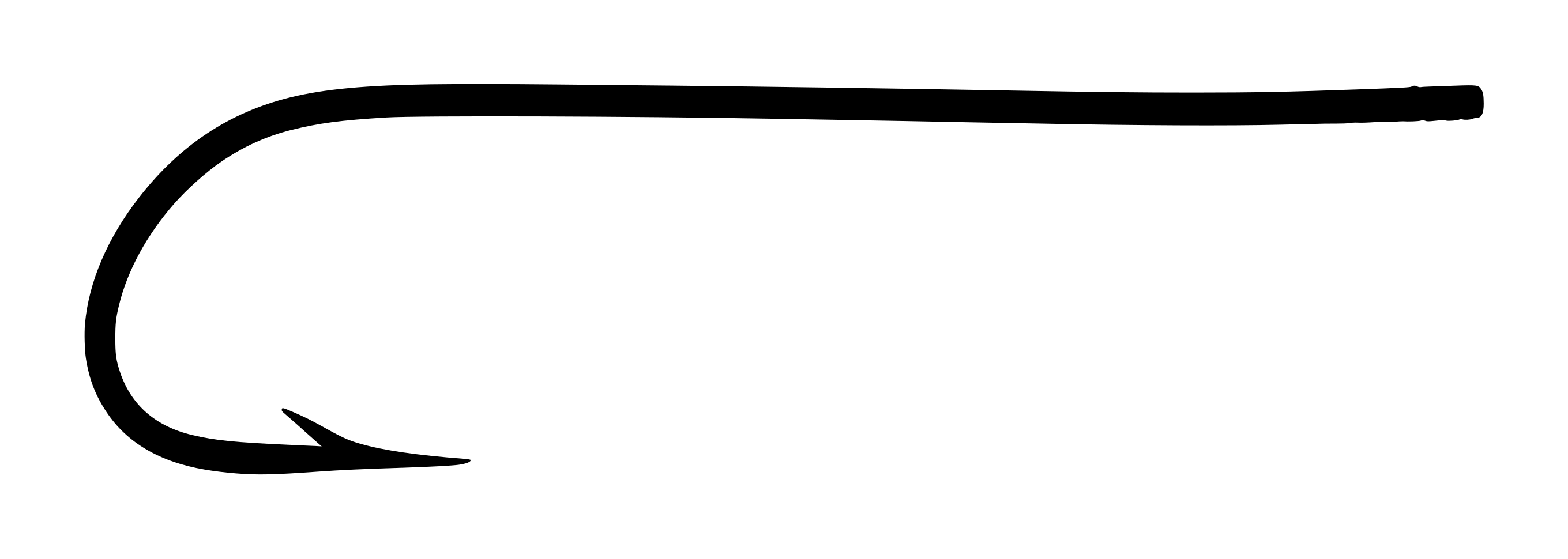
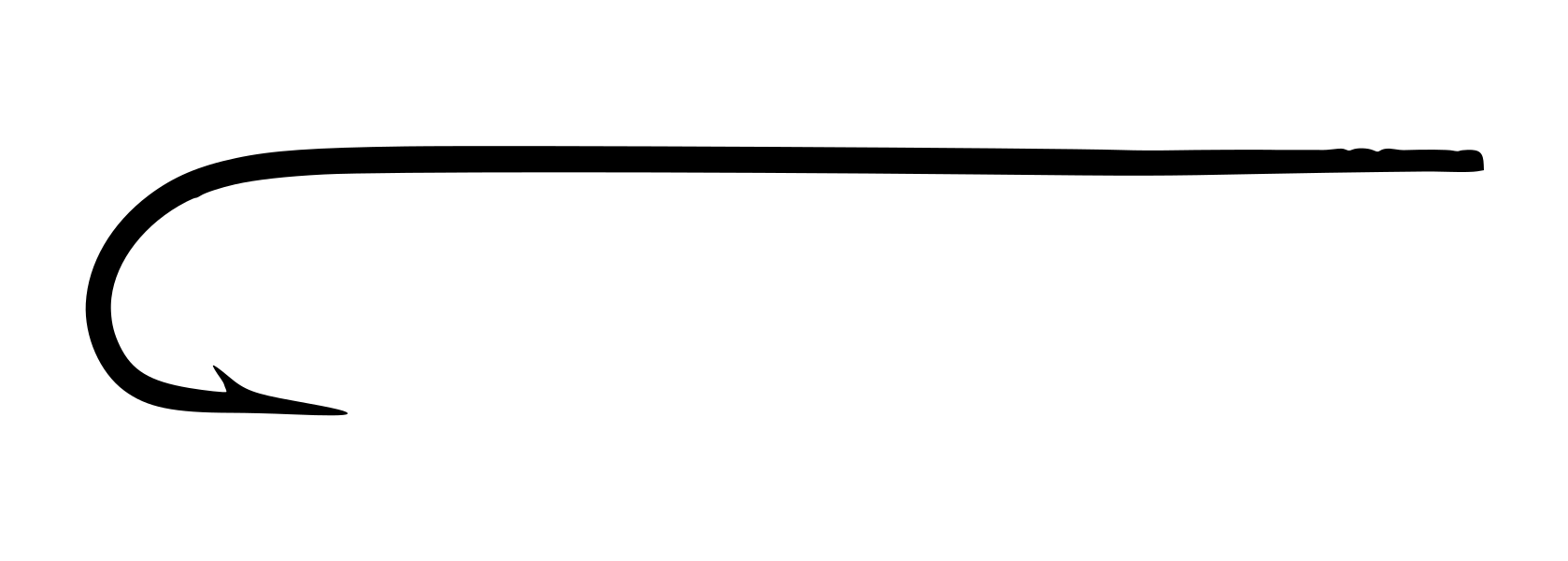
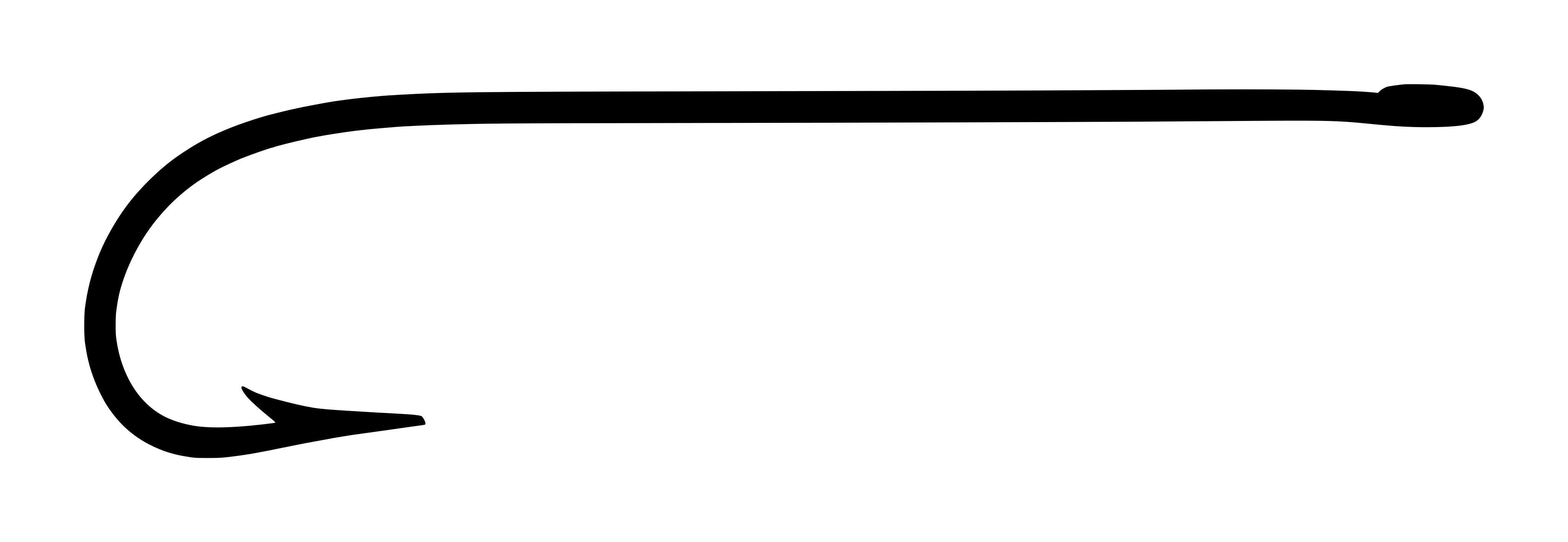
The Mustad 3706 Carlisle Hook is a size 4 extra-long shank pattern designed for streamer and bait fishing, manufactured in Norway during the 1950s–1960s. It combines a blind eye, bronzed finish, standard wire gauge, and the characteristic wide round bend of the Carlisle family, with a kirby offset and hollow point geometry suited to rapid penetration in soft-mouthed fish. The marked ridged shank retains bait during casting while the extended shank accommodates lengthy natural baits and protects leader from sharp teeth. As a mid-century example of Mustad’s strategy to globalize regional British and American bait patterns, the 3706 demonstrates the commercial dominance of Norwegian hook manufacture in postwar fly and tackle supply.
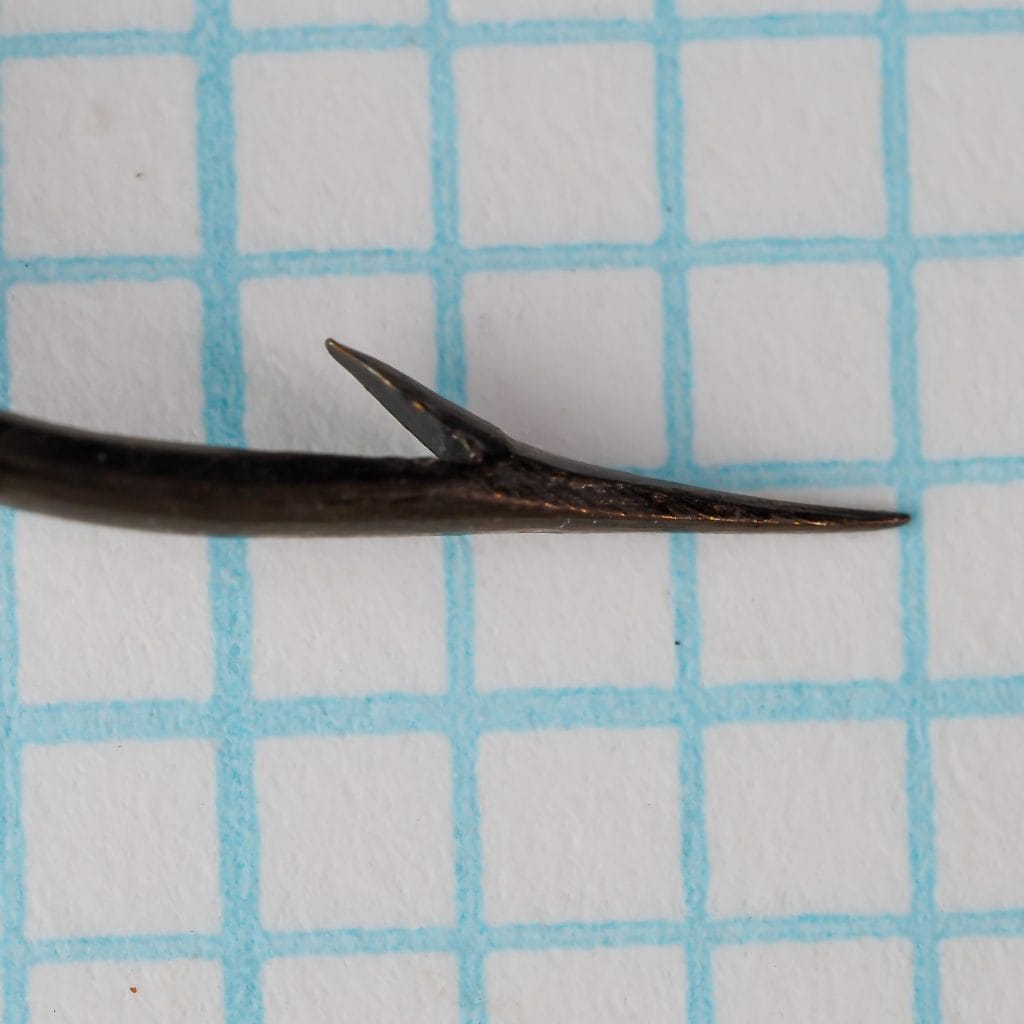
Close-up of the hollow point and cut barb on the Mustad 3706, showing the concave point geometry typical of this vintage era.
Photographic record
10 cataloged imagesSelect any record to load it above.
8 images shown
Mustad 3706 Hook Point Detail Size 4Close-up of the hollow point and cut barb on the Mustad 3706, showing the concave point geometry typical of this vintage era.Open originalMustad 3706 Full Hook Profile Size 4Complete side view of the Mustad 3706 showing the characteristic extra-long shank and wide round bend of the Carlisle pattern.Open originalMustad 3706 Size Comparison 3/0 and 4Size comparison showing both 3/0 (top) and size 4 (bottom) examples of the Mustad 3706, with handwritten size notations.Open originalMustad 3706 Original Box Label Size 3/0Original yellow Mustad label showing the complete 8-line format with Key Brand logo, quality code 3706, and Carlisle pattern designation.Open originalMustad 3706 Point Detail Size 3/0Detailed view of the hollow point on the larger 3/0 size, showing the concave inner face and bronze finish patina.Open originalMustad 3706 Complete Hook Size 3/0Full side view of the 3/0 size Mustad 3706, demonstrating the substantial length and robust construction of larger sizes.Open originalMustad 3706 Box Label Size 4Size 4 version of the Mustad 3706 label, showing identical format with handwritten size notation and aging characteristics.Open originalMustad 3706 Point and Barb Size 4Detailed view of the point geometry and barb placement on the size 4 Mustad 3706, showing manufacturing precision.Open originalMustad 3706 hook size 4Mustad 3706 hook size 4Open originalMustad 3706 hooks size 4Mustad 3706 hooks size 4Open original
Technical profile
Eye
Blind — Marked ShankAnalyst notes specify blind eye construction P
Wire
Fine (1X Fine), Round
Shank
4X Long — Marked / Ridged
Bend
carlisle, Narrow gap, Offset / kirbedClassic Carlisle pattern with wide round bend and long shank P
Point
Hollow Point (concave inner face)Standard cut barb positioned close to point P
Finish
Bronzed — Confirmed (stated on packaging)Warm bronze tone lacquer finish typical of Mustad bronzed hooks from this era P
Hooks show excellent condition with original bronzed finish intact. Some minor oxidation spots consistent with age. Packaging shows moderate aging with corner wear and staining.
The hollow point geometry provides rapid tissue penetration with minimal force, crucial for bait fishing where hook sets must be decisive. The marked ridged shank prevents bait from sliding during casting and helps maintain natural presentation in current. The extra-long shank serves dual purposes: accommodating lengthy baits like nightcrawlers and protecting leaders from sharp-toothed species by keeping the point well forward of the fish’s mouth.
The round bend distributes stress evenly during fights, while the kirby offset increases hook-up probability by preventing the point from lying flat against the fish’s mouth. The bronze finish provides corrosion resistance superior to bright steel while maintaining the subdued appearance favored for natural bait presentations.
We have measurements for sizes 3/0, 4/0. Know any others? Submit calipered measurements and we'll review and add them. Thank you!
Historical context
mustad
O. Mustad & Søn achieved global dominance in hook manufacturing through their revolutionary automated production methods developed in 1877 by Mathias Topp. From their factory in Gjøvik (later Oslo), Norway, they secured over 50% of the world’s hook production by the 1950s through aggressive industrial ‘cloning’ of regional patterns and strict trade secrecy protecting their automated machinery.
The company’s strategy involved reverse-engineering successful local patterns like the Carlisle bend and mass-producing them with Norwegian precision and efficiency, undercutting traditional centers like Redditch, England. The Key Brand trademark symbolized Mustad hooks as the literal ‘key’ to angling success across global markets.
Series History
The Qual. 3706 belongs to Mustad’s mid-tier quality code series (3000-3999 range), representing reliable hooks manufactured to exacting dimensional standards for commercial and sport fishing applications. This specific model represents Mustad’s adaptation of the traditional Carlisle pattern, characterized by extra-long shanks and wide round bends originally favored for worm and minnow fishing.
The Carlisle pattern was particularly important to Mustad’s penetration of American and British markets, where long-shank bait hooks were standard equipment for bass, pike, and general coarse fishing. Production likely continued through the 1960s before being superseded by modern numbering systems.
Era and Packaging Dating
Label displays 'Oslo - Norway' indicating post-1925 production (changed from Christiania). Yellow paper label with Key Brand logo and decorative border design is characteristic of Mustad's mid-century export packaging before transitioning to plastic boxes in the 1970s. No barcode indicates pre-1974.
The Industrial Key to Success
The Key Brand logo was more than marketing - it reflected Mustad's literal industrial dominance. By maintaining absolute secrecy around their automated hook-making machinery, they effectively held the 'key' to efficient large-scale hook production. Competitors spent decades trying to reverse-engineer Mustad's automated systems, while the Norwegian giant continued expanding globally. The yellow boxes with Key Brand logos became so ubiquitous that many anglers worldwide recognized them before they could even read the text.
Design lineage and influence
The Carlisle pattern originated in traditional British hook-making and was widely adopted across America for bass and pike fishing. Mustad’s version represents the industrialization of this artisanal design, maintaining the essential geometry while adding Norwegian precision manufacturing. Competed directly with hooks from Redditch makers and American manufacturers like Pflueger.
This pattern influenced later long-shank designs and remains conceptually similar to modern Aberdeen and Carlisle hooks, though contemporary versions typically feature ball eyes rather than blind construction.
Best matchRelated by Attribute
Computed automatically from catalog data — updated as new hooks are added.
Matches: Bend, Wire, Eye, Eye Orient., Forging +3 moreDiffers: Shank: 4X Long vs 3X Long; Gap: Narrow vs Standard; Point: Hollow Point vs Superior +2 more
Matches: Bend, Gap, Eye, Eye Orient., Point +5 moreDiffers: Shank: 4X Long vs Extra-Extra Long; Wire: Fine (1X Fine) vs Standard; Forging: Round vs Forged +1 more
Matches: Bend, Gap, Eye, Eye Orient., Point +3 moreDiffers: Shank: 4X Long vs Extra-Extra Long; Wire: Fine (1X Fine) vs Extra-Heavy (2X+); Finish: Bronzed vs Blued +1 more
Designed specifically for bait fishing with live or natural baits, particularly nightcrawlers, minnows, and cut bait. The extra-long shank accommodates bulky baits while the wide gap ensures adequate hooking geometry even with large offerings. Historically important for American bass fishing and European coarse fishing applications.
Secondary Applications
Classic streamer flies, large bucktails, vintage fly patterns requiring long shanks
Classic Fly Patterns
Grey Ghost, Black Ghost, Mickey Finn, Ballou Special (when used for fly tying)
Modern Equivalents
Hook
Match Quality
Notes
Mustad 3261 Aberdeen
Very Good
Similar long shank and wide gap, but with turned-down ball eye
Eagle Claw 202 Carlisle
Good
American equivalent maintaining traditional Carlisle geometry
Collector notes
Mid-tier collectability due to vintage era and complete original packaging, limited by relatively common Carlisle pattern.
Reference value
$15 – $35 USD estimate
Packaging condition
Good — moderate wear, legibleRecorded specimen
Packaging format
MUS-YB-01Catalog code
The Qual. 3706 represents solid mid-century Mustad production during their industrial peak. Positive factors include the complete original packaging with intact yellow label, the pre-plastic era vintage status, and the distinctive Key Brand logo that collectors associate with classic Norwegian manufacturing. The Oslo designation places it in the post-1925 export boom period when Mustad dominated global markets.
Limiting factors include the relatively common nature of the Carlisle pattern, which was mass-produced for general bait fishing applications. While historically significant as an example of Mustad’s industrial cloning of regional patterns, it lacks the specialized appeal of salmon flies or the rarity of early Christiania-marked specimens.
Packaging
Yellow paper label with decorative snowflake border pattern printed in orange/gold ink. Standard Mustad 8-line format with Key Brand logo. White cardboard box with aging and corner wear. Handwritten '3/0' and '4' size markings in purple ink.
Market Value Notes
Value driven primarily by packaging completeness and vintage appeal. Mint condition boxes command premium, individual hooks worth significantly less.
Where to Find
Vintage tackle shows, eBay, estate sales from older anglers
Preservation
Storage and Preservation
Store in a cool, dry environment away from humidity to prevent accelerated oxidation of the bronze finish. The blind eye construction makes these hooks particularly susceptible to corrosion at the shank end where moisture can collect. Original packaging adds significant collector value – store hooks on card rather than loose whenever possible.
The yellow paper label is susceptible to further aging and should be kept away from direct light and extreme temperatures. Handle packaging minimally and consider archival sleeves for long-term storage. The bronzed finish may develop additional patina over time, which many collectors consider desirable as evidence of authentic age.
Marking Analysis
Size Markings Analysis
Purple ink handwritten size markings ‘3/0’ and ‘4’ appear to be retailer or collector annotations, likely added when hooks were sorted or inventoried. The ink style and color suggests mid-to-late 20th century ballpoint pen, consistent with the hook’s vintage era but probably added sometime after original packaging.
These markings help identify the hook sizes contained in mixed collections and reflect the common practice of tackle shop owners or serious anglers organizing their inventory. The clear, deliberate handwriting suggests systematic cataloging rather than casual notation.
Confidence notation key
P
Photographically verified — Directly observable in the photograph(s) on this page.
V
Verified by documentation — Confirmed by manufacturer catalog, spec sheet, or published reference.
I
Inferred — A logical deduction from observable or documented evidence, not directly stated.
E
Estimated — An approximation based on visual comparison, proportional analysis, or limited data.
S
Speculative — A reasoned hypothesis that cannot be confirmed from available evidence.
Claims with no notation are confirmed by multiple independent sources. All photographs on garrenwood.com are taken on a measurement grid where each square equals 1/10 inch (0.1″ / 2.54 mm).