5Pattern history and manufacturer context
Series
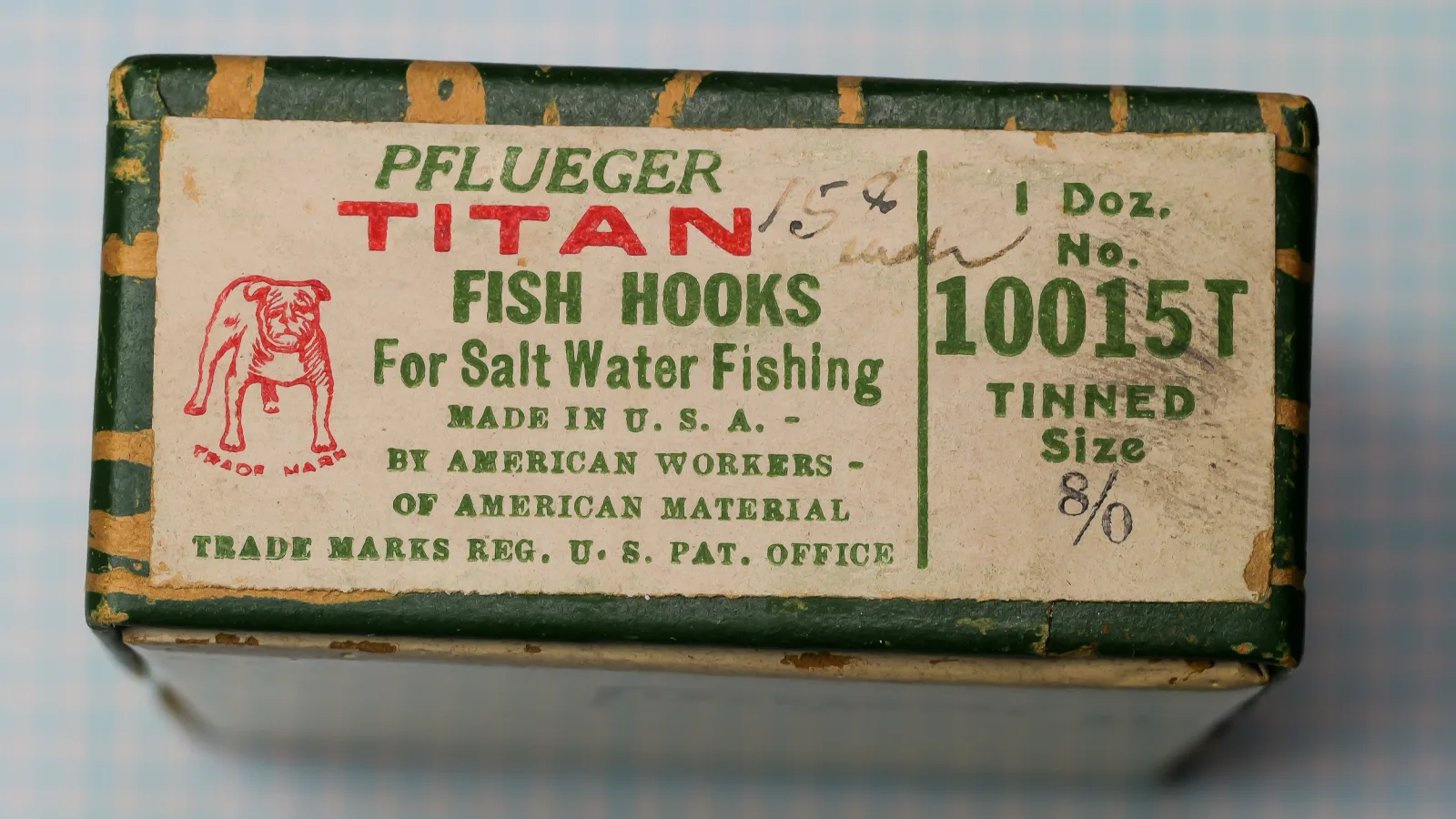
The label prints TITAN in capitals beneath the Pflueger name and above the words FISH HOOKS, with the model number 10015T in the right panel P. No catalog, price list or dated advertisement for the Titan line is recorded, so its dates and range of sizes are not known.
Design lineage
The Pflueger Titan 10015T represents a key inflection point in American hook manufacturing — the period when domestic makers sought to establish parity with British Redditch imports. The Sproat bend itself was a British innovation, popularized by Redditch makers in the mid-19th century. Pflueger’s adoption of the Sproat for their premium saltwater line signaled an intention to compete directly with established British patterns.
The hollow-point knife-edge geometry was itself a response to British advances. While Redditch makers like Partridge pioneered the hollow point for salmon and sea trout fishing in the late 1800s, American manufacturers like Pflueger adapted the technology for salt water applications where the penetrating geometry proved advantageous against hard-mouthed gamefish. The extra-heavy forged wire and substantial proportions represent American engineering pragmatism — building the strength needed for salt water environments.
The Titan’s design influence extends to mid-20th-century American saltwater hooks. Post-WWII manufacturers including Penn, Shakespeare, and later Mustad’s saltwater lines adopted very similar proportions and bend families. However, the hand-forged manufacturing method that defined the Titan fell out of favor as industrialization accelerated. By the 1960s, stamped and die-forged methods had largely replaced hand-forging in American production.
Dating
No barcode visible on original box — indicates pre-1974 production. Letterpress printing method on tan label (red and green ink) is characteristic of 1920s-1940s hook packaging. Box construction with cloth covering and hand-stamped interior label is consistent with American hook manufacturing of the interwar period. Handwritten notations on label (quantity, size) indicate wholesale/distributor packaging. Pflueger Titan line was actively marketed in saltwater tackle catalogs throughout the 1920s-1940s. The hammered appearance on shank stamp suggests hand-forged production methods still in use prior to full industrialization in the 1950s. Overall evidence points to c. 1920-1945 production window, likely 1925-1940 based on label printing style and box condition.
7Collecting and buying
7.5 / 10CollectabilityRarity: Scarce
No rating is given. Sold sales, catalog listings and counts of surviving examples for the 10015T are not recorded.
Readers who hold recorded sold sales, dealer counts or period catalog listings for the 10015T can send them. A rating and value range are added once a source documents scarcity and at least two sold results exist.
Market value
Insufficient recorded sales data to estimate a reliable value.
0 sold observations recorded; 2 are needed, with the basis and date of the range, before a value is shown. Asking prices are shown as asking prices only.
No sold sales are recorded for this model, so no value range is published.
Where to find
Vintage tackle dealers specializing in American hooks; eBay (search 'Pflueger Titan vintage' or '10015T'); Facebook vintage fishing tackle groups; regional tackle shows and antique fishing expos; estate sales and fishing estate auctions (particularly in saltwater-adjacent regions like coastal New England, Mid-Atlantic, and Florida).