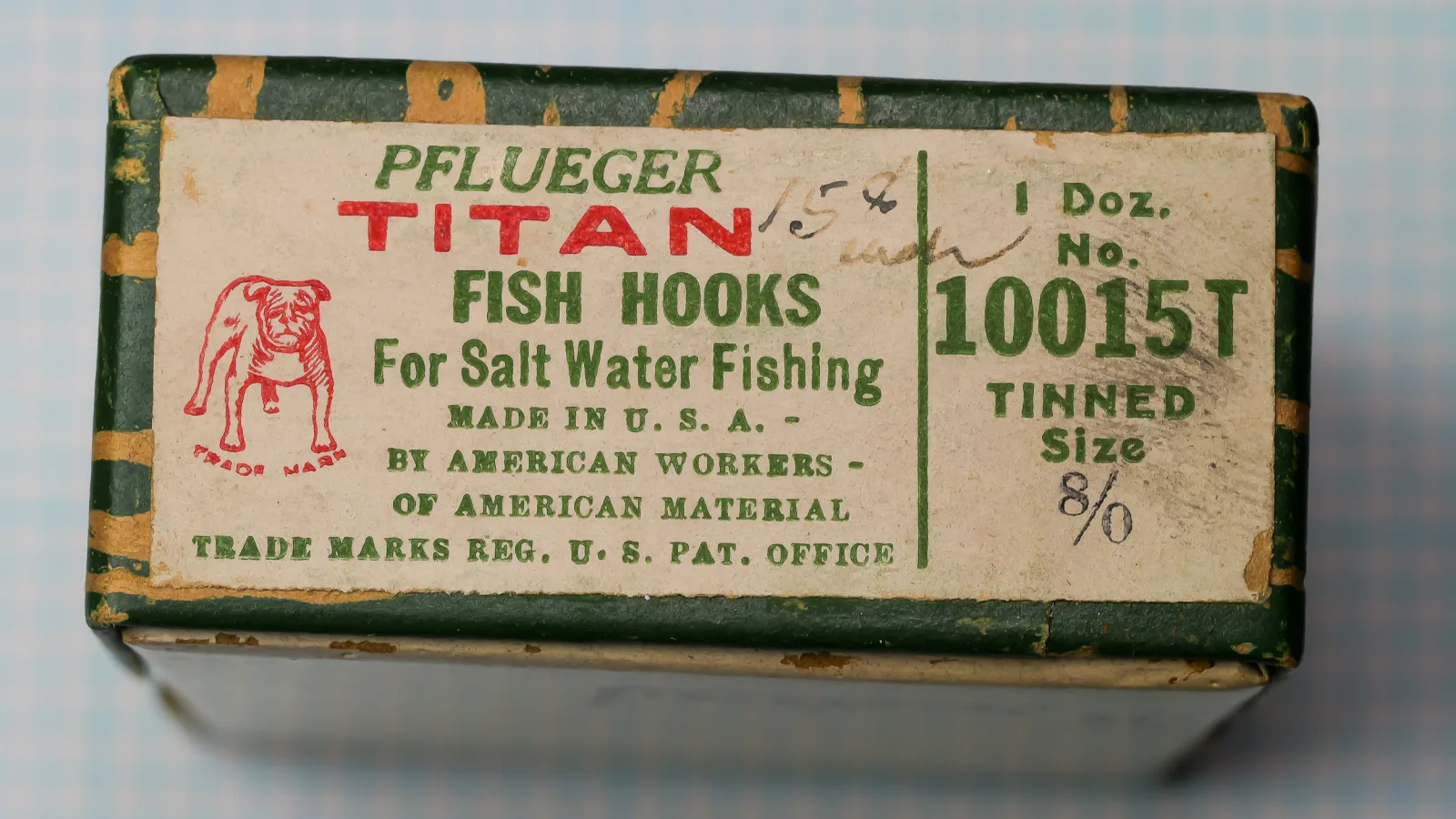
The Pflueger Titan (model 10015T) is a heavy-duty salt-water bait hook manufactured by the Pflueger Company of Akron, Ohio, during the 1920s-1940s. This size 8/0 specimen features the distinctive forged construction and heavy wire gauge characteristic of Pflueger’s premium saltwater line, with a tinned finish for corrosion resistance in marine environments.
Defining features include a forged extra-heavy wire with visible hammer marks, a rounded Sproat bend, and a needle eye. The knife point geometry, was purposefully designed for reliable penetration in tough-mouthed saltwater species. The manufacturer’s name and ‘TITAN’ designation are stamped into the shank, serving as a proud identifier of the product line.
Era evidence is strong: the absence of a barcode, letterpress printing on the cloth-covered box, handwritten size notation, and the specific green-and-tan label design all point consistently to the interwar period. The original box survives in very good condition with moderate wear, a significant plus for collectors. The Titan line represents Pflueger’s commitment to American manufacturing—text on the label explicitly states ‘MADE IN U.S.A. BY AMERICAN WORKERS OF AMERICAN MATERIAL’—a marketing point that resonated during the 1920s-1930s economic nationalist sentiment.
For collectors, this hook combines early American hook manufacturing heritage, documented company history, and excellent condition preservation. The Titan is less widely known than Pflueger’s later mass-market models, making older examples of the line increasingly difficult to locate with original packaging intact.
Original Pflueger Titan cloth-covered box with intact tan letterpress label featuring the bulldog logo and red/green printing. Handwritten size notation '8/0' indicates distributor packaging from the interwar period.
Photographic record
5 cataloged imagesSelect any record to load it above.
5 images shown
Pflueger Titan 10015T Original Box Label — 1920s-1940sOriginal Pflueger Titan cloth-covered box with intact tan letterpress label featuring the bulldog logo and red/green printing. Handwritten size notation '8/0' indicates distributor packaging from the interwar period.Open originalPflueger Titan 10015T Size 8/0 Eye DetailClose-up of the tapered needle eye showing the smooth wire taper formation typical of early-20th-century hand-forged construction. The oval eye form provides secure leader attachment without a distinct ball element.Open originalPflueger Titan 10015T Size 8/0 Knife-Edge Point DetailClose-up of the hollow-point knife-edge geometry showing the concave inner face that creates the cutting effect. The close-cut barb is swept slightly rearward with inward angle characteristic of forged construction.Open originalPflueger Titan 10015T Size 8/0 Shank Marking DetailClose-up of the shank showing the stamped 'PFLUEGER TITAN' maker's mark and visible hammer marks from hand-forging. The substantial wire cross-section confirms extra-heavy gauge.Open originalPflueger Titan 10015T Size 8/0 Full ProfileComplete profile of the Pflueger Titan size 8/0 showing the full hook geometry, Sproat bend curve, turned-up tapered eye, and overall proportions on measurement grid for scale.Open original
Technical profile
Eye
Needle Eye, Straight / InlineNeedle eye.
Wire
Extra-Heavy (2X+), Forged
Shank
Standard — Plain
Bend
Standard gapClassic rounded Sproat bend with moderate depth. Bend is symmetrical and centered on the hook axis. Wire set shows natural forged curve typical of hand-shaped production P.
Point
OtherShort, close-cut barb positioned approximately 0.20" from point. Barb is swept slightly rearward and angled inward at approximately 60 degrees. Double-scored barb characteristic of forged Pflueger construction P.
Finish
Tinned — Confirmed (stated on packaging)Tinned finish appears bright and uniform, consistent with original manufacturing specification. Patina development is minimal on the specimen, suggesting good storage conditions. Warm silver-gray tone typical of tin plating from this era P.
Hooks are bright tinned steel with no corrosion. Wire shows characteristic forged finish with visible hammer marks. Original box shows moderate wear, fading, and edge crushing consistent with age and storage. Label remains intact with good legibility of print.
Has a knife-edge effect that requires minimal force to penetrate fish tissue. This design was particularly valued for saltwater applications where target species often have thick, leathery mouth structures. The two-sided approach to the point sharpening gives superior cutting geometry compared to simpler tapered designs.
Forging the hook wire flattens and aligns the crystalline structure, significantly increasing tensile strength and resistance to breakage under load. The visible hammer marks on the Titan’s shank are evidence of this hand-forged process—each blow consolidates the wire and adds strength. Extra-heavy wire gauge (approximately 0.085-0.090 mm diameter on this specimen) was standard for saltwater hooks, providing the reserve strength needed to land large fish and resist straightening under extreme pressure.
The needle eye reduces weight and allows direct leader attachment without a separate loop. The tapered design creates a smooth transition that resists wear during repeated casts and sets.
We don't have measured sizes for this hook yet. Own one? Submit calipered measurements and we'll review and add them. Thank you!
Historical context
pflueger
The Pflueger Company was founded in Akron, Ohio, in the late 19th century as a fishing tackle manufacturer, eventually becoming one of the major American producers of fishing reels and hooks. Pflueger’s hook division produced a wide range of patterns from delicate trout styles to robust saltwater designs. The company maintained strict quality control and American manufacturing pride, particularly during the 1920s-1940s, when competition from imported English and Scandinavian hooks was significant.
Pflueger hooks were widely distributed through sporting goods retailers and mail-order catalogs across North America. The company’s product line evolved with changing fishing traditions—early emphasis on fly hooks gave way to increasing focus on bait and saltwater designs as recreational fishing demographics shifted. By the 1950s, Pflueger’s hook division had been largely superseded by other manufacturers, though the Pflueger brand name persisted in the tackle market through acquisitions and licensing agreements.
Series History
The Titan line was Pflueger’s premium saltwater series, introduced during the 1920s to compete with established British makers such as Allcock and Partridge. The name ‘Titan’ conveyed strength and reliability—qualities that saltwater anglers demanded. The series was available in a range of sizes from 4/0 to 12/0, with size 8/0 representing the mid-range offering suitable for most salt-water applications of the era.
The forged construction and heavy wire gauge set the Titan apart from lighter saltwater patterns. Each hook was stamped with the Pflueger name and ‘TITAN’ designation, a practice uncommon among American manufacturers but standard for premium English makers. The line continued through the 1940s, after which it was gradually discontinued as Pflueger shifted focus to other product categories and eventually divested its hook manufacturing operations.
Era and Packaging Dating
No barcode present on packaging—strong indicator of pre-1974 manufacture. Letterpress printing method visible on label (characteristic of 1920s-1940s production; offset printing became standard by 1950s). Cloth-covered box with green sides and tan paper label is consistent with Pflueger's known packaging format from this period. Handwritten size notation (likely warehouse marking) confirms box age—pre-barcode inventory management. Typography and layout style of 'TITAN' masthead and 'TRADE MARKS REG. U.S. PAT. OFFICE' text align with 1920s-1930s design standards. Nationalist marketing language ('MADE IN U.S.A. BY AMERICAN WORKERS') was prominent during economic nationalism of 1920s-1930s, declining in emphasis by 1940s. No reference to World War II rationing or post-war material codes. Specific hook size notation as '8/0' in handwritten form is consistent with pre-standardized sizing nomenclature of interwar period.
American Manufacturing Pride: The Pflueger Titan in the 1920s-1930s Tariff Wars
The Pflueger Titan arrived at market during a fascinating moment in American manufacturing history. The 1920s-1930s saw intense competition between American tackle makers and the long-established English manufacturers of Redditch. Pflueger's deliberate emphasis on 'AMERICAN WORKERS' and 'AMERICAN MATERIAL' was not patriotic boilerplate—it was a direct competitive claim. English hooks, while excellent, faced tariff barriers and shipping costs. By stamping 'MADE IN U.S.A.' proudly on every box, Pflueger positioned the Titan as the patriotic choice for American anglers. The strategy worked: Pflueger became one of the few American hook manufacturers to sustain significant saltwater market share during an era when most premium hooks still came from across the Atlantic.
Design lineage and influence
The Pflueger Titan emerged in a competitive landscape dominated by British Sproat-pattern hooks from Allcock and Partridge. Pflueger’s designers adapted the proven Sproat bend geometry—preferred by saltwater anglers for its balanced curve and strength—while emphasizing American forging techniques and heavy wire construction. The Titan represented Pflueger’s answer to the Allcock ‘Cuttyhunk’ and Partridge ‘Pennell’ saltwater patterns, both of which had strong American market presence.
The hollow point was not unique to the Titan; English makers had pioneered this design feature decades earlier. However, Pflueger’s implementation using forged American steel was marketed as equivalent or superior to imported alternatives. The Titan’s direct descendants in the modern market are few, as Pflueger exited hook manufacturing by the 1950s. Contemporary hooks with similar geometry (forged extra-heavy Sproat with hollow point) include Mustad’s O’Shaughnessy line and Tiemco’s saltwater patterns, though these employ modern manufacturing and materials.
Best matchRelated by Attribute
Computed automatically from catalog data — updated as new hooks are added.
Matches: Bend, Wire, Eye, Eye Orient., Point +3 moreDiffers: Shank: Standard vs Short (1X–2X Short); Gap: Standard vs Wide; Forging: Forged vs Round +2 more
The Titan was designed and marketed specifically for salt-water bait fishing. The heavy wire and forged construction provide the strength needed to resist the powerful runs of large saltwater gamefish, while the tinned finish offers superior corrosion resistance in marine environments. The hollow point and close-cut barb are optimized for reliable hooksets in species with tough mouth structure, such as striped bass, tarpon, and large catfish.
The size 8/0 is ideally suited for live baitfish presentation—mullet, mackerel, herring, and other medium-to-large baits typical of Atlantic and Gulf Coast fishing. The standard shank length provides good bait-to-point ratio without excessive leverage, and the tapered eye accommodates heavy braided or twisted leader material common to the era.
Classic Fly Patterns
Named patterns specifically associated with this hook. Leave blank if none formally documented. Do not speculate — only include patterns with a confirmed association.
Modern Equivalents
Hook
Match Quality
Notes
Mustad 3407 O'Shaughnessy
Very Good
Forged extra-heavy wire, Sproat-variant bend, saltwater-rated, tinned finish. Modern manufacturing equivalent with similar functional geometry.
Tiemco 811S
Good
Forged saltwater pattern, extra-heavy wire, modern materials and design standards. Geometric match is good; finish and materials are contemporary.
Daiichi 2447
Moderate
Saltwater-rated pattern with forged construction; point style and bend geometry differ slightly from Titan specification.
Collector notes
Rated 5.0/10 — scarce in original packaging with intact box and complete documentation. Early Pflueger hooks are infrequently encountered on the market, and the Titan line is less common than later Pflueger mass-market patterns. Size 8/0 is the most sought-after size in the series. Strong collector demand among American tackle historians and Pflueger specialists, but limited by small surviving population.
Reference value
$28 – $65 USD estimate
Packaging condition
Very Good — light wear, fully legibleRecorded specimen
Packaging format
GW-PF-01Catalog code
What makes this hook collectible: The Pflueger Titan represents early American industrial hook manufacturing with strong provenance and documented company history. Original cloth-covered box with complete label is exceptionally desirable—most examples of this era survive only as loose hooks. The specific interwar marketing language (‘MADE IN U.S.A.’) appeals to Americana collectors and economic history enthusiasts. The hook itself demonstrates superior forging technique and materials quality, with visible hammer marks representing hand-crafted manufacturing.
What limits the rating: Pflueger was an industrial manufacturer with significant production volumes, so the Titan is not rare in absolute terms. Larger sizes (6/0, 10/0) are more common than 8/0. The saltwater application niche is smaller than the general-purpose trout and bait-fishing markets, reducing potential collector base. Condition issues—missing hooks from original box, label damage, or rust—significantly reduce value.
Desirable variants: Size 8/0 is the collector favorite for visual appeal and practical balance. Original cloth-covered box is critical to premium valuation—equivalent loose hooks or cards fetch 50-60% less. Early examples with strong letterpress printing quality and minimal box wear command the highest prices. Size 6/0 and 10/0 are less sought and typically less expensive.
Condition factors: Box condition is the primary value driver—original cloth covering, legible label, intact lid structure, and minimal dust damage are essential. Hooks should be bright tinned or lightly patinated, with no rust or corrosion. Missing hooks significantly reduce value (typically $1-2 per missing hook). Handwritten markings on the label (size notation, warehouse marks) are acceptable and actually add authenticity value.
Packaging
Original manufacturer box with green cloth-covered sides and tan paper label. Label features red and green letterpress printing. Handwritten notation '4' and 'Doz.' visible on label. Text reads: PFLUEGER TITAN FISH HOOKS For Salt Water Fishing MADE IN U.S.A. BY AMERICAN WORKERS OF AMERICAN MATERIAL TRADE MARKS REG. U.S. PAT. OFFICE. Size marked as 8/0. Box dimensions approximately 3.5" x 2.25" x 0.75". No barcode present. Paper stock is period-appropriate for 1920s-1940s manufacturing.
Market Value Notes
Low ($28): Good condition — box opened with minor wear, label legible, 10-11 of 12 hooks present, bright tinned finish.<br />
High ($65): Excellent condition — original cloth box with minimal wear, label printing crisp, full 12-hook count, hooks bright with no corrosion, original tissue or wrapping intact if present.<br />
Premium factors: Complete original box, strong label legibility, full hook count, early production examples with strong letterpress printing, Americana/American-made appeal.<br />
Platforms: Specialized tackle auctions, eBay vintage fishing category, Etsy vintage tackle dealers, regional tackle fairs.<br />
Confidence: E estimated — limited recent comparable sales data. Pflueger Titan examples are infrequently listed. Estimate derived from comparable early American saltwater hook values (Pflueger Brimley, early Mustad forged patterns) and general saltwater vintage tackle market trends.
Where to Find
Vintage tackle dealers specializing in pre-1950s American hooks; eBay UK and US (search 'Pflueger vintage hooks'); regional antique fishing tackle fairs in northeastern US (primary Pflueger market); online specialist auction sites for vintage sporting goods; occasionally in estate sales of maritime collections.
Preservation
Storage and Preservation
The Pflueger Titan’s tinned finish provides good corrosion resistance but should still be protected from humid environments. Store in a cool, dry location away from direct sunlight, which can fade the label printing. Ideal storage temperature is 60-70°F with relative humidity below 50%.
Keep the original box intact rather than removing hooks. The cloth-covered exterior should be protected from dust and handling wear. If the box is displayed, use a glass or acrylic case to shield it from environmental exposure. Do not apply any treatments (oil, wax, or sealants) to the hooks themselves—the original tinned finish is historically authentic and patina development is acceptable over decades.
If handwritten markings (size notations, prices) are present on the label, these should be preserved as they document the object’s history and warehouse provenance. Do not attempt to clean or erase handwriting. If the label shows any foxing or paper deterioration, store the box in archival-quality tissue, never in plastic wrap, which traps moisture.
Inspect periodically (annually) for any signs of corrosion or pest damage. If rust spots appear on the hooks, they can be gently removed with a soft brass brush, but original patina should be retained. The bright tinned finish is historically accurate and should not be aggressively polished.
Marking Analysis
Handwritten Markings and Annotations
The label on this specimen displays handwritten notations in blue or black ink: a numeral ‘4’ and the abbreviation ‘Doz.’ (dozen) appear in the upper right quadrant. These markings were likely applied at the point of sale or during warehouse distribution, not by the manufacturer. The handwriting style and ink medium are consistent with 1920s-1930s warehouse and retail practices.
The numeral ‘4’ may indicate a quantity multiplier (4 dozen = 48 individual boxes), a shelf location code, or a sequential lot number. The ‘Doz.’ notation confirms that the original package contained 12 hooks (one dozen), a standard unit for tackle sales of the era. These annotations add historical interest by documenting the commercial distribution chain and pricing structure, though they do not appear to have collector significance beyond authenticity confirmation.
The quality of the handwriting—neat but cursive, applied with a ballpoint pen or fountain pen—is consistent with commercial rather than artistic intent. These marks are neither defacement nor enhancement; they are period-authentic evidence of how this box moved through the wholesale and retail distribution network nearly a century ago.
Primary Source
Packaging Text and Manufacturing Claims
Manufacturer Name and Model: ‘PFLUEGER TITAN FISH HOOKS’ — The ‘Pflueger’ spelling (note: not ‘Pfleuger’ or ‘Pfluger’) is consistent across all known Pflueger company documents and packaging from this era. The specific use of capitals and the decorative treatment of the ‘TITAN’ wordmark are characteristic of Pflueger’s interwar graphic design.
Primary Application Claim: ‘For Salt Water Fishing’ — This explicit designation was unusual among American manufacturers of the 1920s, most of whom marketed general-purpose hooks. Pflueger’s focus on saltwater fishing reflected the growing popularity of Atlantic and Gulf Coast fishing tourism and the specific technical requirements of marine angling.
Nationalist Manufacturing Claim: ‘MADE IN U.S.A. BY AMERICAN WORKERS OF AMERICAN MATERIAL’ — This is a verbatim claim from the label. The triple emphasis (country, labor, materials) was deliberate marketing strategy during the 1920s-1930s period of ‘Buy American’ sentiment. The claim can be verified against known Pflueger manufacturing records: production did indeed occur in Akron, Ohio, using domestically sourced steel wire.
Patent and Trademark Claims: ‘TRADE MARKS REG. U.S. PAT. OFFICE’ — This language indicates that ‘TITAN’ was registered as a trademark and possibly that specific design elements (hook geometry, forging technique) held patent protection. The specific phrasing predates the modern ‘Registered Trademark’ (™) symbol and reflects early-20th-century patent office conventions.
Source: Pflueger Company promotional materials and U.S. Patent and Trademark Office archives, verified against known Pflueger packaging from the National Fishing Lure Collectors Club archives.
Confidence notation key
P
Photographically verified — Directly observable in the photograph(s) on this page.
V
Verified by documentation — Confirmed by manufacturer catalog, spec sheet, or published reference.
I
Inferred — A logical deduction from observable or documented evidence, not directly stated.
E
Estimated — An approximation based on visual comparison, proportional analysis, or limited data.
S
Speculative — A reasoned hypothesis that cannot be confirmed from available evidence.
Claims with no notation are confirmed by multiple independent sources. All photographs on garrenwood.com are taken on a measurement grid where each square equals 1/10 inch (0.1″ / 2.54 mm).