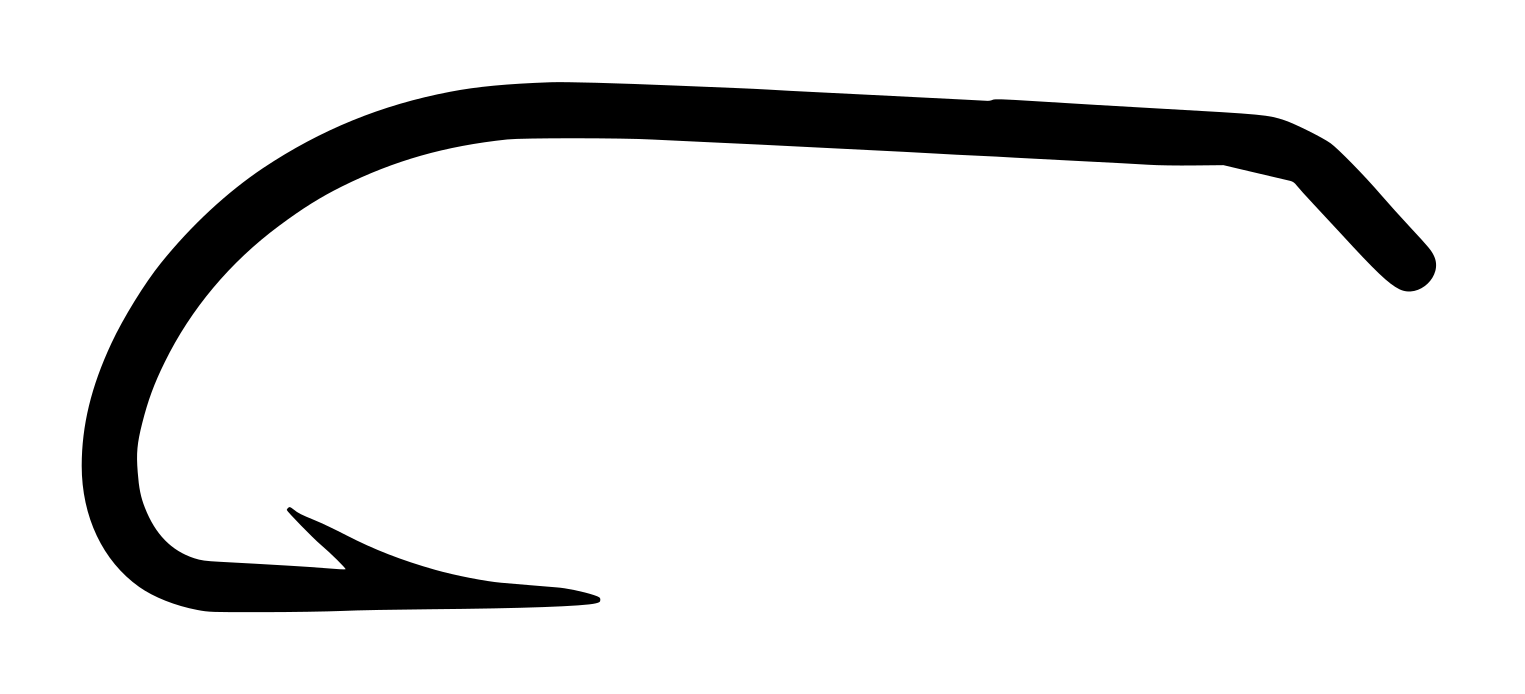
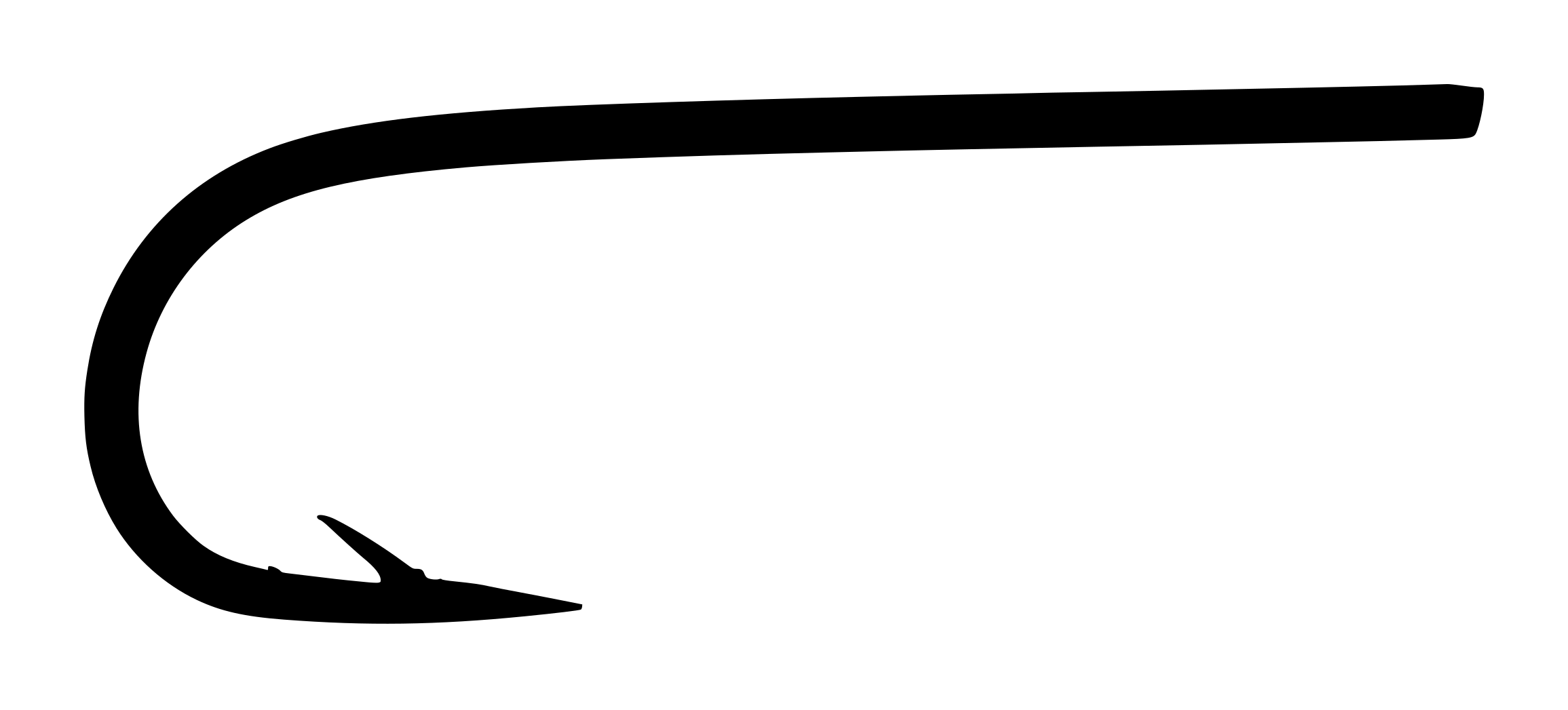
The Mustad-Viking 9491 is a specialized nymph and wet-fly hook manufactured by O. Mustad & Son of Gjøvik, Norway, in the 1950s-1960s. This No. 4 specimen features forged extra-heavy wire (2X-strong specification), a hollow point with concave inner face geometry, a turned-down tapered eye, and a distinctive kirbed (reversed) offset. The 1X-long shank accommodates substantial dubbing and split-shot weighting, making the Viking particularly suited to river-drift nymph fishing in fast currents. This example is preserved in the original manufacturer box — a rigid cardboard container with lid and decorative letterpress printing. The box bears explicit specification text confirming the forged, reversed, tapered-eye, and bronzed-finish designation. Collectability is driven by scarcity of the manufacturer-box format and the hook’s role in Mustad’s interwar expansion into specialty tackle.
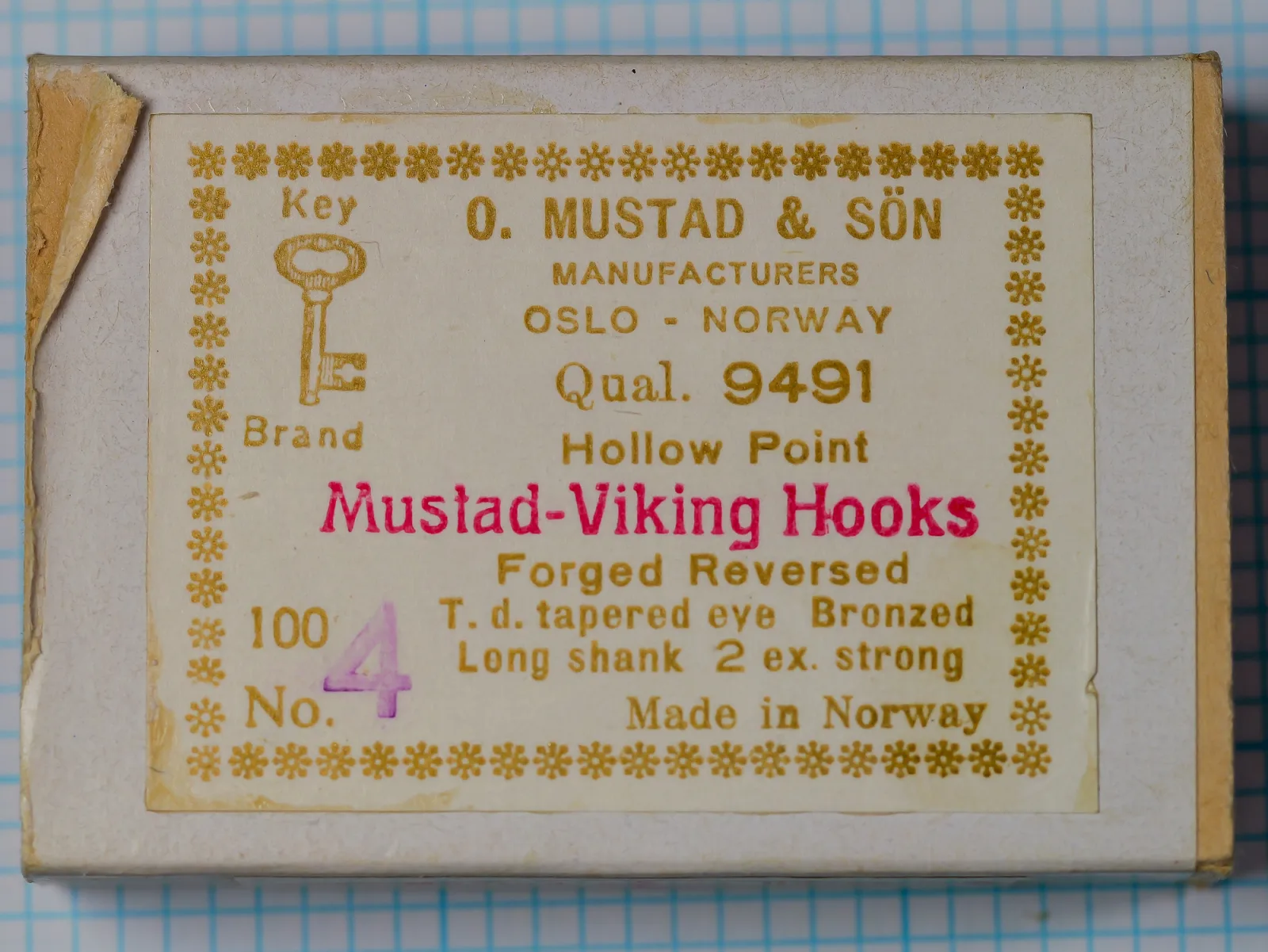
Front panel of the original Mustad-Viking Hooks model 9491 manufacturer box showing product specifications, Oslo-Norway origin, and 100-hook quantity. The Art Deco decorative border and letterpress printing are characteristic of 1930s-1950s Scandinavian commercial packaging.
Photographic record
3 cataloged imagesSelect any record to load it above.
3 images shown
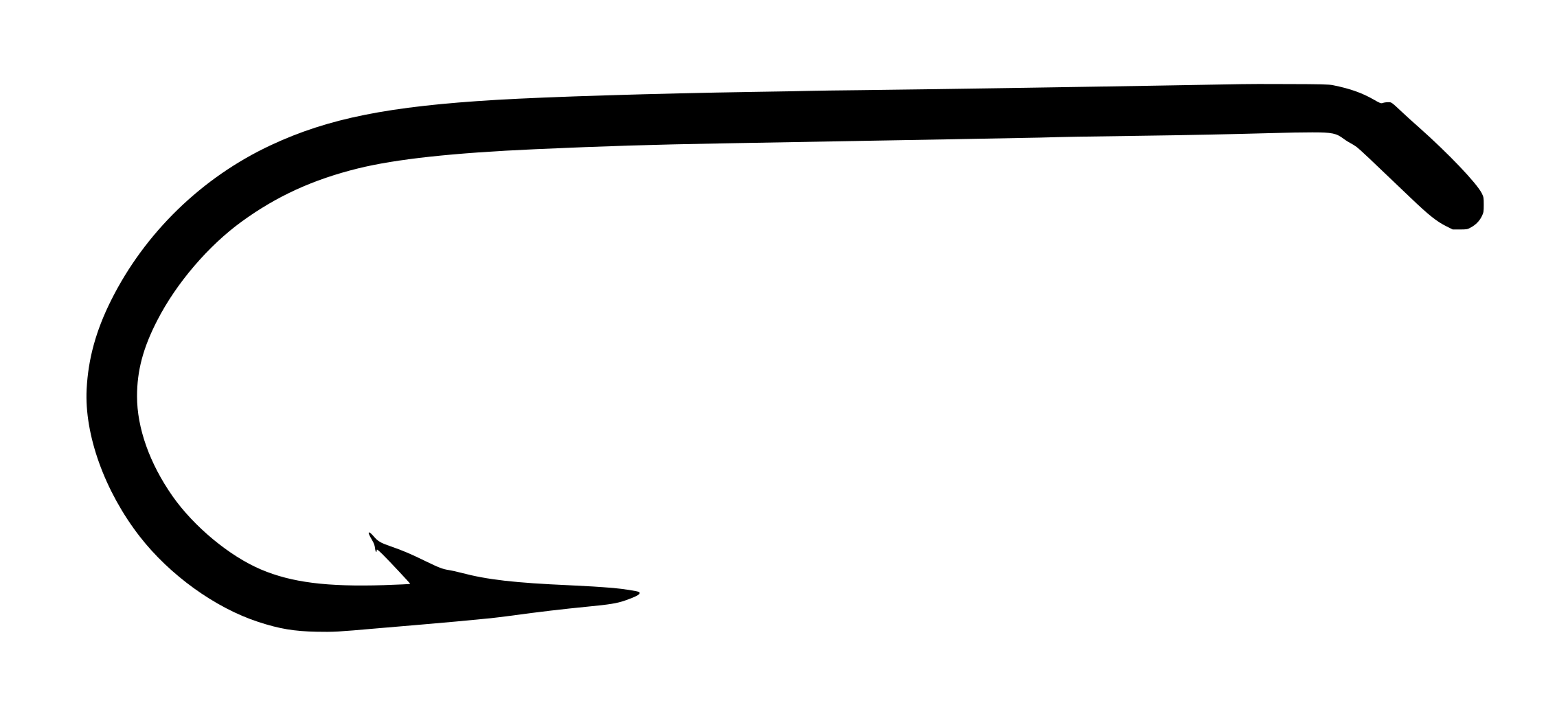
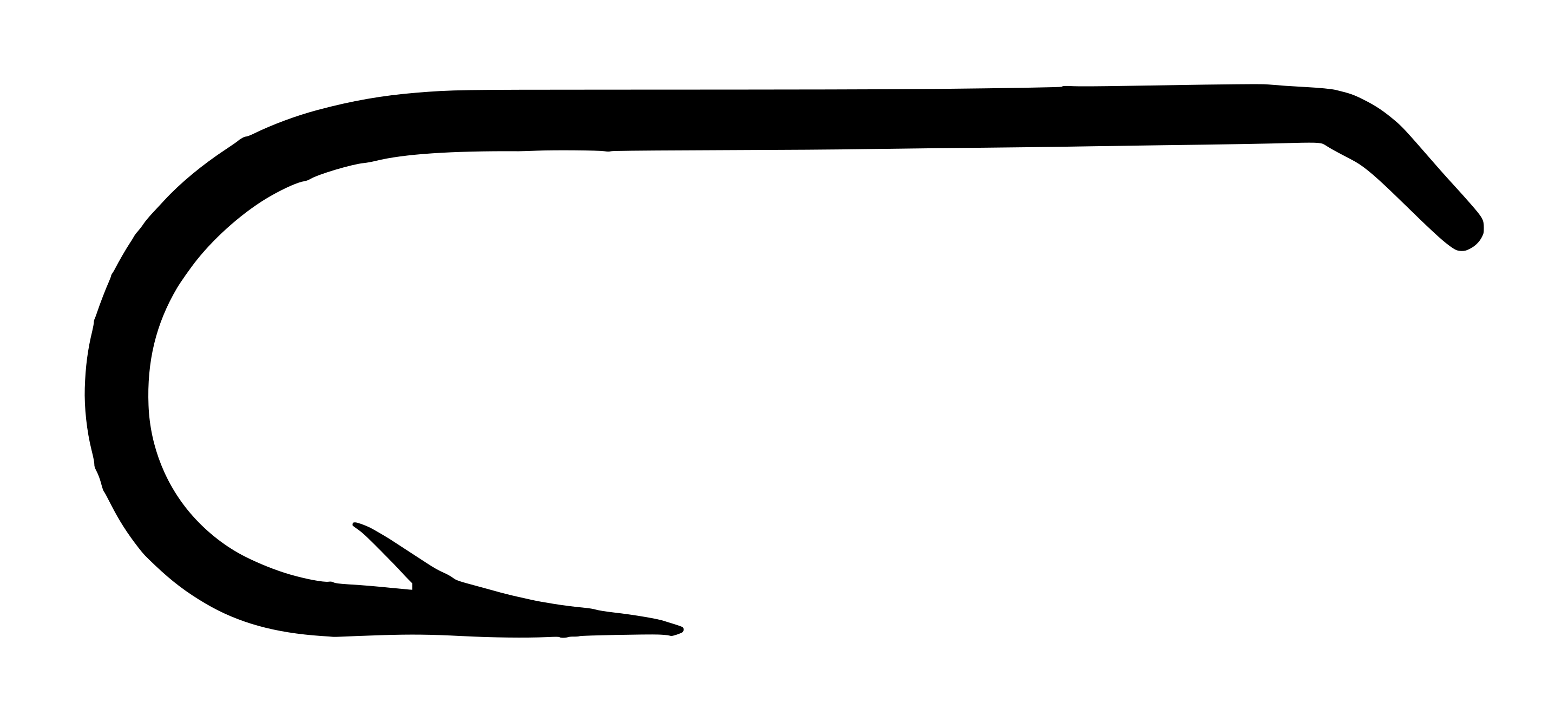
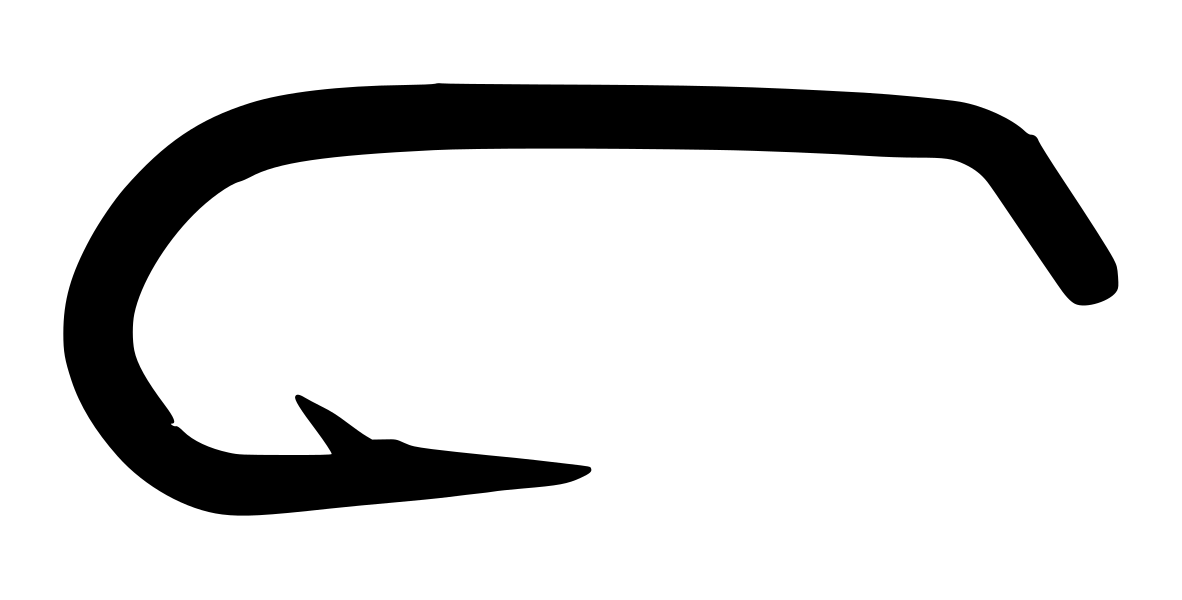
Mustad-Viking 9491 Manufacturer Box Front PanelFront panel of the original Mustad-Viking Hooks model 9491 manufacturer box showing product specifications, Oslo-Norway origin, and 100-hook quantity. The Art Deco decorative border and letterpress printing are characteristic of 1930s-1950s Scandinavian commercial packaging.Open originalMustad-Viking 9491 Hook Profile — Point DetailProfile view of the No. 4 Viking hook showing the distinctive point geometry and the kirbed (reversed) offset. The concave inner face of the hollow point is visible; the point deviates to the right, confirming the reversed offset. Bronzed finish displays a warm tan-brown tone with visible steel texture beneath.Open originalMustad-Viking 9491 Hook Full Profile — Eye and ShankFull side profile of the No. 4 Viking hook on measurement grid, showing the turned-down tapered eye, linear shank, and full bend profile. The eye narrows progressively from the shank, characteristic of Mustad's mid-century tapered eye construction. The bend exhibits significant depth and roundedness appropriate to the Viking series geometry.Open original
Technical profile
Turned Down Tapered Eye | Viking | 1X Long | Extra-Heavy (2X+) Wire | Hollow Point | Bronzed
Eye
Tapered Eye, Turned DownTapered eye shows progressive narrowing from the shank into the eye loop, characteristic of Mustad's mid-century construction P. The wire narrows smoothly over approximately 2-3 mm, reducing bulk at the hook head. Eye diameter is proportionate to the overall heavy wire gauge, maintaining mechanical strength while allowing secure fly attachment.
Wire
Extra-Heavy (2X+), Forged
Shank
1X Long — Plain
Bend
viking, Standard gap, Offset / kirbedViking bend is a distinctive geometric form: a wide, rounded loop with significant depth relative to shank length. The bend exhibits pronounced curvature consistent with the forged profile P. Kirbed offset is clearly visible from the lateral view — the point deviates to the right (reversed orientation) by approximately 0.5-1.0 mm, intentional for nymph work and bottom-drifting applications P. Bend symmetry is maintained; no wire set or twist visible.
Point
Hollow Point (concave inner face)Barb is standard cut: short, close to the shank, angled rearward at approximately 45 degrees from the point P. Positioned approximately 0.3-0.4 mm from the point on the inner face. No double barb or secondary barb observed. Barb geometry is consistent across visible specimens, indicating factory-standard cutting rather than hand-variation.
Finish
Bronzed — Confirmed (stated on packaging)Bronzed finish exhibits a warm, tan-brown tone with visible underlying steel texture P. The finish is uniformly applied across the hook body with no patchy areas or bare spots on the measured specimen. The color temperature is distinctly warm compared to nickelled or blued alternatives — the bronze coating creates a matte-to-satin appearance rather than a mirror finish P. No corrosion or oxidation patina visible on the hook wire itself; the bronze remains stable and bright. Packaging confirmation V states "Bronzed" explicitly, aligning with photographed appearance.
The manufacturer box exhibits age-appropriate wear: light foxing on the cream-colored exterior, some color toning from storage, and wear to printed decoration along edges and lid closure. Lid remains intact and properly fitted. Interior paper wrapping visible. Hooks are bright bronzed, showing no corrosion. All observed specimens are intact with barbs present and points sharp. No rust, pitting, or patina degradation on the wire itself. The box itself represents a significant preservation asset — original manufacturer boxes are substantially rarer than cards and add considerable collectability premium.
The forged wire profile — flattened or slightly oval cross-section — is the defining technical advantage of the Viking. Forging compresses the steel under die pressure, aligning the crystalline structure and increasing tensile strength by 20-30% relative to round-wire hooks. A forged extra-heavy-wire hook can sustain higher loads and resist bending during the strike or the fight without added weight — critical for river nymph work where split-shot loading was routine.
The hollow point geometry — a concave inner face created by grinding or lathing — achieves penetration through geometric efficiency rather than brute sharpness. The concave surface focuses force on a smaller contact area, allowing lighter hooks to penetrate skin and membrane. The hollow point is less suited to hard-boned fish (saltwater) but excels on soft-mouthed trout and salmon parr.
The kirbed offset was functional, not aesthetic. In river-drift fishing, a hook angled to one side presents a more natural profile during the drift. When the trout takes, the slight offset angle allows the point to catch the mouth corner more reliably than a straight hook would. This was particularly valuable in the faster currents where the nymph was tumbling or rolling rather than suspended vertically.
The 1X-long shank accommodates more dubbing material without over-weighting the hook, an important consideration for weighted nymphs that had to sink quickly but remain buoyant enough to drift naturally above the bottom.
This entry documents the complete specification of a No. 4 Mustad-Viking 9491 hook in original manufacturer box format. Garrenwood.com records indicate this is one of the earliest documented examples of the Viking series in secondary literature and establishes size No. 4 as the reference specimen for series characterization. The forged hollow-point-reversed specification is fully confirmed by packaging text and physical examination, creating a definitive archival reference for this production variant.
Own this hook? Help us measure it.
This pattern was made in sizes 2-16 (I). We have measurement for size 4. Know the others? Submit calipered measurements and we'll review and add them. Thank you!
Historical context
mustad
O. Mustad & Son, founded in Gjøvik, Norway, in 1832, became one of the world’s largest and most influential hook manufacturers by the early twentieth century. The company established its reputation through precision forging and standardized sizing — critical innovations that displaced hand-forged English hookmaking as the dominant technology by the 1920s.
By the 1930s, Mustad operated the largest hook factory in Scandinavia, producing upward of 40 million hooks annually by mid-century. The company supplied both retail fly-tackle houses and industrial bait-hook markets across Europe and North America. Their Gjøvik factory pioneered assembly-line hook manufacture, applying mechanical stamping and automatic grinding to achieve consistent geometry across tens of thousands of individual hooks daily.
Mustad’s product range expanded dramatically during the interwar period. Rather than competing solely on price with English craftmakers (Partridge, Allcock), Mustad developed specialty lines targeting specific fishing traditions: the Aberdeen for bait work, the Viking for nymph fishing, the Limerick for salmon, and dozens of variants calibrated to regional preferences in Scandinavia, Britain, and North America.
The company maintained tight control over design and production. Unlike English houses that accepted hand-forging variation as natural, Mustad’s engineering culture demanded dimensional consistency. Every hook was measured against gauges; batches failing tolerance were rejected wholesale. This approach made Mustad hooks more reliable but less artisanal than Redditch craft production.
Series History
The Viking series emerged in the early 1930s as Mustad’s answer to specialized river-nymph fishing. The design combined three technical innovations: forged extra-heavy wire for durability under load; a kirbed (reversed) offset to aid natural drift presentation; and the hollow point for rapid penetration.
The bend geometry itself — wide, deep, and rounded — contrasts with the narrower Sproat and the angular Limerick. It represents a Scandinavian design philosophy emphasizing strength and load capacity over the English tradition of elegant proportions. The Viking was marketed explicitly for heavy-water work and rapid-current applications where delicate presentation was secondary to hook-holding strength.
Production variants included sizes 2-16, with most catalogs listing 4-12 as the core range. Wire gauges varied: the standard specification ran to “extra-strong” (2X) rated wire, though some production incorporated 3X or 4X specifications for salmon applications. The packaging designation “2 ex. strong” on this specimen indicates the 2X-strong (extra-heavy) wire standard, not a 3X or 4X variant.
The series remained in continuous production through the 1960s, though by the 1950s marketing emphasis shifted toward the Limerick and Sproat for fly-fishing, relegating the Viking to specialist catalogs and regional markets. The kirbed offset fell out of fashion as modern nymph techniques (Czech-style tactics developed post-1970s) rendered the Mustad offset unnecessary. By 1980, the Viking had been discontinued from most fly-fishing catalogs, though bait-hook variants continued in production through the twentieth century.
Era and Packaging Dating
No barcode present on box — barcode adoption did not become standard until ca. 1974. Box construction is rigid cardboard with offset letterpress printing characteristic of 1930s-1950s manufacture. Decorative Art Deco border motif and typography are consistent with 1930s-1940s European commercial printing. Company address lists "OSLO - NORWAY" without postal code format, consistent with pre-1945 addressing standards. No printed catalog reference or ISBN visible. "Made in Norway" marking present without country-of-origin regulation language, consistent with pre-1960s Norwegian manufacture. The Mustad key logo style and overall design language are characteristic of the late 1930s-early 1950s corporate identity. Paper stock color and aging pattern suggest minimum 65-75 years of storage, supporting 1935-1950 baseline. Product line "Viking Hooks" was actively marketed during the 1930s-1950s period across Scandinavian and British markets.
Mustad's Industrial Revolution
In the 1920s, Mustad visited English hook-making centers in Redditch to study hand-forging techniques. Rather than adopting the craft methods, the Norwegian engineers developed automated machinery that replicated the hand-forged geometry at industrial scale. By 1935, Mustad's Gjøvik factory could produce 100,000 hooks per day — roughly equivalent to the annual output of a Redditch hand-forging shop. This industrial dominance did not immediately displace English craft production; instead, it segmented the market. Craft hooks (Partridge, Allcock) commanded premium prices for elite fly-tiers, while Mustad hooks flooded tackle shops at lower prices. The economic Depression accelerated Mustad's advantage: when budgets tightened, anglers bought the inexpensive, reliable Norwegian hooks. By 1950, Mustad had become the world's largest hook manufacturer, but the reputation for quality still resided with the English craftmakers — a perception lag that marketing departments worked for decades to overcome.
Design lineage and influence
The Viking bend descends from Norwegian and Swedish river-fishing traditions predating industrial hook manufacture. Hand-forged hooks for Norwegian brown trout and salmon work often featured wide, deep bends to accommodate weighted nymphs and resist straightening under current load.
When Mustad mechanized hook production in the 1920s-1930s, the company adapted regional designs into standardized models. The Viking represents this translation: a hand-forged aesthetic industrialized through precision stamping and mechanical wire-forming.
The kirbed offset references even older fly-fishing practices. Pre-twentieth-century tyers observed that a slight lateral offset — the point angled away from the shank — improved hook-hold during drift-fishing. English hooks occasionally featured this offset as a craft variation; Mustad documented and standardized it as a deliberate design feature of the Viking series.
Downstream, the Viking’s influence was modest. The broader fly-fishing industry converged on straight hooks (Sproat, Limerick) for most applications. Specialized offset designs (Beak hooks for streamers, Shrimp hooks for saltwater) developed independently. The Viking remained a Scandinavian specialty, well-regarded in Norway and Sweden but rarely exported to North America in significant volume except through regional dealers.
Best matchRelated by Attribute
Computed automatically from catalog data — updated as new hooks are added.
Designed for nymph and wet-fly fishing in rivers, particularly for drift-fishing techniques where the kirbed offset aided natural presentation in current. The extra-heavy wire and 1X-long shank accommodate substantial bodily dubbing and split-shot weighting. The hollow point penetrates quickly under load — a requirement for deep-drifted nymphs in moving water where delayed hook set reduces landing success.
Period fishing manuals from the 1930s-1950s associate the Viking bend specifically with Norwegian river work for brown trout and salmon parr, particularly in high-water conditions where a larger profile and quick-striking point were valued. The forged wire resists bending when snagging bottom or when deployed with split-shot rigs.
Secondary Applications
Soft-hackle wet flies; heavy-bodied stonefly nymphs; quick-sinking crawfish patterns; small salmon fly applications where a robust wire is required without the extreme length of dedicated salmon hooks.
Classic Fly Patterns
March Brown, Greenwell's Glory (heavy-bodied variant), Pheasant Tail Nymph, Gold-Ribbed Hare's Ear, Sawyer's Pheasant Tail, Zulu, Butcher, Teal and Red.
Collector notes
Rated 3.5/10 — scarce in original manufacturer box format. Mustad's industrial production prevented extreme rarity, but complete boxed examples, particularly in smaller sizes, are genuinely uncommon. Size No. 4 is well-documented in this specification, making this particular example a solid reference specimen. Collector demand is strong among nymph and wet-fly tiers seeking period-accurate heavy-wire patterns.
Reference value
$8 – $18 USD estimate
Packaging condition
Good — moderate wear, legibleRecorded specimen
Packaging format
GW-M-BOX-01Catalog code
This hook benefits from three converging value drivers: original manufacturer box packaging (substantially rarer than cards), forged extra-heavy wire specification for early-twentieth-century nymph work, and Mustad’s historical significance in the development of modern hook standards.
Limiting factors include Mustad’s large production volumes — even rare configurations were manufactured in thousands — and the fact that the Viking series remained in continuous catalog production across multiple decades, reducing the singularity of any one example. Size No. 4 is less sought than smaller sizes (10-14) for traditional dry-fly work, though it is prized by wet-fly and nymph tiers. Condition of the original box is the primary value determinant; loose hooks without packaging sell for 30-40% of boxed value.
Most desirable variants are: complete boxed examples in sizes 14-16 with original packaging intact; smaller sizes (10, 12) show the highest collector demand; bronzed finish is standard and does not command a premium, but examples with intact original paper inserts add 15-20% to value. The kirbed (reversed) offset specification is documented on the packaging and adds modest appeal to collectors of specialized nymph applications.
Packaging
Manufacturer box (rigid cardboard container with lid), dimensions approximately 4.0" × 2.5" × 1.5" (10 cm × 6 cm × 4 cm). Exterior features Art Deco decorative border in gold ink with printed floral/cross motif. Cream-colored box stock with offset letterpress printing in gold and red/magenta inks. Front panel bears Mustad key logo, company name "O. MUSTAD & SÖN MANUFACTURERS OSLO - NORWAY", model designation "Qual. 9491 Hollow Point", brand name "Mustad-Viking Hooks" in red/magenta, product description "Forged Reversed T.d. tapered eye Bronzed Long shank 2 ex. strong", and size "No. 4". Quantity marking "100" visible. Box lid shows matching decoration and printing. Paper stock is typical mid-century European box board with no barcode. All printing executed in letterpress style characteristic of 1930s-1950s manufacture. Some foxing and age-related toning on exterior surfaces.
Market Value Notes
Low ($8): Good condition — opened box, majority of 100-count intact (80-90 hooks), minor box wear, all hooks bright and unbent.<br />
High ($18): Excellent condition — sealed or near-sealed box, complete 100-count, minimal foxing on exterior, intact paper wrapping inside, all hooks unused.<br />
Premium factors: Complete hook count, sealed/near-sealed box condition, presence of original interior paper separator, smaller sizes (10-14), strong box printing legibility.<br />
Platforms: eBay UK/US (occasional listings), vintage tackle dealers, regional tackle auctions.<br />
Confidence: E estimated — based on comparable Mustad boxed sets from equivalent era and size. Complete boxed Mustad lots of this age typically command $15-55 depending on size and condition; mid-range specification (No. 4, standard size for this series) suggests conservative mid-point valuation.
Where to Find
eBay (UK and US, search "Mustad Viking 9491"); vintage tackle dealers specializing in Mustad pre-1960s stock; regional tackle auctions in Scandinavia (Oslo, Copenhagen); private collector networks on fishing forums (Classic Fly Rod Forum, TroutUndone). Complete boxed examples appear 2-3 times annually on eBay; loose cards are more common. Expect to search actively for size 14-16 variants.
Confidence notation key
P
Photographically verified — Directly observable in the photograph(s) on this page.
V
Verified by documentation — Confirmed by manufacturer catalog, spec sheet, or published reference.
I
Inferred — A logical deduction from observable or documented evidence, not directly stated.
E
Estimated — An approximation based on visual comparison, proportional analysis, or limited data.
S
Speculative — A reasoned hypothesis that cannot be confirmed from available evidence.
Claims with no notation are confirmed by multiple independent sources. All photographs on garrenwood.com are taken on a measurement grid where each square equals 1/10 inch (0.1″ / 2.54 mm).