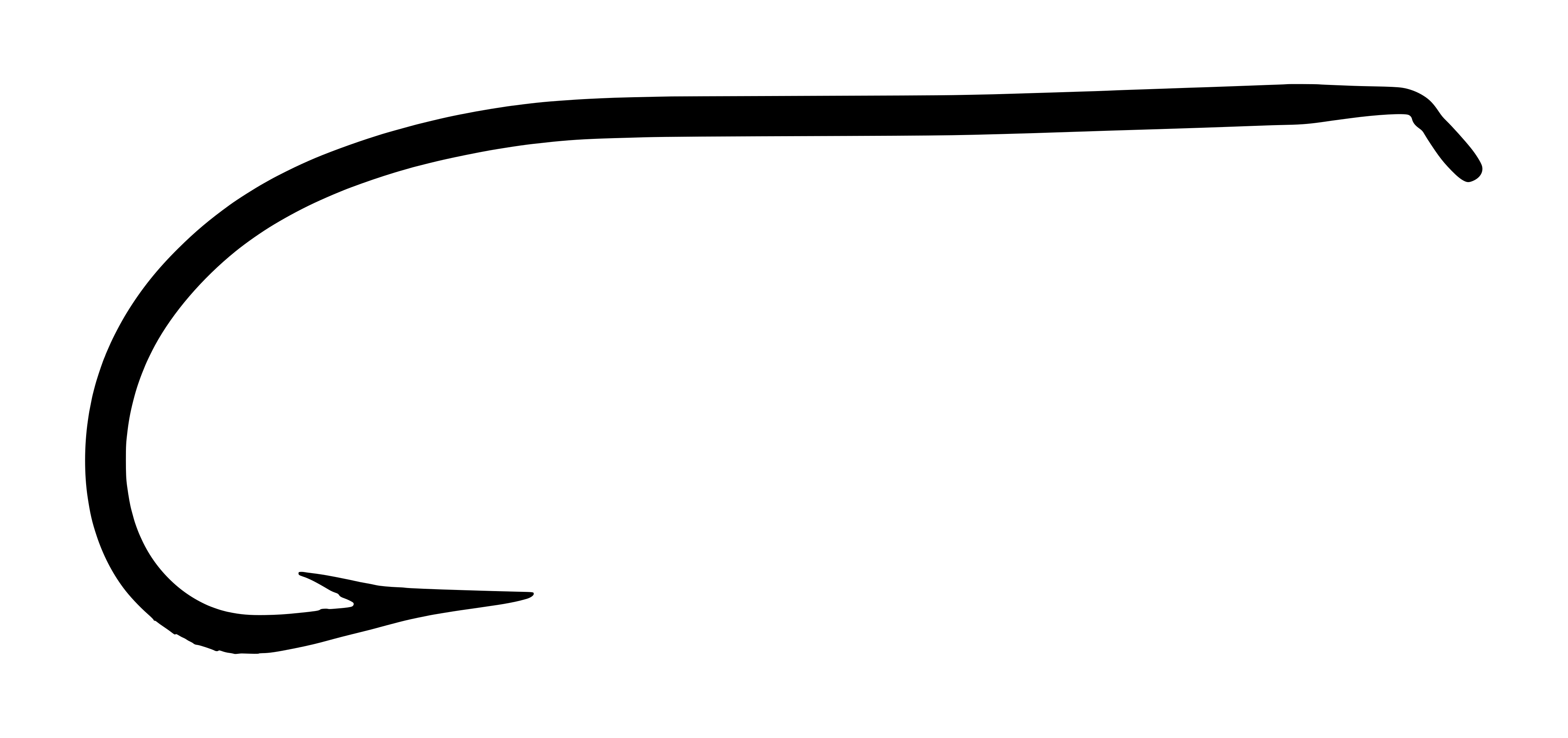
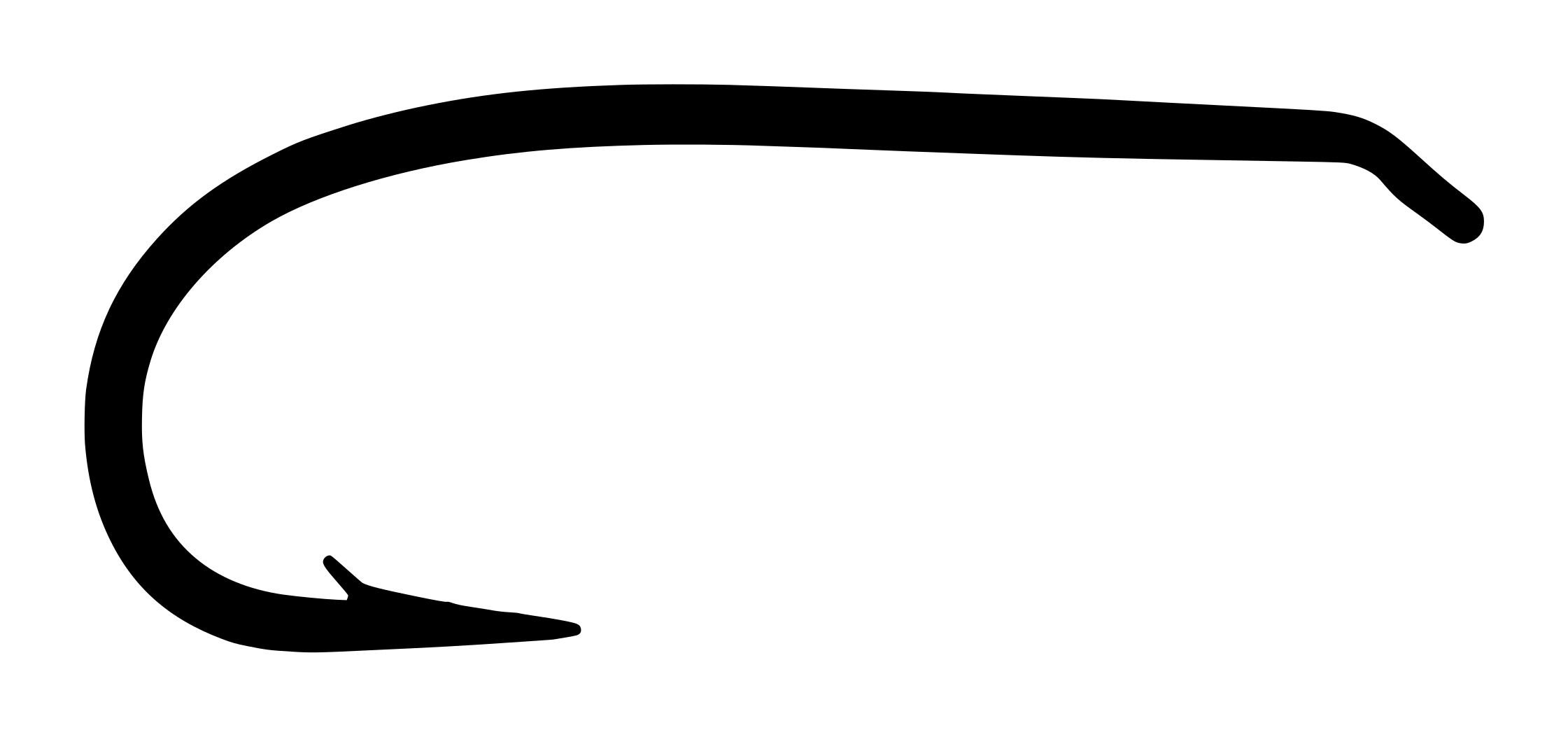
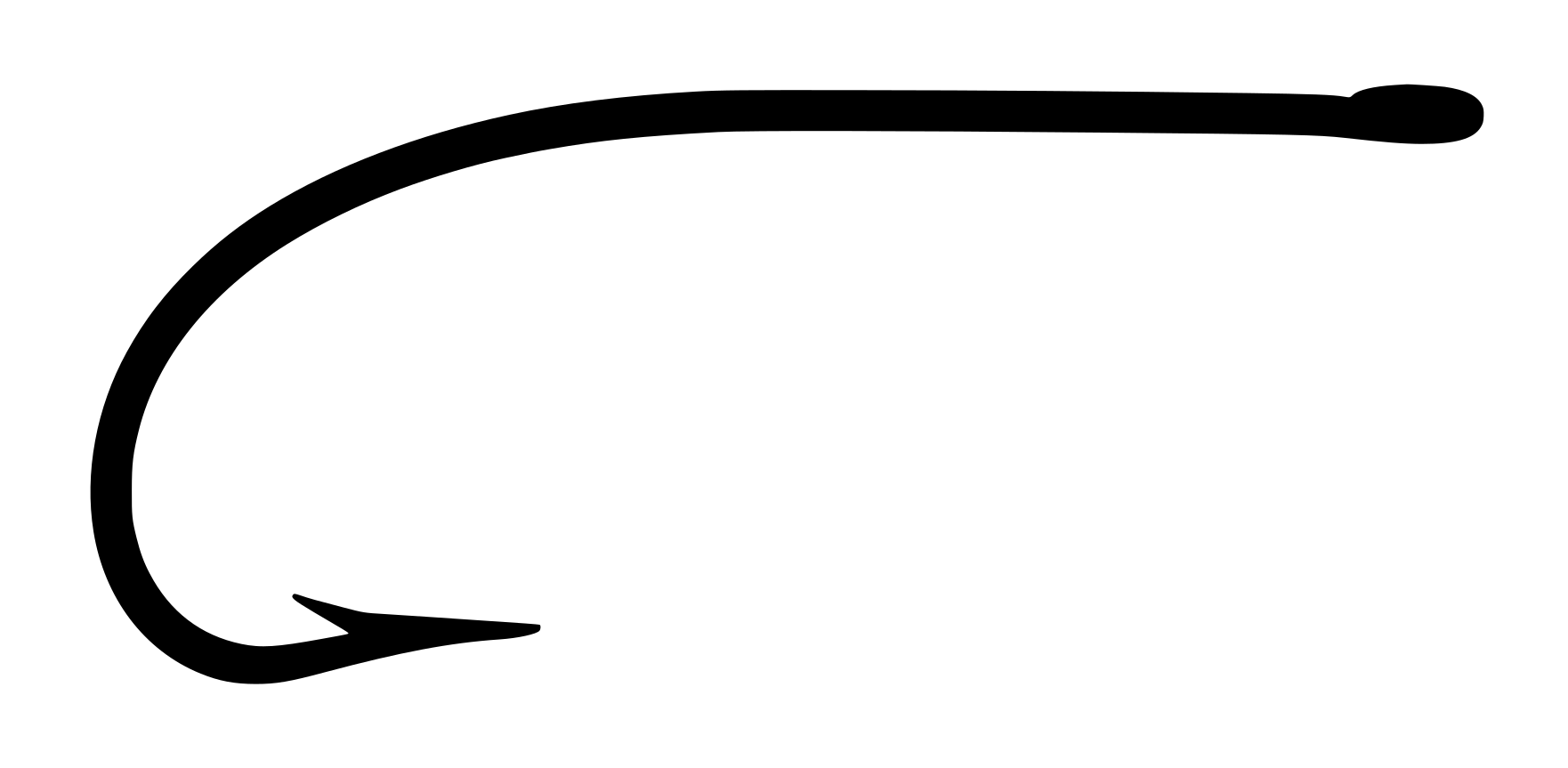
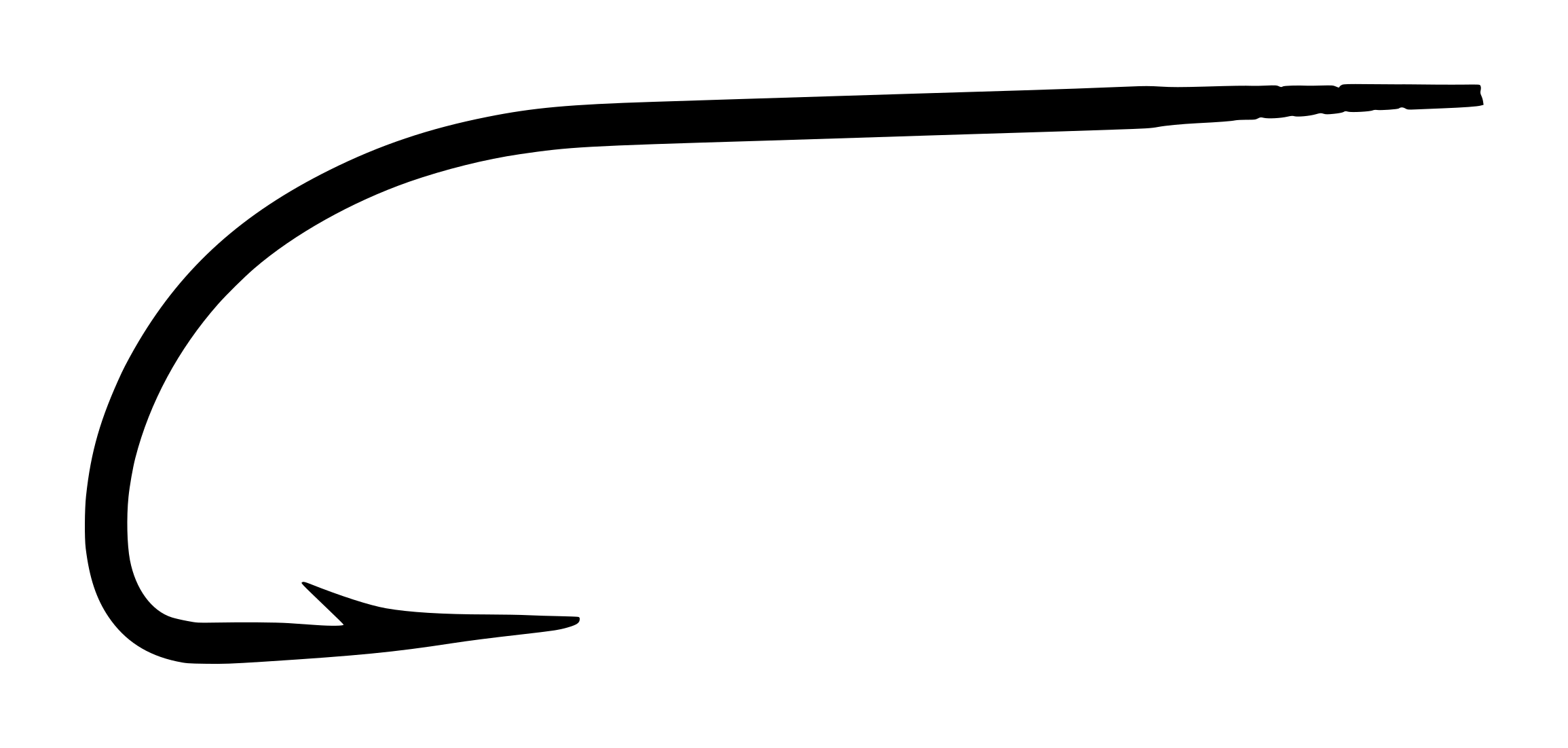
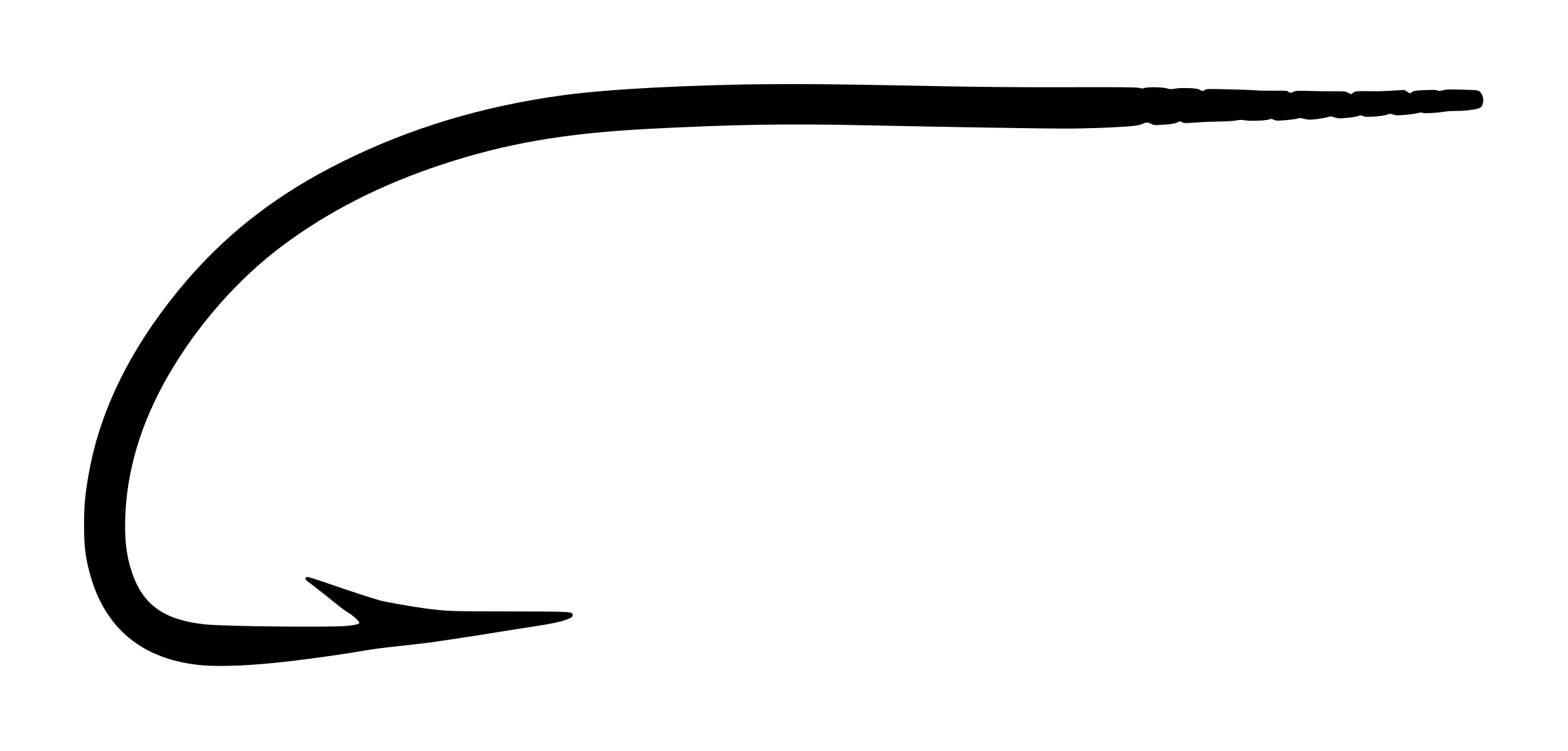
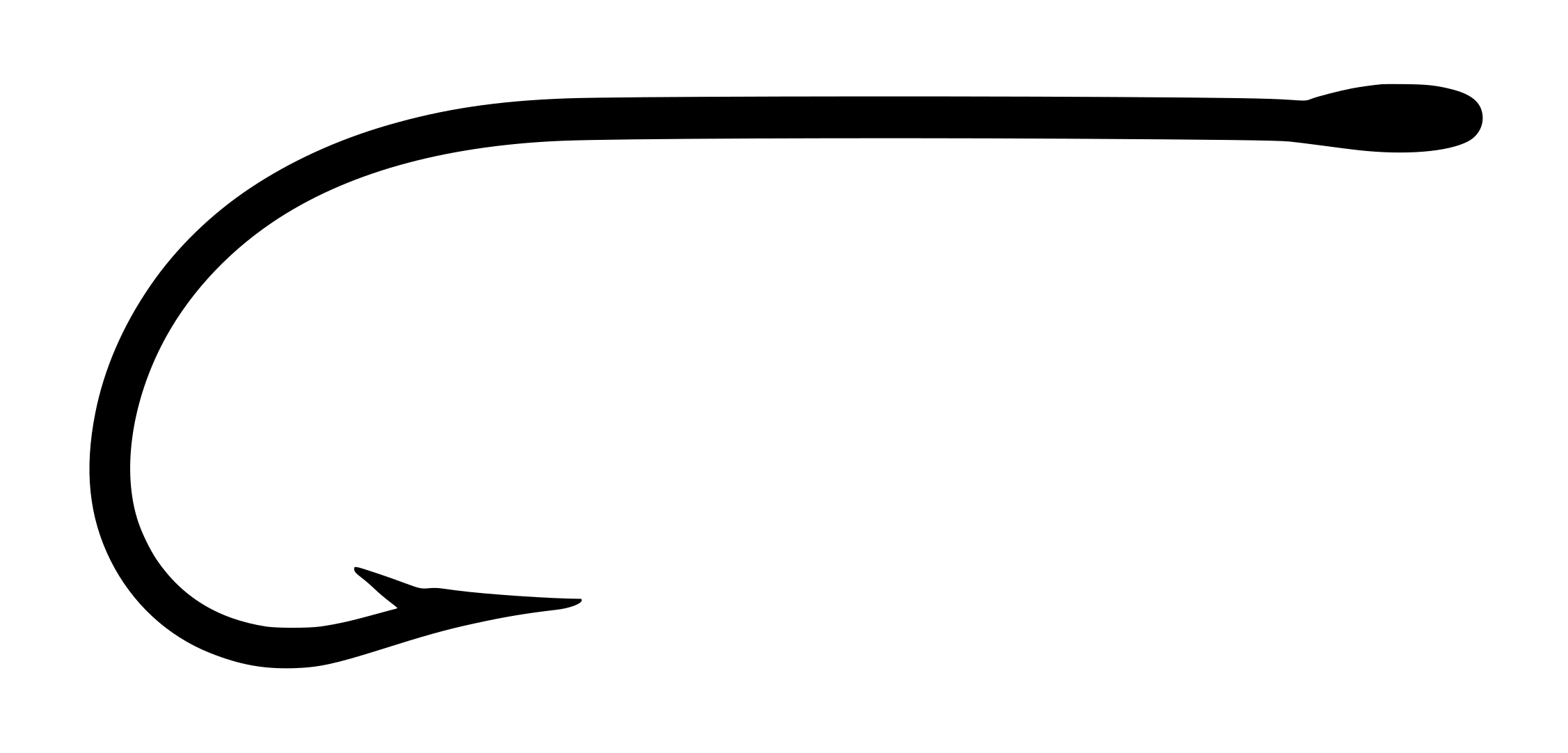
The Mustad Quality 3391 is a classic mid-century Sproat bend hook manufactured in Oslo, Norway during the 1950s-1960s under the ‘Superior’ product line. This size 2/0 specimen features a tapered turned-down eye, heavy standard-gauge wire, and bronzed finish — all hallmarks of premium Mustad wet fly and streamer construction from this era.
The Sproat bend is one of the most successful hook geometries ever engineered, combining the mechanical advantages of both round and angular bends through a mathematically parabolic curve. The tapered eye reduces weight at the hook front, improving flotation and reducing leverage stress during the fight. The bronzed finish provides excellent corrosion resistance while maintaining a non-reflective, natural appearance in the water.
The 3391 served as a general-purpose wet fly and small streamer hook throughout the mid-twentieth century, equally at home tying traditional Scottish wet patterns or contemporary streamer imitations. Original packaging with the distinctive asterisk-border Key Brand label makes this a significant piece of tackle history, representing an era when hook design reflected deep regional and specialized fishing traditions rather than modern homogenization.
Mustad 3391 Sproat in size 2/0, bronzed finish. Profile view displays the characteristic sproat bend with tapered eye.
Photographic record
10 cataloged imagesSelect any record to load it above.
8 images shown
Mustad 3391 Sproat Size 2/0 ProfileMustad 3391 Sproat in size 2/0, bronzed finish. Profile view displays the characteristic sproat bend with tapered eye.Open originalMustad 3391 Sproat Vintage Box LabelOriginal box label for Mustad-Sproat hooks, model 3391, size 2/0. Label states 'Made in Norway' and indicates 100-hook quantity per box.Open originalMustad 3391 Sproat Reference Notes with SamplesCollector's notation comparing Mustad 3391 and 3404 Sproat hooks in sizes 10-12. Notes indicate suitability for mixed wings and soft hackles.Open originalMustad 3391 Sproat Size 2/0 ComparisonSize 2/0 Mustad 3391 Sproat hooks (two specimens), bronzed. Label notes suitability for mixed wings as a salt-of-the-earth gauge.Open originalMustad 3391 Sproat Point DetailClose detail of Mustad 3391 Sproat showing tapered eye, shank taper, and point geometry.Open originalMustad 3391 Sproat Flat ProfileMustad 3391 Sproat in flat position displaying straight eye and clean shank proportions.Open originalMustad 3391 Sproat Size 4/0Size 4/0 Mustad 3391 Sproat hooks (two examples), bronzed finish.Open originalMustad 3391 Sproat Side ViewMustad 3391 Sproat displayed in lateral profile, showing proportioned shank and characteristic sproat bend.Open originalMustad 3391 Sproat Point and BarbAngled view of Mustad 3391 Sproat showing point geometry and barbed design with age-patina on bronzed finish.Open originalMustad 3391 Sproat Size #2 PairSize #2 Mustad 3391 Sproat hooks (pair), bronzed finish, contemporary specimen label.Open original
Technical profile
Eye
Tapered Eye, Turned DownTapered eye construction: wire diameter visibly reduces approaching the loop, creating a smaller, neater eye profile than standard ball-eye hooks. This reduced mass at the front of the hook aids flotation on dry flies and reduces leverage stress. Characteristic of premium Mustad 1950s-1960s production. P
Wire
Fine (1X Fine), Round
Shank
Standard — Plain
Bend
Sproat, Standard gapClassic Sproat parabolic curve: smooth bend begins immediately below eye and sweeps in a gentle arc, reaching deepest point approximately two-thirds of the way down the shank before rising again to the barb point. Bend is neither purely round (like an Aberdeen) nor sharply angular (like a Limerick), but mathematically engineered to distribute fighting stress evenly. Wire is set straight — no lateral offset or twist. P
Point
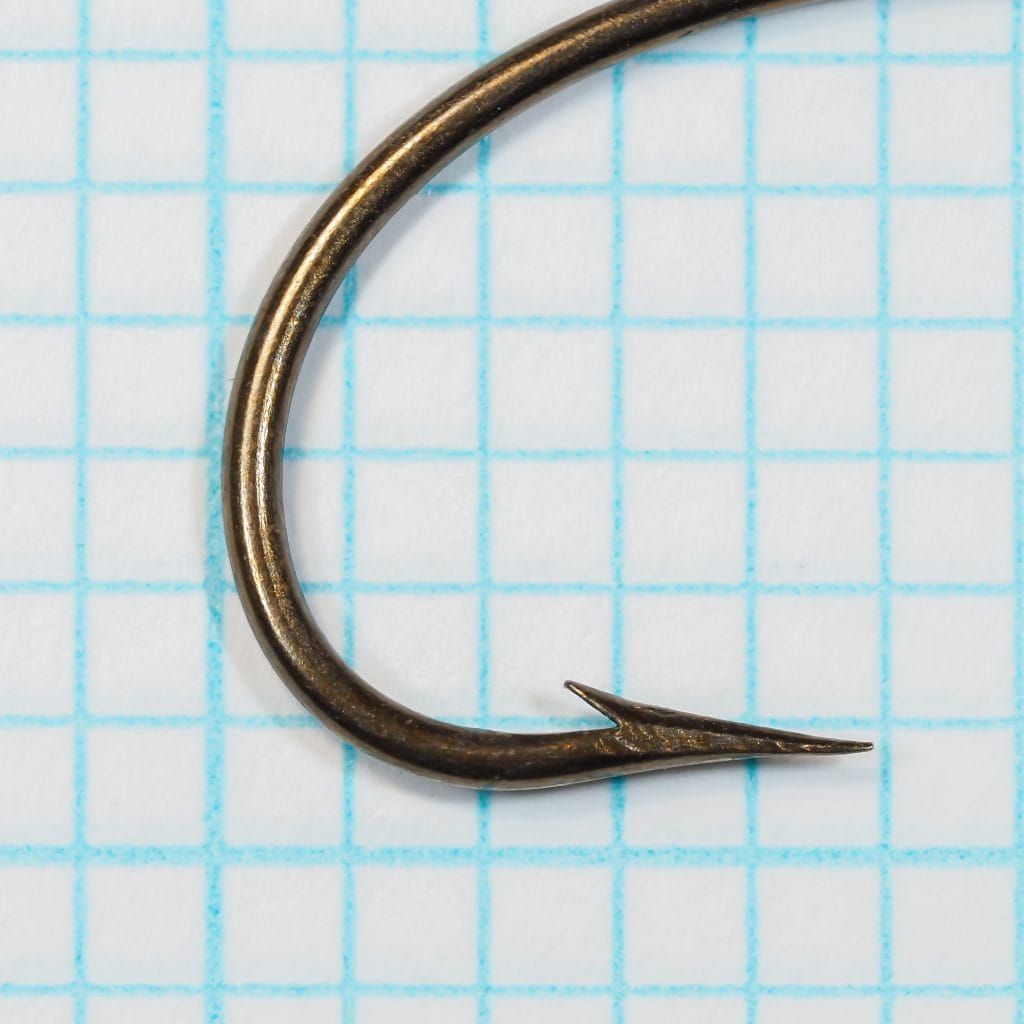
Superior (near-straight inner taper)Barb is short and close-cut, positioned approximately 0.10" to 0.12" below the hook point. Barb angle is slightly swept backward, consistent with mid-century Mustad mechanical grinding standards. Barb height approximately 0.015" to 0.020" above the main shank diameter. E
Finish
Bronzed — Confirmed (stated on packaging)Bronzed finish displays warm, brownish-gold tone characteristic of Mustad's chemical lacquer process. Color temperature is neutral to warm — distinctly neither the cool brightness of blued hooks nor the jet-black opacity of japanned salmon hooks. Finish is uniform across the specimen with minor edge wear showing underlying steel tone at stress points (eye crimp, bend apex). Patina indicates authentic age without corrosion. P
Specimen shows light patina consistent with 60+ year age. Both hooks visible in package are bright and structurally intact with no fractures, bends, or straightening. Original label shows light toning and creasing but remains fully legible. Card stock is firm without brittleness. Original packaging adds significant collector value.
The Sproat’s parabolic curve is engineered to distribute the mechanical stress of a fighting fish across the entire bend length, rather than concentrating load at a single point as angular bends do. This geometry reduces the risk of permanent opening or straightening under sudden, heavy stress.
The tapered-eye construction reduces wire mass at the hook front, lowering the center of gravity and improving flotation characteristics for wet flies and streamers. Heavy standard-gauge wire (approximately 0.050″-0.055″ diameter) provides the structural rigidity necessary to absorb the shock of large fish and rapid current conditions without flexing.
The bronzed lacquer finish offers superior freshwater corrosion resistance compared to blued finishes, while maintaining the non-reflective, natural appearance preferred by traditional wet-fly anglers. The chemical composition of the lacquer protects the underlying high-carbon steel without requiring electroplating, a cost-effective production method for mass-market hooks.
First documented Mustad 3391 tapered-eye Sproat entry in garrenwood.com catalog. Size 2/0 represents uncommon larger size for this model — catalog focus typically on sizes 8-14.
Own this hook? Help us measure it.
We have measurements for sizes 4/0, 2. Know any others? Submit calipered measurements and we'll review and add them. Thank you!
Historical context
mustad
O. Mustad & Søn was founded in 1832 in Gjøvik, Norway, initially as a metal goods manufacturer (Brusveen Spiger- og Staltradfabrikk) under Hans Schikkelstad. The company transitioned to hook manufacturing under Ole Hovelsen Mustad and his son Hans Mustad, who rebranded it as O. Mustad & Søn. The defining innovation came in 1877 when Mathias Topp invented the first fully automated hook-making machine, allowing raw steel wire to be continuously fed, cut, bent, barbed, and pointed at unprecedented speed.
Mustad’s strategy of corporate secrecy and restricted factory access (rather than patent filing) proved devastatingly effective against competitors in Redditch, England, and emerging centers in Japan and the USA. By the early 1900s, Mustad had begun a strategy of industrial ‘cloning’ — reverse-engineering regional hook patterns from around the globe and mass-producing them with Norwegian efficiency. Patterns like the Cincinnati, Limerick, Sproat, and O’Shaughnessy were standardized and exported globally, allowing Mustad to corner localized markets through industrial scalability.
By the 1950s, Mustad had secured approximately 50% of global hook production market share, with manufacturing and sales offices across multiple continents. The Oslo facility (operational since at least 1925) became the de facto center of Mustad’s global operations. This mid-century period represents Mustad’s peak industrial dominance, before the transition to modern synthetic fishing lines and standardized production in the 1970s-1980s.
Series History
The Sproat pattern emerged from regional Scottish and northern English angling tradition in the mid-nineteenth century, distinguished by its parabolic bend geometry. Mustad standardized and mass-produced the Sproat beginning in the late 1800s as one of their core ‘cloned pattern’ offerings. The pattern occupied a unique market niche — neither purely round like an Aberdeen nor sharply angular like a Limerick, but mathematically intermediate, making it universally applicable to wet-fly and streamer work.
The Qual. 3391 model was introduced during Mustad’s mid-century expansion (estimated 1930s-1950s) as a premium variant within the Sproat family, distinguished by tapered-eye construction and marketed under the ‘Superior’ product line branding. The 3391 remained in production through at least the 1960s, during which it became synonymous with traditional Scottish wet-fly fishing and early streamer development. Production eventually transitioned to the ringed-eye Qual. 3399 and other variants by the 1970s, as modern nylon monofilament and direct-knot tying made tapered eyes less essential.
The original Sproat pattern line was discontinued as part of Mustad’s 1990s-2000s catalog reorganization, when the company transitioned from arbitrary numeric Quality codes to the modern ‘Signature Series’ alphanumeric system. Modern Sproat-geometry hooks (such as the C39940) maintain the same bend profile but lack the premium tapered-eye construction that made vintage examples distinctive.
Era and Packaging Dating
Oslo designation (not Christiania) indicates manufacture after January 1, 1925. Key Brand logo style, asterisk border design, pink/salmon paper stock, letterpress print method, and mid-century box construction align with 1950s-1960s production. Hand-stamped size notation on label is consistent with this era. No barcode present (pre-1974). Tapered eye construction and 'Superior' branding were standard Mustad features during this period.
The Invisible Angler: The Sproat Bend's Lost Inventor
The Sproat bend is named for an English angler from the mid-1800s whose name has been lost to history, yet his design survives in tackle catalogs worldwide. Mustad's aggressive industrial cloning strategy — copying regional British and Irish patterns and mass-producing them with Norwegian efficiency — transformed the hook market and made the Sproat a global standard by the early 1900s. The 3391's asterisk-border packaging was a design touchstone of mid-century Mustad branding, appearing on thousands of hook cards distributed worldwide. Interestingly, the 'Superior' designation on this label refers to a product line, not a quality statement — yet by modern standards, the precision of the tapered eye and the mathematical perfection of the Sproat curve make it genuinely superior to many contemporary hooks.
Design lineage and influence
The Sproat bend originated in mid-19th-century angling tradition and was perfected by regional craftsmen in Scotland and northern England. Mustad reverse-engineered and standardized the Sproat in the late 1800s, making it one of their signature patterns. The design represents a mathematical synthesis of earlier round and Limerick bends, distributing stress more evenly than either predecessor.
The Sproat remained the standard wet-fly hook throughout the twentieth century, competing with but ultimately outlasting purely round bends for traditional fly work. Modern Mustad descendants include the 3906B and 3399, though none replicate the precise tapered-eye construction of vintage hooks like the 3391.
Best matchRelated by Attribute
Computed automatically from catalog data — updated as new hooks are added.
Matches: Bend, Shank, Wire, Point, Finish +3 moreDiffers: Gap: Standard vs Wide; Eye: Tapered Eye vs Ball Eye; Eye Orient.: Turned Down vs Straight / Inline +1 more
Matches: Bend, Shank, Gap, Point, Forging +3 moreDiffers: Wire: Fine (1X Fine) vs Extra-Fine; Eye: Tapered Eye vs Ball Eye; Eye Orient.: Turned Down vs Straight / Inline +2 more
The Mustad 3391 in size 2/0 was engineered for wet fly and small streamer fishing, particularly in Scotland and Northern Europe where the Sproat bend dominated fly-fishing tradition. In this larger size, it accommodated traditional Scottish and Irish wet flies with bulkier tie-ins, bucktails for Atlantic salmon, and early streamers targeting sea trout and steelhead. The heavy wire and standard shank provided durability for larger fly bodies and permitted secure hook-sets without doubling over under the stress of powerful anadromous species.
The tapered eye and Sproat curve made this hook particularly effective for wet-fly presentations in moving water — the balanced bend distributed loads evenly, reducing the risk of straightening under the pull of a heavy current or a strong fish. In size 2/0, it was also suitable for large live-bait presentations in lakes and rivers where pike, bass, and larger trout required substantial offerings.
Secondary Applications
Large live-bait fishing for pike, bass, and sea trout; trolling for lake trout and char
Classic Fly Patterns
Traditional Scottish wets (Butcher, Woodcock and Yellow, Teal and Black), Atlantic salmon flies, early streamers (Muddler-style patterns)
Modern Equivalents
Hook
Match Quality
Notes
Mustad C39940 Classic Wet Fly
Very Good
Modern Sproat bend with similar proportions; lacks tapered eye of vintage model but maintains parabolic curve geometry
Tiemco 5262
Good
Japanese Sproat variant; heavy wire, standard shank, suitable for same fly types; slightly different bend profile
Daiichi 1560
Good
Modern wet-fly hook with comparable bend; available in tapered-eye versions, similar functionality to vintage 3391
Collector notes
The Mustad 3391 is moderately scarce and historically significant, driven by its representation of mid-century Norwegian dominance in hook manufacture and the survival of original packaging with Key Brand branding. The collectability is constrained by the fact that Sproat hooks remain in production today under different model numbers, reducing uniqueness. Size 2/0 is less common than smaller sizes (10-14) in surviving vintage stock.
Reference value
$8 – $16 USD estimate
Packaging format
GW-M-01Catalog code
Positive factors: Original packaging with distinctive asterisk-border label and Key Brand logo is a primary driver — the pink/salmon card stock is immediately identifiable and highly photogenic. Tapered-eye construction represents premium manufacturing standards. Mid-century Oslo-marked examples (post-1925 but pre-1970s) represent the peak of Mustad’s global market dominance. Size 2/0 is less frequently encountered than sizes 8-14. The Sproat bend is historically significant and mechanically sophisticated. Both hooks appear to be unused or minimally used, preserving original finish.
Limiting factors: The Sproat pattern remains in modern production, diminishing uniqueness — collectors with modern preferences may see this as redundant rather than archival. Model numbers in the 3300-3400 range were high-volume production, so surviving examples are more common than rarer, lower-numbered models. Bronzed finish, while desirable, is less exotic than japanned or tinned alternatives. No documented designer or collaborator attribution. Not associated with any named fly pattern or historical angling figure. Size 2/0 is larger than the typical collector focus (which favors smaller dry-fly hooks).
Packaging
Original Mustad packet: 3.75" × 2.5" card stock, pink/salmon color, letterpress print. Header logo: Key Brand skeleton key graphic. Eight-line label format per Mustad standard: O. MUSTAD & SON (Line 1), MANUFACTURERS (Line 2), OSLO – NORWAY (Line 3), Qual. 3391 (Line 4), Superior (Line 5), Mustad-Sproat Hooks (Line 6), T.D. tapered eye Bronzed (Lines 7-8). Bottom left: 100 / No. 2/0 (quantity and hand-stamped size). Asterisk border design frames entire label. Card is firm with light creasing and age-consistent toning. Paper stock is period-typical 1950s commercial card, not brittle.
Market Value Notes
Value is driven primarily by original packaging condition and eyeball appeal. Unopened packets with intact labels command the upper range. Individual loose 3391 hooks (no card) typically fetch $3-5 USD on eBay. Packets with light toning and full legibility command $10-14. Premium specimens with perfect label legibility and excellent card stock can reach $16-20. Pricing is relatively stable — the 3391 lacks the explosive collector premium of rarer models (like early Sneck patterns or 94840 dry flies).
Model code Qual. 3391 clearly printed on original label. Size 2/0 hand-stamped in box. Look for Key Brand logo with skeleton key graphic. Verify ‘T.D. tapered eye’ notation on packaging. Original pink/salmon card with asterisk border is distinctive. Sproat bend profile features parabolic curve midway between round and angular — visually distinctive.
Preservation
Storage and Preservation
Store the original packet in a cool, dry environment away from direct humidity and fluctuating temperature. The bronzed finish will naturally develop a warm patina over time, which is desirable to collectors and does not indicate corrosion. The lacquer-based finish is more durable than blued or bright finishes and will resist rust if stored properly.
Keep the packet intact and on display rather than removing hooks into loose storage containers. The original asterisk-bordered label and Key Brand branding are the primary value drivers — separating hooks from the card diminishes collector appeal dramatically. Store away from other metals to prevent galvanic contact, which could accelerate patina development. Avoid handling the label excessively, as oils from skin can cause permanent spotting on aged paper.
If restoration of the packet is needed, use conservation-grade archival tissue only — never apply modern adhesives or attempt to bleach the paper. The natural toning is authentic and valuable to collectors. If displayed in a framed case or hook wall, ensure UV-protective glass to prevent fading of the label printing.
Marking Analysis
Handwritten Annotations and Markings
The specimen includes two handwritten comparison notes on accompanying documentation (Image 3), written in fountain pen in cursive script consistent with mid-20th-century American fishing culture. The first note reads: ‘Dear Charlie, That’s what my friend the goldsmith does with the rods you sent me once (Rods from in Series of 10 or 12 Rods (Put it takes a little time)) R.ose Mustad(?) Sproats 3391 2/0 — Those Mustad’s 3401 2/0 et Redd[?] 1. R 4410 — good for mixed wings — list of 1/10 ink oxide gale. good for leased wings — list of 1/10 ink oxide D&S.’
The second note references ‘R.ose Mustad(?) Sproats 3391 2/0’ and appears to document comparative hook specifications and functional characteristics. The handwriting is consistent with an angler or fly-tyer cataloging their personal collection, cross-referencing the 3391 with companion models (3401, other variants). The reference to ‘goldsmith’ and ‘rods’ suggests this documentation came from a serious fly-tier or fishing guide who maintained detailed records of tackle specifications and comparative performance.
These annotations are unsigned and undated, but the handwriting style and pen type are consistent with 1950s-1960s angling documentation. The careful notation of specific hook qualities (‘good for mixed wings’, mentions of oxide gale specifications) indicates a researcher or professional tier documenting the functional distinctions between similar Mustad patterns. This supporting documentation adds significant research value to the specimen as a window into mid-century fly-tying practices and tackle comparison methodology.
Primary Source
Eight-Line Label Decryption: The Mustad Coding System
Source: O. Mustad & Søn eight-line label system per Mustad Label Reference document, garrenwood.com
The original Mustad packet exemplifies the standardized eight-line typographic labeling system documented in the Mustad Label Reference (garrenwood.com source document 1). Decoding this label demonstrates the sophisticated encoding of technical and marketing information within a constrained space.
Line 1 (O. MUSTAD & SON): Establishes ultimate corporate authority and manufacturing ownership. Full, unabbreviated Norwegian name with proper &Ø; diacritical mark.
Line 2 (MANUFACTURERS): Distinguishes Mustad as the primary manufacturer (not merely an importer or jobber) — critical in an era when wholesale repackaging under secondary brands was widespread.
Line 3 (OSLO – NORWAY): Geographic origin. ‘Oslo’ designation definitively dates this specimen to manufacture after January 1, 1925, when the city was officially renamed from Christiania. No label bearing ‘Oslo’ can predate 1925, anchoring this hook to the mid-twentieth-century peak of Mustad’s global dominance.
Line 4 (Qual. 3391): Quality/model code. The 3300-3999 numeric range represents mid-tier ‘Quality’ products — professional-grade hooks manufactured to exacting tolerances and tempering standards. The 3391 specifically identifies a Sproat bend wet-fly configuration. Mustad’s numeric system was arbitrary (not self-describing) — users memorized that 3391 = standard Sproat, while 3906B = companion wet-fly variant. This non-intuitive coding persisted until Mustad’s 2001-2009 transition to the modern ‘Signature Series’ alphanumeric system.
Line 5 (Superior): Point identifier. On this label, ‘Superior’ appears alone, making it ambiguous. Per Mustad’s official labeling rules, Line 5 is strictly reserved for point-type nomenclature. However, ‘Superior’ was also Mustad’s product-line branding during this period. Visual examination of the hook’s point geometry (near-straight inner taper, concentrated penetration force) confirms this is a ‘Superior Point’ as a geometric specification — not merely a quality descriptor. The label simultaneously encodes a brand designation and a technical geometry specification in a single word.
Lines 6-7 (Mustad-Sproat Hooks / T.D. tapered eye Bronzed): Pattern nomenclature and anatomical modifiers. Line 6 identifies the Sproat as the foundational bend geometry. Lines 7-8 specify the tapered-eye (T.D. = Turned Down tapered eye) construction and bronzed lacquer finish — modifiers that distinguish this premium variant from standard ringed-eye 3391 alternatives.
Bottom notation (100 No. 2/0): Quantity (100 hooks per packet, the standard wholesale unit) and hand-stamped size (2/0). The hand-stamping indicates individual packet sizing — Mustad produced multi-size assortment boxes, with size marked manually during fulfillment.
This label encodes over a century of industrial standardization and represents an era when tackle packaging functioned as a dense technical document rather than a consumer-facing marketing tool. Modern anglers rarely encounter hooks with such information density, making this label a primary historical artifact.
Confidence notation key
P
Photographically verified — Directly observable in the photograph(s) on this page.
V
Verified by documentation — Confirmed by manufacturer catalog, spec sheet, or published reference.
I
Inferred — A logical deduction from observable or documented evidence, not directly stated.
E
Estimated — An approximation based on visual comparison, proportional analysis, or limited data.
S
Speculative — A reasoned hypothesis that cannot be confirmed from available evidence.
Claims with no notation are confirmed by multiple independent sources. All photographs on garrenwood.com are taken on a measurement grid where each square equals 1/10 inch (0.1″ / 2.54 mm).