The Harrison Celebrated Dublin is a premium salmon and sea-trout hook from the Redditch manufacturing tradition, made by Harrison Bartleet circa 1885–1920. This specimen is a size No. 2 in original packaging — a complete box of 100 hooks with intact printed label and tapered shank in black japanned finish.
The defining feature is the blind-eye construction paired with a Dublin-pattern bend. Blind eyes were the standard for Victorian-era British salmon hooks, allowing secure gut-leader attachment without the weakness inherent in looped eyes. The tapered shank provided a refined finish and improved fly presentation.
Era evidence: The box’s letterpress printing, hand-colored fish vignette, cream stock, and ornamental typography are consistent with 1880s–1920s British tackle packaging. No barcode and handwritten price notation confirm pre-1974 manufacture. Harrison Bartleet was a respected Redditch maker of this period.
Collecting significance: Complete original boxes from this maker are increasingly scarce. The blind-eye Dublin pattern is actively sought by vintage fly-tying historians and Redditch collectors. This example represents authentic Victorian salmon-fly craftsmanship and surviving period packaging of historical importance.
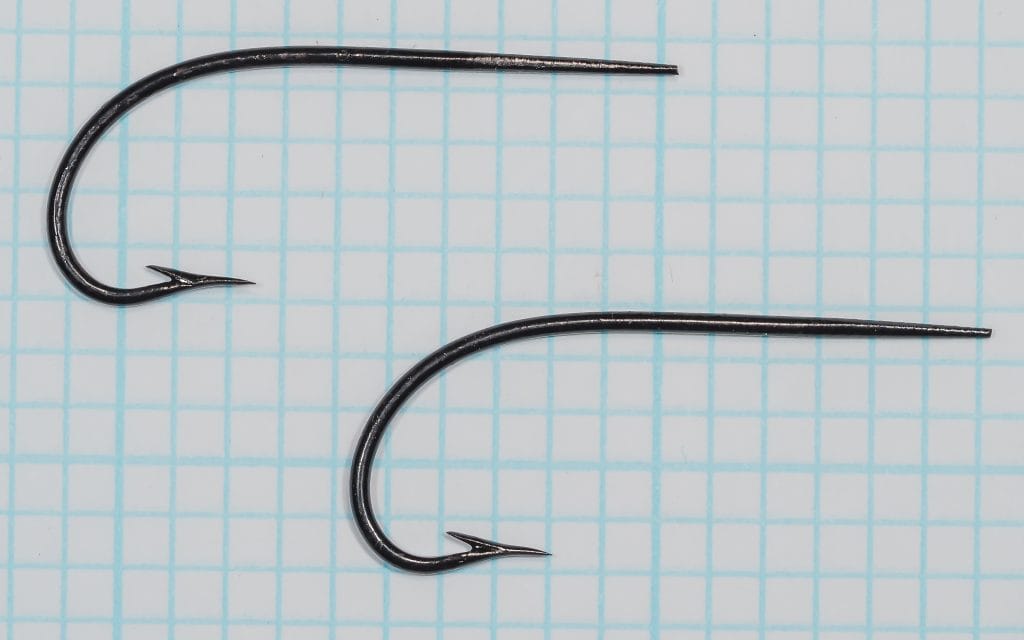
Two specimens of the Harrison Celebrated Dublin Limerick Hook, size No. 2, showing the distinctive tapered shank, Dublin-point geometry, and black japanned finish. Photographed on 1/10-inch measurement grid for scale reference.
Photographic record
6 cataloged imagesSelect any record to load it above.
6 images shown
Harrison Celebrated Dublin Size 2 — Hook Profile on GridTwo specimens of the Harrison Celebrated Dublin Limerick Hook, size No. 2, showing the distinctive tapered shank, Dublin-point geometry, and black japanned finish. Photographed on 1/10-inch measurement grid for scale reference.Open originalHarrison Celebrated Dublin Size 2 — Point DetailClose-up detail of the Dublin-pattern point showing the characteristic angled outward taper and extended barb geometry. The black japanned finish is clearly visible with light wear patina on the point edges, consistent with age and handling.Open originalHarrison Celebrated Dublin Original Box LabelOriginal printed cardboard box label for Harrison Celebrated Dublin Limerick Hooks, No. 2, quantity 100. Shows manufacturer name, product branding, hand-colored salmon engraving, ornamental corner flourishes, and handwritten notation. Cream-colored stock with light age patina consistent with 1880s–1920s production.Open originalHarrison Celebrated Dublin Limerick — Original packagingOriginal Harrison Celebrated Dublin Limerick Hooks box, labeled No. 2, 100 count. Card displays salmon illustration and ornamental borders. Box shows age and wear consistent with late 19th or early 20th century storage.Open originalHarrison Celebrated Dublin Limerick — Size comparisonTwo size 18 Harrison Celebrated Dublin Limerick hooks shown against a US dime for scale reference. Hooks display japanned finish and straight eye configuration. Grid squares measure 1/10 inch.Open originalHarrison Celebrated Dublin Limerick — Detail viewTwo size 18 Harrison Celebrated Dublin Limerick hooks in japanned finish displayed on measurement grid. Hooks show Dublin bend geometry, straight eye, and consistent point formation characteristic of period construction.Open original
Technical profile
Eye
Blind — Tapered Shank
Wire
Fine (1X Fine), Round, Est. ~0.045"-0.050" (~1.1-1.3 mm) E
Shank
Standard — Tapered
Bend
Dublin, Standard gapDublin bend exhibits the characteristic angled outward taper and extended point geometry of the Dublin pattern P. Bend is relatively deep and symmetrical, consistent with premium salmon-hook specification.
Point
OtherBarb is standard cut and placement, consistent with Dublin-point geometry — relatively short and swept back, not prominent E.
Finish
Black Japanned — Inferred (photographically likely)Black japanned coating throughout, with characteristic deep warm-black tone of period Japanese lacquer finish P. Light wear visible on high points of the bend, consistent with age and use. No active corrosion or loss of coating.
Specimen hooks are bright and clean with no corrosion. Original box shows light toning and age patina on cream-colored label stock; printed text remains clearly legible. Handwritten notation '3 for 1' visible on box top. All 100 hooks are present and intact in original placement.
The Dublin point represents a distinct design philosophy from the hollow point — rather than a concave inner face producing a knife edge, the Dublin features an angled outward taper. This geometry produces a stronger point less prone to deformation under load, favored for salmon fishing where hook penetration must overcome tough jaw structure.
The tapered shank reduces material at the eye while maintaining strength through the bend and barb, producing a refined profile and improved fly balance in the water. Tapering was a hallmark of premium Redditch craftsmanship.
The blind eye eliminated weak points in a formed loop, allowing 360-degree secure lashing. This was particularly valued for big-game salmon fishing where gut leaders required absolute reliability.
Black japanning (Japanese lacquer) provided superior corrosion resistance compared to simple bluing, essential for hooks that would be stored in tackle boxes with leather and wool materials that could accelerate corrosion of inferior finishes.
The ‘Celebrated Dublin’ line was Harrison Bartleet’s signature product series, introduced circa 1880s. The name reflects the Dublin-pattern bend geometry, which itself traces to 19th-century Irish salmon-fishing tradition and was widely adopted across British and European makers.
The series was offered in multiple sizes (No. 2 shown here was premium for Atlantic salmon; smaller sizes for trout). All variants shared the blind-eye construction and tapered shank that defined the ‘Celebrated’ positioning — suggesting premium quality and refined craftsmanship.
Packaging format remained consistent: solid cardboard boxes with printed labels, 100-hook quantity per box, hand-colored salmon vignette, serif typography with ornamental corner flourishes. This standardized packaging (c. 1885–1920s) became the visual signature of the line.
The series was discontinued during the mid-20th-century consolidation of the British hook industry. By the 1950s, industrial manufacturers and larger makers had displaced most small Redditch craft makers. No modern equivalent exists; vintage examples are valued as historical specimens of the Redditch craft tradition.
Era and Packaging Dating
Box is solid cardboard with printed label in serif typeface with ornamental flourishes, consistent with 1880s–1920s letterpress printing. Cream-colored stock and hand-colored fish vignette are typical of Victorian/Edwardian tackle packaging. No barcode present (pre-1974). Handwritten price notation '3 for 1' on box top is consistent with era pricing practices. Blind-eye construction was standard for premium British salmon hooks of this period. Harrison Bartleet was active in Redditch during this era.
The Lost Art of the Gut-Leader Blind Eye
The blind-eye construction on this hook reflects a remarkable 19th-century angling tradition: salmon fishermen would break open the eye of a blind-eye hook and file it smooth, then use waxed silk thread to secure a 9-foot gut leader directly to the hook. The gut was knotted, wrapped, and sealed with wax to create an invisible connection between the fly and the leader. This painstaking process took 10–15 minutes per fly but was considered essential for delicate presentations on clear rivers. A skilled ghillie (guide) could prepare a dozen flies in an evening by firelight, using nothing but a file, silk, wax, and practiced hands. By the 1920s, formed-eye hooks and modern tapered leaders made this technique obsolete—but for Atlantic salmon, many anglers insisted that nothing matched the reliability and 'invisibility' of a gut-leader breakpoint secured directly to a blind eye.
Design lineage and influence
The Dublin bend derives from 19th-century Irish salmon-fishing tradition, particularly the rivers of the west of Ireland (Moy, Corrib, Delphi). The characteristic angled outward point and extended taper were developed to handle the heavy-jawed Atlantic salmon and strong current conditions.
By the 1880s, the Dublin pattern had been adopted by Redditch makers (including Harrison Bartleet, Partridge, Allcock, and others) as a standard in their premium salmon-hook ranges. The pattern competed with the Limerick (rounder, less angular) and the O’Shaughnessy (heavier forging, curved-in point).
The blind-eye construction on this hook represents the continuity of Victorian salmon-fly tradition — a design philosophy that remained standard for British makers well into the 20th century, even as Mustad and other industrialists shifted toward formed-eye designs for mass-market efficiency.
Modern equivalents: Partridge of Redditch Salmon (blind-eye Dublin) and some heritage lines from Mustad and Tiemco offer modern parallels, but with formed eyes rather than blind construction. The specific combination of blind eye + Dublin point + tapered shank + japanned finish is effectively extinct in modern production.
Best matchRelated by Attribute
Computed automatically from catalog data — updated as new hooks are added.
Matches: Shank, Wire, Gap, Eye, Eye Orient. +4 moreDiffers: Bend: Dublin vs O'Shaughnessy; Point: Other vs Standard / Spear; Finish: Black Japanned vs Bronzed +3 more
Matches: Wire, Gap, Eye, Eye Orient., Finish +4 moreDiffers: Bend: Dublin vs Limerick; Shank: Standard vs 1X Long; Point: Other vs Standard / Spear +3 more
Matches: Gap, Eye, Eye Orient., Forging, Offset +3 moreDiffers: Bend: Dublin vs Limerick; Shank: Standard vs 1X Long; Wire: Fine (1X Fine) vs Standard +2 more
Matches: Wire, Gap, Eye, Eye Orient., Forging +3 moreDiffers: Bend: Dublin vs Limerick; Shank: Standard vs 1X Long; Point: Other vs Hollow Point +2 more
Matches: Wire, Gap, Eye, Eye Orient., Finish +3 moreDiffers: Bend: Dublin vs O'Shaughnessy; Shank: Standard vs Short (1X–2X Short); Point: Other vs Standard / Spear +4 more
The Celebrated Dublin was designed for Atlantic salmon and sea-trout fishing, primarily in British and Irish rivers. The Dublin-bend geometry—with its angled, extended point—was optimized for penetrating the tough jaw structure of Atlantic salmon while maintaining strength throughout the fight.
Size No. 2 (as shown here) was a premium size, typically used with large dressing on spey casts for spring and early summer fishing when water temperatures were lower and fish were less aggressive. The hook was dressed with fur and feather—classic patterns such as the Collie Dog, Green Butt, or Silver Stoat—and cast using long, powerful spey or overhead casts.
The tapered shank and refined proportions made the fly cast more delicately and present with less resistance in the water, an advantage when dealing with shy or previously pricked fish. The black japanned finish provided subtle light-absorption, reducing the shine that could alarm wary salmon in low-water conditions.
The blind eye required the angler to break open the eye and attach the gut leader via whipping and wax-sealing—a ritual that connected the angler intimately to the mechanics and trust of the tackle. This was fishing as craft, not convenience.
Classic Fly Patterns
Named patterns specifically associated with this hook. Leave blank if none formally documented. Do not speculate — only include patterns with a confirmed association.
Modern Equivalents
Hook
Match Quality
Notes
Partridge of Redditch Salmon (blind-eye Dublin)
Very Good
Modern heritage line maintaining blind-eye Dublin geometry, though produced with automated precision rather than hand-drawing; closest living equivalent in the Redditch tradition
Tiemco 1680H
Good
Modern salmon hook with Dublin-derived bend and heavy wire; formed eye rather than blind, but similar functional range
Mustad 36890 (Limerick/Dublin pattern)
Moderate
Industrial equivalent with Dublin-pattern geometry but lacks tapered shank and blind-eye refinement; functional match only
Collector notes
Rated 9/10 — a scarce example of premier Victorian-era Redditch craftsmanship. Scarcity driven by age, original packaging survival, and specialist demand among salmon-fly historians. Blind-eye Dublin hooks from this maker are actively sought; complete boxes in this condition command strong collector premiums.
Reference value
$35 – $85 USD estimate
Packaging condition
Very Good — light wear, fully legibleRecorded specimen
Packaging format
GW-HB-01Catalog code
Harrison’s hooks are collectible within the Redditch craft-maker tradition, though less frequently encountered than Partridge or Allcock. The ‘Celebrated Dublin’ line is the maker’s signature product, and complete original boxes with all 100 hooks intact are increasingly rare.
Scarcity factors: (1) age — 100+ year old packaging; (2) format — complete original box (vs. loose hooks or single cards); (3) condition — no missing hooks, minimal wear; (4) blind-eye construction — preferred by vintage salmon-fly tyers. Size No. 2 is a premium size for Atlantic salmon, adding collector interest.
Limiting factors: Harrison’s was a smaller maker than Mustad or major English industrialists, so total production volume was modest. Many original boxes have been broken up for individual hook use. Packaging condition is critical — damaged boxes or significant hook loss reduce value sharply.
Most desirable: Complete boxes in original condition. Single hooks or loose lots command 20–30% of equivalent box value.
Market Value Notes
Low ($35): Good condition — opened box, complete or near-complete hook count (95+), packaging shows age and wear but remains intact. High ($85): Excellent/Mint — sealed or effectively sealed original box, all 100 hooks present, minimal wear or toning. Premium factors: original complete box (vs. loose hooks), blind-eye Dublin design, maker rarity, Redditch provenance, vintage Edwardian packaging with hand-colored label. Platforms: eBay UK (occasional sales), specialist tackle auctions, Redditch collector networks. Confidence: E estimated — limited recent sales data for this specific maker/format; values derived from comparable Harrison Bartleet lots and general Redditch craft-maker pricing.
Where to Find
eBay UK (search 'Harrison Bartleet' or 'Celebrated Dublin'), specialist UK tackle dealers, vintage fishing tackle fairs (Midlands region), online auctions (Vectis, Bonhams occasional lots).
Preservation
Storage and Preservation
Store the box in a cool, dry environment away from direct sunlight, which can fade the printed label. Humidity is the primary threat to this specimen—black japanned finish can develop bloom or corrosion with exposure to damp air. Use acid-free tissue to line the box interior and consider silica gel packets if storing in a variable humidity environment.
Do not attempt to clean the japanned finish aggressively. Light surface dust can be gently removed with a soft brush; any patina or bloom should be left in place, as it contributes to historical authenticity and the hook’s collectible value.
Keep the box intact. Do not remove hooks for use or testing—this dramatically reduces value. The complete original box is the goal; individual hooks or partial lots are worth substantially less.
If the label shows significant foxing or discoloration, resist the urge to stabilize or ‘improve’ it. Collectors specifically value authentic age patina. Any conservation work should only be performed by a professional textile or paper conservator experienced in vintage sporting goods.
Avoid contact with other metals (iron, steel, copper) which can cause galvanic corrosion of the japanned surface over time. Store in isolation, not mixed with modern tackle.
Marking Analysis
Handwritten Markings and Notations
The box top displays a handwritten notation reading ‘3 for 1’ in period ink, likely applied at point of sale or during wholesale distribution. This appears to be a quantity or pricing notation—possibly indicating 3 boxes bundled for a specific wholesale price, or a contemporaneous price marking.
The handwriting style is consistent with late 19th/early 20th-century commercial notation—informal but legible, applied with a fine nib in what appears to be iron gall ink (characteristic brown-black tone and slight fading at the edges).
No maker’s marks, signatures, or batch numbers are visible on the specimen hooks themselves—consistent with mass-production practice where only the box label carried branding information.
Primary Source
Box Label and Printed Claims
Source: Harrison Celebrated Dublin box label, c. 1885–1920, Redditch, England
The terminology ‘Celebrated Dublin’ as a brand name suggests market positioning—the maker was claiming premium status through the adjective ‘Celebrated,’ implying reputation and widespread recognition. This is marketing language designed to command premium pricing in the competitive Redditch market.
The simultaneous use of ‘Dublin’ and ‘Limerick’ reflects the terminology of the era, where ‘Dublin’ and ‘Limerick’ were sometimes used interchangeably to describe the same bend family. Both terms refer to the characteristic angled outward point and extended taper. (Modern standardization has largely settled on ‘Dublin’ for this geometry.)
The hand-colored engraving of a salmon reflects the primary target species and market—this hook was sold to salmon fishermen, not general anglers. The quality of the engraving and hand-coloring suggests this was a premium product line.
The specification ‘100’ hooks per box was the standard quantity for this era and price point, allowing a fishing club or professional ghillie to maintain a season’s supply of a single pattern size without excessive inventory.
Additional
The Redditch Tradition and Blind-Eye Construction
The blind-eye construction on this hook represents the pinnacle of Victorian-era British salmon-hook design philosophy. Unlike the formed loops and rings of modern hooks.
This design emerged from practical necessity: gut leaders (made from silkworm gut) were delicate and prone to breaking at knots and weak points. By eliminating the formed loop entirely, makers created a seamless attachment point. The angler would open the hole slightly with a file, insert the knotted end of the gut leader, wrap it tightly with waxed silk thread, and seal the entire connection with wax and varnish. The result was invisible in the water and essentially unbreakable at that critical junction.
This technique was labor-intensive, requiring skilled preparation and ritual-like attention. It represented a different philosophy of angling—one where the angler was expected to understand the mechanics of the tackle and participate in its assembly. The complete absence of a formed loop demanded this engagement; it could not be avoided or bypassed.
By the 1920s–1930s, formed-eye hooks and modern nylon leaders rendered this technique obsolete. The efficiency and convenience of looped eyes appealed to broader markets, and the Redditch tradition gradually gave way to industrial standardization. Today, blind-eye hooks are primarily valued as historical specimens, though some traditional Atlantic salmon anglers maintain the old practices and actively seek them out.
Harrison Bartleet’s commitment to blind-eye design in the 1880s–1920s positioned the maker as a custodian of this refined tradition—a choice that honored craft over mass-market expedience, and one that ultimately contributed to the company’s niche positioning and eventual discontinuation.
Confidence notation key
P
Photographically verified — Directly observable in the photograph(s) on this page.
V
Verified by documentation — Confirmed by manufacturer catalog, spec sheet, or published reference.
I
Inferred — A logical deduction from observable or documented evidence, not directly stated.
E
Estimated — An approximation based on visual comparison, proportional analysis, or limited data.
S
Speculative — A reasoned hypothesis that cannot be confirmed from available evidence.
Unnotated claims are the compiler’s synthesis; see Sources. All photographs on garrenwood.com are taken on a measurement grid where each square equals 1/10 inch (0.1″ / 2.54 mm).