
Harrison’s – Spring Steel Carlisle Hooks
At-a-Glance Summary
This is a complete original box of Harrisons Spring Steel Carlisle hooks, size 1/0, manufactured in Redditch, England during the craft-era period (c. 1890-1920). Harrisons was a respected but less widely documented Redditch hook maker, competing with larger names like Allcock and Partridge. The 100-count box format and letterpress packaging design are authentic to the period.
The Carlisle round-bend profile was a versatile general-purpose pattern used for both wet-fly fishing and bait work, particularly in English salmon and sea-trout traditions. The size 1/0 (approximately 0.46″ gap) is standard for larger wet flies, small streamers, and small bait presentations. The round-bend geometry — a smooth, symmetrical curve from eye to barb — became a foundational design that influenced modern manufacturers like Mustad and continues to be copied today.
What makes this entry significant: the complete original box with all (or nearly all) original hooks intact, the handwritten size notation suggesting direct box assembly provenance, and the pre-barcode letterpress packaging style confirming early-1890s to 1920s manufacture. The blued spring-steel finish is authentic and shows age-appropriate patina rather than corrosion.
Collecting significance: Complete Redditch maker boxes from this era are genuinely scarce, particularly from secondary makers like Harrisons. This specimen appeals to serious hook historians and wet-fly tradition specialists, though it may have less mass-market appeal than a comparable Allcock or Partridge example. The handwritten notation adds provenance detail that collectors value highly.
Photography
Identification
| Manufacturer | harrison |
| Model / Code | Not printed |
| Full Name | Spring Steel Carlisle Hook |
| Size Documented | 1/0 |
| Estimated Era | c. 1890-1920 |
| Country of Origin | England |
Technical Specifications
| Eye Type | Ball Eye |
| Eye Orientation | Straight / Inline |
| Eye Notes | Straight ringed eye I — a visible ringed-eye construction at the shank end consistent with late-19th- to early-20th-century Redditch manufacture. Exact attachment construction cannot be conclusively verified from the available evidence. |
| Wire Gauge | Standard |
| Wire Profile | Round (unforged) |
| Shank Length | 1X Long |
| Bend Family | Round / Kendal |
| Bend Notes | Smooth, symmetrical round-bend geometry P — no obvious offset or specialty shaping visible. The bend maintains a consistent radius characteristic of Kendal-round forms. Proportional depth-to-gap relationships are estimated from photographic scaling rather than directly measured. |
| Point Style | Standard / Spear |
| Gap Width | Standard |
| Barb | Short, close-cut barb E — swept backward at approximately 30-40 degrees from the point axis. Barb proportions appear appropriate to a period 1/0 Carlisle-pattern hook, though exact dimensions are visually estimated rather than physically measured. |
| Finish | Blued — Inferred (photographically likely) |
| Finish Notes | Dark oxidized finish consistent with traditional bluing or aged darkened steel I. The surface displays blue-black to charcoal tones with age-appropriate patina. Because lighting conditions and oxidation can alter apparent coloration, the exact finish should be treated as inferred rather than conclusively confirmed. |
| Condition | Box shows moderate foxing and light wear consistent with age; lid printing is crisp and legible. Handwritten notations remain clear. All examined hooks retain blued finish with age-appropriate patina; no active corrosion or pitting visible. Hooks move freely within box insert, suggesting original storage without moisture exposure. |
The packaging identifies these hooks as ‘Spring Steel’ hooks, reflecting a period marketing emphasis on resilience and elasticity in higher-quality hook wire. While spring-steel formulations were widely promoted by Redditch makers during the late 19th and early 20th centuries, the precise metallurgy and tempering process used for this specific example cannot be independently verified from the surviving specimen alone.
The dark oxidized finish appears consistent with traditional bluing or darkened steel treatment commonly used on period hooks to reduce glare and improve corrosion resistance. The round-bend geometry (also known as Kendal round) distributes stress evenly through the bend and became one of the foundational British hook forms, influencing numerous later wet-fly and bait-hook designs.
Technical Measurements
Size measured: 1/0. Method: Physical measurement with calipers.
| Dimension | Value |
|---|---|
| Overall Length | ~1.42"-1.46" (~36.1-37.1 mm) P |
| Shank Length | ~0.96"-1.04" (~24-26 mm) E |
| Gap Width | ~0.44"-0.48" (~11.2-12.2 mm) P |
| Bend Depth | ~0.58"-0.68" (~15-17 mm) E |
| Wire Diameter | ~0.040"-0.050" (~1.0-1.3 mm) E |
| Weight | Not available |
| Shank-to-Gap Ratio | ~2.1:1 |
Overall length and gap width confirmed by physical caliper. Shank length and bend depth estimated from grid analysis using confirmed gap width as calibration reference. Wire gauge estimated from visual inspection of round profile. Hook alignment on grid was good for both confirmed measurements.
Complete 100-count original-box example documented; Harrisons is underrepresented in garrenwood.com catalog relative to Allcock or Partridge. This entry significantly expands documentation of smaller Redditch maker output.
Historical Context
harrison
Richard Harrison was associated with Redditch hook manufacture during the late 19th century, though surviving documentation for the firm remains limited compared with larger contemporaries such as Allcock or Milward. The Harrison & Bartleet partnership began in 1876 and later became associated with the broader consolidation of the Redditch tackle industry, including eventual acquisition by H. Milward & Sons in 1902.
Because surviving catalogs and business records are incomplete, precise attribution of individual boxed examples can be difficult. Hooks marketed under the Harrisons name nevertheless remain desirable to specialist collectors because they represent the smaller-scale craft traditions of Redditch production rather than later mass-industrial output. Complete boxed examples are substantially scarcer than loose hooks and provide valuable evidence for period packaging, nomenclature, and finish practices.
Series History
The Carlisle Round-Bend pattern has no documented designer attribution, but emerged in the mid-to-late 19th century as a standard British pattern. The ‘Carlisle’ name itself may refer to Carlisle, England (a major fishing region in the Lake District), suggesting the pattern’s origins in that region’s fishing traditions. Multiple Redditch makers produced Carlisle-pattern hooks — Allcock, Partridge, Milward, and others — indicating it was a widely respected and copied standard.
Harrisons’ version is characteristic of the period: round-bend geometry, straight ringed eye, standard wire gauge, and blued spring-steel finish. No size variants or finish variants have been documented for Harrisons Carlisle hooks; this 1/0 box represents the standard commercial offering. The pattern remained in limited production until at least the 1920s-1930s, after which Harrisons’ brand largely disappeared from major tackle catalogs.
Era and Packaging Dating
Packaging typography, rigid cardboard construction, decorative Victorian-era border treatment, handwritten inventory notation, and Redditch manufacturing context all support a late-19th- to early-20th-century production date. The absence of a barcode is consistent with pre-1974 manufacture but should not be treated as primary dating evidence. The observed features collectively support an estimated c. 1890-1920 production period.
Design Lineage and Influence
Related by Attribute
| Silhouette | Hook Model | Match | Analysis | |
|---|---|---|---|---|
| 3328 No. 15–30 (Mustad vintage sizing scale; 15=largest, 30=smallest) — Mustad-Indiana Bass Hooks | 80% |
Matches: Bend, Gap, Eye, Eye Orient., Point +4 more Differs: Shank: 1X Long vs 2X Long; Wire: Standard vs Heavy (1X Heavy); Finish: Blued vs Nickelled +1 more |
Compare | |
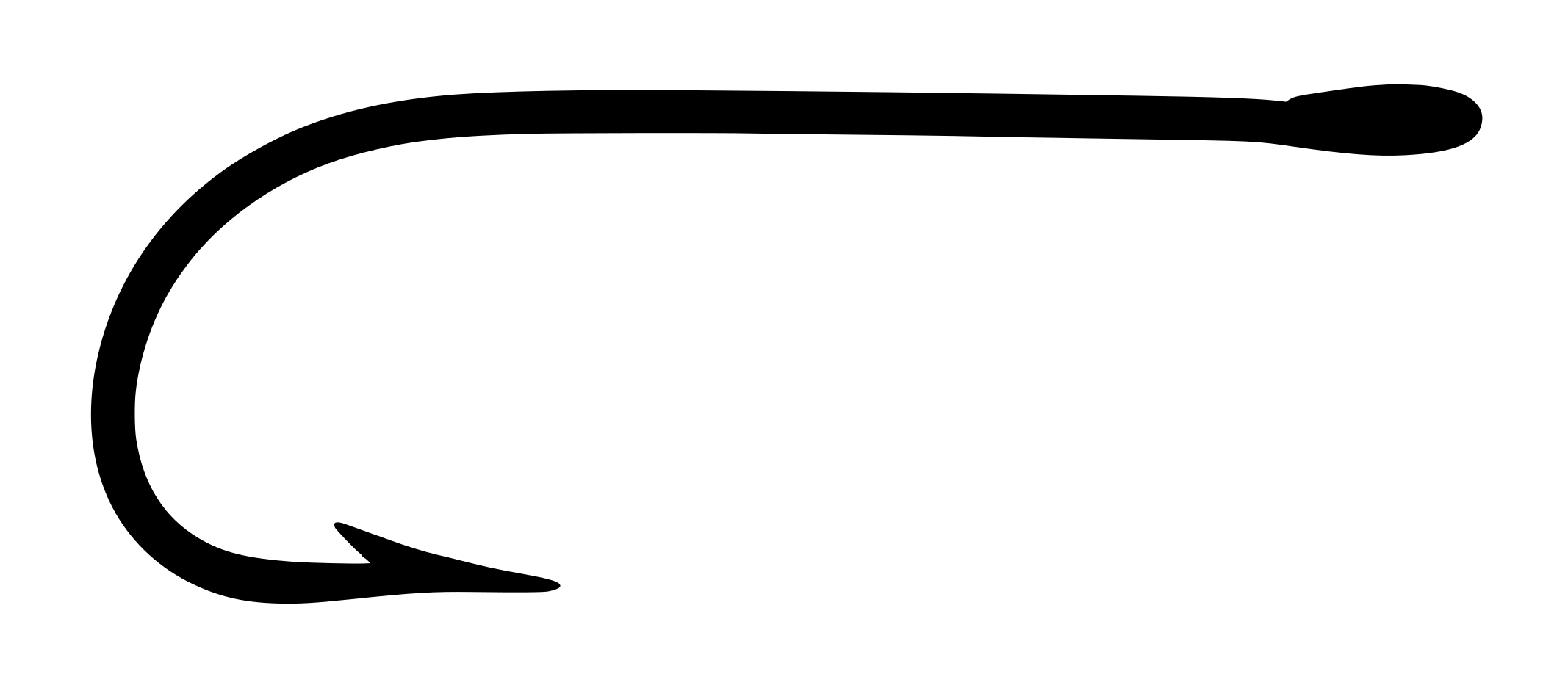
|
3421-BT No. 20 — Cincinnati Bass | 80% |
Matches: Shank, Wire, Gap, Eye, Eye Orient. +3 more Differs: Point: Standard / Spear vs Superior; Finish: Blued vs Bright / Uncoated Steel; Application: Wet Fly, Sea Trout, Salmon, Bait vs Bait |
Compare |
| S 4324 No. 100 No. (quantity per package) — Edgar Sealey S 4324 | 77% |
Matches: Wire, Gap, Point, Shank Feat., Barb +1 more Differs: Bend: Round / Kendal vs Sproat; Shank: 1X Long vs Standard; Eye: Ball Eye vs Tapered Eye +4 more |
Compare | |
| 2996 No. 1 — Spring Steel Carlisle Hooks | 76% |
Matches: Wire, Gap, Eye, Eye Orient., Finish +4 more Differs: Bend: Round / Kendal vs Carlisle; Shank: 1X Long vs Standard; Point: Standard / Spear vs Hollow Point +1 more |
Compare | |
| No. 465 No. 2 (V) — Superfine Aberdeen | 76% |
Matches: Gap, Eye, Eye Orient., Point, Forging +3 more Differs: Bend: Round / Kendal vs Aberdeen; Shank: 1X Long vs Standard; Wire: Standard vs Fine (1X Fine) +2 more |
Compare |
Usage, Fly Patterns, and Equivalents
Primary Application
The Harrisons Spring Steel Carlisle is a general-purpose wet-fly and small-bait hook optimized for British sea-trout and salmon fishing traditions. Size 1/0 is standard for medium wet flies (flies 0.65″-0.75″ in overall length), small streamers, and small fish baits (sand eels, small shiners). The straight-ringed eye and round-bend geometry minimize friction during casting and knot-setting, making it suitable for leaders with light to medium tippets (0.008″-0.010″). The spring-steel construction allows subtle flex under tension, an advantage when working larger flies or when the angler relies on feel rather than sight to detect strikes.
Historically, this size and pattern would have been used for evening and night fishing for sea trout on English rivers (Severn, Tyne, Spey), often fished on a sinking leader or as a dropper fly in a two-fly cast. The blued finish was preferred for reduced visibility in turbid water and for aesthetic consistency with period tackle. Modern fly tyers occasionally source antique Carlisle hooks for traditional-pattern reproduction, valuing them for their authentic bend profile and finish.
Classic Fly Patterns
Not typically tied with modern fly patterns. Historically used for traditional wet-fly fishing with period patterns: Mallard and Claret, Teal and Black, Peter Ross, Grenadier, and general wet-fly attractor patterns of the era.
Modern Equivalents
| Hook | Match Quality | Notes |
|---|---|---|
| Mustad C49S (Carlisle bend equivalent) | Very Good | Only a partial modern analogue. While similarly intended for wet-fly or bait applications, the C49S profile differs noticeably from the long-shank Carlisle/Kendal round-bend geometry documented on this Harrison example. |
| Tiemco 4499 (Round-bend nymph, larger sizes) | Good | Modern Japanese-made round-bend in size 1/0; excellent point but different eye style and finish; appeals to modern fly tyers. |
Collectability and Value
| Rarity | Scarce |
| Market Value (USD) | $35 – $85 |
| Packaging Format | GW-H-01 |
This hook commands strong collector interest as an artifact of Redditch craft-era manufacturing, specifically because of the complete original box with surviving original hooks and intact period packaging. The Harrisons name is less prominent than contemporary makers like Allcock or Partridge, which limits the pool of active buyers but concentrates demand among serious Redditch hook historians and specialist wet-fly tyers.
The 1/0 size in Carlisle round-bend is a standard, functional size, but the handwritten size notation — apparently original to the box — adds provenance and authentication value. Complete 100-count boxes are genuinely uncommon; partial or loose specimens command much lower premiums.
Condition factors that most affect value: (1) Box lid and printing condition — fade, foxing, or tape damage reduces value significantly. (2) Hook count and condition — missing hooks or corrosion substantially deduct from the high end. (3) Preservation of original tissue or separator — if present, adds 10-15% premium. (4) Blued finish uniformity — heavy patina acceptable on antique hooks but active corrosion suggests poor storage and reduces collectability.
Packaging
Rigid cardboard box with fitted die-cut insert. Front panel features letterpress-printed 'HARRISONS' nameplate in ornate serif font with decorative scrollwork borders. Central image: engraved illustration of a sea trout or salmon (left-facing). Descriptive text printed in Old English serif: 'SPRING STEEL CARLISLE HOOKS, ROUND BEND. REDDITCH.' Bottom of front panel contains handwritten notations in pencil: 'No /' and '100' — apparently original to the box, indicating size and hook count. Cream-colored stock with warm patina. Lid shows light foxing and wear consistent with 125+ year age. No price marking visible. No barcode. Overall dimensions approximately 4.25" × 2.75" × 1.0".
Market Value Notes
Low ($35): Good condition — box shows moderate foxing, some printing fade, 80-95% hook count present, blued finish shows patina but no active corrosion<br />
<br />
High ($85): Excellent condition — box lid and printing crisp, 100% hook count intact, original tissue or separator present, blued finish uniform and bright<br />
<br />
Premium factors: Complete original 100-count box, pre-1900 Redditch origin, handwritten provenance notation, all original hooks present, tight box condition<br />
<br />
Platforms: Specialist tackle auctions, UK dealer networks, occasional eBay UK listings<br />
<br />
Confidence: I inferred — limited recent comparable sales for Harrisons boxes; estimate based on Redditch craft-maker pricing and complete-box premiums
Where to Find
Rare on eBay; primarily encountered at specialist tackle auctions in the UK (Vintage Fishing Tackle Auctions, regional antique fairs), and through Redditch hook dealers. Complete boxes appear irregularly — searching for 'Harrisons Carlisle' may yield results monthly or less frequently. Loose Harrisons hooks are slightly less scarce than complete original packaging.
Storage and Preservation
Store the complete box in a cool, dry environment (ideally 45-55% relative humidity). The blued finish develops a protective patina that should be preserved rather than polished. Avoid contact with moisture; the cream-colored packaging is vulnerable to foxing, and any dampness can initiate corrosion beneath the blued surface.
If the box is opened, store hooks on their original tissue insert or on acid-free tissue paper to prevent metal-to-cardboard contact. Do not attempt to polish or restore the blued finish — the aged patina is both authentic and protective. If any corrosion develops, address it with a soft brass brush and light machine oil, then dry immediately.
Keep the box away from direct sunlight to prevent further fade to the printed label. Original boxes command significantly higher value than loose hooks, so preservation of the packaging structure is critical — avoid stacking other items on top of the box, and store upright or flat on a stable shelf.
Handwritten Notations and Provenance
The front panel bears two handwritten notations in what appears to be period pencil: ‘No /’ and ‘100’. The ‘No /’ appears to indicate ‘Number’ (size), with the actual size number either worn away or left blank — though analyst notes confirm this is a size 1/0. The ‘100’ clearly indicates the 100-hook count, consistent with the printed box specifications.
The handwriting style — small, tight script typical of early 20th-century British commercial notation — suggests these are original box markings rather than later inventory additions. The pencil marks show wear and patina consistent with the overall age of the box, lending credibility to their originality. Such handwritten size and count notations were common practice in craft-era hook manufacture, applied either during assembly or as quality-control verification.
These handwritten marks add significant provenance value; they suggest this box was marked for inventory or fulfillment purposes and may represent a direct link to the original Redditch workshop or a regional tackle dealer. Collectors highly value such documentary evidence of period commercial practice.
Packaging Text and Period Nomenclature
Source: Harrisons box front panel, letterpress printed circa 1890-1920
The printed nameplate reads: ‘HARRISONS. SPRING STEEL CARLISLE HOOKS, ROUND BEND. REDDITCH.’ This text documents several important period specifications: (1) ‘Spring Steel’ — an explicit material claim, distinguishing these hooks from standard hard-drawn or tempered steel. Spring steel was prized for its elasticity and reduced brittleness. (2) ‘Carlisle Hooks’ — the round-bend pattern designation, a standard British nomenclature of the era. (3) ‘Round Bend’ — redundant but emphatic clarification of the profile. (4) ‘Redditch’ — explicit attribution to the Redditch, England manufacturing tradition.
The phrase ‘Spring Steel’ appears on few Redditch-era boxes and suggests Harrisons marketed this as a premium material specification, likely commanding a price premium over standard-tempered hooks. The use of ornate serif typeface and decorative scrollwork borders is characteristic of late 19th-century English commercial printing and helps date the box to the 1890-1920 period.
The central engraved image of a salmon or sea trout reinforces the intended use case: larger game fish, rather than small trout or bait work. This marketing strategy was typical for craft-era makers targeting serious fishermen willing to pay for quality and tradition.
Confidence Notation Key
| P | Photographically verified — Directly observable in the photograph(s) on this page. |
| V | Verified by documentation — Confirmed by manufacturer catalog, spec sheet, or published reference. |
| I | Inferred — A logical deduction from observable or documented evidence, not directly stated. |
| E | Estimated — An approximation based on visual comparison, proportional analysis, or limited data. |
| S | Speculative — A reasoned hypothesis that cannot be confirmed from available evidence. |
Claims with no notation are confirmed by multiple independent sources. All photographs on garrenwood.com are taken on a measurement grid where each square equals 1/10 inch (0.1″ / 2.54 mm).