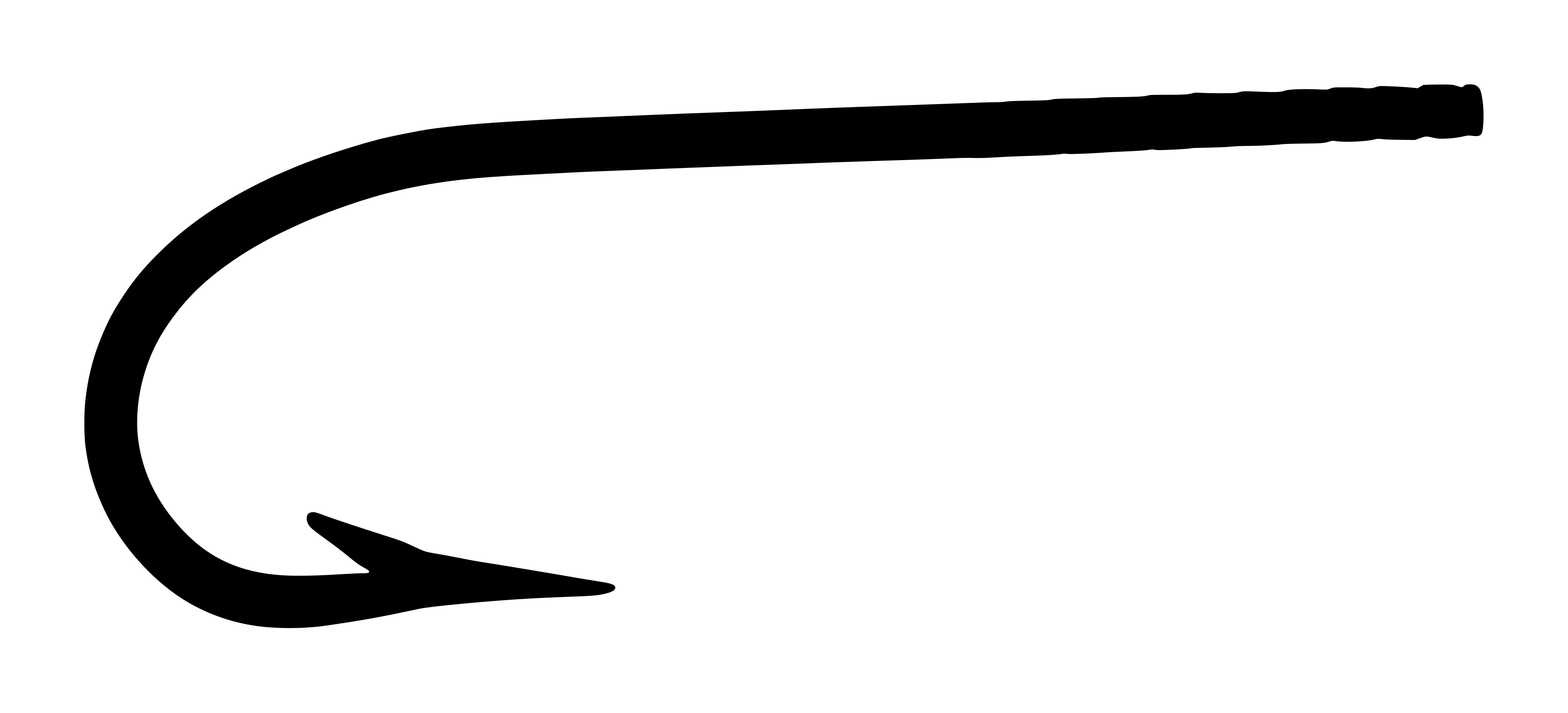
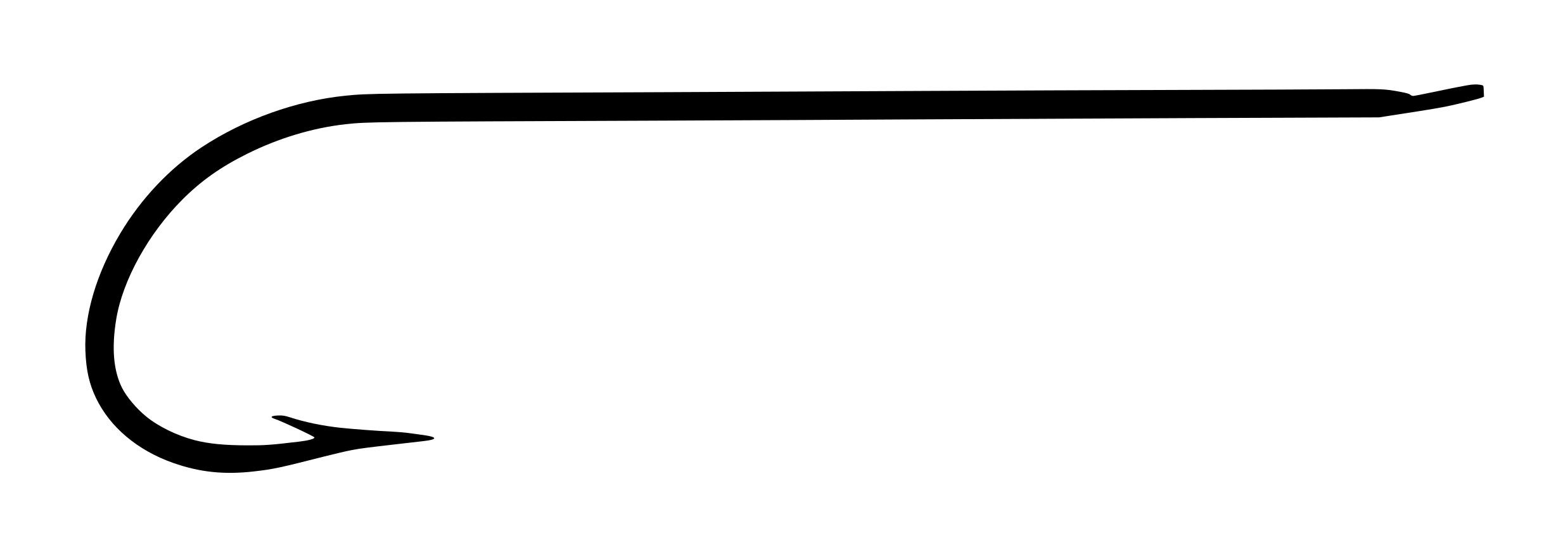
The Mustad Quality 3801 New York Trout Hook represents a classic American bait fishing pattern from the early 20th century P. This size No. 10 specimen features the distinctive blind eye (flatted end) construction with marked ridged shank designed for snelling with silkworm gut or horsehair leaders P.
The hook displays hollow point geometry with a concave inner face that curves inward for rapid penetration P. The New York bend pattern is a variation of the Sproat bend with a slightly straighter shank profile, optimized for American freshwater trout and panfish angling V.
Dating evidence places this specimen in the 1920s transition period – the original box bears the ‘CHRISTIANIA – NORWAY’ marking (pre-1925) while the sales card shows ‘OSLO – NORWAY’ (post-1925) P. The rustproof bronzed finish and marked shank construction represent period manufacturing standards before modern eyed hooks became universal I.
This hook holds moderate collecting interest as an example of early 20th century American regional pattern production and the Christiania-to-Oslo transition period. The complete packaging documentation adds significant historical value I.
Original Mustad Quality 3801 box with rare pre-1925 Christiania Norway marking and embossed gold lettering.
Photographic record
6 cataloged imagesSelect any record to load it above.
6 images shown
Mustad 3801 Box Christiania Norway MarkingOriginal Mustad Quality 3801 box with rare pre-1925 Christiania Norway marking and embossed gold lettering.Open originalMustad 3801 Hollow Point DetailClose-up detail showing the hollow point geometry with concave inner face typical of early 20th century Mustad construction.Open originalMustad 3801 Blind Eye ConstructionTwo Mustad 3801 hooks displaying the blind eye construction with marked ridged shanks on measurement grid.Open originalMustad 3801 Sales Card Size RangeOriginal Mustad sales card showing the complete size range from No. 2 to No. 12 available in the 3801 series.Open originalMustad 3801 Oslo Norway Sales LabelSales card label showing Oslo Norway marking and complete product specifications for the Quality 3801 series.Open originalMustad 3801 3802 Complete Sales DisplayComplete Mustad sales card displaying both Quality 3801 (rustproof) and Quality 3802 (blued) variants with full size range.Open original
Technical profile
Eye
Blind — Marked ShankBlind eye construction with stamped ridges along the shank end. The ridges provide mechanical grip for silk snelling thread, preventing slippage under load P.
Wire
Heavy (1X Heavy), Round
Shank
4X Long — Marked / Ridged
Bend
New York, Standard gapNew York bend pattern - modified Sproat geometry with slightly straighter shank profile. Features rounded bottom section without offset, optimized for American freshwater fishing applications I.
Point
Hollow Point (concave inner face)Standard cut barb with moderate length and angle, proportioned for size No. 10 applications P.
Finish
Bronzed — Inferred (photographically likely)Bronzed rustproof finish with warm bronze-gold coloration typical of period lacquered coatings. Finish shows good preservation with minimal tarnishing on specimen P.
Hooks show excellent preservation with original bronze finish intact. Box shows age-appropriate toning but structural integrity remains good. Sales card displays minor edge wear but all text remains legible P.
The marked ridged shank construction represents sophisticated early 20th century snelling technology P. These ridges were stamped into the wire to provide superior friction, preventing the gut snell from slipping off under the tension of a fighting fish V. The hollow point geometry features a concave, sweeping profile ground from tip to barb base, creating an incredibly fine, razor-sharp tip that flares rapidly toward the barb V. This design achieves initial penetration with minimal applied pressure while ensuring secure holding power in soft tissue without creating large entry wounds that could tear under strain I.
Size & scale lab
Selected size
(unspecified)
Physical specimen
Shank Length
21.5 mmE
Gap Width
8.5 mmE
Bend Depth
4.5 mmE
Confidence
P
Physical specimen
Grid-derived from photograph (1/10" grid)
Own this hook? Help us measure it.
We don't have measured sizes for this hook yet. Own one? Submit calipered measurements and we'll review and add them. Thank you!
Historical context
mustad
O. Mustad & Søn was founded in 1832 in Gjøvik, Norway, initially operating under the name ‘Brusveen Spiger- og Staltradfabrikk,’ specializing in basic metal goods such as nails and steel wire V. The defining pivot occurred in 1877 when Mathias Topp invented the first fully automated hook-making machine, allowing continuous production at unprecedented pace V. By the 1950s, Mustad had secured fifty percent of the global hook production market, establishing the word ‘Mustad’ as virtually synonymous with fishing hooks V.
Series History
The New York Trout Hook series represented Mustad’s strategy of reverse-engineering successful American regional patterns for mass export V. Mustad became the world’s largest hook manufacturer through aggressive ‘cloning’ of highly localized regional patterns, taking designs favored by local blacksmiths and producing them with Norwegian industrial efficiency V. The New York bend was specifically developed for the American freshwater market, featuring a modified Sproat geometry optimized for trout and panfish angling I. This series was produced in both rustproof (Quality 3801) and blued (Quality 3802) finishes to suit different angler preferences and water conditions P.
Era and Packaging Dating
Box label shows CHRISTIANIA - NORWAY which pre-dates the name change to Oslo on January 1, 1925. Sales card shows OSLO - NORWAY indicating post-1925 production. This represents the transition period around 1925.
The Christiania-Oslo Dating Marker
The transition from Christiania to Oslo represents one of the most reliable dating markers in vintage tackle collecting. When Norway regained independence in 1905, there was growing sentiment to restore the city's original Norse name 'Oslo,' which had been changed to honor Danish King Christian IV in 1624. The official name change on January 1, 1925, creates a precise chronological boundary that collectors can use to date Mustad products to within a few years.
Design lineage and influence
The New York Trout Hook evolved from traditional European Sproat patterns adapted for American freshwater conditions I. The pattern predates the widespread adoption of eyed hooks, representing the final era of blind-eye snelling construction in recreational fishing V. While modern equivalents exist in European spade-end patterns, the specific New York bend geometry and marked shank construction was largely abandoned by the 1940s in favor of more universal eyed designs S.
Best matchRelated by Attribute
Computed automatically from catalog data — updated as new hooks are added.
Matches: Shank, Eye, Eye Orient., Point, Finish +4 moreDiffers: Bend: New York vs Carlisle; Wire: Heavy (1X Heavy) vs Standard; Gap: Standard vs Narrow
Matches: Wire, Gap, Eye, Eye Orient., Finish +4 moreDiffers: Bend: New York vs Kirby (offset); Shank: 4X Long vs Standard; Point: Hollow Point vs Superior
Matches: Shank, Wire, Eye, Eye Orient., Point +4 moreDiffers: Bend: New York vs Carlisle; Gap: Standard vs Narrow; Application: Bait vs Salmon, Sea Trout, Bait
Matches: Wire, Gap, Eye, Eye Orient., Forging +3 moreDiffers: Bend: New York vs Kirby (offset); Shank: 4X Long vs 1X Long; Point: Hollow Point vs Superior +1 more
Matches: Gap, Eye, Eye Orient., Point, Finish +4 moreDiffers: Bend: New York vs Kirby (offset); Shank: 4X Long vs 1X Long; Wire: Heavy (1X Heavy) vs Fine (1X Fine)
The Mustad 3801 New York Trout Hook was designed specifically for American freshwater bait fishing in the early 20th century V. The blind eye construction required snelling – a technique where silkworm gut or horsehair leaders were whipped directly to the marked ridged shank using fine silk thread and pitch I. This method was preferred over eyed hooks for delicate presentations targeting trout, panfish, and other soft-mouthed freshwater species V. The hollow point geometry provided rapid penetration with minimal force, essential for successful hooksets on wary trout in clear water conditions I.
Not typically used for fly tying - designed for bait fishing applications.
Modern Equivalents
Hook
Match Quality
Notes
European spade-end coarse fishing hooks
Moderate
Similar blind construction but different bend geometry and wire gauge
Mustad 3366 Aberdeen
Poor
Similar size range but eyed construction and different bend pattern
Collector notes
Moderate collector interest driven by early 20th century dating and Christiania marking, limited by relatively common production numbers.
Reference value
$15 – $35 USD estimate
Packaging condition
Very Good — light wear, fully legibleRecorded specimen
Packaging format
MUS-BOX-01Catalog code
Positive factors include the rare Christiania marking predating 1925, complete original packaging with both box and sales card, and documentation of the Oslo transition period P. The marked shank construction represents an important evolutionary stage in hook development before modern eyed patterns became standard I. Limiting factors include substantial original production quantities and the basic utility design lacking specialized features that drive premium collecting interest E. The New York pattern, while historically significant, was produced in large commercial volumes for the American export market S.
Packaging
Cream-colored cardboard box with embossed gold lettering and decorative border. Eight-line Mustad label format with Key Brand logo. Contains 100 hooks size No. 10. Shows CHRISTIANIA - NORWAY location marking.
Market Value Notes
Complete packaging commands premium over loose hooks. Christiania marking adds 20-30% value premium over Oslo-marked examples. Condition critical for box value.
Where to Find
Vintage tackle shows, eBay vintage fishing lots, estate sales in regions with strong early 20th century trout fishing traditions.
Preservation
Storage and Preservation
Store in a cool, dry environment away from humidity to prevent further tarnishing of the bronze finish. The original box and sales card add significant historical value and should be preserved with archival methods. Keep hooks on the original card rather than loose to maintain provenance and prevent damage to the marked shank ridges. The cardboard packaging is susceptible to insect damage and should be monitored. Consider museum-quality display cases for exhibition while maintaining handling access for research purposes.
Marking Analysis
Package Markings and Production Codes
The box displays ‘100 No.’ quantity marking and size designation clearly printed in the established Mustad format P. The sales card shows individual hooks numbered 2, 4, 5, 6, 10, 12 representing the size range availability P. The transition from Christiania to Oslo labeling visible between the box and card represents a documented production changeover that occurred around 1925, providing precise dating evidence for this specimen V.
Size Note
Historical Sizing Context
The No. 10 size marking follows early 20th century American hook sizing conventions which differed from modern standardized measurements V. Vintage regional patterns like the New York bend often utilized local sizing metrics that varied significantly from contemporary fly hook gap measurements I. The marked shank construction adds approximately 2mm to the overall hook length compared to modern eyed equivalents, which should be considered when evaluating size relationships E.
Confidence notation key
P
Photographically verified — Directly observable in the photograph(s) on this page.
V
Verified by documentation — Confirmed by manufacturer catalog, spec sheet, or published reference.
I
Inferred — A logical deduction from observable or documented evidence, not directly stated.
E
Estimated — An approximation based on visual comparison, proportional analysis, or limited data.
S
Speculative — A reasoned hypothesis that cannot be confirmed from available evidence.
Claims with no notation are confirmed by multiple independent sources. All photographs on garrenwood.com are taken on a measurement grid where each square equals 1/10 inch (0.1″ / 2.54 mm).