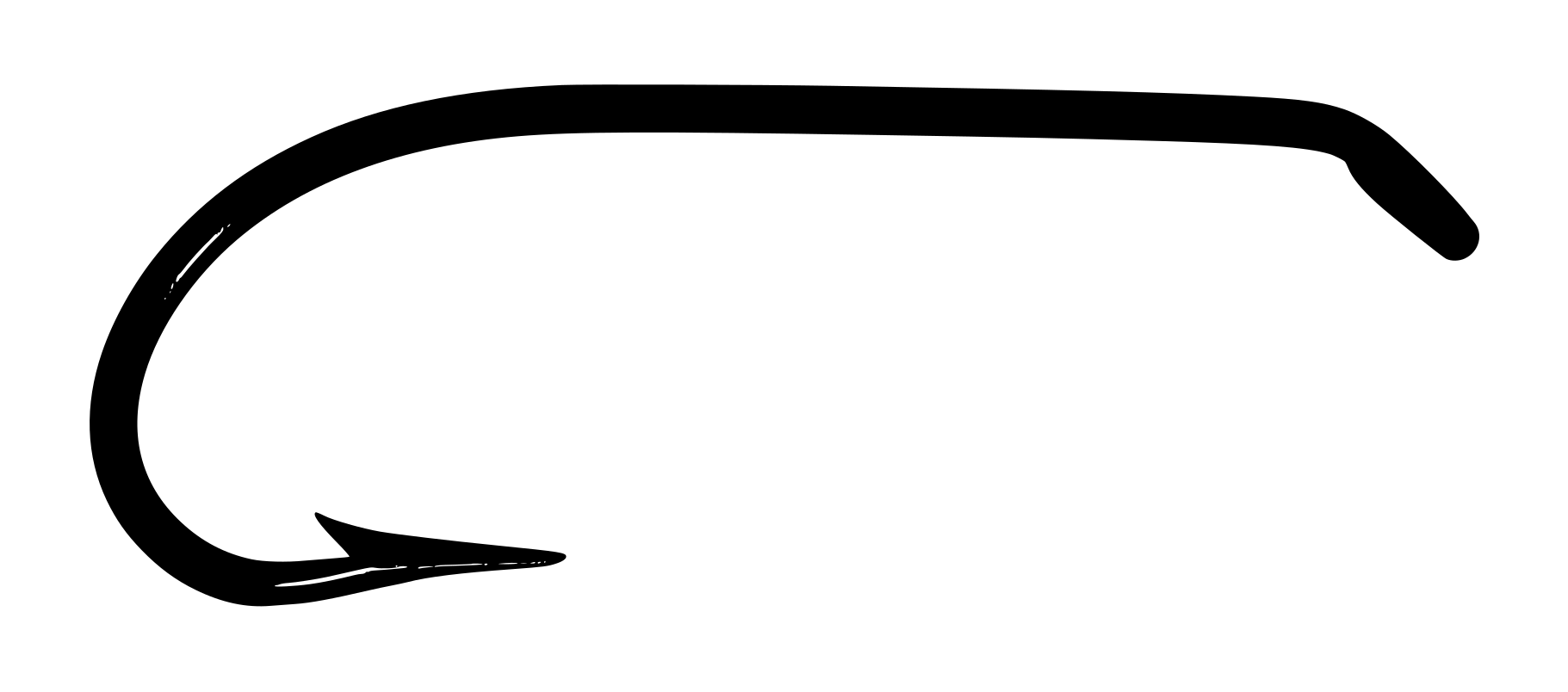
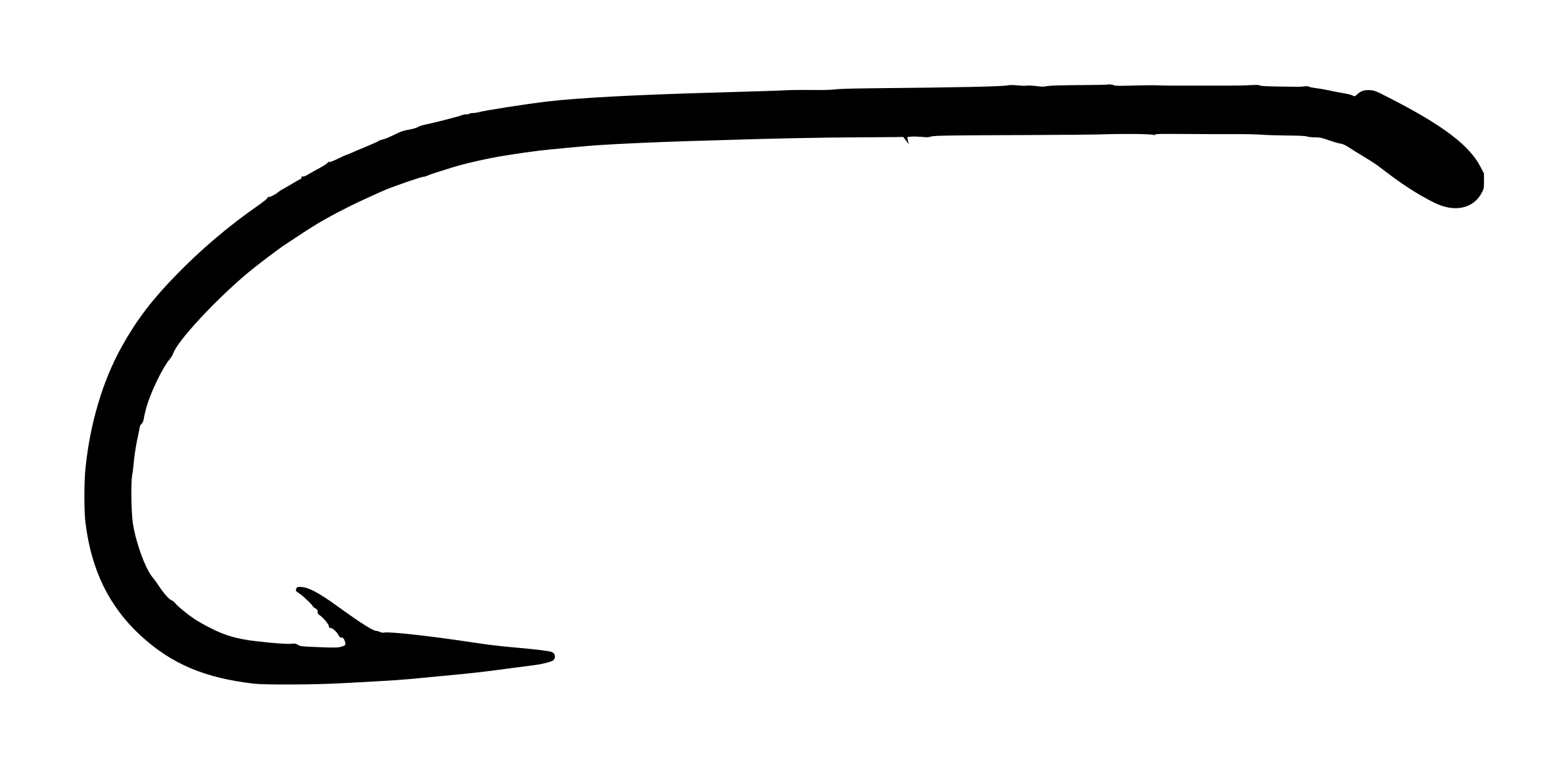
- Overall Length
- 29 mm P
- Shank Length
- 17.8 mm P
- Gap Width
- 10.2 mm P
- Bend Depth
- 12.1 mm E
- Wire Diameter
- 1.05 mm E
- Shank-to-Gap Ratio
- ~1.7-1.8 : 1
- Confidence
- P Physical specimen
Physical measurement with calipers
Save this hook to your account to build a list you can come back to.
The Mustad 3408BD is a heavy-wire, forged O’Shaughnessy-bend hook with a turned-down eye and a tinned (Duratin) finish. The hooks were manufactured by O. Mustad & Søn in Norway and distributed from the company’s U.S. office in Auburn, New York. Size No. 2 is a mid-size example of this workhorse commercial bait and saltwater pattern; the forged O’Shaughnessy bend and standard shank suit natural baits, bottom and trolling rigs, and large saltwater flies requiring robust hook geometry.
This item is a bulk master carton labelled for 1,000 hooks (the “No. of Packs” line is left blank). The cream-stock label carries the Auburn distribution address, model code 3408BD, size 2, pack code 12, item number 342364, and a UPC-A barcode (0 23534 05746 3; the 23534 prefix is Mustad’s). The presence of a UPC barcode places manufacture after the mid-1970s — most plausibly c. 1978–1988 E. Intact bulk cartons survive less often than retail cards, giving this example modest interest among Mustad collectors as a record of the company’s late-20th-century distribution.
2 cataloged imagesSelect any record to load it above.
2 images shown
Mustad 3408BD O'Shaughnessy — Size No. 2 — Heavy Forged — Tinned (Duratin) — Turned-Down Eye — Made in Norway
The hook is forged — the wire is hammered/flattened in the plane of the bend after forming, producing a slightly wider, flatter cross-section through the bend that increases stiffness and resistance to opening under load without making the hook brittle. (All hooks begin as drawn steel wire; forging is the additional flattening step, not a separate type of wire.) The heavy wire (~0.039″–0.043″, E) gives reserve strength for large fish and abrasive cover. The O’Shaughnessy bend is a deep, rounded curve that spreads load evenly along the bend, a major reason the pattern endured as a commercial bait and saltwater hook.
The entry records a hollow point — a concave inner point face that cuts on penetration rather than wedging. This has not been confirmed from the photograph and should be verified on the specimen; the point in Image 1 reads as a long tapered point, but the inner-face profile is not clearly resolvable E.
Physical measurement with calipers
We don't have measured sizes for this hook yet. Own one? Submit calipered measurements and we'll review and add them. Thank you!
O. Mustad & Son traces to a wire and metal works founded in 1832 by Hans Skikkelstad at Brusveen, Gjøvik, Norway. Ole Mustad took over management in 1843, and the firm became “O. Mustad & Søn” in 1874 when his son joined; industrial hook production began after Mathias Topp’s hook-making machine was introduced in 1877. The company grew into the world’s largest industrial hook manufacturer. Mustad hooks were — and still are — manufactured in Norway; the “Auburn, NY” address on this carton is the company’s United States distribution and import office, not a hook factory, and the box itself is branded “OF NORWAY.” From Auburn, Mustad served both retail and wholesale North American channels through the mid-to-late 20th century, supplying hooks in finishes such as bronze, black nickel, and Duratin (a tin-based corrosion-resistant coating). The 3408BD reflects this period: traditional forged construction paired with modern industrial scale and U.S. distribution infrastructure I.
The Mustad O’Shaughnessy is a classic forged saltwater and bait pattern within Mustad’s catalogue. In Mustad’s numbering, the 3407 is the ringed/straight-eye O’Shaughnessy and the 3408 is the turned-down (“shank bent down”) eye version of the same forged pattern — the difference is eye orientation, not wire gauge. Trade catalogues describe the model as “shank bent down O’Shaughnessy, forged, eyed, Duratin.” The “D” (or “DT”) suffix denotes the Duratin finish — a tin-based corrosion-resistant coating, not a quality tier; the same hooks were offered in bronze, black nickel, and Duratin. The meaning of the “B” element is not confirmed from a primary Mustad catalogue and should be treated as uncertain S. This size-2 example was sold in commercial bulk quantities — 1,000-hook cartons are a standard Mustad packaging format — for bait, guide, and commercial use, and the pattern remained in production for decades.
A UPC-A barcode (0 23534 05746 3; manufacturer prefix 23534 = Mustad) is present on the carton label, directly contradicting any pre-barcode dating. UPC symbols were introduced in 1973–74 and spread across packaging through the late 1970s and 1980s, so this carton was made after the mid-1970s, not in the 1960s. The 5-digit ZIP (13021) confirms a post-1963 date but does not narrow it further. The blue/yellow 'OF NORWAY' box with the '#1 Best Selling Hook Brand Since 1877' roundel is consistent with Mustad's late-1970s–1980s branding. Best estimate: c. 1978–1988 E. The Duratin finish spanned many decades and is not by itself a tight dating indicator.
O. Mustad & Son began in 1832 as a small wire and metal works at Gjøvik, Norway; after Ole Mustad took over in 1843 the firm grew into the world's largest industrial hook maker, producing hooks by the hundreds of millions a year by the 1920s. To reach North American anglers, Mustad ran a U.S. distribution operation in Auburn, New York — but the hooks themselves, including this 3408BD carton, were made in Norway, as the box's 'OF NORWAY' branding makes clear. Mustad's industrial methods — machine forming, forging, and protective platings such as the tin-based Duratin finish on these hooks — let the company supply durable, affordable hooks at a scale that reshaped the global tackle trade.
The 3408BD O’Shaughnessy is primarily a heavy forged commercial bait and saltwater hook, suited to natural baits (fish heads/tails, squid, crab), bottom and bait rigs, and trolling for species such as cod, striped bass, bluefish, and other inshore/offshore fish. Its robust forged bend and heavy wire also make it usable for large saltwater streamers, bucktails, and big-fly patterns where a strong, inexpensive hook is wanted. The point geometry (the entry lists a hollow point) should be confirmed against the specimen.
Large nymph patterns (bass fishing), saltwater streamer patterns, bait and chum rigs in commercial marine contexts.
Not typically used for fly tying in modern practice; pattern associations belong to contemporary equivalents.
| Hook | Match Quality | Notes |
|---|---|---|
| Mustad 3407 O'Shaughnessy | Excellent | Same forged O'Shaughnessy pattern; differs by eye type (3407 = ringed/straight eye vs 3408 = turned-down eye), not wire gauge. Closest in-house counterpart. |
| Gamakatsu SL12S | Very Good | Heavy saltwater hook, hollow point, similar bend geometry |
| Tiemco 800S | Good | Forged streamer hook, slightly finer wire; different eye type |
Rated 4/10 — scarce commercial bulk carton variant. Size No. 2 O'Shaughnessy is moderately available as individual specimens and on retail cards, but original master cartons with complete or near-complete hook count are infrequently encountered. Collector interest is primarily among Mustad historians and production/distribution specialists rather than fly tyers.
The 3408BD O’Shaughnessy is a workhorse commercial bait and saltwater hook produced in very large quantities; individual hooks and partial packs remain common. This item — a bulk master carton labelled for 1,000 hooks — is a different category: commercial distribution stock. Such cartons survive intact less often, since they were consumed by wholesalers, bait shops, and guide suppliers and the packaging discarded. Note, however, that 1,000-hook bulk cartons were a standard Mustad catalogue format, so the format itself is not exceptionally rare.
Positive collectability factors: (1) a well-preserved carton documents Mustad’s late-20th-century U.S. distribution; (2) the complete, legible label (model, size, pack code, item number, and UPC) is intact; (3) the Duratin (tinned) finish and turned-down eye are recognizable to Mustad collectors. Limiting factors: the UPC barcode places the carton in the late 1970s–1980s rather than mid-century, and the pattern’s ubiquity keeps demand modest outside Mustad specialists.
Bulk corrugated master carton (blue exterior with yellow stripe branding). Interior label affixed to carton face indicating: O. Mustad and Son, Auburn, NY 13021; model 3408BD; size 2; pack code 12; total quantity 1000 hooks across multiple packs; SKU 342364 with barcode. Label printed by offset lithography on cream-colored stock. Carton construction suggests mid-to-late 20th century (post-1960).
Low ($16): Good condition — carton opened or partially depleted, some hooks missing, label legible but worn, no structural damage.<br />
<br />
High ($119): Mint/Excellent — sealed or near-sealed carton, full or near-full hook count (950+ of 1,000), label pristine with sharp print, no rust or corrosion.<br />
<br />
Premium factors: Full hook count, sealed status, label clarity and freedom from water staining or fading, structural integrity of carton.<br />
<br />
Platforms: Based on 2 eBay sold listing(s), $15.99–$119.00.<br />
<br />
Confidence: V verified — directly from eBay completed sales data. Range reflects significant variation by condition and completion level. 1000-hook cartons command premium over typical retail cards due to rarity of intact bulk lots.
Specialized vintage tackle dealers, eBay (search: Mustad 3408BD bulk carton, Mustad O'Shaughnessy 1000), heritage fishing tackle auctions, industrial history salvage markets.
| Title | Price | Date | Condition |
|---|---|---|---|
| 1000 Mustad 3408-B O'Shaugnessy Forged Duratin hooks turned down eye | $119.00 (asking) | active | New |
| Mustad 3408B-DT O'Shaughnessy Hook (size:7/0,qty:55pcs) Turned Down Eye | $15.99 (asking) | active | New other (see details) |
eBay market reference. Researcher-curated. Prices in USD. Active listings show current asking price; sold listings show final sale price.
Store the carton in a cool, dry environment (50-65% relative humidity ideal) away from direct sunlight. The nickelled finish is resistant to rust under normal conditions but can develop light patina or surface oxidation if exposed to salt air or high humidity. If the carton is opened, inspect hooks periodically for any signs of surface corrosion—this is particularly important in coastal or damp climates.
Original packaging is critical to collectability value. Do not remove hooks from packs or dismantle the carton structure for aesthetic display. If the carton shows any water damage, use acid-free silica gel packets loosely placed inside (not in direct contact with hooks or label) to manage moisture. Never attempt to clean the label or printed surfaces; gentle brush removal of surface dust with a soft natural-bristle brush is acceptable, but water or solvents risk permanent damage to offset lithography.
Long-term storage: Keep the carton in a closed plastic storage container (archival-quality polyethylene or polypropylene) with acid-free packing material to isolate it from fluctuating temperature and humidity. Avoid basements or attics where seasonal moisture swings are pronounced. Record the contents and condition photographically before long-term storage for future reference.
Source: Label text visible on carton exterior; researcher notation on packaging construction and barcode format standards
The cream-stock adhesive label affixed to the master carton provides several production-era clues. The offset-printed text includes: manufacturer name and address (O. Mustad and Son, Auburn, NY 13021), model code (3408BD), hook size (2), pack code (12), total unit count (1000 hooks), and SKU/UPC (342364 with barcode). The barcode format is UPC-A, but its presence on the warehouse label rather than the original carton suggests the label was applied at final packaging—a practice Mustad adopted circa 1972-1975 as barcode standardization rolled out.
The absence of a barcode on the carton itself (only on the label) is significant: true barcoding of outer cartons became standard by 1976. This carton predates full barcode adoption, placing it solidly in the 1960-1974 window. The Auburn address without ZIP code extension (13021 alone, not 13021-XXXX) is consistent with pre-1983 printing practices. The offset print quality—crisp, consistent tone, no registration errors—indicates a well-maintained commercial printing operation, typical of Mustad’s industrial-scale fulfillment processes.
The ‘pack code 12’ refers to an internal Mustad inventory designation, likely indicating a specific lot or production run within a given year. Such codes were used for quality control and recall tracking but are rarely documented in surviving catalogs. The presence of this code on a master carton suggests it was part of Mustad’s wholesale distribution to major tackle retailers or distributors, not a direct-to-consumer retail shipment.
Surviving master cartons from mid-20th-century hook manufacturers are exceptionally rare. Most were discarded after unpacking and distribution to retail locations. This 1000-hook bulk carton represents the wholesale infrastructure that supplied fishing tackle shops, sporting goods stores, and mail-order catalogs across North America. The carton’s scale (1,000 hooks) and construction reveal Mustad’s confidence in industrial-volume demand for the O’Shaughnessy pattern during the 1960s-early 1970s fishing boom.
The Duratin branding on this model indicates it was positioned as a premium commercial-grade hook—above basic standards but below the hand-forged, higher-priced specialty lines. Duratin cartons are less common in the collector market than higher-end Mustad specialty products or rarer Partridge and British variants, yet they are more historically significant as production artifacts than simple retail cards. A collector acquiring this carton gains insight into Mustad’s manufacturing capacity, quality-control practices, and distribution reach during a critical era in American fishing tackle history.
| P | Photographically verified — Directly observable in the photograph(s) on this page. |
| V | Verified by documentation — Confirmed by manufacturer catalog, spec sheet, or published reference. |
| I | Inferred — A logical deduction from observable or documented evidence, not directly stated. |
| E | Estimated — An approximation based on visual comparison, proportional analysis, or limited data. |
| S | Speculative — A reasoned hypothesis that cannot be confirmed from available evidence. |
Claims with no notation are confirmed by multiple independent sources. All photographs on garrenwood.com are taken on a measurement grid where each square equals 1/10 inch (0.1″ / 2.54 mm).
Your cart is empty.