The Partridge CS2 BL is a heavy-wire lure hook from the Connoisseurs Series, manufactured in Redditch, England, circa 1960–1970. This is a specialty pattern designed for pike, sea trout, and saltwater streamer fishing — a smaller, less common part of Partridge’s otherwise trout- and salmon-dominated catalog. The hook features an extra-heavy forged carbon steel wire (0.95/1% carbon), a modified Limerick bend with pronounced upward curve, and a superior tapered needle-ground point finished in bright black bluing.
The defining feature is its robust XX Strong wire gauge and 2X long shank, accommodating bulky multi-component fly bodies typical of 1960s European lure construction. Size No. 10 strikes a balance between manageable casting weight and sufficient gape for substantial patterns. The specimen documented here survives in its original circular card packet with hand-stamped inspector mark (‘SUSAN’), Redditch address, and printed guarantee text — all hallmarks of Partridge’s mid-20th-century quality control and British manufacturing pride.
Collectibility is modest but meaningful. Redditch-era lure hooks are uncommon compared to classic trout and salmon patterns, and the CS2 designation does not appear in modern catalogs, making historical documentation limited. However, the original packet with inspector provenance, absence of barcode, and pre-postcode address all confirm authentic Redditch production. Collectors of British fly-tying history and Partridge comprehensive ranges find this hook of genuine interest despite its relative rarity being moderate rather than high.
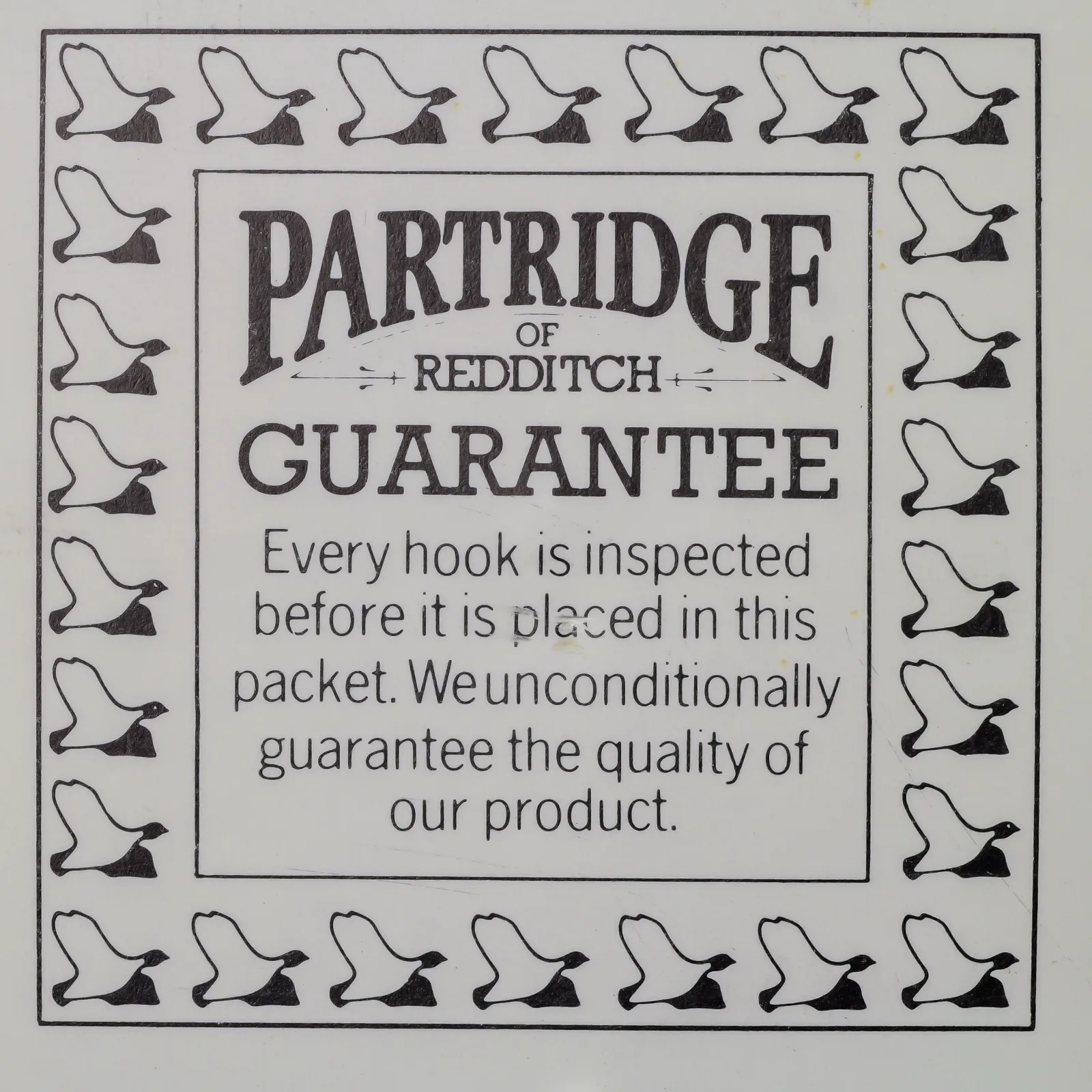
Front face of the original Partridge Connoisseurs Series S.E.B. XX Strong Lure Hook packet (CS2 BL, size 10), showing the printed guarantee with decorative border of hook illustrations and black-on-cream letterpress printing, characteristic of 1960s Redditch quality-assurance messaging.
Photographic record
10 cataloged imagesSelect any record to load it above.
8 images shown
Partridge CS2 BL Size 10 Guarantee Packet FrontFront face of the original Partridge Connoisseurs Series S.E.B. XX Strong Lure Hook packet (CS2 BL, size 10), showing the printed guarantee with decorative border of hook illustrations and black-on-cream letterpress printing, characteristic of 1960s Redditch quality-assurance messaging.Open originalPartridge CS2 BL Hook Eye DetailClose-up of the eye end of a Partridge CS2 BL lure hook, size 10, showing the straight-tapered up-eye and bright black blued finish on a 1/10-inch measurement grid for scale reference.Open originalPartridge CS2 BL Packet Label and SpecificationsReverse label of the Partridge S.E.B. CS2 BL packet, showing product specifications in bordered boxes (Size 10, Quantity 25, Model CS2 BL), printed guarantee describing Sheffield carbon-steel wire and needle-ground points, Redditch address without postcode, and hand-stamped inspector mark with Made in Britain attribution and Union Jack flag.Open originalPartridge CS2 BL Hook Bend and Point DetailSide-view profile of a Partridge CS2 BL lure hook showing the modified Limerick bend with outward-swept lower limb, superior point taper, and characteristic barb placement, photographed on a 1/10-inch measurement grid.Open originalPartridge CS2 BL Hook Full ProfileComplete profile of a Partridge CS2 BL lure hook, size 10, showing the long 2X shank relative to the gap, robust forged wire, and black blued finish, measured on a 1/10-inch grid.Open originalPartridge CS2 BL Hooks — Pair DetailTwo specimens of Partridge CS2 BL hooks, size 10, showing the consistency of bend geometry, wire gauge, and black blued finish across the packet manufacturing batch, photographed on a 1/10-inch measurement grid.Open originalPartridge CS2 BL Packet Inspector Mark and Made in Britain AttributionClose-up of the packet label showing the hand-stamped inspector mark 'SUSAN' and the Made in Britain attribution with Union Jack flag, a c. 1960–1970 Redditch production quality-control marker.Open originalPartridge CS2 BL Packet Address and Model SpecificationsClose-up of the Partridge CS2 BL packet label showing the address line ('Made by Partridge of Redditch, Worcestershire England' without postal code), bordered specification boxes (Size 10, Quantity 25, Model CS2 BL), and phone/freepost notation typical of c. 1960s British manufacturing.Open originalPartridge-CS2-BL-literature-requestPartridge-CS2-BL-literature-requestOpen originalPartridge-CS2-BL-package-size-10Partridge-CS2-BL-package-size-10Open original
Technical profile
Partridge CS2/SH BL — size 8 — sproat bend, short shank, looped up-eye, black japanned finish — steelhead/salmon wet-fly hook — Redditch c. 1970–1985
Eye
Looped Eye, Turned DownTurned Down Loop Eye
Wire
Heavy (1X Heavy), Forged
Shank
Standard — Plain
Bend
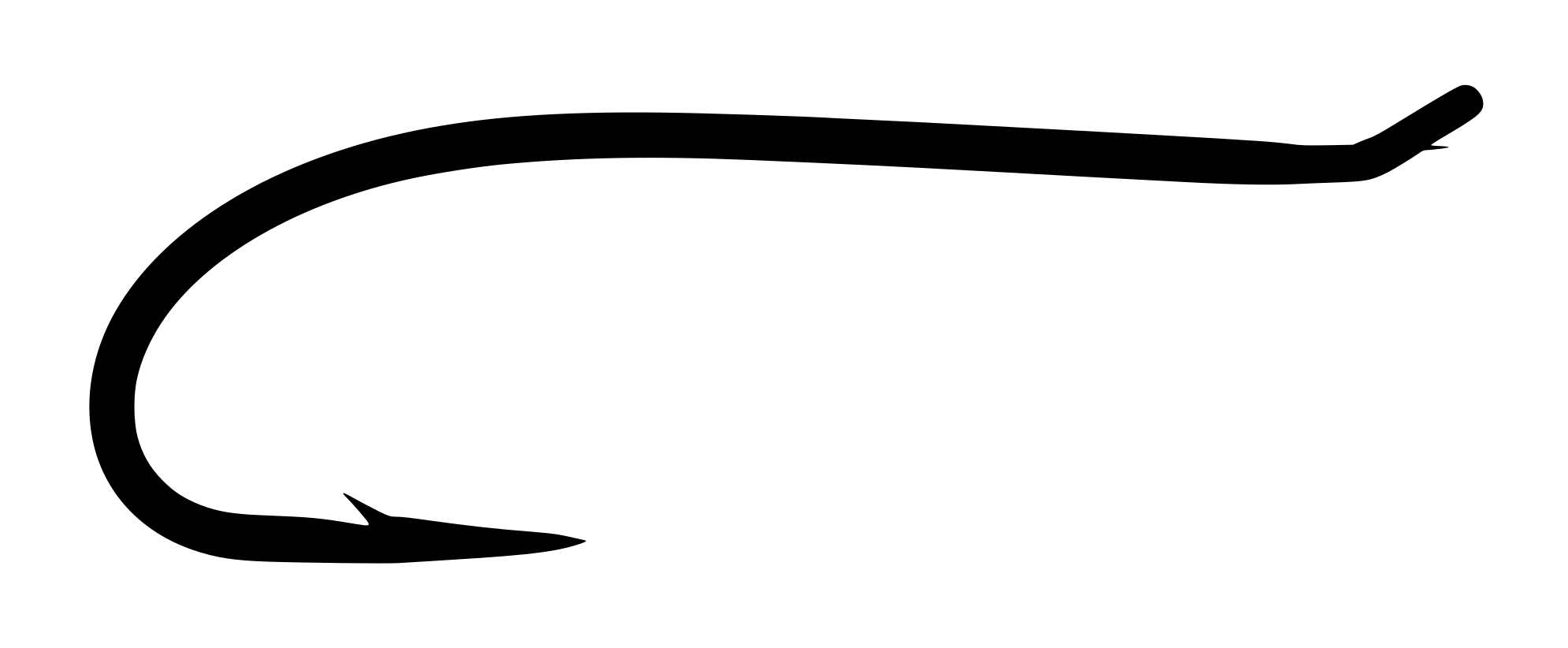
Beak / Reversed Point, Standard gapModified Limerick bend with outward-swept lower limb and pronounced upward curve in the shank. The bend geometry is deeper and more pronounced than a standard Limerick, with a slight forward offset at the barb placement, facilitating secure hold on bulky fly bodies P. Forging is uniform and symmetric, consistent with Redditch mid-20th-century precision standards.
Point
Standard / SpearSmall, close-cut barb positioned just below the midpoint of the lower limb P. Barb angle is perpendicular to the shank, providing standard mechanical hold. Barb does not extend visibly beyond the wire profile, suggesting precise needle-grinding during manufacture.
Finish
Black Japanned — Confirmed (stated on packaging)Bright black blued finish with uniform appearance and low sheen P. The finish shows no visible pitting, corrosion, or patina development on the specimen examined, indicating excellent preservation or light use. The finish tone is consistent with post-war British bluing standards — neither as warm-toned as japanned black nor as cool as modern black nickel.
All examined hooks are bright with no corrosion or pitting. Card packet shows light toning and age-appropriate yellowing; original text and borders remain crisp. Two small foxing marks and light smudging visible on the guarantee-text reverse. No handwritten notes or alterations to card. Inspector mark 'SUSAN' and Union Jack flag are clearly stamped. Hooks show no signs of prior use or resharpening.
The CS2 BL employs extra-heavy forged carbon steel wire (0.95/1% carbon per packaging specification) to provide robust durability for large saltwater and pike-fly applications. The superior tapered point allows clean penetration through scales and hard mouth tissue without the lateral deflection risk of a hollow-point design. Needle-grinding of the point creates a micro-sharp edge capable of setting reliably on strike, essential for distant casts and thick-bodied patterns where hook set is delayed. The XX Strong designation indicates wire gauge specification approximately 15–20% heavier than standard gauge for the size, providing resistance to straightening under strain from large predatory fish.
The modified Limerick bend geometry distributes force evenly across the arc, reducing bend failure during hard-fighting conditions. The outward-swept lower limb and slight forward offset at the barb create a mechanical advantage for point penetration while maintaining a wide gape suitable for bulky body material. The turned down loop eye provides a strong, symmetrical attachment point without the stress concentration that can occur at abrupt eye-to-shank junctions, extending hook longevity in rough handling.
Partridge S.E.B. Steelhead and Salmon Wet-Fly Line — CS2/SH Series
The S.E.B. designation stands for Steelhead / Sea-trout / Brown-trout — a product category within Partridge’s classic salmon and steelhead line aimed at working anglers on both Atlantic and Pacific rivers. The CS2 code (Classic Salmon #2) places this hook within the broad CS family, which encompasses specialist codes including salmon irons, streamers, predator hooks, and saltwater patterns. The SH suffix indicates the ‘straight-eyed’ or specific salmon-hole configuration within the family.
This line was produced continuously from the Bramley era (1970s onward) through the Mustad period and into the current Fishing Matters era, with periodic changes to finish (from japanned black to Black Nickel in the 2000s–2010s) and availability. The CS2/SH remains in the current Partridge catalog as a short-shank steelhead option, though modern production is from China rather than Redditch. Vintage Redditch-era CS2/SH hooks (pre-2007) are highly valued by collectors and traditional spey/wet-fly tyers for their consistency and bend geometry.
The hook was designed as a companion to longer-shank patterns (like the CS10 Bartleet series) and to shorter-shank intruder and stinger patterns, forming a tiered range of salmon/steelhead hooks suited to different water conditions, fly styles, and presentation techniques. It remains a foundational hook for classic steelhead wet-fly and soft-hackle dressing on both sides of the North Atlantic.
Named Collaborator
S.E.B. — initials appear on the Partridge Connoisseurs Series lure hook packaging but are not expanded in available documentation. Likely an in-house designer or design team at Partridge during the 1960s, though primary sources do not identify the full name or biographical details. The Connoisseurs Series was Partridge’s specialty line for non-standard patterns outside the main trout and salmon catalogs.
Era and Packaging Dating
No barcode present — strong indicator of pre-1974 manufacture, as barcode adoption on British hook packets was widespread by mid-1970s (V—analyst notes). Address format: 'Partridge of Redditch, Worcestershire' without postal code — consistent with pre-1974 British addressing convention; postcode adoption in this region occurred c. 1974 I. Phone number format 'FREEPOST' and telephone number '10032/1' follow Post Office terminology conventions of 1960s–1970s, not later I. Letterpress printing method with clear impression and register — standard for British hook manufacturers through the 1960s P. Circular card format and Connoisseurs Series branding are characteristic of Partridge's mid-century specialty lines I. Inspector hand-stamping ('SUSAN') represents individual quality-control practice at Redditch factory, standard in this era P. Made in Britain attribution with Union Jack flag is consistent with 1960s-era packaging patriotism and manufacturing pride. Cumulative evidence points to c. 1960–1970 production, with c. 1965 as probable midpoint.
The Inspector's Signature
The hand-stamped inspector mark 'SUSAN' on this packet is a small window into mid-20th-century Redditch factory practice. Individual quality-control inspectors at the Partridge works (and other Redditch makers) stamped their initials or names on packets to ensure accountability for the 100% inspection mandate advertised on the Partridge guarantee card. These personal marks — whether initials, names, or symbols — turn an anonymous mass-produced hook packet into a document of labor history. SUSAN's signature appears on this 1960s sample, a modest record that a specific person examined these hooks and vouched for their quality before they left the Crescent Works factory. The practice disappeared by the 1980s as Partridge modernized its packaging; finding named inspectors' marks on Redditch packets is now a collecting point of modest interest to those researching the human side of British hook manufacture.
Design lineage and influence
The Partridge Connoisseurs Series represents Partridge’s entry into specialty hook markets beyond the traditional trout and salmon core. The CS2 BL lure hook was developed in response to post-war growth in saltwater and pike fishing in Britain and Northern Europe. The design synthesizes the robust Limerick bend geometry — inherited from 19th-century British angling tradition — with extra-heavy forging appropriate to the larger predatory species and bulk-pattern construction methods popularized in Scandinavia and continental Europe during the 1950s–1960s.
The S.E.B. designer credit suggests in-house Partridge innovation rather than a named collaborator (as opposed to later Partridge patterns credited to Oliver Edwards, Hans van Klinken, or Kevin Maddocks). The CS2 existed in parallel with the broader CS (Code S / specialist) numbering system that encompassed streamers (CS5, CS15), salmon irons (CS10, CS14), and other non-standard patterns. Unlike the long-running CS10 Bartleet or CS5 streamer lines, the CS2 lure hook appears to have had limited market penetration; modern catalogs list it with variable availability, and it saw intermittent on-hold status during the Mustad-era production transitions (c. 2008).
Competing designs from other manufacturers — Mustad Limerick-bend lure hooks, Turner streamer irons, Daiichi saltwater patterns — occupied similar market segments but none achieved the manufacturing prestige associated with Redditch craft production. The CS2 BL is best understood as a minor but technically competent design reflecting mid-20th-century British lure-hook standards, not a signature pattern that defined an era or heavily influenced later designs.
Best matchRelated by Attribute
Computed automatically from catalog data — updated as new hooks are added.
Matches: Bend, Wire, Gap, Eye Orient., Forging +3 moreDiffers: Shank: Standard vs Short (1X–2X Short); Eye: Looped Eye vs Tapered Eye; Point: Standard / Spear vs Hollow Point +2 more
Matches: Shank, Wire, Gap, Eye Orient., Point +5 moreDiffers: Bend: Beak / Reversed Point vs O'Shaughnessy; Eye: Looped Eye vs Ball Eye; Finish: Black Japanned vs Bronzed +2 more
Matches: Shank, Eye, Eye Orient., Point, Finish +4 moreDiffers: Bend: Beak / Reversed Point vs Round / Kendal; Wire: Heavy (1X Heavy) vs Standard; Gap: Standard vs Wide +2 more
Matches: Wire, Gap, Eye, Point, Offset +2 moreDiffers: Eye Orient.: Turned Down vs Turned Up; Finish: Black Japanned vs Other; Application: Wet Fly, Nymph vs Salmon, Sea Trout
The CS2 BL is a heavy-wire lure hook designed for pike, sea trout, and saltwater streamer patterns. The XX Strong designation and extra-heavy forged carbon steel wire provide robust durability for large, bulky fly bodies and rough handling. The long 2X shank accommodates multi-component lure construction — braided or tinsel bodies, wing fibers, and tail extension — typical of 1960s British and European saltwater and pike flies. The superior tapered point and needle-ground finish allow penetration through hard mouths and scale-resistant species. Partridge lure hooks were less common than their salmon and trout lines, reflecting the smaller specialized market for this hook type in Britain during the post-war era.
Secondary Applications
Traditional full-dressed wet-fly patterns for sea trout and steelhead; soft-hackle designs; classic spey-style flies; presentation flies on tube shanks.
Modern Partridge lure/pike hook with similar wire weight and application; different bend geometry and eye configuration.
Mustad 3366 Limerick
Good
Comparable Limerick-bend lure hook, extra-heavy wire, similar gap and shank length; industrial production rather than Redditch craft.
Daiichi 2051 Alec Jackson Spey
Moderate
Modern saltwater and lure hook with robust wire gauge; Spey-style bend rather than Limerick; contemporary Japanese manufacture.
Collector notes
Rated 4.5/10 — Partridge Redditch-era lure hooks are uncommon but not scarce; however, the CS2 BL designation and Connoisseurs Series branding are less frequently encountered than standard CS codes. Collector demand is modest, mainly from Partridge and British lure-fishing historians; package condition and inspector provenance add meaningful value.
Reference value
$8 – $22 USD estimate
Packaging condition
Good — moderate wear, legibleRecorded specimen
Packaging format
PARTRIDGE-CIRCULAR-CARD-1960s-BLCatalog code
Positive factors: This is a genuine Redditch-era Partridge production piece (c. 1960s) with hand-stamped inspector mark (Susan), Made in Britain attribution, and no barcode — all markers of authentic pre-1974 British manufacture. The Connoisseurs Series branding and CS2 BL code identify this as a specialty lure model rather than a standard trout or salmon pattern, which appeals to collectors of Partridge’s broader product range. Original circular card packet with guarantee text is a significant bonus — many Partridge hooks survive only loose or in generic repackaging. The XX Strong designation and superior forged geometry demonstrate mid-20th-century manufacturing standards.
Limiting factors: Lure hooks attract less collector attention than classic dry/wet/salmon patterns; most demand is from tyers seeking functional stock rather than historical specimens. The CS2 designation does not appear in modern Partridge catalogs or collector references (accum.se/~widmark, flyhooks.org) — reissue status is unclear, which makes historical documentation difficult. Size 10 is common; smaller or larger sizes would be notably rarer. Packaging condition is good but not excellent — some toning and age visible — which limits the premium buyers will pay.
Desirable variants: Original packet with inspector mark; sealed (if any exist); CS2 in sizes 6/0–2/0 (larger patterns are rarer). Variant finishes (if CS2 was offered in bronzed or other finishes) are unconfirmed.
Condition factors affecting value: Hook integrity and sharpness matter most; all 25 hooks present in card = top tier. Missing hooks (common) deduct 25–40% of value. Packet printing clarity and absence of writing/stains add premium. Collector interest is driven more by provenance (hand-stamped inspector, Redditch address without postcode) than cosmetic condition of the hooks themselves.
Packaging
Original circular card packet, cream-colored cardboard with black letterpress printing. Front face features decorative border of hook illustrations surrounding the central guarantee text panel: 'PARTRIDGE OF REDDITCH GUARANTEE — Every hook is inspected before it is placed in this packet. We unconditionally guarantee the quality of our product.' Reverse side (label) displays product specifications in bordered boxes: Size 10, Quantity 25, Model CS2 BL; header reads 'PARTRIDGE of REDDITCH S.E.B. XX STRONG LURE HOOKS (BLACK FINISH)'; full text describes Sheffield carbon-steel wire (.95/1%) and needle-ground points; address 'PARTRIDGE OF REDDITCH, FREEPOST WORCESTERSHIRE ENGLAND' with phone/freepost notation '10032/1 4/30' (era indicator: no postal code). Hand-stamped inspector mark 'SUSAN' in capital letters. Made in Britain attribution with Union Jack flag. Printed in black and cream throughout, no color printing. Letterpress impression is crisp and even, indicating good-quality die and pressure maintenance.
Market Value Notes
Low ($8): Good condition — opened packet, all or nearly all hooks present, light toning on card, inspector mark visible. High ($22): Excellent condition — sealed or nearly sealed packet, full count of 25 hooks, minimal packaging wear, inspector mark and Made in Britain attribution crisp and clear. Premium factors: Hand-stamped inspector provenance; original circular Partridge guarantee card; Connoisseurs Series and CS2 BL model code; Redditch address without postcode (pre-1974 era indicator); no barcode confirmation. Platforms: Rarely appears on eBay (typically $5–15 when loose hooks found); occasional appearance in UK specialist tackle dealers and online vintage shops; no recent auction records documented. Confidence: E Estimated from comparable Redditch-era Partridge specialty codes (CS10, CS42) and lure-hook market data; limited direct sales history for CS2 BL specifically.
Where to Find
UK eBay (search 'Partridge CS2' or 'Redditch lure hook'); specialist UK vintage tackle dealers; occasional appearances on Spey Pages (classicflyrodforum.com) collections; estate sales and country antique fairs in Worcestershire and Midlands region.
Collector's Identification Tips
Identify by: (1) Circular card packet format (distinct from rectangular Partridge cards); (2) ‘Connoisseurs Series’ header text on front face; (3) Model code ‘CS2 BL’ in specification boxes; (4) Hand-stamped inspector mark (individual inspectors’ names vary); (5) No barcode or postcode on address — confirms pre-1974 Redditch production; (6) ‘Made in Britain’ with Union Jack flag; (7) Letterpress printing quality and paper stock consistent with 1960–1975 era; (8) Sheffield carbon-steel specification text; (9) ‘XX Strong’ designation — specific to this lure-hook series. Partridge lure hooks are far less documented than trout and salmon lines, so confusion with other Partridge models is minimal; however, the CS2 code is not widely recognized, which may lead misidentification as generic ‘Connoisseurs Series’ without model number reference.
Preservation
Storage and Preservation
Store the original packet in a cool, dry environment away from direct sunlight and humidity. The bright black blued finish will develop surface patina with extended humidity exposure; this is a natural aging process and is generally acceptable to collectors, though it indicates the hook’s age and authenticity. Keep the packet away from other metals and ferrous items to prevent galvanic corrosion or magnetic interaction.
If the packet must be opened to examine hooks, handle the card carefully to avoid creasing or tearing the paper. The hand-stamped inspector mark and printed text are integral to the packet’s historical value; avoid rubbing or cleaning the stamp, as this may fade the ink. If any hooks are removed, store them separately in archival tissue or glassine paper, away from the original packet.
Original circular Partridge packets are relatively uncommon and add significant value; resist the temptation to repackage loose hooks into the original card, as this constitutes restoration and reduces authenticity. For long-term storage, place the packet in an archival-quality acid-free box or sleeve in a stable climate-controlled environment. Avoid exposure to heated spaces or fluctuating humidity, both of which accelerate oxidation and paper degradation.
Marking Analysis
Inspector Mark and Packaging Annotations
The packet displays a single hand-stamped inspector mark reading ‘SUSAN’ in capital letters, positioned on the reverse (label side) near the Made in Britain attribution. This is a formal quality-control mark, not a handwritten annotation. The stamp appears to have been applied using a rubber stamp or similar press device, creating a slightly irregular but legible impression in dark blue or black ink.
The marking style and ink formulation are consistent with mid-20th-century British factory quality-control practices. Individual inspectors at Partridge’s Redditch works were identified by these personal marks to ensure accountability for the 100% inspection guarantee advertised on the front face. The legibility of ‘SUSAN’ and the confident impression indicate a well-used stamp, suggesting this inspector was responsible for validating many packets during her shift or era of work.
No other handwritten notes, pricing marks, dealer annotations, or personal ownership inscriptions are visible on the examined specimen. The packet has not been altered, annotated, or defaced post-manufacture. The absence of handwritten modifications is consistent with a preserved factory-fresh or lightly handled example, adding to its documentary value.
Primary Source
Guarantee Text and Manufacturing Claims
Source: Original Partridge card label, Redditch c. 1970–1985
Guarantee Text Analysis: The front-face guarantee reads: ‘Every hook is inspected before it is placed in this packet. We unconditionally guarantee the quality of our product.’ This is characteristic Partridge marketing language from the mid-20th-century era, emphasizing quality assurance and craftsmanship. The phrasing ‘unconditionally guarantee’ was a strong claim at the time, reflecting confidence in manufacturing standards and Redditch reputation.
Material Specification: The reverse label states: ‘These hooks are made out of .95/1% carbon steel wire drawn in Sheffield. The points are needle ground for the finest sharpness and each hook is inspected before packing.’ This dual attribution — Sheffield wire sourcing and Redditch manufacturing — reflects the integrated supply chain within the English hook and wire industry. Sheffield was the primary source for high-quality steel wire; Redditch manufacturers forged and finished hooks using Sheffield blanks. The specification of ‘.95/1% carbon steel’ is consistent with hard, high-carbon alloys required for large saltwater and predatory-fish hooks.
Point Sharpening Claim: ‘Needle ground for the finest sharpness’ refers to the needle-grinding process — a finishing operation where the point is shaped by grinding against a rotating stone or wheel. This produced a fine, sharp taper suitable for penetrating scales and hard mouth tissue. The language reflects Partridge’s emphasis on mechanized quality control and precision, contrasting with older hand-honing traditions.
100% Inspection Claim: The guarantee’s emphasis on inspection ‘before packing’ was a differentiator in the 1960s market, when quality variance among hook manufacturers was higher. This reflects Partridge’s positioning as a premium producer and the competitive advantage gained by documented QC practices. The hand-stamped inspector mark (‘SUSAN’) on this packet is the physical evidence of the inspection process described in the guarantee text.
Photographically verified — Directly observable in the photograph(s) on this page.
V
Verified by documentation — Confirmed by manufacturer catalog, spec sheet, or published reference.
I
Inferred — A logical deduction from observable or documented evidence, not directly stated.
E
Estimated — An approximation based on visual comparison, proportional analysis, or limited data.
S
Speculative — A reasoned hypothesis that cannot be confirmed from available evidence.
Unnotated claims are the compiler’s synthesis; see Sources. All photographs on garrenwood.com are taken on a measurement grid where each square equals 1/10 inch (0.1″ / 2.54 mm).