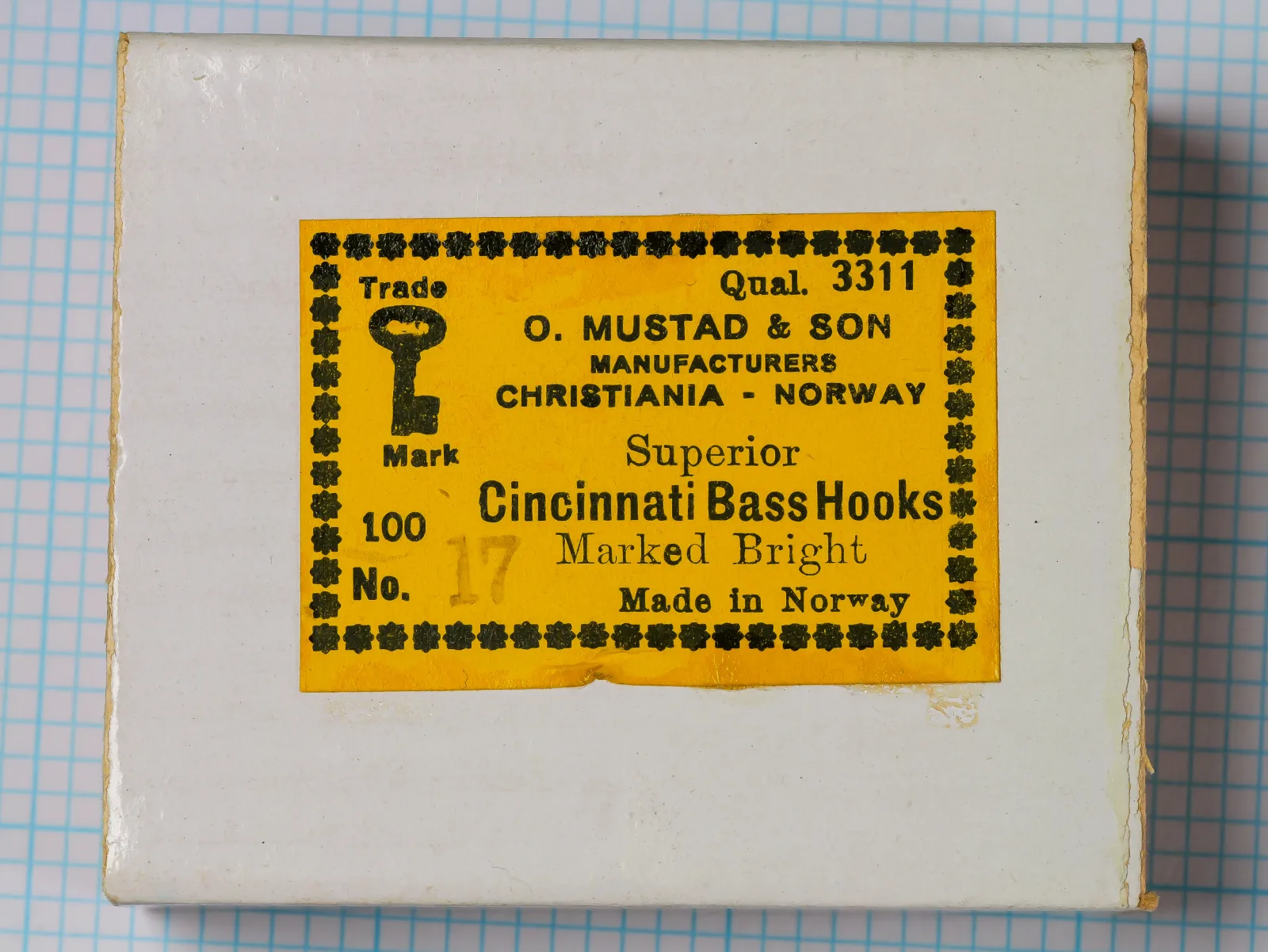
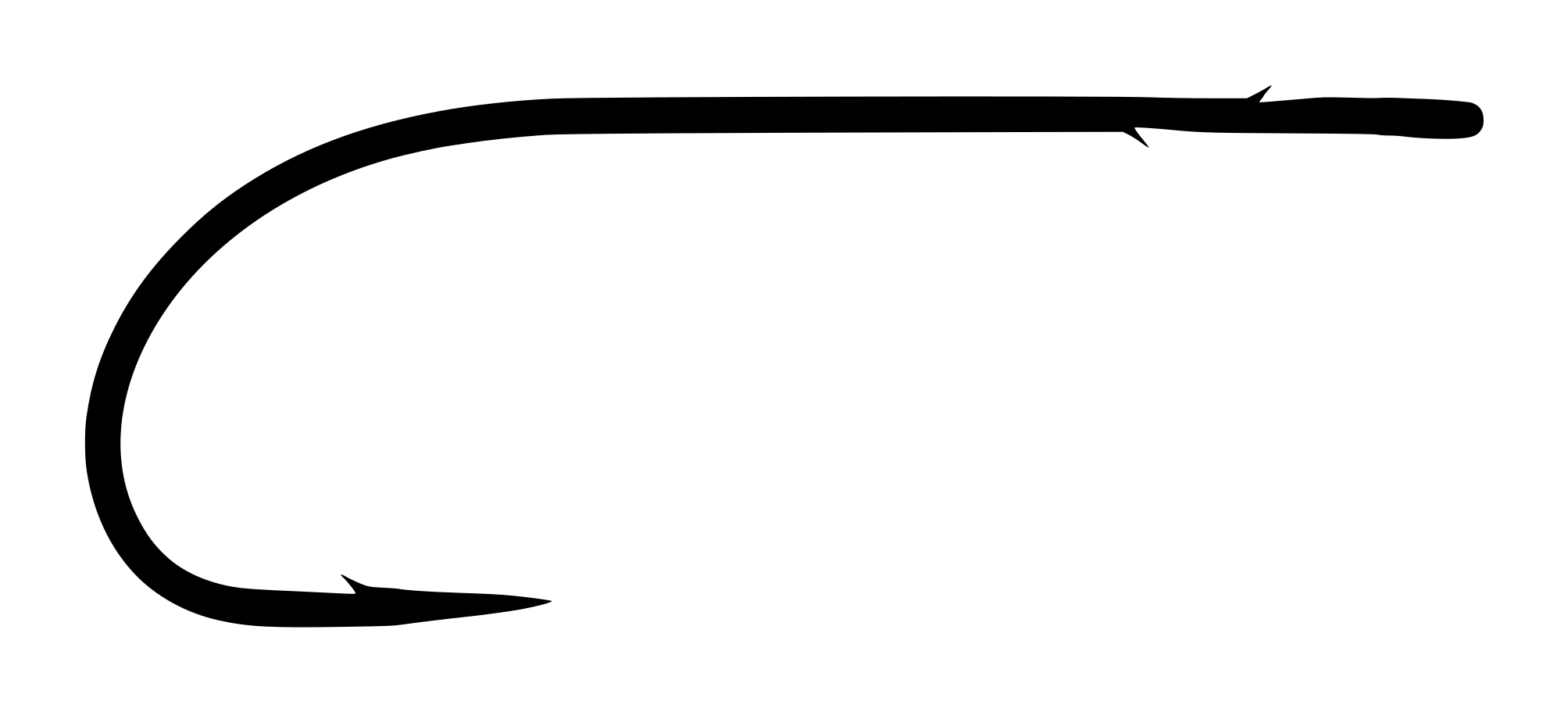
Mustad Quality 3311 Cincinnati Bass Hook, No. 17 — a historically significant bait hook from the early 20th century Norwegian manufacturing era. This is a marked (eyeless) shank design with a distinctive offset Kirbed point, intended for professional snelling — the practice of whipping a leader onto the shank with thread to create a streamlined bait presentation.
The packaging label reads ‘Christiania’ rather than ‘Oslo,’ providing a definitive dating clue: the city reverted to its Norwegian name Oslo in January 1925, making this box Pre-1925 V. The bright steel finish, heavy round-wire construction, and bold letterpress printing on mustard-yellow card stock are all consistent with Mustad’s peak export production to the American market in the early 1900s.
The 3311 represents a crucial moment in American fishing tackle history — when European manufacturers dominated the market and regional bend designs (like the Cincinnati shape from the Ohio River Valley) were standardized globally by industrial giants like Mustad. The marked shank design is now largely obsolete, having been replaced by ringed eyes, making surviving original boxes highly prized by tackle historians and vintage fishing collectors.
Original mustard-yellow Mustad box label with black letterpress printing and trefoil border. The 'Christiania - Norway' designation confirms pre-1925 production. Label shows 'Quality 3311,' 'Cincinnati Bass Hooks,' 'Marked Bright,' and 100-hook count.
Photographic record
3 cataloged imagesSelect any record to load it above.
3 images shown
Mustad 3311 Original Box Label Size 17 Christiania NorwayOriginal mustard-yellow Mustad box label with black letterpress printing and trefoil border. The 'Christiania - Norway' designation confirms pre-1925 production. Label shows 'Quality 3311,' 'Cincinnati Bass Hooks,' 'Marked Bright,' and 100-hook count.Open originalMustad 3311 Hook Point Detail Size 17 Bright SteelSide-profile detail of the 3311 point and barb, showing the characteristic Kirbed (offset) geometry and bright polished steel finish with age patina.Open originalMustad 3311 Complete Hook Profile Size 17Full side profile of the Mustad 3311 showing the marked (ridged) shank, Cincinnati Kirbed bend, heavy round wire, blind flatted eye, and overall bright steel finish.Open original
Technical profile
Blind Eye (Marked Shank) • Kirbed Cincinnati Bend • Standard Wire • Bright Steel • Made in Norway
Eye
Blind — Marked Shank
Wire
Fine (1X Fine), Round
Shank
1X Long — Marked / Ridged
Bend
Kirby (offset), Standard gap, Offset / kirbedClassic Kirbed offset P — point angles distinctly to left when viewed from above, consistent with Cincinnati bend specification. Bend geometry is symmetrical and smooth, showing no manufacturing irregularities. Offset is moderate, approximately 15-20 degrees from centerline E.
Point
Standard / SpearBarb is short, close-cut, and placed approximately 0.15" (3.8 mm) from the point E. Barb angle is standard, neither notably steep nor swept. Barb size is proportionate to the heavy wire gauge, designed to hold against the resistance of bait-fish scales and skin.
Finish
Bright / Uncoated Steel — Confirmed (stated on packaging)Bright polished steel P. The specimen shows a warm silvery tone with light patina spotting typical of century-old bright finishes. No coating visible — unbrassed, unblued, unbraced. Even finish across the entire hook with no wear flaking or rust spotting (specimen condition excellent).
Hooks are bright with light age-spotting and no corrosion damage. Original mustard-yellow card stock shows light browning and toning at edges, consistent with storage in a dry collection. A few minor edge tears to the card. All 100 hooks appear present (or near-present). Box integrity is very good.
The marked shank was engineered to minimize profile disruption when a natural bait (minnow, frog, or crayfish) was presented. Traditional eye designs — ball eyes, turned-down eyes — created a pronounced bulge at the bait head that could alert cautious fish or snag on vegetation. The marked shank, combined with a whipped leader, allowed the hook to sit flush with the bait body, creating an essentially eyeless presentation.
The Kirbed offset point was designed on biomechanical principles: when a bass strikes a bait crosswise, its mouth naturally closes with a slight lateral bias. The Kirbed point angles into this closing motion, increasing penetration probability. The heavy round wire provided the strength needed for fresh-water bass and pike, which fight hard and have tough mouths.
The bright (uncoated) finish was standard for bait hooks of this era — no protective plating was considered necessary, and the cost savings were passed to the consumer. The finish would gradually develop a light patina in use, which some fishermen believed actually improved the hook’s effectiveness by reducing visibility.
The Quality 3311 Cincinnati Bass series represents Mustad’s commitment to the American marked-shank bait-fishing tradition. Cincinnati Bend hooks — first developed in the mid-1800s by Ohio River tackle makers — featured a distinctive Kirbed (offset) point designed to angle into a fish’s mouth mouth rather than slide away. Mustad acquired or licensed this design and produced it in multiple iterations for the global market.
The 3311 was positioned as a ‘Quality’ grade — a mid-tier offering between the premium (and more expensive) models and entry-level hooks. It remained in production through at least the 1940s, though the marked-shank variant shown here is most commonly encountered in pre-1930 boxes. By mid-century, the ringed eye had almost entirely replaced marked shanks in freshwater fishing, and the 3311 transitioned to looped-eye variants, which persisted much longer.
Era and Packaging Dating
Packaging label states 'CHRISTIANIA - NORWAY' — Christiania was the official name until January 1925, establishing a strict pre-1925 upper bound. No barcode visible (consistent with pre-1974 production). Letterpress printing on mustard-yellow card stock is typical of Mustad's 1900-1920s export branding. Black trefoil ornament border is a signature design element from this period. Typography (serif and sans-serif mix, industrial aesthetic) consistent with early-20th-century Scandinavian printing. Marked-shank snelling design was standard through 1920s-1930s but phased out by 1940s, suggesting this box falls within 1900-1925 range. All evidence points to c. 1900-1925.
The Christiania Smoking Gun
The 'Christiania' designation is a collector's gold standard. In January 1925, the Norwegian capital officially reverted from the Scandinavian name Christiania to the ancient Norse name Oslo. Any Mustad box bearing 'Christiania' is guaranteed to predate 1925 — making it a precise, zero-guesswork dating tool. Tackle historians prize these Christiania boxes as tangible artifacts from the peak of Norwegian hook manufacturing dominance, when Mustad was shipping billions of hooks annually to America and building a global empire on industrial precision and clever marketing.
Design lineage and influence
The Cincinnati bend itself predates Mustad by several decades, emerging as a regional innovation in the Ohio and Kentucky river valleys during the 1850s-1870s. Local tackle makers developed the offset point to counter the tendency of straight-pointed hooks to deflect off fish mouths during the strike. Mustad recognized the design’s effectiveness and incorporated it into their global catalog, essentially industrializing an American folk tradition.
The marked shank reflects an even older snelling tradition, common in British salmon and sea-trout fishing, where leaders were whipped onto eyeless shanks. Mustad adapted this European practice for American freshwater bass and pike fishing, creating a unique hybrid design that remained competitive until the 1930s-1950s, when ringed eyes became the new standard.
Best matchRelated by Attribute
Computed automatically from catalog data — updated as new hooks are added.
Matches: Bend, Shank, Eye, Eye Orient., Forging +5 moreDiffers: Wire: Fine (1X Fine) vs Standard; Point: Standard / Spear vs Superior; Finish: Bright / Uncoated Steel vs Bronzed +1 more
Matches: Bend, Gap, Eye, Eye Orient., Forging +4 moreDiffers: Shank: 1X Long vs Standard; Wire: Fine (1X Fine) vs Heavy (1X Heavy); Point: Standard / Spear vs Superior +2 more
Matches: Wire, Gap, Eye, Eye Orient., Forging +3 moreDiffers: Bend: Kirby (offset) vs Sneck; Shank: 1X Long vs 2X Long; Point: Standard / Spear vs Superior +4 more
The Quality 3311 was designed as a professional snelling hook for bait fishermen, particularly those targeting freshwater bass and pike. The ‘snelled’ technique — whipping a monofilament or gut leader onto the marked shank with thread — was standard practice among experienced bait anglers through the mid-20th century. The offset Kirbed point was believed to increase hook-up rates by angling into the fish’s mouth during the strike, while the streamlined marked-shank presentation minimized bait disturbance.
These hooks were particularly valued for live-minnow presentations in lakes and rivers where bass and pike cruised weed beds and shallow flats. The heavy wire and sharp point could penetrate tough fish mouths without bending or breaking. The bright finish — while not camouflaged — was considered acceptable because the bait itself was the primary lure attractant.
Secondary Applications
Catfish, pike, and large perch fishing; some use in saltwater bait presentations.
Classic Fly Patterns
Not typically used for fly tying.
Modern Equivalents
Hook
Match Quality
Notes
Mustad 3366 Cincinnati Bass
Very Good
Same bend and offset geometry, but with ringed eye instead of marked shank. Represents the direct lineal successor when snelling went obsolete in the 1950s.
Mustad 92611 Circle Hook
Good
Modern offset design for bait fishing, but uses circle-point geometry (not standard spear) and is often plated rather than bright steel.
Owner SSW Offset Circle
Moderate
Modern Japanese equivalent for bait and saltwater fishing with offset geometry, but different eye and point designs.
Collector notes
Highly collectible. The Christiania address provides definitive Pre-1925 dating; the marked-shank snelling design is now obsolete and represents a forgotten fishing tradition; the 100-hook complete-box format is increasingly rare. Limited demand from general collectors but strong appeal to Mustad specialists and American tackle historians.
Reference value
$45 – $85 USD estimate
Packaging condition
Good — moderate wear, legibleRecorded specimen
Packaging format
GW-M-03Catalog code
Positive factors: Christiania address (definitive pre-1925 dating), marked-shank snelling design (now essentially obsolete), complete original 100-hook box (increasingly scarce), early Mustad export era (peak of Mustad’s dominance), bright steel finish (period-correct and desirable), excellent box condition with legible label, No. 17 size (mid-range, practical size for collectors).
Limiting factors: Marked-shank hooks have minimal practical utility in modern fishing (no fly-tying applications), bait-fishing specialization appeals to narrower collector base than dry-fly or salmon hooks, some users perceive ‘bait hooks’ as less prestigious than trout flies, heavy wire gauge limits versatility, offset-point Kirbed design has never achieved the iconic status of Sproat or O’Shaughnessy bends in American collecting culture.
Packaging
Mustard-yellow card stock box with black letterpress printing. Label measures approximately 3.5" × 2.75" and is glued to the lid. Ornamental border of black trefoil (three-leaf) designs frames the entire label. Text elements in bold sans-serif type (likely Alternate Gothic or similar early-20th-century industrial typeface). Layout reads: 'Trade Mark' (with key symbol) at top-left; 'QUAL. 3311' in large text; 'O. MUSTAD & SON / MANUFACTURERS' centered; 'CHRISTIANIA - NORWAY' in capital letters; 'Superior' and 'Cincinnati Bass Hooks' in mixed sizes; 'Marked Bright' below; 'Made in Norway' at bottom. Left side lists '100' and 'No. 17' vertically. Box interior is plain white cardboard with no visible manufacturing details or secondary text. No barcode, no lot codes, no lot-number stamps visible.
Market Value Notes
Typical range USD 45–85 for a clean, complete original box with legible Christiania label. Premiums apply for exceptional box condition (USD 100+), pristine untagged specimen hooks, or documented provenance. Specialist Mustad dealers command higher prices; eBay and general online auctions tend toward lower end. Condition of the box label (legibility, color retention) is the primary value driver.
Where to Find
Specialist vintage tackle dealers, eBay (search 'Mustad Christiania'), tackle antique shows, private collections. Original complete boxes are increasingly rare; single hooks are occasionally found but lack the collectibility of a full documented box.
Collector's Identification Tips
Model confirmation: The label clearly states ‘QUAL. 3311’ and ‘CINCINNATI BASS HOOKS.’ The marked shank (ridged, eyeless) is visually unmistakable — no other major Mustad model of this era featured this construction.
Dating via Christiania: The label must read ‘CHRISTIANIA – NORWAY’ to be Pre-1925. Post-1925 boxes will state ‘OSLO – NORWAY’ or simply ‘NORWAY.’ This is the single most reliable dating tool for Mustad boxes of this period.
Box format: Original boxes are bright mustard-yellow with black letterpress printing and trefoil border ornaments. Reproduction or later reissues will have different card stock color (often duller), offset printing (instead of letterpress), or different typography.
Hook construction: All 3311 hooks should be bright steel, Kirbed (offset), marked-shank, and heavy wire. Any corrosion, plating, or different shank construction indicates a different model or a damaged specimen.
Preservation
Storage and Preservation
Store the original box in a cool, dry environment away from direct sunlight. The mustard-yellow label is prone to fading if exposed to extended UV light. Maintain relative humidity below 50% to prevent rust spotting on the bright-steel hooks and to slow the gradual browning of the card stock.
If the hooks are removed, keep them separate from other metals to prevent galvanic corrosion. Some collectors store original boxes in archival-quality kraft sleeves or acid-free tissue to reduce dust exposure and minimize handling damage to the label. Do not laminate or seal the original box — collectors and appraisers need to examine the label in its original state for dating and condition assessment.
Avoid cleaning the hooks with harsh solvents or abrasive materials. If rust spotting develops, light surface rust can be gently removed with very fine (0000) steel wool or a soft brass brush, working carefully to avoid scratching the steel. A light coat of mineral oil (not gun oil) can help inhibit further oxidation without leaving a sticky residue.
Primary Source
Label Text Analysis — Packaging Claims
Source: Original mustard-yellow label, Mustad 3311 box
‘Marked’ — Refers to the ridged shank (also called ‘marked shank’), which featured shallow longitudinal ridges designed to grip and hold thread during snelling. The ridges serve no function beyond facilitating the whipping-on of a leader — they do not aid in bait-holding in the modern sense.
‘Bright’ — Indicates bare, polished steel with no protective coating (no plating, no japanning, no bronzing). The finish would develop a light gray or olive patina over time, which some anglers believed improved concealment in the water.
‘Cincinnati’ — Refers to the specific bend geometry, which originated in the Ohio River Valley and was popularized by Mustad globally. The Cincinnati bend is characterized by a Kirbed (offset) point and a moderately deep, rounded bend with a slight upward taper toward the eye.
‘Made in Norway’ — Confirms Norwegian manufacture, almost certainly at the Gjøvik factory. This was Mustad’s primary production facility and represents the height of Scandinavian industrial hook manufacturing.
Marking Analysis
Markings and Stamps
No handwritten notations, lot codes, or secondary stamps are visible on the specimen box. The label and box interior bear no pencil marks, ink stamps, or retailer notations typical of some vintage hook boxes. This absence of secondary marking is consistent with a box that remained in storage or collection rather than passing through retail inventory multiple times. The lack of marking actually enhances value, as it suggests direct wholesale or warehouse retention.
Additional
The Snelling Tradition — A Lost Fishing Art
The marked-shank snelling hook represents a sophisticated but now-forgotten technique in bait fishing. ‘Snelling’ was the practice of permanently whipping a leader (originally gut, later monofilament) onto the hook shank using fly-tying thread, creating a virtually eyeless, streamlined presentation. This required skill and patience — a proper snell was created at home, not bought pre-made, and demanded knowledge of thread-wrapping, knot-tying, and varnish application.
The marked shank’s longitudinal ridges were designed specifically to prevent the whipped thread from slipping. A smooth shank would allow the leader to rotate or slide off during use. The ridge pattern — typically 3-5 shallow grooves running the length of the shank — provided mechanical grip without significantly increasing the hook’s profile.
By the 1950s, the ringed eye (a small wire ring soldered to the hook eye) became the industry standard, and snelling fell into obsolescence. Ringed eyes were easier to use, required no preparation, and allowed anglers to quickly tie on a leader with a simple clinch knot. The marked shank, once a mark of professional craftsmanship, became a curiosity.
Today, snelling is experiencing a modest revival among traditional fly-tiers and purist salmon anglers, but the marked-shank design is rarely manufactured. These vintage Mustad boxes represent the height of the snelling era — when marked-shank hooks were the preferred choice for serious bait anglers.
Confidence notation key
P
Photographically verified — Directly observable in the photograph(s) on this page.
V
Verified by documentation — Confirmed by manufacturer catalog, spec sheet, or published reference.
I
Inferred — A logical deduction from observable or documented evidence, not directly stated.
E
Estimated — An approximation based on visual comparison, proportional analysis, or limited data.
S
Speculative — A reasoned hypothesis that cannot be confirmed from available evidence.
Unnotated claims are the compiler’s synthesis; see Sources. All photographs on garrenwood.com are taken on a measurement grid where each square equals 1/10 inch (0.1″ / 2.54 mm).