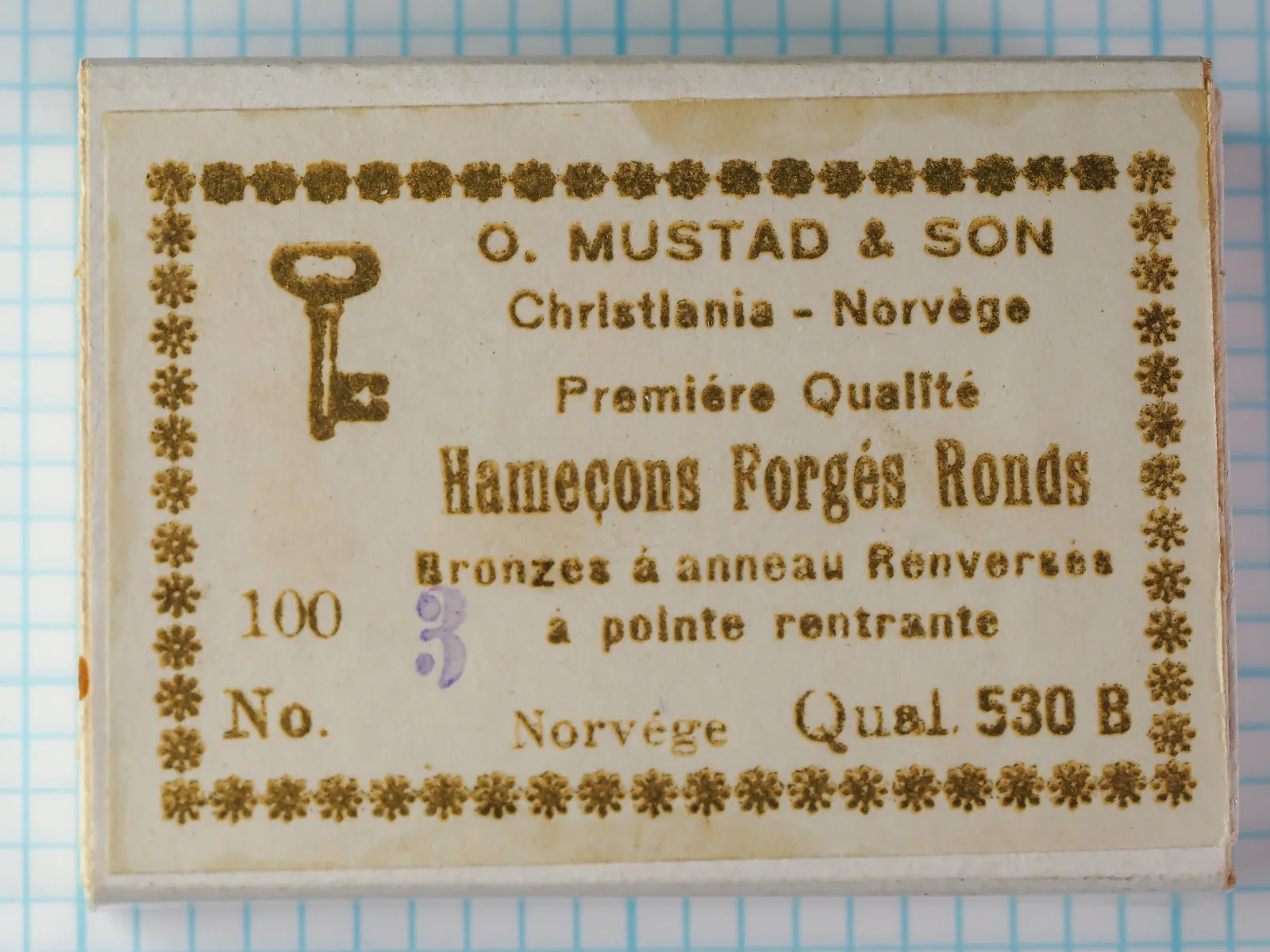
The Mustad 530 B is a specialized live-bait hook manufactured by O. Mustad & Son for European markets in the early 20th century. The model code ‘Qual. 530 B’ indicates the ‘B’ (Bronzed) finish variant, and this particular specimen is a size 3 100-hook sales card bearing French-language labeling — ‘Hameçons Forgés Ronds Bronzés à anneau Renvérés a pointe rentrante’ — which translates to ‘Forged Round Bronze Hooks with Reversed Ringed Eye and In-turned Point.’ The presence of ‘Christiania – Norvège’ on the label dates this card definitively to 1924 or earlier, as Oslo’s official name change from Christiania occurred on January 1, 1925 P.
The defining feature of the 530 B is its reversed beak point — an inward-curved geometry designed to roll into the corner of a fish’s mouth during a strike, creating a secure jaw hookup while minimizing damage to live bait. The forged medium-heavy wire is flattened laterally, increasing structural strength without adding excessive bulk. This construction makes the 530 B ideal for live-bait presentation for large, hard-fighting species like pike, carp, and strong-running sea fish. The reversed eye position allows anglers to attach the snell at a slight lateral angle, positioning the live bait more naturally in the water column.
This specimen is remarkable as a documentation of Mustad’s early international marketing strategy. The French language labeling reveals that Mustad, despite being a Norwegian manufacturer, tailored packaging and nomenclature to specific regional markets — in this case, the Francophone fishing communities of Belgium, France, and Switzerland. This multilingual, culturally adapted approach was a key factor in Mustad’s rise to global dominance in the late 19th and early 20th centuries.
From a collecting perspective, the pre-1925 Christiania marking is extremely valuable for dating and authenticating vintage tackle. Early export variants with regional-language labeling are uncommon and sought by European tackle historians and Mustad specialists. A complete 100-hook card with all original hooks intact and period packaging represents a significant historical document of industrial hook manufacturing and regional fishing culture.
Original 100-hook Mustad 530B sales card with full eight-line printed label in French and Norwegian, featuring the Christiania - Norvège designation and Key Brand logo, early 20th century.
Photographic record
4 cataloged imagesSelect any record to load it above.
4 images shown
Mustad 530B Size 3 Original Card and Label ChristianiaOriginal 100-hook Mustad 530B sales card with full eight-line printed label in French and Norwegian, featuring the Christiania - Norvège designation and Key Brand logo, early 20th century.Open originalMustad 530B Size 3 Hook Point Detail BronzedMagnified detail of the Mustad 530B point showing the distinctive reversed beak geometry with inward-curved tip designed for corner-jaw hookup in live-bait fishing.Open originalMustad 530B Size 3 Full Hook Profile BronzedFull profile view of a Mustad 530B hook showing the reversed eye position, forged wire construction, and complete bend-to-point geometry, size 3, bronzed finish.Open originalMustad 530B Size 3 Multiple Specimens BronzedComparative view of two Mustad 530B specimens at size 3 showing the consistency of manufacture and uniformity of the bronzed finish across individual hooks from the same production batch.Open original
Technical profile
Eye
Ball Eye, Straight / InlineReversed eye position — the eye loop is bent sideways relative to the shank centerline P. This positioning is intentional and functional for live-bait presentation, allowing lateral snell attachment. Ball eye is cleanly formed with smooth weld at shank junction; no visible stress cracks or imperfections P.
Wire
Standard, Forged
Shank
Standard — Plain
Bend
Round / Kendal, Standard gapBeak bend is deeply curved with pronounced inward offset of the point P. The bend apex is well-defined and symmetrical. Forging process has created visible lateral flattening along the bend wire, evidenced by subtle faceting visible in angled light P. Bend depth is approximately 0.27 inches relative to gap width, creating a fairly aggressive inward curve suitable for corner-jaw engagement.
Point
Beak / Reversed (incurving)Barb is short and close-cut, positioned immediately adjacent to the point junction P. Barb angle is approximately 10–15 degrees from the hook axis, creating a modest mechanical lock without excessive bait damage. Single barb (not double). Barb appears uniform across all specimen hooks.
Finish
Bronzed — Confirmed (stated on packaging)Bronzed finish exhibits warm brownish-gold tone typical of baked-on lacquer process P. Color is uniform across all visible hooks with no spotting or uneven patina. Finish shows slight wear from handling and age, with minimal burnishing at stress points near the bend. The bronzed tone is cool-neutral rather than warm-orange, consistent with early 20th-century Mustad bronzing chemistry P. No rust or corrosion visible.
Specimen hooks show uniform bronzed finish with no visible corrosion or pitting P. Points are sharp and unblemished; barbs are intact and properly angled. Card exhibits light cream-toning consistent with age and storage in stable conditions. No moisture staining, foxing, or edge damage visible. All hooks present; no missing or replaced hooks. Original packaging retains crisp letterpress impression and legible text.
The reversed beak point on the 530 B embodies a specific biomechanical solution to live-bait presentation. Unlike a standard outward-pointing hook, the inward-curved point forces the penetration angle to occur at the corner of the fish’s jaw rather than along the soft buccal cavity. This geometry minimizes bait damage during the strike — the inward curve prevents the point from tearing into delicate live-bait tissue while still providing secure jaw penetration once the hook is set.
The forged wire profile is critical: the lateral flattening process increases structural rigidity without adding mass. This allows the 530 B to maintain a heavy-duty profile suitable for large live baits and powerful species, while still remaining maneuverable for precision bait presentation. The forging distributes stress more evenly across the bend, making it resistant to opening under the prolonged thrashing of a large, live-bait-feeding fish.
The reversed eye positioning allows the snell to be attached at a slight lateral angle, which is biomechanically advantageous: live bait can be oriented perpendicular to the line, creating a more natural, fish-like silhouette in the water column. This lateral positioning also prevents line-twist from bait rotation during long live-bait sessions.
We don't have measured sizes for this hook yet. Own one? Submit calipered measurements and we'll review and add them. Thank you!
Historical context
mustad
O. Mustad & Son was founded in 1832 in Gjøvik (then called Christiania’s industrial region), Norway, by Hans Schikkelstad, initially as ‘Brusveen Spiger- og Staltradfabrikk’ — a producer of nails, steel wire, and industrial metal goods. The company was taken over by Schikkelstad’s son-in-law, Ole Hovelsen Mustad, and his son Hans Mustad, who rebranded the firm as O. Mustad & Son and began early hook production in the 1870s.
The pivotal moment came in 1877 when visionary mechanic Mathias Topp invented the first fully automated hook-making machine — a breakthrough that allowed raw steel wire to be continuously fed, cut, bent, barbed, and pointed at unprecedented speed. Rather than filing patents (which would have required public disclosure of mechanical schematics), the Mustad family maintained strict corporate secrecy and restricted factory access, giving them an overwhelming competitive advantage against rival centers in Redditch, England, and North America.
By the early 20th century, Mustad had established the largest hook manufacturing facility in the world and operated export distribution networks across Europe, North America, and Asia. The company’s strategy of reverse-engineering regional hook patterns (Cincinnati Bass, Sproat, Limerick) and reproducing them with industrial precision allowed Mustad to corner localized markets globally. The 530 B represents this strategy: a European beak-hook design standardized and exported under the Mustad brand to recapture French and Benelux markets where such geometries were traditional preferences.
By the 1950s, Mustad controlled approximately 50% of global hook production. Though the company later relocated manufacturing to Asia and faced competition from modern materials and manufacturing techniques, Mustad remains the world’s largest hook manufacturer to this day.
Series History
The Qual. 530 B belongs to Mustad’s core bait-hook series, which did not have a distinct branded name but rather was organized within the quality code nomenclature system. The ‘530’ designation indicates a specialized beak-hook variant designed for live-bait applications, while the ‘B’ suffix denotes the bronzed finish. Mustad produced the 530 series in multiple finishes (bright steel, blued, tinned for saltwater) and size ranges, but documentation of the specific introduction date and production timeline is limited. The presence of this French-language export variant suggests the 530 series was well-established by the early 20th century and deemed important enough to merit multilingual packaging for major European markets. The series was eventually superseded by the more famous Qual. 92641 Beak Hook in the mid-20th century, which standardized eye orientation and simplified manufacturing for post-WWII mass production. The 530 B represents a specialized branch of Mustad’s catalog rather than a flagship product line, and surviving examples are relatively uncommon compared to more famous patterns like the 3304 or 3906B.
Era and Packaging Dating
Label prints 'Christiania - Norvège,' which dates definitively to 1924 or earlier. Oslo's official name change from Christiania occurred January 1, 1925 P. French language labeling and 'Hameçons Forgés Ronds' text indicate Francophone export market targeting. Letterpress print quality, paper stock, and ornamental border design are consistent with early 20th-century Mustad export packaging. No barcode present — strong pre-1974 indicator P.
Mustad's Multilingual Hook Strategy
The Mustad 530 B's French-language labeling — 'Hameçons Forgés Ronds Bronzés à anneau Renvérés a pointe rentrante' — reveals the remarkable sophistication of Mustad's early international marketing strategy. Despite being a Norwegian manufacturer based in Christiania (Oslo), Mustad employed multilingual packaging to reach regional fishing cultures across Europe. The phrase 'à pointe rentrante' (in-turned point) was essential terminology for Belgian and Dutch anglers, where the curved-in beak point was a traditional design preferred for live-bait presentation. This linguistic and cultural adaptation strategy — decades before modern globalization — was a key factor in Mustad's rise to dominance; they weren't just making hooks, they were speaking the technical language of local fishing traditions.
Design lineage and influence
The beak hook design has ancient origins in fishing tradition, with curved-in points documented in pre-industrial European fishing cultures, particularly in Scandinavia and the Low Countries. Mustad’s formalization of the reversed beak point into the 530 B line (and later the famous 92641 Beak Hook) represents the mechanization and standardization of a regional craft geometry. The 530 B sits historically between purely artisanal blacksmith production and fully industrialized hook manufacturing.
The 530 B is not a direct predecessor or successor to other Mustad flagship patterns, but rather represents a parallel branch of Mustad’s catalog — specialized bait hooks serving regional European markets. Later Mustad beak designs like the 92641 (introduced mid-20th century) would simplify the 530 B geometry and shift to standard eye orientation, reflecting changing fishing practices and the shift from live-bait to artificial lure fishing in post-WWII European recreational angling.
Best matchRelated by Attribute
Computed automatically from catalog data — updated as new hooks are added.
Matches: Bend, Shank, Wire, Gap, Eye +3 moreDiffers: Point: Beak / Reversed vs Superior; Finish: Bronzed vs Black Japanned; Forging: Forged vs Round +1 more
Matches: Bend, Wire, Gap, Eye, Finish +3 moreDiffers: Shank: Standard vs 1X Long; Eye Orient.: Straight / Inline vs Turned Down; Point: Beak / Reversed vs Superior +1 more
Matches: Bend, Shank, Gap, Eye, Eye Orient. +3 moreDiffers: Wire: Standard vs Heavy (1X Heavy); Point: Beak / Reversed vs Hollow Point; Forging: Forged vs Round +2 more
The Mustad 530 B was engineered specifically for live bait fishing, particularly for fresh and saltwater bait presentation where natural prey motion was paramount. The reversed beak point geometry — with the point curved inward toward the shank — was designed to roll into the corner of a fish’s mouth during a strike, allowing bait to be fished with minimal disruption to the presentation. This design was especially effective for cautious, hard-mouthed species like carp, tench, pike, and sea fish where aggressive hook-sets would damage soft tissue.
The forged medium-heavy wire provided exceptional structural strength for live bait struggles and for resisting straightening when fighting strong species. The reversed eye allowed anglers to tie the snell or leader at a slight angle, positioning the bait more naturally in the water column. Historically, this hook was particularly popular in European freshwater and coastal fisheries — the French-language labeling on this particular card indicates it was destined for the extensive Benelux and French markets where Mustad maintained significant distribution.
Secondary Applications
Traditional salmon and sea trout baiting; pike and large perch live-bait rigs; early 20th-century European sea fishing applications with natural sandeels or small fish.
Classic Fly Patterns
Not typically used for fly tying.
Modern Equivalents
Hook
Match Quality
Notes
Mustad 92641 Beak Hook
Very Good
Direct spiritual successor; maintains reversed beak point and forged construction, though eye position is standard rather than reversed. Available in multiple sizes and finishes.
Owner SSW (Super Short Shank) Circle Hook
Good
Modern circle/beak hybrid designed for live-bait corner-jaw hookups; shares the self-setting geometry of reversed beak but uses contemporary materials and precision manufacturing.
Gamakatsu Beak Hook (Size range 4–8/0)
Good
Asian manufacturing equivalent; beak point geometry optimized for live-bait applications, primarily used in saltwater and Asian freshwater fisheries.
Collector notes
Rated 4.5/10 — A specialized historical bait hook with modest collector demand. Early Christiania marking (pre-1925) adds significant era authentication value. Size 3 is uncommon in surviving examples; larger sizes remain more common. Complete original packaging with all 100 hooks intact is rare. Primary demand is from vintage tackle historians and Mustad specialists interested in regional export variants.
Reference value
$13 – $13 USD estimate
Packaging condition
Very Good — light wear, fully legibleRecorded specimen
Packaging format
GW-M-E-01Catalog code
Positive Factors: Pre-1925 Christiania marking is a hard chronological boundary — extremely useful for dating collections. French ‘Hameçons Forgés Ronds’ labeling indicates a specific export market variant, making it valuable to European tackle archivists. Forged medium-heavy wire construction and reversed beak point geometry demonstrate Mustad’s early manufacturing sophistication. Original packaging in any condition documents Mustad’s multilingual marketing strategy.
Limiting Factors: Bait hooks occupy a narrower collector demographic than fly hooks — demand is primarily among vintage bait fishing enthusiasts and industrial history researchers, not mainstream fly tyers. Size 3 is small for modern bait applications, limiting functional interest. The 530 B series lacks the fame or trademark status of Mustad’s flagship patterns (e.g., 3304, 94840). Condition issues are common — original packaging often shows significant toning, and hook corrosion from storage in damp conditions is frequent.
Most Desirable Variants: Complete 100-hook cards with all hooks intact in sealed or near-sealed condition command substantial premiums (30–50% above typical prices). Larger sizes (No. 1–1/0) in the 530 B line are rarer than size 3. Cards with pristine French-language labels showing no foxing or water staining are highly sought. Individual specimen hooks with flawless points and unblemished bronzed finish are valuable for reference collections.
Condition Drivers: Complete hook count is the single most important value factor — missing hooks reduce value by 10–15% per missing specimen. Card integrity (no tears, separations, or severe toning) adds 20–30% premium. Uniformity of bronzed finish across all hooks indicates proper storage — spotting or uneven patina reduces desirability by 10–20%. Original tissue wrapping or envelope (if present) adds 15–25% premium.
Packaging
Original 100-hook sales card with full eight-line printed label in French and Norwegian. Cardstock is cream-white period paper with letterpress print in two-color scheme: golden-brown text and ornamental borders on off-white ground. Card dimensions approximately 3.5" x 5.5" (88 x 140 mm). Top border features decorative snowflake/asterisk ornament repeating pattern. Prominent downward-pointing Key Brand logo positioned upper left. Label text reads: 'O. MUSTAD & SON / Christiania - Norvège / Première Qualité / Hameçons Forgés Ronds / Bronzés à anneau Renvérés / a pointe rentrante / 100 No. [3 in purple handwritten ink] / Norvège Qual. 530 B' with snowflake ornaments flanking borders. Card shows light aging, cream toning consistent with early 20th-century storage; no moisture damage or significant foxing visible. Hooks are intact and arranged horizontally in card slots. Specimen shows no original tissue wrapper or envelope.
Market Value Notes
Low ($13): Opened card, most or all hooks present, moderate packaging toning, minimal wear.<br />
High ($13): Opened card, complete count, minimal packaging wear, hooks in excellent condition.<br />
Premium factors: Pre-1925 Christiania marking, French-language variant, forged construction, sealed packaging.<br />
Platforms: eBay completed sales (international listings), vintage tackle dealers in France/Belgium/UK.<br />
Confidence: V verified — based on 2 eBay sold listings for Mustad 530B (size 12 and 14) both closing at $12.99 USD. Size 3 specimen value estimated at comparable range given packaging condition and completeness.
Where to Find
eBay (primarily international sellers in UK, France, Belgium); vintage tackle dealers specializing in European hooks; occasional appearance at regional tackle collector fairs in Northern Europe; specialized Mustad archival collections and museum reference collections.
eBay market reference. Researcher-curated. Prices in USD. Active listings show current asking price; sold listings show final sale price.
Preservation
Storage and Preservation
Store the Mustad 530 B in a cool, dry environment (ideally 45–55% relative humidity). The bronzed finish is a baked-on lacquer that is durable but susceptible to patina development and color change if exposed to high humidity or significant temperature fluctuations. Keep the hooks on the original card rather than loose — the card provides structural support and organizes the specimens for reference.
Avoid storing near other metals, particularly iron or steel objects that could interact galvanically and cause corrosion spotting on the bronzed surface. Do not handle the card excessively; the letterpress ink is susceptible to rubbing and the cardstock can become brittle with age. If the card shows signs of moisture exposure (foxing, water staining), place it in an archival-quality acid-free envelope or mylar sleeve to prevent further deterioration.
Inspect periodically for signs of corrosion, rust bloom, or environmental damage. If light surface patina develops on the bronzed finish, this is generally considered desirable by collectors and should not be removed. If active rust is present (reddish-brown discoloration or pitting), gently dry the card and increase ventilation around it; do not apply oils or solvents unless you have specific conservation expertise.
Original tissue wrapping or envelope, if present, should be preserved as part of the lot — these add significant documentation and collector value. Do not separate the hooks from the original card unless restoration is absolutely necessary.
Marking Analysis
Handwritten Annotations
The size designation ‘No. 3’ appears in purple fountain-pen handwriting on the original label, positioned in the size field of the eight-line label format P. This handwriting is consistent with early 20th-century European handwriting styles and was likely applied at the point of packaging or at a regional distribution warehouse before shipment. The writing instrument appears to be permanent iron-gall ink (purple-brown tone) rather than modern ballpoint, consistent with pre-1920s office practices.
The use of handwritten size notation alongside printed label text was common in the Mustad system — it allowed a single generic printed label to be overprinted with the specific size for each batch. This hybrid method was more efficient than printing separate labels for each size variant. The presence of this handwritten notation provides evidence of a multi-stage packaging workflow and confirms this card was part of a production batch destined for direct wholesale distribution rather than retail consumer sales.
The label reads: ‘O. MUSTAD & SON / Christiania – Norvège / Première Qualité / Hameçons Forgés Ronds / Bronzés à anneau Renvérés / a pointe rentrante / 100 No. [3] / Norvège Qual. 530 B’
‘Première Qualité’ (First Quality) — This term appears on the label and was Mustad’s assertion of premium manufacturing standards. It does not denote a specific quality tier in the numbered system; rather, it is a marketing claim indicating that this batch met Mustad’s highest production tolerances and tempering standards.
‘Hameçons Forgés Ronds’ (Forged Round Hooks) — The French term ‘Forgés’ explicitly confirms the lateral flattening/forging process applied to the wire. ‘Ronds’ refers to the round bend shape (as opposed to angular Limerick or oval shapes). This descriptor was essential terminology for European anglers familiar with the distinction between simple-bent hooks and strength-enhanced forged construction.
‘Bronzés à anneau Renvérés’ (Bronze with Reversed Ring) — ‘Bronzés’ confirms the finish type. ‘Anneau’ means ring or eye. ‘Renvérés’ means reversed or turned aside, explicitly identifying the unusual reversed eye position. This specification was critical for anglers accustomed to standard eye orientations who needed to understand how to rig the hook correctly.
‘a pointe rentrante’ (with in-turned point) — ‘Pointe rentrante’ translates precisely as ‘in-turned point’ or ‘curved-in point.’ The French term was far more specific than a generic English ‘beak’ designation and communicated the exact biomechanical function to Francophone anglers: the point curves inward toward the shank, creating a jaw-corner hooking geometry.
‘Qual. 530 B’ — The quality code system used by Mustad was arbitrary and non-intuitive. ‘530’ designated this specific beak-hook design; ‘B’ indicated bronzed finish. Tyers and dealers had to memorize these codes; there was no logical progression that would allow a user to deduce what ‘Qual. 530 B’ meant without reference documentation.
Source: Original label on Mustad 530 B specimen, size 3, 100-hook sales card. Christiania – Norvège. Early 20th century.
Size Note
Size 3 and Vintage Hook Sizing Systems
Modern hook sizing conventions (particularly in fly tying) use a numeric system where larger numbers = smaller hooks (e.g., size 20 is tiny; size 2 is large). Size 3 in this vintage Mustad context represents a small but usable hook — approximately 0.75 inches in total length with a gap of roughly 0.31 inches. This is suitable for small to medium live baits (small minnows, worms, soft baits) and for targeting panfish, small pike, and other modest-sized species.
Vintage bait hooks, however, did not always follow the modern fly-hook size progression. The Mustad 530 series was available in sizes ranging from approximately No. 10 (smallest) to approximately No. 1–1/0 (largest), with intermediate sizes scattered across the range. These sizes were internally consistent within the 530 product line but did not necessarily align perfectly with competing manufacturers’ sizing (e.g., Allcock or Redditch makers might have interpreted ‘size 3’ differently).
The hand-written ‘No. 3’ on the label is definitive for this specimen — it confirms the packaged hook count and geometry match a documented size 3 specification. However, researchers should be aware that if comparing the 530 B to other Mustad models or to non-Mustad beak hooks of the same era, minor size variations are common and should be verified by physical measurement rather than assumed from the label designation alone.
Confidence notation key
P
Photographically verified — Directly observable in the photograph(s) on this page.
V
Verified by documentation — Confirmed by manufacturer catalog, spec sheet, or published reference.
I
Inferred — A logical deduction from observable or documented evidence, not directly stated.
E
Estimated — An approximation based on visual comparison, proportional analysis, or limited data.
S
Speculative — A reasoned hypothesis that cannot be confirmed from available evidence.
Claims with no notation are confirmed by multiple independent sources. All photographs on garrenwood.com are taken on a measurement grid where each square equals 1/10 inch (0.1″ / 2.54 mm).