Collecting Significance: Complete original cards from this era are scarce. Represents an important regional US hook brand during the period when American manufacturers competed with established English imports. Early copyright mark and Denver manufacturing address make this a significant artifact of US tackle manufacturing history. Size 6 is a standard working size; smaller and larger sizes command proportionally higher premiums.
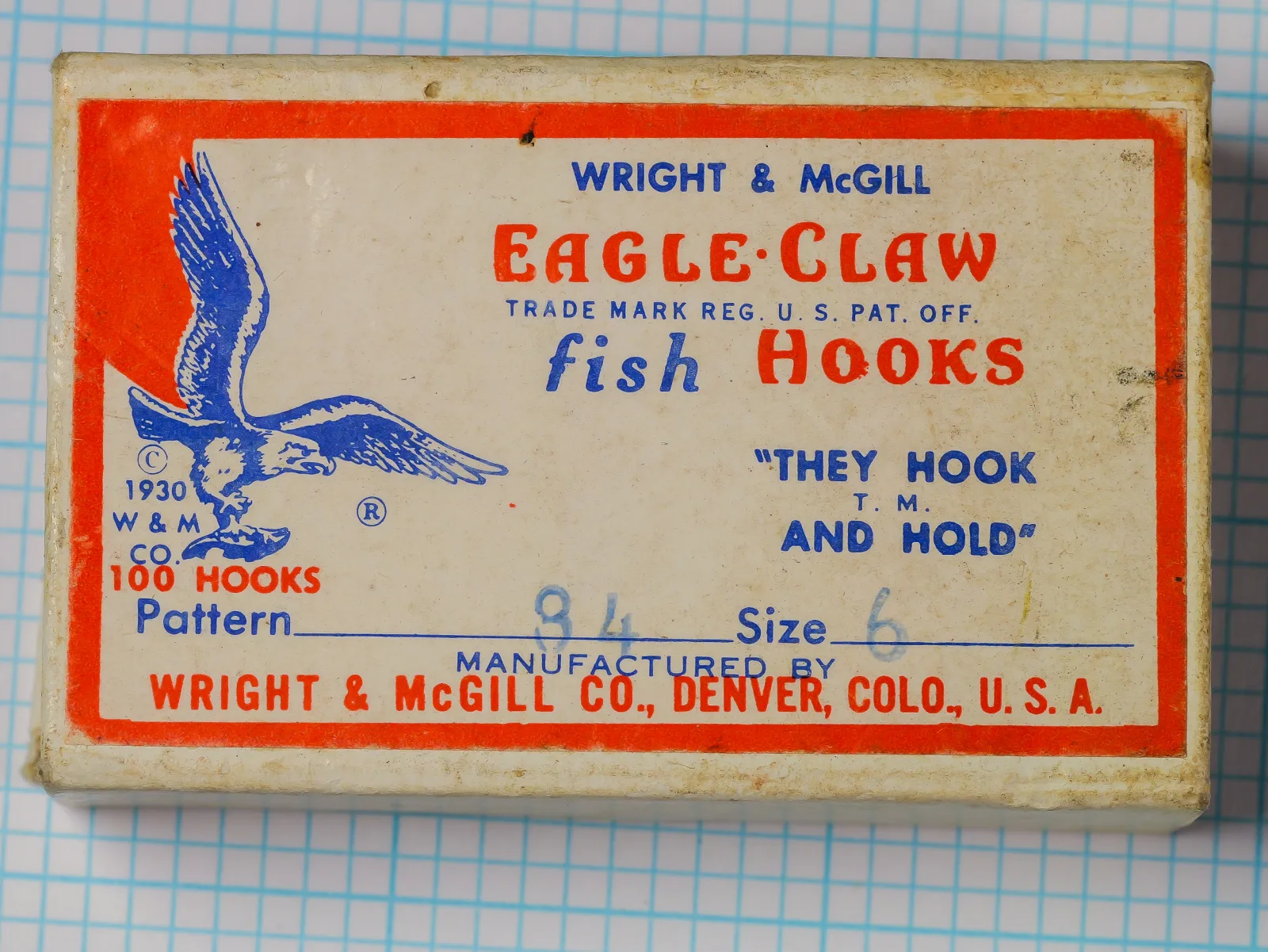
Original Wright & McGill Eagle Claw No. 84 sales card, size 6, showing two-color red and cream letterpress design with 1930 copyright mark and Denver, Colorado manufacturer address.
Photographic record
3 cataloged imagesSelect any record to load it above.
3 images shown
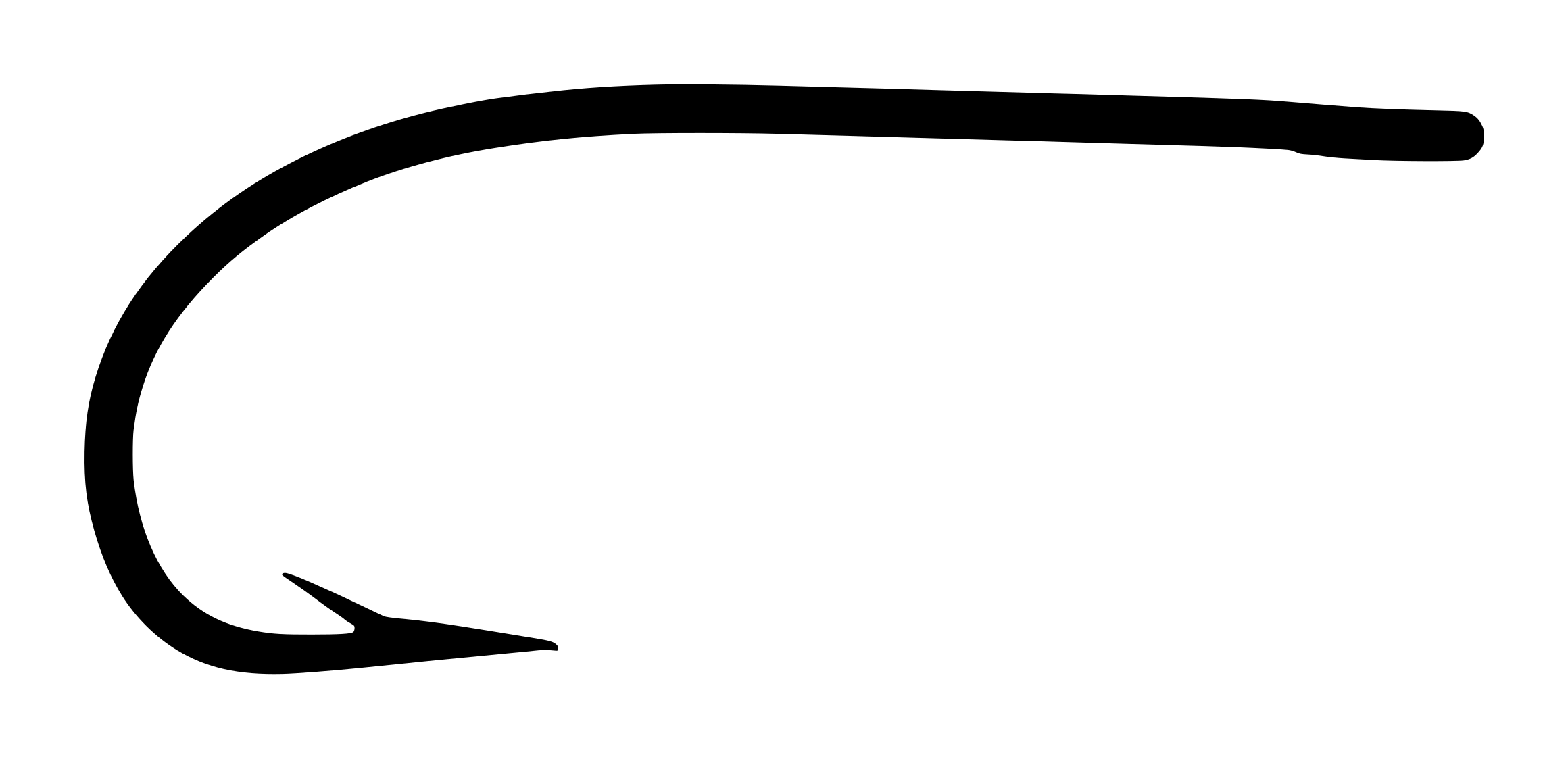
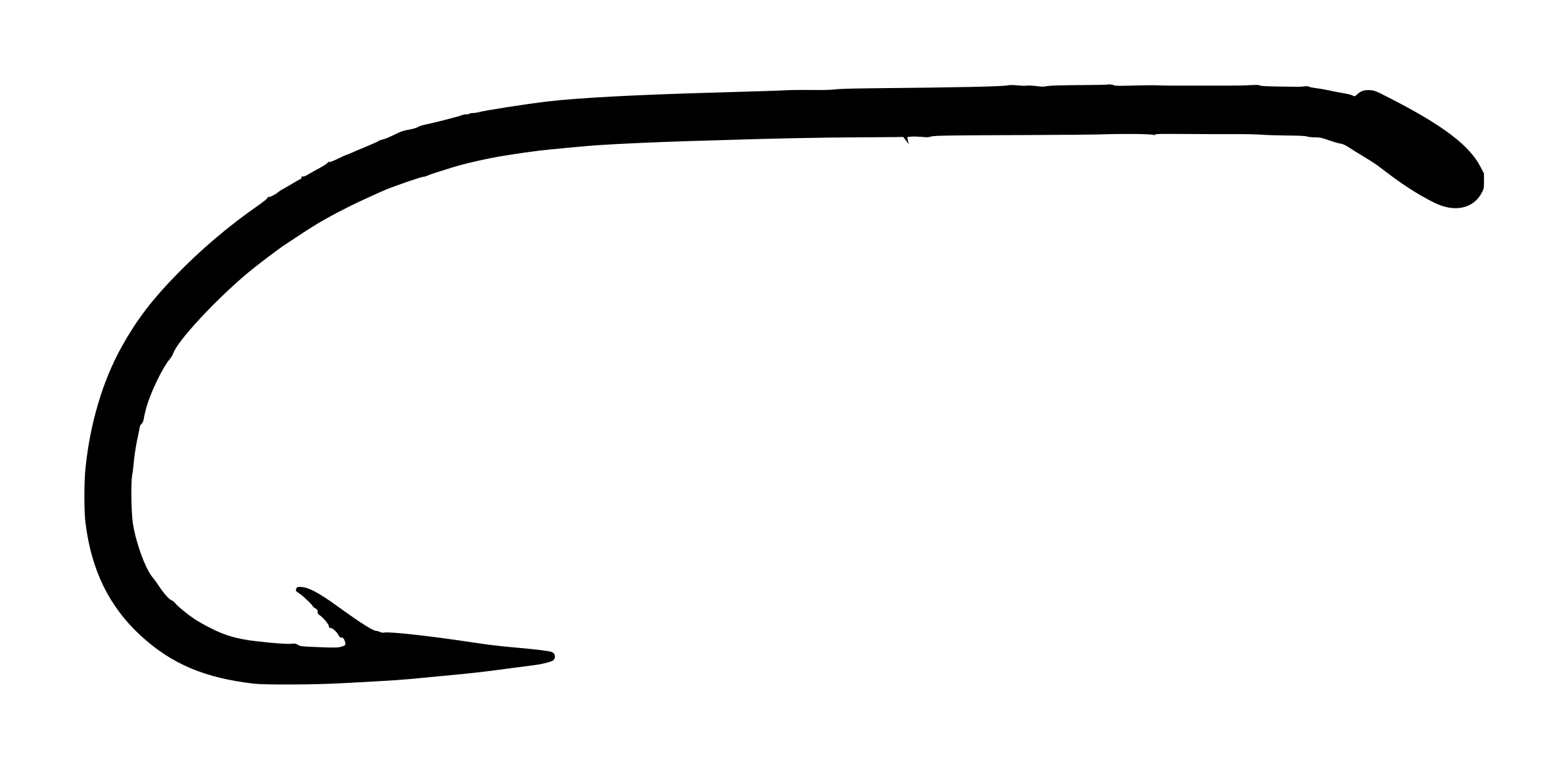
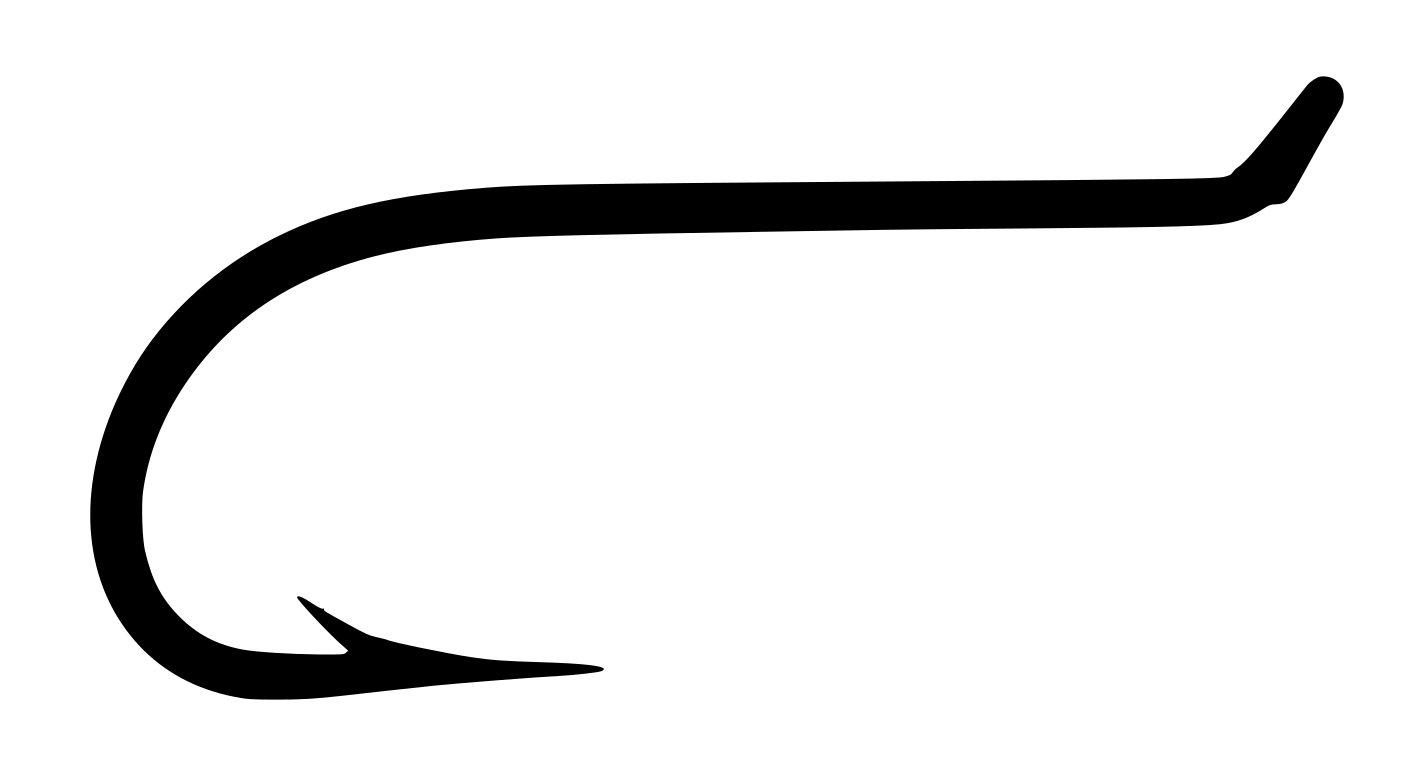
Wright McGill Eagle Claw No. 84 Size 6 Sales Card 1930Original Wright & McGill Eagle Claw No. 84 sales card, size 6, showing two-color red and cream letterpress design with 1930 copyright mark and Denver, Colorado manufacturer address.Open originalWright McGill Eagle Claw No. 84 Size 6 Point Detail BronzedClose-up of the point and lower bend showing the standard-spear point geometry, moderate bend depth, and bronzed finish with visible steel grain texture.Open originalWright McGill Eagle Claw No. 84 Size 6 Profile View Straight Ring EyeProfile view of the complete hook showing straight ringed eye construction, proportionate shank, and characteristic Sproat-family bend profile. Photographed on 1/10-inch measurement grid for dimensional reference.Open original
Technical profile
Straight Ringed Eye | Sproat Bend | Standard Shank | Standard Wire | Standard Spear Point | Bronzed Finish
Eye
Ball Eye, Straight / InlineStraight ringed eye confirmed by physical examination P. Wire is drawn round through the eye without taper. No ball formation at the wire terminus. Eye opening is approximately 0.10"-0.12" (2.5-3.0 mm), consistent with standard fly-dressing practice. No knob or enlarged feature at the eye base.
Wire
Standard, Round
Shank
Standard — Plain
Bend
Sproat, Wide gap, Offset / kirbedSproat-family bend with moderately rounded bottom P. Bend depth measured ~0.22"-0.24" (5.6-6.1 mm) P. The radius of curvature is smooth and continuous; no angular dorsal ridge characteristic of Limerick or Dublin profiles. Wire set is vertical and symmetrical in the bend — no reversal or twist.
Point
Beak / Reversed (incurving)Short close-cut barb positioned just behind the spear point P. Barb length is approximately 0.020"-0.025" (0.5-0.6 mm), consistent with standard American hook practice. Barb angle is swept slightly rearward (approximately 20-25° from the shank axis). No microbarbs or auxiliary barb features.
Finish
Bronzed — Confirmed (stated on packaging)Bronzed finish confirmed by researcher physical examination P and stated on original packaging V. Warm amber-brown tone visible in photograph, consistent with bronze coating rather than blue-grey oxide or silver nickel. Steel grain is faintly visible through the coating, typical of bronzed hooks of this era. Specimen shows light even patina development; no pitting or rust spotting. Finish is uniform across shank, bend, and point.
Specimen hooks are bright bronzed with no corrosion or pitting. Points are sharp with no dulling or bending. Original card shows light, even aging patina; no major creases, tears, or water damage. Print is fully legible in all areas. Handwritten size field is clear blue ink with no fading. All observable hooks on card appear to be original and undamaged. Card structure is intact; no delamination of layers.
The standard-spear point geometry reflects American hook-design conventions of the 1930s-1950s. The nearly straight inner taper provides a sharp penetrating point without the pronounced concavity of a hollow-point geometry, balancing ease of manufacture with adequate hook-holding performance for fly-dressing applications.
The Sproat-family bend is moderately deep with a rounded bottom, providing a profile suited to both dry-fly suspension and wet-fly sinking. The depth is slightly less than contemporary Limerick or Dublin bends, making the Sproat a versatile mid-range profile adaptable to multiple fly types.
Standard wire gauge (approximately 0.025″-0.027″ or 0.64-0.69 mm) offers adequate strength for trout-sized flies without the mass of a heavy-wire streamer hook. The straight ringed eye accommodates both traditional silk and gut tying and later nylon monofilament leaders, though contemporary practice would have employed silk or gut exclusively.
The bronzed finish provides corrosion resistance suitable for freshwater fly fishing. Warm brown tone develops character over time with exposure to moisture; collectors often appreciate the patina development as evidence of age and authenticity. The finish is more durable than bright steel but less mirror-like than nickelled alternatives.
We don't have measured sizes for this hook yet. Own one? Submit calipered measurements and we'll review and add them. Thank you!
Historical context
wright_mcgill
Wright & McGill Company was established in Denver, Colorado, as an American hook and fishing tackle manufacturer. The company was active by 1930, as evidenced by the copyright mark on this card. Wright & McGill operated as a regional industrial manufacturer during the 1930s-1950s, competing in a market dominated by established Redditch producers (Mustad, Partridge, Allcock) and other US manufacturers (Herters, Pflueger, American Fish Hook).
The Eagle Claw trademark, registered with the U.S. Patent Office (as stated on the card), became Wright & McGill’s principal commercial brand. The company manufactured hooks across a broad size and type range, marketing to both retail fly-tying shops and bait-and-tackle dealers throughout North America. Denver’s location placed Wright & McGill at the center of the Rocky Mountain fly-fishing market, where local tyers and anglers provided steady demand for quality hooks.
Production methods employed standard wire-forming and tempering techniques of the era. The bronzed finish and straight-eye construction are consistent with American industrial hook manufacturing practices of the 1930s-1950s. Wright & McGill maintained production until acquisition or closure in the mid-to-late 20th century; by the 1970s, the company’s market presence had diminished relative to larger industrial producers.
The line included streamer hooks (sizes 2-8), dry-fly hooks (sizes 12-20), wet-fly hooks (sizes 6-12), and larger salmon patterns (sizes 1/0-3/0). Each size was offered on cards of 100 hooks, packed in the characteristic two-color letterpress format shown here. The straight ringed eye was the standard eye construction for the line — no blind-eye variants are documented.
Finish options included bronzed (warm brown), nickelled, and blued finishes, though packaging evidence for non-bronzed variants is limited. Production appears to have continued through the 1950s based on surviving cards, with possible changes to packaging design and address format in later variants. No dramatic redesign or discontinuation date is currently documented; the line appears to have faded gradually as larger manufacturers consolidated the market.
Wright & McGill's Denver location placed the company at a strategic crossroads of American fly-fishing tradition. The 1930s-1950s were a golden age for regional US hook makers competing against English imports, and Denver — gateway to the Rocky Mountains and center of western trout country — was ideal for sourcing local tyer feedback and supporting the growing population of Western fly fishermen. The Eagle Claw brand became so established in the region that it remained in use for decades, even as larger industrial competitors consolidated the market. By mid-century, Wright & McGill had become an institution in Colorado sporting circles, a regional success story of American manufacturing.
Design lineage and influence
The Eagle Claw No. 84 Sproat-family design follows a well-established pattern within American hook manufacturing. The Sproat bend itself originated in England (J.W. Sproat, Redditch) but was adopted and refined by American manufacturers, including early producers like Pflueger and Herters. The straight ringed eye was standard for American streamer and wet-fly hooks by the 1920s-1930s, representing a design consensus across multiple manufacturers.
Wright & McGill’s Eagle Claw was not a novel design but rather a competent execution of established American hook standards. The company did not claim proprietary point geometry or bend innovation; instead, the trademark protection focused on the brand identity and manufacturing reputation. Competitors in the era (Herters, Pflueger, American Fish Hook) produced functionally similar hooks with comparable geometry.
No documented successor or direct evolutionary line has been established for the Eagle Claw No. 84. Modern streamer hooks (Mustad 3906, Tiemco 2312) follow similar Sproat-family geometry but with refined manufacturing tolerances and materials. The design remains in use today among traditionalist fly tyers who prefer the modest bend depth and standard wire gauge for classic streamer patterns.
Best matchRelated by Attribute
Computed automatically from catalog data — updated as new hooks are added.
The Eagle Claw No. 84 size 6 was designed as a general-purpose streamer and wet-fly hook for trout and panfish. The straight ringed eye, standard wire gauge, and Sproat-family bend profile are consistent with American streamer patterns of the 1930s-1950s. The slight depth of the bend and standard gap provide moderate hook-holding properties suited to dressing patterns with bucktail, marabou, or tinsel bodies. Historical angling literature suggests the Eagle Claw line was marketed to both fly tyers and bait fishermen, though the size 6 is most naturally suited to streamer work in small-to-medium trout streams.
Secondary Applications
Bait fishing (minnow rigs), panfish, small bass patterns in lakes and slow streams
Similar standard Sproat-family streamer hook; straight eye; widely available modern equivalent
Tiemco 2312
Good
Contemporary curved-shank streamer; straight eye; slightly longer shank but similar wire gauge and bend family
Partridge Patriot
Good
Traditional Scottish Sproat bend; modern production maintains historical profile; available in multiple finishes
Collector notes
Rated 3.0/10 — Wright & McGill Eagle Claw hooks are moderately uncommon in original packaging, particularly complete cards with minimal loss. The manufacturer's industrial production and broad distribution mean no individual size is truly rare, but original 1930s-1940s cards are genuinely scarce. Collector demand is steady among American tackle historians and vintage streamer tyers.
Reference value
$8 – $22 USD estimate
Packaging condition
Good — moderate wear, legibleRecorded specimen
Packaging format
WM-CARD-01Catalog code
The Eagle Claw line represents a significant American hook brand of the mid-20th century, manufactured in Denver during a period when regional US hook makers competed with established Redditch imports. Complete original cards from the 1930s-1950s are infrequently encountered; most surviving examples are either loose hooks or partially depleted cards.
Size 6 is a standard working size for streamers and wet flies, so demand is consistent but not exceptional. Smaller sizes (12-16) and larger sizes (1/0-3/0) command proportionally higher premiums due to reduced survival rates of extreme sizes on original cards.
Condition factors: sealed or near-sealed cards in mint condition are extremely scarce and can command 50-100% premiums over opened cards. Cards with complete or near-complete hook counts (95+ of 100) are significantly more desirable than depleted cards (60-80 hooks remaining). Print quality, paper tone, and legibility of the handwritten size field all affect collector value. A card with faded or illegible handwriting loses appeal as a reference specimen.
Packaging variant notes: This particular card shows the early 1930s copyright mark and Denver address without ZIP code, making it a period artifact in its own right. Later 1950s-era cards may show different address formats or updated trademark language — these variants are worth tracking for collectors of American manufacturing history.
Low ($8): Good condition — opened card, 85-95 of 100 hooks present, light wear to packaging, print legible.<br />
High ($22): Excellent condition — sealed or near-sealed card, 99-100 hooks present, minimal wear to corners and edges, bright print.<br />
Premium factors: 1930s copyright mark and early Denver address (collectors of US manufacturing history); complete or near-complete hook count; sealed original tissue if present; bright legible print; size 6 is standard working size (moderate demand).<br />
Platforms: eBay.com (US regional sellers), online vintage tackle dealers, occasional regional tackle fairs in Colorado/US West.<br />
Confidence: E estimated — limited transaction data for this specific model. Based on general Wright & McGill vintage card pricing ($5-35 range depending on size, condition, and era) and comparable Denver-era American hook manufacturers (Herters, Pflueger). Size 6 is neither premium nor undersized, placing it in mid-range of model pricing.
Where to Find
eBay.com (search 'Wright McGill Eagle Claw' with size/era filters); online vintage tackle dealers (Etsy, Shopify-based tackle shops); occasional offerings at regional US fishing tackle collector fairs (particularly Rocky Mountain region). Complete cards are infrequent — most acquisition requires patience or active dealer relationships.
Preservation
Storage and Preservation
Store the card in a cool, dry environment, ideally in a sealed plastic sleeve or archival-quality acid-free envelope. The bronzed finish is stable in normal conditions but will develop darker patina with humidity exposure; this is generally considered desirable by collectors as evidence of age. Avoid storage in basements or damp areas, which accelerate patina development and can lead to rust spotting on the steel beneath the finish.
Original cardstock packaging is fragile and should be protected from direct handling. Do not attempt to clean the card with water or chemical solvents. Light surface dust can be removed with a soft brush or dry cloth. The letterpress print is permanent but can fade with prolonged light exposure — store the card away from direct sunlight.
If hooks are removed from the card for use, the card loses significant value; the original packaging is a primary value driver for this model. Complete cards with all 100 hooks command 2-3× the price of depleted cards or loose hooks. If the card must be opened, do so carefully to preserve the structural integrity of the cardstock and the visibility of the original print and handwritten size field.
For long-term institutional or museum storage, house the card in a standard archival flat file or vertical file system at stable temperature (60-70°F) and humidity (30-40% RH). Do not store near ferrous metals or in rubber-lined drawers, which can cause corrosion.
Marking Analysis
Handwritten Size Notation
The size field ‘Size____6’ bears a handwritten blue-ink entry of the numeral ‘6’, indicating this is a hand-marked retail card. The handwriting is consistent with 1930s-1950s fountain-pen lettering, with a steady upright stroke and moderate pressure on the paper. The numeral is clearly legible and appears to be a single original marking rather than an overwrite.
Hand-marked size notations on period cards suggest retail shop marking — the blank fields on the card template allowed local tackle retailers to stock mixed patterns and write in the appropriate size at the point of sale. This practice was common among independent tackle shops and general sporting goods stores of the Depression and post-war era, before mass-production standardization of pre-printed sizing.
The presence of the original handwritten mark adds modest collector value as evidence of authentic retail provenance. Heavily faded, illegible, or overwritten size notations reduce the card’s utility as a reference specimen and proportionally lower value.
The card’s printed language documents several significant details. The phrase ‘TRADE MARK REG. U.S. PAT. OFF.’ following ‘EAGLE CLAW’ indicates that Eagle Claw was a registered U.S. trademark and that patent protection was sought for the design or manufacturing process. This level of formal trademark registration was common among established American manufacturers but relatively rare among regional shops or cottage producers, suggesting Wright & McGill was a serious industrial concern.
The registered trademark symbols (®) placed after the eagle logo reinforce the company’s legal protection of the brand. The tagline ‘THEY HOOK AND HOLD’ (with T.M. — trademark — notation) is a marketing claim emphasizing the hook’s reliability for hook-setting and fish retention. This language is typical of 1930s-1950s fishing tackle marketing, appealing to both bait and fly fishermen.
The quantity marking ‘100 HOOKS’ establishes the card as a standard wholesale/retail unit of measure. The notation ‘MANUFACTURED BY’ (rather than ‘MADE BY’ or ‘PRODUCT OF’) reflects formal business-to-business sales language common in the era. The Denver, Colorado address with no ZIP code confirms pre-1963 (when ZIP codes were introduced nationally in the US).
Photographically verified — Directly observable in the photograph(s) on this page.
V
Verified by documentation — Confirmed by manufacturer catalog, spec sheet, or published reference.
I
Inferred — A logical deduction from observable or documented evidence, not directly stated.
E
Estimated — An approximation based on visual comparison, proportional analysis, or limited data.
S
Speculative — A reasoned hypothesis that cannot be confirmed from available evidence.
Claims with no notation are confirmed by multiple independent sources. All photographs on garrenwood.com are taken on a measurement grid where each square equals 1/10 inch (0.1″ / 2.54 mm).